What This Guide Actually Covers
Every year we get a version of the same message on WhatsApp. A woman, usually traveling by herself, wants to know if she can really do the Everest Base Camp with Gokyo Lake trek on her own, and whether the Cho La Pass crossing is something she should be worried about as a solo woman rather than as a trekker in general. This article is our honest answer, written from years of actually putting solo female trekkers on this exact route, not from a marketing brief.
We are not going to tell you Nepal has zero risk, because that would be dishonest and you would find out otherwise within a day of arriving in Kathmandu. We are also not going to scare you into thinking a Sherpa village trail is comparable to walking alone at night in an unfamiliar city, because that is not accurate either. The goal here is a grounded, specific, planning focused guide for one particular trek: 17 days, Lukla to Gokyo to Cho La Pass to Everest Base Camp and Kala Patthar and back, and what solo travel on it actually looks like for a woman, in practice, from someone who runs the trips.
We will cover, in order:
- What the real safety picture in Nepal looks like for women, based on what is actually documented rather than repeated online
- Why a licensed guide is now a legal requirement on this route, not just a nice option
- What makes the Gokyo Valley and Cho La Pass section genuinely more remote than the standard Everest Base Camp trail, and why that matters more when you are traveling alone
- How to vet a trekking company and a specific guide before you commit any money
- Teahouse living as a woman: rooms, privacy, toilets and washing
- Health, hygiene and menstruation management at altitude
- What to actually pack and wear, for warmth and for cultural respect in Sherpa villages and monasteries
- Whether an all female group changes anything, versus a mixed group or a private guide
- Staying in contact with family for over two weeks with patchy signal
- Money and logistics specific to this route
- A frequently asked questions section addressing the exact worries we hear most often
The Honest Answer to Is Nepal Safe for Solo Female Trekkers
Across the major solo travel safety communities and travel focused platforms that rate destinations specifically for women traveling alone, Nepal is consistently described as one of the more comfortable countries in Asia for solo female travel, particularly once you are outside the most congested tourist strips of Kathmandu. That reputation is earned by decades of trekking tourism, a culture where trekking guides and lodge families are accustomed to hosting solo women, and a mountain culture that is generally more reserved and respectful toward guests than some travelers expect. That said, comfortable is not the same as risk free, and a serious guide should never pretend otherwise.
Here is what is actually true, based on what is documented rather than assumed:
- Violent crime against foreign tourists in Nepal is uncommon, and it is rarer still in the mountain districts than in parts of Kathmandu.
- The more common problems reported by solo female travelers in Nepal are petty theft, overcharging, catcalling or unwanted attention in dense tourist areas like Thamel, and a small but persistent pattern of scams aimed at trekkers in general, including fake guides, inflated helicopter rescue billing and unlicensed agencies who disappear once payment is made.
- Government travel advisories from Canada and other countries have specifically flagged helicopter rescue and medical evacuation scams targeting trekkers in Nepal, which affects solo travelers of any gender disproportionately because there is no one else in the group to question a bill or a decision at a vulnerable moment.
- Harassment, where it happens, is reported far more often in cities than on remote trekking trails, where you are almost always accompanied by a guide and moving through small, close knit villages where everyone knows everyone.
- The single biggest practical safety factor that changes outcomes for solo travelers, according to almost every source that studies this, is not gender at all. It is whether the traveler is trekking with a competent, licensed guide who can make decisions, communicate in Nepali and English, and get help quickly if something goes wrong.
If you want the full country level picture, including city safety, transport, and general cultural context beyond this one trek, we have written a dedicated solo female trekking safety guide for Nepal that covers the broader picture. This article stays focused specifically on the Gokyo Lake and Cho La Pass route, because that route has its own particular considerations that a general country guide cannot cover in enough depth.
Why You Cannot Legally Trek This Route Alone Anymore
This part surprises a lot of people who researched independent trekking in Nepal five or ten years ago. As of the rule changes that Nepal’s tourism authorities have been enforcing more strictly in recent years, independent solo trekking without a licensed guide has been restricted in the country’s major conservation areas and national parks, including the Sagarmatha National Park that covers this entire route. In practical terms, this means:
- You are required to trek with a licensed guide to obtain the permits needed for this route, including the Sagarmatha National Park entry permit and the local Khumbu Pasang Lhamu Rural Municipality fee.
- Trekking permits and the TIMS style registration are now tied to a guide’s license number, so an unguided trekker cannot legally register for this route through the normal permit system.
- This rule was introduced largely because of a rising number of trekker deaths and missing person cases involving people who went without a guide, got lost, suffered altitude illness with no one to recognize the symptoms, or crossed passes in weather they should not have attempted.
- For a woman trekking by herself, this rule is not an inconvenience. It removes a decision that used to put a lot of pressure on solo travelers, because the choice of whether to hire a guide is no longer optional, it is simply how the trek works now.
So when we talk about solo female trekking on this route, we are talking specifically about a woman traveling and booking on her own, joining with a licensed guide and porter support, rather than a group of friends or family. That is a completely normal and common way to do this trek, and it is the version of solo trekking that is actually legal and sensible on a route that includes a glacier crossing at 5420 meters.
What Makes Gokyo Lake and Cho La Pass Different From the Standard Everest Base Camp Trail
A lot of general advice about the Everest Base Camp trek does not fully apply here, because this itinerary is a longer, more remote variation. If you look at the full 17 day Everest Base Camp with Gokyo Lake itinerary, you will notice it splits away from the main Everest Base Camp trail after Namche Bazaar and Phortse Thanga, heading up the Dudh Koshi valley toward Machhermo and Gokyo rather than continuing straight up the busier Dudh Kosi corridor through Tengboche and Dingboche.
This matters for a solo traveler for several concrete reasons:
- Trekker volume in the Gokyo Valley is meaningfully lower than on the direct Everest Base Camp trail through Dingboche. Fewer trekking groups pass through each day, which means fewer other travelers around at any given teahouse stop.
- Teahouse density above Machhermo drops noticeably. Between Machhermo and Gokyo, and again around Thangnak before the Cho La Pass crossing, there are fewer lodges, smaller villages, and less choice if a particular teahouse is full or closed for the season.
- Mobile network coverage is inconsistent through this section. Nepal Telecom generally offers wider reach through the Khumbu than the other network, but even that coverage is patchy in the valleys around Gokyo and largely absent for stretches of the Cho La Pass crossing itself, where you are moving across boulder fields and a glacier with steep rock walls on either side.
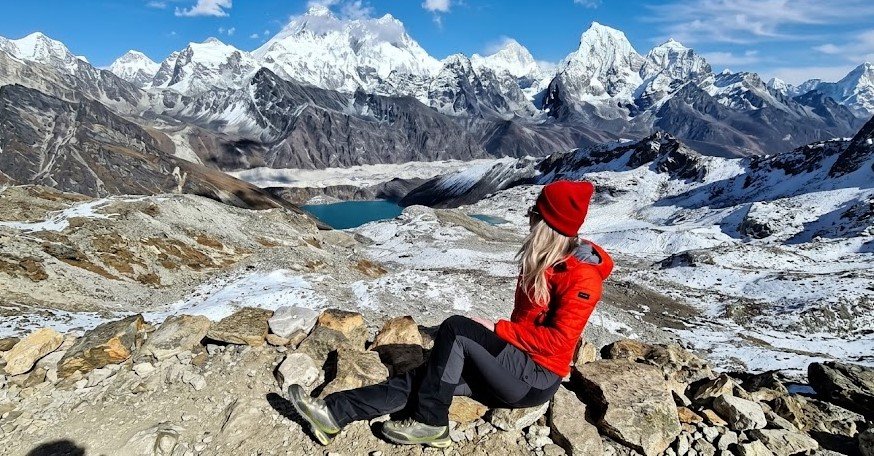
- The Cho La Pass crossing, at 5420 meters, is not a marked trail in the way lower valley paths are. It crosses glacial ice and loose rock, conditions change with weather and season, and route finding requires someone who has actually done the crossing many times, in different conditions, and knows the safe line across the ice.
- Rescue response times are longer than they would be on the main trail. If a medical issue happens between Thangnak and Dzongla, the nearest help is not a nearby lodge, it is a radio or satellite call to arrange either a slow evacuation on foot and horseback, or a helicopter if weather allows, which is not guaranteed at that altitude and in mountain weather.
None of this means the route is unsafe when handled properly. Thousands of trekkers cross Cho La Pass every season without incident. It means that the margin for error is smaller than on the standard Everest Base Camp trail, and that margin matters more, not less, when you are traveling by yourself rather than with three friends who can help you make decisions or go for help. This is precisely the section of the trek where the difference between a licensed, experienced guide and no guide, or an unlicensed freelance guide, stops being a legal technicality and becomes a genuine safety factor.
How a Licensed Guide Actually Changes the Experience for a Solo Woman
It is worth being specific about what a guide actually does for you on a route like this, rather than treating “having a guide” as a vague comfort blanket. On this itinerary, our guides are all government licensed, first aid trained, and carry a pulse oximeter to check your blood oxygen and pulse at altitude, which is the single most useful early warning tool for altitude sickness. Our lead guide on this route, Pasang Sherpa, has personally guided the Gokyo Lake and Cho La Pass itinerary 19 times, which means he has seen this exact stretch of trail in good weather, bad weather, early snow, and everything in between.
For a solo woman specifically, here is what that translates to in practice:
- You are never actually walking the trail alone, even though you booked as a single traveler. A solo booking gets you a dedicated guide and porter support, so from the moment you land in Lukla you have a companion who knows the route, the language, and the culture.
- Room and teahouse arrangements are handled by someone who has stayed in these specific lodges dozens of times and knows the owners personally in most villages, which affects everything from which room you get to how quickly hot water actually appears.
- A licensed guide recognizes altitude sickness symptoms early, including symptoms that are easy for a first time trekker to dismiss as tiredness, and has the authority and experience to insist on a rest day, a slower ascent, or a descent if needed, rather than pushing on because a fixed itinerary says so.
- On the Cho La Pass crossing itself, a guide who has done it many times reads the ice and rock conditions on that specific day and chooses the safest line, decides on timing to avoid the worst of afternoon weather, and knows exactly where the tricky sections are before you reach them.
- If anything does go wrong, from a twisted ankle to acute mountain sickness, a licensed guide knows the actual rescue and evacuation procedures, has the contacts to arrange help, and can communicate clearly in both Nepali and English with rescue coordinators, other guides, and teahouse owners.
- Socially, a guide who has worked with trekkers from many countries understands what solo female travelers usually want in terms of personal space, pacing, and privacy, without you needing to explain or negotiate it every day.
This is also where the difference between a licensed guide and a freelance, unlicensed guide picked up cheaply in Kathmandu becomes serious rather than theoretical. An unlicensed guide has no accountability to any regulatory body, often lacks real first aid training beyond what they have picked up informally, and in some documented cases has been involved in exactly the kind of scams that government advisories warn about, including inflated rescue costs or simply disappearing when a trek gets difficult. A guide’s license is not paperwork for its own sake. It is the closest thing you have to a background check on the one person you will be spending 17 days alone with in the mountains.
How to Vet a Trekking Company and Guide Before You Hand Over Any Money
If you are booking this trek solo, the single most important decision you will make happens before you ever set foot in Nepal, and that is choosing the company and confirming who your guide will be. Do not skip this step because a website looks polished or the price looks good. Polished websites are cheap to build and prices can be deliberately lowered by companies who plan to cut corners on guide quality, insurance, or safety equipment.
Ask a company these questions directly, ideally before you pay anything:
- Is the guide who will actually walk with me a government licensed trekking guide, and can you tell me their license number and name before I book?
- What first aid and altitude sickness training has this specific guide completed, not just the company in general?
- Do guides carry a pulse oximeter or other altitude monitoring equipment on this route?
- What is your rescue and evacuation procedure if someone becomes seriously ill on the Cho La Pass section specifically, given the terrain and distance from a road?
- How many times has this guide personally led the Gokyo Lake and Cho La Pass route, as opposed to only the standard Everest Base Camp trail?
- What is your policy on room sharing for solo travelers, and can I request a private room in teahouses where one is available?
- Do I need to pay in advance, or can I pay after arriving in Kathmandu and meeting the guide and company in person?
- Can I speak to a previous solo female client, or see reviews specifically mentioning solo women on this route?
- What happens if I need to turn back early due to altitude symptoms, and how is that handled logistically and financially?
- Are you reachable quickly by WhatsApp or phone if my family needs to check on me during the trek?
Red flags to walk away from, without exception, include:
- A company that cannot or will not confirm the guide’s license before you pay a deposit.
- Pressure to pay the full amount online, weeks in advance, with no option to pay in Kathmandu after meeting the team.
- Vague or evasive answers about first aid training, rescue insurance requirements, or evacuation procedures.
- A price that is dramatically lower than every other licensed operator quoting the same 17 day itinerary with the same inclusions, since that gap usually comes from cutting guide pay, porter support, or safety margin.
- No verifiable office address in Kathmandu, or a company that only communicates through a personal number with no business registration details offered.
- Reluctance to answer questions on WhatsApp or by phone before booking. A company that is slow or dismissive before you have paid will not suddenly become responsive once you are on the mountain.
A simple way to test responsiveness before you commit anything is to message a company directly and see how they handle a real question. We answer these questions daily on WhatsApp at +977 9869225929, seven days a week, and by email at nexttripnepal@gmail.com, and we would rather answer twenty detailed questions from a solo traveler before booking than have her arrive with unresolved doubts.
The table below summarizes what to check and why it matters, so you can use it as a checklist against any company you are considering, including us.
| What to check | Why it matters for a solo woman | Good sign |
|---|---|---|
| Guide license status | Confirms legal accountability and minimum government training standards | Company gives you the guide’s name and license number before payment |
| First aid and altitude training | Determines how early and accurately altitude sickness is caught | Specific, named training courses, not just “experienced” |
| Payment terms | Advance payment pressure is a common scam pattern | Payment accepted after arrival in Kathmandu, in person |
| Guide’s route specific experience | Cho La Pass requires route finding skill beyond general trekking experience | Guide has crossed Cho La Pass many times, not just the main EBC trail |
| Room allocation policy | Affects your privacy and comfort every single night for 17 days | Company confirms single or private rooms where teahouses allow it |
| Communication before booking | Predicts how reachable they will be during an emergency | Fast, specific, non evasive answers on WhatsApp or email |
| Rescue and insurance clarity | Protects you from inflated evacuation billing scams | Clear explanation of how evacuation is coordinated and paid for |
Teahouse Life as a Woman Trekking Alone
This is the part of the trip that first time trekkers, and especially solo women, tend to underestimate in their planning and overestimate in their worry. Teahouses on this route are simple family run lodges, and the reality is more mundane and more manageable than most people expect.
On room allocation and privacy, here is what you should actually plan for:
- Most teahouses on this route offer twin rooms as standard, with two single beds in each room, and increasingly offer single rooms as well, especially at the busier stops like Namche Bazaar, Gokyo, and Lobuche.
- As a solo traveler booking through a guide company, you will typically get your own room where the teahouse has the space, since you are not sharing with a second paying trekker. In smaller villages with fewer rooms, particularly around Thangnak and Dzongla before and after the Cho La Pass crossing, room availability is tighter, and you may occasionally be offered a shared room situation, so it is worth confirming this with your guide company in advance and asking them to prioritize a private room for you wherever the teahouse allows it.
- Doors on teahouse rooms are usually simple, and some do not lock securely. A short travel door wedge or a small portable door lock, sold cheaply in Kathmandu’s trekking gear shops in Thamel, is a genuinely useful addition to your packing list for peace of mind, not because incidents are common, but because it costs nothing and removes one small source of worry.
- Walls in teahouses are often thin plywood, so noise carries. Earplugs are worth packing both for sleep quality and for a sense of control over your own space.
On toilets and washing facilities, plan for the following realities as you climb higher:
- Below Namche Bazaar, most teahouses have Western style flush toilets attached or nearby. Above Namche, squat style toilets become more common, and flushing water is often manually poured rather than a working cistern, especially higher up in Machhermo, Gokyo, Dzongla and Lobuche.
- Hot showers are available in some lower villages, usually for a small extra fee, but become rare or nonexistent above Machhermo. By Gokyo and through the Cho La Pass crossing at Thangnak and Dzongla, expect basic washing with a bowl of warm water rather than a shower.
- Pack a quick drying travel towel, wet wipes in reasonable quantity, and a small basin sized bar of biodegradable soap. These three items do more for daily comfort at altitude than almost anything else in your bag.
- Toilet paper is not always provided, so carry your own supply, and carry a spare stash in a dry bag or ziplock since paper products absorb moisture quickly in mountain air.
- Hand sanitizer matters more than usual on a long trek, since stomach illness spreads easily in shared teahouse kitchens and dining rooms, and getting sick with limited toilet access at altitude is unpleasant for anyone, but a specific added stress when traveling alone.
On dressing appropriately in Sherpa villages and at monasteries, a few points of etiquette make a real difference in how you are received:
- Sherpa culture in the Khumbu is generally practical and not strict about tourist clothing on the trail itself, since everyone is dressed for cold weather anyway, but modest coverage is appreciated in villages and required at monasteries.
- Cover your shoulders and knees when visiting monasteries such as the one at Tengboche, and remove your hat, and consider removing footwear if you see others doing so at the entrance.
- Walk around religious structures like mani walls, stupas and prayer wheels in a clockwise direction, which is the traditional custom, and spin prayer wheels clockwise as well if you choose to spin them.
- Avoid overly short shorts or sleeveless tops in village centers, not because of any real danger, but because it stands out and can draw more attention than you want, particularly in smaller, more traditional communities like Khumjung or Phortse.
- A light scarf or buff is genuinely one of the most useful items you can pack, doubling as sun protection, dust protection, warmth, and quick modest coverage when entering a monastery or a village home.
Health, Hygiene and Menstruation at Altitude
Altitude affects your body regardless of gender, but there are specific considerations for women that general trekking guides tend to skip entirely, so we are addressing them directly here.
On altitude sickness itself, the basics matter enormously on this specific route because the itinerary includes several genuine high points, Gokyo Ri at 5360 meters, Cho La Pass at 5420 meters, Kala Patthar at 5555 meters, and Everest Base Camp at 5364 meters. For a full breakdown of symptoms, prevention, and what to do if you experience them, read our detailed altitude sickness guide for the Everest Base Camp trek. In summary for planning purposes:
- Drink more water than feels necessary, roughly three to four liters a day, since dehydration mimics and worsens altitude symptoms.
- Ascend gradually and use the built in acclimatization days in the itinerary rather than trying to rush ahead of your group or guide’s pace.
- Report headaches, nausea, or unusual fatigue to your guide immediately rather than pushing through quietly, which is a pattern we see more often in solo women who do not want to seem like they are slowing anyone down. There is no one else in your group to slow down. Speak up.
- Your guide’s pulse oximeter readings are a useful, objective way to track how your body is coping, separate from how you feel emotionally about the day.
On menstruation specifically, since this is rarely covered honestly in trekking guides:
- Altitude, exertion, and changes in diet and hydration can shift your cycle timing, sometimes earlier, sometimes later, sometimes lighter or heavier than usual. This is common and not a sign of anything being wrong, though it is worth knowing about in advance rather than being caught off guard mid trek.
- Pack more sanitary products than you think you will need for the full 17 days, since these are not reliably available above Namche Bazaar, and you should not plan on finding them along the trail.
- A menstrual cup is worth seriously considering for a multi week trek, since it reduces the amount you need to carry and reduces waste disposal issues at altitude, though it is worth practicing with one at home first if you have never used one, rather than trying it for the first time on the trail.
- Pack out used sanitary products in a sealed ziplock or dedicated waste bag rather than attempting to dispose of them in teahouse toilets, many of which cannot handle solid waste of any kind, or in the outdoors, since these do not decompose quickly at altitude and this is a genuine environmental concern in a fragile ecosystem.
- Pain relief for cramps is worth packing from home in a familiar brand and dosage, since pharmacy options are limited once you are past Namche Bazaar.
- Privacy for changing supplies is generally manageable in your own teahouse room, and your guide, if briefed appropriately by a company experienced with solo female trekkers, will build in reasonable stop timing on trail days without you needing to over explain the reason.
On general hygiene and hydration:
- Water purification tablets or a portable filter are essential, since boiled or treated water is what teahouses provide, and buying bottled water becomes both expensive and environmentally wasteful the higher you go.
- Hand hygiene before eating matters more than people expect, since gastrointestinal illness is one of the most common reasons trekkers cut a trip short, solo or otherwise.
- Bring your own basic medical kit including rehydration salts, any personal medication, blister care, and a general antidiarrheal, even though your guide typically carries a first aid kit as well.
What to Wear: Modesty, Warmth and Practicality
Clothing on this trek needs to solve two problems at once: staying warm and dry across a temperature range that can swing from mild spring afternoons in Namche Bazaar to well below freezing nights at Gorak Shep and Dzongla, and dressing in a way that fits comfortably into village and monastery culture without you having to think about it every day.
A layering system works better than a small number of heavy items, since you can add or remove layers throughout the day as temperature and effort level change. Here is a practical breakdown:
| Layer or item | Purpose | Notes for women specifically |
|---|---|---|
| Moisture wicking base layers, top and bottom | Keeps sweat away from skin during exertion | Pack at least two sets so you always have a dry one for sleeping |
| Mid layer fleece or light down | Core warmth during trekking hours | A longer length that covers the hips reads as more modest in villages |
| Heavy down jacket | Warmth at high camps and during summit mornings | Essential for Kala Patthar and Cho La Pass crossings before sunrise |
| Waterproof and windproof shell | Protection from wind, rain and snow | Choose one with a hood roomy enough for a warm hat underneath |
| Trekking trousers, not shorts, for daily wear | Sun and scrape protection, and better fit with village norms | Loose fitting trousers are more culturally comfortable than tight leggings alone |
| Long sleeve sun shirt | UV protection at altitude where sun exposure is intense | Doubles as modest coverage in village centers |
| Buff or light scarf | Sun, dust, warmth, and quick coverage for monasteries | One of the single most useful items on this list |
| Warm hat and sun hat | Heat loss prevention and sun protection | Bring both, since you will need each on different days |
| Thermal sleepwear | Comfortable sleep at high altitude lodges with minimal heating | Choose full coverage styles for comfort in shared lodge corridors |
| Sturdy broken in trekking boots | Ankle support on rocky and glacial terrain | Never trek this route in new, unbroken boots |
A few additional notes worth stating plainly. Leggings alone, without an outer layer of looser trousers or a long jacket, tend to draw more attention in conservative village settings than trekkers expect, simply because they are more fitted than most local daily wear. This is not a rule, and nothing terrible happens if you wear them, but many solo female trekkers report feeling more comfortable and drawing less notice with a slightly looser silhouette in villages, even if leggings are exactly what you wear underneath for warmth. Comfort and warmth should always come first in a genuine safety situation like a storm or extreme cold, but on an ordinary trekking day, a small adjustment in silhouette costs nothing and can make daily interactions in villages a bit smoother.
All Female Group, Mixed Group, or Private Guide: What Actually Changes
A common question we get is whether a solo woman should try to join an all female trekking group rather than trek with a mixed group or simply her own private guide. The honest answer is that the group composition matters less than most people assume, and the guide quality matters more.
Here is how the options actually compare in practice:
- Private guide and porter, booked solo: This is what most solo female trekkers on this specific route choose, and what our Everest Base Camp with Gokyo Lake trek is set up for at the individual price point. You get full control of pace, rest days, and daily decisions, and a guide whose full attention is on you rather than split across a group.
- Joining a small mixed group with a shared guide: This can lower cost and adds social company on the trail, but means less flexibility in pace and rest day decisions, since these now need to work for everyone in the group, not just you.
- All female trekking groups: These exist and can be a genuinely enjoyable, socially comfortable option for some travelers, but they do not inherently change the actual safety profile of the trek, since the guide’s license, first aid training, and route experience are what determine how well handled an altitude issue or a difficult pass crossing will be, regardless of who else is walking alongside you.
What we tell solo women honestly is this. If your priority is safety margin and flexibility on a route that includes a genuine high pass crossing, a private guide who knows you are traveling alone and adjusts pacing and rest days accordingly is usually the stronger choice over joining a larger mixed group purely for the social comfort of numbers. If social company matters a great deal to you and you would find 17 days without peer conversation genuinely difficult, a small group, whether mixed or all female, can be worth the tradeoff in flexibility, as long as the guide leading it meets every standard already covered in the vetting section above.
Staying in Touch With Family During 17 Days With Limited Connectivity
One of the harder practical adjustments for many solo travelers, and something families back home worry about more than almost anything else, is the reality that you cannot simply message home every evening on this route the way you might elsewhere. Setting expectations correctly before you leave prevents unnecessary panic on both ends.
Here is what connectivity actually looks like along this specific itinerary:
- Lukla and Namche Bazaar have the most reliable mobile data and WiFi access on the entire route, so this is the best window to send longer messages, photos, or a video call home.
- Between Phortse Thanga and Gokyo, and again through Thangnak, Dzongla and the Cho La Pass crossing itself, coverage becomes patchy and unreliable, with stretches of no signal at all, particularly on the pass crossing where you are moving through a narrow, high walled section between rock and ice.
- Coverage improves again somewhat around Lobuche, Gorak Shep and Everest Base Camp itself, and through Dingboche and Tengboche on the return route, though it is still not as consistent as Namche.
- A local SIM card purchased in Kathmandu before you fly to Lukla is worth having as a backup even with patchy coverage, and it is worth testing both major providers if your itinerary allows a day in Kathmandu first, since coverage strength varies noticeably by valley.
- Most teahouses above Namche charge a small fee for WiFi access, and speeds are slow and unreliable, adequate for a short text message but not dependable for video calls.
Practical steps to manage this well for your own peace of mind and your family’s:
- Before you leave home, tell your family explicitly that multi day gaps in contact are normal on this route, not a sign that something has gone wrong, particularly during the Gokyo Valley and Cho La Pass section of the trek.
- Agree on a general check in rhythm before you go, such as a message whenever you reach a village with signal, rather than a strict daily promise you cannot actually keep given the terrain.
- Share your trekking company’s contact details with your family before you leave, including our WhatsApp number, +977 9869225929, and our email, nexttripnepal@gmail.com, so they have a direct line to someone on the ground in Nepal if they ever cannot reach you and want reassurance.
- Consider a basic satellite messenger device if you want a higher degree of independent reassurance beyond what your guide’s own communication equipment provides, though note that a licensed guide company on this route already carries appropriate communication equipment for genuine emergencies.
- Keep a paper note or a saved digital note with your itinerary dates and your guide company’s contact information somewhere your family can access it, separate from your own phone, in case your phone is lost, damaged, or simply out of battery for a stretch.
Money, Permits and Practical Logistics You Need to Know Before You Go
Beyond safety specifically, there are a few practical realities about this route that catch first time trekkers off guard, and they matter more when you are managing them solo rather than splitting the mental load with travel companions.
- Cash only above Namche Bazaar. There are no ATMs once you climb past Namche, and every teahouse, tea stop, and shop above that point operates on cash only. Withdraw and carry enough Nepali rupees in Kathmandu or Namche Bazaar to cover the rest of the trek, including meals not included in your package, snacks, hot drinks, charging fees, WiFi fees, and any souvenirs.
- Our solo pricing for this trek, at 1865 US dollars for one person, includes a licensed English speaking guide, porter support at a ratio of one porter for every two trekkers, teahouse accommodation, all trek meals, permits, and Lukla flights, so your remaining cash needs are mainly for extras like drinks, snacks, hot showers where available, and device charging.
- No advance payment is required with us. You can pay after you arrive in Kathmandu, meet your guide, and confirm everything in person, which removes a common source of anxiety for solo travelers who are understandably cautious about sending money to an unfamiliar company before ever meeting anyone.
- Namche Bazaar functions as the last real town on this route, with proper shops, bakeries, ATMs, and a wider range of gear available if you forgot something. If you want a deeper sense of what to expect there, including where to rest, shop, and acclimatize, see our Namche Bazaar guide, since this is genuinely the last point to sort out cash, gear gaps, or last minute questions before the route becomes more remote.
- Lukla flights are weather dependent in both directions, so build one or two buffer days into your overall trip plan around the fixed trekking days, particularly if you have an international flight booked close to your expected return date.
Route Specific Safety Notes, Village by Village
It helps to walk through the actual route and flag what matters at each stage, rather than treating the whole trek as one undifferentiated block of remote wilderness.
- Lukla, 2840 meters, to Namche Bazaar, 3440 meters: The most trafficked, best supported section of the entire trek, with strong teahouse density and the widest range of facilities. This is a good stretch to settle into your guide’s pace and communication style.
- Namche Bazaar acclimatization: Use the rest day here properly, since it is your last major town with full facilities. This is also the point to withdraw remaining cash and confirm you have everything you need for the more remote stretch ahead.
- Namche Bazaar to Phortse Thanga, 3680 meters, and on to Machhermo, 4470 meters: The trail begins branching away from the busier main Everest Base Camp route here, and trekker numbers thin out noticeably.
- Machhermo to Gokyo, 4790 meters: Facilities become simpler, and this is where you genuinely feel the reduced traffic and quieter valley compared to the main trail.
- Gokyo Ri summit, 5360 meters: A demanding early morning climb rewarded with one of the best panoramic views on the entire route, and a good early test of how your body is handling altitude before the harder Cho La Pass crossing ahead.
- Gokyo to Thangnak, 4700 meters, and the Cho La Pass, 5420 meters, crossing to Dzongla, 4710 meters: The most technically demanding and most remote day of the entire trek. This is precisely the section where guide experience, weather judgment, and route finding skill matter most, and where cell coverage is least reliable.
- Dzongla to Lobuche, 4910 meters, and on to Everest Base Camp, 5364 meters, and Gorak Shep, 5164 meters: You rejoin busier trail sections here, with more teahouses and more fellow trekkers, which for many solo travelers brings a welcome sense of returning to more populated ground after the pass crossing.
- Kala Patthar, 5555 meters, sunrise climb: The highest point of the trek and typically the coldest departure time of the entire itinerary, so this is the moment to have your full down layer system ready the night before.
- Return via Dingboche, Tengboche and back to Namche and Lukla: A steady descent with improving facilities, more oxygen, and a good stretch to reflect on the trip and reconnect properly with family back home once signal improves.
Frequently Asked Questions
Is it actually legal to trek the Gokyo Lake and Cho La Pass route completely alone, with no guide at all?
No. Current permit rules for the Sagarmatha National Park and this route require a licensed guide, so fully independent trekking without a guide is not a legal option here, regardless of gender or experience level.
Generally no. Booking as a solo traveler through a guide company typically gets you your own room wherever the teahouse has one available, since you are not paired with another paying trekker. Availability is tighter in the smallest villages around Thangnak and Dzongla, so confirm your room preference with your company in advance.
Is the Cho La Pass crossing dangerous for a woman trekking alone?
The pass itself is not more dangerous for a woman than for any other trekker. It is a genuinely demanding, high altitude crossing over rock and glacier that requires a guide with real route finding experience on that specific section, which is exactly why a licensed, experienced guide matters here more than on gentler parts of the trek.
What happens if I get my period during the trek?
Pack enough supplies for the full 17 days, since they are not reliably available above Namche Bazaar. Many women find their cycle shifts somewhat with altitude and exertion, which is normal. Pack used products out with you rather than disposing of them in teahouse toilets or outdoors.
How do I know if a guide is actually licensed and not just claiming to be?
Ask the company directly for the guide’s name and license number before you pay anything, and ask how their guides are trained in first aid and altitude recognition. A company confident in its guides will answer this without hesitation.
Can I stay in contact with my family every day during the trek?
Not reliably. Namche Bazaar has the best coverage on the route, but signal becomes patchy through the Gokyo Valley and largely disappears during the Cho La Pass crossing. Set expectations with your family in advance rather than promising daily contact you cannot guarantee.
Do I need to pay the full trek cost in advance to book?
With us, no. You can arrive in Kathmandu, meet your guide and confirm every detail in person, and pay only then. Be cautious of any company that pressures full advance payment before you have met anyone.
Is an all female trekking group safer than trekking with a private guide alone?
Not inherently. Guide licensing, first aid training, and route specific experience determine safety outcomes far more than group gender composition. A well matched private guide who adjusts pace and rest days to you specifically is often the stronger choice on a route with a genuine high pass crossing.
What should I do if I feel unwell or notice altitude symptoms and I am traveling alone?
Tell your guide immediately. There is no travel companion to notice for you, which means the responsibility to speak up early falls on you. A licensed guide with a pulse oximeter can assess your condition objectively and make the right call on rest, descent, or continuing.
What is the single most useful clothing item for both warmth and cultural comfort on this route?
A buff or light scarf. It handles sun protection, dust, warmth around the neck and face, and gives you quick, easy coverage when entering a monastery or a more conservative village setting, all in one lightweight item.
Why Booking With an Established, Licensed Guide Company Addresses Most of This
We have tried to be direct throughout this article rather than simply reassuring, because a solo woman planning a 17 day trek through remote high altitude terrain deserves an honest account of what she is actually deciding, not a glossy sales pitch. Having gone through all of it, here is the straightforward conclusion.
Almost every specific risk factor discussed in this guide, from altitude sickness going unrecognized, to route finding mistakes on the Cho La Pass crossing, to scams around unlicensed guides or inflated rescue billing, to simple discomfort with room allocation or privacy in teahouses, is directly addressed by one decision: booking with a genuinely licensed, experienced, properly run guide company rather than trying to save money on an unlicensed freelancer or a company that will not confirm its guide credentials in writing.
On our side specifically, here is what that looks like in practice for this exact trek:
- All our guides are government licensed and first aid trained, and carry a pulse oximeter on every trek at altitude, including this route.
- Our lead guide for the Gokyo Lake and Cho La Pass route, Pasang Sherpa, has personally guided this specific itinerary 19 times, which means he knows this pass, this valley, and these villages in detail, not just the standard Everest Base Camp trail.
- We have supported trekkers from more than 40 countries, including a great many solo women, so accommodating a solo female traveler’s pace, privacy needs, and communication preferences is routine for us, not a special request.
- Solo pricing for the full 17 day Everest Base Camp with Gokyo Lake trek is 1865 US dollars, including your guide, porter support, teahouse accommodation, all trek meals, permits, and Lukla flights, with no advance payment required.
- You can message us directly with any question covered in this article, or anything we missed, on WhatsApp at +977 9869225929, available seven days a week, or by email at nexttripnepal@gmail.com, and you will get direct, specific answers rather than a generic reply.
Solo female trekking on this route is not about being fearless or pretending the mountains carry no risk. It is about being prepared, asking the right questions of the company you choose, packing correctly for both warmth and comfort, and putting yourself in the hands of a guide who has genuinely done this exact crossing many times before. Do that, and the Gokyo Lake and Cho La Pass route becomes one of the most rewarding treks in Nepal to do on your own terms, at your own pace, with a support system that actually understands what that means for a woman traveling by herself.
\n
Related Reading
\n
- Travel Insurance for the Cho La Pass Crossing
- \n
- How to Book the Everest Base Camp with Gokyo Lake Trek With Next Trip Nepal
- \n
- Why Trek the Gokyo Lake and Cho La Pass Route With Next Trip Nepal
- \n
\n