Of the three medieval royal cities in the Kathmandu Valley, Bhaktapur is the one that still feels lived in the old way. Kathmandu Durbar Square sits inside a busy modern capital, and Patan Durbar Square is now wrapped by dense city suburbs. Bhaktapur, about 13 kilometres east of central Kathmandu, kept its own rhythm. Farmers still dry grain in the squares. Potters still work foot wheels in open courtyards. Families still hang washing from carved wooden windows that are three or four centuries old. This guide covers everything an independent traveler or a group tour visitor needs to plan a full day here: what to see in each square, how to get there, what it costs, what to eat, and how the day fits into a longer Nepal itinerary such as the company’s 10 Days Nepal Tour 2026, which schedules Bhaktapur as a full day visit on day 9.
A Short History of Bhaktapur
- Bhaktapur’s name is generally translated as City of Devotees, from the Newar and Sanskrit roots referring to devotion and a settled place. Locals also call it Khwopa, an older Newar name still used in everyday speech and in the names of local schools and organizations.
- The town’s growth is closely tied to its position on an old trade route linking the Kathmandu Valley with Tibet, which brought steady wealth through salt, wool, and other goods moving between the Himalaya and the Indian plains.
- Bhaktapur reached its architectural peak under the Malla dynasty, the same family line that ruled Kathmandu and Patan before the valley split into three separate kingdoms after the death of King Yaksha Malla in 1482.
- Once the valley divided, Kathmandu, Patan, and Bhaktapur became rival capitals, and their kings competed openly to build the grandest palace, the tallest temple, and the most elaborate gateway. That rivalry is the direct reason all three towns ended up with their own Durbar Square rather than sharing one.
- Bhaktapur’s most ambitious building phase came under King Bhupatindra Malla in the late 17th and early 18th centuries, the same ruler responsible for both the Golden Gate and the Nyatapola Temple, the two single monuments most visitors remember afterward.
- The unification of Nepal under the Shah dynasty in the 18th century ended the three kingdom rivalry, and Bhaktapur lost its status as an independent royal capital. Somewhat fortunately for later visitors, this also meant it stopped attracting the large scale redevelopment that came with Kathmandu’s later growth as the national capital.
- Through the 19th and 20th centuries, Bhaktapur remained a working agricultural and craft town rather than an administrative center, which is a large part of why so much of its medieval fabric, streets, courtyards, temple spacing, survived largely intact into the present day.
- Conservation work through UNESCO and various bilateral partnerships, including a long running German supported urban development project through the later 20th century, helped protect and restore the old town’s infrastructure well before the 2015 earthquake made international headlines and brought a further wave of restoration funding and attention.
Why Bhaktapur Is the Most Medieval of the Three Durbar Squares
- Bhaktapur was the capital of the Kathmandu Valley during parts of the Malla period, and its rulers competed with Kathmandu and Patan to build the grandest palaces and temples, which is why the valley ended up with three separate UNESCO listed Durbar Squares instead of one.
- Its historic core has changed less since the 15th and 16th centuries than either Kathmandu or Patan. The street layout, the brick paving, the courtyard housing and the temple spacing are close to what a visitor would have found 400 or 500 years ago.
- Bhaktapur was never absorbed into a modern urban sprawl the way Kathmandu and Patan were. It kept a semi rural, small town character even as Kathmandu grew into a capital city of over a million people.
- The population still practices many of the same trades their families have practiced for generations: pottery, wood carving, weaving, and farming on the terraces just outside the old town walls.
- Bhaktapur is compact enough to explore fully on foot in a day, unlike Kathmandu Durbar Square, which is more scattered across a busier city center.
- For context, day 2 of the same 10 day itinerary covers the other two UNESCO sites in the valley, Swayambhunath and Patan Durbar Square, so travelers doing the full tour see all three Durbar Squares by the end of the trip, each with a distinct character.
Bhaktapur at a Glance
| Detail | Information |
|---|---|
| Location | Bhaktapur District, roughly 13 km east of central Kathmandu |
| UNESCO status | Part of the Kathmandu Valley UNESCO World Heritage Site, along with Kathmandu Durbar Square and Patan Durbar Square |
| Foreign entrance fee | USD 15 per person |
| Main squares to visit | Durbar Square, Taumadhi Square, Dattatreya Square, Pottery Square |
| Tallest monument | Nyatapola Temple, 30 metres, 5 tiers, built in 1702 |
| Oldest major structure | The 55 Window Palace, built in 1427 and expanded through later Malla reigns |
| Signature food | Juju dhau, a thick set yogurt often called the king of yogurt |
| Signature festival | Bisket Jatra, held around the Nepali New Year in mid April |
| Time needed | 4 to 6 hours minimum, a full day for a relaxed visit with the side lanes and workshops |
How to Get to Bhaktapur From Kathmandu
Most travelers on an organized tour will simply be driven there, but for anyone planning an independent day trip, here are the practical options.
- Private taxi: The most straightforward option from Thamel or central Kathmandu. The drive covers roughly 13 km and normally takes 40 minutes to over an hour, depending on traffic on the Araniko Highway and through Koteshwor and Jorpati. A round trip with waiting time is the easiest way to do this independently.
- Ride hailing apps: Pathao and InDrive both operate in the Kathmandu valley and can be a cheaper alternative to a street hailed taxi, though drivers may be less familiar with tourist drop off points near the old town gates.
- Local bus or microbus: Buses toward Bhaktapur or Suryabinayak run from Ratna Park, Bagbazar and the airport area. They are the cheapest option but slower, more crowded, and the drop off point is a short walk from the entrance gates rather than right at them.
- Combining with Nagarkot: Many independent travelers combine Bhaktapur with a stop or overnight at Nagarkot, since the road that continues east from Bhaktapur climbs toward Nagarkot’s viewpoints.
- By tour vehicle: On a packaged itinerary such as the 10 Days Nepal Tour, transport, the entrance ticket and a guide are already arranged, which removes the need to negotiate fares or find the correct ticket counter on arrival.
- From Kathmandu’s Tribhuvan International Airport: Bhaktapur is actually somewhat closer to the airport than central Thamel is, since the airport sits on the eastern side of Kathmandu toward Bhaktapur’s direction. Travelers arriving on a late flight sometimes ask about a direct airport to Bhaktapur transfer rather than routing through central Kathmandu first, which can save some time on the road.
- Traffic timing: Kathmandu valley traffic is heaviest in the morning and early evening rush periods around Koteshwor, a junction most routes between Kathmandu and Bhaktapur pass through. Traveling mid morning after the rush, or heading back mid afternoon before the evening rush, generally makes for a smoother drive in either direction.
- Parking and drop off: Private vehicles typically stop near one of the main entrance gates (Durbar Square gate, Siddha Pokhari side, or the Nyatapola approach). Ask your driver which gate is closest to the sights you want to prioritize first.
Entrance Fee and Opening Hours
- Foreign visitors pay a USD 15 entrance fee to enter the historic core of Bhaktapur. This is a separate ticket from Kathmandu Durbar Square and Patan Durbar Square, since each of the three cities manages its own heritage fee.
- SAARC nationals pay a reduced rate, and Nepali citizens generally enter free, though rules can change, so it is worth confirming current rates with your driver or guide on arrival if traveling independently.
- On the company’s 10 Days Nepal Tour, the entrance fee is already included in the package price, so there is nothing extra to pay at the gate on day 9.
- Tickets are checked at entry points around the edge of the old town, not just at one central booth, since Bhaktapur is a living settlement with several roads leading in.
- The town itself has no real closing time in the way a museum does, because people live and work inside it, but ticket checkpoints typically operate through daylight hours, roughly early morning to early evening.
- Individual museums inside the palace complex, such as the National Art Gallery in part of the 55 Window Palace, keep separate and shorter hours, generally mid morning to mid afternoon, and are often closed one day a week. If a specific gallery matters to you, check locally the same morning rather than assuming it is open.
- Early morning, shortly after sunrise, is the quietest and coolest time to walk the squares before day visitors arrive, and it is also when much of the daily life of the town, morning prayers, market setup, and the first potters at their wheels, is easiest to watch.
- Keep your ticket with you for the day. Staff occasionally check it again if you leave and re enter through a different gate.
Bhaktapur Durbar Square: The Main Monuments
Durbar Square is the historic seat of royal power in Bhaktapur and the most photographed part of the old town. Here is what to look for.
- The 55 Window Palace: Built in 1427 and expanded through successive Malla period reigns, this long brick palace facade is named for the 55 carved wooden windows set into its upper floor. The window frames are carved rather than painted, which is typical of Newar palace architecture, and the repetition of identical carved openings along a single long wall is one of the most recognizable images of the Kathmandu Valley.
- The Golden Gate (Sun Dhoka): A gilded copper gateway leading into the palace’s inner courtyard, generally considered the finest single piece of repousse metalwork in the region. The gate is topped with a figure of the goddess Taleju and framed by mythical creatures worked in raised copper relief. Take time here specifically, since photographs rarely capture the depth of the metalwork, which needs to be seen at close range and in different light.
- Vatsala Temple: A stone temple in the square, notable because most Newar temples in the valley are built in wood and brick, while this one is carved from stone in a style that shows some South Indian influence. It also carries a large bronze bell used historically to sound alarms and curfews.
- The wooden Pashupatinath Temple: Not to be confused with the much larger Pashupatinath Temple complex in Kathmandu visited earlier in most itineraries. This smaller Bhaktapur version, built in a pagoda style, is one of the oldest structures in the square and is known for erotic carvings on its roof struts, a common but often overlooked feature of traditional Newar temple architecture.
- Siddhi Lakshmi Temple steps: Look for the sequence of stone guardian figures lining the staircase, animals and mythological figures placed in an ascending order of symbolic power, a design feature repeated at other major temples in the valley including Nyatapola.
- The 2015 earthquake context: The April 2015 earthquake caused significant damage across the Kathmandu Valley’s heritage sites, including parts of Bhaktapur and, notably, the near total collapse of the Kasthamandap temple in Kathmandu Durbar Square along with several other Malla era buildings. Reconstruction in Bhaktapur, supported by UNESCO and international conservation partners, has been methodical rather than fast, prioritizing traditional materials and techniques over quick concrete fixes. As a result, the major monuments described in this guide are all standing and open to visitors today, though you may still see scaffolding or in progress restoration work on a smaller structure here or there.
- Statue of King Bhupatindra Malla: A kneeling bronze statue of the king who commissioned much of Bhaktapur’s most ambitious building work, including the Golden Gate and, in Taumadhi Square, the Nyatapola Temple. Placed on a stone pillar facing the palace he helped complete.
- Big Bell and Taleju Bell: Two large bells near the palace complex historically served practical civic purposes, sounding curfews, alerting residents to trouble, and marking the start of daily worship at the Taleju Temple, the valley kingdom’s dedicated royal deity. The Taleju Temple itself is closed to non Hindu visitors, a restriction that applies at the equivalent Taleju temples in Kathmandu and Patan as well.
- Take your time at ground level too: It is easy to focus entirely on the tallest and most photographed structures in Durbar Square, but the paving stones, the smaller shrines tucked between larger buildings, and the everyday activity of pigeons, vendors, and residents crossing the square are as much a part of what makes Bhaktapur feel different from a purely preserved museum site.
Taumadhi Square and the Nyatapola Temple
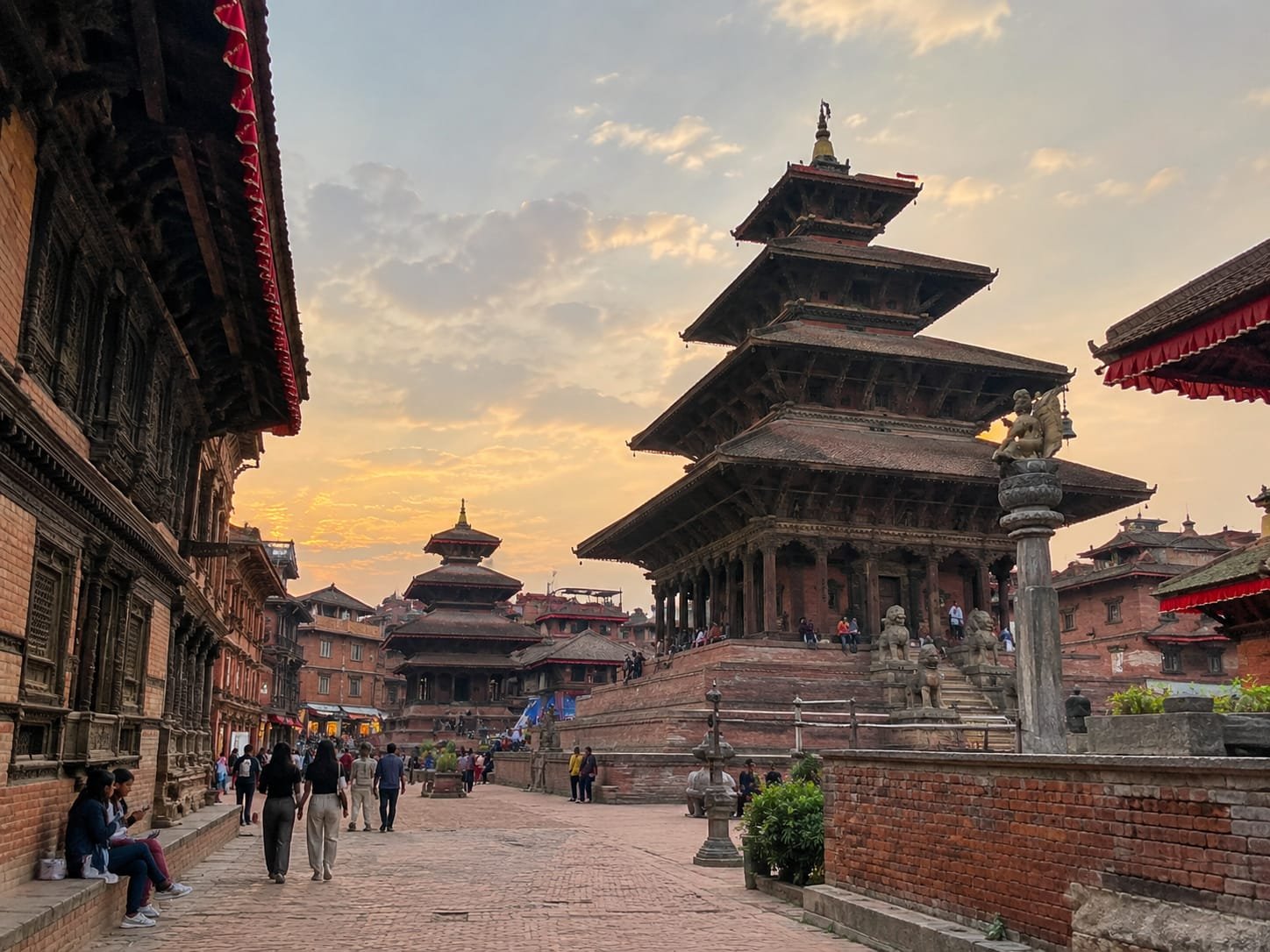
A short walk from Durbar Square, Taumadhi Square is dominated by the tallest and most dramatic single structure in the old town.
- Construction: The Nyatapola Temple was built in 1702 under King Bhupatindra Malla, and remarkably it was completed in just 14 months, a fast build for a structure of this scale and complexity by any historical standard.
- Height and form: At 30 metres, it is the tallest pagoda temple in Nepal. It rises in 5 tiers, each roof slightly smaller than the one beneath it, giving the whole structure a tapering silhouette that is visible from several streets away.
- The guardian staircase: Climbing the plinth toward the temple, visitors pass a sequence of paired stone figures at each of the 5 levels, famous wrestlers, elephants, lions, griffins, and finally goddesses, each pair said to be ten times stronger than the pair below it. It is one of the best examples in Nepal of a symbolic ascending guardian sequence carved directly into a temple’s access stairs.
- Structural resilience: Nyatapola has survived multiple major earthquakes with only minor damage, including the severe 1934 earthquake and the 2015 earthquake, both of which caused serious destruction elsewhere in the valley. Structural engineers studying traditional Newar timber frame construction point to this temple as a genuine case study in earthquake resistant design achieved centuries before modern engineering codes existed.
- The deity inside: The temple is dedicated to Siddhi Lakshmi, a fierce tantric form of the goddess, though the inner sanctum is not open to non Hindu visitors, which is standard practice at many active temples in the valley.
- Bhairavnath Temple: Directly across the square from Nyatapola stands the Bhairavnath Temple, dedicated to a fierce form of Shiva and central to the Bisket Jatra festival described later in this guide. Its comparatively squat, wide form is a deliberate visual contrast to Nyatapola’s height.
- Best viewing spots: The teashops and small restaurants with upper floor balconies around the edge of Taumadhi Square give a higher, wider view of the temple’s full height, useful both for photography and simply for sitting and taking in the square without competing with foot traffic at ground level.
Pottery Square: A Living Ceramics Neighbourhood
North of the main Durbar Square, Pottery Square is a working neighborhood rather than a museum display, and it rewards visitors who slow down and actually watch the process.
- The foot wheel: Potters here use a traditional foot powered wheel, spun by hand or kicked to build momentum, a method that has not fundamentally changed in around 500 years. Watching a potter center a lump of clay and throw a pot in under a minute is one of the most quietly impressive things to see in Bhaktapur.
- What is made: Common items include water pots, incense holders, oil lamps, decorative flower pots, small money banks shaped like animals, and the small clay bowls called kataura that are used to serve juju dhau, the local yogurt described later in this guide.
- Drying in the open squares: Rows of unfired pots are commonly left out to dry directly on the brick paving in the surrounding courtyards before firing, which is why visitors often see hundreds of identical pots laid out in the sun.
- Traditional firing: Some potters still fire work in open air straw covered kilns rather than enclosed electric or gas kilns, a visibly different process from a factory setting and one that depends heavily on dry weather.
- Buying pottery: Small, lightweight pieces such as painted clay ornaments or miniature pots travel well if you plan to buy a souvenir. Larger fired pieces are heavier and more fragile to carry home, so ask about shipping if you fall for a bigger item.
- Etiquette: This is someone’s workplace, not a staged demonstration. A small purchase or a polite request before taking close up photos of an individual potter is appreciated.
- Best time to visit: Mid morning tends to have the most active wheel work, since much of the drying and courtyard work happens once the sun is fully up.
Dattatreya Square and the Wood Carving Lanes
- Dattatreya Temple: The square takes its name from this temple, said in local tradition to have been built from the timber of a single tree. Its wooden pillars and carved struts are among the most detailed in the old town.
- The Pujari Math: A former monastic residence near the square, famous for its carved wooden peacock window, one of the most photographed single carvings in Nepal and a benchmark piece that local wood carvers still study and replicate.
- Wood carving workshops: In the lanes off Dattatreya Square, small workshops produce replica peacock windows and latticed window panels using the same joinery and chisel techniques as the historic originals, without power tools for the fine detail work.
- What to look for in a good carving: Consistent depth across repeated lattice patterns, clean undercuts around figures rather than flat, shallow relief, and joinery at the corners rather than glued or nailed seams.
- Buying carved windows or panels: These make substantial souvenirs, sized from small wall hung panels to full frame replicas of temple windows. Ask about the wood used, since older workshops tend to favor the same dense hardwoods used historically for durability.
- Watching the process: Many workshops are open fronted onto the lane, so it is possible to watch a carver at work on a panel for a few minutes without needing a formal tour or appointment.
- Other crafts nearby: The same lanes also turn up mask makers, thangka painters, and metalworkers producing small ritual items, so it is worth a slow wander rather than a direct walk to any single workshop.
Newar Architecture Explained: What to Look For
A little background on how these buildings were actually put together makes the whole visit more interesting, since Bhaktapur is essentially an open air catalogue of traditional Newar building methods.
- Brick and timber, not stone: Aside from the Vatsala Temple, almost every major structure in Bhaktapur is built from fired brick walls with a timber frame, rather than cut stone. This is the standard Newar approach and is one reason these buildings needed such careful post earthquake repair, since brick and timber respond differently to shaking than stone masonry does.
- Struts, not just walls: Look up at almost any temple roof and you will see diagonal wooden struts running from the wall to the underside of the roof, carved with deities, guardian figures, or, on some older temples, more explicit erotic imagery. These struts are structural, supporting the heavy overhanging roof, as well as decorative.
- Tiered pagoda roofs: The multi tiered roof form seen at Nyatapola and elsewhere is native to the Kathmandu Valley and predates the pagoda style later associated with China and Japan, which most architectural historians agree traveled outward from this region rather than the other way around.
- Courtyard housing: Away from the main squares, ordinary residential buildings in Bhaktapur are arranged around internal courtyards, a layout that keeps daily life, drying grain, community shrines, children playing, mostly hidden from the main street and visible only if you happen to glance through an open gate.
- Carved windows: The famous peacock window at the Pujari Math near Dattatreya Square is the best known example of a broader tradition of latticed wooden window carving, where a single panel might take weeks of chisel work by hand.
- Repousse metalwork: The Golden Gate is the standout example, but smaller repousse copper and brass work, gilded finials, guardian figures, ceremonial vessels, appears throughout the old town on temple roofs and doorways.
- Why so much survived: Traditional Newar timber framing allows a degree of flexibility during an earthquake that rigid modern concrete construction does not always match, which is part of the explanation for why a 300 year old temple like Nyatapola came through 2015 with only minor damage while some newer concrete buildings elsewhere in the valley did not fare as well.
Where to Stay if You Want to Spend a Night in Bhaktapur
- Staying overnight versus a day trip: Most visitors, including everyone on the 10 Days Nepal Tour, see Bhaktapur as a day visit from Kathmandu. Independent travelers with more flexible schedules sometimes choose to stay a night, since the old town looks and feels noticeably different once the day visitor crowds thin out in the early evening.
- Why an overnight appeals to some travelers: Staying inside or near the old town means catching Durbar Square and Taumadhi Square at sunrise, before the ticket booths get busy, and again after dark, when many temples are lit and the squares are far quieter.
- Types of accommodation: Options range from small guesthouses built into converted traditional courtyard houses inside the old town itself to more standard hotels on the edges of Bhaktapur closer to the main roads. A courtyard guesthouse gives a more immersive sense of the town’s residential architecture described above.
- Noise and practicalities: The old town’s narrow brick lanes mean most guesthouses do not allow vehicle access right to the door, so be ready to carry luggage a short distance from wherever a taxi can actually stop.
- For travelers on the 10 Days Nepal Tour: Accommodation on the package itinerary is arranged in Kathmandu rather than overnight in Bhaktapur, since the tour treats Bhaktapur as a full day visit on day 9 followed by departure preparations, but the option to extend independently before or after the fixed itinerary is always worth asking about directly with the company.
A Suggested Walking Route and Photography Tips
Bhaktapur’s old town is compact enough to cover on foot in a single loop. Here is a practical order that avoids unnecessary backtracking.
- Enter through the main Durbar Square gate and spend the first hour on the palace complex: the 55 Window Palace facade, the Golden Gate, Vatsala Temple, and the wooden Pashupatinath Temple.
- Walk the short lane southeast toward Taumadhi Square and spend 45 minutes to an hour at the Nyatapola Temple and Bhairavnath Temple, including time to sit at a balcony teashop.
- Continue toward Dattatreya Square, viewing the Pujari Math peacock window and the Dattatreya Temple, then spend time in the wood carving lanes just off the square.
- Double back north toward Pottery Square, ideally timed for mid morning to catch active wheel work and drying pots in the courtyards.
- Use any remaining time to wander the smaller residential lanes between the main squares, where daily life, drying grain, laundry, small shrines, and courtyard temples, continues undisturbed by the main tourist route.
- Finish with a sit down meal or a bowl of juju dhau near Durbar Square before heading back to Kathmandu.
Photography tips specific to Bhaktapur:
- Early morning light works best for the 55 Window Palace facade, which faces roughly east and catches direct sun soon after sunrise.
- Shoot Nyatapola from the far side of Taumadhi Square with a wide angle to capture all 5 tiers in one frame, or use a balcony teashop for a higher angle that separates the temple from the crowd at ground level.
- The Golden Gate rewards a close, detailed shot rather than a wide one, since the value is in the metalwork texture, not the overall gate shape.
- Ask before photographing individual craftspeople up close, especially potters and carvers mid task, since a quick nod or a small purchase goes a long way.
- Midday light is flat and harsh on the open brick squares. If your schedule allows flexibility, late afternoon light is softer and adds warmth to the brick and wood tones.
- A tripod is rarely necessary for a day visit and can draw unwanted attention in narrow lanes. A stabilized phone or a light mirrorless setup is usually enough.
- Look for reflections and framing opportunities in the shallow ponds and stone water spouts scattered around the old town, several of which sit close enough to the main squares to include in the same walk without a detour.
- If you only have one wide shot to choose for the whole day, most photographers pick the view across Taumadhi Square with Nyatapola rising above the rooftops in the middle distance, since it captures scale, the pagoda form, and the ordinary town life around its base in a single frame.
What to Eat in Bhaktapur
- Juju dhau (the king of yogurt): Bhaktapur’s most famous food, a thick, set yogurt made traditionally from buffalo milk and served in small unglazed clay bowls called kataura. The clay bowl is part of the process, not just presentation, since the porous clay helps draw out excess whey and firms up the set. It is noticeably richer and creamier than standard yogurt and is sold at small dedicated shops around Durbar Square and Taumadhi Square.
- Where to try it: Look for shops with visibly stacked clay bowls and a steady stream of locals buying it, a reliable sign of freshness, rather than the first stall closest to the entrance gate.
- Chatamari: Sometimes described as Newar style rice flour pizza, a thin rice batter base topped with minced meat, egg, or vegetables and cooked on a flat griddle. Widely available around the old town.
- Bara: A savory lentil flour patty, sometimes topped with a fried egg, common as a snack food throughout the Kathmandu Valley and easy to find in small eateries near the main squares.
- Yomari: A steamed rice flour dumpling shaped like a fig, filled with either a sweet mixture of molasses and sesame or a savory filling, traditionally associated with the Newar harvest festival but often available beyond that season as well.
- Sel roti: A ring shaped, slightly sweet rice flour doughnut, a common Nepali snack food sold at stalls throughout Bhaktapur, good with tea.
- Where to sit: The upper floor balcony cafes around Taumadhi Square combine food with one of the best views of Nyatapola, making them a practical choice for a lunch stop that doubles as a viewpoint.
- Local snacks worth trying alongside a meal: Look out for aloo tama, a sour bamboo shoot and potato soup, and various pickled vegetable side dishes called achar, both common accompaniments in small Newar restaurants rather than dishes ordered on their own.
- Drinking options: Tea shops around every square sell milk tea, and some restaurants around the old town also serve local rice or millet spirits, though these are stronger than most travelers expect and are best approached carefully, particularly earlier in the day before a full afternoon of walking.
Bisket Jatra: Bhaktapur’s Biggest Festival
- What it is: Bisket Jatra is Bhaktapur’s major annual festival, marking the Nepali New Year in mid April. It runs across several days and is one of the most physically dramatic festivals in the Kathmandu Valley.
- The chariot procession: A large wooden chariot carrying an image of Bhairava, the fierce form of Shiva associated with the Bhairavnath Temple in Taumadhi Square, is pulled through the streets by two competing groups from the upper and lower parts of the old town. The tug of war between the two sides over the chariot’s direction is central to the event and can get genuinely intense.
- The pole raising ceremony: A tall wooden pole, decorated with two long banners said to represent serpent demons from local legend, is erected at Yosinkhel on the edge of town to mark the start of the festival, then ceremonially pulled down some days later to mark the actual changeover into the new year.
- Timing: The festival generally falls around mid April, tied to the Nepali calendar’s new year, so exact dates shift slightly from year to year. Anyone hoping to see it should check the specific dates for the year they are traveling rather than assuming a fixed date.
- Crowds and logistics: Bisket Jatra draws large local crowds in addition to visitors, and the chariot pulling in particular can involve sudden, fast crowd movement. Anyone attending should stay alert, keep to the edges near the main pulling routes, and follow local guidance on where it is safe to stand.
- Other festivals worth knowing about: Bhaktapur and the wider Kathmandu Valley host a full calendar of Newar festivals across the year, many tied to specific temples or neighborhoods in the old town. For a broader look at how Nepal’s festival calendar works across the country, see the company’s guide to the Main Festivals of Nepal.
- Visiting outside festival dates: Most travelers, including those on a fixed 10 day itinerary, will visit Bhaktapur outside the Bisket Jatra period, which is not a downside. The daily life of the old town, the pottery, the carving, the ordinary temple routines, is on show every day of the year, festival or not.
Frequently Asked Questions
How much time do I need in Bhaktapur?
A minimum of 4 to 5 hours covers the main sights: Durbar Square, Taumadhi Square with the Nyatapola Temple, and either Pottery Square or Dattatreya Square. A full day, roughly 6 to 7 hours, allows time for both craft neighborhoods, the smaller lanes, a proper meal, and time to simply sit in a square rather than rush between monuments. Visitors who arrive with only 2 to 3 hours tend to see Durbar Square and Taumadhi Square and then regret skipping the pottery and wood carving lanes, since those are the parts that show Bhaktapur functioning as a living town rather than a historical display. On the company’s 10 Days Nepal Tour, day 9 is allocated as a full day for Bhaktapur specifically because the town rewards unhurried walking rather than a quick checklist visit.
Is Bhaktapur worth visiting if I have already seen Kathmandu Durbar Square?
Yes. The three Durbar Squares are genuinely different from each other rather than repeats of the same experience. Kathmandu Durbar Square sits inside a dense modern city center, with traffic and commerce pressing close on several sides. Patan Durbar Square is smaller and more concentrated, surrounded by dense city suburbs, and is often praised for having the single most tightly arranged group of temples in the valley. Bhaktapur is the most intact and the most lived in of the three, with an old town layout and daily rhythm that has changed the least since the medieval period, and it adds working craft neighborhoods that neither of the other two squares has in the same concentration. Seeing all three gives a much fuller picture of Newar architecture and valley history than seeing just one, which is part of why the company’s own itinerary schedules Patan on day 2 and Bhaktapur separately on day 9 rather than trying to combine them into a single rushed day.
How do I get from Kathmandu to Bhaktapur on my own?
The most reliable independent option is a private taxi or a ride hailing app, covering roughly 13 km in 40 minutes to over an hour depending on traffic. Local buses and microbuses run from central Kathmandu but are slower and drop passengers a short walk from the entrance gates rather than directly at them. Travelers who prefer not to arrange transport, tickets, and a guide themselves often find it simpler to visit as part of a set itinerary such as the 10 Days Nepal Tour 2026, where transport and entrance fees are already arranged.
What is the entrance fee for Bhaktapur and does it cover everything?
Foreign visitors pay USD 15 to enter the historic core of Bhaktapur. This covers access to the open squares and street level monuments. A small number of individual museums or galleries inside the palace complex may charge separately or keep their own hours. On the 10 Days Nepal Tour, this entrance fee is included in the overall package price, so there is nothing additional to pay at the gate.
What is juju dhau and where should I try it?
Juju dhau, often translated as the king of yogurt, is a thick, rich, set yogurt traditionally made from buffalo milk and served in small unglazed clay bowls. Bhaktapur is considered its home, and it is widely regarded as the best version of this yogurt found anywhere in Nepal. Small dedicated shops around Durbar Square and Taumadhi Square sell it fresh daily, and it makes a natural stop during a walking tour of the old town rather than something to seek out separately.
Is Bhaktapur safe to visit after the 2015 earthquake?
Yes. The 2015 earthquake caused significant damage across the Kathmandu Valley’s heritage sites, and Bhaktapur was affected along with Kathmandu Durbar Square, where the Kasthamandap temple and several other Malla era buildings were badly damaged or lost. Reconstruction across the valley, supported by UNESCO and international conservation partners, has continued steadily since then, and the major monuments covered in this guide, the 55 Window Palace, the Golden Gate, the Nyatapola Temple, and the other main squares, are all standing and open to visitors today.
What should I wear or bring for a day in Bhaktapur?
Comfortable walking shoes matter most, since the old town is paved in brick and stone, uneven in places, and best explored on foot over several hours. Modest clothing is appropriate given the number of active temples, though there is no strict formal dress code for the open squares themselves. Bring sun protection for the open plazas, cash in small denominations for craft purchases and food stalls, and a reusable water bottle, since bottled water is easy to find but generates unnecessary plastic waste.
Can I combine Bhaktapur with other places in one day?
Yes. Bhaktapur is often paired with Nagarkot, a hill town further east known for Himalayan views, or occasionally with Changu Narayan, another valley heritage site. On a fixed itinerary such as the 10 Days Nepal Tour, Bhaktapur is scheduled as its own dedicated day, which allows a genuinely full and unhurried visit rather than splitting the day between multiple sites.
Are there active temples in Bhaktapur that visitors cannot enter?
Yes, several. Many temples in Bhaktapur remain active places of worship, and some inner sanctums, including at the Nyatapola Temple, are restricted to Hindu worshippers. Visitors can still view these temples closely from the outside, appreciate the architecture and carving, and observe daily rituals respectfully from a distance. Photography rules can also vary by temple, so it is worth glancing for a posted sign or simply asking a local shopkeeper nearby if you are unsure whether a particular structure is open for viewing. This is standard practice across active temples in the Kathmandu Valley, not specific to Bhaktapur, and it applies equally at Pashupatinath in Kathmandu and at several temples in Patan Durbar Square.
Is Bhaktapur suitable for older travelers or families with children?
Generally yes. The old town is walked at ground level with only occasional temple staircases to climb, and there is no trekking or high altitude involved, since Bhaktapur sits in the valley at roughly the same elevation as Kathmandu itself. The main effort is simply walking on brick paving for a few hours, which most travelers of any age manage comfortably with a reasonable pace and a few rest stops at teashops along the way. It fits naturally into an easy, non trekking itinerary such as the 10 Days Nepal Tour, which is designed to suit all ages.
Visiting Bhaktapur on the 10 Days Nepal Tour 2026
- On the company’s 10 Days Nepal Tour 2026 (10 days, 9 nights, covering Kathmandu, Pokhara, and Chitwan), Bhaktapur is visited as a full day on day 9, right after returning from Chitwan the previous day.
- Day 8 covers the drive from Chitwan back to Kathmandu, with an optional stop at the Manakamana cable car and an evening visit to Pashupatinath Temple, so day 9 begins fresh with the whole day free for Bhaktapur.
- Day 10 is the departure day, which means Bhaktapur is deliberately placed as a calm, walkable, low effort close to the trip, a contrast to the wildlife activity in Chitwan and the mountain and lake scenery around Pokhara earlier in the itinerary.
- The USD 15 Bhaktapur entrance fee is already included in the package price, along with transport and a guide, so there is no separate ticket to buy or transport to arrange on the day.
- The whole 10 day itinerary is rated easy difficulty with no trekking involved anywhere on the trip, and the highest point reached across the entire tour is only 1,592 metres at Sarangkot near Pokhara, which makes the trip genuinely suitable for all ages, including travelers who specifically want Nepal’s culture, wildlife, and mountain views without any trekking.
- Day 2 of the same itinerary covers Swayambhunath and Patan Durbar Square, the other two UNESCO valley sites, so travelers on the full package see Kathmandu, Patan, and Bhaktapur, the complete set of the valley’s medieval royal cities, across the ten days.
- For travelers who want the full context of the itinerary, including day by day details, inclusions, and pricing, the complete plan is on the 10 Days Nepal Tour 2026 trip page.
- To check availability, ask questions about the itinerary, or book a place on an upcoming departure, reach the company directly on WhatsApp at +977 9869225929 or by email at nexttripnepal@gmail.com. Both channels are checked regularly and are the fastest way to get a direct answer about dates and group sizes.
- Whether Bhaktapur is visited as part of this full 10 day tour or as an independent day trip using the information in this guide, it remains one of the most rewarding single day destinations in the Kathmandu Valley, and a fitting, calm final full day before heading home.