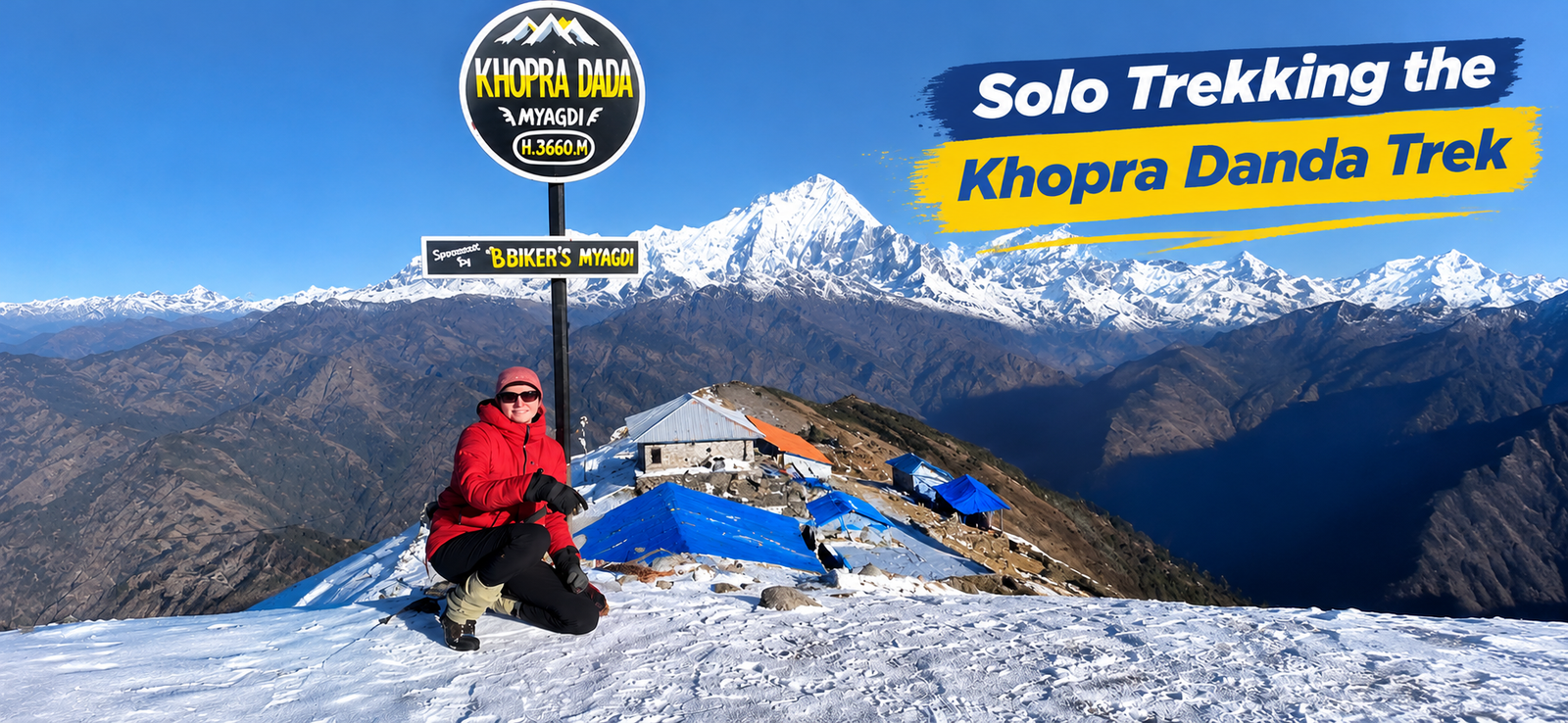
Searching for information on trekking the Khopra Danda Trek solo turns up a confusing mix of answers. Some older guides describe it as one of the easier independent treks in the Annapurna region. More recent reporting says a licensed guide is now effectively required across the whole Annapurna Conservation Area. Neither version is entirely wrong, but neither tells the full story either, and the gap between them is exactly where most solo travelers get stuck when planning this trip.
This guide walks through what solo trekking on this specific route actually looks like today, what the permit and guide rules say, what is still genuinely uncertain, and how to plan a trip that is both compliant and safe if you are traveling without a built in group. For the full standard itinerary and day by day breakdown, see our main Khopra Danda Trek page.
What Solo Can Actually Mean on This Route Now
The word solo gets used loosely, and on this specific trek it now covers three genuinely different arrangements rather than one.
- Fully independent and unguided: walking the route alone with no licensed guide at all. This is the version that current guidance since 2023 indicates is generally no longer permitted within the Annapurna Conservation Area, though as covered in detail below, how consistently this is enforced varies depending on the source consulted.
- Solo traveler paired with a licensed guide: you travel alone, but hire a guide for the trip, either privately or through an operator. This is the realistic path most solo trekkers now take on this route, and it satisfies the current guide requirement while still letting you set your own pace and schedule.
- Solo traveler joining a fixed group departure: you book as a single traveler onto a scheduled departure that already has a guide and possibly other trekkers, sharing costs and company without needing to arrange your own private guide.
- Why this distinction matters before you plan anything else: the compliance, cost, and social experience of these three options are meaningfully different, so deciding which one you actually mean by solo is the first real planning decision, before itinerary details or packing lists.
Annapurna Conservation Area Permit and TIMS Explained
Regardless of which solo arrangement you choose, two permits apply to anyone trekking this route, and understanding what they are and why they exist helps make sense of the guide requirement discussed next.
- The Annapurna Conservation Area Permit exists to fund conservation work: this permit is specific to the Annapurna Conservation Area, which covers the entire Khopra Danda route, and the fees collected support conservation and community development projects within the protected area.
- The Trekkers Information Management System registration exists for trekker safety tracking: this is a separate, national level registration system intended to help authorities track who is trekking where, which becomes relevant in the event of a search and rescue situation.
- Both are checked at entry points along the route: expect your permits to be checked at more than one checkpoint, regardless of which starting point or direction you use, so keep them accessible throughout the trek rather than packed deep in your bag.
- Do not rely on a specific fee figure from any single source, including this one: permit fees change periodically, and because this guide is published at a fixed point in time, we recommend confirming current Annapurna Conservation Area Permit and Trekkers Information Management System fees directly with your operator or the issuing office before booking, rather than budgeting around a number you read somewhere.
- Arrange both before you begin walking: most operators handle this as part of booking, but if you are piecing together an independent trip yourself, confirm exactly where and how both permits are obtained before you commit to a start date.
The 2023 Guide Requirement in Detail
This is the single most important thing to understand before planning a solo trip on this route, and it deserves more detail than a single line in a facts list.
- What the rule says: reporting since a 2023 government and tourism board decision indicates that solo trekking without a licensed guide is generally no longer permitted within conservation areas like the Annapurna Conservation Area, which covers this entire route.
- This is a guide requirement, not a group requirement: the rule is generally understood to require a licensed guide accompanying you, not a minimum group size, so a single traveler with one licensed guide is the typical way independent minded trekkers now satisfy this requirement.
- This is not unique to this trek: the rule is reported to apply across conservation areas in Nepal generally, not specifically targeting the Khopra Danda route, so you will encounter the same requirement on nearby treks in the Annapurna region.
- We are not a government authority and this guide is not legal advice: we are summarizing what has been publicly reported about this rule as of when this guide was written. Regulations and their enforcement can change, so confirm the current requirement directly with the Annapurna Conservation Area office, the Nepal Tourism Board, or your trekking agency before planning an unguided trip.
Why This Rule Exists
Understanding the stated rationale behind the guide requirement helps explain why it is framed the way it is, even if you are specifically weighing whether it affects your own trip.
- Safety is the most commonly cited reason: search and rescue operations in remote mountain terrain are easier and faster when a licensed guide with local knowledge and communication training is present, particularly in situations involving altitude sickness, injury, or sudden weather changes.
- Local employment is a secondary, commonly cited rationale: licensed guide and porter work is a significant source of income in trekking regions, and guide requirements are often framed as supporting that local economy.
- Both rationales are typical of conservation area guide rules generally: this pattern, safety plus local economic support, is common to similar requirements in other trekking regions and conservation areas, not something specific to this trek.
- Whatever the rationale, the practical outcome for planning purposes is the same: budget for a licensed guide as part of your trip cost, and treat it as a standard line item rather than an optional add on if you want your trip to be clearly compliant with current guidance.
How Consistently Is This Enforced
This is the part of the rule that genuinely varies depending on who you ask, and we want to be honest about that uncertainty rather than overstate our own confidence.
- Available reporting suggests enforcement is not perfectly uniform: some trekkers and operators report checkpoints along popular routes checking for guide credentials alongside permits, while other accounts describe looser enforcement in practice, particularly outside peak season.
- Do not plan around enforcement being loose: even where enforcement has reportedly been inconsistent, the rule itself still stands, and relying on lax checkpoint enforcement is not the same as being compliant, nor does it address the underlying safety rationale the rule is meant to serve.
- Enforcement patterns can change without much notice: rule changes and enforcement intensity can shift between seasons or years, so information from even a recent trip report may not reflect current conditions by the time you travel.
- The only reliable way to know the current situation is to ask directly: contact the Annapurna Conservation Area office, the Nepal Tourism Board, or a licensed trekking agency shortly before your planned travel dates, and treat anything you read online, including this guide, as a starting point rather than a final answer.
Safety Considerations Specific to Solo Trekkers on This Route
Setting the guide rule aside for a moment, there are practical safety considerations that matter specifically because you are traveling without a built in group, even if you hire a guide.
- A guide is not the same as a companion for every situation: a licensed guide handles navigation, local knowledge, and emergency response, but you are still the only other trekker experiencing symptoms like altitude sickness in your own body, so self monitoring remains entirely your responsibility.
- Tell someone your itinerary before you go: whether or not you are traveling with a guide, share your planned route and expected return date with someone outside the trip, in addition to any registration your operator or the Trekkers Information Management System provides.
- Carry a way to communicate problems even with a guide present: a guide can typically communicate with their own network, but having your own basic means of signaling trouble, discussed further below, adds a layer of safety that does not depend entirely on one other person.
- Solo does not mean reckless, and a guide does not remove all risk: treat every safety practice recommended for this trek, acclimatization pacing, weather awareness, proper gear, as equally important whether you are alone, with a guide, or in a group.
Altitude and Khayer Lake: the Real Risk Regardless of Guide Status
Whatever arrangement you choose for compliance with the guide rule, the single biggest physical risk on this specific trek has nothing to do with being alone and everything to do with altitude.
- Khayer Lake sits at close to 4660 meters: the day hike from Khopra Ridge to Khayer Lake and back, covered in more detail in our dedicated Khayer Lake and Khopra Ridge guide, is the highest and most physically demanding day of the entire trek.
- This day deserves your full attention regardless of who you are traveling with: altitude sickness does not care whether you have a guide, a group, or neither, so treat the Khayer Lake excursion as the point in the trip to be most attentive to symptoms like headache, nausea, or unusual fatigue.
- A solo traveler should be especially deliberate about pacing: without a group setting an external pace, it is easier to either push too hard trying to keep up with a guide’s typical walking speed or to underestimate how your own body is responding, so check in with yourself explicitly rather than assuming you would notice a problem automatically.
- Know the basic signs that mean you should stop ascending: persistent headache that does not resolve with rest and hydration, nausea or vomiting, unusual shortness of breath at rest, or confusion are all signals to discuss descent with your guide immediately rather than pushing on to see if symptoms improve.
Overview of the Khopra Danda Trek The Khopra Danda Trek, also known locally as the Khopra Ridge Trek, is a…
Trail Remoteness and Phone Signal
Parts of this route are genuinely remote, and that remoteness is worth planning around specifically as a solo traveler.
- The stretch between Khopra Ridge and Swanta sees fewer trekkers than the Ghandruk or Ghorepani sections: this is part of what makes the route appealing, but it also means fewer other travelers around if something goes wrong on that specific stretch.
- Phone signal is generally patchy and unreliable in the more remote sections: do not assume you will have reliable connectivity to call for help at every point on the trail, and plan your communication expectations accordingly rather than treating a phone as a guaranteed safety net.
- Teahouses along the route can often relay messages or help coordinate assistance: even without personal phone signal, teahouse operators are generally well connected to the broader support network in the region and can be a practical resource in an emergency.
- A guide’s local knowledge becomes especially valuable in the quieter sections: knowing which teahouses have better connectivity, how far help is from a given point on the trail, and how weather typically moves through a specific stretch is exactly the kind of local knowledge that matters most when fewer other trekkers are around.
Travel Insurance for Solo High Altitude Trekkers
Insurance is not a substitute for good judgment on the trail, but it is a practical safety net every solo trekker on this route should have in place before departure.
- Confirm your policy specifically covers trekking at the altitude you will reach: general travel insurance does not always include high altitude trekking by default, and the Khayer Lake excursion reaches close to 4660 meters, so check the specific altitude threshold your policy covers.
- Emergency evacuation coverage matters more for solo travelers: confirm your policy includes emergency evacuation, including helicopter evacuation if needed, since this is typically the most expensive component of a mountain emergency and the one most likely to be excluded from a basic policy.
- Keep your policy details accessible, not just stored on your phone: carry a printed copy or written note of your insurance provider, policy number, and emergency contact number, since relying solely on phone access in an area with patchy signal and potentially low battery is a real risk.
- Share your insurance details with your guide if you are trekking with one: this means your guide can act faster on your behalf in an emergency rather than needing to locate your information first.
Solo With a Private Guide vs Joining a Fixed Group Departure
Once you have accepted that some form of licensed guide is the realistic path forward, the next real decision is whether to hire a guide privately or join an existing fixed departure as a single traveler.
- A private guide gives you full control over pacing and schedule: you set your own daily walking pace, choose your own rest days, and can adjust your itinerary on the fly if you want extra time somewhere or need to descend early.
- A fixed group departure is generally more budget friendly: sharing the cost of a guide and sometimes porters across several travelers typically brings the per person cost down compared to a fully private arrangement.
- A fixed group departure offers built in social company: for solo travelers specifically worried about being lonely on a multi day trek, joining other trekkers on a scheduled departure solves that concern directly without needing to rely on meeting people at teahouses.
- A private guide offers more flexibility if your schedule is unpredictable: if your travel dates are not fixed far in advance, or you want the option to adjust your route significantly, a private arrangement is generally easier to adapt than joining an existing departure with its own fixed schedule.
Packing and Preparation Specific to Solo Trekkers
Most packing advice for this trek applies equally whether you are traveling solo, with a guide, or in a large group, and our dedicated packing list guide covers that in full. A few items and habits are worth emphasizing specifically for solo travelers.
- A fully charged power bank matters more when you are relying on your own devices: in a group, there is often someone with a spare charger or battery, but as a solo traveler you should assume you are your own backup for phone charge, headlamp batteries, and any other electronics you depend on.
- A basic first aid kit tailored to your own needs: guides typically carry some first aid supplies, but a solo traveler should still carry personal items such as any prescription medication, blister care supplies, and basic pain relief, since you cannot assume a guide’s kit covers your specific situation.
- A paper map or offline map download, even with a guide present: this is not about distrusting your guide, but about reducing your own total reliance on one other person for every piece of route awareness, which is a reasonable habit for any solo traveler in remote terrain.
- Write down key contacts and policy numbers before you lose phone signal, not after: prepare this information while you still have reliable connectivity in Pokhara, rather than trying to retrieve it once you are already on the trail with patchy signal.
- Pack entertainment or a way to unwind in the evenings: teahouse evenings can be quiet, and solo travelers sometimes underestimate how much downtime there is without a group to socialize with, so a book, journal, or downloaded media can make those evenings more comfortable.
Meeting Other Trekkers Along the Way
Even if you choose a private guide rather than a fixed group departure, this route is popular enough that solo travelers often end up with more social contact than expected.
- Teahouses function as natural social spaces: shared dining areas and common sitting rooms mean trekkers from different groups and guides frequently end up chatting over meals, particularly in the evenings.
- Popular stretches like Ghandruk, Ghorepani, and the approach to Poon Hill see more trekker traffic: if meeting other travelers is a priority for you, these busier sections of the route offer more opportunities for that than the quieter Khopra Ridge to Swanta stretch.
- Guides often know other guides and groups on the same schedule: your own guide may introduce you informally to other travelers moving along a similar itinerary, particularly if they have worked together before or are from the same local area.
- If social contact matters more to you than route flexibility, weigh that honestly against a private arrangement: this is one more reason some solo travelers ultimately prefer joining a fixed group departure over a fully private trip, even at a similar or higher cost.
Comparison Table: Three Ways to Go Solo
The table below summarizes the three realistic ways a solo traveler can approach this trek today.
| Arrangement | Compliance | Typical cost | Social experience | Flexibility |
|---|---|---|---|---|
| Fully independent, unguided | Generally not compliant with current guidance, confirm before relying on this | Lowest on paper, but increasingly not a realistic option | Entirely alone unless you meet others informally | Highest in theory |
| Solo with a private licensed guide | Compliant with current guide requirement | Higher per person cost, confirm current rates with operator | Guide company, limited other trekker contact unless at teahouses | High, schedule adapts to you |
| Solo joining a fixed group departure | Compliant with current guide requirement | Generally the most budget friendly option | Built in group company and shared experience | Lower, schedule is fixed by the departure |
Cost Realities for Solo Travelers
Cost is often the first question solo travelers ask, and the honest answer depends heavily on which of the three arrangements above you choose.
- A single supplement is common on private solo arrangements: because a guide’s time and logistics cost roughly the same whether they are leading one trekker or several, a solo private trip typically costs more per person than the same itinerary shared across a small group.
- Fixed group departures spread shared costs across more people: this is the main reason a fixed departure is generally the more budget friendly path for a solo traveler who is flexible on exact dates.
- Do not assume solo automatically means cheaper: this is one of the most common misconceptions we hear from solo inquirers, and it is worth adjusting your budget expectations before you start comparing operator quotes.
- Ask for a clear breakdown of what is and is not included: permits, guide fees, accommodation, meals, and transport are sometimes bundled differently between operators, so compare full inclusive quotes rather than a single headline price when evaluating solo options.
Weather and Season Considerations Specific to Solo Planning
Season affects every trekker on this route, but it carries a few extra considerations when you are planning solo rather than with a built in group.
- Fixed group departures tend to concentrate in peak seasons: if joining a scheduled group is your preferred solo option, autumn and spring typically offer the widest choice of departure dates, since these are the most popular seasons for this trek generally.
- Off season solo travel often means a private arrangement by default: if you want to trek outside the busiest months, be prepared for fewer fixed departures to choose from, which may push you toward a private guide regardless of your initial cost preference.
- Weather related delays affect a solo traveler’s planning differently: with a group, a delay is shared and decided collectively, while a solo traveler with a private guide has more flexibility to adjust plans quickly, which can be an advantage during unpredictable weather.
- Confirm your guide’s experience with the specific season you are traveling in: a guide who mostly leads autumn departures may have less direct experience with monsoon or winter conditions on this route, so ask about this specifically if you are planning outside the main season.
Practical Booking Advice for Solo Travelers
A few practical questions help you book the right arrangement for your situation rather than defaulting to whichever option an operator happens to mention first.
- Ask directly whether a fixed departure currently has space: fixed group departures run on their own schedule, so confirm there is an upcoming departure that matches your travel window before planning around joining one.
- Ask how far in advance you need to book to be paired into a departure: popular departure dates can fill, so if joining a group is your preferred and more budget friendly option, do not leave this until the last minute.
- Ask what happens if a fixed departure does not reach a minimum group size: some operators cancel or convert departures to private trips at a different price if too few people join, so understand this policy before committing to a specific date.
- Ask about the guide’s experience with solo travelers specifically: a guide who regularly leads solo trekkers will generally be more attuned to the specific pacing and communication needs of a single traveler compared to one who mostly leads larger groups.
- If safety or loneliness is a specific concern, say so directly when you enquire: a good operator will tailor their recommendation, private guide versus group departure, based on what actually matters to you rather than defaulting to whichever is easiest for them to arrange.
What We Offer
We regularly support solo travelers on the Khopra Danda Trek, and we are upfront about what current guidance means for how we structure these trips.
- Licensed guides as standard: every trip we run, solo or otherwise, includes a licensed guide, which keeps your trip compliant with current guidance while also supporting the safety and local knowledge benefits discussed throughout this guide.
- Honest cost comparisons between private and group options: we will walk you through the real cost difference between a private solo arrangement and joining a fixed departure, rather than steering you toward whichever is more convenient for us.
- Direct answers on permits and current requirements: we will tell you plainly what we understand the current ACAP and TIMS requirements to be at the time you enquire, and point you toward the relevant office if you want to confirm independently.
- Flexibility for solo travelers with specific concerns: whether your priority is cost, company, safety, or schedule flexibility, tell us when you enquire so we can recommend the arrangement that actually fits your situation.
You can see our full standard itinerary and current pricing on our main Khopra Danda Trek page, and let us know you are traveling solo when you enquire so we can talk through the private guide versus group departure decision with you directly. If you are also deciding which direction to walk the route, our starting point comparison guide covers that question in detail, and our packing list guide is worth reviewing regardless of which solo arrangement you choose.
Frequently Asked Questions
Can I still trek this route completely alone with no guide at all?
Current guidance since 2023 indicates this is generally no longer permitted within the Annapurna Conservation Area, though enforcement consistency varies by report. Confirm the current rule with the conservation area office, the Nepal Tourism Board, or your agency before planning an unguided trip.
Is trekking solo more expensive or cheaper than trekking in a group?
A private solo arrangement is typically more expensive per person than joining a fixed group departure, since guide and logistics costs are shared across more people in a group. Joining a scheduled departure as a single traveler is generally the more budget friendly solo option.
Will I be lonely trekking this route by myself?
It depends on which arrangement you choose. Joining a fixed group departure gives you built in company from the start, while a private guided trip offers a guide’s company plus whatever other trekkers you meet informally at teahouses along the route.
Is this trek safe for solo women travelers?
Many solo women travelers complete this trek safely, particularly with a licensed guide. Discuss any specific concerns directly with your operator when booking so they can recommend a guide and arrangement suited to your comfort level.
What exactly are ACAP and TIMS?
ACAP refers to the Annapurna Conservation Area Permit, which funds conservation and community development within the protected area this trek passes through. TIMS refers to the Trekkers Information Management System, a national registration system used to track trekker movements for safety purposes.
How much do ACAP and TIMS permits cost?
Fees are subject to change, so we recommend confirming current Annapurna Conservation Area Permit and Trekkers Information Management System fees directly with your operator or the issuing office before booking rather than relying on a figure from any single source.
Can I hire a guide only for part of the trek and go alone for the rest?
This is not a standard arrangement and is unlikely to satisfy current guidance, which generally expects a licensed guide for the trek as a whole within the conservation area. Confirm directly with your operator or the ACAP office if you are considering any partial arrangement.
Do I need a porter as well as a guide if I am trekking solo?
A porter is not strictly required the way a guide now generally is, but many solo trekkers choose to hire one for comfort, particularly on the longer Khayer Lake day. This is a personal preference rather than a compliance requirement.
What happens if I get altitude sickness and I am traveling solo?
A licensed guide is trained to recognize symptoms and coordinate descent or evacuation if needed. This is one of the clearest safety benefits of trekking with a guide rather than attempting the route fully unguided, regardless of the current permit rules.
Is phone signal reliable enough to call for help if something goes wrong?
Signal is generally patchy and unreliable in the more remote sections of this route, particularly between Khopra Ridge and Swanta. Do not plan around guaranteed connectivity, and rely on your guide’s local knowledge and teahouse networks as a more consistent backup.
Should I buy travel insurance specifically for this trek?
Yes, confirm your policy covers trekking at the altitude you will reach, close to 4660 meters at Khayer Lake, and that it includes emergency evacuation coverage, since general travel insurance does not always include this by default.
How far in advance should I book if I want to join a fixed group departure?
Booking well ahead of your preferred travel window is advisable, since popular departure dates can fill and some operators require a minimum group size for a departure to proceed as scheduled.
Can I switch from a group departure to a private guide if I change my mind?
This depends on your operator’s policy and how close to departure you are asking. Discuss this flexibility directly when booking if you think you might want to switch arrangements later.
Does trekking with a guide mean I lose control over my own pace?
Not with a private guide, who generally adapts to your pace and preferences. A fixed group departure moves at a pace set by the group as a whole, which is worth considering if a highly flexible pace matters to you specifically.
Is this trek a good first solo trek for someone new to trekking in Nepal?
It can be, particularly with a licensed guide and a moderate difficulty level compared to higher, more technical routes. First time solo trekkers should be especially attentive to pacing and altitude guidance during the Khayer Lake excursion specifically.
Will I get much time to myself if I join a fixed group departure?
Yes, a group itinerary still involves plenty of individual time walking, resting, and settling into teahouses. Joining a group affects your company at meals and on the trail generally, not every moment of the day.
Can I bring my own portable charger or do teahouses have charging available?
Many teahouses offer charging for a small fee, but availability and reliability vary by location. Bringing your own fully charged power bank is a sensible backup regardless, particularly as a solo traveler managing your own devices.
How do I know if my guide is actually licensed?
Ask your operator directly for confirmation of your guide’s licensing before departure, and feel free to ask your guide to show their credentials on the trail if you want to confirm this yourself. A reputable operator will not hesitate to provide this.
What should I do if I feel unsafe or uncomfortable with my assigned guide?
Raise this with your operator as early as possible, ideally before the trek begins or at the first opportunity if a concern arises during the trip. A reputable operator will take this seriously and work with you to address it.