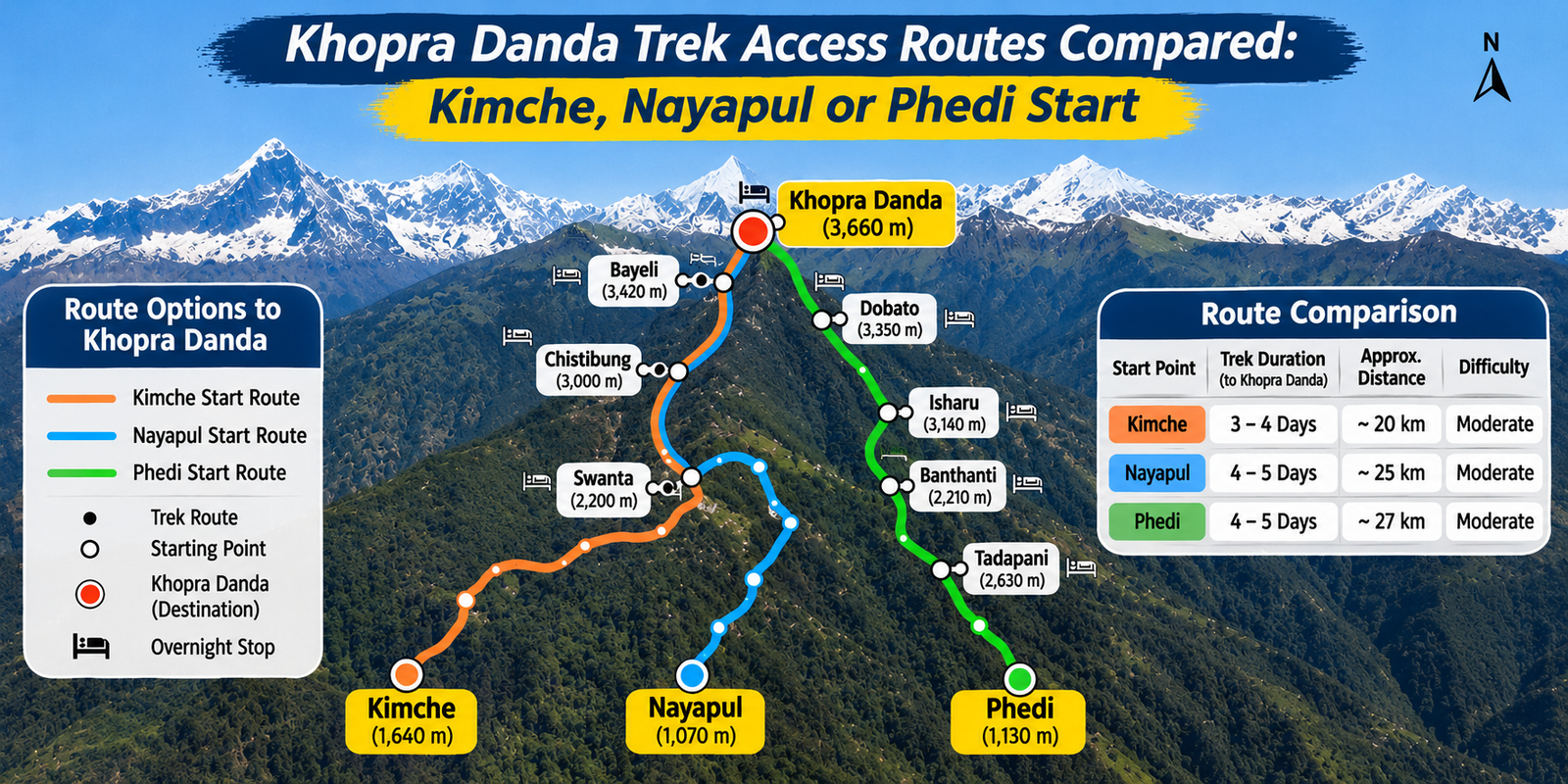
Most writing about the Khopra Danda Trek describes a single fixed itinerary, starting at Kimche and finishing at Nayapul. That is a genuinely good way to do this trek, and it is the route we run ourselves, but it is not the only reasonable way to approach this part of the Annapurna region. Which end you start from, and which direction you walk the loop, changes the order you see the highlights in, how the trek paces your acclimatization toward Khayer Lake, and how crowded the trail feels on any given day.
This guide walks through the realistic starting point options for this trek, what changes depending on which one you choose, and the practical questions worth asking your operator before you commit to a specific plan. For the full standard itinerary and day by day breakdown, see our main Khopra Danda Trek page.
The Standard Start: Kimche to Ghandruk
The most common and, in our view, the most sensible way to do this trek begins with a drive from Pokhara to Kimche, followed by a trek up to Ghandruk on the first day on the trail.
- Shortest drive in: Kimche is a relatively short drive from Pokhara compared to some alternative starting points, meaning less time spent in a vehicle and more time on the actual trail on your first trekking day.
- Eases you in through Gurung country: Ghandruk and Tadapani sit within traditional Gurung villages, giving you a gentle, well supported introduction to teahouse life before the trail becomes quieter and more remote.
- Saves Poon Hill for the finale: this direction visits the quieter Khopra Ridge and Khayer Lake sections in the middle of the trip, then finishes with the famous Poon Hill sunrise near the end, which many trekkers find works well as a dramatic closing highlight.
- Descends through Nayapul: the trek finishes by descending from Ghorepani toward Nayapul, a well established exit point with reliable onward transport back to Pokhara.
- Who this suits: trekkers who want a logical narrative arc to the trip, building from busier villages into genuine quiet, then closing with a famous and crowded viewpoint as a final reward rather than an opening act.
The Reverse Start: Nayapul to Ghorepani First
Some trekkers and operators prefer to walk this loop in the opposite direction, starting at Nayapul and reaching Ghorepani and Poon Hill within the first few days, before continuing on to Swanta, Khopra Ridge, Khayer Lake, Chistibung, Dobato, Tadapani, and finally Ghandruk and Kimche.
- Gets the famous, crowded viewpoint out of the way early: Poon Hill is the busiest single viewpoint on this entire route, and starting here means you experience that crowd early in the trip rather than at the end, when you may be more used to the trail and less bothered by other groups.
- Front loads a shorter, more established approach: the Nayapul to Ghorepani section is one of the most heavily trekked and well developed stretches in the whole Annapurna region, with frequent teahouses and a very clear trail, which some first time trekkers find reassuring at the very start of a multi day trip.
- Saves the quiet highlights for later: Khopra Ridge and Khayer Lake become the climax of the trip in this direction rather than the middle section, which appeals to trekkers who want their quietest, most remote experience to be the last major memory of the trek.
- Finishes at Kimche or Ghandruk: the exit point shifts to Kimche rather than Nayapul, so confirm with your operator how this affects the return drive to Pokhara, since the two exit points are not identical in driving time.
- Who this suits: trekkers who would rather handle the most crowded section while fresh at the start of the trip, and who want the payoff of genuine solitude to arrive later rather than earlier.
Which Direction Gives Better Acclimatization
Beyond preference for crowds and narrative arc, the direction you walk this loop has a real effect on how your body adjusts to altitude before the demanding day hike up to Khayer Lake.
- The standard direction builds altitude gradually: starting at Kimche and working through Ghandruk, Tadapani, and Dobato before reaching Khopra Ridge gives your body several days of progressively higher sleeping elevations before the Khayer Lake excursion, which is a textbook gradual acclimatization profile.
- The reverse direction front loads a lower, flatter stretch: the Nayapul to Ghorepani section does not gain nearly as much elevation relative to the days involved, meaning trekkers in this direction may reach the higher sections of the route with slightly less acclimatization time banked, though the overall itinerary length is usually similar.
- Khayer Lake is the single highest point regardless of direction: whichever way you walk the loop, the day hike to Khayer Lake at close to 4660 meters remains the most physically demanding and altitude sensitive day of the entire trek, so this is the point to be most attentive to symptoms no matter which direction you started from.
- Ask your operator how they structure rest days in each direction: a well run itinerary builds in acclimatization margin regardless of direction, but the exact placement of rest or short days can differ, so this is worth confirming specifically rather than assuming it is identical to the standard itinerary.
The Phedi or Dhampus Approach
A longer alternative start used by some operators begins at Phedi or Dhampus, overlapping partly with the trailhead area shared by the Annapurna Base Camp and Mardi Himal treks, before cutting across toward Tadapani or Ghorepani to join the main Khopra Danda route.
- Adds extra days to the trip: this approach typically adds a day or two compared to the standard Kimche start, since Phedi and Dhampus sit at a greater walking distance from the core Khopra Danda route.
- Offers a different lower valley experience: trekkers who have already done the standard Ghandruk approach on a previous trip to the region sometimes choose this start specifically to see a different stretch of lower Annapurna foothill villages.
- Less standardized than the Kimche or Nayapul starts: because this approach is used less consistently across operators, the exact routing, timing, and added cost can vary considerably, so confirm feasibility, added days, and current pricing directly with your chosen operator before assuming this option is available or budgeting for it.
- Worth asking about if you are combining treks: this start point is most relevant if you are already considering combining Khopra Danda with Annapurna Base Camp or Mardi Himal, covered in more detail below, since the trailhead overlap can make a combined itinerary more efficient.
Comparing the Starting Points
The table below summarizes the practical differences between the three approaches discussed in this guide.
| Start point | Typical added time | Crowd pattern | Best suited to |
|---|---|---|---|
| Kimche to Ghandruk (standard) | None, this is the baseline itinerary | Quiet middle section, busy Poon Hill finale | Trekkers who want a dramatic, well known closing highlight |
| Nayapul to Ghorepani (reverse) | Little to none, similar total length | Busy start at Poon Hill, quiet closing stretch | Trekkers who prefer handling crowds early while fresh |
| Phedi or Dhampus (alternative) | One to two extra days, confirm with operator | Different lower valley crowd pattern | Trekkers combining this trek with Annapurna Base Camp or Mardi Himal, or repeat visitors wanting a new approach |
Driving Logistics From Pokhara
Each starting point involves a different drive from Pokhara, and understanding this in advance helps you plan your first and last days realistically.
- Pokhara to Kimche: the drive used for the standard itinerary, a private vehicle transfer that typically takes a few hours depending on road conditions, after which all travel is on foot.
- Pokhara to Nayapul: a similarly short private vehicle transfer, used either as the finishing exit point in the standard direction or as the starting point in the reverse direction.
- Pokhara to Phedi or Dhampus: a separate trailhead area used for the alternative approach, with its own drive time and logistics that your operator should confirm clearly before you book.
- Road conditions can affect timing: hill roads in this region can be affected by seasonal landslides or maintenance work, so build some flexibility into your arrival schedule in Pokhara rather than cutting your connection too tightly.
How the Viewpoints Change Depending on Direction
The three signature viewpoints on this trek, Mulde Viewpoint above Dobato, the Khopra Ridge panorama, and the Poon Hill sunrise, remain the same regardless of which direction you walk, but their position in your trip changes your experience of them considerably.
- Mulde Viewpoint and Khopra Ridge in the standard direction: these arrive after several days of walking, when your body is already somewhat adjusted to the trail and the altitude, which many trekkers find lets them appreciate the views without the fatigue of a first ascent.
- Mulde Viewpoint and Khopra Ridge in the reverse direction: these become the closing highlights of the trip rather than the midpoint, giving the trek a structure where the most remote and arguably most impressive scenery is also the last thing you see before returning to the lower villages.
- Poon Hill as an opener versus a finale: seeing Poon Hill first means comparing every subsequent viewpoint back to that famous sunrise, while seeing it last means it closes the trip on a familiar, crowd pleasing note after days of quieter trail. Neither is objectively better, and the right choice depends on what kind of narrative you want your trip to have.
- Khayer Lake is unaffected by direction in terms of the view itself: since this is always approached as a day hike from Khopra Ridge rather than a through route, the lake itself looks the same regardless of which direction you walked to reach the ridge. For more detail on this viewpoint and the lake, see our dedicated Khayer Lake and Khopra Ridge guide.
Combining Khopra Danda With Annapurna Base Camp or Mardi Himal
Travelers with more time sometimes ask about combining Khopra Danda with either Annapurna Base Camp or Mardi Himal into a single extended trip, taking advantage of the overlapping trailhead area near Phedi and Dhampus discussed earlier.
- This is possible with careful planning: both combinations are achievable for trekkers with enough vacation time and a reasonable fitness base, since the trailheads and some lower sections overlap geographically.
- Acclimatization planning becomes more important, not less: combining two treks with separate high points, Khayer Lake on this trek and Annapurna Base Camp’s roughly 4130 meters on the other, requires a carefully built schedule rather than simply adding the two standard itineraries together.
- See our dedicated comparison for the fuller picture: we cover how these two treks compare in detail, including when combining them makes sense versus when choosing just one is the better call, in our Khopra Danda versus Annapurna Base Camp guide.
- Budget extra time, not just extra days on paper: a combined itinerary needs buffer days for weather, fatigue, and recovery between the two high points, so treat any quoted combined itinerary length as a minimum rather than a guarantee.
Practical Considerations for Choosing Your Start Point
Beyond the route specific trade offs above, a few practical questions help narrow down which starting point actually suits your trip.
- How much total time do you have? the standard and reverse directions are similar in total length, while the Phedi or Dhampus approach typically adds time, so your available vacation window may decide this for you.
- How do you feel about crowds at the start versus the end of a trip? there is no wrong answer here, but being honest with yourself about this preference will point you toward the standard or reverse direction more clearly than any other single factor.
- Are you combining this with another trek? if so, the Phedi or Dhampus approach may make logistical sense even with the added time, since it avoids doubling back through Pokhara between two separate trips.
- What does your specific operator actually offer? not every operator runs every variation described in this guide, so confirm which starting points and directions your chosen operator actually supports before building your travel plans around a specific option.
Permits and Checkpoints Along Each Route
Regardless of which starting point or direction you choose, the permit requirements for this trek remain the same, since the entire route sits within the Annapurna Conservation Area.
- The Annapurna Conservation Area Permit is required throughout: this permit is checked at entry points into the conservation area regardless of which trailhead you use, so arrange this before you begin walking from any starting point.
- The Trekkers Information Management System registration is also required: this national registration system applies across the whole route and is generally arranged alongside your conservation area permit.
- A licensed guide is now expected for independent trekkers in this region: reporting since a 2023 government and tourism board decision indicates that solo trekking without a licensed guide is generally no longer permitted within conservation areas like this one, though how consistently this is enforced at every checkpoint varies depending on the source consulted. Confirm the current requirement directly with the Annapurna Conservation Area office or your trekking agency before planning an unguided trip.
- Checkpoints exist at multiple points regardless of direction: whichever way you walk the loop, expect your permits to be checked at more than one point along the route, so keep them accessible rather than packed away.
- Permit fees are subject to change: rather than quote a specific figure that may be outdated by the time you travel, we recommend confirming current Annapurna Conservation Area Permit and Trekkers Information Management System fees directly with your operator or the issuing office before booking.
Weather and Seasonal Impact on Route Choice
The best season for this trek generally does not change based on starting point, but a few seasonal factors are worth weighing against your chosen direction.
- Spring rhododendron blooms favor the standard direction slightly: since the lower forest sections between Kimche and Tadapani carry much of the rhododendron display, walking this stretch early in the standard direction puts the blooms near the start of your trip rather than the end.
- Autumn stability benefits any direction equally: the clear, stable weather typical of autumn makes this generally the most forgiving season regardless of which way you walk the loop.
- Winter snow risk affects the Khayer Lake approach regardless of direction: since this day hike is always approached from Khopra Ridge as a round trip, winter snow conditions near the lake are a consideration no matter which starting point brought you to the ridge.
- For the full seasonal breakdown, see our dedicated guide: we cover month by month conditions for this trek in detail in our Best Time to Trek Khopra Danda guide.
Transportation Options From Pokhara to Each Trailhead
Beyond the private vehicle transfers most operators arrange, it is worth understanding the broader transport picture for each starting point, particularly if you are piecing together part of your own trip.
- Private jeep or car transfers are the standard choice: most operators, including ourselves, arrange a private vehicle for the drive from Pokhara to Kimche, Nayapul, or Phedi, since this is faster and more predictable than relying on public transport on travel days that matter for your itinerary.
- Local buses exist but add uncertainty: independent travelers piecing together their own trip can reach Nayapul and the Phedi area by local bus, which costs considerably less but takes longer and runs on a less predictable schedule than a private transfer.
- Kimche access typically requires a private vehicle or shared jeep: this trailhead sees less public transport service than Nayapul, so most trekkers starting here arrange a private or shared jeep rather than relying on a local bus route.
- Road quality varies by season: hill roads throughout this region can be rougher during and immediately after monsoon season, so a journey that takes a predictable amount of time in autumn may take noticeably longer in other seasons.
- Factor transport time into your first and last day plans: whichever trailhead you use, avoid scheduling anything time sensitive, such as a flight out of Pokhara, too close to your trek’s start or finish time, since road transport in hill terrain is rarely perfectly punctual.
Common Mistakes When Choosing a Starting Point
We have heard from enough trekkers after the fact to notice a handful of avoidable mistakes related specifically to starting point choice, separate from general trek planning errors.
- Assuming every operator offers every direction: not every trekking company runs the reverse direction or the Phedi alternative as a standard product, so some travelers book before confirming their preferred direction is actually available, then are disappointed to learn it requires a custom private arrangement at extra cost.
- Underestimating the Phedi or Dhampus approach’s added length: a small number of trekkers choose this option without fully registering that it adds real walking days, then find their total trip length does not match their available vacation time.
- Not asking how direction affects the exit point: some trekkers book flights or onward travel assuming they will exit via Nayapul, then discover their chosen direction actually finishes at Kimche, creating an unnecessary scramble to adjust transport plans.
- Treating direction as purely cosmetic: a few trekkers assume the choice between standard and reverse direction is only about which viewpoint comes first, without considering the acclimatization implications discussed earlier in this guide.
- Not confirming guide and permit requirements before planning an independent trip: given the 2023 rule changes discussed above, some independent minded trekkers plan an unguided trip around a specific starting point only to find a guide is expected regardless of which trailhead they intended to use.
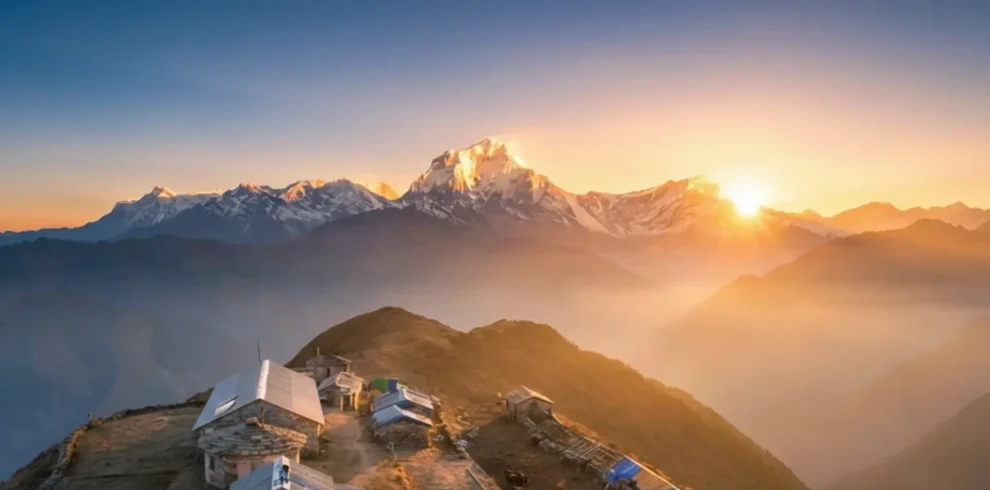
Overview of the Khopra Danda Trek The Khopra Danda Trek, also known locally as the Khopra Ridge Trek, is a…
A Closer Look at the First and Last Days in Each Direction
Since the start and end of a trek shape first and last impressions disproportionately, it is worth looking specifically at what those bookend days feel like in each direction.
- Standard direction, first day: after the drive from Pokhara to Kimche, the trek begins with a climb up to Ghandruk, a well established Gurung village with reasonably developed teahouses, giving new trekkers a gentle, supported introduction to life on the trail.
- Standard direction, last day: the trip closes with the Poon Hill sunrise followed by a descent to Nayapul and a drive back to Pokhara, meaning your final trekking memory is the single most photographed viewpoint on the route.
- Reverse direction, first day: after driving to Nayapul, the first walking day heads up toward Ghorepani along one of the most heavily used and well signposted trails in the entire region, which can feel almost busy compared to what comes later.
- Reverse direction, last day: the trip finishes by descending from Ghandruk to Kimche, a quieter close than the Poon Hill finale, which suits trekkers who prefer their trip to wind down gently rather than peak at the very end.
- Neither bookend experience is wrong: both have real advantages, and the right fit depends on whether you want your trek to build toward a famous crescendo or to ease you back toward normal life after the more remote highlights.
Porter and Luggage Logistics by Starting Point
Porter arrangements do not change dramatically between starting points, but a few details are worth confirming depending on which direction and trailhead you choose.
- Porters are typically assigned at the trailhead itself: whether you begin at Kimche, Nayapul, or Phedi, porters usually join the group at the starting point rather than traveling with you from Pokhara, so confirm this handoff point with your operator in advance.
- Weight limits remain consistent regardless of direction: most operators apply the same per trekker weight limit for porter carried luggage no matter which trailhead is used, typically with one porter assigned to the combined bags of two trekkers.
- Storing extra luggage in Pokhara works the same way for any direction: most hotels in Pokhara can store a bag you do not need on the trail regardless of which trailhead you depart from or return to, so this is one piece of planning that does not change based on your chosen route.
- Returning to a different hotel or city stay may need confirming: if your direction means you exit via a different point than you entered, double check that any stored luggage or onward hotel booking in Pokhara still lines up with your actual return point and timing.
Guide and Group Considerations by Direction
Your guide’s familiarity with a given direction can genuinely affect how smoothly the trek runs, so it is worth asking a few direct questions about this before booking.
- Ask how often your guide has led this specific direction: a guide who runs the standard Kimche start regularly every season will generally know the current state of teahouses, water sources, and trail conditions on that direction better than one who rarely leads it, and the same logic applies in reverse.
- Fixed group departures usually run a single fixed direction: if you join a scheduled group departure rather than booking a private trip, confirm which direction that specific departure runs, since you will not usually be able to choose a different direction within an existing group.
- Private trips allow more direction flexibility: booking privately, either solo or with your own group, generally gives you more freedom to request your preferred direction, though this may affect pricing compared to joining an existing fixed departure.
- Mixed groups sometimes split preferences: if you are traveling with others who have a different directional preference than you do, discuss this openly before booking rather than assuming everyone is equally happy with whichever direction gets chosen.
- A guide who knows the Phedi alternative well is worth seeking out specifically: since this approach is less standardized, a guide with genuine, recent experience leading it is more valuable here than on the two more established directions.
What We Offer
We run the Khopra Danda Trek most often via the standard Kimche to Ghandruk direction, since it gives the most reliable acclimatization profile and a strong narrative arc toward the Poon Hill finale, but we are glad to discuss alternative starting points for travelers with specific preferences or time constraints.
- Honest guidance on what is actually available: we will tell you plainly which starting point options we can run reliably and which would require more custom planning, rather than promising flexibility we cannot deliver.
- Acclimatization built around your chosen direction: whichever starting point you choose, our itinerary planning accounts for the altitude profile of that specific direction rather than applying a single generic schedule to every booking.
- Combined trip planning: if you are considering pairing this trek with Annapurna Base Camp or Mardi Himal, we can help assess whether a combined itinerary genuinely makes sense for your timeline and fitness level.
You can see our full standard itinerary and current pricing on our main Khopra Danda Trek page, and let us know if you are considering an alternative starting point when you enquire so we can advise honestly on what is realistic.
Frequently Asked Questions
Which starting point do you recommend for most trekkers?
For most trekkers, we recommend the standard Kimche to Ghandruk direction, since it offers a gradual acclimatization profile and a strong finish at Poon Hill. The reverse direction is a reasonable alternative for those who specifically prefer handling crowds early.
Does walking the loop in reverse change the total trek length?
Generally not significantly, since both directions cover the same core route. The Phedi or Dhampus alternative start typically does add a day or two, which should be confirmed with your operator.
Is the Phedi or Dhampus start available with every operator?
No, this approach is less standardized across the industry, so confirm directly with your chosen operator whether they offer it and what it adds in time and cost.
Do I need a guide regardless of which starting point I choose?
Current guidance since 2023 indicates a licensed guide is generally expected for trekkers in Annapurna Conservation Area regardless of starting point, though enforcement consistency varies by report. Confirm the current rule with the conservation area office or your agency before planning an unguided trip.
Which direction is better for avoiding crowds at Poon Hill?
Neither direction avoids the Poon Hill crowd entirely, since it is simply a popular viewpoint. The choice is whether you prefer to experience that crowd at the start or the end of your trip.
Does the permit process differ depending on starting point?
No, the same Annapurna Conservation Area Permit and Trekkers Information Management System registration apply regardless of which trailhead you use, since the entire route sits within the same conservation area.
Can I combine this trek with Annapurna Base Camp using the Phedi start?
Yes, the overlapping trailhead area near Phedi and Dhampus makes this combination more logistically efficient, though it requires careful acclimatization planning given the two separate high points involved.
Does the direction I choose affect how I experience Khayer Lake?
The lake itself looks the same regardless of direction, since it is always reached as a day hike from Khopra Ridge. What changes is whether this excursion falls in the middle or near the end of your overall trip.
Is one direction significantly harder than the other?
Not dramatically, though the standard direction offers a slightly more gradual altitude gain profile before the demanding Khayer Lake day, which some trekkers prefer for acclimatization purposes.
Which exit point should I plan my return flight or onward travel around?
This depends on your chosen direction. The standard route exits via Nayapul, while the reverse direction exits via Kimche. Confirm the exact exit point and expected arrival time back in Pokhara with your operator before booking onward travel.
Do road conditions ever affect which starting point is practical?
Yes, seasonal landslides or road maintenance can occasionally affect driving times to Kimche, Nayapul, or Phedi. Build some flexibility into your schedule and ask your operator about current road conditions close to your travel dates.
Is the reverse direction a good option for first time trekkers?
It can be, since the Nayapul to Ghorepani section is one of the most established and well supported stretches in the region, which some first timers find reassuring early in a multi day trip.
Should I decide my starting point before or after booking?
Discuss your preference with your operator before booking, since not every starting point is run as a fixed departure, and a custom direction may need to be arranged specifically as a private trip.
Does the Mardi Himal combination use the same alternative start as Annapurna Base Camp?
The trailhead area near Phedi and Dhampus overlaps with both the Annapurna Base Camp and Mardi Himal approaches, so a combined itinerary with either is logistically similar, though the specific routing and timing should be confirmed with your operator.
Can I store luggage in Pokhara no matter which direction I choose?
Yes, most hotels in Pokhara offer luggage storage regardless of which trailhead you depart from or return to, though it is worth confirming your storage and onward hotel booking align with your actual exit point.
Will my porter change if I switch starting points?
Porters are generally assigned at the trailhead itself rather than traveling with you from Pokhara, so your porter arrangement should work the same way regardless of which starting point you choose, provided your operator confirms this handoff in advance.
Is public transport a realistic option for reaching any of these trailheads?
Local buses can reach Nayapul and the general Phedi area, though they take longer and run less predictably than a private transfer. Kimche typically requires a private or shared jeep rather than a public bus route.