

Overview
Overview of the Khopra Danda Trek
The Khopra Danda Trek, also known locally as the Khopra Ridge Trek, is a thirteen day journey through one of the quieter corners of the Annapurna region in Nepal. While the trails to Annapurna Base Camp and Poon Hill carry a steady stream of visitors throughout the trekking seasons, the ridge above Khopra remains comparatively untouched, reached only by a side trail that branches away from the busier routes near Tadapani. For travelers who want the full visual reward of the Annapurna range, Dhaulagiri, and Machhapuchhre, without walking shoulder to shoulder with large groups, Khopra Danda offers one of the best balances of scenery and solitude found anywhere in Nepal.
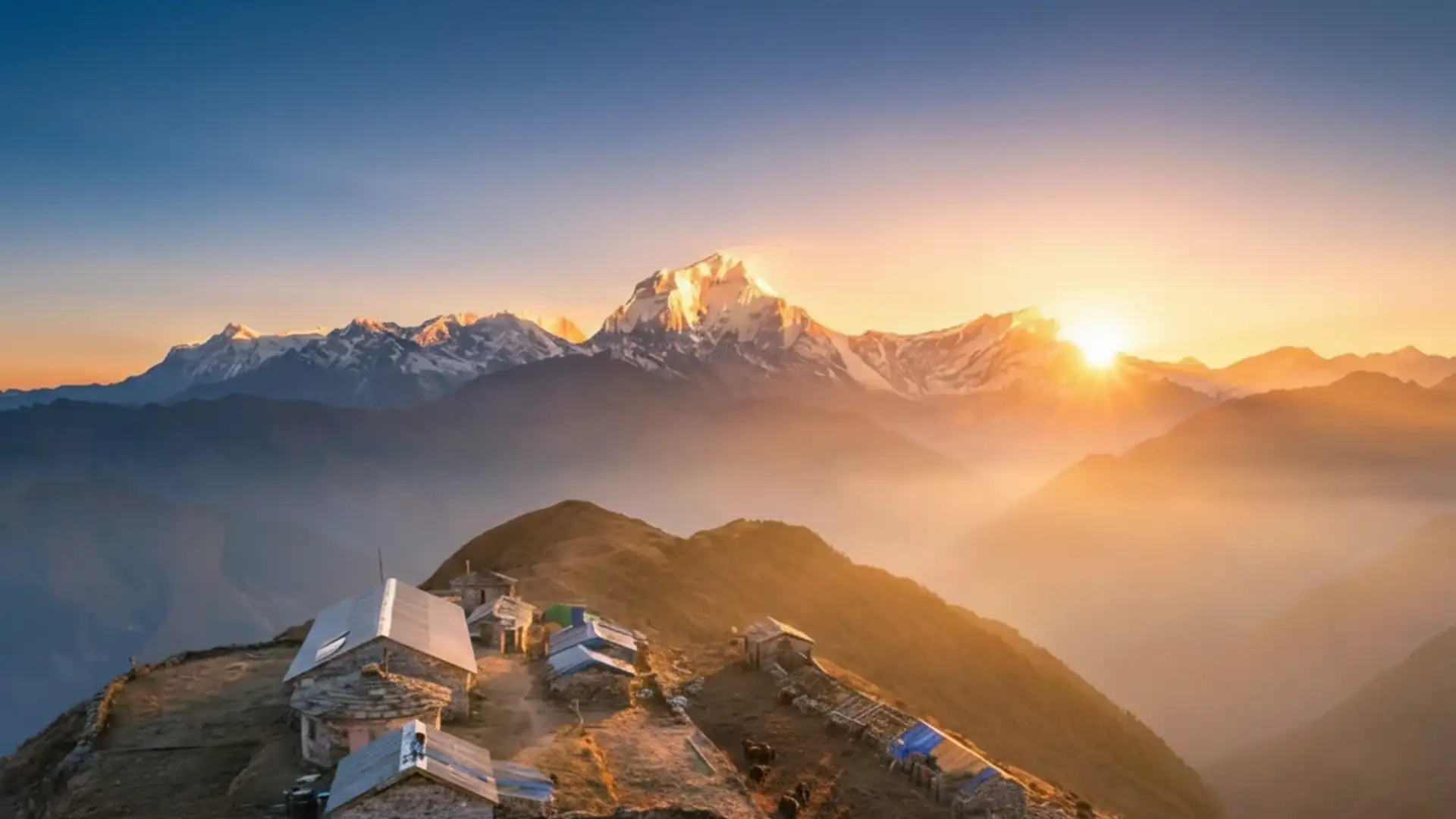
This trek takes its name from the open grassy ridge at about three thousand six hundred and sixty meters where a small cluster of lodges sits facing an almost uninterrupted wall of Himalayan peaks. From here, a day hike leads up to Khayer Lake, a glacier fed alpine lake held sacred by both Hindus and Buddhists, sitting at close to four thousand six hundred and sixty meters beneath the southern flank of Dhaulagiri. The combination of the ridge viewpoint and the lake excursion gives this trek two genuinely distinct highlights, rather than a single payoff at the end, which is part of why it has become increasingly popular among trekkers who have already done the more famous routes in the region and are looking for something a little different.
Our itinerary for the Khopra Danda Trek runs for thirteen days from arrival in Kathmandu to final departure, including the drive to and from Pokhara, nine days of actual trekking, and a built in rest and acclimatization structure that keeps the altitude gain reasonable at every stage. The route passes through Ghandruk, Tadapani, Dobato, Chistibung, Khopra Ridge, Swanta, and Ghorepani, finishing with the classic sunrise at Poon Hill before the descent back to the road at Nayapul. It is, in effect, a trek that threads together several of the best viewpoints in the Annapurna region into a single coherent journey, while spending as little time as possible on the more crowded sections of trail.
Why Choose the Khopra Danda Trek
Most trekkers who ask us about Khopra Danda have already read about Annapurna Base Camp or the Poon Hill trek and are trying to decide whether this route offers something meaningfully different. The honest answer is yes, and it comes down to a few things:
- Far fewer crowds beyond Tadapani: the trail toward Dobato and Chistibung sees only a fraction of the foot traffic of the main Annapurna Base Camp trail, since most trekkers continue up the Modi Khola valley rather than branching west toward Khopra, so for several days you will often have the trail and lodges largely to yourselves.
- A quieter version of the Poon Hill panorama: the viewpoint at Khopra Ridge is frequently compared to Poon Hill for its range of visible peaks, Dhaulagiri, Tukuche Peak, Nilgiri, Annapurna South, Hiunchuli, and Machhapuchhre, yet receives only a small portion of Poon Hill’s visitors, which is why many clients who have done both prefer the atmosphere at Khopra.
- A genuine high alpine excursion to Khayer Lake: a long day hike, reaching close to four thousand six hundred and sixty meters, into terrain that most Annapurna itineraries simply do not include, remote enough and physically demanding enough to feel like a real achievement on its own.
- Villages most visitors never see: Swanta and Chistibung offer a look at rural Annapurna life far removed from the busier trekking highways, and Swanta in particular is a traditional Magar farming village that has only recently begun hosting trekkers at all.
Route and Location
The Khopra Danda Trek takes place entirely within the Annapurna Conservation Area in central Nepal, the largest protected area in the country, covering a range of environments from subtropical forest at the lower elevations to high alpine terrain above four thousand meters. The trek begins with the drive from Pokhara to Kimche, after which all travel is on foot, following a route that loops through the hill country west of the main Annapurna massif before rejoining the well known Ghorepani and Poon Hill trail for the final descent.
Geographically, this places the trek in the district of Myagdi and the western part of Kaski district, an area characterized by steep forested ridgelines, fast flowing rivers draining from the Annapurna and Dhaulagiri ranges, and villages inhabited mainly by Gurung and Magar communities. The highest point of the trek, Khayer Lake, sits almost directly across the Kali Gandaki gorge from Dhaulagiri, giving walkers an unusually close and dramatic view of one of the ten highest mountains on earth.
Trek Highlights
- Sunrise from Mulde Viewpoint above Dobato: a wide panorama taking in Dhaulagiri, Tukuche Peak, Nilgiri, Annapurna South, and Machhapuchhre as first light strikes the summits, often watched with only your own group present since the viewpoint sits away from the main trekking routes.
- The Khopra Ridge viewpoint: the centerpiece of the trip, an open plateau with uninterrupted views across the Annapurna and Dhaulagiri ranges, one of the finest and quietest panoramas in the region given the scale of what is on display.
- The day hike to Khayer Lake: the most physically demanding single day of the trek and the most rewarding for reaching genuine high alpine terrain, a sacred lake sitting in a stark basin of rock and seasonal snow with Dhaulagiri rising close by to the west.
- The village of Swanta: a cultural highlight distinct from the natural scenery elsewhere on the trek, a traditional Magar settlement where farming still shapes daily life and visitors remain a relatively new and welcome presence.
- Sunrise from Poon Hill: one of the most famous views in all of Nepal, busier than anywhere else on the route but still a fitting and spectacular close to the trip, with Dhaulagiri, Annapurna South, Annapurna I, and Machhapuchhre all visible across the horizon.
Best Time for the Khopra Danda Trek
Like most treks in the Annapurna region, Khopra Danda is best attempted during the two main trekking seasons in Nepal, spring and autumn, though each season brings a somewhat different experience and both have their own strong advocates among experienced trekkers.
Spring
Spring, running roughly from March through May, is especially popular for this particular trek because the lower and middle sections of the route pass through extensive rhododendron forest, and in a good year the blooms can be spectacular from late March into April. Daytime temperatures on the trail are generally comfortable, though mornings and nights at higher points like Khopra Ridge and Dobato remain cold. Visibility in spring can occasionally be reduced by haze in the lower valleys, though the higher sections of the trek, including Khopra Ridge and Khayer Lake, usually remain clear.
Autumn
Autumn, from late September through November, is generally considered the single most reliable season for mountain views throughout Nepal, with stable weather, clear skies, and comfortable daytime temperatures. This is the busiest season on the more famous trails in the region, though Khopra Danda, given its quieter character, does not feel nearly as crowded even during peak autumn weeks.
Winter
Winter, from December through February, is a viable option for trekkers who are properly prepared for cold temperatures and the possibility of snow at higher elevations, particularly around Khopra Ridge and on the approach to Khayer Lake, where snow can occasionally make the final stretch difficult or impassable without proper equipment. The reward for winter trekkers is exceptionally clear air and almost total solitude on the trail.
Monsoon
The monsoon season, from June through early September, is generally not recommended for this trek. Heavy rainfall makes trails slippery and increases the risk of leeches in the forested sections, while persistent cloud cover frequently obscures the mountain views that are the main reason to undertake this trek in the first place.
Difficulty Level and Fitness Required
The Khopra Danda Trek is generally rated as moderately challenging, suitable for trekkers with a reasonable level of fitness and at least some prior hiking experience, though it does not require technical mountaineering skills or specialized climbing equipment. Daily walking hours range from roughly three to eight hours, with the longest and most demanding day being the excursion to Khayer Lake, which can take eight to nine hours round trip at an altitude where the available oxygen is noticeably reduced.
The total elevation gain across the trek is substantial, taking you from around one thousand six hundred meters at Kimche up to nearly four thousand six hundred and sixty meters at Khayer Lake, and the trail includes a good deal of both ascending and descending, since the route does not follow a single steady climb but rather rises and falls across several ridgelines. Trekkers who have completed other moderate treks in Nepal, such as the standard Poon Hill trek or the Mardi Himal trek, generally find Khopra Danda a comparable or slightly greater challenge, mainly due to the additional distance covered and the altitude reached at Khayer Lake.
We recommend that anyone considering this trek spend the weeks before departure building general cardiovascular fitness through regular walking, hiking, or similar aerobic activity, ideally including some hill walking with a loaded daypack to simulate trail conditions. While no specific technical skill is required, a baseline level of comfort walking for multiple consecutive days on uneven terrain will make the experience considerably more enjoyable.
Altitude and Acclimatization
The highest point on the Khopra Danda Trek is Khayer Lake at close to four thousand six hundred and sixty meters, an elevation at which altitude related illness becomes a genuine consideration for every trekker, regardless of fitness level or previous experience at lower elevations. Our itinerary is structured specifically to reduce this risk, with a short day built into the schedule on the approach to Khopra Ridge and the Khayer Lake excursion planned as a round trip day hike rather than an overnight stay at the higher elevation.
Your guide will monitor the group closely for the common early symptoms of altitude sickness, including headache, nausea, dizziness, and unusual fatigue, and will adjust the day’s plans if anyone shows signs of struggling. The standard guidance of climbing high and sleeping low is built into the Khayer Lake day specifically for this reason, since returning to the lower elevation of Khopra Ridge for the night gives your body a chance to recover after the exertion of reaching the lake.
We strongly recommend that all trekkers drink plenty of water throughout each day, avoid alcohol until the trek is complete, and inform their guide immediately if they begin to feel unwell at any point, however minor the symptoms may seem at first. Many trekkers choose to carry a basic altitude medication such as acetazolamide after discussing it with their doctor before departure, though this should never be treated as a substitute for proper acclimatization and honest communication with your guide about how you are feeling.
Permits Required
Two permits are required for the Khopra Danda Trek, both of which our team arranges on your behalf as part of the trip cost. The first is the Annapurna Conservation Area Permit, required for all travel within the protected area through which this entire trek passes. The second is the Trekkers Information Management System card, a national registration system used to track trekkers in Nepal for safety purposes.
To process these permits, we will need copies of your passport and two passport sized photographs, which our team can also help arrange in Kathmandu if you arrive without them. Both permits are checked at various points along the route, so you should keep them accessible, along with your passport, throughout the trek rather than leaving them packed away at the bottom of your bag.
Accommodation During the Trek
Before and after the trek, you will stay in comfortable three star hotels in Kathmandu and Pokhara, with private rooms and attached bathrooms as standard. During the trek itself, accommodation is in local teahouses and lodges, typically on a twin sharing basis with simple but adequate rooms, usually furnished with a bed, a pillow, and a blanket, though we recommend bringing your own sleeping bag for additional warmth, particularly at the higher elevations around Khopra Ridge and Dobato.
Bathroom facilities in the lower villages such as Ghandruk and Tadapani are generally attached or close by, often with a hot shower available for an additional small charge. At the higher and more remote stops, including Chistibung, Khopra Ridge, and Swanta, facilities are more basic, typically shared squat toilets, and hot water for washing may be limited to a bucket provided on request rather than a proper shower. Electricity for charging devices is usually available in the dining rooms of the lodges, though often for a small per device charge, and this becomes less reliable the higher and more remote you travel.
Food and Water on the Trek
Meals throughout the trek are taken at the teahouses and lodges where you stay each night, and the menus follow a fairly consistent pattern across the entire Annapurna region. Dal bhat, the traditional Nepali meal of rice, lentil soup, and vegetable curry, is available everywhere, is usually served with unlimited refills, and is generally considered the best choice for sustaining energy on long trekking days. Other common options include noodle soups, fried rice, momos, and a range of simpler Western dishes such as pancakes, porridge, and toast, particularly for breakfast.
We recommend drinking only boiled, filtered, or properly treated water during the trek. Bottled water is available for purchase at most lodges, though we encourage trekkers to bring a reusable bottle and either water purification tablets or a filtration device instead, both to reduce plastic waste in an already fragile mountain environment and to save money over the length of the trek. Most lodges will also boil water for you for a small fee if you prefer that option to tablets or a filter.
Packing List and Equipment
A well prepared trekker travels comfortably, and a poorly prepared one struggles regardless of fitness level, so we ask all our clients to take the packing list seriously. Essentials include:
- Clothing: a warm down jacket, a waterproof and windproof outer shell, several layers of moisture wicking base layers, trekking trousers, a warm hat, a sun hat, gloves, and good quality wool or synthetic hiking socks.
- Footwear: a broken in pair of sturdy trekking boots with ankle support, since the trail includes long sections of uneven and occasionally steep terrain.
- Sleep system: a sleeping bag rated for temperatures at or below freezing.
- Trail essentials: a headlamp with spare batteries for the early starts to Mulde Viewpoint and Poon Hill, trekking poles, sunglasses with strong ultraviolet protection, sunscreen, a basic personal first aid kit including any personal medication, and a water bottle or hydration system.
- Daypack: around thirty liters is generally enough to carry your layers, water, snacks, and camera gear for each day, since your main duffel bag will be carried by a porter.
We provide a full and detailed packing list to every client once their booking is confirmed, along with suggestions on where to rent or purchase gear in Kathmandu or Pokhara at reasonable prices if you prefer not to bring everything from home.
Guides and Porters
Every group on the Khopra Danda Trek is accompanied by a government licensed trekking guide, fluent in English and trained in wilderness first aid, who manages the daily logistics, monitors the health and safety of the group, and shares knowledge of the local culture, geography, and natural history along the way. Our guides have extensive experience specifically on this route and know the lodges, the trail conditions, and the local communities well.
Porters are also provided to carry the bulk of your luggage, typically with one porter assigned to carry the combined bags of two trekkers up to a combined weight limit of around twenty kilograms, allowing you to walk with only a light daypack. All of our guides and porters are insured, properly equipped, and paid fairly in line with the standards set by the Nepal government and the trekking industry associations we operate under.
How Khopra Danda Compares to Other Annapurna Treks
Trekkers researching this region often ask how Khopra Danda compares to the standard Poon Hill trek or to Annapurna Base Camp, and the honest comparison depends on what you are looking for. The standard Poon Hill trek is shorter, generally four to five days, and is a good introduction to trekking in Nepal, but it covers only a small portion of what Khopra Danda offers and sees significantly more foot traffic throughout.
Annapurna Base Camp is a longer and in some ways more famous trek, bringing you directly into the heart of the Annapurna Sanctuary at close to four thousand one hundred and thirty meters, surrounded on all sides by towering peaks. It is a wonderful trek in its own right, but it follows one of the most heavily used trails in Nepal, and during peak season the lodges and trail can feel crowded.
Khopra Danda sits in an interesting middle ground, longer and in places more demanding than the standard Poon Hill trek, yet quieter and in some ways more varied than Annapurna Base Camp, since it combines a high alpine lake excursion, a dramatic open ridge viewpoint, traditional village stays, and a classic Poon Hill sunrise all within a single itinerary. For trekkers who have the time for a full two week trip and want a genuine sense of discovery alongside the classic Himalayan scenery, we often recommend Khopra Danda over either of the more famous alternatives.
Connectivity and Communication
Mobile phone signal is intermittent throughout much of the Khopra Danda Trek, generally available in the lower villages such as Ghandruk, Tadapani, and Ghorepani, and largely absent at the higher and more remote stops including Chistibung, Khopra Ridge, and Swanta. Nepali telecom providers such as Ncell and Nepal Telecom offer the most reliable coverage where any signal exists at all, and we recommend purchasing a local SIM card in Kathmandu if you need to stay in touch with family or work during the trip.
Wifi is available at many of the lodges along the lower sections of the route, usually for a small fee, though connections can be slow and unreliable, and should not be relied upon for anything beyond basic messaging. We suggest informing family or colleagues before departure that you may be largely unreachable for several days in the middle of the trek, which for most of our clients becomes one of the more welcome and restful aspects of the whole experience.
Group Size and Pricing
The Khopra Danda Trek can be booked as a private trip for an individual traveler or arranged for small groups, with per person pricing decreasing as group size increases, reflecting the shared cost of guides, porters, and transportation. We offer this trek on a fixed departure or a fully private basis, and our team is happy to combine solo travelers into a shared group departure if you would like the social aspect of trekking with others, or to arrange a fully private trip if you prefer to travel with just your own party.
Please see the detailed package pricing below for the exact rates by group size. All of our pricing is transparent, with no hidden charges beyond the items listed under cost exclusions, and our team is always available to answer questions about what is and is not included before you book.
Cultural Insights Along the Trail
One of the understated rewards of the Khopra Danda Trek is the chance to pass through communities belonging to two distinct ethnic groups within a single journey. Ghandruk and Tadapani sit within traditional Gurung territory, a community long associated with service in the Gurkha regiments of the British and Indian armies, and the architecture, the layout of the villages, and even the small museum in Ghandruk reflect that history. Houses here are typically built from stone with slate roofs, clustered tightly together on the hillside, a style developed over generations to withstand the monsoon rains and the occasional earthquake that affects this seismically active part of the world.
Further along the route, in Swanta and the surrounding area, the population shifts to predominantly Magar communities, whose traditions, dialect, and farming practices differ in subtle but noticeable ways from the Gurung villages earlier in the trek. Terraced fields of millet, maize, and potatoes surround Swanta, and many households still rely on a mix of subsistence farming and seasonal labor, a pattern of life that has changed only gradually even as trekking tourism has slowly reached this part of the region in recent years.
Throughout the trek, your guide will be able to explain local customs, point out religious shrines and chortens along the trail, and answer questions about daily life in these communities. We encourage all our clients to approach these interactions with curiosity and respect, asking before photographing people directly, and recognizing that the villages you pass through are home to real communities going about their daily lives, not simply scenery for visitors to pass through.
Wildlife and Natural Environment
The Annapurna Conservation Area, through which the entire Khopra Danda Trek passes, is home to a remarkable range of plant and animal life across its various elevation zones. The lower forested sections of the trek, particularly between Kimche and Tadapani, support dense stands of rhododendron, Nepal’s national flower, along with oak, chestnut, and various species of fern and moss that thrive in the humid middle hills climate.
Birdlife is abundant throughout the lower and middle sections of the trek, with over four hundred species recorded within the wider conservation area, including various pheasants, sunbirds, and birds of prey that can often be spotted circling the ridgelines. Mammal sightings are less common given how shy most species are around human activity, though langur monkeys are occasionally seen in the forested sections, and the conservation area is also known to support populations of Himalayan tahr, musk deer, and even the elusive snow leopard at higher elevations, though actually encountering these animals during a standard trek remains rare.
As you climb above the tree line approaching Khopra Ridge and continuing toward Khayer Lake, the landscape transitions to alpine meadow and eventually bare rock and seasonal snow, a stark contrast to the dense forest lower on the route. This transition through multiple distinct ecological zones within a relatively short distance is one of the quietly impressive aspects of trekking in this part of Nepal, something that is easy to overlook amid the excitement of the mountain views themselves.
Training and Preparation Tips
Preparing properly for the Khopra Danda Trek in the months before departure makes a meaningful difference to how much you enjoy the experience. We recommend starting a structured walking or hiking routine at least six to eight weeks before your trip, gradually increasing distance and, where possible, the amount of elevation gain involved, since hill walking conditions your legs and lungs in a way that flat walking or typical gym cardio does not fully replicate.
Strength training focused on the legs and core, including exercises such as squats, lunges, and step ups, can help reduce muscle soreness during the trek itself, particularly on the steep descents through forest that feature on several days of this itinerary. Many trekkers also find it useful to practice walking with a loaded daypack in the weeks before departure, both to build the relevant muscles and to test that their boots and pack fit comfortably over a longer walk, rather than discovering a blister or a pressure point for the first time on the trail itself.
Beyond physical preparation, we encourage every client to read through the full itinerary and packing list we send after booking, and to reach out with any questions well before departure, rather than waiting until you arrive in Kathmandu. The more prepared you are mentally for what each day involves, the more you will be able to relax and enjoy the experience once you are actually on the trail.
Travel Insurance and Emergency Support
Travel insurance that specifically covers high altitude trekking and emergency helicopter evacuation is a requirement for every client joining the Khopra Danda Trek, and we ask that you arrange this before departure rather than attempting to do so once already in Nepal. Given that Khayer Lake sits at close to four thousand six hundred and sixty meters, your policy should explicitly cover activity up to at least five thousand meters to be safe, since some standard travel policies cap coverage at a lower altitude without clearly stating so.
In the rare event that a medical emergency arises during the trek, our guides are trained in wilderness first aid and carry a comprehensive medical kit, and we maintain contact with rescue coordination services in Pokhara and Kathmandu capable of arranging helicopter evacuation from several points along the route if conditions allow. We strongly advise keeping a copy of your insurance policy details and emergency contact numbers with you throughout the trek, separate from your main luggage, so this information is immediately accessible if ever needed.
Responsible and Sustainable Trekking
The Annapurna Conservation Area operates under a strict set of guidelines designed to protect the fragile mountain environment while still allowing the local economy to benefit from trekking tourism, and we ask all our clients to help uphold these principles throughout the Khopra Danda Trek. This means carrying out all non biodegradable waste rather than leaving it behind, avoiding single use plastic bottles wherever a refill or purification option exists, and respecting any posted guidelines about campfires or firewood use in the more remote sections of the route.
We also encourage trekkers to support the local economy directly where possible, purchasing snacks, drinks, and souvenirs from lodges and small shops along the way rather than carrying everything needed from Kathmandu or Pokhara. The fees collected through your conservation area permit go directly toward maintaining trails, supporting local schools and health posts, and funding conservation projects within the protected area, so simply undertaking this trek through a permitted and properly organized operator already contributes meaningfully to the region.
Extending Your Trip
Many of our clients choose to extend their time in Nepal beyond the Khopra Danda Trek itself, and we are glad to help arrange additional activities either before or after the main itinerary. Popular options include:
- Annapurna Butterfly Museum and International Mountain Museum (Pokhara): a short, easy visit before or after the trek.
- Phewa Lake boat ride (Pokhara): a relaxed way to spend an afternoon in the city.
- Paragliding over the Pokhara valley: for those seeking an additional adrenaline filled activity after the trek.
- Bhaktapur or Patan day trip (Kathmandu): historic towns home to extraordinarily well preserved medieval architecture and temple complexes.
- Chitwan National Park: wildlife viewing in the lowland Terai region, including the chance to see rhinoceros and, with some luck, even tigers in their natural habitat.
Our team is happy to put together a custom extension of any length to suit your remaining time in Nepal.
Why Book the Khopra Danda Trek with Next Trip Nepal
Next Trip Nepal has organized treks throughout the Annapurna region for many years, and the Khopra Danda route is one that our guides know intimately, having led groups along this exact path across every season. We take care of every logistical detail, from airport transfers and permits to daily meals and lodge bookings, so that your only job during the trek itself is to walk, enjoy the scenery, and rest when needed.
Our guides are chosen not only for their technical competence and safety training but also for their genuine knowledge of the villages and communities along the route, which adds real depth to the experience beyond simply reaching each viewpoint. We keep our group sizes manageable, our itineraries honest about the physical demands involved, and our pricing clear from the start, so that you can book with confidence and focus your energy on preparing for the trek itself rather than worrying about what might be left out.
If you have any questions about the Khopra Danda Trek, whether about fitness requirements, the best season for your travel dates, or how this trek compares to other options in the Annapurna region, our team is always glad to help you plan the trip that suits you best.
Write a Review
You must be logged in to post a comment.