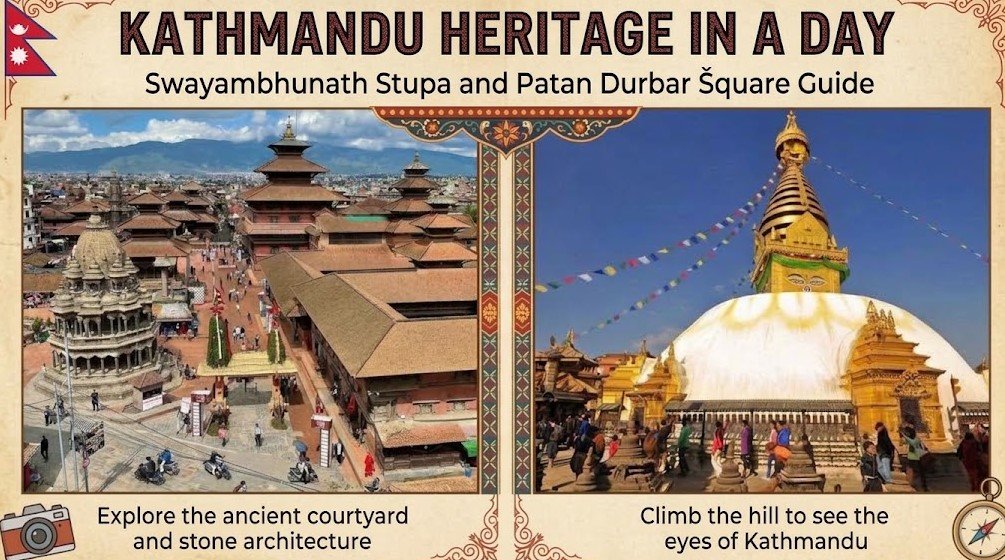
Kathmandu Valley holds 7 UNESCO World Heritage Sites inside a 30 kilometre radius, a concentration of protected monuments that few urban valleys anywhere in the world can match. On Day 2 of the 10 Days Nepal Tour 2026, before Pokhara and Chitwan enter the picture, this itinerary visits two of those seven sites in a single day: Swayambhunath Stupa and Patan Durbar Square. A third site on this trip, Bhaktapur, is covered separately on Day 9, later in the journey.
This guide is written to stand on its own. If you are researching Swayambhunath and Patan Durbar Square for an independent trip, a short stopover, or simply to understand what you would be looking at, everything below applies whether or not you ever book a tour. Where it is useful, this guide also explains how the two sites fit into a structured 10 day Kathmandu, Pokhara, Chitwan itinerary, and how a licensed guide changes what you get out of a single day at both.
Kathmandu Valley’s Seven UNESCO Sites and Why This Day Covers Two of Them
- The seven UNESCO World Heritage Sites in the Kathmandu Valley are Kathmandu Durbar Square, Patan Durbar Square, Bhaktapur Durbar Square, Swayambhunath, Boudhanath, Pashupatinath, and Changu Narayan.
- All seven are grouped under a single UNESCO listing, “Kathmandu Valley,” recognized for the concentration of Newari architecture, religious sites, and urban planning inside one relatively small geographic area.
- The 10 Days Nepal Tour 2026 visits three of these seven: Swayambhunath and Patan Durbar Square on Day 2, and Bhaktapur Durbar Square on Day 9.
- Pairing Swayambhunath with Patan on the same day makes practical sense. Swayambhunath sits on a hill at the western edge of Kathmandu city, and Patan (across the Bagmati River, technically its own municipality of Lalitpur) is a short drive south. Both can be covered comfortably between a morning start and mid afternoon finish.
- Bhaktapur is deliberately handled as its own day later in this itinerary rather than crammed in alongside these two, because Bhaktapur’s old city rewards slower, unhurried walking rather than being squeezed into a half day.
- Each of these sites represents a different piece of the valley’s religious and architectural character: Swayambhunath is the hilltop Buddhist and Hindu shrine complex, Patan is the finest surviving example of Newari palace architecture, and Bhaktapur (covered on Day 9) is the most intact medieval city layout of the three.
Swayambhunath Stupa: History, Origin Story, and Structure
- Swayambhunath is commonly called the Monkey Temple by visitors, a reference to the resident population of rhesus macaques that has lived on the hill for centuries, not an official name.
- The stupa in its current structural form is approximately 2,500 years old, though the hill itself has been a site of continuous religious use since at least the 5th century.
- It sits on a hill at the western edge of Kathmandu city, high enough to be visible from much of the valley floor on a clear day, including from parts of central Kathmandu and Thamel.
- The main stupa is a Buddhist structure in the Vajrayana tradition, one of the oldest and most significant Buddhist monuments in Nepal.
- The hilltop complex is not exclusively Buddhist. It also includes Shiva shrines, temples to Newari deities, and smaller ritual structures that do not belong strictly to either the Hindu or Buddhist tradition.
- This overlap is not an accident or a modern tourist friendly blending of traditions. It reflects how religion has actually worked in the Kathmandu Valley for centuries, where Hindu and Buddhist practice share space, shrines, and sometimes the same festival calendar rather than existing as separate, competing systems.
- Swayambhunath was moderately damaged in the 2015 earthquake. Reconstruction, supported by UNESCO backed restoration efforts, is complete, and the site today is fully open and structurally sound.
The origin story behind the hill explains why this particular site, rather than any other high point around the valley, has held religious significance for so long.
- According to the Newari Buddhist legend recorded in the Swayambhu Purana, the Kathmandu Valley was once a vast lake. A lotus grew from its waters and produced a self created flame of light, from which the name Swayambhu, meaning self arisen or self created, comes.
- The bodhisattva Manjushri is said to have drained the lake by cutting a gorge through the surrounding hills with a sword, allowing the valley floor to emerge and the flame to settle on the hill that now holds the stupa.
- Whether or not visitors take the legend literally, it explains why this particular hill, rather than any other high point around the valley, became the focus of continuous religious use for well over a thousand years.
- Archaeological and textual evidence places religious activity on the hill back to at least the 5th century, with successive kings, guilds, and religious communities adding shrines, renovating the stupa, and expanding the complex over many centuries since.
- Because the site has been rebuilt, gilded, and expanded repeatedly rather than preserved untouched, what stands today is best understood as a living structure that has been in continuous use and continuous renovation for roughly 2,500 years, not a single unchanged relic frozen at one point in history.
What to See at Swayambhunath: The Eyes, the Dome, and the View
Swayambhunath rewards visitors who know what they are looking at before they arrive. A few minutes with this list will make the hilltop far more legible.
- The Buddha eyes: painted on all four faces of the spire base above the main dome, these are the single most reproduced image in Nepali tourism, appearing on postcards, book covers, and posters across the country. Each set of eyes looks outward in one of the four cardinal directions, so that from the summit platform the stupa appears to watch all directions of the valley at once.
- The shape below the eyes: the curling symbol positioned beneath each pair of eyes, often mistaken for a nose or a stylized question mark, is actually the number 1 in Devanagari script, representing the unity of all things and the single path to enlightenment in Buddhist teaching.
- The main dome: the whitewashed hemisphere below the spire represents the world, over which the eyes and spire rise as a symbol of wisdom and enlightenment.
- The prayer wheels: rows of copper prayer wheels line the base of the stupa at a height that lets visitors spin each one while walking clockwise around the structure, the traditional direction for circumambulation at Buddhist sites.
- The surrounding shrines: smaller temples and shrines around the main stupa, including Hindu structures dedicated to Shiva and Newari deity temples, are worth walking past slowly rather than heading straight for the main dome.
- The resident monkeys: the rhesus macaques that give the hill its nickname are genuinely wild animals, not tame photo props. They are most active in the early morning and late afternoon.
- The summit view: on a clear morning, the summit platform offers a full sweep of the Kathmandu Valley below, a bowl of green hills ringed by the white peaks of the Himalaya to the north, with the Langtang range visible on the clearest days.
- The Tibetan influence: a number of monasteries and Tibetan Buddhist institutions sit around the base of the hill, a reminder of Swayambhunath’s importance to the Tibetan Buddhist community in Nepal as well as to Newari Buddhists.
Climbing the 365 Steps and the Best Time to Visit
- The main approach to Swayambhunath from the eastern side involves 365 stone steps, worn smooth in places by centuries of foot traffic.
- At a relaxed walking pace, the climb takes about 15 minutes. Visitors who stop often for photographs, or to watch the monkeys, should allow closer to 20 to 25 minutes.
- The steps are steep in sections and uneven in places, since the stone has not been replaced uniformly over the centuries. Sturdy, closed toe shoes with grip are strongly recommended over sandals.
- Rhesus macaques occupy the steps and the railings along the climb in large numbers. They are generally not aggressive toward people who leave them alone, but a few practical points matter:
- Do not carry food visibly or eat on the steps, since monkeys will approach and sometimes snatch food directly from hands or bags.
- Keep plastic bags out of sight. Monkeys in this population have learned to associate rustling plastic with food.
- Avoid direct eye contact or sudden gestures toward a monkey that approaches closely.
- Secure loose items such as sunglasses, hats, or phones, since macaques will occasionally grab small unattended objects.
- An alternative route exists on the western side of the hill, a gentler road style path that some vehicles and less mobile visitors use, avoiding the steepest sections of the eastern steps.
- Travellers with mobility limitations, knee problems, or those visiting with young children who tire quickly should ask about the western approach rather than defaulting to the steps.
- There is no shade for most of the climb. Midday visits in the dry season can be genuinely hot on the exposed stone steps.
Once the climb itself is out of the way, timing the visit correctly makes the biggest difference to what the site actually looks and feels like.
- The single best window is early morning, before 9am. At this hour, the monkeys are most active, the light comes in low from the east and illuminates the stupa face directly, and the crowds are thinnest.
- Late afternoon, roughly two hours before sunset, is the second best window, with warm light on the western side of the hill and good conditions for wide shots of the valley below.
- Midday visits, while workable, tend to produce flat, harsh light on the white dome and fewer active monkeys, since the animals tend to rest during the hottest hours.
- Photography points to keep in mind:
- The Buddha eyes photograph best from the summit platform looking up at the spire, ideally with the eastern face lit by morning sun.
- Photographing individual worshippers, monks, or people engaged in prayer without asking first is considered intrusive by many Nepali visitors and should be avoided, even where a sign does not explicitly prohibit it.
- Some smaller shrine interiors and specific images inside temple structures restrict photography. Look for posted signage at each shrine entrance, and when in doubt, ask a guide or a monastery attendant.
- The clearest valley and mountain views usually occur in the cooler months, from October through February, before the pre monsoon haze builds up in March and April.
- Sunday mornings and Buddhist festival days bring larger crowds of local worshippers rather than tourists, which can be a rewarding time to observe active religious practice, though it means a slower, more crowded climb.
Swayambhunath Practical Information: Fees, Hours, and Dress Code
- The stupa grounds are technically accessible from early morning until evening, and many Nepali worshippers visit before sunrise, since the site itself has no fixed closing gate in the way a museum does.
- Ticket counters for foreign visitors generally operate through daylight hours, roughly from early morning until early evening. Foreign nationals pay an entrance fee at the base of the steps, while Nepali citizens enter free of charge with identification.
- Entrance fees for foreign visitors to Swayambhunath are modest compared to Patan Durbar Square, reflecting its status as an active religious site rather than a museum complex. Fees are subject to periodic revision by the Kathmandu Metropolitan City authority, so confirming the current rate locally or through a guide is worthwhile.
- Dress code at Swayambhunath:
- Shoulders and knees should be covered for both men and women. Sleeveless tops, very short shorts, and short skirts are best avoided.
- Shoes must be removed before entering the interior of any shrine building, though the outdoor stupa platform itself does not require bare feet.
- Hats should be removed inside enclosed shrine spaces as a sign of respect, though this is less strictly enforced on the open air stupa platform.
- Modest, breathable clothing also makes practical sense given the exposed climb and lack of shade.
- Etiquette points beyond dress:
- Walk clockwise around the stupa and any prayer wheel rows, the traditional direction of circumambulation.
- Spin prayer wheels with the right hand, and spin them so they turn clockwise (from top to bottom on the side facing you).
- Keep voices low near active shrines where people are praying.
- Do not touch statues, painted images, or ritual objects unless specifically invited to do so.
Patan Durbar Square: History of the City of Beauty
- Patan’s ancient name is Lalitpur, meaning City of Beauty, and the modern city retains that name officially, with Patan used as the older, more common name for the historic core and its Durbar Square.
- Patan was a separate kingdom in its own right, ruled by its own branch of the Malla dynasty, until Nepal was unified under the Gorkha conquest in 1768.
- That independent history matters architecturally. Because Patan developed its palace, temples, and public square as the capital of its own kingdom rather than as a secondary town, its Durbar Square received the same royal investment in craftsmanship and stone carving as Kathmandu’s own royal square.
- Patan Durbar Square is widely regarded as the finest example of Newari palace architecture surviving in the Kathmandu Valley today, for three connected reasons:
- It is better preserved than either Kathmandu Durbar Square or Bhaktapur Durbar Square.
- It has undergone less reconstruction, meaning more of what stands today is original fabric rather than rebuilt sections.
- It reads as more architecturally cohesive, since its temples, palace wings, and courtyards were developed as a coordinated whole under sustained Malla patronage rather than in disconnected phases.
- Patan Durbar Square was the least earthquake affected of the valley’s three Durbar Squares in the 2015 earthquake, a fact that is part of why so much of what visitors see today is genuinely old rather than recently rebuilt.
- For comparison, the 2015 earthquake caused significant damage elsewhere in the valley, most notably to the Kasthamandap temple and several other Malla era structures in Kathmandu Durbar Square, along with parts of Bhaktapur. Patan’s relative structural stability during that same earthquake is one of the reasons it stands out today as the most cohesive of the three squares.
What to See in Patan Durbar Square, the Patan Museum, and the Golden Temple
- Krishna Mandir (1637): the single most distinctive temple in the square, built in stone in the shikhara style rather than the tiered pagoda style that dominates elsewhere in the Kathmandu Valley. It is carved floor to ceiling across 21 friezes depicting scenes from the Mahabharata, the Ramayana, and the Bhagavata Purana, a scale and density of narrative stone carving found nowhere else in the valley.
- The old royal palace complex: a series of connected courtyards and wings that once housed the Malla royal family, now partly open to the public and partly converted into the Patan Museum.
- Bhimsen Temple: dedicated to Bhimsen, a figure from the Mahabharata associated with strength and trade, historically popular with Newari merchant communities.
- Taleju Temple: a temple dedicated to Taleju Bhawani, the tutelary goddess of the Malla kings, though the inner sanctum is generally restricted to Hindu worshippers.
- Vishwanath Temple: a pagoda style temple with detailed wood carving, flanked by stone elephant statues at its entrance.
- Stone pillars and statues: including free standing pillars topped with royal figures, a common feature of Malla era Durbar Squares across the valley.
- Public water fountains (hiti): sunken stone water spouts, some centuries old, that historically served as the neighborhood’s water supply and are still functional in parts of Patan today.
- The Golden Temple (Hiranya Varna Mahavihar): a 12th century Buddhist monastery a 10 minute walk north of the main square, discussed in detail below.
The Patan Museum, inside the same Durbar Square grounds, is the single best place in Nepal to understand the religious art visible throughout the square.
- The Patan Museum occupies the restored Degutale wing of the old royal palace complex, inside the Durbar Square grounds.
- It holds bronze castings, stone sculpture, painted manuscripts, and ritual objects spanning roughly the 7th to the 19th centuries, one of the deepest single collections of Newari religious art anywhere in the country.
- What sets the Patan Museum apart from many museums in Nepal is the quality of its English language interpretation. Object labels and gallery text explain the religious and historical context of each piece in genuine depth, rather than offering only a name and a date.
- Highlights typically include:
- A significant collection of bronze statues of Hindu and Buddhist deities, produced using the lost wax casting technique for which Patan’s metalworkers have been known for centuries.
- Stone sculpture recovered from sites across the valley, some predating the current standing temples by hundreds of years.
- Painted manuscripts and ritual objects used in Newari Buddhist and Hindu ceremonies.
- Restored palace rooms, including sections of the Degutale wing itself, giving a sense of how the space functioned as a royal residence.
- Allow 45 minutes to an hour and a half inside the museum for a thorough visit, longer for visitors with a specific interest in Himalayan art or Newari metalwork.
- The museum has a small courtyard cafe, a useful stop for a break partway through a day that also includes Swayambhunath.
A short walk beyond the square itself, the Golden Temple and Patan’s surrounding old city extend the same architectural and religious tradition into a living neighbourhood.
- The Golden Temple, formally Hiranya Varna Mahavihar, is a 12th century Buddhist monastery roughly a 10 minute walk north of the main Durbar Square.
- It remains an active place of worship rather than a preserved relic. Monks based at the monastery perform twice daily rituals, and visitors are welcome to observe from the courtyard without disrupting the ceremony.
- The building itself is named for its extensive gilded metalwork, covering much of the courtyard facade, roof structures, and interior shrine.
- Beyond the Golden Temple, Patan’s old city extends outward from Durbar Square in narrow lanes lined with courtyards (called bahal in Newari), smaller shrines, traditional metalworking and woodcarving workshops, and residential buildings several centuries old.
- Patan has long been associated with fine metalworking and craft production, and visitors who walk even a few streets beyond the main square will pass working workshops producing bronze statues, jewelry, and religious objects using techniques passed down through generations of Newari artisan families.
- Unlike Swayambhunath, which sits somewhat apart from the modern city on its own hill, Patan Durbar Square sits directly inside a living, functioning old city, with shops, homes, and daily life continuing around the monuments.
Patan Durbar Square Practical Information: Fees, Hours, and Dress Code
- Patan Durbar Square operates on a paid ticket system for foreign visitors, with the ticket covering entry to the square itself and to the Patan Museum inside the palace complex.
- Entrance fees for foreign nationals at Patan are noticeably higher than at Swayambhunath, reflecting the scale of the palace complex and the inclusion of museum access in the same ticket. SAARC nationals typically pay a reduced rate, and Nepali citizens enter free with identification.
- As with all entrance fees in Nepal, rates are periodically revised by the local authority. Confirming the current price with a guide, at the ticket counter, or through the museum’s own information point on the day is the most reliable approach.
- The square itself, as an open public space, is accessible from early morning, though the ticket booth and the Patan Museum operate on a fixed schedule, generally opening around mid morning and closing in the late afternoon.
- The Patan Museum in particular keeps stricter hours than the open square, so visitors who want to see the museum collection should plan their arrival with the museum’s opening and closing times in mind rather than assuming all day access.
- Dress code at Patan Durbar Square and the Golden Temple:
- Shoulders and knees covered, as at Swayambhunath, applies to the temples and shrine interiors within the square.
- Footwear must be removed before entering the Golden Temple courtyard and before entering most temple interiors.
- Modest clothing is expected inside the Patan Museum as a general courtesy, though the museum itself is not a strict religious site in the way the temples are.
- General etiquette:
- Ask before photographing monks performing rituals at the Golden Temple, and keep a respectful distance during the ceremony rather than crowding the courtyard.
- Some temple interiors in the square, particularly the Taleju Temple’s inner sanctum, restrict entry to Hindu worshippers. A guide can point out which structures are open to all visitors and which are not.
- Bargaining is common in shops surrounding the square, but is not appropriate inside the museum or temple grounds themselves.
Quick Reference: Swayambhunath and Patan Durbar Square Side by Side
| Feature | Swayambhunath Stupa | Patan Durbar Square |
|---|---|---|
| Location relative to central Kathmandu | Western edge of Kathmandu city, on a hill | South of the Bagmati River, in Lalitpur (Patan) |
| Primary religious tradition | Buddhist (Vajrayana), with Hindu and Newari shrines sharing the site | Hindu Malla royal architecture, with Buddhist sites including the Golden Temple nearby |
| Approximate age | About 2,500 years in current form, in use since at least the 5th century | Krishna Mandir built in 1637, palace complex older |
| 2015 earthquake impact | Moderately damaged, fully restored | Least affected of the valley’s three Durbar Squares |
| Time needed for a solid visit | 1 to 1.5 hours including the climb | 2 to 3 hours including the museum |
| Best time of day | Early morning, before 9am | Mid morning to early afternoon, when the museum is open |
| Main physical challenge | 365 stone steps, steep and uneven in places | Flat, easy walking throughout |
Newari Architecture and a Side by Side Comparison of Both Sites
- Both sites are built almost entirely within the Newari architectural tradition, developed over centuries by the Newar people, the historic inhabitants of the Kathmandu Valley, and understanding a few basic elements makes both visits far more rewarding.
- Tiered pagoda roofs: the multi tiered, curved roof style seen across most of Patan Durbar Square (though not on the stone Krishna Mandir) originated in the Kathmandu Valley and later influenced pagoda architecture as far away as China and Japan, spread through trade and diplomatic contact centuries ago.
- Carved wooden struts: the diagonal wooden supports holding up each tiered roof are almost always carved, typically with deities, mythological scenes, or, on some older and less publicly discussed struts, erotic imagery believed by some scholars to ward off misfortune or lightning.
- Brick and timber construction: most Newari temples and palace buildings combine fired brick walls with timber framing, carved wooden windows, and wooden doorways, a building method suited to the valley’s clay rich soil and its historic timber supply from surrounding hills.
- Stone shikhara style: the Krishna Mandir stands out precisely because it breaks from this brick and timber norm, using a solid stone shikhara design imported from Indian temple architecture rather than the tiered wooden pagoda style used almost everywhere else in the square.
- Courtyard planning (bahal): residential and monastic buildings in both Patan and around Swayambhunath are frequently organized around enclosed courtyards, a layout that provided security, communal space, and often a small shrine at the courtyard’s center.
- Gilded metalwork: copper and gilt copper repousse work, seen on the Golden Temple’s facade and roof structures and on decorative elements throughout both sites, reflects Patan’s long standing reputation as a center of fine metalworking within the valley.
- Recognizing these elements while walking through either site turns a sequence of temples into a readable architectural language, and it is exactly the kind of detail a licensed guide will point out in real time rather than leaving guests to notice on their own.
Getting Between the Two Sites Independently
- Travellers visiting without a guide or private vehicle have several practical options for covering both sites in one day.
- Taxi: the most straightforward option for independent travellers. Agreeing a fare before departure, rather than assuming a working meter, avoids disputes. A one way taxi ride between Thamel and Swayambhunath, or between Swayambhunath and Patan, typically takes 15 to 30 minutes depending on Kathmandu’s traffic.
- Ride hailing apps: apps used in Kathmandu allow booking a car or motorbike ride at a fixed, upfront price, which removes the negotiation step and is often the simplest option for visitors unfamiliar with local fare norms.
- Local bus and tempo: cheaper but considerably slower and less comfortable, requiring some familiarity with unmarked routes and stops. Generally not recommended for visitors on a tight one day schedule.
- Walking: Swayambhunath is walkable from parts of Kathmandu, including Thamel, in around 30 to 45 minutes, though the route crosses busy roads without consistent pavements in places. Patan is too far from central Kathmandu for a practical walk and requires vehicle transport.
- Traffic and timing: Kathmandu’s traffic is heaviest in the morning and evening commuting windows. Since the recommended visiting time for Swayambhunath is also early morning, an early start also means lighter traffic for getting there.
- Combining the two sites in one day independently generally means: an early taxi or ride hailing trip to Swayambhunath, one to one and a half hours at the stupa, a taxi across town to Patan (allowing extra time for midday traffic), then two to three hours in Patan Durbar Square and the museum before the ticket counter or museum closes for the day.
- This is exactly the kind of day where a private vehicle and driver removes the largest source of friction: negotiating fares twice, navigating unfamiliar traffic patterns, and timing arrival around museum hours. It is also why this pairing appears as a single organized day on the 10 Days Nepal Tour 2026.
How This Day Fits Into the 10 Days Nepal Tour 2026 Itinerary
- This heritage day is Day 2 of the company’s 10 Days Nepal Tour 2026, a 10 day, 9 night itinerary covering Kathmandu, Pokhara, and Chitwan.
- The trip is built as a cultural and wildlife tour, not a trekking itinerary and not a helicopter tour. It is rated easy difficulty, with a maximum altitude across the entire 10 days of only 1,592 metres, reached at Sarangkot near Pokhara, making it suitable for a wide range of ages and fitness levels.
- Day 1 covers arrival in Kathmandu, an orientation walk through Thamel, and a welcome dinner, setting up Day 2 as the first full day of sightseeing.
- On Day 2, guests travel by private vehicle with a private, English speaking, Nepal Tourism Board licensed guide who provides a briefing on each site before entry, covering the history, symbolism, and layout of Swayambhunath and Patan Durbar Square before guests explore.
- Having a licensed guide on this specific day matters more than it might on a simpler sightseeing stop, for a few concrete reasons:
- Swayambhunath’s shared Hindu and Buddhist symbolism, and the meaning behind features like the Buddha eyes and the Devanagari number below them, are easy to miss or misinterpret without explanation.
- Patan Durbar Square’s temples are not uniformly open to all visitors, and knowing which structures can be entered and which are restricted saves time and avoids accidental disrespect.
- The Patan Museum’s collection benefits enormously from context. A guide can point toward specific bronzes or manuscripts of particular historical interest rather than leaving guests to work through the entire building unguided.
- A private vehicle removes the fare negotiation and traffic navigation issues that complicate an independent version of this same day.
- Later in the same trip, Day 9 covers Bhaktapur Durbar Square, the third of the valley’s UNESCO sites on this itinerary, giving guests a point of comparison against what they saw on Day 2 at Patan.
- Between these Kathmandu Valley days, the itinerary moves to Pokhara for lake and mountain views and to Chitwan for wildlife viewing in Nepal’s lowland national park, rounding out a trip that balances heritage sightseeing, scenery, and wildlife across 10 days.
Practical Tips and Common Mistakes to Avoid
- Wear closed shoes with grip. The Swayambhunath steps and Patan’s stone courtyards are both easier and safer in proper footwear than in sandals.
- Carry a light scarf or shawl. It covers shoulders quickly when moving between an outdoor square and a temple interior without needing a full change of clothes.
- Bring cash in small denominations. Entrance fees, the Patan Museum ticket, small shrine donations, and tips for anyone assisting at either site are usually handled in cash rather than by card.
- Carry water, particularly for the Swayambhunath climb, since there is limited shade on the steps and no reliable vendor at every point along the way.
- Start early. An early morning start at Swayambhunath sets up the rest of the day: better light, fewer crowds, cooler temperatures for the climb, and enough time afterward to reach Patan before museum closing hours.
- Check the calendar for festival dates before travelling. Both sites, and the Kathmandu Valley generally, host religious festivals throughout the year that can mean larger crowds, closed sections, or, for the right traveller, a genuinely rewarding chance to see living tradition rather than an empty monument. The Main Festivals of Nepal guide covers the major dates worth knowing before you plan a Nepal trip around this time of year.
- Keep small change or notes ready for the many photogenic moments involving Sadhus, musicians, or vendors around Durbar Square who may expect a small payment if you photograph them directly.
- If travelling independently rather than with a guide, download an offline map of both sites beforehand, since mobile data coverage inside the older parts of Patan can be inconsistent.
Even well planned visits to these two sites tend to run into the same handful of avoidable mistakes.
- Rushing Swayambhunath in under 30 minutes. The climb alone takes about 15 minutes, and treating the summit as a photo stop rather than allowing time to walk the full stupa base and surrounding shrines misses most of what makes the site worthwhile.
- Visiting Patan Durbar Square without allowing time for the museum. Many visitors treat the museum as optional and end up skipping the single best collection of Newari religious art in the country because they ran out of time in the square itself.
- Assuming Swayambhunath is purely a Buddhist site and ignoring the Hindu and Newari shrines around it, missing the actual religious character of the hill.
- Wearing shorts or sleeveless tops without a backup layer, then being turned away from a specific shrine interior or feeling underdressed for the rest of the day.
- Not agreeing a taxi fare in advance when travelling independently, leading to a disputed price at the end of the ride.
- Feeding the monkeys at Swayambhunath, which encourages aggressive behaviour toward the next visitor who is simply trying to walk past with a snack in a bag.
- Trying to combine Swayambhunath, Patan, and Kathmandu Durbar Square all in the same day. Three major sites in one day usually means rushing all three rather than properly seeing two, which is part of why this itinerary spreads its three Kathmandu Valley UNESCO sites across two separate days.
Frequently Asked Questions
How many UNESCO World Heritage Sites are in the Kathmandu Valley, and how many does this tour visit?
The Kathmandu Valley contains 7 UNESCO World Heritage Sites within a 30 kilometre radius: Kathmandu Durbar Square, Patan Durbar Square, Bhaktapur Durbar Square, Swayambhunath, Boudhanath, Pashupatinath, and Changu Narayan. The 10 Days Nepal Tour 2026 visits three of them across the trip: Swayambhunath and Patan Durbar Square on Day 2, and Bhaktapur Durbar Square later on Day 9.
Is Swayambhunath a Hindu site or a Buddhist site?
The main stupa at Swayambhunath is a Buddhist structure belonging to the Vajrayana tradition. The wider hilltop complex, however, also includes Hindu shrines dedicated to Shiva, temples to Newari deities, and other ritual structures that do not belong exclusively to either tradition. This overlap reflects how Hindu and Buddhist practice have coexisted and shared sacred space in the Kathmandu Valley for centuries, rather than existing as two separate, competing religious systems.
How difficult is the climb up Swayambhunath’s steps?
The main eastern approach involves 365 stone steps, taking about 15 minutes to climb at a relaxed pace. The steps are steep and uneven in sections, and there is little shade along the way, so it is a moderate physical effort rather than a difficult one. Visitors with mobility limitations, or who prefer to avoid stairs entirely, can use the gentler western approach road instead, which some vehicles also use.
What are the entrance fees for Swayambhunath and Patan Durbar Square?
Foreign visitors pay an entrance fee at both sites, with Swayambhunath’s fee considerably lower than Patan Durbar Square’s, since the Patan ticket also covers entry to the Patan Museum inside the old palace complex. SAARC nationals typically pay a reduced rate at both, and Nepali citizens enter free with identification. Because entrance fees in Nepal are periodically revised, confirming the current rate at the ticket counter, with a guide, or on the day of your visit is the most reliable approach.
What should I wear to visit these sites?
At both Swayambhunath and Patan Durbar Square, cover shoulders and knees, avoid sleeveless tops and very short shorts or skirts, and be ready to remove your shoes before entering temple interiors and the Golden Temple courtyard in Patan. Closed shoes with good grip are recommended for the Swayambhunath climb, and a light scarf or shawl is a useful, easily packed way to cover up quickly when moving between an open square and a temple interior.
Can I take photographs inside the temples and shrines?
Photography is generally allowed in the open areas of both Swayambhunath and Patan Durbar Square, including the main stupa platform and the square itself. Some individual shrine interiors and specific religious images restrict photography, usually indicated with posted signage, and it is worth asking a guide or attendant when signage is unclear. At the Golden Temple, ask before photographing monks during their twice daily rituals, and keep a respectful distance during the ceremony itself.
How much time should I set aside to visit both sites in one day?
A solid visit to Swayambhunath, including the climb, walking the stupa base, and taking in the summit view, takes about 1 to 1.5 hours. Patan Durbar Square, including a proper visit to the Patan Museum and a short walk to the Golden Temple, generally takes 2 to 3 hours. Add travel time between the two sites, which runs from 15 to 30 minutes each way depending on Kathmandu traffic, and a full but comfortable day covering both sites runs from roughly a mid morning start to a mid to late afternoon finish.
Is Patan Durbar Square worth visiting if I will also see Kathmandu Durbar Square and Bhaktapur Durbar Square?
Yes. Patan Durbar Square is widely regarded as the finest example of Newari palace architecture in the Kathmandu Valley, better preserved and more architecturally cohesive than either the Kathmandu or Bhaktapur squares, and it was also the least earthquake affected of the three in 2015. Each square has a distinct character: Patan for its stone carved Krishna Mandir and museum quality collection, Kathmandu for its central royal palace history, and Bhaktapur for its intact medieval city layout. Seeing more than one gives a genuine sense of how each Malla kingdom expressed the same architectural tradition differently.
When is the best time of year to visit, considering festivals?
Both sites host religious festivals and events throughout the year, and visiting around a major festival date can mean a genuinely memorable look at active religious practice, though also larger crowds and, occasionally, restricted access to certain areas during ceremonies. The dry months from October through February generally offer the clearest weather and mountain views from Swayambhunath’s summit. For a full list of major festival dates worth planning around, see the Main Festivals of Nepal guide.
Do I need a guide, or can I visit both sites independently?
Both sites are fully accessible to independent visitors, with English signage at major points and ticket counters that operate for foreign visitors daily. That said, a licensed guide adds real value at both locations, particularly at Swayambhunath, where the symbolism behind features like the Buddha eyes is easy to miss, and at the Patan Museum, where context transforms a room of bronzes and manuscripts into a genuinely informative visit. On the 10 Days Nepal Tour 2026, this day includes a private, English speaking, Nepal Tourism Board licensed guide who briefs on each site before entry.
Plan Your Kathmandu Heritage Day With Next Trip Nepal
- Swayambhunath and Patan Durbar Square, covered together in a single day, give a genuine introduction to how Buddhist and Hindu tradition, and Newari architecture at its finest, come together in the Kathmandu Valley, without requiring a full extra day set aside just for Kathmandu sightseeing.
- This pairing works as Day 2 of the 10 Days Nepal Tour 2026 precisely because it is manageable, well paced, and set up with a private vehicle and a licensed guide who handles the logistics and the context, leaving guests free to actually look at what is in front of them rather than managing directions, tickets, and fare negotiations.
- The wider 10 day, 9 night itinerary continues from this heritage day into Pokhara’s lakes and mountain views, Chitwan’s wildlife viewing, and, later in the trip, a comparison point at Bhaktapur Durbar Square on Day 9, rounding out all three of the valley’s UNESCO sites visited on this trip.
- Rated easy difficulty, with a maximum altitude across the whole 10 days of only 1,592 metres at Sarangkot, this itinerary is built for travellers who want genuine cultural depth and Himalayan scenery without trekking, and it suits a wide range of ages and fitness levels.
- To see the full day by day breakdown, including where Day 2 fits alongside Kathmandu orientation, Pokhara, and Chitwan, visit the full 10 Days Nepal Tour 2026 itinerary page.
- To ask questions about dates, private departures, or customizing this itinerary, reach the Next Trip Nepal team directly by WhatsApp at +977 9869225929 or by email at nexttripnepal@gmail.com. Both channels reach a real person who can confirm availability and answer specific questions about this Kathmandu heritage day or any other part of the trip.