Every trekker booking the Everest Base Camp Trek with Helicopter Return eventually faces the same decision point, usually somewhere between reading the itinerary and actually paying a deposit. Do you take the shared helicopter option that comes standard with most group packages, or do you pay extra for a private flight? The question sounds simple, but the actual answer depends on details that most trip pages never explain clearly. This guide walks through exactly how each option works, what it costs, and who should choose which.
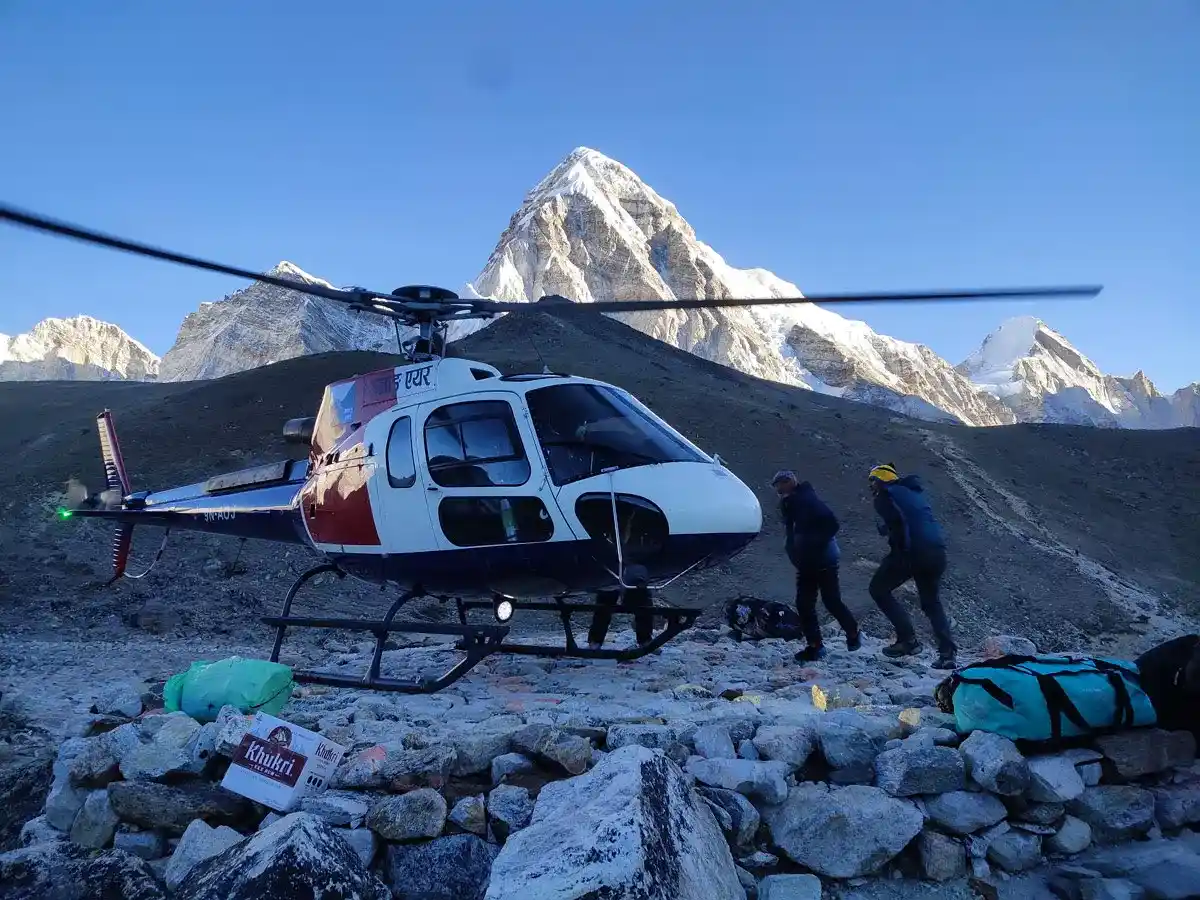
A shared helicopter return means you are one of several passengers filling the available seats on a single flight, typically a five or six seat aircraft such as an AS350 Écureuil or similar model commonly used in the Khumbu. The flight is coordinated by your trekking company based on who else is departing from the same general area on a similar day.
- How the group is formed: Your trekking company coordinates with other trekkers, sometimes from other companies entirely, who are also finishing their trek around the same time and flying from a similar location, usually Gorakshep, Pheriche, or Syangboche depending on the specific itinerary.
- Seat allocation: You are guaranteed a seat if you have booked the shared option, but you do not control who else is on the flight or the exact departure time within the scheduled window.
- Luggage limits: Shared flights typically enforce a stricter weight limit per passenger, often around 5 kg of cabin baggage per person, since the aircraft is carrying multiple passengers and their gear simultaneously.
- Timing flexibility: You depart when the group is ready and weather allows, which means less control over your exact schedule but also a lower cost per person.
What Private Helicopter Actually Means
A private helicopter charter means the entire aircraft is booked exclusively for you and whoever is traveling with you, whether that is a solo flight, a couple, or a small group of friends or family trekking together.
- Full control over timing: Within the constraints of weather and daylight, a private charter departs when you want it to, not when a group has been assembled.
- Flexible landing and routing: Some private charters allow requests such as a scenic detour, an extra photo stop, or landing at a specific location rather than the standard pickup point.
- Higher luggage allowance: Since the aircraft is not splitting capacity across strangers, you often have more flexibility with luggage weight, though this still depends on altitude, fuel load, and total passenger weight.
- Privacy: No strangers on your flight, which matters to some trekkers more than others, particularly those celebrating a specific occasion or traveling with family.
Cost Comparison
Pricing varies by company, season, and exact route, but the table below reflects typical ranges you should expect to see when comparing quotes.
| Option | Typical Cost Per Person | Total Aircraft Cost | Passengers |
|---|---|---|---|
| Shared helicopter (add on to trek package) | USD 500 to 700 | Split among 4 to 5 passengers | 4 to 5 |
| Private charter, small group | USD 700 to 1,200 per person | USD 2,800 to 4,000 total | 2 to 4 |
| Private charter, solo | USD 2,500 to 3,500 | Full aircraft cost borne by one traveler | 1 |
These figures are approximate and change with fuel prices, exchange rates, and the specific operator. Always request a written, itemized quote rather than relying on a general estimate.
A Detailed Look at What Drives the Price Difference
- Aircraft cost is fixed regardless of passengers. A helicopter flight from the Khumbu to Kathmandu or Lukla costs roughly the same to operate whether it carries one passenger or five. Sharing simply divides that fixed cost among more people.
- Positioning flights. If a private charter requires the helicopter to fly empty to reach you, rather than picking you up as part of an existing route, that positioning cost is usually passed on to you.
- Altitude and weight restrictions. Helicopters operating at high altitude have reduced lift capacity, meaning fewer passengers or less fuel can be carried per flight. This is a real physical limitation, not a pricing trick, and it is why private altitude flights sometimes cost more than the simple per seat math would suggest.
- Weather contingency built into pricing. Reputable operators build some buffer into private charter pricing to account for potential weather delays, since a private aircraft sitting idle for a day still costs money.
- Solo trekkers or pairs who are comfortable with a flexible but coordinated departure time
- Budget conscious travelers for whom the difference between 600 dollars and 1,500 dollars matters
- Trekkers who are not attached to an exact return time and can accept a departure window rather than a fixed hour
- Anyone who does not mind sharing the experience with a few strangers also finishing their trek
Who Should Choose Private
- Couples celebrating an anniversary, honeymoon, or proposal who want the flight itself to be part of the experience
- Families traveling together who want to stay as one unit rather than being split across available shared seats
- Trekkers with a tight onward travel connection, such as an international flight the same day, who cannot risk being bumped to a later shared flight if the group configuration changes
- Anyone with mobility considerations, a medical condition, or a support animal that makes a private, controlled environment preferable
- Photographers or content creators who want control over route, timing, and the ability to request specific viewing angles during the flight
How Booking Actually Works for Each Option
- You typically confirm the shared helicopter option at the same time you book your overall trek package, sometimes as a simple add on fee to the standard trek cost.
- Your trekking company monitors group formation in the days leading up to your descent window and confirms your exact flight date once enough passengers are matched, usually a day or two in advance.
- On the morning of the flight, you and any other passengers gather at the designated landing point, typically Gorakshep or a nearby helipad, and wait for the aircraft.
- Boarding order and seating within the aircraft is managed by the flight crew, not by you, though window seats are sometimes offered on request if available.
Booking a Private Charter
- Private charters usually need to be requested and confirmed before you depart from Kathmandu, since availability during peak season fills quickly.
- You agree on a specific date, pickup location, and often a rough time window with your operator in advance.
- Payment is typically required in full or with a substantial deposit before the flight, since the operator is committing an entire aircraft to your booking.
- On the day itself, you have more flexibility to adjust your exact departure time within the weather window, and boarding is limited to your own group.
Weather and Cancellation: Does the Choice Matter
Weather is the single biggest variable in either scenario, and it is worth being honest about what changes and what does not between shared and private options.
| Factor | Shared Helicopter | Private Helicopter |
|---|---|---|
| Weather delay risk | Same underlying risk, since weather does not care about booking type | Same underlying risk |
| Rebooking flexibility if delayed | Depends on when the next group forms, potentially less predictable | Often easier to reschedule since you control the full aircraft |
| Refund policies | Usually bundled into overall trek terms | Often has its own separate contract and refund terms, worth reading carefully |
| Backup plan if flight cancelled entirely | Usually reverts to walking down or waiting for the next available seat | Same reversion, though rebooking a new private slot may be faster once weather clears |
Questions to Ask Before You Book Either Option
- What is the exact luggage weight allowance, and what happens if I am over it on the day?
- What happens to my payment if the flight is cancelled due to weather and cannot be rescheduled within my remaining trip dates?
- Is the helicopter model and operator licensed for high altitude operations in Nepal specifically, not just general commercial flying?
- For shared flights, how many passengers is the flight typically split between, and is there a guarantee I will not be bumped if the group configuration changes?
- For private flights, is the quoted price the full and final cost, or are there additional landing fees, fuel surcharges, or positioning charges that could be added later?
A Note on Safety
Safety standards for the aircraft itself, the pilot’s certification, and weather protocols should be identical whether you fly shared or private, assuming you are booking through a reputable operator. Choosing private does not buy you a safer flight, it buys you control, privacy, and flexibility. Do not let a company suggest otherwise as a sales tactic. If a shared flight feels unsafe to you for a reason unrelated to weight and balance, that is a red flag about the operator generally, not a reason to assume private is inherently safer.
How to Decide: A Simple Framework
- Start with your budget. If the difference between shared and private genuinely changes whether you can afford the trip, shared is the practical choice and there is nothing wrong with it.
- Consider your onward schedule. If you have an international flight the same day as your return, or very little buffer built into your itinerary, the flexibility of a private charter reduces your risk meaningfully.
- Think about who you are traveling with. A private charter keeps your group together and adds a personal touch for special occasions.
- Ask what matters emotionally. Some trekkers specifically want the shared experience, meeting other trekkers on their final flight and swapping stories from the trail. Others want a quiet, private close to their trip. Neither preference is wrong.
What Most Trekkers Actually Choose
Based on typical booking patterns among trekking companies operating this itinerary, most solo travelers and budget conscious groups choose the shared option, while couples on honeymoon trips, families, and trekkers with tight onward travel plans lean toward private charters. Neither choice is more common enough to call it a clear industry standard, and reputable companies will offer both without pushing you toward the more expensive option.
Frequently Asked Questions
In most cases yes, as long as you request the change with enough notice before your descent window and private capacity is available on your preferred date. Contact your trekking company directly rather than assuming this is automatic.
Does a private charter guarantee I will not be delayed by weather?
No. Weather affects all helicopter operations in the Khumbu equally. A private charter gives you more control over rescheduling once weather clears, but it cannot override weather itself.
No. Both are subject to the same aircraft maintenance standards, pilot licensing, and weather protocols when booked through a reputable operator. The difference is about control and privacy, not safety.
How far in advance should I book a private charter?
Ideally at the time you book your overall trek, especially during peak season in spring and autumn when private aircraft availability is limited.
What happens to unused private charter capacity if my travel companion cancels?
This depends entirely on your contract with the operator. Clarify cancellation and partial refund terms before paying a deposit, since policies vary significantly between companies.
Can I bring souvenirs or extra gear bought in Kathmandu back on the helicopter?
Only within your confirmed weight allowance. Both shared and private flights enforce strict weight limits due to altitude performance restrictions, and excess weight is either charged extra or left behind for a later transfer by road, if that option exists.
Aircraft Types Commonly Used on This Route
Understanding what kind of helicopter you might actually fly on helps set realistic expectations for both shared and private options.
| Aircraft | Typical Seating | Common Use |
|---|---|---|
| Airbus AS350 (Écureuil / Squirrel) | 5 passenger seats plus pilot | Most common aircraft for shared and private tourist flights in the Khumbu |
| Airbus H125 | 5 passenger seats plus pilot | Modern variant increasingly used for high altitude operations |
| Bell 407 | 6 passenger seats plus pilot | Used by some operators, particularly for slightly larger group charters |
All of these aircraft are certified for high altitude operations, and reputable Nepali operators maintain them to strict standards given the demanding conditions of Himalayan flying. The specific aircraft you get is usually determined by availability on the day, not by whether you booked shared or private, though private charters sometimes have more say in requesting a preferred model.
What to Pack Specifically for the Flight Day
- A small daypack that fits your weight allowance. Do not plan to bring your full duffel bag on board. Your main luggage typically travels separately by road or on a later cargo flight if you are on the shared option, so pack a small bag with essentials for the flight and your first day back in Kathmandu.
- Layers for a temperature swing. You board in near freezing conditions at altitude and land forty minutes later in the relative warmth of Kathmandu. A layer you can remove quickly makes the transition more comfortable.
- Your camera or phone, charged and accessible. The views during this flight are genuinely spectacular, and you do not want to be digging through a bag to find your phone as you pass Ama Dablam or the Khumbu Icefall.
- Any medication you need on hand. Do not pack essential medication in checked luggage that may travel separately from you.
- Motion sickness precautions if needed. Helicopter flight involves more vibration and sudden movement than a fixed wing flight. If you are prone to motion sickness, take your usual precaution before boarding, not after you feel unwell.
Tipping the Helicopter Crew
This is a detail many trekkers do not think about until they are already on the ground wondering what is appropriate. Tipping a helicopter pilot is not universally expected the way tipping a trekking guide is, but it is appreciated, particularly on private charters where you have had direct, personalized service. A modest tip of USD 20 to 50 per flight, split if there is a copilot or ground crew member who assisted with your baggage, is a reasonable guideline. This is entirely optional and should never feel obligatory.
How This Differs From the Everest Helicopter Day Tour
It is worth being clear about a common point of confusion. The helicopter return discussed in this guide is the second leg of a trek you complete on foot, walking in over multiple days and flying out once. This is different from the standalone Everest Base Camp Helicopter Tour, a single day product where you fly in and out the same day without trekking at all. If you are choosing between shared and private for that different product, the same general logic about cost, control, and group formation applies, but the itinerary, pricing, and experience are otherwise distinct products entirely.
Trekkers who have flown shared consistently describe a similar experience. You typically meet your fellow passengers only shortly before boarding, sometimes from an entirely different trekking company than your own. Conversation is common but not guaranteed, since everyone is usually tired, cold, and focused on the flight itself. Seating is assigned by the flight crew based on total weight distribution for balance, not by preference, so do not expect to choose your seat freely even if you ask. Most trekkers describe the shared flight as efficient and functional rather than an inconvenience, with the shared excitement of finishing the trek often creating a friendly, if brief, camaraderie among strangers.
Environmental and Practical Considerations
- Fuel and emissions. A shared flight distributes the environmental impact of the aircraft across more passengers per flight, which is a genuine consideration for travelers weighing the tradeoffs of flying versus a slower walk down.
- Noise impact on local communities. Helicopter traffic in the Khumbu has increased over recent years, and some conversation exists locally about managing flight frequency. Choosing a shared flight when your schedule allows it reduces the total number of flights needed compared to everyone booking individual private charters.
- Local economic impact. Helicopter operations employ local pilots, ground crew, and support staff, and both shared and private bookings contribute to this local economy, so neither option is inherently better or worse in this respect.
Real World Scenario Comparisons
Scenario One: A Solo Trekker on a Budget
A solo trekker with a fixed budget and no urgent onward travel plans books the shared helicopter option bundled into their standard trek package. They accept a departure window rather than a fixed time, save several hundred dollars compared to a private charter, and end up sharing the flight with two other trekkers from a different company finishing a similar itinerary that day.
Scenario Two: A Couple Celebrating an Anniversary
A couple wants their trek to end with a memorable, private experience and books a private charter in advance. They request a slightly later departure time to allow an extra hour at Gorakshep to enjoy the morning light, something that would not have been possible on a shared flight bound to a group schedule.
Scenario Three: A Family With a Tight International Flight
A family of four has an international flight out of Kathmandu the same evening their trek concludes. They book a private charter specifically to avoid the risk of being delayed by shared group coordination, prioritizing schedule certainty over cost savings.
How to Get an Accurate Quote
Because pricing varies so much by operator and season, use this checklist when requesting quotes from trekking companies to make sure you are comparing like for like.
- Ask whether the quoted price is per person or for the total aircraft.
- Confirm whether the price includes the return leg only, or also positioning flights to reach your pickup location.
- Ask what currency the quote is in and whether it is subject to change based on exchange rate fluctuations closer to your travel date.
- Request confirmation of the exact luggage allowance included in the quoted price.
- Ask what the cancellation and rescheduling policy is if weather prevents the flight on your originally scheduled day.
Understanding Weight and Balance in High Altitude Helicopter Operations
One reason helicopter pricing and passenger limits look so different from what you might expect at sea level comes down to basic physics. At altitude, air is thinner, which means a helicopter’s rotor blades generate less lift for the same amount of power compared to sea level operation. This is the same underlying principle that makes it harder for you to breathe at altitude, and it applies just as directly to aircraft performance.
- Reduced payload capacity at altitude. A helicopter that could comfortably carry six passengers at sea level might be limited to four or five at 5,000 meters, purely due to reduced air density affecting lift.
- Fuel load tradeoffs. Pilots must balance fuel carried against passenger weight, since less fuel means a shorter range but allows for more passenger or cargo weight, and vice versa.
- Why weight limits are enforced strictly, not loosely. Unlike an airline where an overweight bag might mean an extra fee, exceeding weight limits on a high altitude helicopter operation is a genuine safety issue, not a revenue opportunity, which is why operators are typically firm about enforcing them.
- Temperature effects. Warmer air is less dense than cold air, meaning helicopter performance can actually be worse on a warm, clear afternoon than on a cold morning, which is part of why many flights are scheduled early in the day.
Your travel insurance policy should cover scheduled helicopter transport as part of a booked itinerary, but this is worth confirming explicitly rather than assuming, since not all policies treat helicopter travel identically to standard emergency evacuation coverage.
- Scheduled flights versus emergency evacuation. The helicopter return discussed in this guide is a scheduled, planned flight, not an emergency evacuation. Some insurance policies distinguish between the two, covering emergency evacuation automatically while treating a planned helicopter transfer as a standard part of your trip that simply needs general travel coverage.
- Private charter cancellation coverage. If you have paid a significant deposit for a private charter and it is cancelled due to weather with no ability to reschedule within your trip, check whether your travel insurance includes trip interruption coverage that could reimburse this cost.
- Confirm with your insurer directly. Rather than assuming coverage based on a general policy summary, contact your insurer before departure and ask specifically whether scheduled helicopter transport within Nepal, at the altitudes involved in this itinerary, is covered under your specific plan.
What Happens if Someone in a Private Group Needs to Change Plans
Private charters are booked as a package, and changes to the passenger list after booking can be more complicated than they sound.
- If a passenger cancels entirely, the remaining group members are usually still liable for the full charter cost, since the aircraft was reserved based on the original headcount and weight estimate, not a per seat basis that can simply be reduced.
- If a passenger needs to descend earlier than the group, for example due to illness, this typically requires a separate arrangement, either an earlier private flight for that individual or a walk down with a guide, since altering an already scheduled charter mid trip is logistically difficult.
- If the group wants to add a passenger, this is usually possible with advance notice, subject to the aircraft’s total weight capacity, but should be arranged well before the flight date rather than requested last minute.
A Brief History of Helicopter Access in the Khumbu
Helicopter tourism in the Everest region has grown substantially over the past two decades, evolving from a service used almost exclusively for emergency evacuation into a mainstream part of the trekking industry. Early helicopter operations in the area were limited to rescue missions, given the cost and technical difficulty of high altitude flying. As aircraft technology improved and more operators established a presence in Lukla and Kathmandu, scheduled tourist flights became commercially viable, first as sightseeing tours and later as a genuine alternative return option for trekkers. Today, helicopter return has become common enough that most established trekking companies offer it as a standard add on, a shift that has changed how many travelers plan their Everest itinerary, particularly those with limited vacation time.
| Factor | Shared Helicopter | Private Helicopter |
|---|---|---|
| Typical wait time at pickup point | 1 to 3 hours, depending on group coordination | Usually shorter, since only your own group’s readiness matters |
| Flexibility to delay departure by a few hours | Limited, tied to group schedule | High, within weather and daylight constraints |
| Ability to request a specific route or extra viewing time | Rarely available | Often negotiable with advance notice |
| Predictability of exact landing time in Kathmandu | Moderate | Higher, since there is no dependency on other passengers |
Additional Frequently Asked Questions
Yes, though most operators have a minimum age recommendation, often around six to eight years old, due to the altitude and cabin environment. Confirm specific age policies with your trekking company before booking if traveling with young children.
Is there a weight limit for individual passengers, separate from luggage weight?
Operators calculate total weight including passengers and luggage together for balance purposes. Very heavy individual passengers should disclose this in advance so the operator can plan aircraft loading appropriately, which is a safety matter rather than a judgment.
Can I choose which seat I sit in in a private charter?
Often yes, within the constraints of weight and balance requirements determined by the pilot, though this should be confirmed with your specific operator rather than assumed.
This can happen if too few trekkers are finishing at the same location on the same day, though reputable operators typically have contingency plans, such as combining passengers from multiple trekking companies, to avoid this outcome.
Are there other helicopter routes besides Gorakshep to Kathmandu?
Yes. Depending on your specific itinerary, pickup points can include Pheriche, Syangboche, or Lukla, with onward routing sometimes via Lukla or Ramechhap rather than a direct flight to Kathmandu, depending on operator scheduling and airspace considerations.
Who Actually Flies These Helicopters
Pilots operating tourist and trekking helicopter flights in the Everest region typically hold commercial licenses with specific high altitude and mountain flying endorsements, a distinct qualification from standard commercial helicopter certification given the unique demands of operating near peaks above 8,000 meters. Many pilots flying these routes have thousands of hours of specific Himalayan flying experience, since mountain flying at this altitude and in this terrain is considered a specialized skill within the aviation industry. When comparing operators, it is reasonable to ask about a pilot’s specific experience on the route you will be flying, and reputable companies are generally transparent about this.
A Simple Decision Checklist
If you are still undecided after reading through the details above, work through these five questions in order. Your first “yes” answer points you toward the right choice.
- Do you have a same day onward flight or a tight schedule with little room for delay? If yes, lean private.
- Are you celebrating a specific occasion where privacy and control matter to you? If yes, lean private.
- Is the cost difference between shared and private a genuine constraint on your travel budget? If yes, lean shared.
- Are you traveling solo or as a pair and comfortable with a flexible departure window? If yes, shared works well.
- If none of the above feel strongly true either way, shared is the more common default choice and works well for the majority of trekkers.
Whichever option you choose, book it as part of your overall trek planning rather than as an afterthought, since availability for both shared coordination and private charters tightens considerably during the peak spring and autumn seasons.
Both typically land at Kathmandu’s domestic terminal or a designated helicopter facility, though private charters occasionally have more flexibility to arrange landing at a specific location by prior agreement with the operator and relevant authorities.
This depends on your operator’s policies and how close you are to your travel date. Ask about this flexibility before paying a private charter deposit if cost uncertainty is a concern.
Whatever you choose, confirm the details in writing, understand the weight limits before you pack, and treat the flight itself as a genuine part of the Everest experience rather than a rushed formality at the end of your trek. It is often the part of the trip photographs come out best, and the part trekkers remember most vividly years later.
Final Word
Shared and private helicopter returns both get you safely from the Khumbu back to Kathmandu, and the right choice comes down to budget, schedule flexibility, and personal preference rather than any meaningful difference in safety. Ask the specific questions in this guide before you book, get pricing in writing, and choose the option that matches how you actually want your trek to end.