Planning your Everest Helicopter Tour?
A complete, research-backed guide to the specific aircraft that fly Nepal’s most famous aerial tour — their engines, safety records, altitude limits, passenger capacity, and why they are the only helicopters trusted for Kala Patthar at 5,545 m.
The same aircraft and safety standards apply to trekkers who walk in and fly out. Our shared versus private helicopter guide covers this same fleet question for the Everest Base Camp Trek with Helicopter Return.
When people book the Everest Base Camp Helicopter Tour, the question of which aircraft will carry them to 5,545 m above sea level is not a minor logistical detail. It is one of the most important factors separating a safe, successful tour from a dangerous one. At that altitude, thin air reduces the lift generated by a helicopter’s rotor by approximately 50 percent compared to sea level. Most civilian helicopters simply cannot operate at the heights required to land at Kala Patthar. The aircraft that do it are not generic. They are among the most advanced high-altitude rotorcraft ever engineered.
This guide explains exactly which helicopters are used for the Everest Base Camp Helicopter Tour in 2026, why these specific models were chosen, what their technical specifications mean in practice for passengers, and how CAAN (the Civil Aviation Authority of Nepal) regulates which aircraft are permitted to operate above certain altitudes in the Everest region. By the time you finish reading, you will understand not just what you are flying in, but why it matters that you are flying in precisely that aircraft and no other.
At Next Trip Nepal, we work exclusively with CAAN-licensed helicopter operators using certified high-altitude aircraft for all Everest helicopter tours. The information below reflects what we have learned through years of coordinating these flights and what our partners in Nepal’s aviation industry operate daily.
Why the Helicopter Choice Matters at 5,545 Metres
The physics of high-altitude helicopter flight are not negotiable. As altitude increases, air density decreases. Thinner air means less oxygen for the engine’s combustion process and less air mass for the rotor blades to push against when generating lift. At sea level, a helicopter generates abundant lift relative to its weight. At 5,000 m, that same helicopter may be operating at or near its theoretical performance ceiling. At 5,545 m, only a small number of aircraft in the world have the engine power and rotor design to hover safely, let alone land and take off with passengers on board.
Nepal’s Civil Aviation Authority (CAAN) has codified these physical realities into mandatory operational limits. Above Pheriche at 4,371 m, the permitted payload per helicopter is reduced. Above 5,000 m, only specific aircraft types with proven high-altitude performance are authorized to operate commercial passenger flights. The regulations governing what lands at Kala Patthar are among the strictest altitude-aviation rules applied anywhere in the world for civilian operations.
This is why the question of which helicopter matters. Not all helicopters are equal at altitude. A helicopter that performs well at 2,000 m may be unable to generate sufficient lift to take off safely from 5,500 m with passengers on board. The aircraft used for the Everest Base Camp Helicopter Tour are not chosen for cost efficiency or availability. They are chosen because they are the only aircraft that can do this safely.
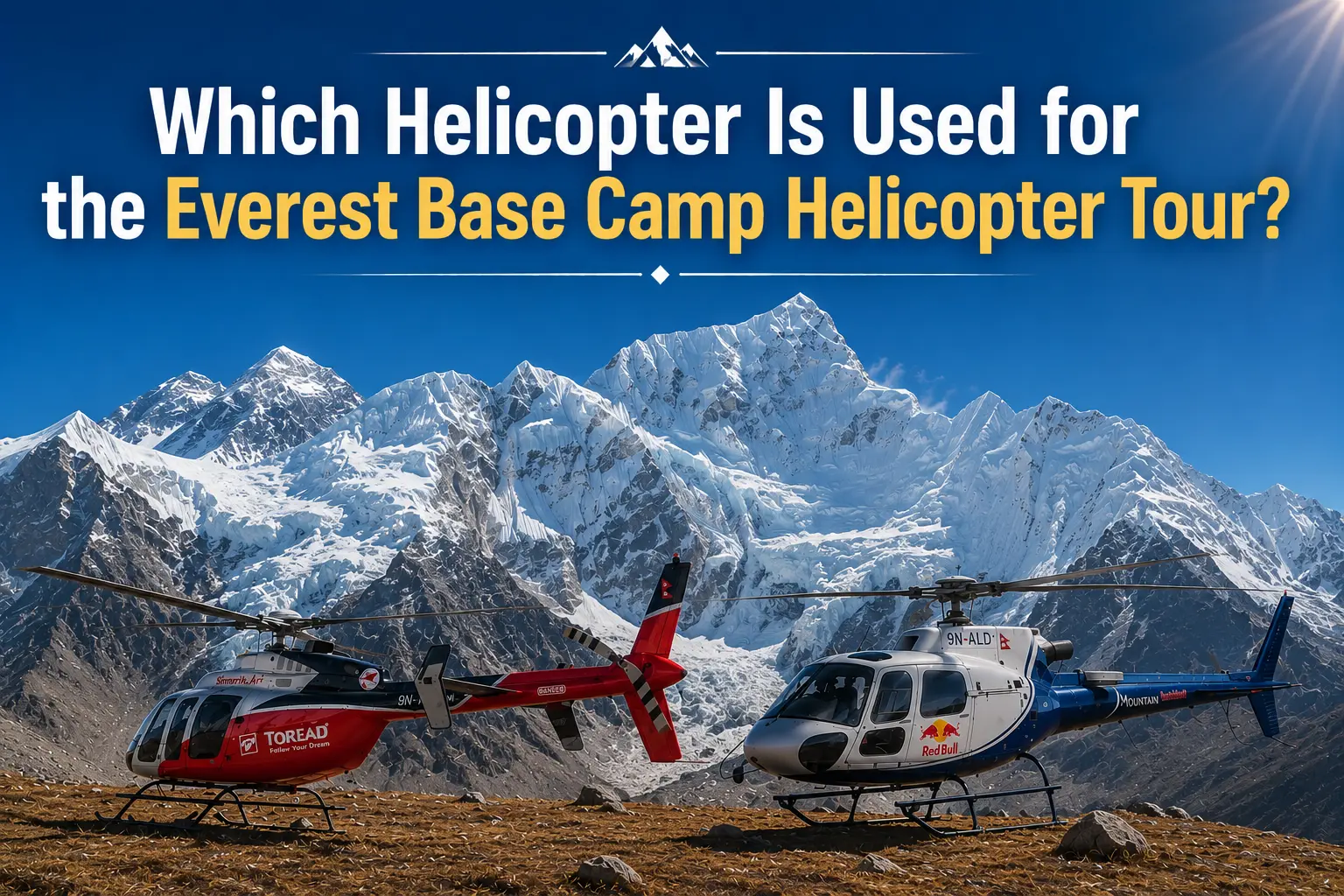
The primary helicopter used for the Everest Base Camp Helicopter Tour in 2026 is the Airbus H125, also known as the AS350 B3e. This aircraft holds the world record for the highest helicopter landing ever performed, set on the summit of Mount Everest at 8,848 m in 2005. The secondary aircraft used for some tours is the Bell 407GXP. Both are CAAN-certified for high-altitude Everest region operations.
The Airbus H125 (AS350 B3e): The Primary Aircraft
The Airbus H125 is the most important helicopter in Nepal’s high-altitude aviation fleet and the aircraft you are most likely to board when you take the Everest helicopter tour. Understanding this aircraft properly — its origins, its engineering, and its real-world performance in the Khumbu — puts the experience in the right context before you even reach the airport.
Name, Origin and History
The Airbus H125 is the current designation for what began as the Aérospatiale AS350 Écureuil (the French word for “squirrel”) in the 1970s. The prototype first flew in 1974. Over the following decades, successive engine and avionics upgrades produced increasingly capable variants: the AS350 B1, B2, B3, and eventually the high-performance B3e model. When Eurocopter rebranded as Airbus Helicopters in 2014 and redesignated its fleet in 2016, the AS350 B3e became the H125.
The aircraft has been manufactured in France since its inception and is today one of the most widely operated civil helicopters in the world. More than 7,200 members of the Écureuil family have been delivered to operators in 137 countries. The H125 variant alone has accumulated over 34 million flight hours across its global fleet. That extraordinary flight-hours figure represents the most operationally proven single-engine helicopter family in history.
The H125 is the only civilian helicopter in history to have landed on the summit of Mount Everest. Its Safran Arriel 2D turboshaft engine with full authority digital engine control (FADEC) provides unmatched performance in thin, cold, high-altitude air — precisely the conditions encountered above Pheriche on the Everest helicopter tour.
The Bell 407GXP: The Secondary Aircraft
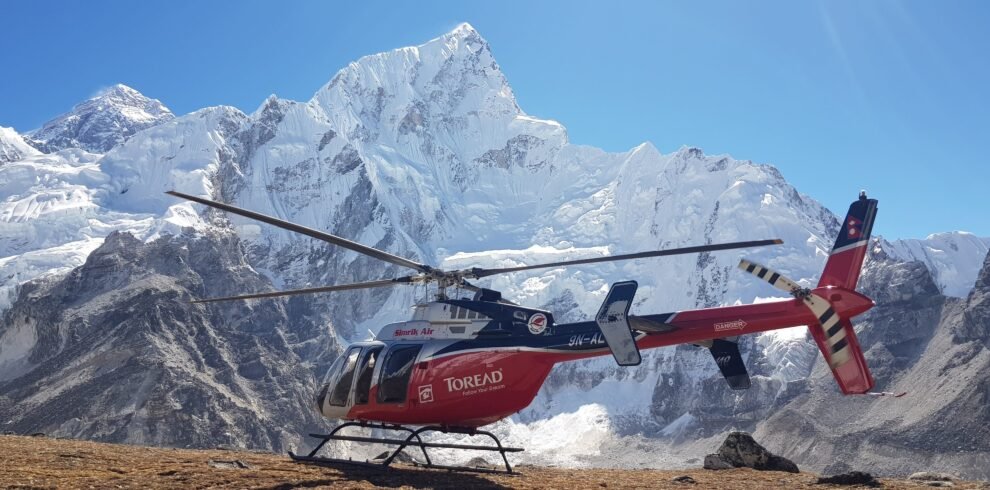
The Bell 407GXP is the second aircraft type used for Everest helicopter tours in Nepal. It is less common than the H125 for the highest-altitude sectors but is a capable and widely respected aircraft for mid-to-high altitude operations in the Khumbu.
The Bell 407 was developed by Bell Helicopter Textron and first flew in 1995. The GXP designation refers to the modernized variant with a Rolls-Royce 250-C47B/8 engine, a Garmin G1000H NXi integrated flight deck, and improved performance characteristics over earlier Bell 407 variants. It is manufactured in the United States and has a well-established safety record across mountainous terrain operations worldwide.
The Bell 407GXP is frequently used for the Kathmandu to Pheriche sectors of the tour and for lower-altitude legs. Its Garmin G1000H flight deck is one of the most advanced avionics systems available in a civil helicopter and provides pilots with comprehensive terrain awareness, weather data, and navigation information in real time. For the Kala Patthar sector specifically, the H125 is generally preferred due to its superior high-altitude lift performance.
Side-by-Side Aircraft Comparison
| Specification | Airbus H125 (AS350 B3e) | Bell 407GXP |
|---|---|---|
| Manufacturer | Airbus Helicopters, France | Bell Helicopter Textron, USA |
| Engine | Safran Arriel 2D turboshaft | Rolls-Royce 250-C47B/8 |
| Engine Management | FADEC (Full Authority Digital Engine Control) | Dual-channel FADEC |
| Max shaft horsepower | 847 shp | 650 shp (continuous) |
| Max operational altitude | 7,010 m (23,000 ft) | 6,096 m+ (20,000 ft+) |
| Cruise speed | 137 knots (254 km/h) | 133 knots (246 km/h) |
| Passenger capacity (tour) | Up to 5 | Up to 6 at lower altitude |
| Kala Patthar landing | Standard | Operator dependent |
| World altitude record | Yes — Everest summit 8,848 m (2005) | No |
| Avionics | Garmin G500H TXi glass cockpit + VEMD | Garmin G1000H NXi integrated flight deck |
| Window design | Large panoramic windows; all passengers window-adjacent | Large wraparound windows; front seat panoramic |
| Rotor system | Starflex semi-rigid 3-blade main rotor | 4-blade semi-rigid main rotor |
| Primary use on EBC tour | All sectors including Kala Patthar (5,545 m) | Lower sectors; Pheriche and below primarily |
| Fleet hours worldwide | 34 million+ (entire H125/AS350 family) | High; widely operated globally |
| CAAN certification | Certified for all Everest region operations | Certified for Nepal operations |
The 2005 Everest Summit World Record and What It Means
On May 14, 2005, French test pilot Didier Delsalle landed an AS350 B3 — the direct predecessor of today’s Airbus H125 — on the summit of Mount Everest at 8,848 m. He remained on the summit for approximately three minutes and thirty-six seconds, then took off and descended safely. It is a world record that stands to this day and that no other pilot or aircraft has been able to replicate.
To put that in context: the Everest helicopter tour’s highest landing point is Kala Patthar at 5,545 m. The world record landing happened 3,303 m higher than that, at minus 35 degrees Celsius, with wind conditions that make the Khumbu in October look benign. When you board an Airbus H125 for the Everest helicopter tour, you are boarding the same aircraft family that holds that record.
First flight of the AS350 Écureuil prototype
Aérospatiale completes the first flight of the AS350 Écureuil in France. The aircraft earns recognition for its performance in hot and high conditions from its earliest operational deployments.
Manaslu and Everest region open to foreign trekkers and helicopter operations
Nepal begins allowing foreign helicopter operators into the high Himalayan zones. The AS350 family rapidly becomes the aircraft of choice for Everest rescue and tourism operations.
Didier Delsalle lands AS350 B3 on Everest summit: world record
On May 14, 2005, Delsalle lands on the summit of Mount Everest at 8,848 m, setting the world altitude landing record that no other aircraft or pilot has surpassed. Nepal’s operators switch decisively to the B3 and subsequent B3e variant for all high-altitude work.
World’s highest long-line rescue on Lhotse at 7,800 m
An AS350 B3 performs a long-line rescue operation on Lhotse at 7,800 m, the highest such operation ever completed. It further confirms the aircraft’s unique capability in the Himalayan rescue environment.
AS350 B3e officially redesignated as Airbus H125
Airbus Helicopters rebrands the AS350 B3e as the H125, the name used by all current operators including Nepal’s CAAN-certified Everest tour operators.
H125 remains the standard for all commercial high-altitude Nepal operations
Nepal’s helicopter tour operators continue to deploy the H125 as the primary aircraft for all Everest helicopter tours above 5,000 m, including the Kala Patthar landing sector at 5,545 m. CAAN certification for high-altitude operations remains exclusive to this aircraft type for the highest sectors.
How the Safran Arriel 2D Engine Performs at Altitude
The H125’s exceptional high-altitude performance is the direct result of its powerplant: the Safran Arriel 2D turboshaft engine. Understanding how this engine works at altitude explains why the H125 can do what other helicopters cannot.
The Physics of Altitude and Engine Performance
At sea level, air contains a specific density of oxygen molecules. As altitude increases, air pressure drops and oxygen density falls proportionally. At 5,545 m (Kala Patthar), air pressure is approximately 50 percent of sea-level pressure. This directly reduces the amount of oxygen available for fuel combustion inside the engine, which reduces the power the engine can generate.
Most piston engines struggle severely with this problem. Turboshaft engines like the Arriel 2D handle it far better because they are designed for combustion efficiency across a wide range of atmospheric conditions. The Arriel 2D produces up to 847 shaft horsepower and is managed by FADEC (Full Authority Digital Engine Control), a computerized system that continuously adjusts fuel delivery, ignition timing, and engine parameters in real time to extract optimal performance regardless of altitude and temperature.
What FADEC Does for Passengers
For passengers, FADEC translates into two practical benefits. First, the engine maintains consistent, reliable power delivery without the pilot needing to manually adjust for changing altitude during ascent. This reduces pilot workload and allows more attention to navigation and situational awareness. Second, the FADEC system continuously monitors engine health parameters and alerts the pilot to any anomaly before it becomes an operational issue. The system’s real-time diagnostics represent a significant safety layer that older, manually-controlled engines simply do not have.
Safety Systems Inside the Airbus H125
Safety equipment and systems on the H125 go well beyond the engine. Several specific systems directly protect passengers and crew on high-altitude commercial tours.
Garmin G500H TXi Glass Cockpit
The primary flight display integrates navigation, terrain mapping, weather data, and engine parameters into a single touchscreen interface. Pilots have complete situational awareness at all times during the flight.
VEMD (Vehicle and Engine Multifunction Display)
Developed specifically for Airbus, the VEMD provides real-time monitoring of all critical engine and vehicle parameters. Pilots can read the full system status at a glance without interrupting flight operations.
Terrain Awareness Warning System (TAWS)
Automatically alerts pilots when the aircraft is approaching terrain or descending below safe altitude margins. Particularly valuable in the Khumbu where valleys are narrow and terrain rises sharply.
Emergency Oxygen Supply
All reputable Everest helicopter tour operators carry emergency oxygen on board. Used in case of altitude sickness symptoms during the flight or at the Kala Patthar stop. Confirm this is included when booking.
FADEC Engine Management
Continuously adjusts engine parameters for optimal performance at current altitude and temperature. Prevents both under-performance and over-temperature conditions that could compromise engine reliability.
Crash-Resistant Fuel System
The H125 incorporates a crash-resistant fuel system designed to prevent post-impact fire in the event of a hard landing. An important passive safety system for operations in remote mountain environments.
Energy-Absorbing Landing Gear
The skid landing gear is engineered to absorb impact energy and reduce forces transmitted to the airframe and occupants. Designed specifically for operations on unprepared, uneven mountain terrain.
First Aid Kit On Board
A comprehensive first aid kit is carried on all commercial Everest helicopter tours. Tour operators are required to carry this equipment by CAAN operational standards for high-altitude commercial flights.
CAAN Regulations and Altitude Weight Limits in 2026
The Civil Aviation Authority of Nepal governs all commercial aviation including helicopter operations through its Air Operator Certificates (AOC) system. Every helicopter company operating Everest tours must hold a valid AOC from CAAN. Pilots must be licensed and current on type. The aircraft must pass regular CAAN airworthiness inspections. These are not theoretical standards. CAAN inspectors conduct unannounced checks at major airports and helipads across the Khumbu region during peak operating seasons.
Following a series of helicopter accidents in the Solukhumbu district in recent years, CAAN strengthened its altitude weight limit regulations for commercial passenger flights. The table below represents the operational limits as applied in 2026.
| Flight Sector | Altitude Range | Max Payload per Helicopter | Max Passengers (H125) | Notes |
|---|---|---|---|---|
| Kathmandu to Lukla | 1,400 to 2,860 m | 500 kg | 5 | Standard sea-level performance range; full payload permitted |
| Lukla to Syangboche | 2,860 to 3,880 m | 450 kg | 4 to 5 | Weight begins to reduce effective lift; minor restriction |
| Syangboche to Pheriche | 3,880 to 4,371 m | 420 kg | 4 | Pre-split sector; group division planning begins here |
| Pheriche to Kala Patthar | 4,371 to 5,545 m | 250 kg | 2 to 3 | High-altitude shuttle; groups split here; most critical sector |
| EBC area overfly | ~5,364 m | Not applicable (flyover only) | All passengers | No landing; altitude maintained briefly; no weight restriction applies to overfly |
At 5,545 m, air density is approximately 50 percent of sea-level density. The H125’s engine and rotor system can still generate sufficient lift to hover and maneuver, but its payload capacity is substantially reduced. The 250 kg limit at the Kala Patthar shuttle sector is calculated based on the H125’s demonstrated performance envelope at that altitude under standard atmospheric conditions. It is not a conservative estimate. It is an engineering limit. Exceeding it would reduce the aircraft’s safety margins to unacceptable levels.
Passenger Capacity and the Pheriche Group Split
One of the most frequently misunderstood aspects of the Everest Base Camp Helicopter Tour is why passengers are divided into smaller groups at Pheriche. The helicopter carries up to five passengers from Kathmandu to Lukla. Above Pheriche, only two to three passengers can fly to Kala Patthar at once. This is not an inconvenience or an organizational failure. It is a mandatory safety requirement.
At Pheriche (4,371 m), the pilot and ground crew weigh the combined passenger group and divide them into shuttle loads of two to three people, each within the 250 kg maximum for the high-altitude sector. The first shuttle flies to Kala Patthar, lands for 10 to 15 minutes, and returns to Pheriche. The second shuttle then makes the same flight. Waiting time at Pheriche for the second group is typically 30 to 45 minutes.
Provide your accurate body weight when booking with Next Trip Nepal. We use this information to pre-plan shuttle groupings before tour day, eliminating any awkward on-site recalculations. Being in the second Pheriche shuttle is not a disadvantage — the weather and the mountain are there regardless of which shuttle you ride. The experience at Kala Patthar is identical for both groups.
Window Seats and Visibility Inside the H125
One concern passengers frequently raise is whether everyone gets a window seat. The H125’s cabin design addresses this thoughtfully. The aircraft has a wide passenger cabin with large panoramic windows on both sides and the front. The standard configuration for Everest tours is one pilot plus four passengers in the rear seats, with the co-pilot front seat typically occupied by a fifth passenger (when weight permits).
All four rear seats are positioned directly adjacent to windows. There is no middle seat in the rear cabin configuration used for tourism. The front co-pilot seat provides the widest forward panoramic view of any position on the aircraft. Seat rotation is practiced on multi-leg tours to ensure every passenger gets time in the optimal viewing position at some point during the flight.
| Seat Position | View Quality | Notes |
|---|---|---|
| Co-pilot (front right) | Exceptional | 360-degree forward and side view; unobstructed glass; best seat for photography facing the mountains |
| Rear left window | Excellent | Direct window seat; no middle passenger blocking; good for left-side mountain views depending on flight direction |
| Rear right window | Excellent | Direct window seat; particularly good for Everest views on the outbound Kathmandu to Khumbu leg |
| Rear center left | Very Good | Adjacent to left window passenger; views through front cockpit glass on climb sectors |
| Rear center right | Very Good | Adjacent to right window; operators typically rotate seating between legs to optimize views for all passengers |
The Pilots Flying These Aircraft in Nepal
The aircraft is only one part of the safety equation. The pilot is the other. Nepal’s high-altitude helicopter pilots are among the most experienced mountain aviators in the world. Flying in the Khumbu requires skills and situational judgment that are genuinely rare in global aviation.
The valleys of the Khumbu are narrow, terrain rises sharply on all sides, and weather can change faster than any forecast predicts. Pilots who operate the Kathmandu to Kala Patthar route daily during peak season develop an intuitive understanding of local wind patterns, cloud behavior, and the specific landing characteristics of helipads cut into glacial terrain. They know which mornings are good for the Kala Patthar landing based on cloud formations the night before. They read the visual weather at the Pheriche staging point and make immediate go or no-go calls for the high-altitude shuttle.
What Nepal Requires of Commercial Helicopter Pilots
- Valid Commercial Pilot License (Helicopter) issued or validated by CAAN
- Type rating current on the specific aircraft operated (H125 or Bell 407 type rating)
- Valid medical certificate issued within required renewal periods
- Instrument rating for operations in marginal meteorological conditions
- Specific mountain flying endorsement for Himalayan region commercial operations
- Annual proficiency checks conducted by CAAN-approved examiners
- Operator-mandated currency requirements including minimum recent flight hours on type
Reputable operators including those Next Trip Nepal works with employ pilots with 2,000 to 10,000 or more hours of total flight time, a significant proportion of which is accumulated specifically in the Everest region. The lead pilots on Kala Patthar shuttles have often completed this specific flight hundreds of times.
Frequently Asked Questions About the Helicopter
No. The historic 2005 Everest summit landing by Didier Delsalle was performed by a solo test pilot in a stripped-down aircraft specifically for the world altitude record attempt. Commercial passenger tours are not permitted to attempt summit landings. The standard tour reaches Kala Patthar at 5,545 m, which is the highest commercial passenger landing point in the Everest region.
Yes, in most cases. The same H125 that departs Kathmandu typically completes the full circuit including the Kala Patthar shuttle. The Lukla stop is a refueling stop, not an aircraft change. Occasionally, operational factors require the use of a second aircraft for specific sectors, but this is the exception rather than the rule.
Yes. Commercial Everest helicopter tours operate with a single pilot. The co-pilot seat is used by a passenger (when weight permits). Single-pilot operations in the H125 are fully certified by CAAN for commercial passenger operations in Nepal. The aircraft’s avionics systems, FADEC engine management, and autopilot capabilities significantly reduce pilot workload.
Yes, and this is precisely why the engines stay running during the Kala Patthar stop. Keeping the rotors turning means the helicopter is in ready-to-depart status at all times during the ground stop. If weather closes in rapidly, the pilot can have all passengers back on board and be airborne within 60 to 90 seconds.
Tell the pilot or crew member immediately. The standard response is to board all passengers and descend. The H125 can be airborne and descending within seconds of a medical alert. Altitude sickness symptoms almost universally resolve rapidly once the aircraft descends below 4,000 m. Emergency oxygen is carried on board for interim relief.
The H125 has a cabin heating system that provides comfort during flight. However, the brief ground stop at Kala Patthar exposes passengers to outside temperatures of minus 10 to minus 15 degrees Celsius. Dress in warm layers including a down jacket, warm hat, and gloves regardless of cabin comfort during flight. The cold at the ground stop is real and the 10 to 15 minutes outside the aircraft feels longer than it sounds when underdressed.
The H125 is one of the quietest single-engine helicopters in its class due to its Starflex semi-rigid rotor system, which produces less vibration and noise than older rotor designs. Hearing protection (earplugs or aviation headsets) is provided or recommended by most operators. Pilots communicate with passengers through an intercom system connected to passenger headsets where fitted.
Book Your Everest Helicopter Tour With Next Trip Nepal
Every Everest Base Camp Helicopter Tour organized by Next Trip Nepal uses CAAN-certified aircraft operated by licensed mountain pilots. We work exclusively with operators whose fleets include the Airbus H125, the aircraft this guide describes in full. We do not offer tours on uncertified aircraft or with operators who cannot confirm their CAAN AOC status on request.
We organize daily departures throughout spring and autumn. No advance payment is required to confirm your booking. Contact us via WhatsApp or email with your preferred date, your group size, and whether you want group sharing or a private charter. We confirm availability, provide a full cost breakdown, and hold your seat without any upfront financial commitment.
Daily Everest Helicopter Tours. No Advance Payment Required.
Message us on WhatsApp or email to check availability for your date. Our team confirms your slot immediately and handles all permits and logistics.
For trekkers planning a longer Nepal journey, the helicopter tour pairs naturally with the Everest Base Camp Trek for those who want to experience both the ground-level walk and the aerial perspective. The Everest Three Passes Trek is the most comprehensive Khumbu circuit for experienced trekkers. Climbers interested in a summit attempt should explore Island Peak Climbing and Lobuche East Peak Climbing.
For visitors exploring Nepal beyond the Everest region, the Annapurna region, the Manaslu Circuit, and the Langtang Valley all offer distinct Himalayan experiences. Jungle safaris in Chitwan National Park and Kathmandu valley cultural tours complete a fully rounded Nepal itinerary.
Next Trip Nepal is a Kathmandu-registered tour and trekking company organizing Everest helicopter tours daily alongside a full program of Himalayan treks, peak climbs, wildlife safaris, and cultural tours. All helicopter tours use CAAN-certified aircraft and licensed pilots. No advance payment is required for any booking. Read verified traveler reviews and contact our team directly via WhatsApp at +977 9869225929 or email at info@nexttripnepal.com.