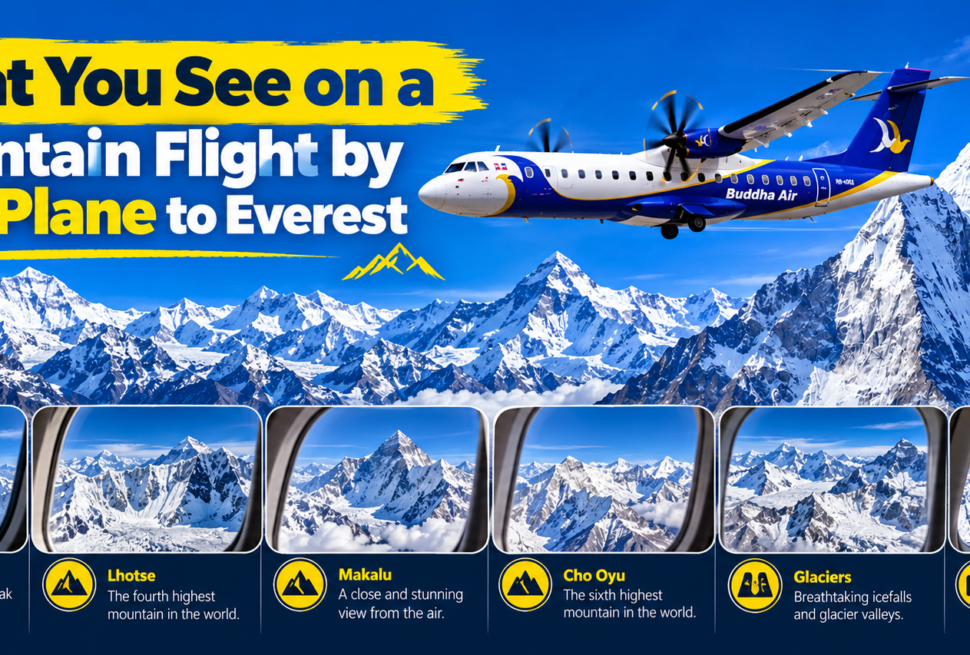
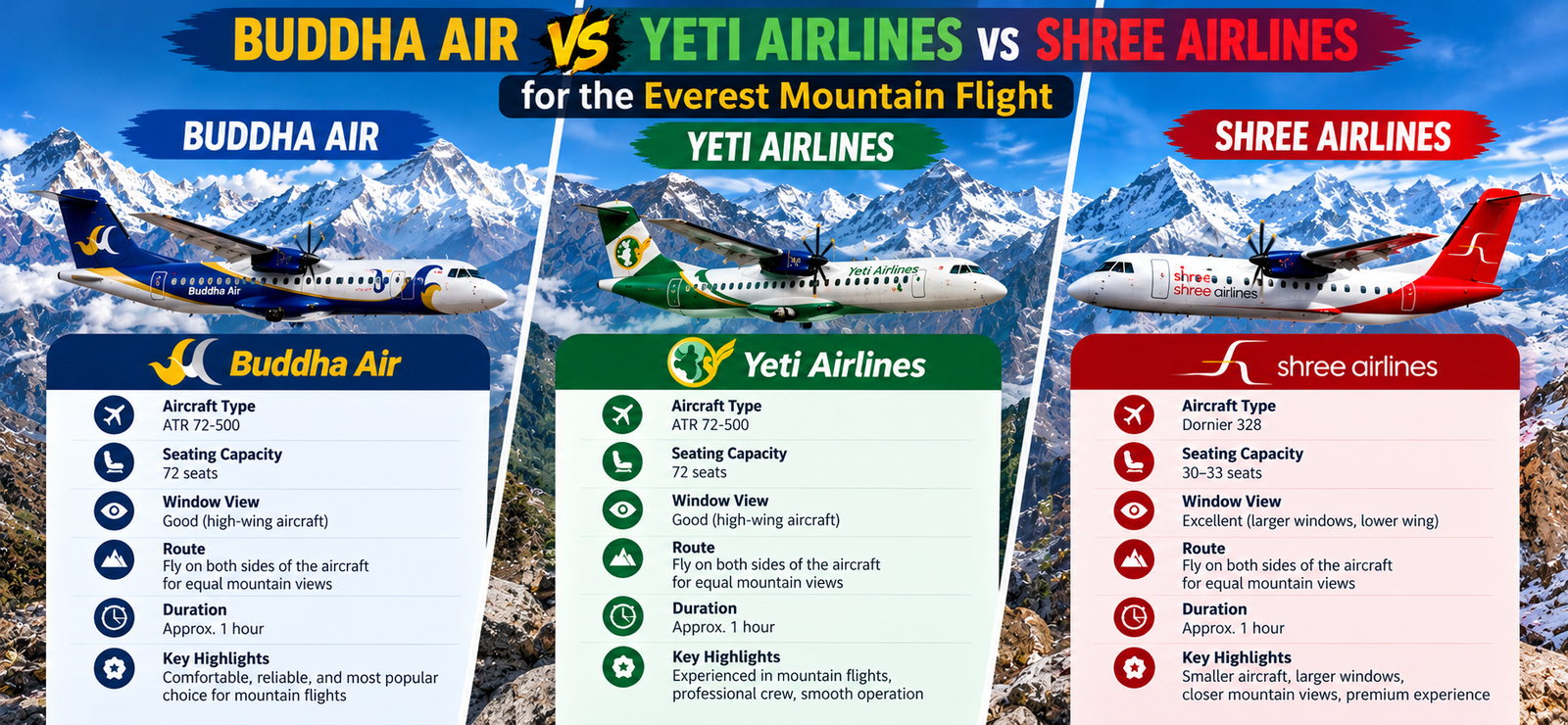
When you book the Everest mountain flight, you are not booking a seat with a single, fixed airline the way you might assume. Three different Nepali domestic carriers operate this route on any given morning, Buddha Air, Yeti Airlines, and Shree Airlines, and which one you actually fly with depends on scheduling that is largely out of any booking agency’s hands, decided by the airlines themselves closer to your travel date. Travelers researching this flight often want to know whether one of the three is meaningfully better than the others, and the honest answer is more nuanced than a simple ranking. Each airline has a different history, a different fleet, and a slightly different general reputation, and this article lays all three out plainly so you understand what you are actually getting regardless of which one ends up operating your specific departure. We run this flight ourselves and work with all three airlines regularly, so the details below come from direct, ongoing experience arranging this exact trip rather than from secondhand research alone.
Buddha Air: The Airline That Invented This Exact Flight
Buddha Air was founded in 1996 by Surendra Bahadur Basnet and his son Birendra Bahadur Basnet, and it began commercial operations on October 11, 1997, with an Everest sightseeing flight as its very first scheduled service. That detail is worth sitting with, since it means the mountain flight product this article series is about is not something Buddha Air added to its business later. It is, in a real sense, the product the airline was built around from day one. Based in Lalitpur near Kathmandu, Buddha Air grew to become the largest domestic carrier in Nepal by passengers carried as of 2023, a position that reflects decades of continuous operation on Nepal’s busiest domestic routes alongside its mountain flight service.
As of our most recent information, Buddha Air’s fleet consists of seventeen aircraft entirely built around the ATR turboprop family, including one ATR 42 300, fifteen ATR 72 500 aircraft, and one newer ATR 72 600, with two more ATR 72 600 aircraft on order. The airline’s older Beechcraft 1900D aircraft, which it flew from its founding in 1997, was fully retired from service in 2023, and an earlier Beechcraft 1900C was retired back in 2009. This matters specifically for the mountain flight, since the Beechcraft 1900D was the aircraft type involved in a serious 2011 accident on this exact route, which we cover honestly and in full in our separate article on mountain flight safety. Every Everest sightseeing flight Buddha Air operates today uses the newer ATR fleet rather than the retired Beechcraft type.
Buddha Air’s operational history since includes a small number of other incidents worth mentioning for completeness: a 2003 flight that landed at the wrong airport due to an air traffic and communication error, a 2020 flight that landed at Pokhara instead of its intended destination of Janakpur because of a similar communication mix up, a 2021 engine failure that led to a safe emergency landing with all passengers later flown onward without injury, a 2024 runway skid that saw all 63 people aboard evacuated without injury, and a 2026 runway excursion at Bhadrapur that injured seven people. None of these incidents occurred on the Everest mountain flight route specifically, and we mention them here for a complete picture of the airline’s operational history rather than because they relate directly to this product.
Yeti Airlines: The Sherpa Founded Carrier Behind the Everest Express
Yeti Airlines was established in Kathmandu in May 1998 by Ang Tshering Sherpa, receiving its Air Operator’s Certificate that August, and began flying with just two de Havilland Canada DHC 6 Twin Otter aircraft. In 2009, the airline created Tara Air as a dedicated subsidiary for its rural short takeoff and landing operations into Nepal’s more remote mountain airstrips, a separate but related brand still operating today. In late 2023, Asian Life Insurance took a 49 percent stake in the company. Yeti Airlines markets its version of the Everest sightseeing flight under the name Everest Express, and operates it using ATR 72 aircraft as part of its current fleet.
Yeti Airlines is also, unavoidably, the airline connected to Nepal’s deadliest aviation accident in three decades, the January 2023 crash of an ATR 72 on a scheduled flight between Kathmandu and Pokhara that killed all 72 people aboard. We want to be direct about this here rather than let readers piece it together elsewhere, and equally direct about the context that matters: that crash involved a different route entirely, a point to point domestic service rather than the Everest mountain sightseeing flight, and the government investigation attributed the most likely cause to a specific pilot error during the landing approach rather than a fault in the aircraft type. We cover this accident, along with an earlier, directly relevant 2011 accident on the Everest sightseeing flight itself operated by a different airline, in full and honest detail in our dedicated safety article, which we think is worth reading regardless of which of the three airlines you end up flying with.
Shree Airlines: Nepal’s Largest Helicopter Operator, Now Also Flying Fixed Wing
Shree Airlines has a meaningfully different history from the other two. It traces back to a company founded by Banwari Lal Mittal, originally incorporated as Air Ananya and previously operating as Shree Air, which grew to become Nepal’s largest helicopter operator, flying a fleet built around the Mil Mi 17, a large Russian built helicopter widely used across Nepal for both charter tourism and cargo work in remote areas. Shree only added fixed wing passenger operations in 2016, launching scheduled domestic flights from Tribhuvan International Airport under the Shree Airlines name with an initial fleet of three jets, and later made an international debut with charter flights to Singapore during the COVID nineteen pandemic period.
As of our most recent information, Shree’s fleet includes nine fixed wing aircraft, two Bombardier CRJ200ER regional jets and seven Bombardier Dash 8 Q400 turboprops, alongside eight helicopters, six Mi 17s and two Eurocopter AS350 B3e aircraft. This is a meaningful difference from Buddha Air and Yeti Airlines worth understanding clearly: Shree’s core fixed wing fleet is built around Bombardier aircraft rather than the ATR family the other two airlines use, though the airline does offer its own Everest mountain sightseeing flight product, generally priced and timed comparably to the other two. If which specific aircraft type you fly matters to you personally, it is worth asking us to confirm the aircraft for your specific booked departure, since this is one of the clearer differences between Shree and the other two operators on this route. Shree Airlines’ deeper operational history and reputation in Nepal rests most heavily on its helicopter division, where it is also one of the operators involved in Everest Base Camp helicopter tours of the kind we run as a separate product from the fixed wing mountain flight.
Domestic Network Beyond the Mountain Flight
It is worth understanding how large and established each airline’s broader domestic operation is, since this gives a sense of institutional depth beyond the single route this article focuses on. Buddha Air operates from Tribhuvan International Airport in Kathmandu as its main hub, with Pokhara International Airport serving as a secondary hub, and flies to numerous domestic airports across Nepal alongside limited international service to destinations including Kolkata and Varanasi in India, with earlier routes to Paro in Bhutan and Lucknow in India since discontinued. Yeti Airlines similarly operates an extensive domestic network from Kathmandu, with its Tara Air subsidiary specifically covering the shorter, more rugged airstrips in Nepal’s remote mountain regions that standard ATR aircraft cannot safely use. Shree Airlines runs scheduled domestic flights from Tribhuvan International Airport using its Bombardier fleet, alongside an international charter history that includes flights to Singapore, and maintains a separate and arguably larger footprint in helicopter charter work across Nepal’s trekking regions, including Everest Base Camp helicopter tours, Annapurna region charters, and remote area cargo and rescue work.
Fleet Age and Modernization
Fleet age is one of the more concrete, checkable differences between the three airlines, and it has shifted meaningfully in recent years as each has retired older aircraft types. Buddha Air retired its last Beechcraft 1900D in 2023, meaning its entire current fleet is now built around the ATR 42 and ATR 72 family, including newer ATR 72 600 models alongside its larger number of ATR 72 500 aircraft, with further ATR 72 600 deliveries on order. Yeti Airlines’ fleet is similarly built around the ATR 72, including the 500 series aircraft referenced in its operational history. Shree Airlines’ fixed wing fleet is comparatively newer to passenger service, since the airline only began flying fixed wing aircraft in 2016, and its Bombardier CRJ200 and Dash 8 Q400 aircraft represent a different aircraft family entirely from the ATR equipment the other two airlines rely on for this route. None of these differences point to one airline being clearly safer than another on paper, since all three operate under the same CAAN maintenance and airworthiness oversight framework regardless of fleet composition, but the fleet details are genuinely useful for any traveler specifically curious about what aircraft type they are likely to board.
How to Tell Which Airline You Are Checking In With
On the morning of your flight, the practical way to know which airline you are flying with is simply the check in counter you are directed to at the domestic terminal, each clearly branded with that airline’s name and logo, along with the boarding pass you receive at check in, which will show the operating airline directly. Our team confirms the airline with you before your flight, typically a few days ahead once the airline’s schedule for that morning is set, and we accompany you through check in on the day itself, so you will know well before boarding which of the three airlines is operating your specific flight rather than finding out only once you arrive at the airport.
Aircraft Comparison at a Glance
Buddha Air’s current Everest mountain flight fleet is built entirely around the ATR 42 and ATR 72 turboprop family, a well established aircraft type used by regional airlines worldwide. Yeti Airlines also operates its Everest Express flight using ATR 72 aircraft. Shree Airlines’ core fixed wing fleet centers on Bombardier CRJ200 and Dash 8 Q400 aircraft rather than ATR models, though it also markets an Everest mountain flight product. If flying specifically on an ATR aircraft matters to you, Buddha Air and Yeti Airlines are the more consistent choices based on their publicly documented fleets, while Shree Airlines is worth asking about directly if aircraft type is a deciding factor for your booking.
Why Three Separate Airlines Compete on the Same Route
It is worth understanding briefly why this single route is shared across three competing carriers rather than being the exclusive territory of one, since it explains why scheduling works the way it does. Demand for the Everest mountain flight is strong and consistent year round, peaking in the spring and autumn tourist seasons, and the route itself requires relatively modest infrastructure compared to many other forms of tourism, a short, well understood scheduled flight using aircraft each airline already operates on other domestic routes. This makes it a relatively accessible product for any CAAN licensed carrier with the right aircraft type to add to its schedule, which is part of why Buddha Air, Yeti Airlines, and Shree Airlines all compete for the same pool of travelers on broadly similar mornings, each bringing a slightly different institutional history to an otherwise very similar product.
Ownership and Who Actually Runs Each Airline
Understanding who stands behind each airline gives a little more context on how each company fits into Nepal’s broader tourism and aviation industry. Buddha Air remains closely associated with its founding family, the Basnets, who established the airline and have continued to shape its direction as it grew into Nepal’s largest domestic carrier by passenger numbers. Yeti Airlines was founded by Ang Tshering Sherpa, a name with a long association with Nepal’s mountaineering and tourism industry more broadly, and the airline brought in Asian Life Insurance as a significant minority shareholder with a 49 percent stake in late 2023, a sign of continued investment in the company’s future rather than a change in its core operating identity. Shree Airlines was founded by Banwari Lal Mittal and built its early reputation and scale in the helicopter charter sector before expanding into fixed wing passenger service, giving it a notably different origin story from the other two airlines, which were built around fixed wing passenger flying from the start.
Tara Air and Why It Sometimes Comes Up in the Same Conversation
Travelers researching Yeti Airlines sometimes also come across Tara Air, and it is worth clarifying the relationship since the two names are closely connected but serve different purposes. Tara Air is a subsidiary created by Yeti Airlines in 2009 specifically to operate short takeoff and landing flights into Nepal’s more remote, shorter mountain airstrips using smaller aircraft than the ATR 72, including routes that standard regional turboprops cannot safely use. Tara Air does not operate the Everest mountain sightseeing flight described throughout this article series, which remains a Yeti Airlines branded service using ATR 72 aircraft. We mention Tara Air here only to prevent confusion for travelers who encounter the name during their own research and want to understand how it relates, or does not relate, to the flight this article is actually about.
Booking Through Next Trip Nepal Versus Booking an Airline Directly
Some travelers wonder whether booking this flight directly with one of the three airlines, rather than through an agency like ours, might give them more certainty about which airline they end up flying with. In practice, it generally does not, since even a direct booking with, say, Buddha Air is still subject to that airline’s own scheduling and operational decisions for the specific morning, the same variables that affect a booking made through any agency. What booking directly removes is the local support layer, the hotel pickup, the airport check in assistance, and the single point of contact if something about your morning needs to change, all of which we include as part of arranging this flight for you regardless of which of the three airlines ends up operating your specific departure. For travelers who want the certainty of dealing with one specific airline for their own reasons, we are happy to tell you honestly whether that is realistic for your dates rather than promising something we cannot actually guarantee.
Which Airline Will Actually Operate Your Flight
This is the part travelers find most frustrating to hear, but we would rather be upfront about it than imply a certainty that does not exist. Which of the three airlines operates your specific morning’s departure depends on each airline’s own scheduling, aircraft availability, and passenger load on that date, decided largely on their end rather than ours. We confirm the likely operating airline with you as your travel date approaches, generally within a few days of your flight, once the airline’s own schedule for that morning is set. We are not able to guarantee a specific airline weeks or months in advance, and we would be cautious of any operator who claims they can, since the underlying scheduling simply does not work that far ahead on this route.
Can You Request a Specific Airline?
You can tell us a preference, and we will do what we can to accommodate it, but we cannot promise it will be possible for every date. If you have a specific reason for preferring one airline, for example wanting to fly on an ATR aircraft specifically, let us know when you first get in touch, and we will tell you honestly whether that is realistic for your travel dates rather than promising something we may not be able to deliver on the day.
What Happens If the Operating Airline Changes Close to Your Flight
Because the mountain flight schedule depends on each airline’s own aircraft availability and demand for a given morning, it is not unusual for which airline is operating a specific departure to shift in the days leading up to your flight, even after we have given you an initial confirmation. This is not a sign of anything going wrong, simply a reflection of how scheduling works across three competing operators sharing broadly similar morning departure windows. If this happens on your booking, we update you directly as soon as we know, and nothing else about your experience changes meaningfully, since the route, the guaranteed window seat, the hotel pickup, and the overall timing of your morning remain consistent regardless of which of the three airlines ends up operating your specific flight.
In Flight Experience Differences Worth Knowing
Once you are actually on board, the core experience across all three airlines is more similar than different, since all three fly a broadly comparable route, hold position near the peaks for a similar few minutes, and provide a similar level of onboard narration identifying the major mountains as they come into view. Minor differences exist in cabin crew style and the specific small touches some airlines include, such as a printed flight certificate handed out after landing, which several operators provide as a keepsake though this is not guaranteed on every flight with every airline. Buddha Air and Yeti Airlines, flying the same general ATR aircraft type, offer a broadly similar cabin layout and seating experience, while Shree Airlines’ Bombardier equipped flights may differ slightly in cabin feel given the different aircraft family, though the fundamental promise of a guaranteed window seat and a close range mountain view holds across all three.
General Reputation and Passenger Experience
All three airlines operate under the same CAAN licensing framework and the same general safety and weather protocols described in our dedicated safety article, and we do not have independent data that would let us rank them against each other with real confidence on safety specifically. In terms of general passenger experience, Buddha Air’s long history with this exact flight, going back to its founding service in 1997, means its cabin crews and ground staff at the mountain flight counter tend to have deep familiarity with first time flyers’ questions and the specific choreography of this particular route. Yeti Airlines brings a similar level of route specific experience through its Everest Express branding and its long operating history since 1998. Shree Airlines, newer to fixed wing passenger operations generally, draws on a different kind of institutional experience from its decades as Nepal’s largest helicopter operator, though its fixed wing mountain flight operation itself has a shorter specific history than the other two.
Price Differences Between the Three Airlines
In practice, pricing for the Everest mountain flight is broadly similar across all three operators, generally falling in a similar range regardless of which airline you end up flying with on a given morning. We do not currently see a meaningful enough price gap between the three to recommend choosing based on cost alone, and the 199 US dollar per person price we quote for the Everest Scenic Flight reflects the market rate across these operators rather than a rate specific to just one of them. If pricing does shift meaningfully between operators on your specific dates, we will tell you directly rather than default you to the more expensive option without mentioning it.
A Word on Reading Airline Reviews Online
If you search for reviews of any of these three airlines individually, you will find a wide range of feedback, much of it about their broader domestic network rather than this specific mountain flight product. We would encourage some caution here, since a one star review about a delayed flight to a remote airstrip in monsoon season, or a complaint about a different route entirely, tells you very little about the specific experience of a clear morning Everest sightseeing flight. When evaluating any of the three airlines specifically for this product, it is worth looking for feedback that mentions the mountain flight by name rather than drawing conclusions from reviews about an airline’s unrelated domestic routes, which can carry very different operational challenges, particularly routes into Nepal’s more remote mountain airstrips where weather and runway conditions are considerably more demanding than the Kathmandu based mountain flight route this article covers.
Why This Comparison Matters More for Research Than for Your Actual Booking Decision
We want to close this comparison with an honest observation about its own limits. Everything in this article is genuinely useful if you want to understand Nepal’s domestic aviation landscape, the history behind the companies operating your flight, and the real differences in fleet and institutional background between them. What it is not, and what we do not think any article honestly can be, is a reliable tool for picking the single best airline for your specific morning, since you will not get to choose which of the three actually operates your flight in most cases, and the differences between them, while real, do not meaningfully change the core experience you are booking. We wrote this comparison because we think informed travelers deserve to understand what they are reading when an airline name comes up in their research, not because we think the choice between them should be a significant factor in deciding whether or when to book this flight at all.
What We Would Tell a Friend Asking Which One to Hope For
If a friend asked us honestly which of the three we would want them to fly with, we would tell them it genuinely does not matter enough to worry about. All three operate under the same regulatory oversight, fly the same general route, and deliver the same core experience, close range views of Everest and the surrounding peaks from a small aircraft with a guaranteed window seat. The meaningful differences between them are historical and structural rather than something that changes what you will actually see and feel on your specific morning. We would rather a traveler spend their attention on choosing a good weather window and a reliable booking agency than on which of three well established, CAAN licensed airlines happens to be flying that day.
Frequently Asked Questions
Which airline is best for the Everest mountain flight?
We do not think there is a single correct answer. All three, Buddha Air, Yeti Airlines, and Shree Airlines, operate under the same regulatory framework and deliver a broadly similar core experience. Buddha Air has the longest specific history with this exact product, having launched with an Everest sightseeing flight in 1997.
Can I choose which airline I fly with?
You can tell us a preference, and we will try to accommodate it, but the final operating airline for your specific date depends on each airline’s own scheduling closer to your travel date, which we cannot fully control or guarantee far in advance.
Which airlines use ATR aircraft for this flight?
Buddha Air and Yeti Airlines both operate their Everest mountain flight using ATR 72 aircraft, with Buddha Air also flying one ATR 42. Shree Airlines’ core fixed wing fleet is built around Bombardier aircraft rather than ATR models, though it also offers its own Everest mountain flight product.
Is Shree Airlines mainly a helicopter company?
Historically, yes. Shree Airlines grew out of a long running helicopter charter operation and remains Nepal’s largest helicopter operator, adding fixed wing scheduled passenger flights only in 2016. Its helicopter division is also involved in Everest Base Camp helicopter tours, a separate product from the fixed wing mountain flight.
Has Yeti Airlines had any accidents?
Yeti Airlines was the operator involved in the January 2023 crash of an ATR 72 on a scheduled Kathmandu to Pokhara flight, a different route from the Everest mountain flight, which investigators attributed primarily to pilot error during the landing approach. We cover this in full context in our dedicated safety article.
Has Buddha Air had any accidents on the Everest flight specifically?
Yes, in 2011, a Buddha Air aircraft on an Everest sightseeing flight crashed while landing at Kathmandu in poor weather. The aircraft type involved, a Beechcraft 1900D, has since been fully retired from Buddha Air’s fleet, with the airline’s current Everest flights using ATR aircraft instead.
Does the airline affect the price I pay?
Generally no. Pricing for this flight is broadly similar across all three operators, and the price we quote reflects the general market rate rather than a rate tied to one specific airline.
Will I know which airline I am flying with before I arrive at the airport?
Yes. We confirm the operating airline with you as your travel date approaches, typically within a few days of your flight, once that morning’s airline schedule is set on their end.
Do all three airlines offer the same guaranteed window seat?
Yes. The small aircraft used by all three operators on this route are narrow enough that every seat is a window seat, regardless of which airline operates your specific flight.
Which airline has the longest history flying Everest sightseeing flights?
Buddha Air, by a clear margin. The airline’s first ever commercial flight in October 1997 was an Everest sightseeing service, making this product part of the company’s history from its very first day of operation rather than something added later.
Is Tara Air the same as Yeti Airlines for this flight?
No. Tara Air is a subsidiary of Yeti Airlines that operates short takeoff and landing flights into remote mountain airstrips, using different aircraft from the ATR 72 used on the Everest mountain flight. The Everest mountain flight itself is operated under the Yeti Airlines brand, not Tara Air.
Does Shree Airlines use the same aircraft as the helicopter tour for the fixed wing mountain flight?
No. Shree Airlines’ helicopter fleet, used for Everest Base Camp helicopter tours and other charter work, is entirely separate from its fixed wing fleet used for scheduled passenger flights including the mountain flight. The helicopter fleet includes Mil Mi 17 and Eurocopter AS350 aircraft, while the fixed wing fleet is built around Bombardier aircraft.
Will my flight take longer or shorter depending on the airline?
No. The route, altitude, and general timing of the flight are consistent regardless of which of the three airlines operates it, since all three fly a broadly similar scheduled route and hold position near the peaks for a comparable amount of time.
Do any of the three airlines fly internationally?
Buddha Air operates limited international service to destinations including Kolkata and Varanasi in India. Shree Airlines has operated international charter flights, including to Singapore. Yeti Airlines’ operations are primarily domestic within Nepal. None of this affects the Everest mountain flight itself, which is a domestic route for all three carriers.
Can I ask Next Trip Nepal which airline typically flies on my specific travel dates?
We can give you a general sense based on what we are seeing closer to your dates, though we cannot commit to a specific airline with full certainty until the airline’s own schedule for that morning is finalized, typically within a few days of departure.
Is it worth paying more to fly with a specific airline?
We do not currently see a meaningful price difference between the three operators for this route, so we would not recommend paying a premium to guarantee a specific airline unless you have a particular reason, such as a strong preference for ATR aircraft specifically, that matters enough to you personally to make the request.
Whichever of the three airlines ends up operating your specific morning, the core experience, the route, the guaranteed window seat, and the general safety framework, remains broadly consistent, and we have tried in this article to give you the real, specific differences that do exist rather than either a false ranking or a vague claim that they are all identical. If you have a specific question about any of the three before booking, or want to understand how this flight compares to our Everest Base Camp Helicopter Tour or what the honest safety picture looks like, our related guides cover both in depth. Reach out to us on WhatsApp at plus 977 9869225929 or by email at nexttripnepal@gmail.com with any questions before you book, or learn more about why travelers choose to book with Next Trip Nepal.