
A parent in Manchester opens a map, measures the gap between Kathmandu and Pokhara, sees roughly 200 kilometres, and assumes a two hour drive. Then they read that the road takes six or seven hours. That one detail explains more about family travel in Nepal than any brochure will. Distances here are measured in time and terrain, not kilometres, and once you accept that, the whole trip becomes easier to plan.
So the honest starting point is this: Nepal is not the smoothest country in Asia for roads, distances or infrastructure. Some drives are long. Some roads are rough. Facilities thin out quickly once you leave the two main cities. Parents who want a resort where every hour is scheduled and every meal is familiar will find it hard work.
And yet Nepal as a family destination keeps drawing families back, often the same families, sometimes with the same children now several years older. The reason is not scenery. It is that children here are given something to do rather than something to watch.
Think about what a child can actually take part in during two weeks in Nepal. They can walk through a village where people still thresh rice by hand. They can watch a rhino move through elephant grass at first light in Chitwan. They can cross a suspension bridge over a river loud enough to drown out conversation. They can eat momo cooked in a kitchen the size of a cupboard, learn to say Namaste and get a smile back from a shopkeeper, spot monkeys on temple steps, hold a prayer wheel and spin it, sleep in a stone lodge at 2,800 metres and open the shutters in the morning to a mountain that was invisible the night before.
None of that is an attraction with an opening time. It is experience, and children absorb experience differently from adults. A ten year old will forget the name of the temple. They will not forget the moment a monkey ran off with somebody’s banana.
That is the case for Nepal with kids, and the rest of this guide gets practical about it: what is safe, what is difficult, which places suit which ages, which treks families can realistically do, what to pack, how many days you need, and who should probably choose somewhere else.
Why Nepal Is Different From a Typical Family Holiday
Most family destinations sell entertainment. Nepal sells participation. There are very few theme parks, water slides or curated kids clubs. What replaces them is outdoor space, animals, mountains, rivers, temples and people who will talk to your children rather than around them.
The advantages are real. Days are spent outside. Screens lose most of their appeal by day three, partly because the wifi in the hills is honestly not worth fighting over. Children interact directly with a culture instead of watching a performance of it. Costs are moderate compared with Western Europe or North America, so a private vehicle and a guide are within reach for many families, which changes the trip completely.
The challenges are equally real. Kathmandu is dusty and loud. Traffic feels chaotic if you are used to lane discipline. Pavements are uneven. Outside the main cities, medical facilities are basic. Hot showers in mountain lodges are sometimes a bucket. Plans get rearranged by weather, roadworks or a delayed flight, and there is no customer service desk to complain to.
Families who do well here treat those two lists as a package deal rather than a compromise.
Children Can Learn Without Feeling Like They Are Studying
This is probably the strongest argument for Nepal as a family trip. Almost everything a child studies at school shows up here in physical form, and none of it feels like a lesson.
Geography stops being abstract
A child who has drawn contour lines on paper will understand them in about four minutes on a hillside above Pokhara. Rivers cut valleys. Terraces follow slopes. Snow sits above a line you can actually see. When you stand at Sarangkot and the Annapurna range is laid out across the horizon, the idea of a mountain range becomes a thing, not a diagram.
Culture is on the street, not behind glass
Prayer flags, temple bells, morning offerings of marigold and rice, monks walking to a monastery, a wedding procession blocking a lane. Children ask questions constantly in Nepal because there is constantly something odd and interesting happening at their eye level.
History is layered and visible
Kathmandu Valley has centuries of woodcarving, brick and stone stacked in one small area, some of it repaired after the 2015 earthquake, and the repairs themselves tell a story. A child can see old and new in the same courtyard.
Agriculture makes sense when you walk through it
Rice, millet, buckwheat, goats, buffalo, chickens under the house. Children who have only ever seen food in packaging tend to be genuinely surprised by the sight of a field being harvested by hand.
Environment and altitude
Walking uphill for three days teaches a child what changing climate zones mean better than any textbook. Subtropical forest gives way to rhododendron, then to pine, then to bare rock and snow. They can feel the temperature drop as they climb.
Human geography and how other people live
Perhaps the most valuable part. Children see homes without central heating, schools with fifty pupils in a room, water carried uphill, and families who are cheerful about all of it. That comparison lands quietly, and it tends to last.
Nepal Gives Children a Chance to Experience Real Adventure
Adventure does not have to mean a high pass or a technical climb. For most children the adventure is in the ordinary things that are not ordinary to them.
Crossing a long suspension bridge while it moves under their feet. Walking a forest path where the trees close overhead. Seeing an eight thousand metre peak for the first time and realising the white part is not cloud. A jeep ride on a rough track where everyone bounces. Getting up in the dark for the Sarangkot sunrise and being cold, then not caring. Wandering a village and being followed by four children who want to know their name. Monkeys at Swayambhunath. A dugout canoe on the Rapti river with a crocodile on the bank. A rhino, seen from a safe distance, doing absolutely nothing in particular. Sleeping in a mountain village where the only sound after eight in the evening is a dog. Trying a new food and deciding it is good. Sitting in a teahouse kitchen while somebody’s grandmother stirs a pot.
Children rank these things very differently from adults. Parents remember the mountain. Children often remember the bridge.
Is Nepal Safe for Children?
Short answer: Nepal is generally a safe country for families, with low levels of violent crime and a strong tradition of hospitality, but the practical risks are environmental rather than criminal. Roads, altitude, hygiene and fatigue are what need managing, and a sensible itinerary manages most of them.
No responsible company will tell you a destination is completely safe, and Nepal is no exception. The honest list of things to plan around looks like this.
Traffic and roads. Kathmandu traffic is dense and rules are loosely applied. Mountain roads are narrow, often unsealed in sections, and drops are unprotected. Night driving between cities is best avoided.
Weather. Conditions change quickly in the hills. A warm morning can become a cold, wet afternoon at altitude. Monsoon months bring landslides that can close roads for hours or days.
Altitude. Anything above roughly 2,500 metres needs a gradual profile. Children can be less articulate about how they feel, so parents and guides need to watch rather than wait to be told.
Long travel days. Fatigue is the most common problem on family trips here, not illness. A tired seven year old will not enjoy a temple, however remarkable it is.
Food and water hygiene. Stick to treated, filtered or boiled water. Avoid raw salads and unpeeled fruit outside good hotels. Freshly cooked and hot is the general rule.
Uneven ground. Temple steps, village lanes and trekking paths are stony and often without railings. Small children need a hand held in more places than they would at home.
Heat, cold and crowds. The Terai is hot in spring. Mountain evenings are cold from October onwards. Festival crowds in Kathmandu can be overwhelming for a young child.
Practical ways to reduce all of that:
- Travel with an experienced local guide who has worked with families before
- Build a realistic itinerary with fewer places and more nights in each
- Never plan a trek schedule that assumes children walk at adult pace
- Use private vehicles with seat belts rather than public buses for long transfers
- Carry treated water and refill rather than rationing
- Ascend slowly, add rest days, and treat any unwell child as a reason to stop
- Carry a basic family first aid kit and know where the nearest clinic is
- Take travel insurance that explicitly covers trekking altitude and helicopter evacuation
That last point matters more than most parents expect. Read the altitude limit in the policy, not the marketing page.
Nepal With Toddlers and Very Young Children
Travelling with a toddler in Nepal is possible, and families do it, but it works only if you drop the ambition and keep the trip low and short.
Kathmandu, Pokhara and Chitwan are the realistic triangle. All three sit at low or moderate elevation, all three have hotels with proper rooms, hot water and cots, and all three are reachable without extreme journeys. Pokhara in particular tends to suit very young children because the pace is slower, the lakeside is walkable and there is grass.
Private transport is close to essential. Being able to stop for a nappy change, a nap or a meltdown without negotiating with a bus driver is the single biggest quality of life improvement available.
A good child carrier is worth its weight. Pushchairs are close to useless outside hotel grounds because of pavements, steps and street surfaces. Most parents who bring one regret it.
Food is manageable. Rice, eggs, plain noodles, bananas, boiled potatoes, bread and pancakes are widely available. Familiar brands of formula and nappies are sold in Kathmandu and Pokhara supermarkets but the range is limited and sizes vary, so bring what your child actually uses and top up locally rather than relying on finding it.
On altitude, be conservative. Long or high trekking routes are generally not appropriate for very young children, and any plan that takes a toddler to significant elevation should be discussed with a doctor who knows your child and with a trekking operator who will tell you honestly if it is a bad idea. Medical care is good in Kathmandu, adequate in Pokhara and limited elsewhere, which is another reason to stay within reach of the cities.
Keep the schedule loose. Two activities a day is plenty. Many families with toddlers find a seven to ten day trip based in two locations far more enjoyable than a longer loop.
Nepal With School-Age Children
Roughly six to twelve is arguably the sweet spot for a Nepal family trip. Children this age can walk a few hours, are curious about almost everything, still find animals thrilling, and have not yet developed the teenage instinct to be unimpressed.
What works well:
- Short hikes of two to four hours with a clear destination, ideally with a view or a snack at the end
- Village walks around Ghandruk, Dhampus or Bandipur where there is something happening in every courtyard
- Wildlife in Chitwan, including canoeing, birdwatching and guided nature walks
- The Annapurna cable car and Sarangkot for mountain views without the climb
- Boating on Phewa Lake, which children will happily do twice
- Cultural sightseeing in short doses, one or two sites a day rather than four
- Monasteries, which are usually calm and visually rich, and where children behave surprisingly well
- Cooking a plate of momo with a hotel kitchen, which several places in Pokhara will arrange
A two to three day teahouse trek is realistic for many children in this bracket, provided the daily walking is short and there is no pressure to reach a specific point by a specific hour.
Nepal With Teenagers
Teenagers do well in Nepal for a slightly different reason: it is physically demanding and it is not curated for them, which they tend to respect.
Multi-day trekking is genuinely on the table. A fit fifteen year old can complete routes that many adults find challenging, and the sense of achievement at the end is not something a hotel pool provides. Mountain biking around Pokhara and the Kathmandu Valley rim is popular. Rafting on the Trishuli or Seti is available, with operators applying their own minimum age and weight rules. Paragliding from Sarangkot has age and weight limits that vary by operator, so check directly rather than assuming.
Beyond adrenaline, teenagers often engage with the cultural side more seriously than younger children. Photography gives them a job. Many take a real interest in Buddhist and Hindu practice once someone explains it properly. Camping trips and longer treks give them a level of independence within a safe structure that is hard to arrange at home.
Give them some control over the itinerary. A teenager who has chosen one day of the trip will complain about the other days considerably less.
Best Places to Visit in Nepal With Children
| Destination | Best For | Children Can Enjoy | Suggested Stay |
|---|---|---|---|
| Kathmandu | Culture | Temples, museums, markets | 2-3 days |
| Pokhara | Nature and relaxation | Boating, views, short walks | 2-3 days |
| Chitwan | Wildlife | Rhino, canoeing, nature | 2-3 days |
| Nagarkot | Mountains | Sunrise, short walks | 1-2 days |
| Bandipur | Culture and walking | Village exploration | 1-2 days |
Kathmandu with kids
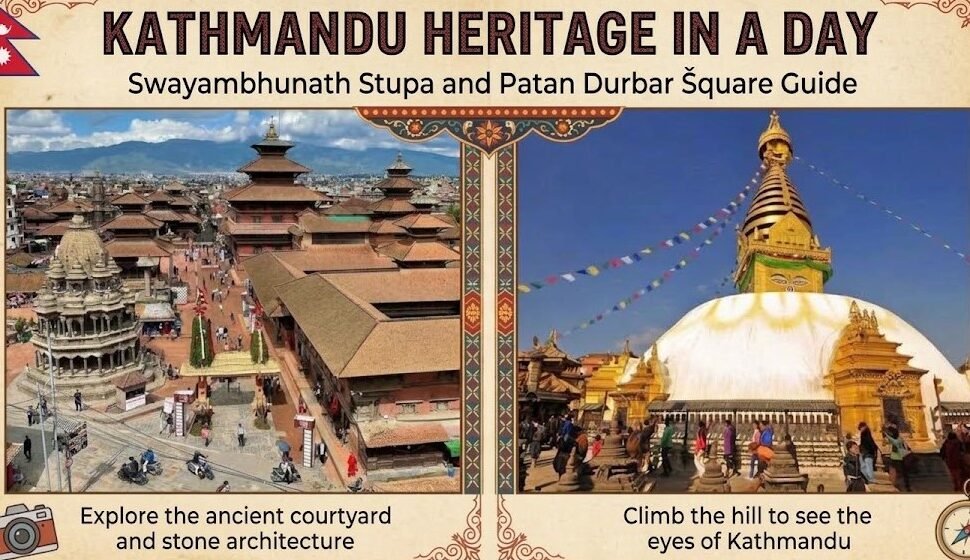
Kathmandu Durbar Square, Swayambhunath with its resident monkeys, the enormous white dome of Boudhanath, and the riverside area at Pashupatinath cover most of what makes the valley remarkable. Add the Garden of Dreams for an hour of quiet, the Patan Museum for one of the best small museums in South Asia, and a walk through the old streets of Patan or Bhaktapur where woodcarvers still work in open workshops.
The trick with Kathmandu is restraint. Two sites in the morning, lunch, a long break at the hotel, one thing in the late afternoon. Heat, dust and noise tire children faster than walking does. Thamel is entertaining for an hour and exhausting for three. A structured Kathmandu day tour with a vehicle between sites saves a great deal of energy compared with walking between them.
Pokhara with kids
Pokhara is the easiest city in Nepal for families. Phewa Lake has rowing boats children can help paddle. Sarangkot sunrise is a short drive and delivers the Annapurna range across the horizon. The cable car up to Sarangkot removes the climb entirely. Devi’s Fall and the Gupteshwor cave next to it are odd enough to hold attention. Begnas Lake is quieter than Phewa if you want an afternoon with nobody selling anything.
Short walks around the lakeside, the mountain museum, paragliders landing on the field by the water, and a warm evening with dinner outside make Pokhara the natural recovery point in any family itinerary.
Chitwan with kids
Chitwan National Park is where a lot of children decide the trip was worth it. One-horned rhinos are the headline, and sightings are common though never guaranteed. Beyond that: dugout canoe trips with crocodiles on the bank, deer, wild boar, kingfishers, hornbills, more than five hundred bird species, and guided nature walks with a naturalist who can explain tracks and calls.
Tharu villages nearby offer cultural visits and evening stick dance performances that children usually enjoy more than they expect to. Wildlife activities and jungle safari trips run in the early morning and late afternoon, which conveniently leaves the hot middle of the day free for a swim and a rest.
Nagarkot with kids
An hour and a half from Kathmandu on the valley rim, Nagarkot is the shortest possible escape from city noise. Clear mornings give a long Himalayan skyline including, on very good days, a distant Everest. Short walks along the ridge and through pine forest suit all ages. One or two nights is enough, and it works well as a first or last stop to buffer a flight.
Bandipur with kids
A restored Newari hill town on the Kathmandu to Pokhara road, Bandipur has a traffic-free main street, old shuttered houses, a viewpoint over the valley and almost nothing to do, which is the point. Children can wander safely, which is rare in Nepal. Adding a night here also breaks the long drive between the two main cities, which is a favour to everyone in the vehicle.
Best Family Treks in Nepal
Families do not need Everest. The best family treks in Nepal are short, low, and structured around villages rather than mileage. Suitability depends on the individual child, so treat these as starting points to discuss rather than guarantees.
Ghorepani Poon Hill Trek
The most popular family trek in the country for good reason. Four to five days, comfortable teahouses, forest and village walking, and a sunrise viewpoint at 3,210 metres with Dhaulagiri and Annapurna South in front of you. There are a lot of stone steps, which children generally handle better than their parents. Suitable for many active children from around eight upwards. The Ghorepani Poon Hill Trek can also be shortened for younger families, and there is a fuller Poon Hill trek guide covering the route in detail.
Australian Camp Trek
The gentlest real trek in the Annapurna region. Two days, a short drive from Pokhara, one night in a lodge on a ridge with a wide mountain view, and about three hours of walking each day. This is the ideal first trek for younger children or for families who are not sure whether trekking will work for them. The Australian Camp trek from Pokhara is often the best answer to the question “can we try it without committing to a week?”
Dhampus Trek
Similar in character to Australian Camp and often combined with it. Gurung villages, terraced fields, easy gradients and a large mountain view for very little effort. Can be done as a long day walk or an overnight, which makes it flexible when you are not sure how a child will cope.
Mardi Himal Trek
Better suited to older children and active teenagers. Five to seven days on a ridge trail through rhododendron forest, with high camp at around 3,550 metres and a viewpoint higher again. The scenery is exceptional and the trail is quieter than Poon Hill, but the altitude, the exposed sections and the daily distances mean the Mardi Himal Trek needs a genuine assessment of fitness rather than optimism.
Everest View Trek
The Everest region without the commitment of a full base camp expedition. A flight to Lukla, a few days walking to Namche Bazaar and the viewpoint above it, then back. Around six to eight days with proper acclimatisation. Altitude is the constraint: Namche sits at about 3,440 metres, so this needs a slow profile and honest monitoring. The Everest View Trek suits older children and teenagers who have hiked before, and is a far more sensible choice than the full Everest Base Camp Trek for anyone under about sixteen.
Langtang Valley Trek
Beautiful, culturally rich, and reached by road rather than by flight, which some families prefer. Seven to ten days through forest into a high glacial valley with Kyanjin Gompa at roughly 3,870 metres. The scenery and the village life are outstanding. The duration and the altitude mean the Langtang Valley Trek works for fit teenagers rather than young children, and the drive in from Kathmandu is long and rough.
For context on what is realistic, this list of beginner-friendly treks in Nepal is a useful companion. Longer routes such as the Annapurna Base Camp Trek and the Manaslu Circuit Trek sit firmly in adult and older-teenager territory.
Why Children Often Love Nepal’s Mountains
Something worth knowing before you go: the mountains do not impress children the way they impress adults. Adults look at Machapuchare and go quiet. Children look at it for about eight seconds and then ask what the yak is doing.
What actually holds them is the detail. Snow, which for many visiting children is a novelty in itself. Yaks and their bells. Suspension bridges with prayer flags shredded by wind. Rivers the colour of milk. Waterfalls beside the trail. Forests of rhododendron that are red in spring. Mani walls with carved stone. Small monasteries with butter lamps burning. Fried Tibetan bread with honey. The dog that adopts your group for three days.
The moment most parents describe afterwards is a quiet one. A child wakes early in a lodge in Ghandruk or Ghorepani, the window is cold, and outside it there is a wall of snow and rock lit orange, closer and larger than anything they have seen. They do not say much. They just look at it. That is the part that stays.
Wildlife Adventures in Nepal
Chitwan is the main draw, and Bardia in the far west is wilder, quieter and better for anyone serious about wildlife, at the cost of a much longer journey.
Realistically, families can hope to see greater one-horned rhinos, spotted deer, sambar, wild boar, langur and rhesus monkeys, mugger crocodiles, gharial, a large range of birds from kingfishers to hornbills, and a great many butterflies. Wild elephants move through both parks. Tigers are present in both and seen by a small minority of visitors.
Nothing is guaranteed, and that should be explained to children before the first game drive rather than after it. A morning in the park with no rhino is still a morning of tracks, alarm calls, birds and a naturalist explaining what left which print. Managing that expectation up front turns a potential disappointment into a proper lesson about wild animals in wild places.
In the mountains, wildlife is subtler: Himalayan monal, danphe, langur in the lower forest, occasional musk deer, and vultures riding thermals at eye level from a ridge. Give a child a bird book and a pair of binoculars and the walking speed problem often solves itself.
One point worth making to children directly: these animals are not in enclosures. Nobody feeds them, nobody puts them where you can see them, and everyone keeps their distance. That difference from a zoo is usually the thing children mention weeks later.
Food in Nepal With Children
Food is a smaller problem than most parents fear, provided you start familiar and expand slowly.
The national dish, dal bhat, is rice, lentil soup, vegetable curry and pickle, usually mild unless you add the chilli yourself, and it comes with refills. Momo, steamed or fried dumplings with vegetable, chicken or buff filling, are close to universally popular with children. Beyond that: fried rice, chow mein, noodle soup, Tibetan bread, pancakes, porridge, omelettes, boiled potatoes, and in trekking areas a reliable if unexciting spaghetti.
Kathmandu and Pokhara have restaurants covering Italian, Indian, Korean, Thai, Israeli, Japanese and standard Western menus, so a child who wants pizza after five days of rice can have pizza. In mountain lodges the menu narrows considerably and prices rise with altitude, because everything has been carried up.
Practical rules that work:
- Order food freshly cooked and hot rather than anything sitting out
- Drink only treated, filtered or boiled water, and use a filter bottle to cut plastic waste
- Skip raw salads, ice and unpeeled fruit outside good hotels
- Carry snacks your child already likes for long drives and slow trail sections
- Let children choose one new dish each day rather than being handed one
- Never force unfamiliar food, because a hungry child on a mountain is a genuine problem, not a discipline issue
Peanut butter, biscuits, dried fruit and chocolate travel well and solve more situations than any other item in the bag.
What Makes Nepalese People Welcoming to Families?
It is easy to overstate this, so here is the specific version instead. Children in Nepal are not treated as an inconvenience in public places. A crying toddler in a restaurant will more often get help than a hard look. Shopkeepers talk to children directly. In villages, local kids will approach visiting children within minutes, and language turns out not to matter much when the activity is throwing a ball.
Teahouse owners on trekking routes are used to families and will quietly adjust: food brought out earlier for the children, an extra blanket, a spot near the stove. Guides who work with families regularly develop the habit of watching the smallest walker rather than the fastest.
Some of this comes from a culture where extended families live together and children are simply part of adult space rather than separate from it. Whatever the reason, the practical effect is that travelling with children here is socially easier than in a lot of places.
Learning Through Nepalese Culture
Nepal packs an unusual amount of religious and cultural variety into a small area, and the overlap between Hindu and Buddhist practice is visible almost everywhere. Prayer wheels, prayer flags, stupas, shrines, courtyard temples, carved wooden struts, monks in maroon, sadhus in orange, festivals that shut whole streets.
Sightseeing with children works far better as a game than as a tour. A few things that reliably work:
- Ask your child how many prayer wheels they can spin in one circuit of Boudhanath, and which direction is correct
- Get them to find animals in temple carvings: elephants, lions, snakes, peacocks, garudas
- Let them count the eyes painted on stupas and work out what the third one is for
- Have them pick one local dish per day and order it themselves
- Ask them to spot the difference between a Hindu temple and a Buddhist monastery by the third day, and then explain it to you
- Give them the job of photographing one thing per site, chosen by them
Newari culture in the Kathmandu Valley, Sherpa culture in the Everest region and Tharu culture in the Terai are different enough from each other that children notice, and noticing is most of the point. If your dates land near a festival, that changes the trip entirely; the main festivals of Nepal are worth checking against your travel window.
Nepal Helps Children Become More Confident
Careful claims only here. Nobody comes home transformed by two weeks abroad. But there are specific, observable things that a trip like this asks of a child.
They carry their own small backpack and become responsible for their own water and jacket. They walk further than they thought they could and find out that tired is survivable. They order food in a language they do not speak. They use a squat toilet, get over it, and stop mentioning it. They talk to adults who are not family. They wait, because the bus is late and there is no alternative. They adapt to a room with no heating and a light that goes off at nine.
Those are small things individually. Together they make a child who is slightly more comfortable with unfamiliar situations than they were three weeks earlier. Parents tend to notice it first in something trivial, like a child who now packs their own bag without being asked.
Nepal Is Not Perfect for Every Family
Being honest about this is more useful than selling it.
Kathmandu is dusty and the air quality in winter can be poor. Drives are long and often bumpy, and a four hour estimate can become six. Roads in the hills are unsealed in places and some family members will feel travel sick. Outside Kathmandu and Pokhara, facilities are basic: limited hot water, occasional power cuts, patchy wifi, and toilets that are sometimes squat and sometimes not clean. Mountain accommodation is a plywood room and a shared bathroom, not a hotel. Weather rearranges plans without warning, and mountain flights to Lukla in particular are frequently delayed. Trekking involves several hours of walking a day, uphill, repeatedly.
So who should probably choose somewhere else? Families who need predictable schedules and guaranteed comfort. Families with a child who becomes distressed by unfamiliar food, noise or crowds. Families with a very short trip and no tolerance for a lost day. Families where nobody wants to walk. Families with a serious medical condition that needs quick access to a hospital.
There is no shame in any of that. Nepal is a rewarding country for families precisely because it asks something of them, and that will not suit everyone.
How Many Days Should a Family Spend in Nepal?
Short answer: ten to fourteen days is the sweet spot for a first family trip to Nepal. Seven days is enough for Kathmandu and Pokhara. Anything under five is not worth the flights.
- 5-7 days: Kathmandu and Pokhara. Culture, lake, mountain views, no trekking. Comfortable and easy.
- 8-10 days: Add Chitwan. This is the classic Nepal family itinerary and covers culture, wildlife and mountains without rushing.
- 10-14 days: Add a short trek of two to four days, usually in the Annapurna foothills from Pokhara.
- 14+ days: A longer family trek such as Ghorepani Poon Hill or Everest View, or a broader combination including Bandipur, Nagarkot or Lumbini.
The most common planning mistake is trying to see everything. Nepal punishes packed itineraries because the transport does not cooperate. Two nights minimum in each place, three where possible, and accept that you will miss things. You will enjoy the trip considerably more.
Example 7-Day Family Nepal Itinerary
Day 1: Arrive Kathmandu. Transfer to hotel, rest, short walk in the evening. Children enjoy: the flight arrival over the hills, and the first street food.
Day 2: Kathmandu sightseeing. Swayambhunath in the morning, break at the hotel, Boudhanath in the late afternoon. Children enjoy: monkeys, the big dome, spinning prayer wheels, pigeons.
Day 3: Kathmandu to Pokhara. Drive or short flight. If driving, break the journey with a riverside lunch stop. Children enjoy: the river valleys, the rope bridges visible from the road, snacks.
Day 4: Pokhara. Boating on Phewa Lake, lakeside walk, Devi’s Fall and the cave. Children enjoy: rowing the boat themselves, the cave, ice cream.
Day 5: Sarangkot and a short hike. Early start for sunrise, breakfast at the top, easy walk down or cable car. Afternoon free. Children enjoy: the mountain skyline, paragliders taking off, the descent.
Day 6: Pokhara to Kathmandu. Travel, then souvenir shopping in Patan or Thamel. Children enjoy: choosing something to take home, and the woodcarving workshops.
Day 7: Depart. Optional Garden of Dreams or Patan Museum if the flight is late.
Example 10-Day Family Nepal Itinerary
Days 1-3: Kathmandu. Arrival, then two days of valley sightseeing with an afternoon break each day. Patan and Bhaktapur are worth more of your time than Thamel.
Days 4-5: Chitwan. Drive south to the Terai. Two nights, with morning and late afternoon wildlife activities, a canoe trip, a nature walk and a Tharu cultural evening.
Days 6-8: Pokhara. Drive west. Lake, Sarangkot sunrise, a short hike to Australian Camp or Dhampus if the family is keen, and one genuinely lazy day.
Days 9-10: Kathmandu and departure. Return by flight to save a day, last sightseeing, shopping, fly out.
Why it works: it moves through three different Nepals, hills, jungle and mountains, and each transition gives children something new to look at just as the previous place starts to feel familiar. It also puts the physically demanding parts in the middle and the easy parts at both ends. This structure is close to the standard 10 day Nepal family tour most families end up choosing.
Example Family Trekking Holiday
A realistic twelve day version combining cities and a short trek:
- Days 1-2: Kathmandu. Arrival, valley sightseeing, trek briefing and kit check.
- Day 3: Fly or drive to Pokhara. Rest, lakeside evening.
- Day 4: Drive to Nayapul, trek to Tikhedhunga or Hile. Around 3 to 4 hours walking.
- Day 5: Trek to Ghorepani. This is the long day, roughly 5 to 6 hours with a great many stone steps, taken slowly with frequent stops.
- Day 6: Poon Hill sunrise, then trek to Tadapani. Around 5 hours with a downhill second half.
- Day 7: Trek to Ghandruk. Around 3 hours. Afternoon in the village, which children usually like more than the walking.
- Day 8: Trek out and drive to Pokhara. Hot shower, proper bed, celebration dinner.
- Day 9: Rest day in Pokhara. Nothing scheduled before eleven.
- Days 10-11: Return to Kathmandu, free time, shopping.
- Day 12: Departure.
Practical notes on this kind of trip. Walking is four to five hours on average, not eight. Accommodation is teahouses with twin rooms, shared bathrooms and a heated dining room. Meals are ordered from a menu at each lodge, three meals a day included. One guide and one porter per two people is a comfortable ratio for families, and the porter matters more than parents expect, because carrying a child’s pack for the last hour of the day is often what prevents a bad evening. Transport between Pokhara and the trailhead is by private vehicle. A spare day in the plan absorbs weather or a slow child without wrecking the flights.
Any family trek can be adjusted, and a customised Nepal trekking itinerary is usually a better fit than a fixed departure when children are involved.
What Should Parents Pack for Nepal?
Packing depends heavily on season and destination. A Chitwan trip in April and a Poon Hill trek in December need almost nothing in common. Treat this as a base list.
Clothing
- Layers rather than bulk: base layer, fleece or mid layer, windproof and waterproof outer
- Lightweight trousers, shorts and t-shirts for lower altitudes
- Warm hat, gloves and a buff for the mountains, even in spring
- Sun hat and good sunglasses, because UV at altitude is fierce
- Shoulder and knee covering for temple and monastery visits
- Comfortable walking shoes already broken in, plus sandals for evenings
For children specifically
- More changes of clothes than you think, because laundry is slow
- A small backpack they carry themselves, with their water and jacket
- Sun cream with high SPF, lip balm, and a wide brimmed hat
- Snacks from home for long drives and the first few days
- A refillable water bottle, ideally with a filter
- Wet wipes, hand sanitiser and tissues in every bag, because toilet paper is not standard
- A book, a card game and a notebook for waiting time
- A cheap camera or an old phone if they like taking photos
- Any regular medication in original packaging, plus a copy of the prescription
- A favourite small comfort item for younger children
For trekking
- Daypack with rain cover, and a duffel for the porter
- Sleeping bag rated appropriately for the season and altitude
- Down jacket for anything above 3,000 metres
- Trekking poles, which help children on descents more than on climbs
- Head torch each, with spare batteries
- Blister plasters, tape, painkillers, rehydration salts and a basic first aid kit
- Power bank, since charging in lodges costs extra and is not always available
- Water purification tablets or a filter bottle
- Cash in Nepali rupees, because there are no ATMs on the trail
How to Keep Children Interested During the Trip
Children do not need entertaining every minute, and a trip where every gap is filled is exhausting for everyone. But a few small structures help enormously.
Give them a camera and a daily photo assignment. Hand them a travel journal and ask for three lines a night, or drawings if writing is a struggle. Let them choose one meal a day, including the right to choose badly. Turn walking into counting: suspension bridges crossed, prayer wheels spun, rhinos seen, dogs met, mani stones passed. Set small challenges, like learning one Nepali word each morning and using it before dinner. Give them a job, such as navigator with the map, or the person who checks nobody left anything in the room.
Let them lead sometimes. A child at the front of a trekking group walks noticeably faster than a child at the back.
And leave gaps. Some of the best hours on a Nepal family trip are the ones where nothing is planned and a child ends up playing an incomprehensible game with three village kids in a courtyard.
Useful Nepali Words Children Can Learn
Nepali is phonetic and forgiving, and children pick it up quickly. Six words go a long way.
| Word | Meaning | How to use it |
|---|---|---|
| Namaste | Hello / greetings | Palms together, said to everyone |
| Dhanyabad | Thank you | After food, help, or a shop purchase |
| Ramro | Good / beautiful | Point at a mountain and say it |
| Pani | Water | Useful several times a day |
| Ho | Yes | For agreeing |
| Hoina | No | For declining politely |
Namaste is the one that matters. A child who greets a teahouse owner with hands together and a Namaste will get a reaction that they remember for the rest of the trip, and it teaches something about respect that no amount of explaining does.
Best Time to Visit Nepal With Children
There is no single best season. It depends entirely on where you are going and what you want to do.
Spring, March to May. Warm, rhododendron forests in flower, good trekking conditions, clear mornings with more haze later in the day. The Terai gets hot by May. Popular, so trails and lodges are busy. Strong all-round choice for families.
Monsoon, June to September. Rain, humidity, leeches on lower trails, landslides and flight delays. Everything is green and there are very few tourists. Upper Mustang and Dolpo sit in the rain shadow and stay dry. Not the easiest season with young children, but the cities are still perfectly workable and prices are lower.
Autumn, October and November. The clearest skies of the year, stable weather, comfortable temperatures, and the big festivals of Dashain and Tihar. This is peak season, which means busy trails, full lodges and higher prices. If mountain views are the priority, this is the window.
Winter, December to February. Cold at altitude and some high passes close, but the valleys are mild, the visibility is often excellent and the crowds are gone. Kathmandu, Pokhara, Chitwan and low treks like Australian Camp work well. Bring proper warm clothing for mornings and evenings, since heating is uncommon.
For most families with school-age children, October to November or March to April are the practical choices. If you are tied to summer holidays in July and August, keep the trip low, keep it flexible and build in spare days.
Altitude and Children
Altitude deserves its own section because it is the one risk that a good itinerary controls and a bad one ignores.
The general principles that apply to everyone apply to children too: ascend gradually, sleep no more than about 300 to 500 metres higher each night above 3,000 metres, build in rest days, drink plenty of water, and treat any symptoms as a reason to stop climbing rather than to push on.
The difference with children is communication. A young child may not distinguish between altitude symptoms and simply being tired, cold or homesick, and may not report feeling unwell at all. That puts the responsibility on the adults to watch behaviour: unusual quietness, loss of appetite, poor sleep, headache, nausea, unsteadiness. Any of these should be taken seriously and discussed with your guide immediately.
Choose routes appropriate to the age of the child. Low treks in the Annapurna foothills, mostly under 3,000 metres, remove the problem almost entirely. Routes to Namche Bazaar or Kyanjin Gompa need a slower schedule than an adult group would use.
This guide does not offer medical advice. Before booking any trip that goes above 2,500 metres with a child, talk to a doctor with travel medicine experience about your specific child, and be prepared to hear that a lower route is the better plan.
Why Hiring a Local Family-Friendly Guide Can Make a Difference
A guide is optional for a city trip and close to essential for a family trek, and the difference is not just route-finding.
A guide used to families sets the pace by the slowest walker instead of the fastest. They know which teahouse has a warm dining room and which one has a kitchen that will cook a plate of chips at four in the afternoon for a child who has stopped speaking. They read the weather and suggest leaving an hour earlier. They rearrange the day when a child is tired, rather than treating the itinerary as fixed.
They also make sightseeing work. A temple recited as a list of dates and dynasties will lose a nine year old within ninety seconds. The same temple explained through a story about a god, a demon and a mistake will hold them all the way round. That is a skill, and it is the main reason a guided day in Kathmandu feels completely different from an unguided one.
Practically, a guide handles permits and TIMS cards, speaks to lodge owners in Nepali about food and rooms, watches for altitude symptoms, deals with transport, and knows exactly who to call and how evacuation works if something goes wrong. For a family, that last point alone is usually worth the cost. Our full range of Nepal trekking routes is guided by local staff who work these trails year round.
Why Choose Next Trip Nepal for a Family Adventure?
Next Trip Nepal is a Nepal-based trekking and travel company registered in Kathmandu, and our approach to family trips is fairly simple: the itinerary is built around your children rather than the other way around.
That means asking about the things that actually determine whether a trip works. The ages of your children and how they cope with long days. Whether anyone in the family has trekked before. How many days you genuinely have, after flights. Fitness across the whole group, including the adults. The season you are travelling in. How much comfort you need at the end of a walking day. And what you want to spend.
The answers change the plan considerably. A family with a four year old and a nine year old gets a different route from a family with two teenagers, and both get a different route from a multi-generational group with grandparents along. Private family trips give the flexibility to adjust in real time, so a slow morning does not become a lost day, and a child who is tired at lunchtime does not have to keep walking because eleven other people are waiting.
Our Nepal family tours cover the standard combinations of Kathmandu, Pokhara and Chitwan as well as short family treks in the Annapurna foothills, and every one of them can be shortened, lengthened or rearranged.
Planning Nepal with your children? Talk to the Next Trip Nepal team about creating a family itinerary that fits your family, not the other way around. You can reach us on WhatsApp at +977 9869225929, email nexttripnepal@gmail.com, or through the contact page. Our office is in Thamel, Kathmandu.
Go Higher With Confidence.
Frequently Asked Questions
Is Nepal good for families with children?
Yes, for the right kind of family. Nepal works particularly well for families who want their children outdoors, meeting people and doing things rather than being entertained. Children get mountains, wildlife, villages, temples and physical activity in a country where they are genuinely welcome in public spaces. It is less suited to families who need predictable comfort, short travel times and familiar food at every meal. The country asks a bit of effort, and returns a great deal for it.
What is the best age for children to visit Nepal?
Roughly six to twelve tends to be the easiest bracket. Children this age can walk a few hours, remember what they see, are still openly excited by animals and mountains, and do not need carrying. Teenagers do well too, particularly on treks and adventure activities where the physical challenge is the appeal. Toddlers and babies are entirely possible but require a much shorter, lower, slower trip based in Kathmandu, Pokhara and Chitwan.
Is Nepal safe for kids?
Nepal has low levels of violent crime and a strong culture of hospitality, so the risks for families are mostly environmental rather than criminal. The real things to manage are road travel, altitude, food and water hygiene, uneven ground and simple fatigue. Most of these are handled by a sensible itinerary, private transport, treated water, a guide who has worked with families, and travel insurance that covers trekking altitude and helicopter evacuation. No destination is completely safe, and Nepal should not be described that way.
Can we trek with children in Nepal?
Yes, and many families do. The key is choosing a route built for short days and low altitude rather than adapting an adult itinerary. Two to five day treks in the Annapurna foothills, with three to five hours of walking a day and comfortable teahouses each night, work well for many children from around six to eight upwards. Younger children can manage day walks and overnight trips. Hiring a porter is worth it, because carrying a child’s pack at the end of the day often makes the difference between a good evening and a bad one.
What is the easiest family trek in Nepal?
The Australian Camp trek from Pokhara is the gentlest genuine trek in the country: two days, around three hours of walking each day, one night in a ridge lodge with a wide Annapurna view, and a short drive from Pokhara at both ends. Dhampus is similar and can be combined with it. Both are excellent first treks for a family that wants to test whether trekking suits them before committing to something longer.
Is Everest Base Camp suitable for children?
Generally no, for anyone under about sixteen. The route reaches 5,364 metres, takes twelve to fourteen days, involves consecutive long walking days at high altitude, and depends on flights to Lukla that are frequently delayed. Altitude is the main issue, and children do not always report symptoms clearly. The Everest View trek to Namche Bazaar gives the same region, the same culture and genuine Everest views at a much more sensible elevation, and is a far better choice for older children and teenagers.
Is Pokhara good for children?
Pokhara is the easiest place in Nepal for families. It sits at low elevation, the lakeside is walkable and calm, and there is a good mix of activity and rest: boating on Phewa Lake, the cable car and sunrise at Sarangkot, Devi’s Fall and the cave, Begnas Lake, and short walks into the surrounding hills. Accommodation, restaurants and medical facilities are all reasonable. Most families use it as the recovery point in the middle of a trip.
Is Chitwan good for families?
Chitwan is often the highlight for children. Greater one-horned rhinos are commonly seen, though never guaranteed, and the range of activities suits a range of ages: dugout canoe trips, guided nature walks, birdwatching, jeep safaris and Tharu cultural evenings. Activities run early morning and late afternoon, leaving the hot middle of the day free. Two nights is the minimum that makes the journey worthwhile, and three is better if you want more than one attempt at a good sighting.
What should children eat in Nepal?
Start with what they know and expand gradually. Rice, noodles, eggs, potatoes, bread, pancakes and pasta are available almost everywhere, and Kathmandu and Pokhara have a wide range of international restaurants. Momo, steamed dumplings, are usually an instant success. Dal bhat is mild, filling and refillable. Stick to food that is freshly cooked and hot, avoid raw salads and unpeeled fruit outside good hotels, drink only treated or boiled water, and carry familiar snacks for long drives. Never force unfamiliar food on a child who is about to walk uphill.
How many days do we need in Nepal as a family?
Ten to fourteen days is the practical sweet spot for a first trip. Five to seven days covers Kathmandu and Pokhara. Eight to ten adds Chitwan, which is the classic family combination. Ten to fourteen allows a short trek as well. Anything beyond two weeks opens up longer treks or additional regions. The most common mistake is compressing too many places into too few days, because road journeys take longer than the map suggests and children need recovery time.
What should we pack for children in Nepal?
Layers rather than bulk, since temperatures swing widely between valley and mountain and between midday and evening. Broken-in walking shoes, a sun hat, high-factor sun cream and good sunglasses. A small backpack each child carries themselves, a refillable filter water bottle, wet wipes and hand sanitiser, and snacks from home for the first few days and for long drives. More changes of clothes than you expect, because laundry is slow. For trekking, add a season-appropriate sleeping bag, a warm jacket, a head torch each and a basic first aid kit. Exact needs depend heavily on season and destination.
Can toddlers travel to Nepal?
Yes, with a much simpler plan. Stay low, stay slow, and base the trip on Kathmandu, Pokhara and Chitwan. Use private vehicles so you can stop when you need to, bring a good child carrier instead of a pushchair, book accommodation with reliable hot water, and limit yourself to about two activities a day. Nappies and formula are sold in Kathmandu and Pokhara but the range is limited, so bring what your child uses. Long or high-altitude treks are not appropriate for very young children without specific medical and professional trekking advice.
Is altitude dangerous for children?
Altitude needs to be respected at any age, and the main difference with children is that they may not clearly report how they feel. Symptoms such as headache, nausea, loss of appetite, poor sleep or unusual quietness need to be noticed by the adults rather than announced by the child. The controls are the same as for adults: gradual ascent, limited height gain per night above 3,000 metres, rest days, plenty of water, and stopping rather than pushing on if anyone is unwell. Choosing routes that stay below 3,000 metres removes most of the concern. Speak to a doctor with travel medicine experience before booking any high-altitude trip with a child.
Should families hire a guide in Nepal?
For trekking, yes, and for city sightseeing it makes a substantial difference. A guide who works with families sets the pace by the slowest walker, knows which lodges suit children, watches for altitude symptoms, handles permits and transport, and knows exactly what to do in an emergency. Just as importantly, a good guide makes temples and monasteries interesting to a nine year old by telling stories rather than reciting dates, which changes how much of the trip a child actually engages with.
What is the best season for a family trip to Nepal?
It depends on where you are going. Autumn, October and November, has the clearest mountain views and the most stable weather, but it is peak season and busy. Spring, March to May, is warm, colourful and excellent for trekking, with the Terai getting hot late in the season. Winter, December to February, is cold at altitude but bright and quiet in the valleys, and works well for Kathmandu, Pokhara, Chitwan and low treks. Monsoon, June to September, brings rain, leeches and flight delays, though the rain-shadow regions stay dry and prices drop. There is no single best season, only the best fit for your dates and your plans.
Final Thoughts
The point of taking children to Nepal is not the list of places you visit. It is the collection of first times they come home with.
The first Himalayan peak seen properly, close and enormous and slightly unbelievable. The first momo. A monkey crossing a temple roof with something stolen. A rhino standing in grass in Chitwan while everyone goes quiet. A suspension bridge that swayed more than expected. A conversation with a mountain guide who has climbed things the child cannot imagine. A night in a village where the electricity went off and the stars were absurd. Snow, for a child who has never touched it. Saying Namaste to a stranger and getting a proper smile back.
Those moments do not appear on any itinerary, and none of them can be booked. They happen because a child was placed somewhere genuinely different and given room to react to it.
Nepal is a family destination that rewards a bit of planning and a certain amount of flexibility. Get the pace right, keep the days realistic, choose routes that suit the age of your children, and the country does the rest.
If you are thinking about it, start with the ages of your children and the number of days you have, and build from there. That is where every good family trip to Nepal begins.