Two very different products share the same two words in almost every conversation we have with travelers planning a short trip to see Everest from Kathmandu. Someone asks about the mountain flight and means the helicopter tour. Someone else asks about the helicopter tour and means the fixed wing flight. The confusion is understandable, since both trips start at Tribhuvan International Airport before sunrise, both promise close up views of Everest, and both are marketed in Kathmandu as the fast alternative to trekking. They are, in practice, two genuinely different experiences built around different aircraft, different altitudes, and a price difference of roughly a thousand dollars per person. This article lays out that difference plainly, using real numbers from our own two products, the Everest Scenic Flight by ATR plane and the Everest Base Camp Helicopter Tour, so you can choose the one that actually matches what you want out of your morning rather than booking the wrong one by accident. We run both trips ourselves out of Kathmandu, which means we have no reason to steer you toward the more expensive option simply because it earns us more, and every comparison below is written with that in mind.
The Short Version, For Readers in a Hurry
The ATR mountain flight is a one hour round trip sightseeing flight on a fixed wing aircraft that never lands anywhere but Kathmandu, priced at 199 US dollars per person, with a door to door time of under three hours. The helicopter tour is a four to five hour excursion that actually lands near Kala Patthar above 5,500 meters for a ground stop with direct views of Everest’s summit, typically includes a breakfast stop at Hotel Everest View, and is priced from roughly 1,150 to 1,350 US dollars per person depending on group size, plus a government permit levy paid locally. If your priority is seeing Everest clearly at the lowest realistic cost and time commitment, the fixed wing flight is built for that. If actually standing on the ground at high altitude near Everest, even briefly, matters more to you than price, the helicopter tour is the only one of the two that delivers it. Everything below explains why, in enough detail to make an informed choice rather than a guess.
What the Everest Scenic Flight by ATR Plane Actually Is
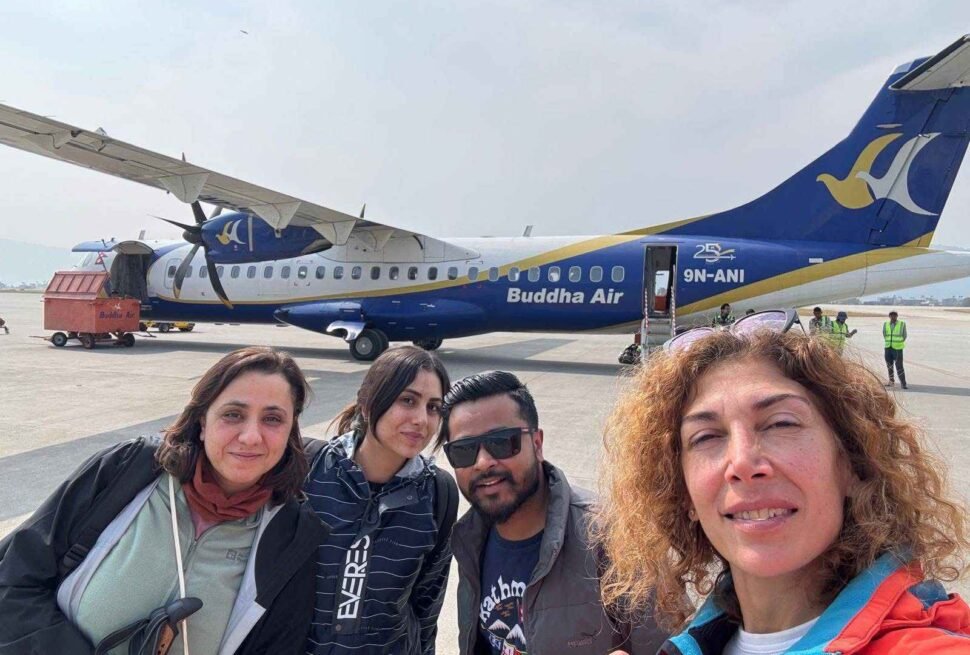
The Everest Scenic Flight is a one hour round trip on a small, fixed wing turboprop aircraft seating roughly fifteen to eighteen passengers, operated by one of Nepal’s CAAN licensed domestic carriers, most commonly Buddha Air, Yeti Airlines, or Shree Airlines. You leave your Kathmandu hotel before sunrise, check in at the airline’s domestic mountain flight counter, board the aircraft, and fly a route that passes close to Everest and more than a dozen other named Himalayan peaks before returning directly to Kathmandu. The aircraft never lands anywhere in the Everest region. Every part of the flight after takeoff is spent in the air, and the entire experience, from hotel pickup to hotel drop off, typically takes a little under three hours. We cover this flight in much more depth, including the full route peak by peak and an hour by hour breakdown of the morning, in our complete guide to the mountain flight by ATR plane.
What the Everest Base Camp Helicopter Tour Actually Is
The Everest Base Camp Helicopter Tour is a substantially longer and more involved trip. Departing Kathmandu in the early morning, the helicopter flies through the Khumbu Valley, typically with a brief refueling stop at Lukla, passes over Namche Bazaar and Tengboche Monastery, and flies near Everest Base Camp itself at 5,364 meters before landing at or near Kala Patthar, generally cited at around 5,545 to 5,644 meters, for a ground stop usually lasting ten to fifteen minutes with direct, close range views of Everest’s summit pyramid. Most tours then descend to Hotel Everest View at 3,880 meters, one of the highest altitude operating hotels in the world, for a breakfast stop before returning to Kathmandu. The full tour runs roughly four to five hours door to door. Unlike the fixed wing flight, this tour puts you on the ground at real high altitude, briefly, which is the single biggest practical difference between the two trips and the one that drives most of the other differences in price, risk, and experience described below.
Price Comparison in Real Numbers
This is usually the first thing travelers want to know, and the gap is large enough that it is worth stating plainly rather than softening it. The Everest Scenic Flight is 199 US dollars per person, a flat rate regardless of group size, including your flight ticket, all airport and domestic flight taxes, a guaranteed window seat, and hotel pickup and drop off in Kathmandu. The Everest Base Camp Helicopter Tour starts at 1,350 US dollars per person for a solo traveler, dropping to around 1,250 US dollars per person for two to three travelers sharing a flight, and around 1,150 US dollars per person for four to five travelers, since the cost of the helicopter charter is effectively shared across the group. On top of that, a government permit levy of approximately 7,000 Nepali rupees per person, covering the Sagarmatha National Park permit and related airport and municipality fees, is payable locally on the day of the tour, along with an optional breakfast charge at Hotel Everest View of around 4,000 Nepali rupees if you want to eat there rather than bring your own snack.
Put simply, a solo traveler pays roughly seven times more for the helicopter tour than for the fixed wing flight, and even a group of four or five sharing a helicopter still pays close to six times more per person. Neither price is unreasonable for what each trip delivers, a scheduled seat on a small plane versus a private or shared helicopter charter that actually lands at extreme altitude, but the gap is large enough that price alone settles the decision for a meaningful share of travelers before any other factor comes into play.
Time Commitment Comparison
The fixed wing flight is the faster trip by a wide margin. Door to door, from hotel pickup to hotel drop off, it typically takes a little under three hours, with the flight itself lasting about an hour round trip. The helicopter tour takes four to five hours door to door, with each leg of the flight alone running roughly one hour and fifteen minutes to one hour and thirty minutes, plus the time spent on the ground at Kala Patthar and at the breakfast stop. For a traveler with only a day or two in Kathmandu, or one who wants the Everest activity to fit into a single early morning without eating into the rest of the day’s plans, the fixed wing flight leaves you back at your hotel in time for a normal breakfast with most of the day still ahead. The helicopter tour, while still a single morning activity, takes a meaningfully larger bite out of your day and is harder to combine with much else before early afternoon.
Altitude Exposure and Who Should Think Twice
This is the comparison that matters most for health and safety planning, and it is worth being specific rather than vague about it. On the fixed wing mountain flight, you never leave the pressurized or lightly pressurized cabin, and the aircraft returns to Kathmandu’s altitude of roughly 1,400 meters without any ground exposure at high altitude at all. For travelers who cannot or should not be at high altitude for medical reasons, including certain heart or respiratory conditions, this makes the fixed wing flight the meaningfully safer choice, since the altitude risk that exists on the helicopter tour simply is not present in the same way here.
The helicopter tour is a different story. It takes you from Kathmandu’s roughly 1,400 meters to a ground stop above 5,500 meters in well under an hour, with no time for the gradual acclimatization that trekking to the same altitude would normally involve. Most passengers experience, at most, a mild headache or brief dizziness at the landing site, and these symptoms generally resolve quickly once the helicopter descends again, since the ground stop itself only lasts ten to fifteen minutes. Serious altitude sickness on a tour this short is uncommon, but it is not impossible, and operators generally advise that travelers with severe heart disease, recent cardiac surgery, serious respiratory conditions, uncontrolled high blood pressure, or a history of altitude related illness consult a doctor before booking, or consider the fixed wing flight instead, which carries essentially none of this specific risk.
What You Actually See From Each Trip
Both trips show you Everest and a long list of neighboring peaks, but the vantage point is different enough to matter. On the fixed wing flight, you see the mountains from a distance of roughly twenty to thirty kilometers at the closest point, which is still close enough for a clear, detailed view in good weather, with the aircraft holding its position for several minutes so every passenger on both sides gets a proper look. On the helicopter tour, the aircraft flies substantially closer to the terrain throughout the route, passing low over the Khumbu Glacier and Icefall before climbing to land directly beside the summit pyramid’s closest ground accessible vantage point. Photographs from Kala Patthar tend to show Everest larger in frame and with more visible detail on the mountain’s southern flank than photographs taken from the fixed wing flight’s higher, more distant cruising pass, simply because you are standing much closer to the mountain rather than viewing it from a moving aircraft further away.
That said, the fixed wing flight has its own advantage worth mentioning: because every seat is a guaranteed window seat and the aircraft is not actively landing or maneuvering at altitude, photography during the main viewing pass tends to be calmer and steadier than trying to shoot photos during a brief, cold, and sometimes rushed ground stop on the helicopter tour, where you are managing the altitude, the cold, and a short window of time all at once.
The Honest Case for the Fixed Wing Mountain Flight
Choose the ATR mountain flight if price is a real factor in your trip, if you have limited time in Kathmandu and want the Everest activity to take up only a small part of your morning, if you or someone in your travel party has a health condition that makes high altitude exposure a genuine concern even for ten minutes, if you are travelling with young children or infants where any altitude exposure is best avoided entirely, or if seeing Everest clearly from the air, without needing to physically stand near it, already satisfies what you came for. This is also the more practical choice for larger families or groups who want everyone travelling together without the cost scaling as steeply as it does on a shared helicopter charter.
The Honest Case for the Helicopter Tour
Choose the helicopter tour if actually standing on the ground near Everest, even for ten or fifteen minutes, is something you specifically want and the cost difference is not a deciding factor. Choose it if you want the Khumbu flyover experience, passing low over Namche Bazaar, Tengboche Monastery, and the Khumbu Icefall on the way, rather than only the higher, more distant cruising view the fixed wing flight offers. Choose it if a mountain breakfast at one of the world’s highest altitude hotels, with Ama Dablam framed in the dining room window, is part of what you are hoping to get out of the morning. And choose it if you are in reasonably good health, free of the specific medical concerns that make rapid ascent to over 5,500 meters inadvisable, since the ground stop, while brief, is real high altitude exposure and not a simulated or pressurized equivalent.
What to Pack for Each Trip
Packing for the two trips overlaps less than you might expect, mainly because of the altitude difference. For the fixed wing mountain flight, you need very little beyond your passport or photo identification for airline check in, a charged camera or phone, a light jacket since early mornings in Kathmandu are cool before sunrise, and sunglasses for glare once the sun is up. There is no technical gear requirement and no altitude clothing needed, since you never leave the cabin.
The helicopter tour calls for genuine cold weather gear, since the ground stop at over 5,500 meters can be well below freezing even in spring and autumn. A warm down jacket over a mid layer, thermal base layers, warm waterproof gloves, a wool or fleece hat, and solid footwear are all worth bringing, along with sunglasses and sunscreen, since UV exposure at that altitude is intense even on a cold morning. Inside the helicopter cabin it is warmer, so layers you can remove partway through the tour are more practical than a single heavy outfit worn the entire time.
A Short History of How Both Trips Became Popular in Nepal
The fixed wing mountain flight has the longer history of the two. Aerial sightseeing near Everest goes back to 1933, when a British pilot flew an open cockpit biplane over the range in brutal winter conditions, decades before anyone reached the summit on foot. Scheduled sightseeing flights followed much later, with Royal Nepal Airlines running early mountain flights from the 1960s onward, and private carriers including Buddha Air turning the Everest flight into a dedicated tourism product after Nepal’s domestic aviation sector opened to private operators. The helicopter tour is a newer development, growing out of Nepal’s helicopter charter industry, which originally served trekking rescue and cargo work in the Everest and Annapurna regions before operators began offering dedicated sightseeing and landing tours as tourist demand for a faster, closer Everest experience increased through the 2000s and 2010s. Today both trips run as established, regularly scheduled tourism products rather than novelty experiences, each with its own established route, pricing structure, and operator network across Kathmandu.
What Past Travelers Say About Each Experience
We maintain detailed, named traveler reviews on our Everest Base Camp Helicopter Tour page, and the recurring themes in that feedback are worth mentioning here since they illustrate what the ground stop actually feels like for most people. Travelers consistently describe the moment of stepping out of the helicopter at Kala Patthar as the emotional high point of the tour, several mentioning being too struck by the scale of Everest at close range to speak for the first few minutes, and multiple reviews specifically praise the breakfast stop at the mountain hotel as a highlight rather than an afterthought. We are still building an equally detailed public review history for the fixed wing flight specifically, and travelers who have taken it tend to describe it in different terms, less about an emotional peak moment and more about an efficient, comfortable, and surprisingly calm way to see the same mountain range without the cold, the altitude, or the four hour time commitment. Both sets of feedback are consistent with what the two trips are actually designed to deliver, which is reassuring from an honesty standpoint even if it does not settle the choice for you on its own.
Combining Either Trip With a Kathmandu City Tour
Because both trips return you to Kathmandu by mid morning at the latest, many travelers pair either one with a Kathmandu Valley heritage tour covering UNESCO World Heritage Sites such as Swayambhunath, Boudhanath, Pashupatinath, or Kathmandu Durbar Square on the same afternoon. This works more comfortably after the fixed wing flight, which frees up your day by around eight thirty in the morning, than after the helicopter tour, which can run past noon depending on your specific package and the morning’s weather. If you want to combine either trip with a city tour or a longer Nepal itinerary covering Pokhara or Chitwan, let us know when you enquire and we will put together a combined schedule around your dates rather than booking the flight or tour in isolation.
Can You Realistically Do Both on the Same Trip?
Some travelers ask whether it makes sense to do both trips during the same visit to Nepal, and the honest answer is that it depends entirely on your budget and your schedule rather than on any logistical conflict between the two. There is nothing stopping you from booking the fixed wing flight on one morning and the helicopter tour on another, and a small number of travelers with a longer Kathmandu stay and sufficient budget do exactly that, often because the fixed wing flight is inexpensive enough to add without much deliberation, while the helicopter tour remains the larger splurge reserved for a specific day. For most travelers working with a single Kathmandu morning and a defined budget, though, the choice comes down to picking the one trip that matches what actually matters most to you, price, time, or the experience of physically standing near the mountain, rather than trying to fit both into one visit.
Noise, Motion, and General Comfort Compared
The two aircraft feel quite different to ride in, and it is worth setting expectations honestly rather than letting you assume one is simply a smaller version of the other. The fixed wing aircraft used for the mountain flight is noticeably loud inside the cabin, since propeller engines run close to the fuselage and the plane itself is lighter and less soundproofed than a larger commercial jet, though most airlines provide earplugs and the flight is short enough that the noise rarely becomes a real problem. Motion on the fixed wing flight tends to be mild, since mountain mornings are calm and the route is scheduled specifically for the stillest part of the day, though some bumps are normal over mountainous terrain as with any flight in the Himalaya.
The helicopter cabin is generally quieter in relative terms once headsets are worn, since most tour operators provide noise cancelling headsets that also let passengers hear the pilot’s commentary clearly during the flight. Motion on a helicopter is different in character from a fixed wing aircraft, involving more noticeable shifts during climbs, descents, and the approach to landing at altitude, which some passengers find more exciting and others find more unsettling, particularly first time helicopter passengers. Neither aircraft type is inherently more comfortable than the other, and the better fit genuinely depends on your own tolerance for engine noise versus your tolerance for the more dynamic motion of helicopter flight.
A Direct Side by Side on the Details That Matter Most
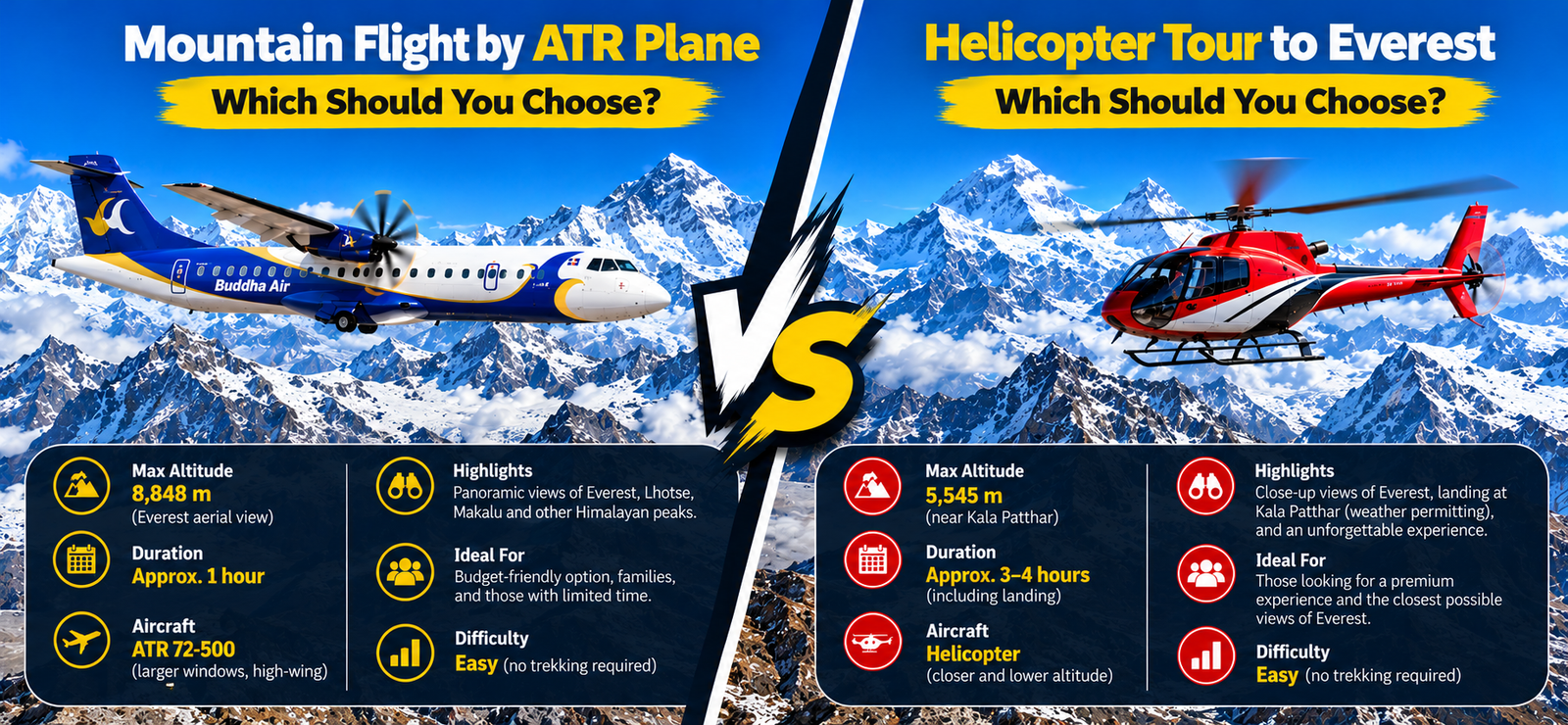
Laid out plainly, the fixed wing mountain flight costs 199 US dollars per person regardless of group size, takes under three hours door to door, never lands anywhere outside Kathmandu, involves no high altitude ground exposure, and is generally the more conservative choice for health, budget, and time. The helicopter tour costs between roughly 1,150 and 1,350 US dollars per person depending on group size, plus a local permit levy, takes four to five hours door to door, lands near Kala Patthar above 5,500 meters for a ground stop, involves genuine rapid altitude exposure, and delivers a physically closer, more dramatic encounter with the mountain for travelers who want that specific experience and can comfortably afford and handle it. Neither description is written to make one trip sound better than the other, since they are simply not aimed at the same traveler or the same budget, and the right choice depends entirely on which of those factors matters most to you personally.
Safety Profile: Fixed Wing Flight Versus Helicopter
Both trips operate under Nepal’s Civil Aviation Authority, known as CAAN, licensing and safety oversight, and both are flown by experienced crews who fly these specific routes regularly, a topic we cover in full honesty in our dedicated safety article. The practical safety considerations differ somewhat by aircraft type rather than by one trip being categorically safer than the other. Fixed wing aircraft used for the mountain flight are standard, certified passenger planes operated under the same scheduled domestic aviation framework as any other Nepali internal flight, and weather cancellations on this route are handled conservatively, with airlines cancelling or delaying rather than flying in marginal conditions. Helicopters used for the EBC tour are single engine turbine aircraft specifically suited to high altitude operations, flown by pilots with extensive high altitude Himalayan flying experience, and the same conservative weather policy applies, with tours cancelled or rescheduled rather than flown in unsafe conditions. Neither trip is risk free, since no form of mountain flying in the Himalaya is, but both are run by licensed operators following standard industry safety protocols, and weather, not mechanical reliability, is the dominant practical risk factor for either trip on any given morning.
Weather Cancellations on Both Trips
Both the fixed wing flight and the helicopter tour are weather dependent activities, and both can be delayed or cancelled on a given morning if conditions are not considered safe or clear enough to be worthwhile. This happens more often during the monsoon season from June through August and less often during the clearer autumn and spring peak seasons, though it is never fully eliminated on either trip even in the best months. With Next Trip Nepal, both products share the same underlying policy: we do not take advance payment, so a weather cancellation before your booked morning means rescheduling to another available date during your stay rather than navigating a refund on money already paid. If your schedule in Kathmandu is tight on either trip, it is worth telling us that directly when you enquire so we can talk through realistic buffer days against a possible weather delay.
Budgeting for a Family or Group
Group size changes the math differently on each trip, which is worth understanding before you plan a family itinerary around either one. On the fixed wing flight, price is per person with no group discount, so a family of four pays exactly four times the per person rate regardless of whether they book together or separately. On the helicopter tour, group size works in your favor, since the per person rate drops as more travelers share the same aircraft, from 1,350 US dollars for one traveler down to around 1,150 US dollars per person for a group of four or five. For a larger family specifically weighing the helicopter tour, this means the total cost gap between a solo traveler and a full group booking the helicopter tour is proportionally smaller than it first appears, even though the absolute cost remains far higher than the fixed wing flight at any group size.
Booking Either Trip With Next Trip Nepal
Both the Everest Scenic Flight and the Everest Base Camp Helicopter Tour are run directly by our team from Kathmandu, and both follow the same no advance payment policy, the same inclusion of hotel pickup and drop off, and the same direct line of communication over WhatsApp from your first enquiry through to your airport drop off. You can read more about why travelers choose to book either trip with us in our guide to why travelers choose Next Trip Nepal. If you are genuinely unsure which one fits your trip, tell us your budget, your available time in Kathmandu, and whether anyone in your group has a health condition that affects high altitude travel, and we will give you an honest recommendation rather than simply steering you toward whichever trip happens to be more profitable for us to sell.
For Travelers Returning to Nepal
A fair number of travelers who book one of these trips have already trekked to Everest Base Camp on a previous visit and are back in Nepal for a shorter trip. For this group, the choice often comes down to what they did not get the first time around. Someone who walked to Base Camp but never saw the mountain from the air sometimes chooses the fixed wing flight specifically for that new perspective, at low cost and with almost no time commitment against a packed return itinerary. Someone who trekked years ago and wants a dramatically different, higher impact way to revisit the region, without repeating eight days of walking, often leans toward the helicopter tour instead, since it offers an experience genuinely distinct from what they already did on foot. Neither choice is more valid than the other, and we are happy to talk through which one makes more sense for a second or third visit to Nepal specifically, since the considerations are a little different from a first time visitor deciding between the two.
Frequently Asked Questions
Is the helicopter tour just a more expensive version of the mountain flight?
Not exactly. The price difference reflects a genuinely different product, a helicopter charter that lands at real high altitude versus a scheduled seat on a fixed wing flight that never lands at all, rather than the same experience sold at two different price points.
Which trip gets you physically closer to Everest?
The helicopter tour, since it lands on the ground near Kala Patthar at roughly 5,500 to 5,600 meters, considerably closer than the fixed wing flight’s cruising pass at a distance generally estimated between twenty and thirty kilometers from the summit.
Which trip is safer for someone with a heart or lung condition?
The fixed wing mountain flight generally carries less altitude related risk, since you remain in the aircraft cabin throughout and never experience the rapid ascent to over 5,500 meters that the helicopter tour’s ground stop involves. Anyone with a relevant medical condition should consult a doctor regardless of which trip they are considering.
Can children take either trip?
Yes, both trips are commonly booked by families with children, though the helicopter tour’s high altitude ground stop is generally considered less suitable for infants and very young toddlers compared with the fixed wing flight, which involves no ground altitude exposure at all.
Do both trips include hotel pickup and drop off?
Yes, both the Everest Scenic Flight and the Everest Base Camp Helicopter Tour include private hotel pickup and drop off in Kathmandu as standard.
Is a deposit required for either trip?
No. We do not require advance payment for either the fixed wing mountain flight or the helicopter tour. You pay once you have arrived in Nepal and your booking is confirmed.
Which trip has a better chance of running on a cloudy day?
Neither trip is immune to weather cancellation, since both depend on clear enough conditions near the mountains to be worthwhile and safe. Morning departures are standard for both specifically because early morning air tends to be the calmest and clearest part of the day before cloud builds up.
Does the helicopter tour always land at Kala Patthar?
A ground stop near Kala Patthar is a standard part of most of our helicopter tour packages, though exact inclusions can vary by package type and group size, and conditions on a given morning always have the final say. Confirm the specific inclusions for your chosen package with our team when you book.
Can I upgrade from the fixed wing flight to the helicopter tour after booking?
Yes, since neither trip requires advance payment, you can simply let us know you would prefer the helicopter tour before your flight is confirmed, and we will adjust your booking accordingly, subject to availability on your dates.
Which trip do you personally recommend?
We do not have a single answer that fits every traveler, which is why this article exists. If price and time are the deciding factors, the fixed wing flight is the clear choice. If physically standing near Everest matters more than either of those, the helicopter tour is worth the larger cost. Tell us your priorities directly and we will give you a specific recommendation rather than a generic one.
Does either trip require a trekking permit?
The fixed wing flight requires no trekking or national park permit since you never land in the Khumbu. The helicopter tour requires a government permit levy covering the Sagarmatha National Park permit and related fees, which is handled as part of the booking process rather than something you need to arrange yourself.
Is one trip more weather reliable than the other?
Both trips share the same general seasonal pattern, with autumn and spring offering the clearest, most reliable conditions and the monsoon months carrying the highest chance of delay or cancellation on either trip. Neither aircraft type has a meaningful advantage over the other in terms of weather reliability on a given morning.
Can solo travelers book either trip?
Yes, both trips accept solo travelers. On the helicopter tour, a solo traveler on a shared departure pays the higher per person rate shown for one traveler, while the fixed wing flight is priced the same per person regardless of whether you are travelling alone or in a group.
Which trip is better for photography?
Both offer strong photography opportunities, but in different ways. The fixed wing flight gives a calmer, steadier shooting environment with guaranteed window access for the whole viewing pass, while the helicopter tour offers closer range shots from the ground at Kala Patthar, generally showing more visible detail on Everest itself at the cost of a shorter, colder, and more time pressured window to capture it.
Both trips deliver a version of the same promise, seeing Everest without committing to a multi week trek, but they deliver it in genuinely different ways and at a genuinely different cost. We would rather you book the one that actually matches what you want from your morning than assume the two are interchangeable and be disappointed with the one you picked. If you are still unsure after reading this, reach out to us directly on WhatsApp at plus 977 9869225929 or by email at nexttripnepal@gmail.com, and we will help you decide based on your own priorities rather than ours.