Every year, tens of thousands of trekkers land in Kathmandu with a single goal: reaching Everest Base Camp at 5,364 meters. And every year, many of them spend more time researching gear than the company taking them there. That is where problems begin.
The same vetting criteria apply if you are considering the version of this trek with a helicopter return. See our dedicated guide to choosing the best Everest Base Camp Trek with Helicopter Return company for that specific itinerary.
Hundreds of trekking companies in Nepal offer the Everest Base Camp Trek. Prices vary from suspiciously cheap to hard-to-justify expensive. Packages look similar on paper. But the real differences, how your guide responds to altitude symptoms, whether permits are ready before you land, how Lukla flight logistics are handled during peak season, whether there is 24/7 emergency support if something goes wrong above Dingboche. These are the details that determine whether your trek is safe, successful, and worth the journey.
This guide covers every factor that separates a well-run EBC operator from a generic one: what to check, what questions to ask, what warning signs to avoid, and what a genuinely complete package looks like.
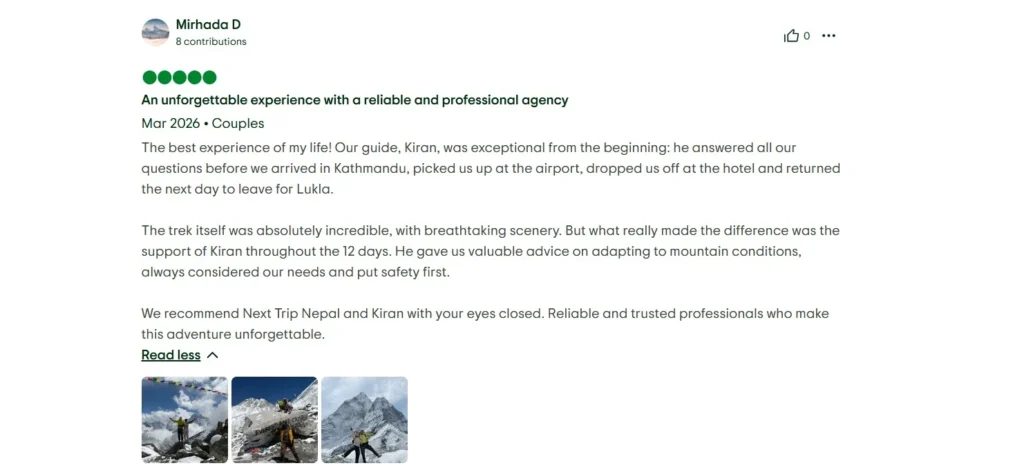
What Makes the Everest Base Camp Trek Logistically Different
The EBC Trek is not a restricted route. Nepal law does not require a licensed guide. But the altitude demands, permit system, and flight logistics of the Khumbu make a well-organized operator far more than a convenience.
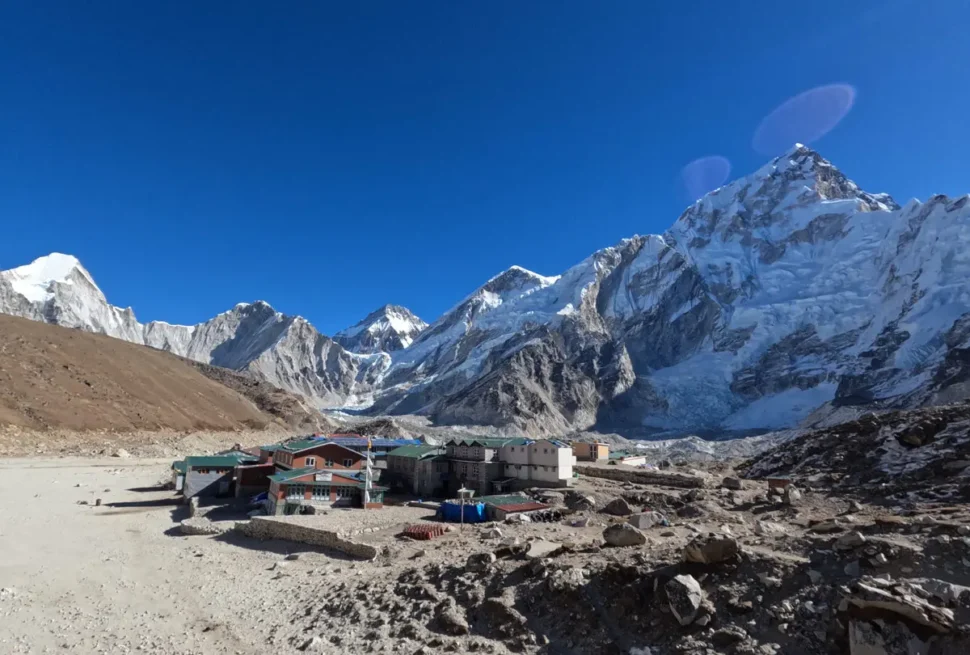
The standard route runs from a flight into Lukla at 2,860 meters through Namche Bazaar, Tengboche Monastery, Dingboche, Lobuche, Gorak Shep, and Everest Base Camp at 5,364 meters. Kala Patthar at 5,643 meters is the highest point of the entire journey, requiring a pre-dawn start from Gorak Shep in cold, often icy conditions.
Several factors make this trek operationally complex in ways a less experienced operator will struggle with:
- During peak seasons (March–May and October–November), Lukla flights are rerouted from Kathmandu to Ramechhap/Manthali Airport to reduce air traffic congestion. This means a 4–5 hour drive from Kathmandu starting between 1am and 2am, followed by a mountain flight to Lukla. Companies that run EBC regularly are prepared for this. Those that do not leave trekkers figuring it out the morning of departure.
- Weather delays and flight cancellations at Lukla happen routinely throughout the year. A well-planned itinerary builds buffer days for this reason. An operator without buffer days is setting trekkers up for unnecessary stress before their international flight.
- Two permits are required: the Sagarmatha National Park Entry Permit (USD 30, checked at the Monjo checkpoint) and the Khumbu Pasang Lhamu Rural Municipality Permit (USD 20, obtainable only in Lukla or Monjo, not in Kathmandu). Note: the TIMS card is no longer required as of the latest policy update.
- Altitude sickness becomes a real concern from Namche Bazaar upward. Your guide’s ability to recognize early symptoms, before they escalate into Acute Mountain Sickness (AMS), High Altitude Pulmonary Oedema (HAPE), or High Altitude Cerebral Oedema (HACE) is the most critical safety variable on the entire trek.
10 Things to Look for When Choosing an Everest Base Camp Trek Company
1. Government Registration and Proper Licensing
Any legitimate Nepal trekking company should be registered with the Nepal Tourism Board (NTB), affiliated with TAAN (Trekking Agencies’ Association of Nepal), and recognised by the Nepal Mountaineering Association (NMA). These registrations confirm that the company operates legally, that guides hold government-issued licenses, and that the agency is accountable to regulatory bodies if something goes wrong.
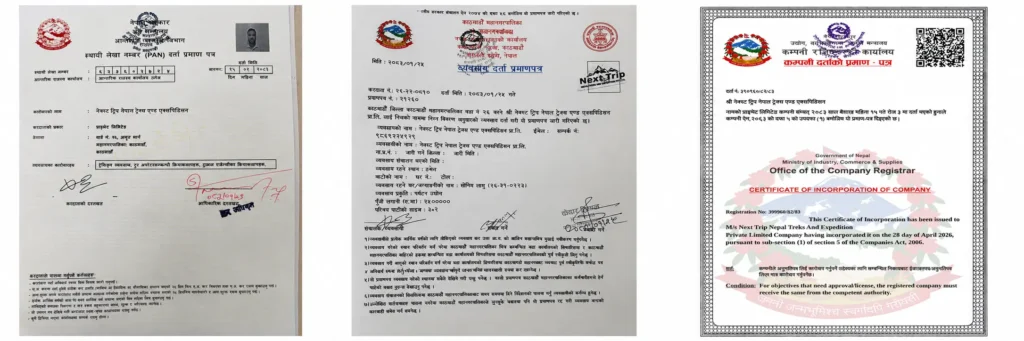
Ask for documentation. A company worth booking will not hesitate to share it. Before confirming a trek, ask:
- Is the company registered with NTB, TAAN, and NMA?
- Are guides government-licensed?
- Are guides and porters insured?
- Can you provide a clear booking confirmation and permit documentation?
If a company avoids or deflects these questions, move on.
2. Real Route Experience on the EBC Specifically
There is a significant difference between a company that runs Everest Base Camp treks regularly across multiple seasons and one that lists EBC in a catalogue alongside fifty other routes. The Khumbu region has its own rhythm, and knowing it takes real time on the ground.
An experienced EBC operator knows which teahouses at Lobuche are reliable in peak season, how to manage the pace on the demanding stretch from Dingboche to Lobuche, and exactly how to handle a Ramechhap reroute without disrupting the trip. These things come from doing the route repeatedly, not from reading a guidebook.
Ask any company:
- How many EBC departures have you run in the past two years?
- Do those include peak season departures with the Ramechhap reroute?
- Have your guides led trekkers of different fitness levels and ages on this specific route?
- Have you managed Lukla flight delays and cancellations before?
Real route experience is more valuable than a polished website.
3. Permits Handled Correctly Before You Arrive
The Everest Base Camp Trek requires two official permits:
- Sagarmatha National Park Entry Permit: USD 30, checked at the Monjo entry checkpoint
- Khumbu Pasang Lhamu Rural Municipality Permit: USD 20, available only in Lukla or Monjo, not in Kathmandu
The TIMS card is no longer required. Any company unfamiliar with this already is telling you something important about their level of route knowledge.
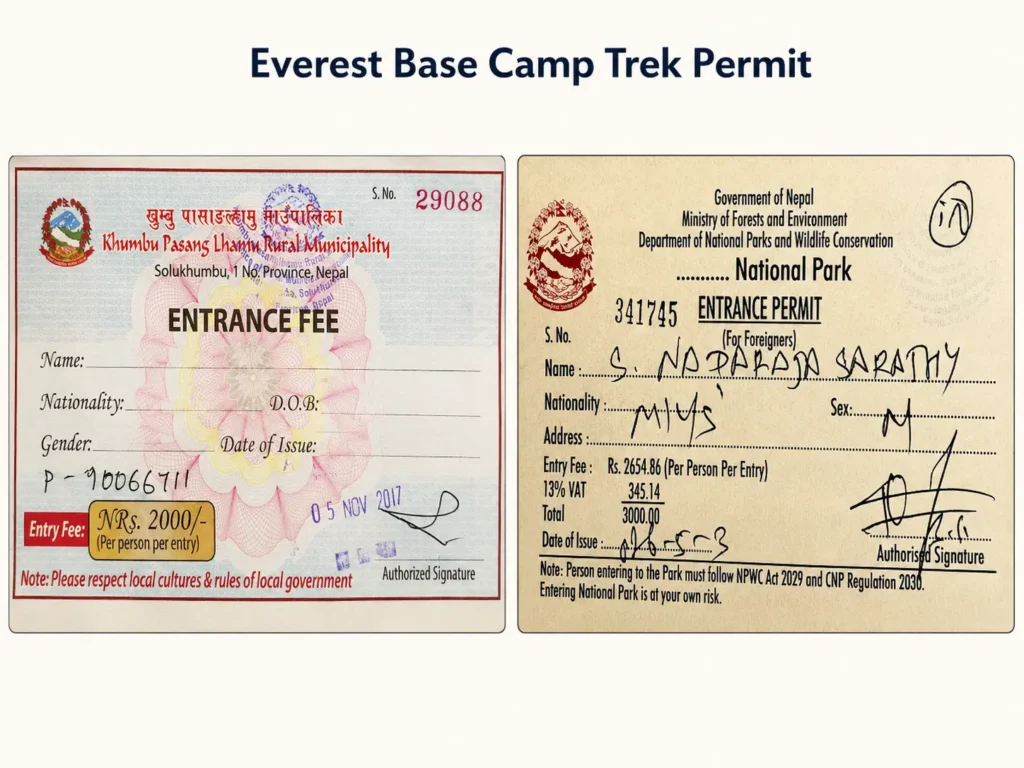
A reliable operator arranges both permits before or at the start of the trek, handles all paperwork, and does not leave you sorting out documents mid-journey. Before confirming, ask whether both permits are included and whether the company handles them in advance or on the trail.
4. Guide Quality, Licensing, and Daily Altitude Monitoring
Your guide is the most consequential part of the Everest Base Camp Trek. More than the teahouse you sleep in or the itinerary on paper, the person leading you through the Khumbu determines whether you reach Base Camp safely and whether altitude problems get caught before they become serious.
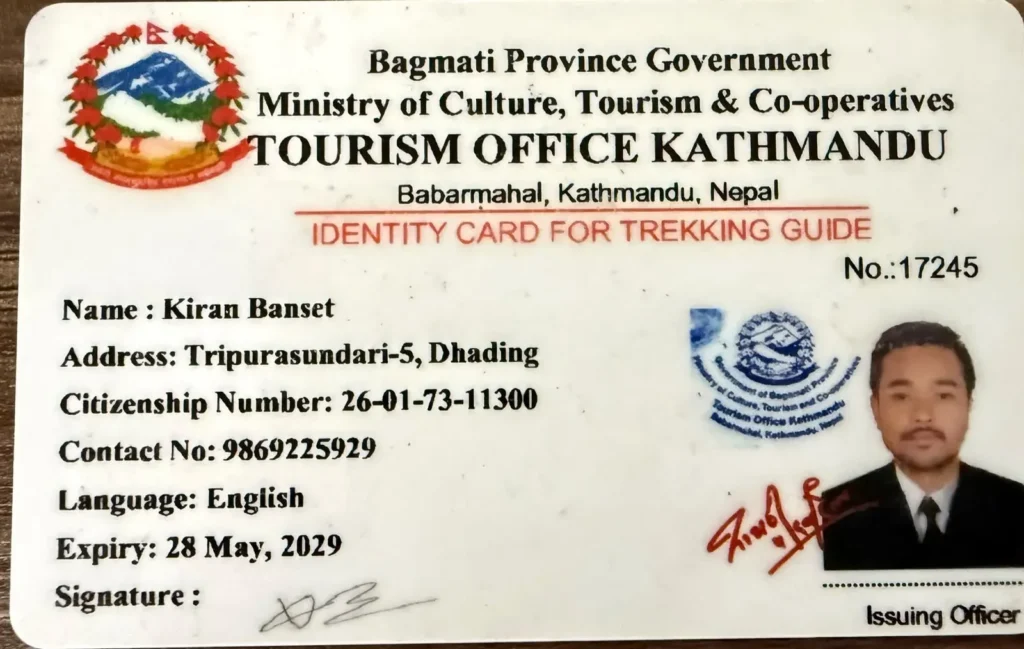
For Everest Base Camp, always choose a licensed and experienced guide. It provides safer trekking, better route support, and proper assistance in case of altitude or weather issues.
When evaluating any company’s guide quality, look for these specifics:
- Government-issued NTB guide license: ask for it; legitimate operators share without hesitation
- Daily pulse oximeter (SpO2) checks: every trekker, every morning before walking and every evening on arrival at the teahouse, from Namche Bazaar upward. Not just “when needed.” Consistent daily monitoring is how altitude problems are caught at the manageable stage, not after they have escalated.
- Supplemental oxygen cylinders carried on trail and available on request; these give the guide and trekker time to make a calm, informed decision when SpO2 drops, rather than having to escalate immediately
- Wilderness first aid training with altitude medicine focus: knowing the early signs of AMS, HAPE (High Altitude Pulmonary Oedema), and HACE (High Altitude Cerebral Oedema) is specific training, different from standard first aid
- Walkie-talkies for communication: mobile networks are patchy above Namche and non-existent in some sections between Tengboche and Dingboche. A guide with only a mobile phone is operating without a reliable backup in the locations where it matters most
- Strong English communication: for explaining altitude symptoms, safety decisions, route details, and local culture in real time
- Guide-to-trekker ratio: smaller groups and private treks allow the guide to monitor every individual’s condition closely, which is especially important at altitude
Ask any company: does your guide check SpO2 for every trekker, morning and evening, every day from Namche upward? If the answer is “when someone feels unwell,” that is not the same thing.
5. Altitude Safety Protocols and Emergency Response
The EBC Trek reaches 5,364 meters at Base Camp and 5,643 meters at Kala Patthar. Altitude sickness can affect anyone, including fit, experienced trekkers. What separates a well-run company from a risky one is having a clear, tested plan before anyone leaves Kathmandu.
A responsible operator’s safety setup includes:
- Guides who carry a stocked first-aid kit checked before every departure: wound care, blister treatment, oral rehydration salts, anti-inflammatories, and altitude-specific medication
- Clear protocols: when to slow pace, when to add a rest day, when to descend, when to initiate helicopter evacuation
- A tested helicopter evacuation process with established contacts in the Khumbu, not a general promise that “we can arrange it.” Pre-established contacts are the difference between a fast evacuation and a slow, stressful one
- 24/7 emergency support line from the Kathmandu operations team throughout the trek
Travel insurance is not optional on this route. You need a policy that explicitly covers high-altitude trekking to a minimum of 5,500 meters with helicopter rescue and medical evacuation included. Standard travel insurance does not cover this. A helicopter rescue from Gorak Shep or Lobuche to Lukla or Kathmandu can cost USD 3,000 to USD 6,000 depending on conditions and aircraft availability. Any reputable EBC operator will advise this clearly during the booking process. If a company does not mention travel insurance before you arrive in Kathmandu, treat that as a warning sign.
6. Lukla Flight Logistics and Peak Season Planning
Lukla flight logistics are one of the clearest separators between EBC specialists and generalists, and one of the things most trekkers do not think to ask about until they are facing a 2am wake-up call in Kathmandu.
Peak season rerouting: During the spring (March–May) and autumn (October–November) peak seasons, Lukla flights are rerouted through Ramechhap/Manthali Airport to reduce congestion in Kathmandu airspace. This means a 4–5-hour drive from Kathmandu, starting between 1am and 2am, followed by a short mountain flight to Lukla. For first-time EBC trekkers, this is a significant logistical shift that a poorly prepared operator will not explain until it is already happening.
Helicopter from Kathmandu to Lukla: For trekkers who prefer to skip the early Ramechhap drive entirely, helicopter flights from Kathmandu directly to Lukla are available. Shared helicopter (4–5 passengers) runs approximately USD 400–450 per person; private charter is available for full schedule flexibility. The aerial approach into the Khumbu is itself a memorable experience.
Buffer days: Weather delays and cancellations at Lukla occur year-round, not just during the off-season. Always allow 1–2 buffer days before your international departure. This one planning detail prevents enormous stress. A company that does not recommend buffer days is not thinking about your full trip.
Before booking, ask your operator: Will my Lukla flight be from Kathmandu or Ramechhap? What is the drive time and departure time if Ramechhap? What is your plan if flights are delayed or canceled? Do you offer helicopter transfer options? Do you recommend buffer days?
7. What the Package Actually Includes
EBC Trek prices vary significantly, and the gap between a USD 900 package and a USD 1,400 package often comes down to what the cheaper one quietly leaves out. Before comparing prices, check exactly what is included and what you will pay for separately on the trail.
A complete EBC package should include:
- Airport pickup and drop in Kathmandu
- Kathmandu hotel accommodation (typically 2 nights pre-trek, 1 night post-trek)
- Domestic round-trip flights to and from Lukla (or Ramechhap transport)
- Both required trekking permits (Sagarmatha NP + KLPA Municipality)
- Licensed government guide
- Porter service (one porter typically covers two trekkers)
- Tea house accommodation throughout the trek
- All meals during the trek (breakfast, lunch, dinner)
- Guide and porter insurance
- First-aid kit on the trail
- Sleeping bag rated to −10°C or below (essential above Namche, where nights are genuinely cold)
- Down jacket for upper elevations
- Duffel bag for porter load
- Government taxes and service charges
Common exclusions to check and budget for: hot showers, Wi-Fi cards, battery charging, bottled water, snacks, alcoholic drinks, travel insurance, tips for guide and porter, and personal purchases. These typically add USD 200–250 over the full duration.
A company that explains all inclusions and exclusions clearly before you book is one you can trust with the rest of the logistics.
8. Tea House Standards at Each Elevation
Accommodation quality on the EBC route varies significantly with altitude, and knowing which lodges to book at each stop comes only from running this route regularly.
- Lower sections: Lukla, Phakding, Namche Bazaar: Private rooms with attached bathrooms, hot showers, and reliable electricity are generally available. Namche has the best lodge facilities on the entire route.
- Mid-route: Tengboche, Dingboche: Facilities become more basic. Shared bathrooms, limited hot water, and less heating are normal. Tengboche lodges fill quickly during peak season.
- Upper route: Lobuche, Gorak Shep: Shared rooms, squat toilets, solar power only, and minimal heating. Everything is harder to transport here, so expect the basics.
A company with good local connections secures better rooms in advance during peak season, which matters especially at Lobuche and Tengboche, where space fills fast. Ask whether the company has established relationships with specific lodges on the route, and whether rooms are pre-booked or arranged on the day.
Food is equally important. Most tea houses offer dal bhat, soup, noodles, pasta, fried rice, potatoes, eggs, and porridge. A good guide helps you choose suitable meals, especially at altitude where appetite changes. If you have dietary needs (vegetarian, vegan, or food allergies), confirm these are manageable before booking.
9. Itinerary Flexibility and Customization
Not every trekker has the same schedule, fitness level, budget, or goals. Some want the classic 14-day EBC Trek. Some want more time with extra acclimatization. Some want to add Gokyo Lakes and Cho La Pass. Some prefer a helicopter return. Some are trekking as a couple, a family, or a solo traveler joining a group.
A reliable operator does not push everyone into one fixed package. It should offer:
- Private departures with flexible start dates
- The option to add extra acclimatization days
- Solo trekkers joining group departures
- Helicopter return or helicopter extension options
- Trek extensions: Gokyo Lakes, Cho La Pass, Island Peak or Lobuche Peak climbing combinations
- Extended, slower itineraries for older trekkers, families, or anyone who wants a gentler pace
Flexibility is important because the trek should match the trekker, not the company’s fixed export schedule. Ask directly whether the itinerary can be adjusted after booking if you need an extra rest day on the mountain.
10. Reviews That Name Guides and Describe the Trail
Reviews matter, but not all reviews carry equal weight. Do not only count ratings. Look for EBC-specific reviews that describe real moments on the trail.
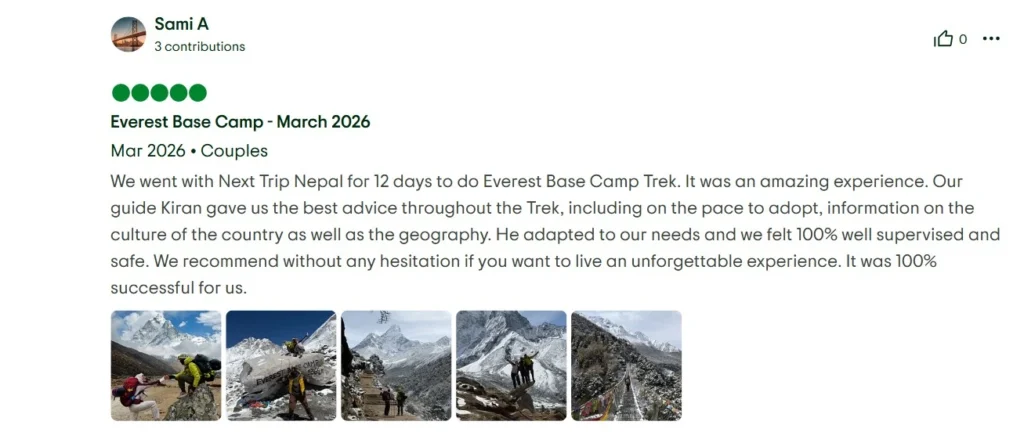
Trustworthy EBC reviews typically:
- Name the guide specifically and describe their handling of altitude or difficult moments
- Mention how logistics like Lukla flights or the Ramechhap reroute were communicated
- Cover multiple seasons, not only reviews from a single month
- Describe the guide monitoring health, adjusting pace, or making safety decisions
- Come from trekkers of different fitness levels and ages
General praise with no specific details is not a reliable signal. A review that says “our guide Dawa noticed I was struggling and slowed the group pace from Lobuche to Gorak Shep, checked my oxygen, and made sure I rested properly” tells you far more than “great experience, recommend!”
How Your Company Choice Shapes the Day-to-Day Trail Experience
Beyond permits and itineraries, the small operational decisions a trekking company makes quietly shape how each day on the Everest Base Camp trail actually feels. These details decide whether the trek feels overwhelming or deeply rewarding.
Pre-departure briefing in Kathmandu: A well-run briefing covers gear distribution (sleeping bag, down jacket, duffel bag, first-aid kit), guide and porter introductions, permit and document confirmation, and a full explanation of Lukla or Ramechhap flight logistics for the next morning. An organized company runs this in under an hour with no confusion. A poorly organized one creates anxiety before the trek even starts.
Daily pacing and rest management: How a company structures walking hours, rest breaks, and lunch stops affects energy levels more than most trekkers expect. Experienced operators plan steadier days between Namche and Dingboche, allowing the body to adjust naturally rather than arriving at the teahouse already exhausted.
Lodge selection and booking: Companies with strong local connections can secure better rooms in busy villages like Tengboche and Lobuche, where space fills fast during peak season. A warm dining room and a quieter room make a real difference to sleep quality and recovery at altitude.
Crowd avoidance and trail timing: On popular sections between Phakding and Namche Bazaar, experienced companies adjust departure times to avoid congestion on narrow trail sections and suspension bridges. Fewer crowds means a calmer walk and more room to take in the scenery.
Weather-based decision-making: Mountain weather changes fast near Gorak Shep and Kala Patthar. The right company knows when to start the pre-dawn Kala Patthar push early for clear views or delay if conditions are unsafe. These calls often determine whether you see the Himalayan panorama or miss it in cloud and wind.
Food choices at altitude: Allowing flexible meal selection helps as altitude changes appetite and digestion. Lighter meals at Dingboche, and energy-rich food before the long day to Base Camp or the Kala Patthar summit, can meaningfully improve how you feel on the hardest days.
Guide presence and group morale: Regular check-ins, encouragement on difficult climbs, and simple conversation during long ascents sustain motivation in ways that are hard to quantify but easy to feel. On the demanding stretch from Lobuche to Gorak Shep, a guide’s attentiveness often matters as much as physical preparation.
Red Flags: When to Look for a Different Company
Not every trekking company that offers EBC is equipped to run it well. These warning signs should make you look elsewhere:
- Vague or evasive answers about licensing: Any reputable company shares NTB, TAAN, and NMA documentation without hesitation. If a company avoids or deflects this question, it is a red flag.
- No daily SpO2 monitoring: If a company says guides check oxygen levels “if someone feels unwell” rather than routinely morning and evening for every trekker above Namche, that is inadequate altitude safety protocol.
- No supplemental oxygen on the trail: This is standard equipment for a responsibly run EBC trek. Companies that do not carry it are not prepared for altitude emergencies.
- Itinerary shorter than 12 days with no justification: A responsible EBC itinerary requires a minimum of 12–14 days to include acclimatization days at Namche and Dingboche. Shorter itineraries significantly increase altitude sickness risk.
- No emergency evacuation plan: Vague assurances are not an emergency plan. Ask for specifics: pre-established contacts, protocol, and how fast an evacuation can be initiated. Companies that operate regularly on this route have tested systems in place.
- Unclear permit knowledge: A company that does not know the KLPA Municipality Permit can only be obtained in Lukla or Monjo (not Kathmandu), or that quotes incorrect permit costs, is signaling limited route experience.
- No mention of travel insurance: A responsible EBC operator advises travel insurance covering 5,500m+ altitude and helicopter rescue as part of the standard pre-trek briefing, not as an afterthought.
- Price significantly below market without explanation: Prices far below standard usually mean something is excluded, including Lukla flights, porter service, permits, or gear. Always ask what is missing.
- Reviews only from one season or with no guide names: A healthy review history covers multiple seasons and includes trekkers who name their guide and describe specific trail experiences.
Essential Questions to Ask Any EBC Company Before You Book
Use this checklist when comparing operators. The answers quickly tell you whether you are speaking with an EBC specialist or a company that runs the trek occasionally.
- Are your guides government-licensed (NTB) and is the company registered with TAAN and NMA?
- Do your guides take daily SpO2 readings with a pulse oximeter for every trekker, morning and evening, from Namche Bazaar upward?
- Do you carry supplemental oxygen cylinders on the trek, available on request from any trekker above Namche?
- Do your guides carry walkie-talkies for communication above Namche, where the mobile signal is unreliable?
- Do you handle both the Sagarmatha National Park Permit and the Khumbu Pasang Lhamu Municipality Permit?
- What is included and excluded in the package price?
- Is my Lukla flight from Kathmandu or Ramechhap during peak season? What is the drive time and departure hour?
- Do you offer a helicopter transfer from Kathmandu to Lukla, and what does it cost?
- What is your helicopter evacuation process, and who are your established contacts in the Khumbu?
- Do you require or advise travel insurance covering trekking above 5,500m with helicopter rescue?
- Is there a 24/7 support line in Kathmandu during the trek for emergencies?
- Do you offer private departures, custom itineraries, or extra acclimatization days on request?
- What gear is provided, and when is it handed over?
Quick Comparison Checklist
| Criteria | What to Expect from a Reliable Operator |
|---|---|
| Government Registration | NTB, TAAN, and NMA registered; documents available on request |
| Guide Licensing | Government-issued NTB license; verifiable |
| Daily Altitude Monitoring | Pulse oximeter: every trekker, morning and evening, from Namche upward |
| Supplemental Oxygen | Carried on trail; available on request above Namche |
| Guide Communication | Walkie-talkies carried above Namche; 24/7 Kathmandu support line active |
| Permit Handling | Both SNP (USD 30) and KLPA (USD 20) permits arranged; TIMS no longer required |
| Lukla Flight Logistics | Ramechhap reroute explained in advance; buffer days recommended; helicopter option available |
| Package Inclusions | Flights, permits, guide, porter, all meals, accommodation, sleeping bag, down jacket, duffel bag, transfers |
| Emergency Plan | Pre-established helicopter evacuation contacts; tested process; not improvised |
| Travel Insurance | Advised: explicit 5,500m+ coverage with helicopter rescue required |
| Itinerary Flexibility | Private and group options; extra acclimatization days; senior, family, and custom itineraries |
| Porter Welfare | Fair wages, proper insurance, not overloaded; responsible trekking practice |
| Reviews | EBC-specific, guide named, multiple seasons, specific trail moments described |
Frequently Asked Questions
How much does an Everest Base Camp Trek cost?
A complete EBC package typically ranges from USD 1,200 to USD 1,800, depending on group size, duration, and what is included. Packages below USD 900 usually exclude Lukla flights, porter service, permits, or gear. Always compare what is actually in the price before choosing based on the headline number.
Is a guide mandatory for the Everest Base Camp Trek?
Nepal law does not legally require a guide on the EBC route. However, a licensed guide is strongly recommended. At high altitude, your guide manages your safety, monitors daily oxygen levels, handles logistics, makes real-time decisions if symptoms appear, and communicates with tea houses, evacuation services, and the Kathmandu support team. Going without a guide at 5,000+ meters significantly increases risk.
What permits are needed for the EBC Trek in 2026?
Two permits are required: the Sagarmatha National Park Entry Permit (USD 30, checked at Monjo) and the Khumbu Pasang Lhamu Rural Municipality Permit (USD 20, obtainable only in Lukla or Monjo, not in Kathmandu). The TIMS card is no longer required. A good operator arranges both before or at the start of the trek.
When should I book the Everest Base Camp Trek?
For spring season (March–May), book 3–6 months in advance, especially if you need specific Lukla flight dates. For autumn season (October–November), book at least 2–3 months ahead. Both are peak seasons with high lodge and flight demand. Booking early also gives more time to arrange travel insurance and visas.
What travel insurance do I need for the EBC Trek?
You need a policy that explicitly covers high-altitude trekking to a minimum of 5,500 meters and includes helicopter rescue and medical evacuation. Standard travel insurance does not cover this. You need a policy specifically designed for high-altitude adventure activities. A helicopter evacuation from Gorak Shep or Lobuche can cost USD 3,000 to USD 6,000. This cost falls on the trekker without proper coverage.
What is the Ramechhap reroute, and how does it affect my trek?
During peak seasons, Lukla flights are rerouted through Ramechhap/Manthali Airport to reduce congestion in Kathmandu airspace. This requires a 4–5 hour drive from Kathmandu starting between 1am and 2am, followed by a mountain flight to Lukla. A good operator explains this before you book and handles all transport arrangements. The alternative is a helicopter direct from Kathmandu to Lukla (approximately USD 400–450 per person for a shared flight).
What gear will I need, and does the company provide any?
Essential gear for the upper elevations includes a sleeping bag rated to −10°C or below, a quality down jacket, trekking poles, and warm layers. A complete EBC package from a reliable operator typically provides the sleeping bag, down jacket, and duffel bag as inclusions, handed over at the pre-departure briefing in Kathmandu. Confirm what gear is provided before booking so you know what to bring or buy.
Ready to Plan Your Everest Base Camp Trek?
Choosing the right trekking company for Everest Base Camp comes down to one thing: substance over surface. Registration, guide training, daily altitude monitoring, proper permits, transparent pricing, tested emergency protocols, and honest communication. These are the factors that determine whether your trek is safe and successful.
If you are ready to start planning, our team at Next Trip Nepal is happy to answer questions about itinerary, costs, permits, or logistics. We offer private and group departures with licensed guides, proper acclimatization days, full trek support from Kathmandu to the Himalayas, and honest pricing with no hidden extras. View our Everest Base Camp Trek or contact us directly on WhatsApp.