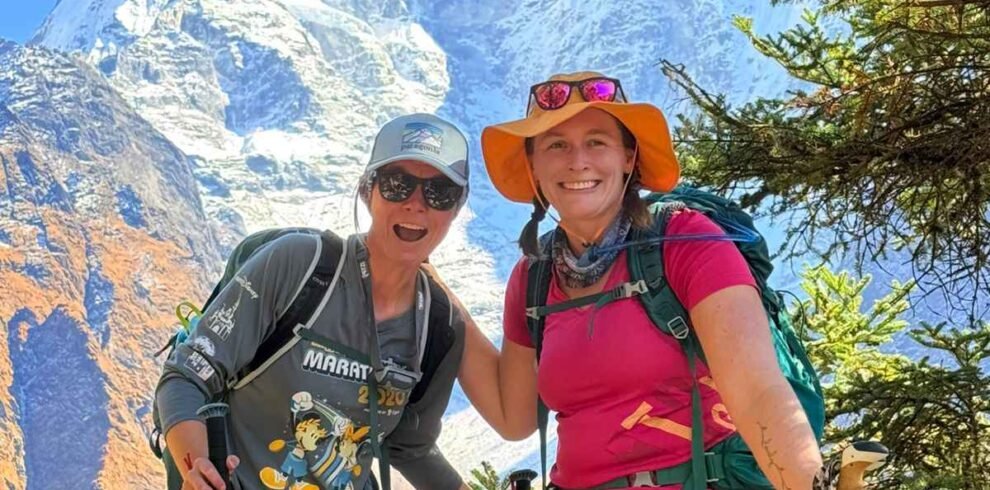
The direct answer to the most common question we get: a 14-day guided Everest Base Camp Trek with a licensed guide and porter costs USD 1,100 to USD 1,450 per person on a group joining departure, or USD 1,500 to USD 2,200 on a private arrangement. Your guide is not optional — Nepal made licensed guides mandatory for EBC in April 2023, and Sagarmatha National Park checkpoints enforce this rule.
These figures are for the standard round trip. If you would rather fly back instead of walking out, our full cost breakdown for the Everest Base Camp Trek with Helicopter Return shows how the price changes once a helicopter replaces several days of walking.
This page covers everything about trekking to Everest Base Camp with a trekking guide: what a guide does, what to look for, exact guide costs, the guide plus porter combination, a full day-by-day itinerary with altitudes, and a complete cost breakdown so you know exactly what you are paying for before you book.
| Category | Budget Range | Notes |
|---|---|---|
| All-inclusive package (group joining, 14 days) | USD 1,100 to 1,450 | Guide, porter, permits, Lukla flights, meals, accommodation |
| All-inclusive package (private, 2 pax) | USD 1,500 to 2,200 | Dedicated guide and porter, same inclusions |
| Private solo trek | USD 2,000 to 2,800 | Full guide and porter cost on one person |
| Lukla return flights only | USD 350 to 450 | Biggest variable — book 2 to 3 months ahead in peak season |
| Licensed guide (per day) | USD 30 to 50 | Includes guide’s food, accommodation, insurance |
| Porter (per day) | USD 20 to 30 | Carries up to 20 kg; includes their food and accommodation |
| Permits (Sagarmatha NP + TIMS + KPL) | USD 50 to 60 | Much lower than Manaslu restricted area permits |
| Personal spending (14 days) | USD 200 to 400 | Drinks, snacks, tips, charging, hot showers |
| Travel insurance (helicopter evacuation cover) | USD 80 to 200 | Mandatory — must cover altitude up to 6,000m |
Nepal’s government made the use of licensed guides mandatory for the Everest Base Camp Trek in April 2023. The rule applies to all foreign trekkers without exception. At the Sagarmatha National Park entrance in Monjo, a licensed guide is required, and trekkers without one are turned back. This is not a recommendation — it is a condition of entry.
The policy exists for real reasons. EBC reaches 5,364m at Base Camp and 5,545m at Kala Patthar. Altitude sickness, frostbite, and weather changes above 4,000m are genuine risks. Every year, rescue helicopters are called for trekkers who did not recognize early altitude symptoms or who continued ascending when they should have descended. A licensed guide monitors your oxygen saturation daily with a pulse oximeter, recognizes early warning signs, and makes the call to descend before a situation becomes an emergency. That knowledge is why the rule exists.
| Factor | Licensed Guide (NTB Certified) | Unlicensed Guide |
|---|---|---|
| NTB license card | Yes — can show you the card | No |
| Government-certified safety training | Yes — includes first aid and altitude sickness protocol | No |
| Sagarmatha NP entry | Permitted | Turned back at Monjo checkpoint |
| Pulse oximeter use | Trained and carries one | Unlikely |
| Emergency contact network | Yes — knows local rescue contacts | No formal network |
| Accountability | Registered with an agency, traceable | None |
| Cost | USD 30 to 50/day | Lower — but illegal and unsafe |
Always ask to see your guide’s Nepal Tourism Board license card. The card has a photo, license number, and expiry date. Any legitimate guide carries it and shows it without hesitation.
The best EBC guides do far more than point the way along a trail. Here is what a good guide actually does across 14 days on the Khumbu:
| Responsibility | Why It Matters |
|---|---|
| Daily oxygen saturation check with pulse oximeter | Detects early altitude sickness before it becomes dangerous — normal SpO2 at Namche is 85-92%; below 75% at altitude, action is needed. |
| Permit management at all checkpoints | Three checkpoints on the EBC route — Monjo (NP entry), Namche, Lobuche. Guide handles all paperwork. |
| Teahouse booking ahead on the route | Peak season (Oct, Apr) teahouses fill up — guides call ahead in Nepali to hold rooms |
| Weather and trail condition updates | Guides communicate with other guides on the route daily — they know if the Khumbu Icefall changed or if snow hit Larkya |
| Cultural interpretation | Sagarmatha region has Sherpa monasteries, mani walls, prayer flags with specific meaning — a guide explains the culture you are walking through |
| Emergency coordination | If you need a helicopter evacuation, your guide contacts rescue services, coordinates with insurance, and stays with you through the process |
| Acclimatization management | Decides pace, rest days, and whether to push to a higher stop or stay lower — the most valuable judgment call on the whole trek |
| Language | Most teahouse owners above Namche speak Nepali and Sherpa. A guide who speaks both gets you better rooms and faster service. |
| Guide Type | Daily Rate | 14-Day Trek Total | What Is Included |
|---|---|---|---|
| Licensed trekking guide (English speaking) | USD 30 to 40/day | USD 420 to 560 | Guide’s food, accommodation, insurance — all covered by trekker or agency |
| Senior guide or Sherpa guide (high altitude experienced) | USD 40 to 55/day | USD 560 to 770 | Same inclusions — preferred for solo trekkers or those with altitude concerns |
| Guide cost on group joining departure (your share) | Split across 6 to 12 trekkers | USD 80 to 140 per person | Same guide, same standards — cost divided by group size |
On a private 2-person trek, you split the guide cost: USD 210-USD 385 each for the full 14 days. The guide’s food and accommodation (approximately USD 15 to USD 20 per day) are also covered by the trekker — this is built into all-inclusive package prices, so you do not pay it separately.
A guide is mandatory. A porter is strongly recommended but not legally required. The combination of guide plus porter is the standard arrangement on the Everest Base Camp Trek for a practical reason: the trail to EBC covers 65 km each way at altitude. Carrying a 14 to 16 kg pack from Lukla to Gorakshep and back is significantly harder than trekkers expect, especially in the final days above 4,500m.
| Factor | With Porter | Without Porter |
|---|---|---|
| Porter cost (14 days, sole cost) | USD 280 to 420 | USD 0 |
| Your pack weight | 5 to 8 kg (day pack: water, camera, layers) | 14 to 18 kg (full pack everything) |
| Energy at altitude above 4,500m | Manageable | Significantly harder |
| Risk at Kala Patthar (5,545m) | Lower — lighter, faster summit | Higher — heavy load at 5,500m is a real safety factor |
| Recommended for | All trekkers, especially first-timers at altitude | Experienced Himalayan trekkers only with prior 5,000m+ experience |
A porter carries up to 20 kg and costs USD 20 to USD 30 per day. For a 14-day trek, porter cost on a private solo trek is USD 280 to USD 420. Split between 2 trekkers, it is USD 140-USD 210 each. On a group joining departure, porter cost is shared and typically adds USD 60 to USD 100 to your per-person price.
Three permits are required to trek to Everest Base Camp. This is significantly simpler (and cheaper) than Manaslu or Upper Mustang, which require restricted area permits. EBC permits are straightforward and can be arranged through your agency before departure.
| Permit | Non-SAARC Cost | SAARC (Indian etc.) | Nepali | Where Checked |
|---|---|---|---|---|
| Sagarmatha National Park Entry | NPR 3,000 (approx. USD 22) | NPR 1,500 | NPR 100 | Monjo checkpoint |
| Khumbu Pasang Lhamu Rural Municipality | NPR 2,000 (approx. USD 15) | NPR 2,000 | NPR 2,000 | Lukla, on arrival |
| TIMS Card | NPR 2,000 (approx. USD 15) | NPR 1,000 | Not required | Kathmandu (TAAN or NTB office) |
| Total permits | USD 50 to 55 | USD 35 to 40 | NPR 2,100 |
Your trekking agency arranges all permits before departure. Your guide carries copies of all permits and handles checkpoint paperwork. You do not queue at any office yourself.
The domestic flight from Kathmandu to Lukla — and the return — is the single largest variable cost on the EBC trek. Lukla (Tenzing Hillary Airport) sits at 2,845m and is the standard entry and exit point for the Khumbu valley. There is no road access.
| Route | Cost (per person, one way) | Return (round trip) | Notes |
|---|---|---|---|
| Kathmandu to Lukla | USD 175 to 220 | USD 350 to 440 | Multiple airlines — Tara Air, Summit Air, Sita Air |
| Ramechhap to Lukla (in peak season) | USD 130 to 175 | USD 260 to 350 | Kathmandu flights are being rerouted to Ramechhap during peak Oct and Apr to reduce congestion. |
| Helicopter return (Gorakshep to KTM) | USD 800 to 1,400 per person | One way only (helicopter out) | Popular luxury option — cuts return walk, gives aerial Khumbu views |
Peak season (October and April) flights sell out 6 to 8 weeks in advance. If your agency is booking flights for you, confirm flight booking as soon as your trek dates are set. Weather delays at Lukla are common — build 1 to 2 buffer nights in Kathmandu at the start and end of your trip.
The standard EBC trek itinerary is 14 days. This includes two important acclimatization days one in Namche Bazaar (3,440m) and one in Dingboche (4,410m) —which are non-negotiable for safety. Cutting these days to save time significantly increases the risk of altitude sickness.
| Day | Route | Overnight | Altitude | Approx. Daily Cost (food + room) |
|---|---|---|---|---|
| Day 1 | Fly Kathmandu to Lukla, trek to Phakding | Phakding | 2,610m | USD 15 to 25 |
| Day 2 | Phakding to Namche Bazaar | Namche Bazaar | 3,440m | USD 20 to 35 |
| Day 3 | Acclimatization: Everest View Hotel hike, Sherpa Museum, Kongde Ri viewpoint | Namche Bazaar | 3,440m | USD 20 to 35 |
| Day 4 | Namche to Tengboche | Tengboche | 3,860m | USD 22 to 38 |
| Day 5 | Tengboche to Dingboche | Dingboche | 4,410m | USD 25 to 40 |
| Day 6 | Acclimatization: Nangkartshang Peak hike (5,100m), Chhukung Ri option | Dingboche | 4,410m | USD 25 to 40 |
| Day 7 | Dingboche to Lobuche | Lobuche | 4,940m | USD 28 to 45 |
| Day 8 | Lobuche to Gorakshep, Everest Base Camp visit | Gorakshep | 5,140m | USD 30 to 50 |
| Day 9 | Kala Patthar (5,545m) sunrise, descend to Pheriche | Pheriche | 4,240m | USD 25 to 40 |
| Day 10 | Pheriche to Namche Bazaar | Namche Bazaar | 3,440m | USD 20 to 35 |
| Day 11 | Namche to Lukla | Lukla | 2,845m | USD 18 to 30 |
| Day 12 | Fly Lukla to Kathmandu | Kathmandu | 1,400m | USD 30 to 60 (hotel) |
| Day 13 to 14 | Buffer days in Kathmandu (flight delay contingency) | Kathmandu | 1,400m | USD 30 to 60/day |
| Section | Main Stops | Accommodation (per night) | Meal Cost (per day, 3 meals) |
|---|---|---|---|
| Lower Khumbu (below 3,500m) | Phakding, Namche Bazaar | USD 8 to 25 | USD 20 to 35 |
| Mid Khumbu (3,500m to 4,500m) | Tengboche, Dingboche, Pheriche | USD 10 to 30 | USD 25 to 40 |
| High Khumbu (above 4,500m) | Lobuche, Gorakshep | USD 12 to 35 | USD 30 to 50 |
Namche Bazaar has the best teahouses on the route — some with hot showers, WiFi, and charging facilities at reasonable prices. Food quality drops above Tengboche, not because teahouses are poor but because everything is carried in on porter backs and yak trains. Dal bhat remains the best-value, most filling meal at every altitude. Above Lobuche, menu options narrow and prices are highest on the entire trek.
| Expense | Budget (group joining) | Standard (private, 2 pax) | Premium (private, solo) |
|---|---|---|---|
| Permits (SNP + TIMS + KPL) | USD 52 | USD 52 | USD 52 |
| Lukla return flights | USD 380 | USD 380 | USD 380 |
| Guide cost (your share) | USD 100 to 140 | USD 280 to 350 | USD 490 to 700 |
| Porter cost (your share) | USD 70 to 100 | USD 175 to 210 | USD 280 to 420 |
| Teahouse accommodation (14 nights) | USD 120 to 200 | USD 120 to 200 | USD 120 to 200 |
| All meals on trail (14 days) | USD 280 to 420 | USD 280 to 420 | USD 280 to 420 |
| Kathmandu hotel (2 nights) | USD 40 to 80 | USD 40 to 80 | USD 40 to 80 |
| Travel insurance | USD 80 to 200 | USD 80 to 200 | USD 80 to 200 |
| Personal spending (drinks, tips, extras) | USD 200 to 350 | USD 200 to 350 | USD 200 to 350 |
| Total estimate | USD 1,320 to 1,722 | USD 1,607 to 2,242 | USD 1,922 to 2,802 |
| Factor | Details |
|---|---|
| Total distance | Approximately 130 km (65 km each way Lukla to EBC) |
| Highest point | Kala Patthar: 5,545m (Everest Base Camp is at 5,364m) |
| Trek duration | 12 to 16 days (14 days is standard with proper acclimatization) |
| Daily walking hours | 4 to 7 hours on most days |
| Physical difficulty | Moderate to demanding. No technical climbing required — this is a trail trek throughout. |
| Altitude difficulty | High. Altitude sickness is the main risk, not trail difficulty. |
| Fitness level required | Should be able to hike 6 to 8 hours continuously at sea level before the trek. Regular cardio training (running, cycling, hiking) for 8 to 12 weeks beforehand. |
| Previous experience needed | No prior Himalayan experience required with a good guide. Prior multi-day trekking experience is a significant advantage. |
| Minimum age | No official minimum. Children under 12 are not recommended for altitudes above 4,000m. |
| Season | Months | Conditions | Crowds | Cost Impact |
|---|---|---|---|---|
| Autumn (best) | September to November | Clear skies, stable weather, good visibility from Kala Patthar. October is peak. | Highest | Highest teahouse prices and most competition for rooms |
| Spring (second best) | March to May | Warmer than autumn, rhododendrons in bloom below 3,500m. April is peak. | High | Similar to autumn |
| Winter | December to February | Cold (-20°C at Gorakshep at night), some high passes closed, but clear days and almost no crowds | Very low | Cheaper teahouses, fewer trekkers, same permit cost |
| Monsoon | June to August | Heavy rain in lower valleys, leeches below 3,000m, cloud-covered views. Not recommended for first-timers. | Very low | Lowest teahouse prices |
Not all licensed guides are equal. A license confirms that someone completed the government training — it does not measure how many times they have been to Base Camp, how well they read altitude symptoms, or how they handle a bad weather situation above Lobuche. When choosing your guide, ask these specific questions:
| Question to Ask | What a Good Answer Looks Like |
|---|---|
| How many times have you guided to EBC? | Minimum 5 full treks. More is better. Should be able to name specific seasons and weather conditions they managed. |
| Can I see your NTB license card? | Shows it immediately. Has current validity date. No hesitation. |
| What do you do if a trekker shows AMS symptoms at Lobuche? | Should mention: stop ascent, monitor SpO2, administer acetazolamide if available, descend to Pheriche if SpO2 drops below 75%, coordinate helicopter if needed. Vague answers are a red flag. |
| Do you carry a pulse oximeter? | Yes — should always. This is a basic requirement for any reputable EBC guide. |
| What language do you speak besides English? | Nepali is essential. Sherpa is a strong advantage in the Khumbu region where many teahouse owners are Sherpa. |
| Are you registered with a trekking agency? | Yes — should be able to name the agency and the agency should be reachable for verification. |
| Category | Essential Items | Rent in Kathmandu |
|---|---|---|
| Insulation layers | Down jacket (rated to -15°C), fleece mid-layer, thermal base layers | Down jacket: USD 1 to 3/day |
| Sleeping | Sleeping bag (rated to -10°C or lower) | Sleeping bag: USD 1 to 2/day |
| Footwear | Waterproof trekking boots (broken in before departure), gaiters, warm socks | Boots can be rented but own is better |
| Trekking accessories | Trekking poles (2), balaclava, gloves, sun hat, sunglasses (UV400+) | Poles: USD 1 to 2/day |
| Health and safety | Pulse oximeter (personal), Diamox (altitude medication), first aid kit, water purification tablets or filter | Not available for rent — buy in Kathmandu |
| Electronics | Powerbank (20,000 mAh), headlamp + spare batteries, camera | Powerbank: USD 1 to 2/day |
| Documents | Passport, NTB permit copies, insurance certificate with emergency number | No |
Next Trip Nepal is a government-registered trekking company based in Kathmandu. All our EBC guides hold current NTB licenses, have completed wilderness first aid training, carry a pulse oximeter on every trek, and have made a minimum of 5 guided trips to Everest Base Camp. We match each trekker to a guide based on language preference, altitude experience, and trekking pace — not just availability.
Every EBC package we run includes: a licensed guide, a porter (one per 1 to 2 trekkers), all teahouse accommodation, all meals on the trail, all three permits, Kathmandu to Lukla return flights, a pre-trek briefing covering acclimatization, packing, and insurance, and 24-hour emergency contact throughout the trek. We do not subcontract your trek to another company.
Yes. Nepal made licensed guides mandatory for EBC in April 2023. Sagarmatha National Park entrance at Monjo requires a licensed guide for entry. Trekkers without a guide are not permitted through the checkpoint. There is no exception for any nationality or experience level.
A licensed guide costs USD 30 to USD 50 per day. For a 14-day EBC trek, the full guide cost is USD 420 to USD 700. On a group joining departure (6 to 12 trekkers), your share drops to USD 80 to USD 140. On a private 2-person trek, each person pays approximately USD 210 to USD 350 for the guide.
An all-inclusive guided 14-day EBC trek costs USD 1,320 to USD 1,722 per person on a group joining departure, or USD 1,607 to USD 2,242 per person on a private 2-person trek. A solo private trek runs USD 1,922 to USD 2,802. These figures include permits, Lukla flights, guide, porter, accommodation, all meals, Kathmandu hotel, insurance, and personal spending.
Not legally, but strongly recommended. A porter carries your main bag (up to 20 kg) so you walk with a 5 to 8 kg day pack. The EBC route covers 130 km at altitude. Carrying 16 kg above 4,500m adds meaningful physical stress. A porter costs USD 20 to USD 30 per day — on a 2-person private trek, that is USD 140 to USD 210 each for 14 days.
Ask to see their Nepal Tourism Board (NTB) license card. It has a photo, license number, and expiry date. You can also ask for the name and contact of the trekking agency they are registered with and call the agency to confirm. Any legitimate guide and agency respond to this request without hesitation.
October is widely considered the best single month: clear skies, dry trails, excellent views from Kala Patthar. April is close behind with warmer temperatures and spring wildflowers in the lower valleys. Both are peak season with high demand — book 2 to 3 months ahead. March and November are shoulder months with fewer crowds and slightly lower prices at the same conditions.
The standard itinerary with a guide is 14 days from Lukla. This includes two essential acclimatization days (Namche Bazaar on day 3, Dingboche on day 6) and two buffer days in Kathmandu for Lukla flight delays. Shorter 12-day itineraries exist but skip acclimatization days, increasing altitude sickness risk significantly.
Yes — all Next Trip Nepal EBC packages include Kathmandu to Lukla return flights. These cost USD 350 to USD 440 per person for the round trip. In peak season (October and April), flights operate from Ramechhap airport (3 hours from Kathmandu by car) rather than Kathmandu directly due to congestion — your guide and agency manage this transfer.
Your guide handles all checkpoint paperwork at three points: the Sagarmatha National Park entrance at Monjo (permit check), the Namche Bazaar checkpoint (trekker registration), and the Lobuche checkpoint. You walk through each checkpoint — your guide presents the permits and handles the registration. No paperwork or waiting on your part.
The standard tip on a 14-day EBC trek is USD 150 to USD 250 for the guide and USD 100 to USD 150 for the porter. Tips are given directly in cash (USD or NPR) on the last day in Kathmandu. They are not included in the package price and are never compulsory, but they are the standard practice on Nepal treks and are a meaningful part of guide and porter income.
Browse our Everest Base Camp Trek packages — all include a licensed guide, porter, all permits, Lukla flights, accommodation, and meals: