Most trekkers who book the Pikey Peak Trek never think twice about how they actually get to the start of the trail, because the modern answer is simple: a jeep drive from Kathmandu to Dhap, then walking from there. That is the route Next Trip Nepal runs as standard, and for most travelers it is the right choice. But it is not the only way in, and understanding the alternatives, where they go, how long they take, and why most operators quietly stopped using them, actually explains a lot about why Pikey Peak Trek looks the way it does today.
Access routes matter more on this trek than on many others precisely because Pikey Peak Trek is sold on its short itinerary and strong view to effort ratio. Change how you get to the trailhead and you change the whole shape of the trip, sometimes doubling its length without adding anything to the summit experience itself, and sometimes shaving a travel day off the end without changing the trek at all. Getting this decision right before you book matters more here than it would on a longer trek like Everest Base Camp or Annapurna Circuit, where the approach is a smaller fraction of the overall trip.
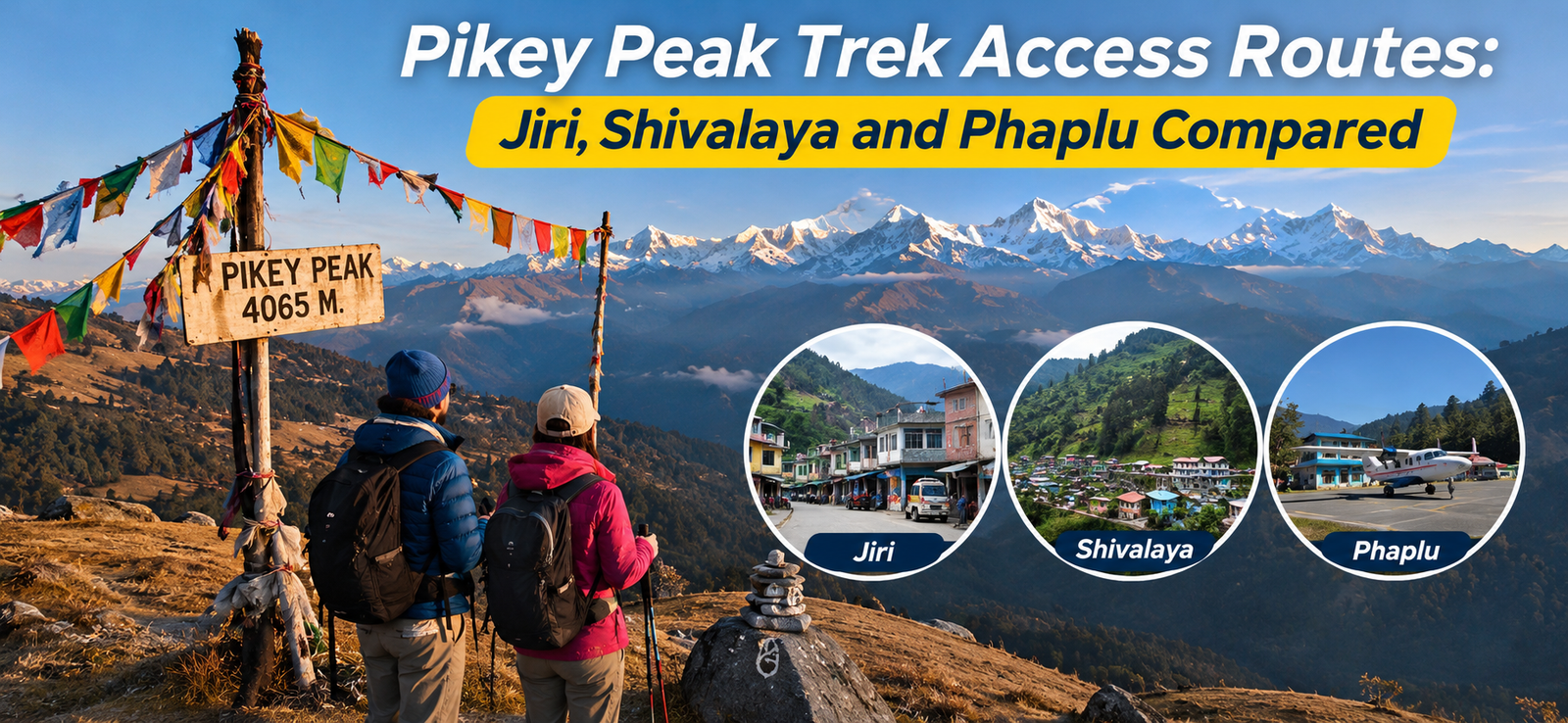
This guide compares every realistic access route to Pikey Peak: the Dhap jeep road that almost everyone uses now, the historic Jiri walk in that was once the only way to reach the entire Everest region on foot, Shivalaya as a shorter version of that same walk in, and Phaplu’s small mountain airstrip as an alternative way to shortcut part of the approach or the exit. Here is the quick summary, with the detail on each option below.
Pikey Peak Access Routes at a Glance
- Dhap jeep route (the standard option): About 7 to 9 hours by road from Kathmandu to Dhap, then roughly 5 to 6 days of trekking to the summit and back out through Junbesi and Phaplu. No flight, no walk in, lowest cost and lowest schedule risk.
- Jiri walk in (the classic option): About 8 hours by road from Kathmandu to Jiri, then 3 to 4 extra trekking days walking in to reach the point where the Pikey route begins, adding real distance, cost, and time but following one of the most historically significant trails in Nepal trekking.
- Shivalaya start (the shortened classic option): A compromise between the two above, roughly 1 to 2 fewer walking days than starting from Jiri itself, reached by road slightly further than Jiri.
- Phaplu airstrip (the flight option): A short flight from Kathmandu to Phaplu’s small mountain airstrip, useful mainly for shortcutting the exit from the trek rather than the approach, and dependent on a flight schedule that has been suspended and resumed more than once in recent years.
The Dhap Jeep Route: Why This Is Now the Standard
The route Next Trip Nepal runs, and the route the large majority of trekking agencies now use for Pikey Peak Trek, starts with a jeep drive along the B.P. Highway from Kathmandu to the village of Dhap, climbing from around 1,400 meters in the Kathmandu valley to roughly 2,850 meters at Dhap itself. From there, the standard itinerary walks through Jhapre, up to Pikey Peak Base Camp, over the 4,065 meter summit, and down through Jase Bhanjyang, Junbesi, and Phaplu, before a return jeep drive back to Kathmandu.
This became the default route for a straightforward reason: it is simply the most efficient way to reach Pikey Peak itself. The drive replaces what used to be several additional days of walking just to reach the trailhead, without taking anything away from the actual trek, since the summit, the forest, the monasteries, and the villages are the same regardless of how you arrive at the starting point.
- Time: Roughly 7 to 9 hours of driving each way, plus about 5 to 6 trekking days in between.
- Cost: The lowest of all four options, since it avoids both a domestic flight and extra trekking days.
- Reliability: Road based, so subject to normal highway conditions rather than mountain flight weather, which makes it the most schedule reliable of the four options.
- Who it suits: Almost everyone. Travelers with limited vacation time, first time trekkers, and anyone who wants to reach the summit and panorama with the least time spent getting there.
The honest tradeoff is that you miss the specific villages and trail sections that the Jiri and Shivalaya walk in routes pass through on the way to the same destination. For the large majority of travelers booking this trek specifically for its short itinerary and strong view to effort ratio, that tradeoff makes sense. For a smaller group of travelers who want the walk in itself as part of the experience, the options below are worth understanding.
The drive itself is worth describing honestly, since it is not simply a dull transfer. The B.P. Highway climbs out of the Kathmandu valley and winds east through hill country, passing small roadside towns, terraced farmland, and increasingly dramatic valley views as the elevation rises toward Dhap. Road conditions are generally reasonable by Nepali hill standards, though like most roads outside the capital they can be affected by seasonal landslides or temporary closures during the monsoon months, and a sensible operator builds a little schedule flexibility into the plan for exactly that reason rather than promising a rigid arrival time regardless of conditions on the day.
- What the drive involves: A full day of road travel each way, broken up with stops, following paved and partially paved mountain roads rather than a single uninterrupted highway stretch.
- What to expect: Winding roads, gradual elevation gain, and views that improve steadily as the valley opens into hill country, a reasonable warm up for the trekking days ahead.
- Seasonal variation: Monsoon months, from roughly June through August, carry a higher chance of temporary road delays from landslides, which is one more reason spring and autumn remain the strongest overall seasons for this trek.
The Jiri Walk In: Nepal’s Original Everest Approach Trail
Before Lukla’s airstrip opened in 1964, built with support from Sir Edmund Hillary’s Himalayan Trust, there was no flight into the Everest region at all. Every expedition and every trekker walked in from the road head, and for decades that road head was Jiri, a hill town about 8 hours by road east of Kathmandu. The trail from Jiri toward Everest Base Camp became one of the most storied approach routes in Himalayan trekking history, used by early mountaineering expeditions and later by generations of budget conscious trekkers who preferred walking the whole way to flying.
That same Jiri trail passes through the general area the Pikey Peak route occupies, which means it is possible to start a Pikey Peak trip the old fashioned way, walking in from Jiri rather than driving to Dhap. Doing so adds roughly 3 to 4 extra trekking days before you even reach the section of trail that leads up toward the Pikey summit itself.
- Time: About 8 hours by road to Jiri, then 3 to 4 extra trekking days before reaching the core Pikey route, on top of the standard trek length.
- Cost: Higher than the Dhap route, since it adds several extra days of guide, porter, and teahouse costs without changing the summit or the main highlights.
- Difficulty: More physically demanding overall simply due to the extra days and the up and down terrain of the lower hill country around Jiri, though no single day is harder than the standard route’s summit push.
- Who it suits: Trekkers with extra time who specifically want the historical experience of walking the old approach trail, rural hill villages that see very little tourism, and a slower, more gradual transition from the Kathmandu valley into high mountain country.
Very few trekking agencies actively promote the Jiri walk in for Pikey Peak Trek specifically, and that is not an oversight. Most trekkers booking this trip are drawn to it precisely because it is short, and adding most of a week of extra walking undercuts the entire value proposition that makes Pikey Peak attractive in the first place. That said, for a specific kind of traveler, generally someone who has already done a shorter Everest region trek and wants a different, more immersive approach this time, the Jiri route is a genuine and historically meaningful option, not a gimmick.
The history is worth understanding on its own terms, not just as trivia. Before 1964, there was no way to shortcut the approach to the Everest region at all, and every mountaineering expedition heading toward Everest, including the parties that eventually reached the summit, walked in from the road head at Jiri or an equivalent starting point further back. That same year, Hillary’s Himalayan Trust helped build the airstrip at Lukla, which over the following decades gradually became the dominant way to reach the upper Khumbu, to the point that most Everest Base Camp trekkers today never set foot anywhere near Jiri at all. The Jiri trail did not disappear, but it shifted from being the only option to being a specialty route for trekkers who deliberately choose the slower, older way in.
- What the trail passes through: A succession of hill villages and ridgelines in the Ramechhap and Solukhumbu districts, with a cultural mix of Tamang, Sherpa, and other hill communities well before the trail reaches the more Sherpa dominated country closer to Pikey itself.
- Why it still has a following: Trekkers who value the walk itself, not just the destination, along with a deliberate sense of connection to the route’s expedition history, continue to choose Jiri over a faster jeep approach for exactly that reason.
- What has changed since the classic era: Teahouse infrastructure along the Jiri trail has grown considerably since the early expedition years, so this is a well supported route with regular lodges, not a wilderness bushwhack, even though it sees far fewer trekkers today than it did before Lukla flights became the norm.
Shivalaya: The Shortened Version of the Classic Walk In
Shivalaya sits a short distance further along the same road and the same general trail system as Jiri, and starting here instead cuts the walk in by roughly a day or two compared to starting at Jiri itself. It is essentially a compromise position: more of the classic walk in experience than the Dhap jeep route offers, but less of a time commitment than starting all the way back at Jiri.
- Time: Slightly longer road journey than to Jiri, but 1 to 2 fewer trekking days needed to reach the core Pikey route compared to starting at Jiri itself.
- Cost: Still higher than the Dhap route, but somewhat lower than the full Jiri walk in, since it trims a day or two of guide, porter, and accommodation costs.
- Difficulty: Similar character to the Jiri approach, hill terrain with sustained ascents and descents, just slightly less of it.
- Who it suits: Travelers who want a taste of the classic approach trail without committing a full extra week to it, a middle path between the Dhap jeep route and the full Jiri walk in.
In practice, Shivalaya is requested far less often than either of the other two land options, since travelers tend to pick one extreme or the other, either the fast, efficient Dhap route or the full historical Jiri experience, rather than landing in between. It remains available as a custom itinerary option for groups who specifically ask for it.
Phaplu Airstrip: The Flight Option
Phaplu, one of the villages the standard Pikey Peak route passes through on the way back down to Kathmandu, has a small mountain airstrip with a genuine, if inconsistent, history of scheduled flights to and from Kathmandu, generally operated by Nepal Airlines Corporation rather than the private carriers that dominate the Lukla route. Flight frequency has varied significantly over recent years, with reports of service being suspended for extended periods and then resumed, sometimes at around four flights a week when running normally, and like every mountain airstrip in Nepal, service is vulnerable to weather related delays and cancellations, occasionally for well over a week at a time during poor conditions.
Because of that inconsistency, we do not build a Phaplu flight into a standard Pikey Peak Trek itinerary as a guaranteed option, and we would rather tell you that plainly than promise a flight schedule that may not actually be running when your trip departs. What the Phaplu airstrip is genuinely useful for, when it is operating, is shortcutting the exit from the trek rather than the approach to it. A trekker who has already driven to Dhap and walked the full route down through Junbesi to Phaplu can, when flights are running, fly out from Phaplu back to Kathmandu instead of taking the return jeep, saving a day of road travel at the end of the trip.
- Time: A short flight, well under an hour, when the route is operating, though schedule reliability is the real variable, not the flight time itself.
- Cost: A domestic flight fare in addition to the standard trek cost, generally used to shorten the return journey rather than to replace the Dhap approach entirely.
- Reliability: The least predictable of the four options, since it depends on a route that has a documented history of extended suspensions and weather related disruption.
- Who it suits: Travelers on a tight schedule at the end of their trip who want to shave a travel day off the return journey, and who have enough schedule flexibility to absorb a flight delay if the route is not running smoothly that week.
We confirm current Phaplu flight status at the time of booking rather than assuming it from older information, since schedules on this specific route have changed more than once in recent years and what was true a year ago is not a safe assumption for your actual travel dates.
A Short History of How Trekkers Reach This Region
Understanding why these four options exist side by side makes more sense with a bit of context on how access to the wider Everest and Solu region has evolved. For most of the twentieth century, foot access from a road head, originally Jiri and similar towns, was the only way in or out, and expeditions budgeted weeks just for the approach march before any climbing or trekking began. The construction of Lukla’s airstrip in 1964 changed that permanently for the upper Khumbu, turning what had been a multi week approach into a short flight, and over time that flight became the default for the large majority of Everest Base Camp trekkers.
Solukhumbu’s lower hill country, where Pikey Peak sits, followed a somewhat different path. Road construction gradually extended further into the hills over subsequent decades, eventually reaching villages like Jiri, then later Shivalaya, and in time the B.P. Highway corridor that now reaches Dhap. Each extension of the road network shortened the walk in required to reach this part of the region, and Dhap represents the current end point of that gradual process, at least for now. It is entirely possible that road construction continues further into the hills in future years, which would shorten the approach even more. For the time being, Dhap is as far as a vehicle reliably goes, and from there the trek proper begins on foot.
The Phaplu airstrip tells a parallel but separate story. Rather than being built primarily for trekking tourism, it has functioned more as a piece of regional transport infrastructure for the wider Solu area, carrying local passengers and supplies as much as visiting trekkers, which partly explains why its flight schedule has been treated as a lower priority during periods of operational difficulty compared to the much higher volume, more tourism dependent Lukla route.
Comparing All Four Options
| Route | Added time vs standard trip | Relative cost | Schedule reliability | Best for |
|---|---|---|---|---|
| Dhap jeep (standard) | None, this is the baseline | Lowest | Highest, road based | Most travelers |
| Jiri walk in | Plus 3 to 4 days | Highest | High, road and trail based | Travelers wanting the historical approach trail |
| Shivalaya start | Plus 2 to 3 days | Mid to high | High, road and trail based | A middle ground between Dhap and Jiri |
| Phaplu flight (exit only) | Can save a return travel day | Adds a flight fare | Lowest, weather dependent | Time pressed travelers willing to accept flight risk |
Which Route Should You Actually Choose
For the great majority of travelers booking a Pikey Peak Trek, the Dhap jeep route is the right call, and it is what we run as standard for exactly that reason. It gets you to the same summit, the same panorama, and the same villages and monasteries as every other access option, without adding cost, time, or flight dependent risk. The entire appeal of this trek for most people is that it delivers a genuine high altitude Himalayan experience in about a week, and the Jiri or Shivalaya walk ins work directly against that by adding most of a week back onto the trip.
Where the classic walk in routes earn their place is with a specific kind of traveler: someone who has already done a shorter Everest region trek, who has extra time available, and who wants the walk in itself, through rural hill villages most tourists never see, to be part of the story rather than a logistical step to skip past. If that describes you, tell us when you enquire and we will build a Jiri or Shivalaya start into your itinerary rather than the standard Dhap route.
The Phaplu flight sits in a different category entirely, since it is not really a competing access route so much as an optional shortcut on the way out, and one we treat with appropriate caution given its uneven recent history. If your schedule has flexibility built in, it is worth asking about when you book. If your return flight home is fixed and non negotiable, the standard jeep return remains the safer choice.
Mixing and Matching: Can You Combine Routes
A question we get occasionally is whether it is possible to mix these options, for example walking in from Jiri for the historical experience but flying out from Phaplu to save time on the way home, or driving in to Dhap but adding a short diversion onto part of the old Jiri trail rather than committing to the full multi day walk in. The short answer is yes, within reason.
- Jiri in, jeep out: A popular combination for travelers who want the historical walk in but are not relying on the uncertain Phaplu flight for their return. You get the full classic approach experience on the way in and a reliable road return on the way out.
- Jeep in, Phaplu flight out: The standard Dhap approach combined with an optional Phaplu flight at the end, for travelers who want the efficient standard trek but would like to shave a travel day off the return if the flight happens to be running that week.
- Partial Jiri diversion: For travelers curious about the historical trail but unwilling to commit several extra days to it, a shorter diversion onto part of the Jiri route can sometimes be arranged as a custom addition, giving a taste of the older approach without the full time commitment.
Whatever combination you are considering, the key is telling us at the enquiry stage rather than after your itinerary is already fixed, since route choice affects guide and porter planning, permit paperwork, and the overall shape of your trip days before you ever reach Nepal. A short message describing what you are hoping to get out of the access route, whether that is speed, history, culture, or flexibility, lets us put together an itinerary that actually matches your priorities rather than defaulting you into the standard route without asking.
Choosing Your Route by Traveler Type
If you are still unsure which option fits your trip, the breakdown below matches common traveler situations to the route that tends to suit them best, based on the patterns we see across actual bookings rather than a generic recommendation.
- Limited vacation time, maybe a week or less available for the whole trip: The Dhap jeep route, without question. Every extra day spent on a walk in is a day not available for the summit, the villages, or a buffer against unexpected delays.
- First time trekker in Nepal, wanting a straightforward introduction: The Dhap jeep route. There is no benefit to adding logistical complexity and extra trekking days to what is meant to be an accessible, low risk introduction to Himalayan trekking.
- Returning trekker who has already done Everest Base Camp or a similar route: Consider the Jiri or Shivalaya walk in. You already know what multi day teahouse trekking involves, and the historical trail offers something genuinely different from a second standard itinerary.
- Traveler specifically interested in trekking history and the pre flight era of Everest region access: The full Jiri walk in is the most historically complete option, following the same general corridor used by early expeditions before Lukla’s airstrip existed.
- Traveler who wants a taste of the classic trail without a full week of extra walking: Shivalaya offers a middle path, trimming a day or two off the Jiri approach while still delivering a genuine walk in experience.
- Traveler with a flexible schedule and curiosity about the Phaplu flight: Worth asking about at booking time, understanding clearly that it is a bonus shortcut on the way out rather than something to build a fixed schedule around.
- Traveler on a strict budget: The Dhap jeep route again, since it avoids both the extra days of the walk in options and the added flight fare of the Phaplu option, keeping total trip cost as low as the trek allows.
- Group or family trip with mixed fitness levels: The Dhap jeep route, since it keeps total trekking days and cumulative physical demand lower, which matters more the more varied a group’s fitness and experience levels are.
None of this is meant to suggest the walk in options are a niche curiosity nobody should consider. They exist, they are well supported with teahouse infrastructure, and for the right traveler they add real value rather than just extra walking. The point is simply that the right choice depends heavily on what you actually want out of the trip, and an honest look at your own priorities, time, and budget will usually point you toward the right answer faster than reading a dozen competing opinions online.
Frequently Asked Questions
What is the standard way to reach Pikey Peak Trek?
A jeep drive from Kathmandu to Dhap along the B.P. Highway, followed by about 5 to 6 days of trekking. This is the route used in almost every modern Pikey Peak Trek itinerary, including ours.
Can I still walk in from Jiri like the old Everest expeditions did?
Yes. The historic Jiri walk in trail passes through the same general area as the Pikey route, and starting here adds roughly 3 to 4 extra trekking days before you reach the core trail up to the summit.
Is Shivalaya a shorter version of the Jiri route?
Yes, starting from Shivalaya instead of Jiri typically saves 1 to 2 trekking days while still offering a version of the classic walk in experience.
Can I fly to or from Phaplu instead of driving?
Sometimes, when the route is operating. Phaplu’s airstrip has had inconsistent scheduled service in recent years, including extended suspensions, so we confirm current flight status at the time of booking rather than assuming it from older information. It is generally more useful for shortening the return journey than the initial approach.
Does the access route change the trek’s difficulty or the summit itself?
No. All four access options lead to the same 4,065 meter summit, the same panorama, and the same core villages and monasteries. The difference is purely in time, cost, and how you reach the start of that core route, not in what you see once you are on it.
Which route does Next Trip Nepal recommend?
The Dhap jeep route for almost everyone, since it is the fastest, cheapest, and most schedule reliable option. We are happy to arrange a Jiri or Shivalaya start for travelers who specifically want the classic walk in experience and have the extra days to spare.
How do I decide if the extra days of a walk in route are worth it for me?
Ask yourself whether you are drawn to this trek for its short, efficient itinerary or for the journey itself. If it is the former, the standard Dhap route delivers everything you are looking for. If you specifically want extra time on foot through rural hill Nepal and have already done a shorter Everest region trip before, the walk in options are worth considering. For more on how to pack and prepare once your route is decided, see our Pikey Peak Trek packing list.
Can I combine the Jiri walk in with a Phaplu flight out?
Yes, this is a fairly common custom request. You get the historical walk in experience at the start of the trip, and if the Phaplu flight route happens to be operating normally at the time, you can save a travel day on the return. We recommend keeping a backup plan for a road return in case the flight is not running that week.
Is the Jiri trail safe and well maintained today?
Yes. Teahouse infrastructure along the Jiri trail has grown substantially since the early expedition era, and it remains a well supported route with regular lodges, even though it carries far fewer trekkers today than the main Lukla based approach to the Khumbu.
Does choosing a different access route change the overall cost significantly?
Yes, meaningfully. Adding 3 to 4 extra trekking days for a full Jiri walk in adds several additional days of guide, porter, and accommodation costs on top of the standard trip price. The Dhap jeep route remains the most budget friendly option for this reason, in addition to being the fastest.
Do I need to decide on an access route before booking, or can I change my mind later?
It is best to decide before booking, since the route you choose affects guide and porter arrangements, the number of trekking days built into your itinerary, and in some cases the specific permits required. Changing from a short Dhap itinerary to a full Jiri walk in after arriving in Nepal is possible in principle but much harder to arrange smoothly than deciding at the enquiry stage, so raise it early if you are even considering one of the walk in options.
Will I miss anything important by taking the Dhap jeep route instead of walking in?
You will miss the specific villages and ridgelines along the classic Jiri and Shivalaya trails, but you will not miss anything that defines the core Pikey Peak Trek experience. The summit panorama, the forest sections, Jhapre, the base camp area, Junbesi, Thupten Choling Monastery, and Phaplu are all part of the standard itinerary regardless of which access route brings you to the start of it.