Packing for a Trek That Changes Climate Every Day
The Pikey Peak Trek runs from the warm midhill villages near Phaplu and Jubing, up through rhododendron forest, and onto the open ridge at Pikey Peak Base Camp, where the summit viewpoint sits at 4,065 meters. Within a single week you move through several distinct climate zones, and the clothing that keeps you comfortable in the lower villages on day one will not keep you warm on the exposed ridge near the top. Good packing for this trek has less to do with bringing a mountain of gear and more to do with layering correctly, understanding that teahouses along the route are not heated, and knowing which pieces of equipment genuinely matter on a trek that tops out under 4,100 meters, as opposed to what belongs on a longer or higher route such as Everest Base Camp.
This guide walks through every category of gear a trekker needs for the Pikey Peak Trek: clothing layers, footwear, sleeping gear, how to split weight between a day pack and a main duffel, the accessories that matter most, the realities of charging electronics and finding signal along the trail, documents and money, and how packing should shift depending on whether you go in winter, spring, autumn, or the monsoon months. It closes with a full checklist organized by category and a look at what first time trekkers most often over pack or under pack. Next Trip Nepal runs this trek with licensed guides as standard and can supply or recommend specific gear, such as a sleeping bag or duffel, for travelers who would rather not buy or carry their own from home.
Understanding the Climate You Are Actually Packing For
Many first time trekkers picture the Himalaya as uniformly cold and pack accordingly, loading a bag with heavy insulation and little else. On the Pikey Peak Trek that approach backfires on the lower days. Villages such as Phaplu and Jubing sit at a modest elevation where daytime walking in the warmer months can be genuinely warm, sometimes warm enough to hike comfortably in a light shirt. As the trail climbs through forest toward Pikey Peak Base Camp, temperatures drop steadily, and the final stretch to the summit viewpoint at 4,065 meters can be sharply cold, especially before sunrise, which is when most groups make the push to catch the view.
The other factor that catches people off guard is that teahouses are unheated buildings. Rooms are simple, usually twin share with shared bathrooms, and while the communal dining area often has a wood or sometimes a yak dung stove running in the evening, the sleeping rooms themselves have no heating of any kind. Walls are often thin, windows are not always well sealed, and once the dining room stove goes out for the night, indoor temperature drops close to outdoor temperature. This single fact, more than any other, shapes what belongs in a packing list for this trek. You are not just dressing for daytime hiking, you are dressing for long, cold nights inside a building that offers shelter from wind and precipitation but very little insulation against cold.
Hot showers are available for a fee at the lower teahouses and become less reliable the higher you climb, so quick drying clothing and a plan for staying clean without daily hot water both matter. None of this requires expedition grade gear. The Pikey Peak Trek is widely recommended as a good first high altitude trek precisely because it is rated easy to moderate, involves no glacier crossing or technical pass, and only a brief stretch of the route sits above 4,000 meters. The packing challenge is less about surviving extreme conditions and more about managing a wide daily temperature swing with a sensible, well chosen set of layers.
The Layering System That Actually Works on Pikey Peak
Layering is the single most useful concept for this trek, more useful than any individual piece of gear. Rather than packing one heavy jacket for cold and one thin shirt for warmth, the goal is several thinner layers that can be added or removed through the day as you climb, descend, stop for lunch, or start walking again after a break. A trekker standing still at a viewpoint in cold wind needs far more insulation than the same trekker ten minutes into an uphill climb, and the whole point of layering is to adjust quickly rather than overheat or freeze.
Base layers
A good base layer sits directly against skin and manages sweat rather than trapping it. Merino wool or a synthetic wicking fabric both work well here, and cotton is the one fabric to avoid for any layer that touches skin during activity, since cotton holds moisture and chills the body once you stop moving or once sweat cools in the evening air. Pack at least two long sleeve base layer tops and two or three base layer bottoms, since you will wear these daily and want a dry one available even if another is still drying from the previous day’s wash. A lightweight short sleeve shirt or two is also worth carrying for the warmer lower villages, where a long sleeve top in direct sun during a midday climb can feel like too much.
Insulating layers
Above the base layer sits the insulating layer, the piece that actually traps warmth. A fleece jacket or a lightweight synthetic insulated jacket both do this job well and pack down small. Many trekkers also carry a down jacket for evenings at the higher teahouses and for the cold push toward the summit viewpoint, since down offers excellent warmth for its weight, though it loses insulating power if it gets wet, which matters if you are trekking during a wetter season. A packable down jacket rated for cold mornings is one of the few pieces of gear on this trek worth spending a bit more on, since it earns its place every single evening once you reach the higher villages.
Outer shell layer
The outer shell blocks wind and rain and should be waterproof or at minimum highly water resistant, with a breathable fabric so you do not simply trade outside moisture for trapped sweat underneath. A quality rain jacket with a hood does double duty as wind protection on the exposed ridge near Pikey Peak Base Camp, where wind can pick up suddenly even on a clear day. Rain pants or a waterproof shell for the legs matter most in spring and especially in the monsoon months, discussed further below, but are worth packing in any season as a safeguard against an unexpected shower.
Lower body layers
For legs, pack two or three pairs of trekking pants that dry quickly and move easily, along with thermal leggings to wear underneath on cold mornings and at the higher teahouses in the evening. Convertible pants that remove the lower leg section to become shorts are popular and genuinely useful on the warmer lower days, though they are not strictly necessary if you would rather simplify and just pack lightweight full length pants plus shorts for camp. Avoid denim entirely, since it is heavy, slow to dry, and offers almost no insulation when damp.
Headwear, hands, and neck
A warm hat that covers the ears is essential for the colder mornings and evenings, and a sun hat or cap with good brim coverage matters just as much for the exposed, sun heavy stretches of trail at midday. Gloves should be layered the same way clothing is, a thin liner glove for general use and a thicker insulated or waterproof glove for the cold push to the summit viewpoint. A buff or neck gaiter is one of the most versatile small items on this packing list, useful as sun protection around the neck, as a makeshift face cover against dust on windy, dry trail sections, and as extra warmth around the neck and lower face in the cold.
Footwear for the Pikey Peak Trail
Footwear deserves careful attention because the trail surface varies considerably, from maintained stone steps and dirt paths through forest to rockier, sometimes icy sections near the top in colder months. A pair of broken in hiking boots with ankle support and a solid tread is the standard recommendation, and new boots should never be worn for the first time on the trek itself. Walk in new boots for at least several weeks before departure so your feet and the boots have both adjusted to each other, since a blister that forms on day one of a seven day trek is a problem that follows you for the rest of the trip.
Waterproof or at least water resistant boots are worth the investment, particularly in spring when trail mud is common and in the monsoon months when rain is near daily. In drier autumn conditions a slightly lighter boot can work, though ankle support still matters on uneven stone steps and loose gravel sections. Alongside boots, pack camp shoes or sandals for evenings at the teahouse, both for comfort after a full day of walking and for practical reasons, since teahouse floors and shared bathroom areas are not places you want to walk barefoot or in the same socks you hiked in all day.
Socks matter more than most first time trekkers expect. Pack four to six pairs of good hiking socks in a wool or wool blend material, since wool regulates temperature and resists odor far better than cotton over several days of reuse between washes. A thin liner sock worn underneath a thicker hiking sock reduces friction and is a simple, low cost way to cut down on blisters. Gaiters are optional on this particular trek but worth carrying in winter or whenever snow is a possibility near the higher sections, since they keep snow, mud, and small stones out of boots without requiring a full change of footwear.
Sleeping Gear for Unheated Teahouses
Because teahouse rooms are not heated, a proper sleeping bag is one of the most important items on this entire packing list, not an optional comfort item. The bag provided on the bed by the teahouse, where one exists at all, is often a thin cotton filled quilt that offers minimal warmth on its own and should be treated as a bonus layer over your own bag rather than a substitute for one. A sleeping bag rated for temperatures around negative 10 to negative 15 degrees Celsius gives a comfortable margin for the colder nights at higher villages and near Pikey Peak Base Camp, and a slightly warmer rating is acceptable for trekkers going in the milder months who run warm at night, though erring toward a colder rating is the safer choice given how cold teahouse rooms can get once the dining room fire dies down.
A sleeping bag liner adds a meaningful amount of warmth for very little extra weight and also keeps the inside of your bag cleaner over the course of a multiple night trek, which matters since washing a full sleeping bag mid trip is not realistic. Silk liners pack small and add a noticeable few degrees of warmth, while fleece liners add more warmth at the cost of extra bulk. A small inflatable travel pillow is a nice comfort addition, since teahouse pillows vary widely in quality and firmness, though some trekkers skip this and simply use a stuffed jacket as a pillow instead.
Travelers who would rather not buy a sleeping bag just for one trip should know that renting is common and straightforward in Kathmandu, and Next Trip Nepal can arrange a rental sleeping bag or advise on the right temperature rating for whichever season you are trekking in, which removes one of the bulkier and more expensive items from your personal packing list entirely.
Day Pack Versus Main Duffel: Splitting Your Load Correctly
Most trekkers on the Pikey Peak Trek use two separate bags, and understanding the difference between them prevents a lot of daily frustration. The main duffel holds everything you do not need hour by hour while walking, things like your sleeping bag, spare clothing layers, toiletries, and any gear you will only use once you arrive at the teahouse for the night. This duffel is typically carried by a porter rather than by the trekker, and a soft sided duffel in the range of 60 to 80 liters is the standard choice, since it is easier for a porter to carry and tie down than a rigid suitcase or an overly structured travel bag. Next Trip Nepal, like most agencies running this route, sets a weight limit for porter carried duffels, commonly somewhere around 12 to 15 kilograms, so it is worth checking the exact limit at booking and packing with that ceiling in mind rather than assuming unlimited space.
The day pack, by contrast, stays on your own back all day and should hold only what you need while actually walking: water, a rain shell, sun protection, snacks, a camera, documents you might need at a checkpoint, and anything medical you would want quick access to without stopping to dig through a duffel a porter is carrying somewhere ahead of or behind you on the trail. A day pack in the range of 25 to 35 liters covers this well for the Pikey Peak Trek, large enough for a rain shell and extra layer plus the daily essentials, without being so large that you are tempted to overfill it and carry more weight than you need on your own shoulders for six to eight hours of walking.
A simple mistake many first time trekkers make is packing too much into the day pack out of worry about being separated from their duffel. In practice, porters and the group move at a similar pace and reconnect at each lunch stop and teahouse, so the day pack genuinely only needs to cover a single day’s immediate needs, not a full backup set of everything in the duffel.
Essential Accessories That Earn Their Weight
Headlamp
A headlamp is non negotiable for this trek, not a nice extra. Teahouse corridors and shared bathrooms are often dim or unlit at night, and if your itinerary includes a predawn start for the summit viewpoint, which most groups do in order to catch clear morning light, you will be walking in full darkness for the first portion of that climb. Pack a headlamp with a reliable beam, spare batteries, and ideally one that is simple to operate with gloves on, since fumbling with small buttons in the cold at four in the morning is an unwelcome way to start a summit push.
Sunglasses and sun protection
Sun exposure is genuinely strong at altitude, even on cool or overcast days, and the open ridge sections near Pikey Peak Base Camp offer little shade. Good sunglasses with real UV protection, not simply dark lenses, protect eyes on the exposed stretches, and a high protection sunscreen applied to face, neck, and hands each morning prevents the sunburn that catches many first time high altitude trekkers off guard, since cooler air temperature creates a false sense that sun exposure is not a concern. Lip balm with sun protection built in is a small item that is easy to forget and genuinely useful given how dry and exposed the higher trail sections are.
Water purification
Carrying a reliable way to purify water matters both for health and for reducing plastic bottle waste along the trail. Purification tablets, a small filtering bottle, or a portable ultraviolet purifier all work, and most trekkers carry one method plus tablets as a backup in case a filter clogs or a battery dies. Bottled water is sold at many teahouses but becomes more expensive the higher you climb, so purifying your own water from teahouse supplies is both cheaper and, over the course of a full trek, meaningfully reduces the amount of plastic waste generated along a route that has no formal recycling infrastructure.
Basic first aid and altitude medication considerations
A basic first aid kit should cover blister treatment, which is the single most common minor injury on any trek of this length, along with pain relief, something for an upset stomach, any personal prescription medication, and a small supply of rehydration salts. Because the trek does briefly climb above 4,000 meters, it is worth discussing altitude medication options with a doctor before departure, since some trekkers choose to carry a preventive medication for mild altitude symptoms while others prefer to rely on a gradual ascent profile and careful hydration instead. Guides on Next Trip Nepal departures are trained to watch for altitude symptoms and will adjust pace or, in a serious case, descend with a client if needed, but personal preparation on medication and a basic understanding of altitude symptoms before you ever reach the trailhead is still worth doing on your own.
Trekking poles
Trekking poles are not mandatory on a trek rated easy to moderate, but the great majority of trekkers find them genuinely useful, particularly on the steeper descents where poles reduce strain on knees, and on the final approach to the summit viewpoint where loose ground or occasional snow can make footing less certain. Collapsible, adjustable poles pack down small enough to strap to a duffel or day pack on the days you are not using them, so there is little downside to packing a pair even if you end up relying on them less than expected.
Electronics and the Reality of Charging and Signal on the Trail
Lower villages on the Pikey Peak Trek generally have mobile signal, and many teahouses offer WiFi for a fee, but both become noticeably less reliable with altitude. By the time you reach the higher teahouses near Pikey Peak Base Camp, expect mobile signal to be patchy at best and WiFi, where it exists at all, to be slow and occasionally unavailable entirely. A local Nepali SIM card, available in Kathmandu before departure, is the most practical way to get at least some connectivity in the lower and middle sections of the trek, though it will not solve the gap in coverage higher up.
Electricity for charging follows a similar pattern. Lower and midroute teahouses typically offer charging for phones and cameras, sometimes free and sometimes for a small fee, while availability becomes less consistent at altitude, and outlets can be shared among many trekkers during busy seasons, meaning your device may not charge as quickly or as fully as you would like. A midsize power bank, in the range of 10,000 to 20,000 milliamp hours, is one of the most useful pieces of electronics on this packing list, since it lets you top up a phone or camera overnight even on a night when the teahouse outlet is occupied or unavailable, and it reduces how much you depend on finding power at every single stop.
Beyond a phone and power bank, keep the rest of your electronics list intentionally light. A dedicated camera is worth carrying if photography matters to you, since phone cameras struggle in the low light of a predawn summit push, but a second device, a tablet, or a laptop adds weight and charging demand with little real benefit on a trek this short. Pack a universal travel adapter, since Nepal uses plug types that differ from many other countries, and bring a couple of spare batteries or a second charging cable rather than a single irreplaceable cord, since losing your only cable on day three of seven is a frustrating and entirely avoidable problem.
Documents, Money, and the Small Essentials People Forget
Before leaving home, confirm your passport has enough validity remaining and pack physical copies of your passport, visa page, and travel insurance details separately from the originals, along with a digital copy saved somewhere accessible without an internet connection. Travel insurance that specifically covers trekking at altitude and emergency evacuation is worth arranging before departure rather than assuming a standard travel policy covers it, since many standard policies exclude trekking above a certain elevation.
Permit requirements for this trek are reported inconsistently across different operator sources, partly because the route sits near the edge of more than one administrative zone. Rather than relying on a fixed claim about exactly which permit applies, the more reliable approach is to confirm current requirements directly with your operator at the time of booking, since a licensed agency such as Next Trip Nepal keeps up with any changes to local permit rules and arranges the correct paperwork as part of the package.
Carry Nepali rupees in cash for the trek itself, since card payment is not realistic at teahouses along the route and even where mobile payment exists it cannot be relied upon given the patchy connectivity already discussed. Budget for bottled water or purification needs, hot showers at lower elevations, snacks, occasional WiFi fees, and tips for your guide and porters, which are customary and genuinely appreciated given how physically demanding their work is across the full seven days. Small denomination notes are more useful than large ones, since teahouses in smaller villages do not always have change available for a large bill. A small dry bag or ziplock style bag to protect cash, passport, and phone from rain or moisture is a cheap, easy addition that prevents a genuinely bad day if weather turns unexpectedly.
Seasonal Packing Differences: Winter, Spring, Autumn, and Monsoon
The Pikey Peak Trek is walkable across most of the year, but the right gear shifts meaningfully depending on when you go, and the two strongest seasons by a wide margin are spring, from March through May, and autumn, from September through November. Operator estimates for conditions in each season vary somewhat from source to source, and rather than presenting a single fixed figure as certain, the ranges below reflect that natural variation.
| Season | Typical daytime temperature | Typical nighttime temperature | Packing note |
|---|---|---|---|
| Winter, December to February | Roughly 5 to 12 degrees Celsius | Well below freezing, with some sources citing lows as cold as negative 15 to negative 20 degrees Celsius at higher points and others citing a milder negative 5 to negative 10 | Heaviest insulation and warmest sleeping bag rating of any season, occasional snow near the top |
| Spring, March to May | Roughly 10 to 18 degrees Celsius | Around freezing to a few degrees above or below, depending on elevation | Balanced layering, rain shell for occasional showers, lighter gloves than winter |
| Monsoon, June to August | Roughly 14 to 20 degrees Celsius | Mild compared with other seasons | Full rain protection, quick drying everything, leech precautions in lower forest |
| Autumn, September to November | Roughly 12 to 25 degrees Celsius depending on elevation | A few degrees above freezing to slightly below at higher points | Most comfortable overall packing, still needs a genuinely warm layer for high teahouse evenings |
Winter trekkers face the coldest nights of any season, and this is the one time of year where it is worth packing the warmest sleeping bag you can reasonably carry or rent, along with a heavier down jacket, thicker gloves, and a hat that fully covers the ears. Snowfall is occasionally possible near Pikey Peak Base Camp in winter, and while this rarely closes the trek entirely, some higher lodges may have limited availability or close for the season, so confirming teahouse availability with your operator before departure matters more in winter than at any other time of year. On the upside, winter sees far fewer trekkers on the trail, and visibility on clear days can be excellent.
Spring brings milder daytime conditions and the added appeal of rhododendron forests blooming through the lower and middle sections of the route, typically peaking around April. Packing for spring means a slightly lighter insulating layer than winter but still a genuinely warm layer for evenings, plus a reliable rain shell, since spring showers are more common than in the driest parts of autumn. Visibility in spring is generally good, though estimates for exactly how often skies stay clear vary fairly widely across sources, so treat any specific percentage you read elsewhere as a rough guide rather than a guarantee. April in particular tends to fill up with trekkers, so booking ahead matters.
Monsoon, from June through August, with some sources extending the wet pattern into early September, is generally discouraged for this trek specifically because of what it does to visibility and trail conditions, not because the trek becomes unsafe. Heavy, frequent rain is the defining feature of this season, and packing priorities shift heavily toward waterproofing: a genuinely waterproof outer shell for both jacket and pants, waterproof boots or at minimum a reliable waterproof treatment on existing boots, dry bags for electronics and documents, and quick drying clothing throughout, since nothing dries quickly in persistent damp air. Leeches are a known nuisance in the lower forest sections during monsoon, and many trekkers pack a small container of salt or a specific leech repellent along with gaiters to keep the lower leg covered. Visibility during monsoon drops substantially and varies widely depending on the exact week, so trekkers going during this period should set expectations around rain and cloud rather than mountain views, and should pack accordingly rather than carrying gear optimized for a clear sky that is unlikely to show up consistently.
Autumn, from September through November, is widely regarded as the best season for this trek, combining comfortable daytime temperatures with the clearest skies of the year, and October in particular is often singled out as the single best month to go. Packing for autumn is the most forgiving of any season, since you are unlikely to face the extreme cold of winter or the heavy rain of monsoon, though a genuinely warm layer and sleeping bag are still necessary for the higher teahouses, where night temperatures still drop close to or below freezing. Autumn is also the busiest season on the trail, coinciding with the Dashain and Tihar festivals in Nepal, so teahouse rooms fill up faster than in other months, and booking ahead through an operator who can secure accommodation is especially worthwhile during this period.
What First Time Trekkers Commonly Over Pack and Under Pack
The most common over packing mistake is bringing far too many clothing items on the assumption that fresh clothes are needed every single day. In practice, most trekkers rotate two or three sets of hiking clothes for the entire week, washing or airing items between uses rather than packing a fresh outfit for each of seven days. A trek of this length simply does not require a full wardrobe, and every extra shirt or pair of pants is weight that either you or a porter has to carry up and down several thousand meters of elevation change over the course of the trip.
A second common over packing mistake is bringing excessive amounts of toiletries and personal care items sized for home use rather than for one week of travel. Full size bottles of shampoo, lotion, and other items add unnecessary weight, and small travel sized containers or simple multipurpose soap cover the actual needs of a week long trek without the extra bulk. Similarly, many first time trekkers pack a stack of books, a tablet, or other entertainment items that end up barely used once the physical demands of daily walking and the simple pleasure of conversation at the teahouse take over the evenings.
On the under packing side, the most frequent mistake is underestimating just how cold teahouse nights actually get, particularly at the higher villages near Pikey Peak Base Camp. Trekkers who pack based on daytime warmth in the lower villages sometimes arrive without a sleeping bag warm enough for the coldest nights, or without enough of a true insulating layer for sitting in a cold dining room after dark. A second frequent under packing mistake is skipping sun protection because the air feels cool, not accounting for how strong direct sun is at altitude regardless of air temperature, which leads to sunburn on exposed skin even on days that never felt particularly hot.
A third under packing mistake, less about gear and more about preparation, is arriving without having broken in hiking boots beforehand, assuming that any sturdy pair of boots will perform the same on day one of walking as they would after weeks of regular use. Blisters from new boots are entirely preventable and are one of the few packing related problems that can genuinely derail an otherwise easy to moderate trek like this one. Taking the time before departure to walk several times in the exact boots, with the exact socks, that you plan to wear on the trail solves this problem completely and costs nothing beyond a bit of planning.
The Complete Pikey Peak Trek Packing Checklist
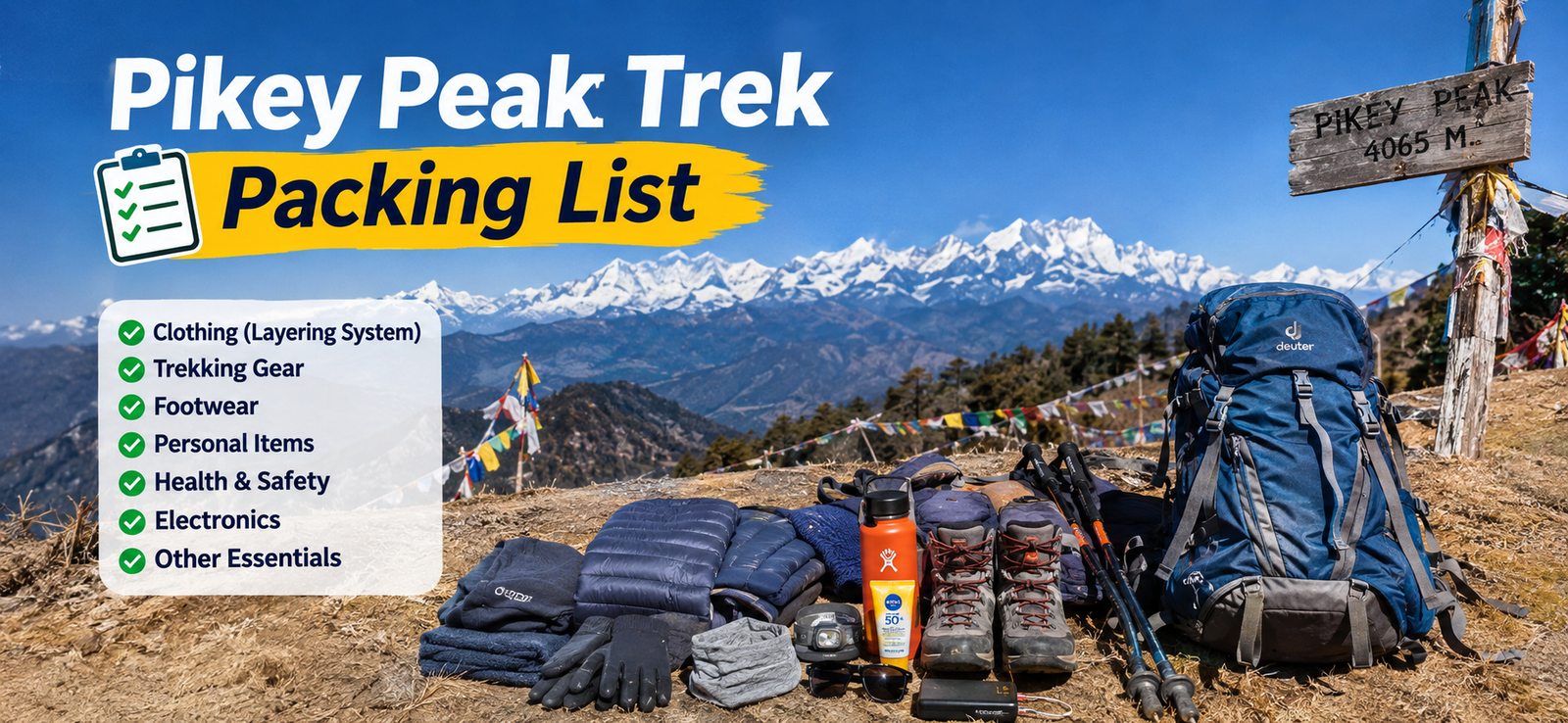
Use the categories below as a working checklist. Not every single item is mandatory for every trekker, but together they cover what matters for a standard Pikey Peak Trek departure in any season, with specific seasonal adjustments noted earlier in this guide.
Clothing
- Two or three long sleeve base layer tops in merino wool or synthetic wicking fabric
- Two or three base layer bottoms or thermal leggings
- One or two lightweight short sleeve shirts for warmer lower sections
- Fleece jacket or lightweight synthetic insulated jacket
- Packable down jacket for cold evenings and the summit push
- Waterproof, breathable outer shell jacket with a hood
- Waterproof or water resistant rain pants
- Two or three pairs of trekking pants
- Shorts or convertible pants for warmer days
- Four to six pairs of wool or wool blend hiking socks
- Thin liner socks
- Warm hat covering the ears
- Sun hat or cap with brim coverage
- Liner gloves and a thicker insulated or waterproof glove
- Buff or neck gaiter
- Underwear for the full trip plus a couple of spares
Footwear
- Broken in hiking boots with ankle support and solid tread
- Camp shoes or sandals for evenings at the teahouse
- Gaiters, optional outside of winter or snowy conditions
Sleeping gear
- Sleeping bag rated for cold conditions, roughly negative 10 to negative 15 degrees Celsius or colder depending on season
- Sleeping bag liner, silk or fleece
- Small inflatable travel pillow, optional
Bags
- Main duffel in the range of 60 to 80 liters for the porter to carry
- Day pack in the range of 25 to 35 liters for daily essentials
- Dry bag or large ziplock style bags for waterproofing documents and electronics
Accessories and health
- Headlamp with spare batteries
- Sunglasses with genuine UV protection
- High protection sunscreen and sun protective lip balm
- Water purification tablets, filter, or ultraviolet purifier
- Reusable water bottle or bladder
- Basic first aid kit including blister treatment, pain relief, and stomach medication
- Personal prescription medication and any altitude medication discussed with a doctor beforehand
- Rehydration salts
- Collapsible, adjustable trekking poles
- Hand sanitizer and a small supply of tissue or wet wipes
Electronics
- Phone with a local Nepali SIM card for lower route connectivity
- Power bank in the range of 10,000 to 20,000 milliamp hours
- Camera, if photography matters to you, with spare battery
- Universal travel adapter
- Spare charging cables
Documents and money
- Passport with sufficient remaining validity
- Physical and digital copies of passport, visa, and travel insurance details
- Travel insurance covering trekking at altitude and emergency evacuation
- Confirmation of current permit requirements from your operator
- Nepali rupees in cash, mostly in small denominations
- Printed or saved copy of your itinerary and operator contact details
Final Thoughts Before You Pack Your Bags for Kathmandu
The Pikey Peak Trek rewards sensible, layered packing far more than it rewards an expensive or exhaustive gear list. Because the route stays below the altitudes where serious mountaineering equipment becomes necessary, and because it is rated easy to moderate with only a brief stretch above 4,000 meters, most of what you need is the same core layering system experienced trekkers already rely on for shorter, cooler climate treks anywhere in the world, adjusted for the specific temperature swing between the warm lower villages and the cold summit viewpoint near 4,065 meters.
If you are unsure about any specific item, particularly bulkier gear like a sleeping bag or down jacket that you may not want to buy for a single trip, raise it with your operator before departure. Next Trip Nepal regularly advises travelers on exactly this kind of decision and can arrange rental gear in Kathmandu, confirm current permit and guide requirements, and give season specific guidance based on when your particular departure is scheduled. Pack in layers, break in your boots well ahead of time, respect how cold teahouse nights actually get regardless of how warm the days feel, and the gear side of your Pikey Peak Trek will take care of itself, leaving you free to focus on the walking, the forest, the monasteries along the way, and the long view toward Everest from the summit viewpoint at the top.