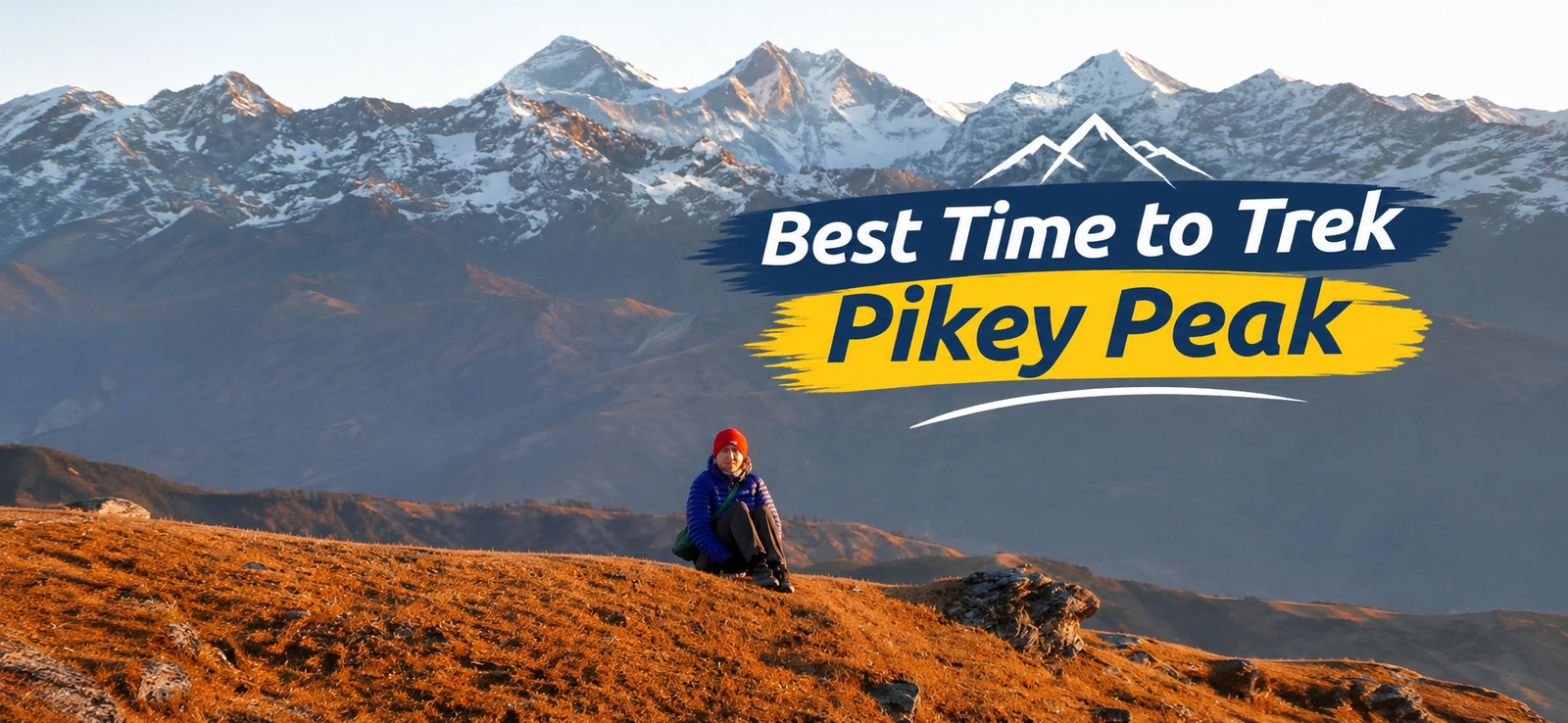
Choosing the Right Season for the Pikey Peak Trek
Pikey Peak sits in the Solu region of eastern Nepal, a quieter and lower approach to the wider Everest region that trades glacier crossings and high mountain passes for rolling rhododendron ridgelines, Sherpa villages, and one of the widest mountain panoramas in the country. The trek itself runs seven days and six nights, starting and ending in Kathmandu, with shared jeep transport on both ends of the route rather than a mountain flight. The summit altitude is most commonly cited as 4,065 meters, though a small number of sources list 4,067 or 4,068 meters, a minor survey discrepancy rather than any real disagreement about the mountain itself.
Because Pikey Peak tops out well below five thousand meters and involves no technical terrain, no glacier crossing, and only a brief stretch above 4,000 meters, timing matters more for comfort and views than for raw safety. That said, the difference between trekking Pikey Peak in peak autumn sunshine and trekking it through a wet August afternoon is enormous. Temperature swings, cloud cover, trail conditions, teahouse crowding, and festival timing all shift with the calendar, and a traveler who understands those shifts books a far better trip than one who simply picks a date at random.
This guide walks through every month of the year on the Pikey Peak Trek, drawing on operator weather data rather than official meteorological records. It is worth saying plainly up front that the two main operator sources behind this kind of trekking content do not always agree with each other on specific numbers, particularly for nighttime winter temperatures, monsoon rainfall, and visibility percentages. Rather than pretend one figure is the confirmed truth, this guide presents ranges and notes the disagreement where it exists, because that is a more honest picture of what trekkers can actually expect.
Quick Answer: Best Months at a Glance
If you want the short version before the full month by month detail: spring, running roughly March through May, and autumn, running roughly September through November, are the two strongest windows for the Pikey Peak Trek. Autumn is generally regarded as the single clearest and most reliable stretch of the year, while spring offers milder nights, blooming rhododendron forests, and somewhat thinner crowds. Winter is trekkable and can reward visitors with crisp, clear mornings, but nights turn seriously cold. Monsoon, from roughly June through August and sometimes bleeding into early September depending on the year, is the season most operators and guides actively discourage for anyone hoping to see the mountains.
The table below summarizes daytime and nighttime temperature ranges, visibility estimates, and crowd levels for each season. Treat the temperature and visibility figures as informed estimates rather than fixed data, since even the operator sources used to build this guide disagree with each other on several of these numbers.
| Season | Months | Daytime Temperature | Nighttime Temperature | Everest Visibility | Crowd Level |
|---|---|---|---|---|---|
| Winter | December, January, February | Roughly 5 to 12 degrees Celsius | Below freezing, with estimates ranging from negative 5 to negative 10 degrees Celsius up to as cold as negative 15 to negative 20 degrees Celsius at higher points depending on the source | Good on clear days, though winter haze and occasional storm fronts can interrupt visibility | Low |
| Spring | March, April, May | Roughly 10 to 18 degrees Celsius | Around freezing, varying a few degrees above or below depending on elevation and source | Roughly 65 to 80 percent clear conditions depending on the specific week and source | Moderate |
| Monsoon | June, July, August, sometimes into September | Roughly 14 to 20 degrees Celsius | Mild compared to winter, rarely dropping near freezing at the elevations the trek reaches | Lowest of the year, with estimates ranging from as low as 20 percent up to around 45 percent depending on source and timing | Lowest |
| Autumn | September, October, November | Roughly 12 to 25 degrees Celsius depending on elevation | A few degrees above freezing down to slightly below at higher points | Roughly 80 percent up to above 95 percent in some reporting, generally the clearest stretch of the year | Highest |
Winter on Pikey Peak: December, January, and February
Winter is the season most trekkers overlook, and for some travelers that oversight works to their advantage. Daytime temperatures along the route tend to sit somewhere between 5 and 12 degrees Celsius under full sun, which, combined with the dry winter air, can feel genuinely pleasant on the trail by midday. The problem is not the day. It is the night. Once the sun drops behind the ridgelines, temperatures fall fast, and this is exactly where the two operator sources behind this guide part ways on specifics. One source puts nighttime lows at a relatively survivable negative 5 to negative 10 degrees Celsius. Another source, describing conditions at the higher points near Pikey Peak Base Camp, cites lows as severe as negative 15 to negative 20 degrees Celsius. Both figures may be accurate for different elevations or different nights of unusually hard frost, but the honest takeaway for a planning trekker is that winter nights on this route are cold, the exact number is uncertain, and packing should assume the colder end of that range rather than the milder one.
Occasional snowfall is possible near the higher sections of the trail, and while it rarely shuts the route down for long, it can briefly affect trail conditions and lodge availability at the upper teahouses. Some smaller lodges reduce their operations or close altogether during the coldest stretches of the season, so travelers heading out in winter should confirm with their operator that accommodation along the planned itinerary is actually open rather than assuming every teahouse runs a full winter schedule.
December on Pikey Peak
Early December often still carries some of the stability of late autumn, with clear skies lingering before the coldest part of winter sets in. Daytime trekking conditions remain comfortable in multiple warm layers, and the forest sections lower on the route stay relatively mild. By the final third of the month, nights grow noticeably harsher, and trekkers should expect to need a sleeping bag rated well below the temperatures they might assume from daytime comfort alone. December also overlaps with the Christmas and New Year travel period for international visitors, which can create a small secondary bump in bookings even though overall winter numbers remain far lower than spring or autumn.
January on Pikey Peak
January is typically the coldest month on the route. This is when the gap between the two cited nighttime ranges matters most in practice: a trekker who packs for negative 10 degrees Celsius and encounters a negative 20 degree night at a high camp is in a genuinely uncomfortable position, while a trekker who over packs for the coldest estimate and only experiences a milder night has simply carried a bit of extra weight. Given the uncertainty in the data, over packing is the safer call. On the upside, January delivers some of the driest, dust free air of the year, and clear mornings can offer sharp, satisfying mountain views precisely because there is so little moisture or haze in the atmosphere. Trail traffic in January is sparse, and trekkers who do go out often have long stretches of path and entire teahouse dining rooms to themselves.
February on Pikey Peak
February begins to show the first hints of the turn toward spring, particularly in its second half. Daytime temperatures edge toward the warmer end of the winter range, and the coldest nights of the year are generally already behind the season by this point, though a late cold snap is always possible at altitude. Snow at the higher elevations can linger from earlier storms, so trail conditions should be checked close to departure. February remains a low crowd month, and travelers drawn to solitude on the trail, rather than the warmest or most reliably clear conditions, often find it an underrated choice.
Who Should Trek Pikey Peak in Winter
Winter suits trekkers who prioritize empty trails and are comfortable packing for serious cold, who want crisp, high contrast mountain photography on clear days, and who are flexible enough to adjust plans if a particular lodge is closed or a storm briefly affects the upper trail. It does not suit trekkers who are sensitive to cold, who are traveling with minimal winter gear, or who want a guarantee of consistently clear skies, since winter weather, while often stable, can also bring short lived storm fronts that spring and autumn rarely see in the same way.
Spring on Pikey Peak: March, April, and May
Spring is where the Pikey Peak Trek starts to show its most popular face. Daytime temperatures generally run from about 10 to 18 degrees Celsius, cooler the higher you climb, and nights become noticeably more forgiving than winter, hovering around freezing and varying a few degrees in either direction depending on elevation and which source you consult. The defining feature of spring, though, is not the temperature. It is the rhododendron.
The lower and middle sections of the trail pass through forest that turns into a wall of color as rhododendron trees bloom, typically peaking around April, though the exact timing shifts slightly year to year depending on winter snowpack and early season warmth. For trekkers who have done other routes in the region before, this bloom is one of the clearest reasons to pick Pikey Peak specifically in spring rather than visiting purely for mountain views, since few other treks in the area combine forest flowering on this scale with wide ranging Himalayan panoramas from the same ridgeline.
Visibility in spring is generally good but not as consistently sharp as autumn. Estimates across sources land somewhere between 65 and 80 percent clear conditions, with real variation from week to week. Afternoon haze can build up as the day warms, particularly later in the season, which is why many experienced trekkers push for early morning summit attempts on Pikey Peak itself, when the air tends to be calmest and clearest before any daytime cloud buildup begins.
March on Pikey Peak
March opens the spring season with the trail still carrying some residual winter chill, especially overnight, but the days warm quickly as the month progresses. Early blooms begin to appear in the lower forest, giving a preview of the fuller display to come in April. Trekker numbers start to climb from winter lows, though March remains noticeably quieter than the following two months. This can make it an appealing middle ground for travelers who want improving weather without the busiest trail conditions.
April on Pikey Peak
April is widely considered the peak of the rhododendron bloom and one of the most photogenic months on the entire route. It is also, for that exact reason, one of the months operators most strongly recommend booking well ahead of time, since the combination of good weather, blooming forest, and manageable trekking difficulty draws a steady stream of visitors. Daytime temperatures sit comfortably in the trekking friendly range, nights are cool but rarely harsh, and the forest sections of the trail feel completely different from how they look in any other season. Anyone building a trip around photography or simply wanting the most visually rewarding version of the lower trail should give April serious priority.
May on Pikey Peak
May extends the favorable spring conditions but begins to show early signs of the approaching monsoon, particularly toward the end of the month. Afternoon cloud buildup becomes more common, and the occasional early rain shower can appear, though nothing close to the sustained wet weather of June onward. Temperatures by this point are at the warmer end of the spring range, which can make lower elevation sections of the trail feel distinctly warm by midday even while higher sections stay comfortably cool. May is a good window for trekkers who want warmth and generally reliable weather but are not specifically chasing the rhododendron peak of April.
Why Spring Works So Well for Pikey Peak
Spring succeeds on this particular route because it balances several factors at once: comfortable temperatures, a genuinely spectacular forest bloom unique to this time of year, visibility that is good even if not quite at autumn levels, and crowd levels that, while higher than winter or monsoon, still fall well short of the autumn peak. Travelers who want a strong experience without competing for the busiest teahouse rooms often land on spring, and particularly April, as their preferred window.
Monsoon on Pikey Peak: June, July, August, and Sometimes Into September
Monsoon is the season almost every operator steers trekkers away from, and the reasoning holds up under scrutiny. Daytime temperatures during this stretch run roughly 14 to 20 degrees Celsius, which sounds pleasant on paper, but the defining feature of these months is rain, not warmth. One source describes daily rainfall exceeding 150 millimeters during peak monsoon weeks, though this specific figure has not been independently confirmed across sources and should be treated as an illustrative estimate rather than a settled statistic. What is consistent across sources is the general picture: heavy, frequent, and at times prolonged rainfall through the core of the season.
Sources also differ on exactly where monsoon begins and ends for planning purposes. Most place the core wet season from June through August, but some extend the discouraged window into early September depending on how late the rains run in a given year. Since monsoon timing varies annually and does not follow a fixed calendar switch, travelers planning a trip anywhere near the edges of this window should check current conditions closer to departure rather than relying on a fixed date.
Visibility is where monsoon suffers most, and where the two sources used for this guide disagree most sharply. One estimate puts clear mountain viewing conditions as low as 20 percent during peak monsoon weeks. Another gives a somewhat less bleak figure of around 45 percent. The honest conclusion sits somewhere between those two numbers, and it reflects a real feature of monsoon weather rather than sloppy data: cloud cover during this season is genuinely unpredictable, shifting hour to hour and day to day, which makes any single fixed percentage somewhat misleading regardless of which source produced it.
June on Pikey Peak
June sits at the transition into monsoon, and early in the month conditions can still resemble a warm, humid extension of late spring before the rains fully establish themselves. By the second half of June, rain becomes a regular, often daily, feature of the trek, and the lower forested sections of the trail start to show the first leeches of the season, a known nuisance in wet lower elevation forest that trekkers in this window should be prepared to manage with basic precautions like gaiters and salt or repellent.
July on Pikey Peak
July is typically the wettest month of the core monsoon period. Trails in the lower and middle sections can turn muddy and slippery, river crossings run higher than in drier months, and cloud cover regularly obscures the mountain views that draw most travelers to this route in the first place. Trekker numbers are at their lowest point of the year, which appeals to a small subset of highly flexible, rain tolerant travelers, but for the majority seeking mountain panoramas, July offers the weakest odds of the entire calendar.
August on Pikey Peak
August generally continues the wet pattern of July, though some years show brief dry spells that offer short windows of clearer skies. These windows are unpredictable and cannot be reliably planned around, so travelers should not book an August departure expecting a guaranteed clear stretch. Humidity remains high, leeches remain present in forested sections, and the overall advice from operators is consistent with July: this is not the season to choose if mountain visibility is a priority.
Should You Trek Pikey Peak in Monsoon
There is a narrow case for a monsoon departure. Trails are nearly empty, teahouses are easy to book on short notice, and the forest itself turns a deep, saturated green that some travelers find appealing in its own right, separate from any mountain view. Travelers interested primarily in botany, bird life, or simple solitude, and who are genuinely comfortable with sustained rain, mud, and leeches, can still have a worthwhile trip. For anyone whose main goal is seeing Everest and its neighboring peaks from Pikey Peak’s famous viewpoint, though, this is the one season where the odds work firmly against that goal, and most honest operators, Next Trip Nepal among them, will say so directly rather than oversell a monsoon departure.
Autumn on Pikey Peak: September, October, and November
Autumn is where the Pikey Peak Trek is generally agreed to perform at its best, and this is one of the few points in the seasonal data where the sources used for this guide land close together rather than far apart. Daytime temperatures range roughly from 12 to 25 degrees Celsius depending on elevation, with the lower stretches of the trail running warm and the exposed ridgelines near the summit staying noticeably cooler. Nighttime temperatures run from a few degrees above freezing down to slightly below at the higher camps, a far gentler range than the deep winter lows reported for December through February.
Visibility is the real headline for autumn. Estimates range from roughly 80 percent up to above 95 percent in some reporting, and while that is still a meaningful spread, every figure in that range describes conditions most trekkers would consider excellent. The post monsoon atmosphere has been washed clean of dust and haze by the rains, and the result is some of the sharpest, most reliable mountain viewing of the entire year. October in particular is often singled out by operators as the single best month on the route, combining peak visibility with comfortable temperatures and a landscape that has fully recovered from the wet season without yet sliding into winter cold.
September on Pikey Peak
September is a transitional month, and its character depends heavily on how the monsoon behaved in a given year. Early September can still carry residual rain and cloud, particularly in years where the wet season runs long, while the back half of the month typically shows a clear improvement as skies dry out and stabilize. Trekkers booking September departures should build some flexibility into their plans, since this is the one autumn month where lingering monsoon conditions remain a real possibility depending on the year.
October on Pikey Peak
October is the month most consistently praised across trekking sources, and the Pikey Peak Trek is no exception. Skies are typically at their clearest, temperatures sit in a genuinely comfortable range for both day and night, and the trail itself, still showing some of the greenery left over from monsoon, looks its best. This is also, unsurprisingly, the busiest month of the year on the route. Teahouses fill up, and travelers who want specific accommodation or a specific departure date should expect to book well in advance rather than arranging things at the last minute.
November on Pikey Peak
November continues much of October’s clarity while nights grow progressively colder as the month advances toward winter. Early November often still delivers excellent visibility and comfortable daytime trekking, while late November starts to feel more like an early preview of winter, particularly after dark. Crowds thin out somewhat compared to the October peak, making November an appealing choice for travelers who want strong autumn conditions without quite the same competition for teahouse rooms.
Why Autumn Draws the Crowds
Autumn’s popularity is not an accident of marketing. It genuinely combines the best visibility estimates of the year, comfortable temperatures across most of the season, and a landscape that has just emerged from monsoon looking fresh rather than dusty or dry. The tradeoff is crowding. This is also the season when autumn’s calendar overlaps with Nepal’s two biggest national festivals, which adds another layer of both appeal and practical planning that deserves its own discussion.
Festivals and Cultural Timing Along the Route
Autumn’s popularity on the Pikey Peak Trek is closely tied to Dashain and Tihar, the two largest festivals on the Nepali calendar, both of which generally fall within the September to November window, though their exact dates shift each year according to the lunar calendar. Dashain is the longer and more significant of the two, a multi week celebration centered on family gatherings, and Tihar follows not long after as a festival of lights with its own distinct traditions. For trekkers, the practical effect of this overlap is twofold. First, domestic travel and tourism activity both rise around these dates, which contributes to the already high autumn demand for teahouse rooms and transport. Second, trekkers passing through Sherpa villages during this period may see some local staff or guides wanting time with family, which a well organized operator plans around well ahead of time rather than leaving to chance.
The route also passes near two monasteries with their own festival traditions, though the specifics require some care. Thupten Choling Monastery, near Junbesi, and Chiwong Monastery, near Phaplu, both observe Mani Rimdu, a traditional Sherpa Buddhist festival tied to the story of Guru Rinpoche establishing Buddhism in Tibet. The full traditional observance of Mani Rimdu is often described as running around 19 days. One source suggests the celebration at Thupten Choling often falls around May, though exact dates vary from year to year and should not be treated as fixed. Several monasteries across the wider Solu Khumbu region hold Mani Rimdu at different times, commonly in autumn at monasteries such as Tengboche, though the precise date at Chiwong specifically is not confirmed in the sources reviewed for this guide. Trekkers hoping to witness any part of a Mani Rimdu observance should treat it as a possible bonus rather than something to plan an entire itinerary around, and should check current dates with a local operator rather than relying on a fixed calendar date repeated across travel blogs.
Thupten Choling itself has an interesting history worth a brief mention here, since it sits directly on the Pikey Peak route near Junbesi. It was founded in 1968 on donated land at roughly 3,000 meters by Trulshik Rinpoche, a senior Nyingma lineage teacher who later became head of the Nyingma school and was a teacher of the 14th Dalai Lama. Trulshik Rinpoche fled Tibet in 1959, and the original 1968 structures were meant as temporary buildings before deteriorating over subsequent decades. Permanent rebuilding began in 2001, reportedly with Swiss funding support, and the April 2015 earthquake caused further damage that residents worked through during the following rainy season. Population estimates for the community vary noticeably between sources, with one giving several hundred monks and nuns and another citing a range as wide as 400 to over 900, both sources agreeing that roughly 80 percent are Tibetan refugees. Given that spread, the most honest statement is simply that the community numbers in the several hundreds, with some estimates running considerably higher, and that the exact figure is not settled across available sources.
Chiwong Monastery, perched on a cliff above Phaplu, predates the 1959 Tibetan refugee movement by several decades. It was established between 1919 and 1923 by Sangey Tenpa Lama, with an original community of around 50 monks, and should not be described as connected to the 1959 exodus the way Thupten Choling is, since it is a separate and considerably older foundation. One source reports that Trulshik Rinpoche spent time residing at Chiwong among other monasteries after his arrival from Tibet, though this specific link is not confirmed by every source reviewed and should be treated as a reported connection rather than a settled historical fact. No source reviewed for this guide confirms any formal institutional link or shared governance between the two monasteries, so they are best understood as two distinct communities sharing a trekking route rather than one continuous lineage.
Crowds, Teahouse Availability, and Pricing by Season
Crowd levels on Pikey Peak shift dramatically across the year, and this matters just as much as temperature for trip planning. Even at its busiest, in peak October, Pikey Peak sees far fewer trekkers than the Everest Base Camp route, which remains one of the most heavily trekked trails in Nepal with substantial volume in every season, especially autumn. Pikey Peak’s relative quiet is part of its appeal, but that appeal is not evenly distributed across the calendar.
Autumn, and particularly October, brings the highest demand for teahouse rooms along the route. While nothing close to the congestion seen on busier Everest region trails, popular lodges in villages like Junbesi can still fill during the peak weeks, and travelers without a confirmed booking may find their first choice of accommodation unavailable. Spring follows as the second busiest season, with April carrying particularly strong demand thanks to the rhododendron bloom. Winter and monsoon sit at the opposite end, with winter offering low but not nonexistent trail traffic and monsoon offering the quietest trails of the entire year, often to the point where trekkers can book accommodation with little advance notice at all.
Pricing follows a related but not identical pattern. Low season departures, generally monsoon and parts of winter, are commonly marketed with meaningful discounts compared to peak season rates. Here again the sources disagree on specifics: one cites savings as high as 20 percent during low season windows, while another suggests a more modest 10 percent reduction. Rather than treat either number as a guarantee, travelers should understand that low season pricing tends to run somewhere in that broad range and is worth asking about directly when requesting a quote.
It is also worth noting how this compares to other popular treks in the region. The Everest Base Camp trek, often considered alongside Pikey Peak as a benchmark route, typically runs 12 to 16 days, most often presented as a 12 to 14 day itinerary, against Pikey Peak’s fixed seven days. It also requires a mountain flight to and from Lukla, reported to cost somewhere between 360 and 460 US dollars round trip depending on source and season, with no single authoritative figure available and a well known risk of weather related delays, though no reliable statistic on exact delay frequency appears in the sources reviewed. Package pricing for Everest Base Camp typically runs from about 1,200 to 4,500 US dollars depending on group size, service level, and season, with budget departures often in the 1,200 to 1,700 dollar range. Pikey Peak, by contrast, involves no flight risk, since the route uses shared jeep transport on both ends, removing one of the most common sources of itinerary disruption on Everest region treks.
Booking Advice: When to Reserve Your Pikey Peak Trek
Booking timelines on Pikey Peak should match the season a traveler is targeting. For an October or April departure, the two busiest windows of the year, booking several months ahead is a reasonable and often necessary habit, particularly for travelers who want a specific start date or specific accommodation along the route. Next Trip Nepal, like most established operators running this trek, schedules departures across every season, but availability during the peak autumn and spring windows tightens well before the dates themselves arrive, simply because demand concentrates so heavily into those months.
Winter and monsoon departures allow considerably more booking flexibility. Travelers targeting these quieter seasons can often confirm a trip on much shorter notice, since teahouse space and group logistics are rarely under the same pressure that builds during peak months. That flexibility should not be mistaken for a reason to delay planning indefinitely, though, since a licensed guide still needs to be arranged, and Nepal’s widely reported guide requirement, in place from 2023 onward for most trekking routes, means independent trekkers in particular should confirm guide arrangements ahead of arrival rather than assuming one can be found on short notice once in Kathmandu. Agency bookings, including those through Next Trip Nepal, already build a licensed guide into the standard package, which removes this particular concern for travelers going through an established operator.
Permit requirements are another area where travelers should lean on their operator rather than fixed online claims. Because the Pikey Peak route sits near the edge of more than one administrative zone, permit requirements have been reported inconsistently across different operator sites, and the safest approach is simply to have a knowledgeable operator confirm current requirements at the time of booking rather than relying on a claim that may be outdated by the time a trip actually departs.
One final piece of practical advice applies across every season. Connectivity along the route is patchy at best, with mobile signal weakening as elevation increases and WiFi available at many lower teahouses for a fee but far less reliable higher up. A local SIM card is worth arranging in Kathmandu before departure regardless of which month a traveler chooses, since relying on international roaming or hoping for consistent WiFi at altitude is a plan that fails more often than it succeeds.
Our Recommendation: The Best Months for Pikey Peak
If pressed for a single answer, October stands out as the strongest overall month for the Pikey Peak Trek, combining the highest visibility estimates of the year, comfortable temperatures across day and night, and a landscape still green from monsoon rather than dried out by a long dry season. The tradeoff is crowding and the need to book ahead, but for a traveler whose main priority is seeing Everest and its neighboring peaks clearly from Pikey Peak’s summit, October is the month every available source points toward most consistently.
April is a close second and arguably the better choice for travelers who weigh the rhododendron bloom heavily in their decision, since no other month delivers that particular combination of forest color and good, though not quite autumn level, visibility. Early autumn, specifically a well chosen window in late September or November, offers a reasonable compromise for travelers who want strong conditions without competing directly against the October peak for teahouse rooms. Winter remains a legitimate option for cold tolerant travelers who prioritize solitude and dramatic, high contrast mountain photography over warmth, provided they pack seriously for the colder end of the reported nighttime range rather than the milder one. Monsoon, honestly, should be reserved for travelers who are not primarily chasing mountain views, since this is the one season where even the more optimistic visibility estimate still falls well short of what spring or autumn can offer.
Across every one of these windows, the numbers presented in trekking guides, this one included, should be read as informed estimates built from operator experience rather than precise meteorological measurement. The disagreements between sources on nighttime winter lows, monsoon rainfall, visibility percentages, and even savings on low season pricing are not evidence of unreliable information so much as evidence that mountain weather in a region like Solu simply does not reduce cleanly to a single confirmed number. A good operator, and a good trekker, treats these figures as a planning guide rather than a guarantee.
Final Thoughts on Timing Your Trek
The Pikey Peak Trek rewards careful timing more than many comparable routes in Nepal, precisely because its short seven day length and relatively low summit altitude mean weather and visibility do most of the work in shaping how memorable the trip feels. A trekker standing at Pikey Peak Base Camp on a clear October morning, looking out at Everest, Lhotse, Makalu, and a long chain of neighboring peaks under what has often been called one of the finest panoramic mountain views in the region, has a genuinely different experience than one standing on the same spot inside a July rain cloud with visibility reduced to a few dozen meters. Both trekkers walked the same trail. Only one of them saw the mountains it was built to show off.
That said, there is no single universally correct month, only a correct month for a given traveler’s priorities. Someone chasing the clearest possible mountain views and willing to book ahead and share the trail with more company should lean toward October. Someone who wants flowering forests alongside solid, though slightly less reliable, visibility should lean toward April. Someone who wants near total solitude and is prepared for serious cold should consider January or February with appropriate gear. And someone who simply cannot travel outside of June, July, or August should go in with clear expectations about rain, limited visibility, and leeches, rather than hoping for an exception to a pattern that holds across most years.
Whatever month ends up working for a given schedule, the most reliable path to a well organized trip remains working with an operator who schedules departures across the full calendar and gives honest, season specific advice rather than selling every month as equally ideal. Next Trip Nepal runs Pikey Peak Trek departures throughout the year for exactly this reason, so travelers constrained to a particular window can still get a trip matched sensibly to the conditions they will actually encounter on the trail.