June Warning: Monsoon Season
June is the opening month of the monsoon season in Nepal. The Annapurna Base Camp route is technically open but conditions are significantly more difficult than any other trekking month. Heavy daily rainfall, flooded trails, leeches throughout the lower and mid sections, poor mountain visibility, and avalanche risk above Deurali make June the most challenging month to attempt ABC. This guide is for trekkers who understand the conditions and are making an informed choice, not for first-time visitors expecting standard trekking conditions.
Annapurna Base Camp Trek in June: Tour at a Glance
| Season | Monsoon (early to mid-monsoon) |
| Recommended? | Not recommended for most trekkers |
| ABC Temperature Range | 0°C to +12°C at 4,130m |
| Pokhara Temperature | 23°C to 30°C (high humidity) |
| Rainfall | 300 to 500mm at Pokhara; daily rain on trail |
| Trail Conditions | Wet, muddy, slippery; leeches throughout lower route |
| Mountain Views | Frequently obscured; occasional clear mornings |
| Teahouse Availability | Open but some lodges run reduced menus |
| Trekker Numbers | Very few — genuine solitude on the trail |
| Permits Required | TIMS Card + ACAP Permit |
| Overall Difficulty Rating | Hard (monsoon conditions require experience) |
June marks the start of the monsoon season across Nepal and transforms the Annapurna Base Camp trail from a well-trodden trekking route into a demanding wet-weather experience. The monsoon arrives in the Pokhara region typically between June 1 and June 15, after which daily rainfall becomes the norm rather than the exception. The rain that falls on the lower trail turns stone steps into slick surfaces, fills the gorge sections with the sound of swollen rivers, and brings the leech population to its annual peak across all forest sections up to 2,500m.
Despite these conditions, June ABC treks are completed every year by a small number of trekkers who specifically want the monsoon experience: the dramatically green and lush landscape, the solitude of a trail that has almost no other trekkers, the occasional clear morning window where the peaks emerge washed and brilliant after rain, and the physical challenge of monsoon trekking that represents a different engagement with the mountains than the manicured October experience.
This guide does not discourage June trekking outright, but it presents the conditions honestly so that your decision is fully informed. June ABC requires a high tolerance for wet and uncomfortable conditions, a guide with monsoon experience, comprehensive rain gear, and the willingness to accept that mountain views may be limited or absent.
June Weather and Rainfall
The monsoon in the Annapurna region delivers rainfall in concentrated daily patterns. Rain typically falls in the afternoon and evening, with some mornings being partially or fully clear. The clearest windows are the early mornings before 7am, when overnight breaks in the cloud system allow the peaks to be visible. By 9am, cloud begins building from the valley floors upward, and by noon most high peaks are obscured.
Pokhara receives approximately 300 to 500mm of rain in June, making it one of the wettest months of the year. At higher elevations on the ABC route, this manifests as rain and occasional mist rather than the tropical downpours of the valley. Above 3,500m, June precipitation is often in the form of snow or sleet, and the high sanctuary approach can see fresh snow at ABC even in June.
| Location / Elevation | Night Low | Day High | Conditions |
|---|---|---|---|
| Pokhara (827m) | 23°C | 30°C | Daily monsoon rain, high humidity |
| Tikhedhunga (1,540m) | 19°C | 26°C | Wet, leeches everywhere, forest intensely green |
| Ghorepani (2,860m) | 10°C | 18°C | Misty, occasional clear morning, views rare |
| Chhomrong (2,170m) | 14°C | 22°C | Rain daily, path muddy, leeches active |
| Himalaya (2,920m) | 8°C | 16°C | Mist and cloud frequent, occasional clear breaks |
| Deurali (3,230m) | 4°C | 12°C | Cloud and mist most of day, occasional rain |
| MBC (3,700m) | 0°C | 10°C | Frequently in cloud, rare clear windows |
| ABC (4,130m) | -3°C | 8°C | Cloud most of day; clear pre-dawn possible |
The paradox of June at high elevation is that ABC itself can have surprisingly clear mornings precisely because the monsoon cloud is still building from the south and the high sanctuary is above the initial cloud layer. Early risers at ABC in June who are awake at 5am sometimes find the peaks completely clear, with the cloud filling the valleys below and the summit of Annapurna I catching the first light above a sea of white. These moments are unpredictable and cannot be guaranteed, but they occur and they are spectacular.
June Trail Conditions
The trail from Nayapul to Deurali in June is challenging by any standard. The stone steps that form much of the lower route become covered in moss and algae during the monsoon, making them slippery when wet. The slopes above the trail shed water continuously during heavy rain, creating small stream crossings across the path. The forest sections between Sinuwa and Dovan are particularly wet, with a permanent drip from the canopy above regardless of whether active rain is falling.
Leeches in June are at their maximum density and activity. Every section of trail below 2,500m has leeches active during and after rainfall. They appear on the trail surface, on vegetation at foot level, and even drop from overhanging branches. Leech socks are not optional in June; they are a basic requirement for the lower trail. Trekkers without leech protection will spend significant time removing leeches from their legs and feet.
Above Deurali, conditions improve significantly in terms of leech concern (leeches are rare above 2,500m), but the trail can be misty and visibility is often limited. The avalanche zones below Hiunchuli and on the approach to MBC are active during heavy monsoon snow events, and your guide needs to monitor conditions before proceeding through these sections.
The positive aspect of June trail conditions is the landscape. The lower route is at its most intensely green and the waterfalls that appear on every cliff face from the monsoon runoff add a dramatic visual dimension to the walk that is completely absent in the dry seasons. The Modi Khola gorge in June, with water cascading from every surface and the river roaring far below, is an impressive natural spectacle.
What June Trekkers Experience at ABC
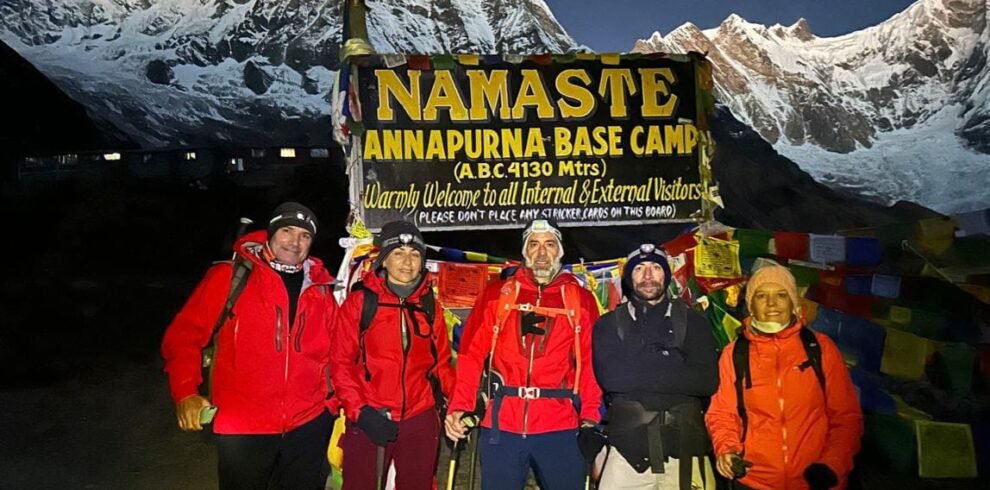
Trekkers who reach ABC in June experience the cirque in a different character from any other month. Fresh monsoon snow may have fallen on the peaks and the high sanctuary floor, adding white to the scene. The cloud dynamics above ABC in June create dramatic lighting conditions when they break: sunlight through monsoon cloud produces diffuse, soft light on the peaks rather than the hard direct light of October. Photographs taken on the occasional clear ABC morning in June have a distinctive quality that is different from the clear-sky images of the dry seasons.
The solitude at ABC in June is absolute compared to the crowds of April. A trekker who reaches ABC in June may find themselves as the only group at the lodge, with the dining room, the teahouse staff, and the entire cirque to themselves. For some trekkers, this solitude is the primary attraction of monsoon trekking. The mountain is unchanged; the crowds are gone.
Teahouses in June
Teahouses on the ABC route remain open in June but operate at reduced capacity. The main lodges at each stop are staffed and serving food. Menus are simplified compared to peak season, with the focus on reliable staples: dal bhat, noodles, rice dishes, and hot drinks. Some of the smaller secondary lodges may be closed or unattended. Your guide will know which lodges are operational on the current week.
The teahouse fire (bukhari) is typically lit in the evenings at Himalaya, Deurali, MBC, and ABC even in June, because the nights remain cold at high elevation. The combination of a warm fire, monsoon rain on the roof, and virtual solitude in the dining room is described by June trekkers as one of the most atmospheric teahouse experiences on the route.
Who Should Trek ABC in June?
June is suitable for trekkers with monsoon experience in Nepal or similar climates, strong mental resilience to prolonged wet and uncomfortable lower trail conditions, a guide with specific monsoon season experience on the ABC route, and no strong expectation of mountain views. It is also suitable for trekkers returning for their second or third ABC who specifically want the monsoon contrast to their previous dry-season experience.
June is not suitable for first-time trekkers to Nepal, for trekkers with strong expectations of mountain views or comfortable weather, for those with a leech phobia or significant aversion to sustained wet conditions, or for anyone on a tight schedule who cannot accommodate the weather delays that monsoon conditions can impose.
Packing for June
June packing prioritises waterproofing above everything else. Every item that must stay dry should be in a waterproof bag inside your pack. The pack itself should have a waterproof cover. Your rain jacket should be a quality waterproof shell, not a water-resistant softshell. Gore-Tex or similar membrane construction is the right choice for June.
For the high camp sections, the same cold-weather kit applies as in any other month: down jacket, fleece, sleeping bag to minus 15°C. Do not reduce your high-camp kit because of the warm and wet conditions at low elevation. ABC at night in June is still cold and often involves fresh snow.
| Category | Item | June Priority |
|---|---|---|
| Waterproofing | Quality waterproof shell jacket (Gore-Tex grade) | Essential |
| Waterproof trousers | Essential | |
| Pack rain cover + dry bags inside | Essential | |
| Waterproof trekking boots | Essential | |
| Leeches | Leech socks (full-leg coverage) | Essential |
| Salt or DEET repellent | Essential | |
| High Camp Cold | Down jacket (minus 10°C rated) | Essential |
| Sleeping bag (minus 15°C) | Essential | |
| Warm hat and gloves | Essential | |
| Quick-dry | Quick-dry trekking shirts (2 to 3) | Essential |
| Quick-dry trekking trousers or shorts | Essential | |
| Footwear | Camp sandals (for teahouse evenings) | Recommended (allows boots to dry) |
Permits and Costs in June
Permit requirements are unchanged: ACAP permit NPR 3,000 (USD 22) and TIMS Card NPR 2,000 (USD 15). Total trek budget for a 10-day guided June ABC trek is approximately USD 750 to 1,000, with potential savings on guide and accommodation costs offset by the practical need for higher quality rain gear.
Frequently Asked Questions: ABC Trek in June
Is it safe to trek to ABC in June?
It is possible with appropriate preparation and an experienced guide, but it has more objective hazards than any other month. The avalanche zones above Deurali are more active during monsoon snowfall. The trail sections in the gorge can be washed out or blocked by rockfall triggered by saturated slopes. Your guide’s assessment of day-by-day conditions above Deurali is critical in June. Never push into the high sanctuary against your guide’s judgment in monsoon season. With an experienced guide and careful itinerary management, a June ABC trek can be completed safely.
Will I see the mountains at all in June?
You will likely see the mountains on some mornings during a 10-day June trek, but you cannot count on it. The pre-dawn window before 6am at ABC is the most reliable view time. Some June trekkers report completely clear ABC sunrises; others are in cloud for their entire sanctuary stay. The probability of at least one partially clear morning at ABC over a 2-night stay is estimated at 40 to 60 percent in a typical monsoon year. If clear mountain views are your primary objective, June is the wrong month.
Should I do ABC in June or September?
September is a significantly better option than June if your choice is between these two months. September is the final month of the monsoon and sees progressively clearing conditions through the month, with the last week of September often approaching the clarity of October. The leech season is ending in September. Teahouses are fully operational. And September delivers an emerging post-monsoon clarity on the peaks that June cannot match. If you have flexibility between June and September, choose September.
What is the landscape like in June?
The lower route in June is extraordinarily green. The monsoon rain saturates every surface and the forest responds with intense growth and colour. Waterfalls appear on cliff faces that are completely dry in October. The river in the gorge is thunderous with snowmelt and monsoon rain combined. Wild orchids flower in the lower forest sections. The visual character of the route in June is completely different from the dry seasons, and trekkers who appreciate the landscape of tropical and sub-tropical forest find June strikingly beautiful below 2,500m.
The Case for June
Despite its challenges, June has genuine advocates among Himalayan trekkers with monsoon experience. The absolute solitude of the trail, the dramatic waterfall-laced green landscape, the atmospheric quality of a monsoon ABC in cloud, and the occasional extraordinary clear morning that rewards patient waiting are experiences that cannot be replicated in any other month. If you go in June, go with full information, go with the best guide you can find, go with waterproof everything, and go with the willingness to be genuinely challenged by the trail conditions. The reward, when it comes, is an Annapurna Base Camp experience that only a small number of trekkers will ever see.
Planning a June ABC Trek?
Next Trip Nepal can arrange June ABC treks for experienced trekkers who understand and accept the monsoon conditions. We work with guides who have specific monsoon season experience on the ABC route and can advise on the safest itinerary approach for June conditions. Contact us to discuss your June dates.
WhatsApp Us Email UsAnnapurna Base Camp Trek: Complete Monthly Guide
Use these month-by-month guides to plan your ABC trek, or visit the Annapurna Base Camp Trek overview page for full itinerary, costs and booking details.
Trek in: January | February | March | April | May | June | July | August | September | October | November | December