Annapurna Base Camp Trek in January: Tour at a Glance
| Best for | Experienced trekkers, solitude seekers, photography |
| Season rating | Challenging but rewarding (off-season) |
| Trail crowds | Very low (fewer than 5% of annual trekker volume) |
| Snow on trail | Likely above Deurali (3,230m), possible above Bamboo |
| Temperature at ABC | Night: -15 to -20°C / Day: -5 to 0°C |
| Teahouses open | Most open to Chhomrong, selective above that |
| Standard duration | 10 to 12 days from Pokhara |
| Permit cost | ACAP: NPR 3,000 + TIMS: NPR 2,000 (foreign trekkers) |
| Budget per day | USD 30 to 55 on the trail |
| Key risk | Ice on trail above Deurali, possible teahouse closures at upper sections |
Should You Trek to Annapurna Base Camp in January?
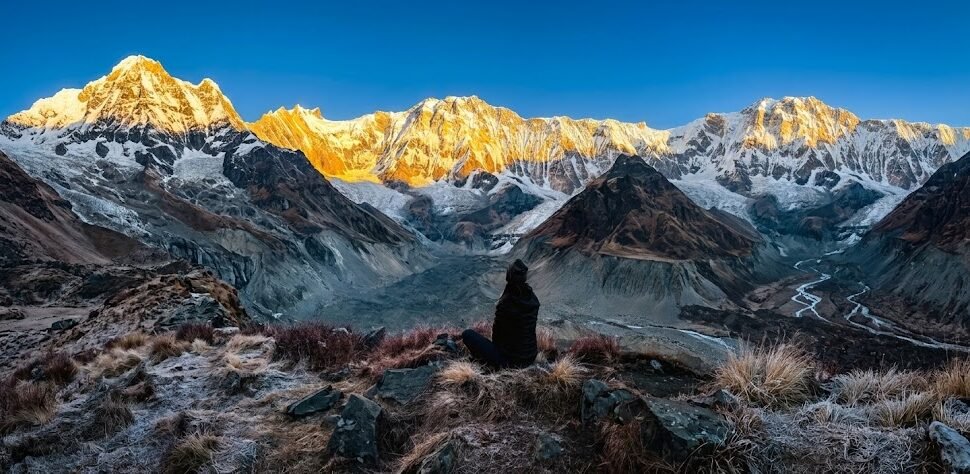
January sits firmly in Nepal’s winter trekking season, which runs from December through February. For the Annapurna Base Camp trek, winter is the most demanding season and also, for the right kind of trekker, one of the most rewarding. The crowds that fill the trail in October and November are gone. The teahouse paths are quiet. The mountain views, on clear days, are extraordinary: cold winter air strips the haze that can soften the horizon in the monsoon shoulder seasons, and the snow on Annapurna South, Hiunchuli, Machhapuchhre, and the surrounding peaks reflects light with a clarity that summer and autumn trekkers rarely see.
The honest trade-off is this: January conditions above Deurali (3,230 metres) are genuinely cold and potentially icy. The trail from Deurali to Machhapuchhre Base Camp (MBC) and from MBC to Annapurna Base Camp can be snow covered and require careful footing. Some teahouses above Deurali reduce services or close during the deepest winter weeks. Temperatures at Annapurna Base Camp overnight can reach minus 20 degrees Celsius. These conditions are not extreme by mountaineering standards, but they are beyond what a first time Nepal trekker unprepared for winter conditions should walk into without guidance and proper gear.
For trekkers who have done other treks in Nepal, who are comfortable in cold conditions, who carry the right gear, and who go with a licensed guide, January ABC is achievable and memorable. Completion rates in January for properly equipped guided groups are high. The key word is properly equipped. Underprepared winter ABC attempts fail more often than any other month.
This guide gives you everything you need to decide whether January is right for you and, if it is, how to do it correctly.
January Weather at Annapurna Base Camp: Month by Month Reality
January is the coldest month of the year on the Annapurna trail. The monsoon ended in September. The post monsoon trekking peak of October and November has passed. January sits in the middle of the dry cold winter pattern that characterises the Himalayas from December through February.
| Location | Altitude | Day Temp (°C) | Night Temp (°C) | Precipitation |
|---|---|---|---|---|
| Pokhara | 822m | 15 to 20 | 5 to 8 | Very low |
| Tikhedhunga | 1,540m | 12 to 17 | 2 to 6 | Low |
| Ghorepani | 2,860m | 3 to 8 | -5 to -2 | Light snow possible |
| Chhomrong | 2,170m | 8 to 14 | 0 to 4 | Very low |
| Deurali | 3,230m | -2 to 5 | -8 to -5 | Snow likely |
| Machhapuchhre Base Camp | 3,700m | -5 to 2 | -12 to -8 | Snow likely |
| Annapurna Base Camp | 4,130m | -8 to -2 | -20 to -12 | Snow likely |
A key winter characteristic: January weather in the Annapurna region is predominantly dry and clear. The same weather system that brings cold also brings stable skies. January averages approximately 3 to 5 days of precipitation in Pokhara, which translates to roughly 2 to 3 days of snowfall on the upper trail. The clear days between snow events are the ones that deliver the spectacular winter mountain views. Planning your upper section days (Deurali to ABC and back) for clear weather windows is the central tactical decision of a January ABC attempt.
Wind in January is moderate at altitude: less than the fierce spring winds of March and April but present above treeline. Above MBC, exposed sections can feel significantly colder than the thermometer reading due to windchill. Wind at minus 10 degrees Celsius with 30 km/h wind creates an apparent temperature well below minus 20 degrees Celsius. This is the kind of cold that makes insufficiently insulated trekkers miserable and that makes proper layering, gloves, and face covering non-negotiable.
January Trail Conditions on the ABC Route
Trail conditions in January vary significantly by altitude. Understanding what to expect at each section helps you pack appropriately and make informed decisions on the trail.
From Nayapul to Chhomrong (up to 2,170 metres): dry, normal conditions. The trail is stone and dirt at these altitudes and winter temperatures do not freeze the trail surface. The stone staircase sections remain as always: physically demanding but not slippery. Morning frost is possible on shaded sections in the gorge below Chhomrong but dissipates quickly once the sun reaches the trail.
From Chhomrong to Bamboo (2,310 metres): still predominantly dry. The trail descends into the Modi Khola gorge after Chhomrong and climbs steeply through forest. The forest section retains some moisture year-round and icy patches on the stone steps in the shade of the gorge are possible in January. Trekking pole use is strongly recommended here even if it was optional before.
From Bamboo to Dovan (2,600 metres): conditions begin to change. Frost and ice on north-facing sections. Snow patches possible above 2,400 metres after any snowfall. The trail remains followable. Light gaiters become useful here to keep snow out of your boots.
From Dovan to Deurali (3,230 metres): ice and snow increasingly likely. Trail surfaces above 2,800 metres can be frozen solid in the pre-dawn departure hours and may remain icy on shaded sections throughout the day. Microspikes or lightweight crampons are strongly recommended from this point upward. Trekking without traction devices on icy stone above 3,000 metres is a significant fall risk.
From Deurali to MBC (3,700 metres): the ABC sanctuary section. Above Deurali, the trail enters the Annapurna Sanctuary through the Modi Khola gorge, and snow coverage in January is the norm rather than the exception. The trail may be buried under 20 to 60 centimetres of accumulated snow. It is still followable with a guide who knows the route and recent trail conditions. In a fresh snowfall event of 30 or more centimetres, the trail becomes difficult to follow without prior knowledge and the avalanche risk on the slopes above the gorge increases. A local guide who has current information on conditions is essential for the January Deurali to MBC section.
From MBC to Annapurna Base Camp (4,130 metres): fully winter conditions. Snow covered, often deeply so. The cirque at ABC itself is surrounded by the high walls of Annapurna South, Hiunchuli, Gangapurna, and Annapurna I. In January these walls carry significant snow and ice. Avalanche paths exist around the sanctuary. The risk is generally low for trekkers staying on the marked trail in stable weather, but after heavy snowfall the sanctuary requires respect and awareness. Your guide should have current information on recent weather and any recent avalanche activity before you enter the sanctuary above MBC.
January Safety Note
The Annapurna Conservation Area sees limited trekker traffic in January. If you have an accident or medical emergency above Chhomrong, evacuation response times are longer than in peak season. Helicopter rescue is possible but weather dependent. A licensed guide with first aid training, a communication device, and a current understanding of trail conditions is not optional in January. It is the difference between a challenging mountain experience and a genuine emergency.
Day by Day Itinerary: Annapurna Base Camp Trek in January
The standard ABC itinerary from Pokhara takes 10 to 12 days roundtrip. In January, we recommend the 12-day version to allow for rest days and weather flexibility at the upper section. The itinerary below follows the classic Ghorepani route on the approach and the Chhomrong direct route on the return, which most trekkers find gives the best combination of scenery and acclimatisation.
Day 1: Pokhara to Tikhedhunga (1,540m)
Drive from Pokhara to Nayapul (1 to 1.5 hours) and begin walking. The day is a warm-up: a pleasant walk along the Modi Khola river valley with views of terraced farmland and the first glimpses of Annapurna South above the ridge. In January, the trail is dry and the walking is comfortable. Distance: 14 km. Walking time: 4 to 5 hours.
Day 2: Tikhedhunga to Ghorepani (2,860m)
The demanding stone staircase climb from Tikhedhunga to Ulleri (1,960m) is the first real test. Approximately 3,000 stone steps gain 420 metres in about 1.5 hours. Above Ulleri, the trail enters rhododendron forest and the gradient eases. Ghorepani is reached in the early afternoon. In January, Ghorepani receives occasional snowfall and the village can be cold and quiet. Distance: 12 km. Walking time: 5 to 7 hours. Night temperature: expect minus 5 to minus 8 degrees Celsius.
Day 3: Sunrise hike to Poon Hill (3,210m) then Ghorepani to Tadapani (2,630m)
Poon Hill is one of the best sunrise viewpoints in Nepal. The pre-dawn hike takes 45 to 60 minutes from Ghorepani and rewards trekkers with a 180-degree panorama of the Annapurna and Dhaulagiri ranges. In January the air is clear and the snow on the peaks catches the first light brilliantly. After sunrise, continue to Tadapani through rhododendron and oak forest. This section can be snowy in January and the trail through the forest may require careful navigation. Distance: 10 km. Walking time: 5 to 6 hours.
Day 4: Tadapani to Chhomrong (2,170m)
A descent through forest to the Kimrong Khola river and a climb back up to Chhomrong village. Chhomrong is the gateway to the Annapurna Sanctuary and the point where the character of the trek changes from valley and ridge walking to gorge and sanctuary trekking. It is also where your guide should check on current conditions above. Distance: 10 km. Walking time: 4 to 5 hours.
Day 5: Chhomrong to Bamboo (2,310m)
The route drops steeply from Chhomrong into the Modi Khola gorge and then climbs through forest to Sinuwa and on to Bamboo. The stone steps of this section are famous among trekkers on the ABC route and the steep descent from Chhomrong is a preview of what the knees will face on the return. In January, icy morning patches on the shaded steps are common. Distance: 9 km. Walking time: 4 to 5 hours.
Day 6: Bamboo to Deurali (3,230m)
Passing through Dovan (2,600m) and Himalaya (2,920m), the trail climbs steadily alongside the Modi Khola river. The gorge narrows dramatically and the walls of the surrounding mountains come closer. Snow begins appearing on the trail at around 2,800 metres in January and is consistent by Himalaya. Deurali sits at the entrance to the Annapurna Sanctuary gorge. Distance: 9 km. Walking time: 4 to 5 hours.
Day 7: Deurali to Machhapuchhre Base Camp (3,700m) to Annapurna Base Camp (4,130m)
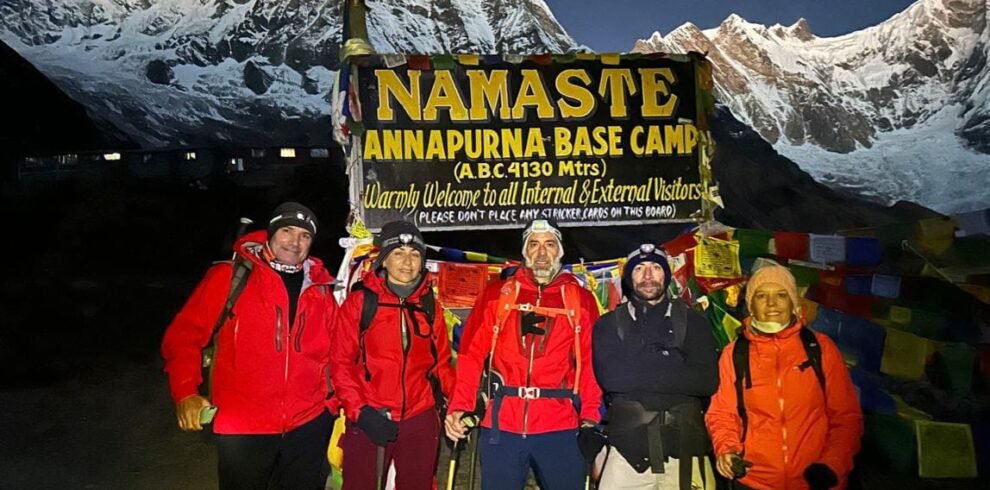
This is the summit day of the trek. Departing Deurali in the early morning, the trail enters the sanctuary gorge with towering walls on both sides. Snow coverage will be significant. MBC is reached in approximately 2 hours, and after a short rest and potentially some food, the push to ABC takes another 1.5 to 2 hours. At ABC, the full amphitheatre of the Annapurna range surrounds you: Annapurna I (8,091m), Annapurna South (7,219m), Hiunchuli (6,441m), Gangapurna (7,455m), Annapurna III (7,555m), and Machhapuchhre (6,993m). The experience of standing in this cirque is what every trekker on this route comes for. In January, you will likely have it almost entirely to yourself. Distance: 8 km. Walking time: 5 to 7 hours. Sleep at ABC in a warm sleeping bag. This is the coldest night of the trek.
Day 8: Annapurna Base Camp to Bamboo (2,310m)
Sunrise from ABC in January is one of the outstanding experiences on the Annapurna trail. The pre-dawn light on the snow-covered peaks of the sanctuary is worth the cold. After sunrise and breakfast, the descent begins. With the trail already familiar, the descent from ABC to Bamboo is achievable in a long day. Distance: 17 km. Walking time: 6 to 8 hours descending.
Day 9: Bamboo to Chhomrong (2,170m)
The reverse of day five. The long climb back out of the gorge to Chhomrong is tiring but the end of the gorge section is in sight. Chhomrong feels like civilisation after the sanctuary. Hot food, warm lodge, and the knowledge that the objective has been achieved. Distance: 9 km. Walking time: 4 to 5 hours.
Day 10: Chhomrong to Ghandruk (1,940m)
An alternative return route via Ghandruk gives a different perspective on the Modi Khola valley and the Gurung villages below the sanctuary. Ghandruk is one of the most traditional Gurung villages in the region, with stone houses, a cultural museum, and excellent views of Annapurna South and Machhapuchhre. Distance: 10 km. Walking time: 4 to 5 hours.
Day 11: Ghandruk to Nayapul to Pokhara
Descend from Ghandruk through Kimche to Nayapul and take a vehicle back to Pokhara. Distance: 12 km walking + 1.5 hour drive. Walking time: 3 to 4 hours.
Days 12 (buffer day in Pokhara)
In January, weather delays on the upper section are possible. A buffer day in Pokhara before a flight departure accommodates any schedule change from a weather hold day in the sanctuary. Not needed if your schedule allows flexibility.
Teahouses in January: What is Open and What to Expect
Teahouse availability in January is the most common concern among trekkers considering the winter season. The situation is more nuanced than a simple open or closed answer.
From Nayapul to Chhomrong: all major teahouses are open year-round. This section of the route sees enough year-round traffic that lodge owners keep their businesses running in winter. Services are the same as in peak season: dorm and private rooms, a menu covering dal bhat, noodles, pasta, and local food, and hot drinks throughout the day.
From Chhomrong to Deurali: most teahouses open. The lodges at Sinuwa, Bamboo, Dovan, Himalaya, and Deurali are generally open in January because they serve the trekking traffic that exists even in winter. Services may be slightly reduced: fewer menu options, limited hot shower availability, and smaller heating options in communal rooms. Hot water bottles for sleeping bags (available for a small fee) are worth requesting at these lodges in January.
From Deurali to MBC to ABC: variable. This is where January creates real uncertainty. The lodges at MBC and ABC are generally present but some reduce operations or close during the coldest weeks of December and January when trekker numbers drop near zero. In January 2024 and 2025, most lodges at MBC and ABC remained open but with limited menus and no guarantee of heating beyond a wood or gas burner in the common room. Your guide should confirm current status before you depart Deurali for the sanctuary. If the ABC lodge is closed when you arrive, your guide should know where the backup option is (typically a returning to MBC for the night).
What to expect at any teahouse in January: mattresses and blankets are provided but sleeping bags are essential for the sanctuary section. Your sleeping bag rated to minus 15 degrees Celsius comfort is the difference between sleep and shivering at ABC. Room temperatures in the sanctuary in January can be near or below freezing overnight even with blankets. The teahouse common rooms with a fire or burner are where warmth concentrates in the evenings: plan your pre-dinner and post-dinner time accordingly.
What to Pack for the January ABC Trek
Winter ABC packing is distinct from the standard ABC packing list. The lower altitude sections (below 2,500 metres) are manageable in standard trekking gear. The sanctuary section above Deurali requires winter mountaineering clothing levels.
The non-negotiable additions for January that are not required in peak season: microspikes or lightweight crampons for the trail above Deurali (essential, not optional, for January), a down jacket rated to at least minus 10 degrees Celsius comfort, a sleeping bag rated to minus 15 degrees Celsius comfort (not extreme rating), balaclava or face covering for the sanctuary section, thick waterproof gloves or mittens over liner gloves, gaiters for snow sections, and waterproof trail boots with Gore-Tex or equivalent waterproof membrane.
The moisture management principle matters even more in January than in peak season. Sweating on the ascent and then stopping creates a rapid heat loss scenario in cold conditions that can lead to hypothermia if your base layer is soaked with sweat and you are no longer generating body heat. Merino wool or synthetic base layers that wick moisture away from the skin are critical. Cotton is completely inappropriate at any altitude in January conditions.
For a complete gear list that applies to all seasons, see our EBC packing guide as a reference for the layering system, which applies equally to ABC in January with the additions noted above.
Permits and Costs for January ABC
Permit requirements in January are the same as all other months. You need two permits for the Annapurna Base Camp route:
Annapurna Conservation Area Permit (ACAP): NPR 3,000 per person for foreign nationals (approximately USD 22). Obtained at the Nepal Tourism Board office in Kathmandu or the ACAP counter in Pokhara.
Trekkers Information Management System card (TIMS): NPR 2,000 per person for foreign nationals (approximately USD 15) when trekking with a registered agency. Obtained at the same locations as ACAP.
Both permits are checked at multiple checkpoints on the trail. SAARC nationals and Nepali citizens have different, lower rates. Permits are checked at the Nayapul checkpoint before the trek begins and at multiple stations further up the trail.
January trek costs on the trail tend to run slightly lower than peak season because teahouses offer modest discounts in low season to attract the limited trekker traffic. Budget approximately USD 30 to 40 per day for accommodation and food on the trail. Guide and porter fees, international flights to Kathmandu, Pokhara accommodation, and the Pokhara transfer are additional. A full 12-day guided ABC trek in January including guide, porter, permits, and all trail expenses typically costs USD 700 to 1,200 per person depending on group size and operator.
Altitude Sickness on the January ABC Trek
The Annapurna Base Camp altitude of 4,130 metres is high enough to cause altitude sickness in susceptible individuals, but significantly lower than treks like EBC (5,364 metres) or the Manaslu Circuit. Most healthy trekkers acclimatise adequately for ABC altitude with the standard itinerary pacing.
January conditions interact with altitude in one important way: cold temperatures make altitude symptoms harder to distinguish from normal cold-related discomfort. A headache at ABC in January could be early AMS or it could be dehydration from breathing cold dry air all day. Nausea could be altitude or it could be cold-induced appetite suppression. This ambiguity is why the rule of thumb at altitude is conservative: if you feel unwell at ABC and are not certain of the cause, a descent to MBC (430 metres lower) will relieve symptoms if they are altitude related and do no harm if they are cold related. Waiting to see if symptoms worsen at altitude is not the correct approach at 4,130 metres in January.
Hydration in January requires active attention. In cold conditions, the sensation of thirst is suppressed compared to warm conditions, but the body is still losing significant moisture through breathing cold dry air at altitude. Force yourself to drink at least 3 litres of water per day above 3,000 metres even if you do not feel thirsty. Electrolyte tablets added to water help replace minerals lost through respiration and light sweating under all the layers.
January ABC Trek: Frequently Asked Questions
Is Annapurna Base Camp open in January?
The Annapurna Base Camp area itself is always accessible in principle: it is not closed by permit restriction in January. The practical question is whether the trail is passable and the lodges are open. The trail is passable in January with a guide who knows current conditions and with appropriate winter gear including microspikes. Most lodges from Chhomrong to Deurali are open. Lodges at MBC and ABC are generally open in January but with reduced services and the occasional closure during the coldest weeks. Confirm with your guide operator before departure.
How cold does it get at Annapurna Base Camp in January?
Overnight temperatures at ABC in January typically fall between minus 12 and minus 20 degrees Celsius. Daytime temperatures at ABC range from minus 8 to minus 2 degrees Celsius on clear days. Wind significantly amplifies the cold on exposed sections between MBC and ABC. A sleeping bag rated to minus 15 degrees Celsius comfort and a good down jacket are the minimum for overnight comfort at ABC in January.
How many trekkers are on the trail in January?
January is one of the two or three quietest months on the ABC trail (the others being February and July). The Nepal Tourism Board records show January trekker numbers in the Annapurna region at approximately 3 to 5% of the October peak. On a typical January day above Chhomrong, you may encounter between 5 and 20 other trekkers rather than the hundreds that pack the trail in October. This is considered by many experienced trekkers to be one of January’s primary appeals.
Do I need a guide for the January ABC trek?
Nepal’s trekking regulations require registered guides for all trekking in restricted and national park areas. Beyond the legal requirement, the January ABC trek specifically benefits from a guide with current information on trail conditions, snow coverage, lodge availability above Deurali, and weather patterns in the sanctuary. The sanctuary above Deurali has no permanent residents and limited passing trekkers in January. A guide who knows the winter trail and who can make informed decisions about when to push for ABC and when to wait for a weather window is genuinely important for a January attempt.
Can I do ABC in January without a sleeping bag?
No. Some teahouses at lower altitudes provide sleeping bags for rent but the quality and temperature rating of rental bags is inconsistent. Above Deurali and at ABC in January, a sleeping bag rated to at least minus 10 degrees Celsius comfort (not extreme) is essential. Teahouse blankets alone are not adequate for overnight temperatures at MBC and ABC in January. Bring or rent a verified quality sleeping bag before you leave Pokhara.
What are the best days for the ABC summit in January?
The best days for the upper sanctuary section are the clear calm days that follow a snow event. Fresh snow on the mountains combined with clear blue sky produces the most spectacular photography conditions of any month. However, immediately after a heavy snowfall, the trail above Deurali is buried and avalanche risk on the slopes above the gorge is elevated. The ideal sequence is: snowfall event, then 1 to 2 days of consolidation, then a clear window where the trail is visible and the mountains are snow-white and sharp against the sky. Your guide monitors weather patterns and the conditions on the ground. Flexibility in your itinerary to wait for this window at Deurali (or to push when it opens) is the most valuable thing you can build into a January ABC plan.
Why January Has Its Own Kind of Beauty
The Annapurna Sanctuary in January looks different from how it appears in October or April. The lower vegetation is bare and brown, the rhododendrons that blaze red in April are skeletal and dormant, and the trail carries the marks of frost rather than flowers. Above the treeline, the sanctuary is white. The snow-covered moraine and glacier debris that surrounds ABC reflects light differently than bare rock or summer grass, and the peaks themselves carry a weight of accumulated winter snow that the more photographed autumn and spring seasons do not.
The cirque at ABC on a clear January morning, with Annapurna I directly ahead and Machhapuchhre’s unmistakable shark fin peak catching the first low-angled winter sun, surrounded by silence and with no other trekkers in the frame, is an experience that a large number of Himalayan trekkers describe as one of their best anywhere. The cold and the effort to get there are part of what makes it feel earned.
The trail itself in January has a quality that busy season trekkers never encounter: the freedom of an empty mountain. No queue at the checkpoints. No crowded teahouse at dinner. No competitive pace setting between groups on the trail. Just the mountains, the sound of the river in the gorge, and the next step in front of you.
Plan Your January ABC Trek With Next Trip Nepal
Our guides know the January Annapurna trail in detail, including current lodge status, snow conditions, and weather patterns. We run winter ABC treks every January and can build an itinerary matched to your fitness and schedule. Get in touch for a January-specific planning consultation.
WhatsApp Us Email UsAnnapurna Base Camp Trek: Complete Monthly Guide
Use these month-by-month guides to plan your ABC trek, or visit the Annapurna Base Camp Trek overview page for full itinerary, costs and booking details.
Trek in: January | February | March | April | May | June | July | August | September | October | November | December