Annapurna Base Camp Trek in September: At a Glance
| Season | Monsoon retreat (improving week by week) |
| Recommended? | Yes — especially second half of September |
| ABC Temperature Range | -2°C to +10°C at 4,130m |
| Pokhara Rainfall | 150 to 300mm — declining through month |
| Trail Conditions | Improving steadily; leeches decline mid-month |
| Mountain Views | Variable early; increasingly clear by late September |
| Teahouse Availability | Fully open; October-level service by month-end |
| Trekker Numbers | Low early; rising sharply in final week |
| Difficulty Rating | Moderate (early Sept) to Easy-Moderate (late Sept) |
September is the month when the Annapurna Base Camp trail transforms. The monsoon that dominated June, July, and August begins its seasonal retreat in early September, and the trail changes character week by week as the rain lightens and the skies start to clear. Early September (the first two weeks) still carries monsoon characteristics: rain on most days, active leeches, limited mountain visibility, and wet trail conditions. But by the third week of September the shift becomes pronounced, and by the final days of the month the trail conditions approach what most trekkers know as the beginning of the October peak season.
Choosing September for ABC means choosing a month of transition. What you experience depends significantly on which week you are on the trail. A September 1 departure lands in near-monsoon conditions; a September 25 departure delivers conditions nearly indistinguishable from October. Both are valid choices, but they require different expectations and preparation.
How September Changes Week by Week
Understanding September’s progression is more important for this month than for any other. The four weeks of September represent a compressed version of the shift from monsoon to post-monsoon that normally requires understanding two separate seasons. Here is what to expect at each stage:
Week 1 (September 1 to 7): Monsoon conditions persist. Rain falls daily, often in sustained afternoon and evening periods. Leeches are active throughout the lower route below 2,500m. Mountain visibility is limited most of the time, though clear pre-dawn windows are slightly more frequent than in August. Trail condition is wet and muddy in the lower sections. This week is closest to late August in character.
Week 2 (September 8 to 14): The first signs of the monsoon retreat appear. Rainfall totals begin declining, though rain still falls on most days. The afternoon rain pattern becomes slightly less reliable, with some afternoons staying dry. Morning clear windows become more frequent and longer-lasting. Leeches remain active but slightly less dense than Week 1.
Week 3 (September 15 to 21): A meaningful shift. The monsoon retreats further, with rain now falling on fewer days. Clear mornings become the norm rather than the exception. Mountain views at ABC become realistic expectations rather than lucky occurrences. Leech activity drops significantly as the soil dries at lower elevations. Trails start drying in exposed sections, though shaded sections remain muddy.
Week 4 (September 22 to 30): Post-monsoon conditions established. Dry, clear days dominate. Mountain views are reliable at ABC and Poon Hill. The trail is largely dry. Leech season is effectively over for the upper route, and nearly over on the lower route. Teahouses are at full service. Trekker numbers rise sharply as October visitors arrive early.
September Weather on the ABC Route
| Location | Night Low | Day High | September Conditions |
|---|---|---|---|
| Pokhara (827m) | 20°C | 28°C | Rain decreasing; clearer days by late Sept |
| Ghorepani (2,860m) | 8°C | 17°C | Clear mornings improving through month |
| Chhomrong (2,170m) | 12°C | 22°C | Lush green; rain tapering off |
| Himalaya (2,920m) | 5°C | 14°C | More frequent clear windows |
| Deurali (3,230m) | 2°C | 11°C | Clearer in third and fourth weeks |
| MBC (3,700m) | -1°C | 8°C | Cold nights; improving mountain views |
| ABC (4,130m) | -4°C | 6°C | Clear mornings reliable by late September |
Trail Conditions in September
The trail dries from the top down and from exposed sections inward. The sanctuary above MBC, which receives less humidity than the gorge below, dries earlier and faster than the lower route. The Sinuwa-to-Deurali gorge section, which is shaded and narrow, stays moist longer and may retain muddy patches even in late September. Stone steps throughout the route remain slippery until they have had several consecutive dry days, so trekking poles and attentive footwork remain important in September regardless of which week you travel.
The leech population declines significantly in September and is essentially gone from the upper route (above 2,500m) by mid-month. The lower route below 2,000m, particularly through the forest sections between Tikhedhunga and Ghorepani and between Jhinu and Chhomrong, may retain some leech activity through the third week of September, particularly after rain. Leech socks are worth carrying for early-September trips; they become unnecessary by late September for most trekkers.
Trail maintenance that was deferred through the monsoon often begins in September. You may encounter sections where local crews are repairing stone steps, clearing debris, or stabilising eroded sections. These works cause brief delays but improve trail quality quickly through September.
Mountain Views in September
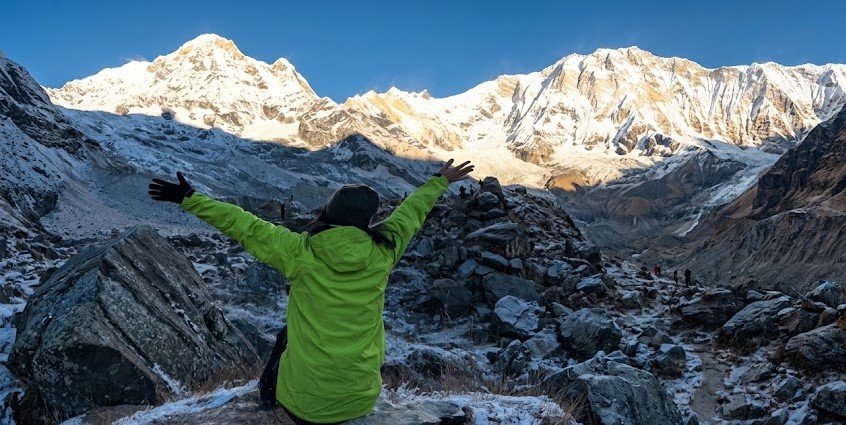
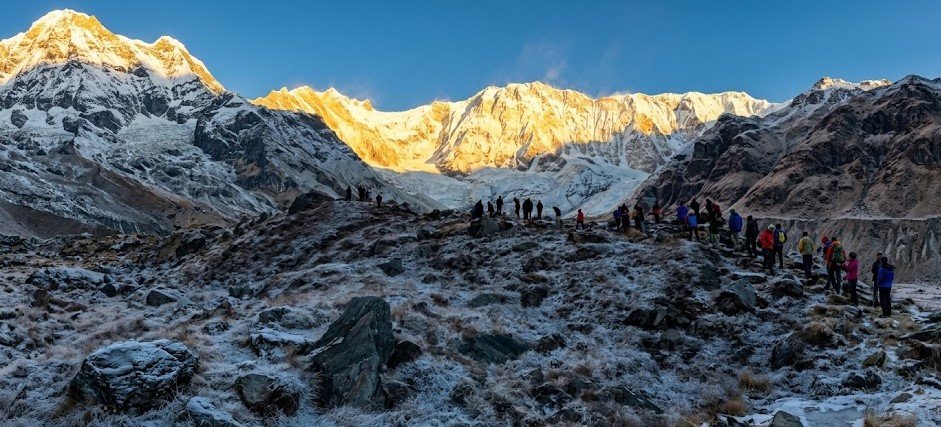
The Annapurna sanctuary offers some of its most dramatic views in late September and early October because the post-monsoon atmosphere has not yet acquired the dry-season haze that builds through November and December. After months of monsoon rain, every surface of the peaks is freshly washed, and the contrast between white snow and dark rock is at its maximum. The air clarity at ABC in late September can exceed what you find in the heart of the October season, though reliable conditions require being on the trail after approximately September 20.
Early September (before the 15th) still carries the risk of cloud-dominated days at the sanctuary. Plan for the possibility of limited views at ABC if travelling in the first two weeks, and treat any clear mountain view as the bonus it genuinely is rather than the baseline expectation it becomes in October. Late September trekkers can plan around mountain views with reasonable confidence.
September Poon Hill Sunrise
The Poon Hill sunrise (3,210m), which is one of the most famous viewpoints on the ABC route, becomes fully reliable in late September. The view from Poon Hill on a clear September morning includes Dhaulagiri (8,167m), Annapurna South, Hiunchuli, and the Annapurna Range stretching across the horizon, with a foreground of rhododendron forest and the Kali Gandaki valley. In late September this view is available with good probability and without the crowds that define October.
Day by Day Itinerary for September
The standard 10-day ABC itinerary works well in September. The acclimatisation rest at Chhomrong or Himalaya serves both altitude preparation and weather management, since an extra day increases the probability of catching a clear window at ABC in variable-conditions September.
Day 1: Pokhara to Tikhedhunga (1,540m) — 5 to 6 hours. Drive to Nayapul, then walk through terraced fields and forest. The trail is well-marked and relatively gentle. In September, expect the lower sections to be muddy after overnight rain.
Day 2: Tikhedhunga to Ghorepani (2,860m) — 5 to 6 hours. The main ascent of the day involves 3,600 stone steps from Ulleri to Banthanti. A long climb through rhododendron forest that still shows monsoon green in September. Ghorepani sits on a saddle with views into the Kali Gandaki valley.
Day 3: Ghorepani to Chhomrong via Poon Hill (2,170m) — 6 to 7 hours. Early departure for Poon Hill sunrise (45 minutes from Ghorepani). On a clear September morning this is the best view of Dhaulagiri and the western Annapurna peaks before the trail descends to Tadapani and continues to Chhomrong.
Day 4: Chhomrong to Himalaya (2,920m) — 5 to 6 hours. The trail descends from Chhomrong, crosses the Chhomrong Khola, then ascends through Sinuwa and Bamboo. The gorge section begins here and the forest becomes denser. In September, this section may have residual mud from recent rain.
Day 5: Himalaya to Deurali (3,230m) — 3 to 4 hours. Short day allowing acclimatisation and weather monitoring. The trail passes through Dovan and crosses several suspension bridges. Deurali is the last teahouse before the sanctuary opening.
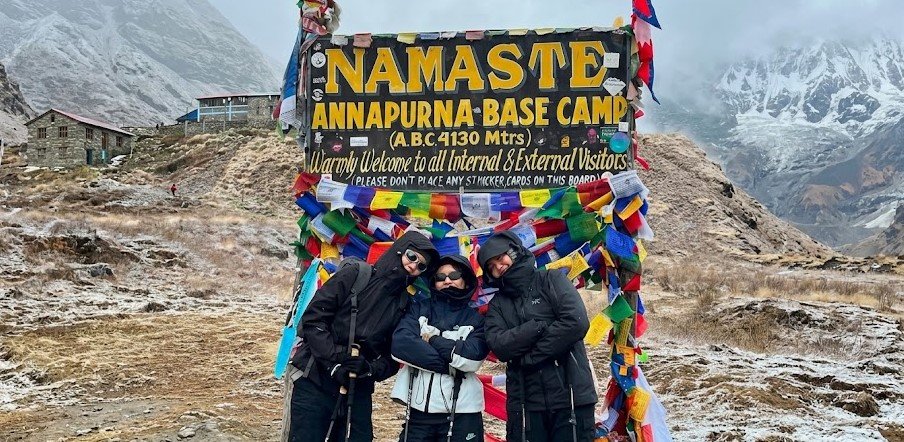
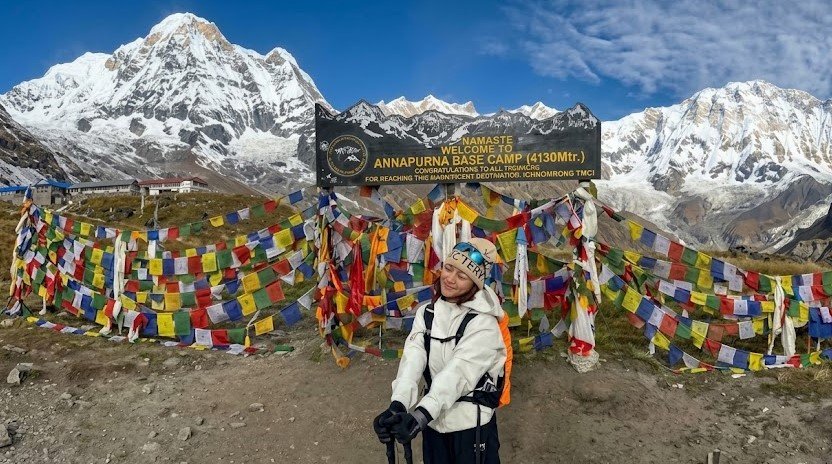
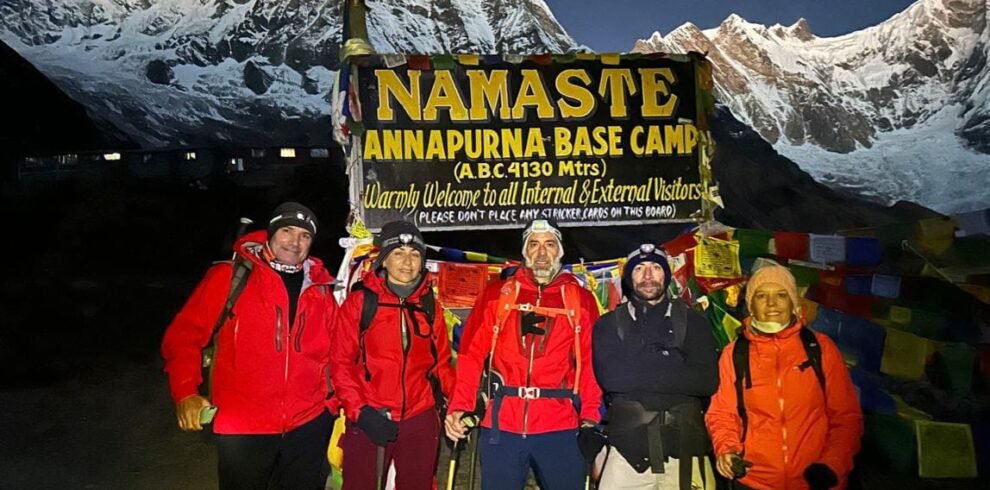
Day 6: Deurali to Annapurna Base Camp (4,130m) — 5 to 6 hours via MBC (3,700m). This day enters the Annapurna Sanctuary through the Modi Khola gorge. The final section from MBC to ABC is exposed and ascends across moraines with Annapurna South directly ahead. In September, this section may have snow from monsoon snowfall on higher sections.
Day 7: Rest/Explore at ABC — Full day at the sanctuary. The amphitheatre of 7,000m and 8,000m peaks surrounding the base camp is the centrepiece of the trek. Explore the moraine, watch for changing light conditions, and use the morning hours for the best views. In late September the probability of a full clear morning at this stage is high.
Day 8: ABC to Bamboo (2,310m) — 6 to 7 hours descending. The descent retraces the gorge sections through Deurali and Himalaya to Bamboo. A long day but mostly downhill.
Day 9: Bamboo to Jhinu Danda (1,760m) — 4 to 5 hours. Continue descent through Sinuwa and Chhomrong. Jhinu Danda has natural hot springs by the river — an excellent stop after a week on the trail.
Day 10: Jhinu Danda to Pokhara — 3 to 4 hours trekking to Nayapul, then drive back to Pokhara. Trek concludes at the lakeside.
Teahouses in September
All teahouses on the ABC route are open in September. Unlike July and August where some secondary lodges may be at reduced capacity, September sees full operations re-establishing through the month. By the third week the major lodges at Ghorepani, Chhomrong, Himalaya, Deurali, MBC, and ABC are fully operational with complete menus and staff. The ABC teahouses at 4,130m, which serve the sanctuary, are reliably open throughout September.
Room availability is excellent in early September when trekker numbers are still low from the monsoon season. By late September, as October trekkers begin arriving early, the main lodges at Ghorepani and ABC start filling up. Pre-booking is not essential but is advisable for late September at the most popular stops.
Packing List for September
| Category | Item | Priority |
|---|---|---|
| Rain Protection | Waterproof jacket (taped seams) | Essential for early Sept; useful late Sept |
| Rain Protection | Waterproof pack cover | Essential |
| Leech Protection | Leech socks or full gaiters | Essential early Sept; optional late Sept |
| Warmth | Down jacket (750+ fill) | Essential for ABC nights |
| Warmth | Sleeping bag (rated -10°C) | Essential |
| Footwear | Waterproof trekking boots | Essential (wet trails persist) |
| Footwear | Trekking poles | Strongly recommended (slippery steps) |
| Layers | Moisture-wicking base layers x2 | Essential |
| Layers | Fleece mid-layer | Essential |
| Accessories | Wool or fleece hat + gloves | Essential for ABC |
| Sun Protection | SPF 50+ sunscreen + lip balm | Essential — UV increases with altitude |
| Navigation | Headlamp + spare batteries | Essential for Poon Hill pre-dawn start |
| Health | Water purification tablets or filter | Essential |
| Health | Diamox (consult doctor) | Recommended for AMS prevention |
Permits for September
The same two permits required year-round apply in September: the Annapurna Conservation Area Project (ACAP) permit at NPR 3,000 (USD 22) and the TIMS Card (Trekkers Information Management System) at NPR 2,000 (USD 15). Both are obtained at the Tourist Service Centre in Kathmandu or the ACAP office in Pokhara. Your guide carries these or assists with the application. The ACAP checkpoint at Nayapul checks permits at the start of the trek; checkpoints at Ghorepani, Chhomrong, and along the route verify they remain valid.
Budget for September
September costs sit between monsoon-season low pricing and October peak pricing. Early September may see slightly reduced teahouse rates from the monsoon period, but by late September prices align with the October standard. For a 10-day guided trek in September, budget USD 750 to 1,000. This includes guide (approximately USD 30 to 40 per day), porter (approximately USD 25 to 30 per day), accommodation (USD 5 to 15 per night per room), meals (USD 25 to 40 per day for two trekkers), and permits (USD 37 total). Flights and Pokhara accommodation are additional.
Altitude Sickness in September
The standard AMS precautions apply in September. The ascent profile from Pokhara (827m) to ABC (4,130m) over 6 days is an appropriate acclimatisation rate when the itinerary includes rest days at Chhomrong and Himalaya. Do not rush the ascent in September regardless of improving trail conditions. The altitude effects are identical in September to any other month.
Symptoms to watch: persistent headache, loss of appetite, nausea, dizziness, difficulty sleeping, unusual fatigue. If any of these appear at MBC or ABC, descend immediately. Do not wait for symptoms to improve at altitude. In September, helicopter evacuation has improving reliability over the monsoon months, but descent on foot remains the primary treatment for mild to moderate AMS.
September vs October: The Honest Comparison
October is widely considered the best month for ABC and September cannot fully match October for reliability of mountain views or trail conditions in its first half. However, late September (September 20 to 30) is extremely competitive with early October on all measures that matter to trekkers: views, trail conditions, temperatures, and teahouse service. The advantages of late September over early October are real: significantly fewer trekkers (October numbers are two to three times higher), slightly more dramatic post-storm light quality, the lush monsoon green still visible in the forest below 2,000m, and lower costs at some teahouses before peak-season pricing fully establishes.
For trekkers who value solitude and want near-October conditions, late September is arguably the best week of the entire trekking year for ABC. The crowds of October have not yet arrived, the monsoon has departed, and the mountain views are fresh and sharp.
Frequently Asked Questions: ABC in September
Is early September worth it or should I wait for October?
Early September (the first two weeks) is still a monsoon-influenced trek and requires the same preparation and mindset as August. If you have flexibility and want reliable mountain views, October is the better choice. If your dates are fixed in early September, go with full monsoon preparation and treat improving conditions as a bonus. The trek is fully achievable but conditions are genuinely more challenging than mid or late September.
When exactly does the monsoon end in Nepal?
The monsoon retreat is not a single event but a gradual process. In the Annapurna region, the monsoon typically begins weakening in the second half of August and the main retreat occurs through September. By October 1 the monsoon is considered to have ended for practical trekking purposes in most years. However, monsoon timing varies by year, and an early-retreating monsoon in a given year can make September excellent, while a late monsoon can push uncomfortable conditions into early October. Your guide and current local knowledge at departure are the best indicators.
Will I see leeches in September?
In early September: yes, leeches are active on the lower route below 2,500m, especially in the forest sections. By mid-September the population begins declining. By late September, leeches are minimal on most sections of the trail and absent on the upper route. If you are hiking in early September, bring leech socks. If departing after September 20, they are unlikely to be a significant concern.
Are the teahouses fully open in September?
Yes. All main teahouses are fully operational throughout September. The reduced-capacity situation of July and August does not apply in September. Full menus, standard room availability, and complete teahouse service are available from September 1 onwards. The abc sanctuary lodges at MBC and ABC are consistently open throughout the month.
What is the best week of September for ABC?
The final week (September 22 to 30) offers the best combination of good conditions and low crowds. You get near-October mountain views, no leeches, drying trails, full teahouse service, and a fraction of the October trekker numbers. If you must choose one week within September, the final week is consistently the strongest option.
How do I book an ABC trek in September?
Contact Next Trip Nepal directly. We run guided September ABC treks with experienced guides who know the transition season conditions. We can advise on the best departure date within September for your specific priorities, whether that is mountain views, avoiding leeches, minimising crowds, or travelling in the most reliable conditions possible.
Book Your September ABC Trek
September is one of our favourite months for guiding the ABC route. The trail transforms through the month and the late-September window delivers some of the clearest mountain views of the year. Contact us to plan your September dates and we will advise on the best departure week for your priorities.
WhatsApp Us Email UsAnnapurna Base Camp Trek: Complete Monthly Guide
Use these month-by-month guides to plan your ABC trek, or visit the Annapurna Base Camp Trek overview page for full itinerary, costs and booking details.
Trek in: January | February | March | April | May | June | July | August | September | October | November | December