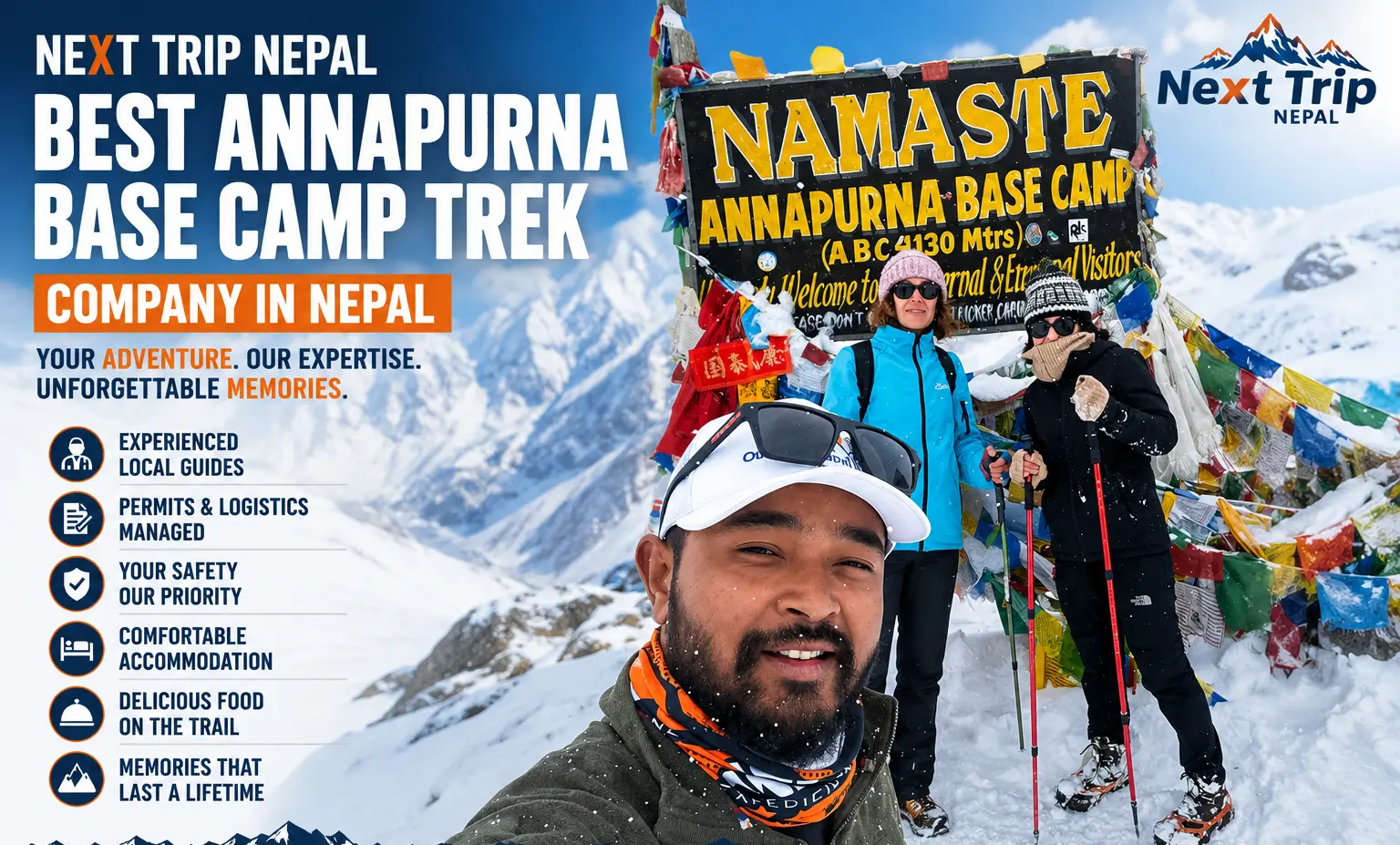
- Why the Annapurna Base Camp Trek Is So Special
- What Makes a Trekking Company Truly the Best
- Why Next Trip Nepal Is the Best Annapurna Base Camp Trek Company
- Our Guides: The Real Reason People Come Back
- What You Get in Our ABC Trek Package
- Other Annapurna Treks We Operate
- Red Flags to Avoid When Choosing an ABC Trek Agency
- Next Trip Nepal vs Other Companies: An Honest Comparison
- Real Reviews from Real Trekkers
- How to Book Your ABC Trek with Us
- Frequently Asked Questions
Every year thousands of trekkers from Germany, Australia, the United Kingdom, the United States, and dozens of other countries fly into Kathmandu with one goal: to stand in the Annapurna Sanctuary, surrounded by some of the highest mountains on earth, and feel something they could not feel anywhere else. The problem most of them face is not the trek itself. It is finding the right company to go with.
There are hundreds of agencies in Thamel offering Annapurna Base Camp packages. If you are planning your trip from Southeast Asia, see our complete guide to the Annapurna Base Camp Trek from Singapore. They range from genuinely excellent local operators to booking intermediaries that pass your money to a third party and disappear. Choosing the wrong one does not just mean a bad experience. It can mean inadequate safety, unlicensed guides, and no real support when something goes wrong at 4,000 metres above sea level.
This guide exists to help you understand what separates a genuinely good Annapurna Base Camp trek company from the rest, and why Next Trip Nepal has become the agency that trekkers return to, recommend to their friends, and leave five star reviews for across multiple platforms.
I am Kiran, a licensed trekking guide from Nepal and one of the people behind Next Trip Nepal. Everything in this guide is written from direct field experience on the Annapurna trail, not from a marketing brief. By the time you finish reading, you will have everything you need to make a confident, informed decision about which company to trust for your Annapurna Base Camp trek.
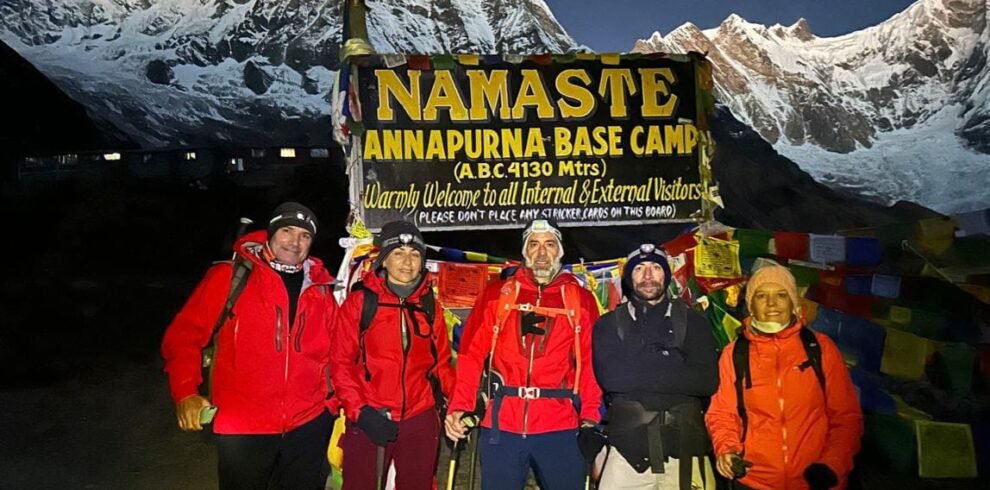
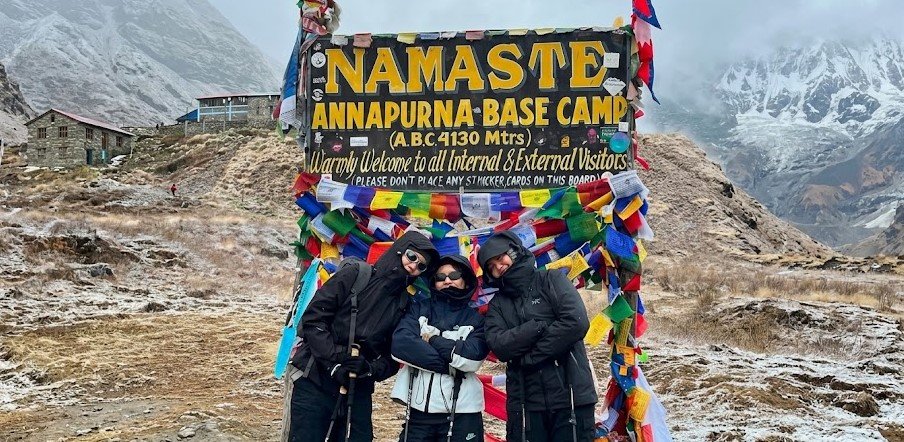
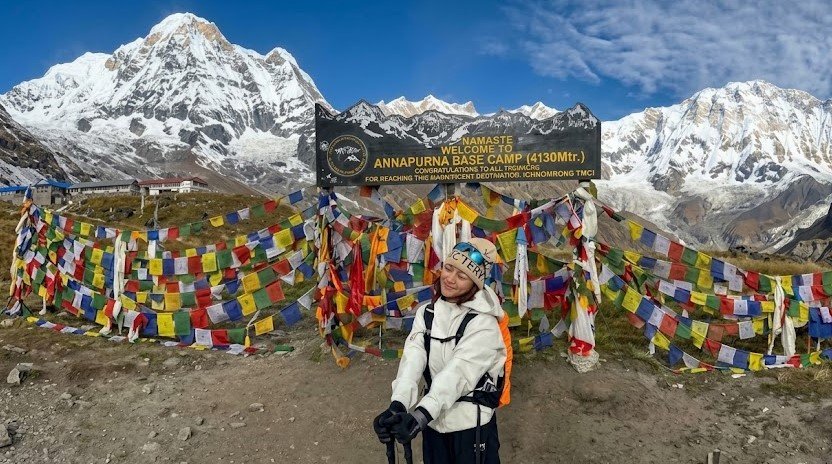
Why the Annapurna Base Camp Trek Is So Special
Before we talk about companies, it is worth taking a moment to talk about why the Annapurna Base Camp trek draws so many people in the first place. Because understanding what makes this trek remarkable helps explain why choosing the right guide and agency matters so much.
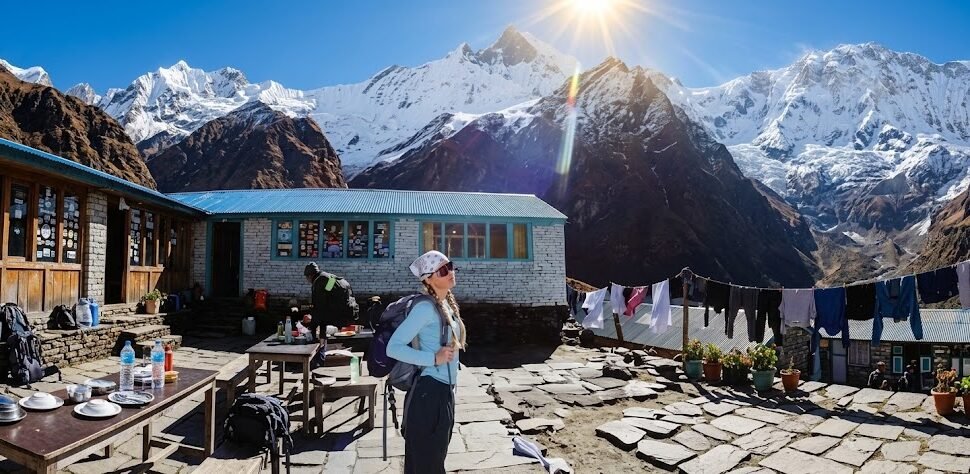
The Annapurna Base Camp Trek takes you into what locals call the Annapurna Sanctuary, a high mountain amphitheatre formed by a complete circle of Himalayan giants. When you arrive at the base camp at 4,130 metres, you are completely enclosed by Annapurna I at 8,091 metres, Annapurna South at 7,219 metres, Machhapuchhre at 6,993 metres, and Hiunchuli at 6,441 metres. There is nowhere else on earth quite like it.
The trail to get there passes through rhododendron forests that turn red and pink in spring, through Gurung and Magar villages where people have lived the same way for centuries, through bamboo groves where you hear more birdsong than boots on the trail, and past the natural hot springs at Jhinu Danda where your tired legs thank you for the stop. It is a trek that changes from one hour to the next, which is part of why people who do it cannot stop talking about it for months afterward.
The Annapurna region also draws trekkers because of its accessibility compared to some other major Himalayan routes. You fly into Kathmandu, take a bus or short domestic flight to Pokhara, and begin walking within a day. No internal flights to high altitude airstrips, no multi day drives to remote trailheads. For trekkers who want a genuine Himalayan experience without the extreme logistics of something like the Manaslu Circuit Trek, the Annapurna Base Camp is often exactly the right answer.
And because it is the right answer for so many people, every agency in Nepal wants to sell it to you. That is precisely why choosing the right one requires a bit of knowledge and a lot of careful reading.
What Makes a Trekking Company Truly the Best
The word “best” gets used carelessly in the Nepal trekking industry. Every agency website claims to be the best, the most trusted, the most professional. So before we make that case for Next Trip Nepal, it is only fair to define what “best” actually means in the context of an Annapurna Base Camp trek company.
Government Registration and Legal Compliance
A legitimate trekking agency in Nepal must be registered with the government and affiliated with the Trekking Agencies Association of Nepal (TAAN). Guides must hold a government issued license. Porters must have insurance. If any of these elements are missing, everything else the company offers is built on an unstable foundation.
Beyond registration, the best companies go further. They ensure their guides are trained in wilderness first aid, they carry medical equipment including pulse oximeters on every trek, and they have clear evacuation protocols that do not involve asking the trekker to figure things out alone at high altitude.
Local Ownership and Field Knowledge
There is a meaningful difference between a company run by people who have walked the Annapurna trail dozens of times and a booking platform staffed by people who have never left an office. Local operators know which tea houses have the cleanest rooms and most reliable kitchens. They know which trail sections are difficult after rain. They know the teahouse owners by name, which means problems get solved faster and trekkers are treated better.
When you book with a local agency, your money also stays in Nepal. It pays the guide who walks beside you, the porter who carries your bag, and the tea house owner who feeds you dinner. That is not a small thing.
Transparent Pricing with No Hidden Costs,
The Annapurna Base Camp trek has a set of fixed costs that any honest agency can account for: permits, transport, accommodation, meals, guide and porter wages, and equipment. The best companies build all of this into a clear, all inclusive price and tell you exactly what is and is not included before you pay anything. Agencies that quote a suspiciously low price and then add costs later are not saving all-inclusiveyou money. They are making the saving feel expensive by the time you are on the trail and have no alternatives
No Advance Payment Requirement
A company that is confident in its service does not need to collect full payment before you arrive. Requiring large advance payments from international trekkers who have never met the team is a risk transfer in the wrong direction. The best local agencies let you pay after you arrive in Nepal, when you can meet the team, verify the arrangements, and make a fully informed decision.
Genuine Reviews from Real Trekkers
Real reviews tell you things no marketing copy ever will. A guide who stayed calm when a trekker wanted to give up in heavy snow. A team that looked after a sick trekker for three extra days without charging more. A porter who carried more than his share without being asked. These are the things that matter on a Himalayan trek and they show up in honest reviews from people who lived them.
Why Next Trip Nepal Is the Best Annapurna Base Camp Trek Company
We started Next Trip Nepal because we believed trekkers deserved a local agency that treated them the way we would want to be treated: honestly, safely, and with genuine care for the experience rather than just the transaction. That belief shows up in every decision we make about how we operate.
“This was my third trek with Next Trip Nepal after Manaslu and Langtang. I came back again because they treat you with real care. What truly sets this company apart is how they look after you like family.” — Sophie L, United Kingdom
Our Guides: The Real Reason People Come Back
The quality of your guide determines the quality of your trek more than any other single factor. A great guide makes a difficult day manageable and a manageable day extraordinary. A poor guide makes everything harder and less safe. When people ask why Next Trip Nepal gets the reviews it does, the honest answer is that our guides are the reason.
What a Next Trip Nepal Guide Actually Does
- Manages your altitude and pace: Your guide watches your breathing, your walking rhythm, and your energy levels constantly. On the Annapurna trail above Deurali, where altitude starts to matter, this attention can be the difference between completing the trek comfortably and developing symptoms that require descent.
- Handles every logistics decision: Room allocation, meal orders, checkpoint procedures, trail route decisions when conditions change, weather assessment before difficult sections. None of these decisions fall to you. Your job is to walk and enjoy. Everything else is managed.
- Provides cultural context at every step: The Gurung village you are walking through has a name and a history. The monastery you are passing has a story. The festival drums you hear in Ghandruk mean something specific. Our guides explain these things naturally as you walk, not as a scripted tour.
- Stays calm when things get hard: Heavy snow near Fishtail Base Camp that turns the trail into something harder than expected. A trekker who is cold and considering turning around. A moment where the guide’s composure, encouragement, and practical decision-making are the only things that matter. This is what Basak described in her review. It is not a skill that can be faked.
- Monitors health and acts on it: Our guides carry pulse oximeters on every trek and check oxygen saturation at altitude. They know the difference between tiredness and early altitude sickness. They know when to adjust the plan and when to descend, and they make those calls without waiting to be asked.
Guide Experience on the Annapurna Route
Our guides have walked the Annapurna Base Camp route in October sunshine, in March snowfall, in the early days of April when rhododendrons are at their peak, and in September when the trail is still damp from monsoon. They know what the trail looks like in every condition. That knowledge is not replaceable by a map app or a trail description on a website.
Kiran, who guides many of our Annapurna Base Camp groups, is also the licensed guide behind Manaslu Treks and Expedition and has completed the Manaslu Circuit more than 20 times. The experience that comes from guiding across multiple Himalayan routes, including genuinely remote restricted area circuits, makes a guide significantly better at reading people, terrain, and conditions on any route, including Annapurna.
What You Get in Our Annapurna Base Camp Trek Package
Our 13-day Annapurna Base Camp Trek is built around one principle: you should not have to think about logistics once you arrive in Nepal. Every detail is handled. Here is what is included in your package.
Full Inclusions
- Airport pickup and drop by private vehicle from Tribhuvan International Airport, Kathmandu
- Two nights at a 3 star hotel in Kathmandu with breakfast, one night before the trek and one night on return
- Three meals per day throughout the trek including breakfast, lunch, and dinner with tea or coffee each morning
- All trekking lodge accommodation in twin sharing rooms throughout the 13 days on trail
- All permits including the Annapurna Conservation Area Permit (ACAP) and TIMS card
- Kathmandu to Pokhara transport and Pokhara to Nayapul trailhead by private vehicle
- Pokhara hotel accommodation at a 3 star hotel with breakfast
- Licensed English speaking local guide for the full duration of the trek
- Porter service covering your main trekking bag
- Complete equipment loan including sleeping bag, down jacket, and walking poles if needed
- First aid kit and medical supplies including pulse oximeter carried throughout
- Farewell dinner and trip achievement certificate in Kathmandu at the end of the trek
- Next Trip Nepal T-shirt, cap, and duffel bag
- All government taxes and official charges
- Helicopter service arrangement in an emergency, coordinated through your travel insurance
Day by Day Route Overview
The 13-day itinerary is designed with a comfortable, senior-friendly pace that does not rush acclimatization. Here is the outline:
| Day | Route | Altitude | Walk Time |
|---|---|---|---|
| Day 1 | Arrive Kathmandu, trek briefing | 1,350 m | Rest day |
| Day 2 | Drive Kathmandu to Pokhara | 820 m | 6 to 7 hours drive |
| Day 3 | Drive to Nayapul, trek to Ulleri | 1,900 m | 6 to 7 hours |
| Day 4 | Ulleri to Ghorepani | 2,860 m | 5 to 6 hours |
| Day 5 | Poon Hill sunrise, trek to Chuile | 2,710 m | 6 to 7 hours |
| Day 6 | Chuile to Upper Sinuwa | 2,360 m | 5 to 6 hours |
| Day 7 | Sinuwa to Deurali | 3,200 m | 5 to 6 hours |
| Day 8 | Deurali to Annapurna Base Camp | 4,130 m | 5 to 6 hours |
| Day 9 | ABC to Bamboo (descent begins) | 2,400 m | 5 to 6 hours |
| Day 10 | Bamboo to Jhinu Danda (hot springs) | 1,760 m | 5 to 6 hours |
| Day 11 | Jhinu Danda to Nayapul, drive Pokhara | 820 m | 6 to 7 hours total |
| Day 12 | Pokhara to Kathmandu, farewell dinner | 1,350 m | 6 to 7 hours drive |
| Day 13 | Departure from Kathmandu | Transfer to airport |
The itinerary includes Poon Hill at 3,210 metres as a pre-acclimatization sunrise viewpoint, which means you have already spent time above 3,000 metres before reaching the higher sections of the trail. This is not accidental. It is a deliberate acclimatization decision built into the route structure that makes the final push to base camp significantly safer and more comfortable.
Our 13-day Annapurna Base Camp Trek is currently priced from USD 1,449 per person with a 22 percent group discount applied. No advance payment required. View full cost details and book your dates here.
Other Annapurna Treks We Operate Through Next Trip Nepal
The Annapurna Base Camp Trek is the route that most people know, but the Annapurna region offers several outstanding alternatives depending on the time you have available and the kind of experience you are looking for. Next Trip Nepal operates the full range of Annapurna treks with the same local guide quality and all inclusive approach.
Annapurna Base Camp Trek
Ghorepani Poon Hill Trek
Mardi Himal Trek
Annapurna Circuit Trek
If you are considering the Annapurna region as part of a longer Nepal stay that also includes Everest or Langtang, we offer combined itineraries. The Everest Base Camp Trek and the Langtang Valley Trek can both be combined with an Annapurna trek for trekkers with three weeks or more in Nepal. Contact us on WhatsApp to discuss combined itinerary pricing.
Red Flags to Avoid When Choosing an Annapurna Trek Agency
Because you deserve to make a well informed choice regardless of whether you book with us or not, here is an honest list of the warning signs that should make you pause before paying a deposit to any Annapurna Base Camp trek company. We break these traps down one by one in our guide to the 15 costly mistakes trekkers make before booking the Annapurna Base Camp Trek.
Prices That Are Suspiciously Low
The Annapurna Base Camp Trek has a minimum real cost that covers permits, licensed guide wages, porter wages with insurance, accommodation, and meals across 13 days. Any agency quoting significantly below market rates is cutting costs somewhere, and the most common places they cut are guide quality, porter welfare, emergency preparedness, and genuine insurance coverage. A guide who costs half the normal rate is usually unlicensed or inexperienced. That is not a saving. That is a risk.
Required Full Payment Before Arrival
Legitimate local operators in Nepal do not need you to pay in full before you land in Kathmandu. An insistence on complete advance payment, especially through wire transfer to an overseas account, is a significant warning sign. At minimum it removes your ability to verify the team before committing. At worst it is fraud.
- Check registration numbers: Ask for TAAN registration and government license numbers for the guide. Any legitimate operator provides these without hesitation.
- Read reviews on TripAdvisor, not just Google: TripAdvisor has stronger review verification. Look for specific names, specific incidents, and consistent patterns across multiple reviews rather than generic five star ratings.
- Ask who your guide actually is: A company that cannot name your guide before departure is a company that has not yet arranged one. Your guide’s qualifications, experience, and previous routes should be transparent information that any agency shares freely.
- Verify permit inclusion: The Annapurna Conservation Area Permit costs NPR 3,000 and the TIMS card has its own fee. If these are not explicitly listed as included in the package, ask why before booking.
- Ask about emergency evacuation protocol: How does this company handle a medical emergency above 3,500 metres? Who contacts the helicopter company, who coordinates with insurance, and what medical equipment does the guide carry? A company that has clear answers to these questions has thought about safety seriously. One that cannot answer them probably has not.
Some agencies operating online are not based in Nepal at all. They are booking platforms in Europe or North America that take a margin and subcontract to Nepali operators. This is not illegal, but it means you are paying a premium for no actual service and working with a company that has no direct control over what happens on the trail. Always ask directly: are you a Nepal based, Nepal registered trekking agency?
Next Trip Nepal vs Other Companies: An Honest Comparison
We are not going to name specific competitors here because that would be unfair and would age badly as companies change. What we will do is compare the standard practices in the industry against what Next Trip Nepal actually does, so you can use this as a framework when comparing any two agencies side by side.
| Factor | Industry Average | Next Trip Nepal |
|---|---|---|
| Advance Payment | 25 to 100 percent before arrival | Zero advance payment. Pay on arrival in Nepal. |
| Guide Licensing | Variable. Some agencies use unlicensed guides especially for budget packages. | Government licensed on every departure, no exceptions. |
| Porter Insurance | Often excluded or mentioned as optional. | All porters fully insured. Porter welfare is a stated company commitment. |
| Medical Equipment | First aid kit mentioned but pulse oximeter often not included. | Pulse oximeter and full first aid kit carried on every trek. |
| 24 Hour Support | Email response within 24 to 48 hours standard. | Phone and WhatsApp answered by a human at any hour. |
| Price Transparency | Quote price, add charges on trail for hot showers, WiFi, equipment. | Full inclusions and exclusions listed clearly before booking. |
| Itinerary Flexibility | Fixed group departures, limited adjustment. | Private and group departures, custom itineraries available. |
| Equipment Included | Often rented separately at additional cost. | Sleeping bag, down jacket, and poles provided in package. |
| Farewell Celebration | Not standard. | Farewell dinner and trek completion certificate in Kathmandu. |
| Owner Accessibility | Managed by booking agents, founder unavailable. | Kiran and the founding team are directly reachable by any client. |
Real Reviews from Real Trekkers
These are excerpts from verified reviews left by trekkers who completed the Annapurna Base Camp Trek with Next Trip Nepal. We share them here not to promote ourselves but because they tell the story of what this experience is like better than we can.
Both of these reviews describe a moment of difficulty. Basak was ready to quit in heavy snow. Sophie needed extra days of care when she was unwell. In both cases, what the trekker remembers most is not the mountain views, which were extraordinary. It is how the team treated them when things were hard.
That is what we think a trekking company should actually be measured by. Not the photos on its website. Not the price on its booking page. But what it does for you when the trail becomes difficult.
You can read all current reviews on our reviews page and on our verified TripAdvisor listing.
We are available seven days a week on WhatsApp and email. No advance payment required. No pressure. Just honest information and a team that wants your trek to be the experience of a lifetime.
How to Book Your Annapurna Base Camp Trek with Next Trip Nepal
Booking a trek with us is genuinely simple. Here is the full process from first contact to first step on the trail.
- Contact us on WhatsApp or email: Reach us at +977 9869225929 or at nexttripnepal@gmail.com with your preferred dates, group size, and any questions you have. We respond within a few hours. Our contact page also has an inquiry form if you prefer that route.
- Receive your customized itinerary and cost breakdown: We send you a complete itinerary, a full cost breakdown covering inclusions and exclusions, and a packing list for the Annapurna Base Camp Trek. No vague quotes. Everything is clear before you commit to anything.
- Confirm your departure date: Once you are happy with the plan, confirm your start date. For group departures, dates are published on the ABC trek package page. Private departures can be arranged on any date that suits your schedule.
- Arrive in Nepal: Our team meets you at Tribhuvan International Airport with your name on a board. You are transferred to your hotel in Thamel by private vehicle.
- Meet your guide for the trek briefing: The evening before departure, your guide meets you at the hotel. You go through the day-by-day route, altitude progression, checkpoint procedures, emergency protocols, gear requirements, and any questions you have saved up. Allow 60 to 90 minutes for this.
- Pay on arrival: Full payment is made in Kathmandu before departure. We accept cash in NPR or USD, and we can discuss bank transfer options for larger groups. No payment is collected before you arrive in Nepal.
- Trek: Your guide collects you from the hotel on departure morning. From this point everything is handled. Walk, look, breathe, and enjoy.
If you want to customize the itinerary, combine the Annapurna Base Camp Trek with a Chitwan Jungle Safari, extend your Nepal stay with a Kathmandu day tour, or add peak climbing with something like Island Peak to your Himalayan experience, use our customize your trip page and we will build it specifically around your preferences.