Why This Article Exists
Every season we watch trekkers arrive in Kathmandu with a tight schedule, a flight home already booked, and no real plan for what happens if Lukla does not cooperate. Most of the time Lukla cooperates fine. Some of the time it does not, and when it does not, the trekkers who planned for it walk away mildly inconvenienced while the trekkers who did not plan for it miss summit days, miss connecting flights, and occasionally miss the whole point of the trip. This article is written from the operations side of that experience, based on running the Everest Base Camp with Gokyo Lake Trek as a 17 day itinerary and dealing with Lukla flight disruption as a routine, recurring, manageable part of the job rather than a rare disaster.
If you take one thing from this article, take this: Lukla flight risk is real, it is predictable in its pattern even if not in its exact timing, and it is almost entirely manageable with the right schedule structure and the right expectations going in. Everything below is built to help you set both correctly for this specific route. If you want to talk through your own dates before booking, message us on WhatsApp at +977 9869225929 or email nexttripnepal@gmail.com and we will look at your calendar with you.
Why Lukla Flights Are Not Like a Normal Domestic Flight
People who have not flown into a mountain airstrip tend to assume a delayed Lukla flight works the way a delayed city flight works: a mechanical issue, a crew rotation problem, maybe a queue on the runway, all things that get fixed in an hour or two by an operations team on the ground. Lukla delays are almost never that kind of problem. They are a weather and terrain problem, and the terrain does not change and the weather does not always cooperate on anyone’s timetable.
- Short runway with a fixed approach. Tenzing Hillary Airport at Lukla has a runway a little under 500 meters long, angled uphill, ending at a mountainside on one end and a drop into the valley on the other. There is no room for a long final approach correction and no second runway option if conditions are marginal.
- No radar approach capability. Lukla has no instrument landing system and no radar guidance for descent through cloud. Pilots fly the approach visually, meaning they need to see the runway, the ridge lines, and the valley walls clearly the entire way in. If cloud sits in the valley, the flight does not happen, no matter how good the pilot is.
- Visual flying rules only. Because there is no instrument approach, every Lukla flight operates under visual flight rules. This is a deliberate safety standard, not a limitation anyone is trying to work around. A pilot who cannot see clearly will abort or divert, and that is the correct decision every time.
- A mountain valley microclimate that changes fast. The Lukla valley can be clear at 6 in the morning and clouded in by 9. Cloud tends to build through the day as the sun heats the slopes and pushes moist air upward, which is why the flying window is almost always a morning window.
- One airstrip serving the whole Everest region. Every trekker headed into the Everest region on a standard schedule funnels through this single strip. When it closes for a morning, the backlog affects everyone flying that day, not just one flight.
- Daylight only operations. There are no night flights into Lukla. If the weather clears at 2 in the afternoon after being closed all morning, but the light and visual references are already fading in the valley shadows, that day’s flights may still be cancelled rather than pushed later.
Put together, this is why Lukla flights operate only in daylight and only in clear visibility conditions, with early morning departures typically between 6 and 10 in the morning and afternoon cancellations common if cloud builds through the day, which is exactly what happens on a meaningful number of days across the year. None of this is unusual or a sign that something has gone wrong with your particular booking. It is simply how flying to a visual mountain airstrip works, and understanding it now is the first step to planning around it properly.
The Manthali and Ramechhap Season: What Actually Happens on Your Departure Morning
From roughly April through June and again from September through November, Lukla flights for most operators do not depart from Kathmandu at all. They depart from Manthali Airport in Ramechhap district, a smaller airstrip east of Kathmandu. This shift exists because of Kathmandu air traffic congestion during these peak trekking windows, not because of anything wrong with Lukla itself. Kathmandu’s single runway has to handle international arrivals, departures, and domestic traffic all at once, and during the busiest trekking months the mountain flight slots get squeezed. Routing Lukla flights out of Manthali instead frees up Kathmandu’s runway and, in practice, gives mountain flights a cleaner and earlier shot at Lukla’s own limited morning window.
Here is what this means for you in practical terms on the days you fly, since this is the part that surprises trekkers who have not been told about it clearly before arriving.
- Hotel departure around 2 AM. Because Manthali is roughly a 4 to 5 hour drive from Kathmandu, and flights need to depart at first light to catch the clearest part of the morning, you will typically leave your Kathmandu hotel around 2 in the morning on your Lukla flight day.
- A long overnight drive in a private vehicle. Most of the drive happens in darkness, on a winding road east of Kathmandu, with a rest stop along the way. It is not a scenic drive at that hour, it is a functional one, and it is the price of a more reliable flight window.
- Arrival at Manthali before sunrise. You reach the airport area with time to spare before the first possible flight slot, so the airline can process check in and manage boarding as soon as conditions allow.
- A wait for the weather call. Even at Manthali, the flight only goes when Lukla itself reports clear conditions. The improved routing reduces one source of delay, Kathmandu congestion, but it does not remove the weather variable at the Lukla end.
- A short flight once cleared. Once conditions allow, the flight itself is quick, and you are in Phakding country within the hour, tired from the early start but on schedule.
We know the 2 AM start is not what most trekkers picture when they imagine day 2 of their trip. We build it into the itinerary honestly rather than glossing over it, because trekkers who know it is coming handle it far better than trekkers who are blindsided by a knock on their hotel door in the middle of the night. We also handle the transport and coordination end to end, so your only job that morning is to be ready, warm, and a little bit patient.
How Delays Cascade: The 24 to 72 Hour Reality
The single most important thing to understand about Lukla flight delays is that they rarely stay small. A flight delay at a normal airport usually resolves within that same day. A Lukla delay behaves differently because of how the schedule stacks.
If morning fog grounds flights, the airlines do not simply cancel the day and start fresh tomorrow. Instead, afternoon slots on that same day fill with the delayed morning departures, since every aircraft and crew is still trying to clear the backlog before daylight runs out. That means a single foggy morning can consume the entire day’s flying capacity just processing the previous delay, before a single new booking for the next day even gets a slot. This is exactly why one bad morning can strand trekkers for 24 to 72 hours during a difficult weather stretch, particularly in the shoulder and monsoon adjacent periods.
The table below sets out realistic scenarios we see across a typical season, from routine to serious, along with what actually happens operationally in each case.
| Scenario | Typical Cause | Usual Duration | Realistic Response |
|---|---|---|---|
| Morning haze clears by mid morning | Light valley fog, common in autumn mornings | 1 to 3 hours | Wait at the airport or hotel lounge, flight departs later the same morning |
| Full morning closure, afternoon backlog | Cloud sitting in the valley past 10 AM | Same day, later flight or next morning | Guide monitors the situation, rebooking begins for priority slots the following day |
| One full day lost | Persistent cloud cover or light rain system | 24 hours | Overnight in Kathmandu or Lukla depending on direction, itinerary buffer absorbs this |
| Two to three day pileup | Extended poor weather system in peak season, large backlog of stranded trekkers | 48 to 72 hours | Helicopter charter considered seriously, buffer days become essential, insurance claim process begins |
| Rare extended closure | Major storm system, monsoon remnants, or regional event | Beyond 72 hours in unusual cases | All available options evaluated together with the trekker, including alternate airstrips and extended charter arrangements |
The two to three day pileup scenario is the one that changes travel plans, and it is also the one that gets the most attention online because it is the most dramatic. It is not the most common outcome, but it happens often enough in peak season that treating it as impossible is the actual mistake, not the delay itself.
What a Real Two Day Pileup Actually Looks Like on the Ground
It helps to walk through an example rather than talk about the pattern in the abstract, since the phrase two to three day pileup can sound worse in theory than it usually feels in practice when it is handled properly. Here is a composite version of a situation we manage several times each peak season, told in the order it actually unfolds.
- Morning one. Cloud is already sitting in the Lukla valley at first light. No flights depart from either Kathmandu or Manthali depending on the season. Trekkers scheduled to fly that day wait at the airport through the morning, and by late morning the day is called as a loss.
- Afternoon one. Airlines begin building the priority list for the next clear morning, and every trekker who missed a flight that day is now ahead of new bookings for the following morning. This is the point where the backlog starts to form.
- Morning two. If the valley clears, the airlines work through the backlog first, meaning some trekkers from the previous day fly out, but new arrivals joining the queue that morning may still be pushed back another day if the backlog is large.
- If morning two also closes. This is where the situation becomes genuinely serious, since two full days of passengers are now waiting for limited daily capacity. This is the point in the scenario where we begin actively arranging helicopter charters for trekkers whose onward international connections are at risk.
- Resolution. In almost every case we have managed, the situation resolves within the 24 to 72 hour range described earlier, either through a clear morning finally arriving or through charter flights clearing the priority cases. Extended closures beyond this range are uncommon but not unheard of in unusual weather years.
The reason this scenario feels manageable to us and alarming to a first time trekker is simply experience with the pattern. We know roughly how it plays out, we know which levers to pull and in what order, and we know that patience combined with an early decision on charter flights, rather than waiting until the last possible hour, produces the best outcome for the trekker.
Day 2 Delays Versus Day 16 Delays: Why the Same Problem Hits Differently on This Route
Because the Everest Base Camp with Gokyo Lake Trek runs 17 days rather than the standard shorter Everest Base Camp itinerary, a delay at the start of the trip and a delay at the end of the trip create genuinely different problems. Treating them as the same risk is a mistake we see trekkers make when they plan their outbound and return flights.
A Delay on Day 2, the Inbound Lukla Flight
Day 2 is when you fly Kathmandu to Lukla at 2840 meters and trek to Phakding. If this flight is delayed by a day or two:
- The entire trekking itinerary shifts back day for day, since the acclimatization schedule through Namche Bazaar, Phortse Thanga, Machhermo, Gokyo, and onward to Everest Base Camp is built around a fixed number of trekking and rest days.
- Because the route is already 17 days with real acclimatization built in, there is generally more room to compress a day here or there later in the trek than there would be on a shorter itinerary, but this only works up to a point.
- A two or three day delay at this stage can still be absorbed on many departures if the group has flexibility on the back end, but it puts pressure on the final Lukla flight date and, in turn, on your international departure.
- The upside of a day 2 delay is that it happens before you have committed physically to the high altitude sections, so the guide and the office have full flexibility to reshuffle the plan around it.
A Delay on Day 16, the Return Lukla Flight
Day 16 is the return flight from Lukla to Kathmandu, followed by a farewell dinner, with day 17 set aside for final international departure. A delay here is a fundamentally different situation:
- You have already completed the physical trek, reached Everest Base Camp and Kala Patthar at 5555 meters, crossed the Cho La Pass, and walked back down through Namche to Lukla. There is no more schedule left to compress into.
- The only day of slack in the standard plan is day 17, and if that is your international departure day with no buffer, a delay of even one day can mean missing an international flight entirely.
- This is precisely why we tell every trekker on this itinerary, without exception, to build a minimum of 2 buffer days between the final Lukla flight and any international connection out of Kathmandu.
- A return delay is also the point where the helicopter charter option earns its cost most clearly, because there is no more downstream flexibility to absorb the lost time and an international ticket is on the line.
The practical takeaway is simple: build your flexibility where it costs you the least, which is before the trek starts, and protect the end of the trip with real buffer days rather than hoping the return flight behaves.
Why Buffer Days Matter More on a 17 Day Itinerary, Not Less
Some trekkers assume that because this is already a longer trip than the standard Everest Base Camp route, there is naturally more slack built in and less need to worry about buffer days. The opposite is closer to the truth, for a few reasons.
- Total trip length is usually fixed by the trekker’s own leave or ticket, not by us. A trekker who has booked 20 total days off work for a 17 day itinerary already has only 3 days of margin before they even think about flight risk. A shorter trek booked inside the same 20 day window would leave far more margin.
- More trekking days mean more days exposed to mountain weather generally. Even though only two of those days involve flights, the extra days on the trail through Gokyo, Gokyo Ri at 5360 meters, the Cho La Pass at 5420 meters, and the high camps around Everest Base Camp mean more days where a weather system could also affect trail conditions, not just flight days.
- International flight bookings are usually made months in advance, before anyone knows the weather. By the time you know whether your specific week will have a clean or difficult flying window, your international ticket is already locked in, often with change fees or no changes allowed at all.
- The financial exposure compounds on a longer trip. More trekking days already means a higher total trip cost, so unplanned extra nights in Kathmandu add to a larger base rather than a smaller one, and the excluded cost of additional nights in Kathmandu due to flight delays falls directly on the trekker.
- Recovery time matters after 15 days of trekking at altitude. Trekkers finishing a 17 day itinerary are physically tired in a way that a rushed, delay driven scramble to the airport does not suit well. Buffer days protect your body’s recovery as much as your schedule.
Our standing advice, based on years of watching which trekkers handle disruption calmly and which do not, is to treat 2 buffer days between your last Lukla flight and your international departure as the minimum, not the ideal. If your dates allow for a third day, take it. It rarely gets used, but on the trip where it is needed, it is the difference between a mild story and a missed flight.
Your Real Options When a Flight Is Delayed or Cancelled
When a Lukla flight is disrupted, trekkers usually want to know their actual choices, not just the general advice to be patient. Here is how we walk through it with clients on the ground, in the order we typically consider them.
Option 1: Wait It Out
- This is the default and correct first response for a delay of a few hours to one day, since most delays do resolve within this window, especially outside the most difficult weather stretches.
- Your guide stays with you, monitors conditions directly with the airline, and keeps you updated rather than leaving you guessing at the airport.
- Waiting costs you time but no extra money beyond incidental meals and lodging, which is the cheapest resolution when it works.
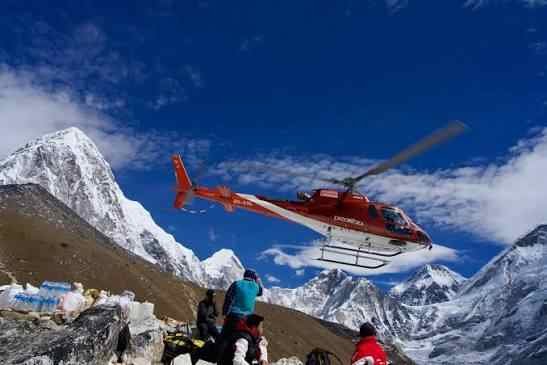
Option 2: Helicopter Charter
- A shared helicopter charter from Namche or Lukla to Kathmandu costs approximately USD 500 to 700 per person and is one of the most effective ways to bypass weather delays entirely, since helicopters can often operate in marginal conditions that ground fixed wing aircraft.
- This is arranged by us directly if needed, and we handle the coordination with the charter operator, the group sizing to keep per person cost reasonable, and the logistics of getting you to the pickup point.
- It is the clearest solution when an international connection is at risk and waiting is no longer a safe bet, and it is worth planning your budget with this possibility in mind rather than treating it as a shock cost.
- Helicopter charter to Phaplu or Ramechhap can also serve as an alternative Lukla bypass route in either direction, not only for the final return leg, if conditions at Lukla itself remain closed while other options stay open.
Option 3: Overland Alternatives
- There is no practical direct road link between the Everest region trekking route and Kathmandu that avoids the multi day walk back through lower elevation villages, so overland is not a realistic fast alternative for most trekkers mid trip.
- In genuinely extended closures, walking out toward Phaplu and connecting to road transport or a flight from Phaplu has been used historically as a slower backup, but it adds several days rather than saving time, so we only raise it as a true last resort in unusual circumstances.
- For nearly everyone, the realistic choice set is wait it out or fly by helicopter, not an overland shortcut.
Option 4: Adjust the International Ticket
- If a delay is unfolding and your buffer days are being consumed, contacting your airline or travel agent early to understand change options is worth doing in parallel with the wait or charter decision, not after the fact.
- This is also where the 2 buffer day minimum earns its value, since it gives you room to make this call calmly rather than under pressure at the airport.
We manage the flight booking and all airline communication throughout your trip, and we handle rebooking and alternative options including helicopter charter as the situation develops, so you are never the one negotiating directly with an airline counter in a language you may not speak while also trying to figure out your options.
What to Carry and Prepare for a Possible Delay Day
Since a delay day can turn into an unplanned overnight or an unplanned charter flight with very little warning, we ask every trekker on this itinerary to travel on flight days as though the delay might happen, even on days when it probably will not. A little preparation removes most of the stress if the morning does not go to plan.
- Carry your passport and insurance documents on your person, not packed away in a duffel bag. If a helicopter charter is arranged quickly, you want your documents accessible immediately rather than buried at the bottom of your luggage.
- Keep a small amount of Nepali cash and a card with you at all times on flight days. An unplanned night in Lukla or an extra meal in Kathmandu is easier to manage with cash on hand.
- Charge your phone fully the night before and carry a power bank. Communication with your guide and with us matters most during a delay, and lodge power in the mountains is not always reliable.
- Pack a change of clothes and any daily medication in your daypack, not your main duffel. If you end up separated from your main bag during a charter reshuffle, you still have what you need for a day or two.
- Bring a book, download offline entertainment, or otherwise plan for genuine waiting time. Airport delays in Lukla or Manthali can mean sitting for several hours with limited facilities, and trekkers who come prepared for that mentally handle it far better than those who do not.
- Confirm your guide has your international flight details written down, not just remembered verbally. This lets the team prioritize decisions correctly if multiple trekkers in a group have different onward connections.
None of this guarantees a smooth morning, since nothing can guarantee that with a visual flying mountain airstrip, but it removes the avoidable friction so that if a delay does happen, you are dealing with one problem, the flight itself, rather than three or four problems stacked on top of it.
Travel Insurance and Lukla Flight Delays: What It Actually Covers
Travel insurance is where a lot of confusion sits, mostly because trekkers assume one policy covers everything mountain related, when in fact flight delay coverage and emergency evacuation coverage are two separate things that solve two separate problems.
What a Good Policy Should Cover for Trip Delay
- Additional accommodation costs. A solid trip delay benefit reimburses hotel nights in Kathmandu caused by a covered flight delay, which directly offsets the excluded cost we mentioned earlier, since additional nights in Kathmandu due to flight delays are not included in the trip price.
- Meals and incidental expenses. Reasonable daily allowances for food and essentials while stranded are a standard feature of decent trip delay coverage.
- Missed connection protection. If a Lukla delay causes you to miss a booked international flight, missed connection coverage can reimburse rebooking fees or a new ticket, which is often the largest single cost at risk.
- A clear delay threshold and documentation requirement. Most policies require the delay to exceed a set number of hours, commonly somewhere between 6 and 12, and require written confirmation of the delay from the airline, which we can help provide since we handle the airline communication directly.
The Separate Question of Helicopter Rescue and Evacuation Coverage
- Emergency helicopter evacuation coverage exists for medical emergencies at altitude, such as altitude sickness, injury, or illness requiring urgent descent, and is a completely different benefit from trip delay coverage.
- A weather related helicopter charter taken voluntarily to bypass a flight delay, when there is no medical emergency, is generally not covered under emergency evacuation benefits, and instead falls under trip delay or trip interruption benefits if it is covered at all.
- This distinction matters because trekkers sometimes assume their evacuation coverage will pay for a weather bypass helicopter, and then are surprised when the claim is processed differently or declined under that specific benefit.
- The fix is straightforward: read your policy’s trip delay and trip interruption sections specifically for language about alternative transport costs during a covered delay, not just the medical evacuation section.
We go into this in more depth, including which policy features matter most for this exact route, on our dedicated page about travel insurance for the Everest Base Camp Trek, which we recommend reading before you buy a policy, not after a delay has already happened. Since costs arising from flight cancellations beyond our control are explicitly excluded from the trip price, a well chosen policy is the single most effective financial protection you can put in place before you fly.
Season by Season: An Honest Risk Assessment for This Trek
Trekkers researching this route deserve a straight answer about when flight risk is genuinely lower and when it is genuinely higher, rather than a vague statement that Nepal weather is unpredictable. Based on years of running this itinerary, here is our honest breakdown.
| Period | General Flight Reliability | Manthali Routing Active | Notes for This 17 Day Itinerary |
|---|---|---|---|
| March | Good, improving through the month | No | Early season, generally clearer mornings, lower trekker volume than peak spring |
| April | Good to moderate | Yes | Peak spring season begins, Manthali routing starts, plan for the 2 AM departure |
| May | Moderate, afternoon cloud common | Yes | Warm, humid air builds afternoon cloud quickly, mornings still generally reliable |
| June | Moderate, declining toward monsoon | Yes | Early monsoon moisture increases cloud risk later in the month |
| July | Poor | No | Full monsoon, heavy cloud and rain, generally not recommended for this trek |
| August | Poor to moderate | No | Monsoon tapering late in the month, still a higher risk window |
| September | Moderate, improving through the month | Yes | Monsoon clearing, Manthali routing active, early month can still see residual moisture |
| October | Very good | Yes | The most reliable month on the calendar for this route, clear mornings, high demand so book early |
| November | Very good, cooling | Yes | Excellent reliability continues, colder high camps but generally stable flying conditions |
| December | Good, colder | No | Clear but cold, occasional winter storm systems can cause short closures |
| January to February | Good, coldest months | No | Generally stable air, main risk is occasional snow affecting the runway rather than valley cloud |
A few honest points beyond the table. October and November are the most reliable months for this specific itinerary, which is also why they are the busiest, so booking early matters as much for securing your preferred dates as for flight reliability. April through early June is a solid second choice with slightly more afternoon cloud risk than autumn. Monsoon season, roughly late June through August, is where we see the highest concentration of multi day delays and we generally steer trekkers away from this window for a schedule sensitive trip like this one. Winter months are surprisingly stable for flying, since cold clear air often behaves better than the moisture laden air of the shoulder seasons, though the trek itself is colder and needs the right gear.
A Practical Checklist: Structuring Your International Travel Around This Trek
This is the section we ask every booked trekker to actually use, not just read. If you are planning your own international flights around this trip, work through this list before you book anything.
- Book your international arrival at least 1 full day before day 1 of the itinerary. Arriving the same day you are due to fly to Lukla leaves zero room for an international flight delay of your own, before Lukla even enters the picture.
- Set your international departure at least 2 full buffer days after day 16, the scheduled return Lukla flight. This is our stated minimum for a reason, and it is based on the realistic 24 to 72 hour range for a serious delay.
- If your schedule allows a 3rd buffer day, take it, especially if you are traveling in April, May, June, September, or the first half of October. These months carry enough shoulder season variability that the extra day is cheap insurance.
- Avoid booking the cheapest, non changeable international ticket for your return leg if your dates are tight. A ticket with even limited change flexibility is worth the extra cost when weighed against the price of missing it entirely.
- Buy travel insurance with explicit trip delay and missed connection benefits, not just medical and evacuation coverage. Confirm the delay threshold and documentation requirements before you travel, not while you are stranded.
- Budget for the possibility of a helicopter charter. Set aside or have access to funds in the USD 500 to 700 per person range as a contingency, even if you never end up needing it.
- Tell us your international flight dates when you book, not just your trek dates. We plan our recommendations around your actual departure ticket, and we can flag early if your buffer looks too tight for the season you are traveling in.
- Keep a digital and printed copy of your travel insurance policy and emergency contact numbers. During a delay is not the time to be searching your inbox for a policy number.
- Stay reachable by WhatsApp during the trek. We coordinate delay updates and rebooking primarily through WhatsApp at +977 9869225929, and having your phone charged and reachable at lodges along the route helps us move quickly on your behalf.
- Confirm your understanding of what is and is not included before you travel. Additional nights in Kathmandu due to flight delays and costs arising from cancellations beyond our control are excluded from the trip price, so knowing this in advance avoids any surprise at settlement time.
Common Planning Mistakes That Make Lukla Delays Worse
Beyond the specific checklist above, there are a handful of recurring mistakes we see that turn a manageable Lukla delay into a genuine crisis. We cover the full range of planning mistakes on this route in our article on common mistakes on the Everest Base Camp Trek, but the flight specific ones are worth listing here directly.
- Booking an international departure the same day as the scheduled return Lukla flight, with zero buffer at all. This is the single most common and most costly mistake we see, and it is entirely avoidable.
- Assuming the Manthali routing is optional or skippable. Some trekkers arrive expecting to fly directly from Kathmandu during a season when Manthali routing is standard, and are unprepared for the 2 AM start.
- Traveling without any travel insurance, or with a policy that only covers medical evacuation. This leaves the trekker fully exposed to excluded delay costs with no recovery path.
- Packing all cash and cards in a way that makes an unplanned extra night in Kathmandu financially awkward. Keep a reasonable contingency fund accessible throughout the trip, not locked away for the planned days only.
- Not communicating international flight dates to your operator before the trek. We can only help you plan around a risk we know about, so tell us early.
How Next Trip Nepal Manages Lukla Flight Risk for You
We are not neutral observers of this problem, we manage it directly on nearly every departure of this trek. Here is what that looks like in practice.
- We book your Lukla flights and handle all airline communication directly, so you are never trying to negotiate rebooking at a counter on your own.
- We manage rebooking and alternative options, including helicopter charter to Phaplu or Ramechhap, as soon as a delay looks likely to extend rather than waiting until the last possible moment.
- Your guide escorts you to the airport on both the outbound and return legs and handles check in directly, removing one more variable from an already early and sometimes stressful morning.
- We advise every trekker booking this itinerary to build a minimum of 2 buffer days into their international schedule, and we will tell you honestly if the dates you are proposing look too tight for the season you are traveling in.
- We are reachable throughout your trip by WhatsApp at +977 9869225929 and by email at nexttripnepal@gmail.com, both before you travel to plan your dates and during the trek if a delay develops.
If you want a clearer sense of how flight related contingencies factor into overall trip budgeting, our detailed breakdown at Everest Base Camp Trek cost for 2026 and 2027 covers what is included in the standard price and what a trekker should hold in reserve for scenarios like an extended delay or a helicopter charter.
Frequently Asked Questions
1. How often are Lukla flights actually delayed on this trek?
Short delays of an hour or two due to morning haze are common, occurring on a meaningful number of departures across the year. Serious multi day delays are less frequent but not rare, and they cluster in the shoulder months and monsoon adjacent periods described in the season by season table above. October and November see the fewest serious disruptions.
2. Why do I need to leave my hotel at 2 AM for a Lukla flight?
During April through June and September through November, Lukla flights operate from Manthali Airport in Ramechhap rather than directly from Kathmandu, due to Kathmandu air traffic congestion. Manthali is roughly a 4 to 5 hour drive from Kathmandu, and flights need to depart at first light, which means an early departure from your hotel to arrive in time.
3. What happens if my flight is delayed at the start of the trek versus the end?
A delay on day 2, the inbound flight to Lukla, generally has more room to be absorbed later in this 17 day itinerary since the trek schedule has some flexibility. A delay on day 16, the return flight, has essentially no downstream flexibility left, which is exactly why a buffer of at least 2 days before any international connection is so important.
4. How much does a helicopter charter cost if I need to bypass a delay?
A shared helicopter charter from Namche or Lukla to Kathmandu costs approximately USD 500 to 700 per person. We arrange this directly if a serious delay develops and it becomes the sensible option, particularly when an international connection is at risk.
This depends on your specific policy and should be checked under trip delay or trip interruption benefits rather than emergency medical evacuation benefits, since a voluntary weather bypass charter with no medical emergency is a different category of claim than an emergency evacuation. Read your policy carefully or ask your provider directly before you travel.
6. Will Next Trip Nepal cover the cost of extra hotel nights in Kathmandu if my flight is delayed?
Additional nights in Kathmandu due to flight delays or early arrival are explicitly excluded from the trip price, along with costs arising from flight cancellations beyond our control. This is why we recommend travel insurance with trip delay coverage as the correct way to protect against this specific cost.
7. How many buffer days should I really build in before flying home?
Our standing recommendation is a minimum of 2 buffer days between your final Lukla flight, scheduled for day 16, and any international connection from Kathmandu. If you are traveling in a shoulder season month or during peak spring or autumn demand, a 3rd buffer day is a reasonable extra layer of protection.
8. Can I just take a jeep or bus instead of flying if Lukla is closed?
There is no fast overland route connecting the trekking trail near Lukla back to Kathmandu. In extended closures, walking toward Phaplu and connecting to road or air transport from there has been used historically, but it adds several days rather than saving time, so for nearly all trekkers the realistic choices are waiting for the flight to resume or taking a helicopter charter.
9. What time does the return flight from Lukla usually depart?
The return flight from Lukla usually departs between 6 and 9 in the morning, in line with the general pattern of morning departures and afternoon cancellations if cloud builds. Your guide escorts you to the airport and handles check in on the return leg as well.
10. Is it worth booking this trek in October or November specifically to reduce flight risk?
Both months carry the strongest flight reliability on our calendar for this route, which is exactly why they are also the busiest months for booking. If minimizing flight risk is your top priority, aim for these months and book well ahead of time to secure your preferred departure date, since availability tightens as the season approaches.
Final Word
Lukla flight risk on the Everest Base Camp with Gokyo Lake Trek is a known, bounded, manageable problem, not an open ended gamble. The pattern is consistent even when the exact timing is not: morning flying windows, afternoon cloud risk, a seasonal shift through Manthali that changes your departure morning rather than your overall risk, and a realistic range of 24 to 72 hours for a serious disruption during the toughest weather stretches. Build your international schedule with a genuine 2 day buffer, carry travel insurance that actually covers trip delay rather than only medical evacuation, and travel with an operator who books your flights, manages your rebooking, and stays on the problem until it is resolved. That is the actual formula for protecting your schedule on this trek, and it is one we apply on every departure we run.
If you are still working out your dates or want a second opinion on your buffer before you commit to international flights, reach out to us directly on WhatsApp at +977 9869225929 or by email at nexttripnepal@gmail.com. We would rather spend twenty minutes with you now going through your calendar than have you find out the hard way what a foggy Lukla morning can do to a tight schedule.
\n
Related Reading
\n