

April is the peak spring month for the Annapurna Circuit Trek, and for most people planning a spring departure it is the single best month to book. Snow left over from March has largely cleared off Thorong La by the middle of the month, daytime temperatures across the route are comfortable for walking, and the forest belt between Dharapani and Pisang carries genuine rhododendron bloom at the lower and middle elevations. The trade off is crowds: April is the second busiest month of the year on this route after October, and teahouses at Manang and around the pass fill up quickly.
This guide walks through April week by week, covers weather separately for the wetter lower approach and the drier, rain shadowed Manang and Mustang side, gives an honest elevation by elevation read on trail conditions, and compares April directly against March and May so you can judge whether this specific month suits your trip. Every price, permit rule and itinerary detail below reflects how Next Trip Nepal actually runs the trek, not generic guidebook figures.
Annapurna Circuit Trek in April at a Glance
| Category | April Conditions |
|---|---|
| Daytime temperature | Roughly 7 to 24 degrees Celsius, warmer than March, cooler and drier than late May on the upper route |
| Night temperature at altitude | Still freezing or below at Manang, Thorong Phedi, High Camp and the pass itself, especially in early April |
| Rain | Essentially none on the upper Manang and Mustang side, occasional afternoon cloud on the lower approach, no meaningful rain risk yet |
| Snow at Thorong La | Minimal by mid month, largely melted by late April, an early April storm can still leave a fresh dusting |
| Crowd level | High, second busiest month of the year after October |
| Permit note | ACAP and TIMS mandatory year round, no seasonal change to permit rules |
| Overall rating | Excellent, among the top two or three months of the year for this trek |
Weather on the Annapurna Circuit in April
April sits inside what independent trekking sources and Next Trip Nepal’s own guides describe as the second best season of the year for this route, after autumn. Skies are generally clear, cold is moderate rather than severe, and the rhododendron forest is in bloom at lower and middle elevations. Night temperatures at Manang, Thorong Phedi and the pass area still drop to freezing or below, a pattern that persists across the whole spring window and is only fully gone once you are well into May.
What makes April specific weather advice useful rather than generic is that the Annapurna Circuit crosses a genuine rain shadow line. Roughly from Upper Pisang and Manang onward through Yak Kharka, Thorong Phedi, over Thorong La to Muktinath and down to Jomsom, the route sits in the shadow of the Annapurna and Dhaulagiri massifs. Those mountains block most of the moisture moving up from the south, so the upper half of the trek stays noticeably drier than the lower approach even during months with real rain risk lower down. In April this effect is a bonus rather than a necessity, since the whole route is broadly dry at this time of year, but it becomes genuinely important later in spring, which is one reason the pattern is worth understanding now.
Lower approach: Dharapani to Chame
| Metric | Typical April Reading |
|---|---|
| Daytime temperature | Roughly 15 to 24 degrees Celsius at these lower elevations (1,860 to 2,710 m) |
| Night temperature | Roughly 3 to 10 degrees Celsius, cool but rarely freezing this low |
| Rain | Low, occasional short afternoon cloud building over the ridgelines, no sustained rain expected |
| Cloud and visibility | Mostly clear mornings, some cloud buildup by mid afternoon on warmer days |
| Forest cover | Green, with rhododendron bloom active at these elevations for much of the month |
Upper Manang and Mustang side
| Metric | Typical April Reading |
|---|---|
| Daytime temperature | Roughly 7 to 16 degrees Celsius at Manang and above, colder again at Thorong Phedi and High Camp |
| Night temperature | Commonly at or below freezing at Manang, Thorong Phedi, High Camp and the pass, especially before dawn |
| Rain or snow | Essentially no rain, minimal snow by mid to late April, an early month storm can still leave a temporary dusting at the pass |
| Wind at Thorong La | Afternoon winds regularly reach 50 to 60 km/h year round, the specific reason every group departs High Camp before dawn |
| Visibility | Generally excellent, clear mountain views for most of the month once past the lower valley cloud line |
The wind pattern at Thorong La is not a seasonal quirk, it is a daily one, and it applies in April exactly as it does in every other month covered by this series. Next Trip Nepal’s standing operating rule is to have every group at or past the pass before roughly 09:30 to 10:00 am, without exception, since conditions deteriorate quickly once the afternoon wind picks up. That means a pre dawn start from Thorong Phedi or High Camp, commonly in the 3:00 to 4:30 am window, is standard practice in April just as it is in October or November.
Early, Middle and Late April on the Trail
Treating April as one uniform block misses the real story. The month has three genuinely different phases, and where you fall within them changes what you should expect at the pass, in the forest and in the teahouses.
| Period | Trail and Pass Conditions | Crowd Level | Practical Note |
|---|---|---|---|
| Early April (1st to 10th) | Some residual chill carried over from March, night freezes at Manang and the pass area still common, an occasional late season snow flurry at High Camp, generally light and quick to clear | Building, still below the late month peak | Bloom is just beginning at the lowest elevations around Dharapani and Chame |
| Middle April (11th to 20th) | Widely regarded by guides on this route as the most reliable pass crossing window of the entire spring season, stable high pressure pattern typical, little to no snow underfoot at the pass | High and rising | Rhododendron bloom reaches further up into the Chame to Pisang belt |
| Late April (21st to 30th) | Warmest part of the month on the lower approach, still dry and clear on the upper Manang and Mustang side, afternoon cloud on the lower valley slightly more frequent than earlier in the month | Peak, busiest teahouses of the month around Manang and Thorong Phedi | Book ahead where possible, this period overlaps with the start of the crowd pressure that carries into early May |
If there is one line to take from this table, it is that the middle third of April tends to combine the best pass crossing reliability with bloom that is now visible across a wider elevation band, while the very start and the very end of the month each carry a small trade off, slightly more residual cold early on and slightly heavier crowds late on.
Rhododendron Bloom Along the Annapurna Circuit in April
Nepal’s national flower blooms on an elevation gradient rather than all at once. Lower elevation trees flower first, generally from February into March, and the bloom then moves progressively higher as the weeks pass. On the Annapurna Circuit specifically, that means the forest sections between Dharapani and Chame, and continuing up toward Upper Pisang, roughly 1,860 to 3,300 m, carry active bloom through much of April, with the higher end of that band often at its best in the middle to later part of the month.
It is worth being precise about what this bloom is and is not, because the Annapurna region’s most famous rhododendron scenery belongs to a different route entirely. The dense, panoramic forest that Ghorepani and Poon Hill are known for sits on the separate Ghorepani and Poon Hill circuit, not on the main Annapurna Circuit trail through Dharapani, Chame and Pisang. If that specific, widely photographed forest experience is the priority, the shorter and lower altitude Ghorepani Poon Hill Trek is the better match, and it can also be combined with other spring plans since it needs far less time.
What the Circuit route offers instead is a quieter, less concentrated bloom experience along a working trail corridor, mixed in with farm terraces, mule trains and small village life rather than framed as a single scenic set piece. Above roughly 3,300 m, once you are past Upper Pisang and into the Manang valley, the forest thins out and gives way to alpine scrub and then the high, dry, almost desert like character of the Manang and Mustang side, a landscape shaped by the same rain shadow that keeps the upper route drier than the lower valley. There is no bloom above this line, and trekkers expecting rhododendron forest all the way to Thorong La will be disappointed. What you do get up there instead is wide open valley views, Braga’s roughly 500 year old monastery with its well preserved murals near Manang, and later the apple orchards of Marpha in blossom on the Mustang side, a different but genuinely pleasant seasonal detail on the descent toward Jomsom.
Framed accurately, April on the Annapurna Circuit gives you a real, if lower key, spring bloom on the lower and middle trail, paired with the reliable high altitude conditions the upper route is known for. That combination, not a single dramatic forest scene, is the honest selling point of this month on this specific trek.
Route Conditions by Elevation in April
| Elevation Zone | April Trail Conditions |
|---|---|
| Lower valley, Dharapani to Chame (1,860 to 2,710 m) | Green and forested, comfortable daytime walking temperatures, rhododendron bloom active for much of the month, trail surface dry |
| Chame to Manang via Upper Pisang, Ghyaru and Ngawal (2,710 to 3,519 m) | Bloom continues into the lower part of this stretch before thinning above roughly 3,300 m, views of Annapurna II and the Manang valley open up on the higher route, cold nights begin here |
| Manang and the acclimatization zone (3,519 m) | Dry, clear, cold at night, home to the Himalayan Rescue Association clinic and its free daily AMS talks in season, Braga’s old monastery is a short walk away |
| Yak Kharka to Thorong Phedi and High Camp (4,018 to 4,925 m) | Sparse, high altitude landscape, freezing overnight temperatures standard, little to no snow underfoot by mid to late April, wind picks up predictably each afternoon |
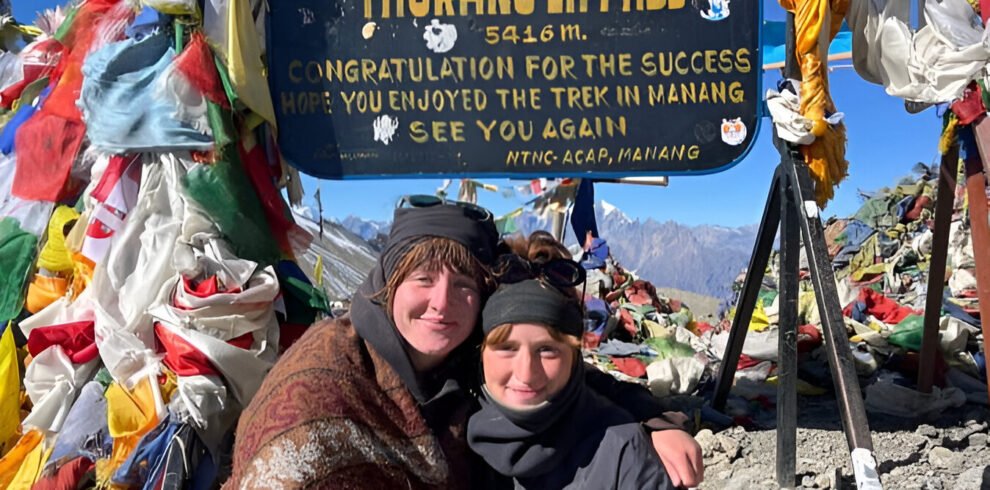
| Thorong La Pass (5,416 m) | Minimal snow by mid month in a normal year, cold and windy, crossed early morning before the afternoon wind pattern sets in |
| Muktinath to Jomsom, Mustang side (3,760 to 2,720 m) | Dry, clear, rain shadow protected, Muktinath’s 108 water spouts and the Jwala Mai shrine’s natural gas flame draw pilgrims as well as trekkers, Kagbeni’s walled medieval streets and Marpha’s blossoming apple orchards sit along or near this stretch |
This elevation by elevation picture is also why our Annapurna Circuit itinerary builds in the Ghyaru and Ngawal high route between Upper Pisang and Manang rather than the more direct low path. It adds a little more distance and a gentler net gain, but it is the preferred acclimatization friendly variant, and in April it also means more time inside the forest and scrub zone where the season’s bloom and mountain views are both at their best.
How Difficult Is the Annapurna Circuit in April
The Annapurna Circuit is graded moderate to strenuous, and April does not change the fundamental physical demands of the route, only the comfort level while you meet them. Daily walking time runs 5 to 7 hours across most days, with the heaviest single day being the pass crossing itself, a roughly 16 km push that gains 566 to 966 m to reach 5,416 m before descending around 1,616 m to Muktinath at 3,760 m, all in one long day.
Elevation gain is steady rather than extreme on most days: roughly 810 m from Dharapani to Chame, around 630 m from Chame to Upper Pisang, a gentler 240 m net gain on the high route from Upper Pisang to Manang via Ghyaru and Ngawal, then 510 m from Manang to Yak Kharka and a further 400 to 800 m from Yak Kharka up to Thorong Phedi or High Camp. None of this requires technical climbing, fixed ropes or crampons in normal April conditions, but it does require sustained high altitude walking stamina, and trekkers should be able to manage roughly 6 hours of continuous walking at sea level without distress before attempting this trek.
Altitude is the real variable, not April’s weather. The compulsory rest day at Manang on day 6 follows the standard climb high, sleep low approach: a 3 to 4 hour hike up to around 3,900 m before returning to sleep at Manang’s lower 3,519 m. From Manang onward, guides monitor blood oxygen with a pulse oximeter; a SpO2 reading under 80 percent triggers a mandatory extra acclimatization day, and a reading under 70 percent triggers immediate descent. Above 3,000 m, guides generally hold to no more than 300 to 400 m of net sleeping elevation gain per night, the same medically grounded pattern used year round, April included. Diamox (acetazolamide), typically 125 to 250 mg twice daily, is a common preventative option trekkers discuss with their own doctor ahead of departure, though it is never treated as a substitute for proper acclimatization days.
The other genuinely April specific difficulty factor is the pass day’s early start. Because afternoon winds at Thorong La regularly reach 50 to 60 km/h regardless of month, groups depart High Camp well before dawn, commonly in the 3:00 to 4:30 am window, to be at or past the pass before roughly 09:30 to 10:00 am. In April that means a cold, dark, high altitude start even though daytime temperatures elsewhere on the route are comfortable, a contrast first time high altitude trekkers sometimes underestimate. Anyone weighing up Annapurna Circuit Trek difficulty against their own fitness should plan around this single hardest day specifically, not just the average daily walking distance.
Annapurna Circuit Trek Cost in April
April’s price sits on the operator’s standard tiered group rate, the same pricing structure used year round, since cost on this trek is driven mainly by group size, not by month. Season affects availability and how far ahead you should book, not the headline price itself.
| Group Size | Price per Person (USD) |
|---|---|
| 1 traveler | 1,445 |
| 2 travelers | 1,375 |
| 3 to 5 travelers | 1,275 |
| 6 to 8 travelers | 1,175 |
| 9 to 12 travelers | 1,075 |
| 13 or more travelers | 975 |
These figures apply to Next Trip Nepal’s own 13 day group package and will vary with itinerary length, group size, season and the specific services you choose, so treat the table as a real reference point rather than a fixed quote. The site’s marketing headline, “13 day Annapurna Circuit Trek from USD 1,449,” is a rounded figure close to but not identical to the solo traveler rate above; the tiered table is the accurate set of numbers to plan against.
The package price covers 3 nights in a 3 star Kathmandu hotel, 1 night in a 3 star Pokhara hotel and 9 nights of twin sharing teahouse accommodation on trek, all trekking meals, private vehicle transfers including the jeep to the trailhead, the one way Jomsom to Pokhara mountain flight, a licensed English speaking guide and porter (one porter per two trekkers, 20 kg carrying capacity), equipment loan including a down jacket, a sleeping bag rated to minus 15 degrees Celsius, a duffel bag, a trekking map and a t shirt, both required permits, a first aid kit and pulse oximeter carried by the guide, and a trek completion certificate.
Not included: lunch and dinner while in Kathmandu and Pokhara (breakfast is covered at the city hotels), the Nepal visa fee (roughly USD 30 to 125 depending on duration, available on arrival), travel and medical insurance, international flights, personal expenses such as laundry and snacks, optional extras on trek like alcoholic drinks, hot showers, device charging and wifi in some teahouses, and tipping for your guide, porter and driver, which is customary though not compulsory. A full breakdown of what is and is not covered sits on the main Annapurna Circuit Trek cost and inclusions page.
Permits and Guide Requirements in April
Permit rules on the Annapurna Circuit do not change by season, so April trekkers face exactly the same requirements as any other month. Two permits are mandatory for every foreign trekker: the Annapurna Conservation Area Permit (ACAP), priced at NPR 3,000 (roughly USD 22), and the TIMS card (Trekkers’ Information Management System), priced at NPR 2,000 (roughly USD 15). Both are arranged through a registered trekking agency before you set out, and both get checked at official checkpoints along the way, specifically at Ghasa, Manang, Muktinath and Jomsom. Carry the originals; photocopies are not accepted at these checkpoints.
One point worth stating clearly, since it differs from some of Nepal’s other major treks: the standard Annapurna Circuit route, as far as Dharapani to Jomsom via Thorong La, does not require a licensed guide by law for independent trekkers, unlike the Kanchenjunga Circuit or Upper Mustang, both of which sit in restricted areas with a legal guide requirement. ACAP and TIMS remain mandatory regardless, but the guide rule specifically is different here.
That said, Next Trip Nepal runs every group on this route with a licensed, English speaking guide and a porter as standard practice, not because the law demands it on this stretch, but because of what a guide actually does across 12 days above 1,800 m: monitoring SpO2 daily from Manang onward, managing the climb high, sleep low acclimatization schedule, navigating route choices like the Ghyaru and Ngawal high path, timing the Thorong La departure correctly against the afternoon wind pattern, and handling emergency logistics if a reading drops low enough to require descent. If your priority is minimizing genuine risk on a route that still climbs to 5,416 m regardless of season, that standard is worth understanding before you compare quotes; our separate rundown of the 5 safest treks in Nepal covers how this trek stacks up against other options on exactly that basis.
Trekkers who want to continue past Kagbeni into Upper Mustang proper should note that this is a separate restricted area with its own permit, outside the scope of the standard Annapurna Circuit itinerary; the Upper Mustang Trek is the natural extension for anyone who wants to go further into that landscape after finishing the Circuit. Anyone still finalizing their plans can review the current Annapurna Circuit Trek permits and booking details directly.
Choosing the right operator matters as much as choosing the right month. If you want a full breakdown of what to check before booking with any Annapurna Circuit trek company, including registration, guide licensing and transparent pricing, see our guide to choosing the best Annapurna Circuit trek company.
What to Pack for the Annapurna Circuit in April
April’s packing list sits between March’s colder gear needs and May’s lighter, sun focused kit. You still need real cold weather layers for the pass day, but you can leave the heaviest winter gear at home.
Clothing
- Base layers, both lightweight and midweight, for temperature swings between valley floor and high camp
- An insulated down jacket for Manang, Thorong Phedi, High Camp and the pass crossing itself (loaner jackets are included in the package)
- A fleece or softshell mid layer
- A waterproof, windproof outer shell, mainly for wind protection at altitude rather than rain
- Trekking trousers, plus a lighter pair for lower elevation, warmer days
- Warm hat, sun hat, buff or neck gaiter, and liner and insulated gloves
Footwear
- Broken in, waterproof trekking boots with ankle support
- Wool trekking socks plus liner socks
- Camp shoes or sandals for evenings at teahouses
- Gaiters, useful if an early April storm leaves fresh snow at High Camp or the pass
Sleep
- A sleeping bag rated to roughly minus 15 degrees Celsius (included as loaner gear in the package)
- A silk or cotton liner for added warmth and hygiene
Rain and sun protection
- High altitude, high SPF sunscreen and lip balm, sun exposure is intense above 3,000 m even on a cool day
- UV protective sunglasses rated for glacier and snow glare, important for the pass crossing
- A light rain jacket or poncho as backup, more for occasional lower valley cloud than for sustained rain in April
Documents
- Passport, passport photos, travel insurance details that explicitly cover trekking above 5,000 m
- ACAP and TIMS permit originals, arranged by the agency but carried by you at each checkpoint
First aid and health
- Any personal prescription medication
- Diamox, if discussed and approved with your own doctor beforehand
- Basic blister and stomach upset supplies, water purification tablets or a filter as backup
Electronics
- A power bank, since device charging is not always included at teahouses
- A headlamp with spare batteries, essential for the pre dawn pass departure
- A camera or phone with cold resistant battery habits, batteries drain faster in the cold at High Camp and the pass
For a full, itemized version of this list built specifically around this trek, see the dedicated Annapurna Circuit Trek Packing List, which goes into more depth on gear weight, rental options and what genuinely gets used versus what stays in the duffel bag.
Advantages and Disadvantages of Trekking in April
| Advantages | Disadvantages |
|---|---|
| Among the most reliable pass crossing conditions of the entire spring season, especially by mid month | Second busiest month of the year on this route, after October |
| Rhododendron bloom active on the Dharapani to Pisang forest belt | Popular teahouses at Manang and Thorong Phedi can fill up, especially in the last third of the month |
| Warmer daytime temperatures than March across the whole route | Nights at Manang, Thorong Phedi, High Camp and the pass are still freezing or below, particularly early in the month |
| Generally clear skies and strong mountain visibility | The 3:00 to 4:30 am pass day departure is still cold and dark, regardless of how mild the rest of the day is |
| Rain shadow keeps the upper Manang and Mustang side dry even as the season progresses | Advance booking of flights and teahouses matters more than in a quieter month |
March vs April vs May: Which Spring Month Should You Choose
All three months sit within the operator’s second best season of the year, spring, but each has a genuinely different character on this specific route.
| Factor | March | April | May |
|---|---|---|---|
| Pass snow risk | Real, especially early month, genuine winter leftovers at High Camp | Low, largely cleared by mid month | Minimal to none |
| Daytime temperature | Coolest of the three, roughly 7 to 20 degrees Celsius | Warmer, roughly 7 to 24 degrees Celsius across the route | Warmest, approaching 20 to 28 degrees Celsius at lower elevations by late month |
| Rhododendron bloom | Just beginning at the lowest elevations by late March | Active across the Dharapani to Pisang belt, often at its best mid month | Fading at lower elevations, largely finished by the route’s forest sections |
| Crowd level | Moderate, noticeably quieter than April | High, second busiest month of the year | Moderate, easing off from April’s peak |
| Lower approach conditions | Dry, cold | Dry, mild | Dry early, increasingly humid with more afternoon cloud by late month |
March wins on quiet trails and a genuine early season feel, with far fewer trekkers sharing the teahouses, but it loses on real, if declining, snow risk at Thorong La and colder nights throughout. Anyone drawn to that trade off should read our full guide to the Annapurna Circuit Trek in March before deciding.
April wins on the best overall balance: the most reliable pass crossing conditions of the spring season, visible bloom, and daytime warmth without yet paying May’s crowd relief price of a more humid lower valley. It loses only on crowd pressure, which is real but manageable with early booking.
May wins on peak daytime warmth and a genuine crowd drop from April’s high, and thanks to the rain shadow effect, the upper Manang and Mustang side stays notably drier and clearer than the lower approach even as the month progresses, a distinguishing feature of this specific route. It loses on the lower valley itself, where humidity and afternoon cloud build more noticeably by late May as the monsoon approaches. Trekkers curious about that late spring trade off should see our detailed Annapurna Circuit Trek in May guide.
For a first time high altitude trekker who wants the single most dependable pass crossing window paired with a genuine seasonal highlight, April is the strongest of the three. For someone who prioritizes solitude over bloom, March is the better call. For someone chasing peak warmth and willing to accept a bit more lower valley cloud, May fits best.
Is April the Best Month for the Annapurna Circuit? Final Verdict
For most trekkers, yes. April delivers the most reliable Thorong La crossing conditions of the entire spring season, comfortable daytime temperatures across the route, genuine (if modest, forest belt rather than panoramic) rhododendron bloom between Dharapani and Pisang, and clear mountain visibility, all without the deeper cold of March or the building humidity that reaches the lower approach by late May.
The honest caveat is crowding. If your priority is a quiet trail with minimal teahouse competition, April is not that month, October and April are this route’s two busiest windows of the year, and March or November suit that preference better. If your schedule is tight and you cannot commit to the full 13 to 14 day circuit, the shorter 6 Day Annapurna Base Camp Trek or the Mardi Himal Trek are worth considering as lower commitment alternatives in the same general region.
For everyone else, especially first time high altitude trekkers who want the safest realistic balance of weather, bloom and crowd manageable enough to plan around with early booking, April is a genuinely strong choice, and one of the two or three best months of the year to book the Annapurna Circuit Trek.
Frequently Asked Questions
Is April a good month to trek the Annapurna Circuit?
Yes. April is widely regarded as one of the two or three best months of the year for this route, offering reliable Thorong La crossing conditions, comfortable daytime temperatures and active rhododendron bloom on the lower and middle trail. The main trade off is crowd level, which is high.
Will Thorong La be open and safe to cross in April?
In a normal year, yes. Snow left over from winter and early spring has generally cleared from the pass by mid April, and conditions by the middle to later part of the month are considered among the most reliable of the entire spring season. An early April departure can still occasionally meet a fresh, light dusting from a late season storm, which your guide will assess before the crossing day.
Is the rhododendron bloom visible on the Annapurna Circuit in April, or only on the Poon Hill route?
Both routes carry bloom, but they are different experiences. On the Annapurna Circuit itself, bloom is genuine and visible along the forest sections between Dharapani, Chame and Upper Pisang, roughly 1,860 to 3,300 m, without the dense, panoramic forest scenery the separate Ghorepani and Poon Hill route is specifically known for. Above roughly 3,300 m on the Circuit, the landscape shifts to alpine and high desert terrain with no bloom at all.
How crowded is the Annapurna Circuit in April?
Busy. April is the second busiest month of the year on this route, after October, particularly around Manang and Thorong Phedi or High Camp in the last third of the month. Booking ahead through a registered agency, rather than arriving and hoping for teahouse space, is the practical way to manage this.
Do I need to book teahouses in advance in April?
It is strongly advisable, especially for departures in the second half of the month. Groups traveling with an agency typically have this handled as part of the itinerary; independent trekkers should expect some competition for rooms at the busier stops.
What is the weather like at Thorong La Pass in April?
Cold and windy regardless of the mild weather elsewhere on the route. Overnight and early morning temperatures at the pass and at High Camp are commonly at or below freezing, and afternoon winds regularly reach 50 to 60 km/h, which is why every crossing happens in the early morning, well before that wind pattern sets in.
Is April warmer than March on the Annapurna Circuit?
Yes, noticeably. Daytime temperatures across the route run warmer in April, and snow risk at the pass drops significantly compared to March, when winter leftovers are still a real factor. Nights at high elevation remain cold in both months, but April’s are generally milder than March’s.
Do I need a guide to trek the Annapurna Circuit in April?
Not by law, on this specific stretch. Unlike the Kanchenjunga Circuit or Upper Mustang, the standard Annapurna Circuit route from Dharapani to Jomsom via Thorong La does not legally require a licensed guide for independent trekkers, though ACAP and TIMS permits remain mandatory regardless of season. Next Trip Nepal still runs every group with a licensed guide and porter as standard practice, for acclimatization monitoring, navigation and safety on the pass day, not because the law demands it here.
What permits do I need to trek the Annapurna Circuit in April?
Two: the Annapurna Conservation Area Permit (ACAP) and the TIMS card, both mandatory for every foreign trekker and both checked at Ghasa, Manang, Muktinath and Jomsom along the way. Original documents are required at each checkpoint, photocopies are not accepted.
How much does the Annapurna Circuit Trek cost in April with Next Trip Nepal?
Pricing follows the operator’s standard tiered group rate, from 1,445 US dollars per person for a solo traveler down to 975 US dollars per person for a group of 13 or more, on the 13 day package. April’s price does not carry a seasonal surcharge, though earlier booking is recommended given how busy the month gets.
What should I pack differently for an April departure compared to October?
Broadly similar core gear, since both months sit at the milder end of the year’s trekking calendar, but April trekkers should still carry full cold weather layers and a rated sleeping bag for the pass day, since night and early morning temperatures at Manang, High Camp and the pass remain close to or below freezing well into the month.
Is April or May better for the Annapurna Circuit?
Both are strong, but they suit slightly different priorities. April offers the more reliable pass crossing window and active bloom, with higher crowd levels. May offers warmer daytime temperatures and a modest crowd drop from April’s peak, along with a notably drier upper Manang and Mustang side thanks to the rain shadow effect, though the lower approach grows more humid as the month progresses. Trekkers wanting the safest, most predictable spring booking window generally do best with April; those chasing peak warmth and slightly quieter trails can look at May.
Whichever spring month fits your schedule, the underlying route, permits and safety protocol stay the same. If April’s balance of reliability, bloom and manageable crowd sounds right for your trip, our team can walk you through the Annapurna Circuit Trek itinerary, current departure dates and group pricing in detail.