Two Trails to Everest, One Decision You Actually Need to Make
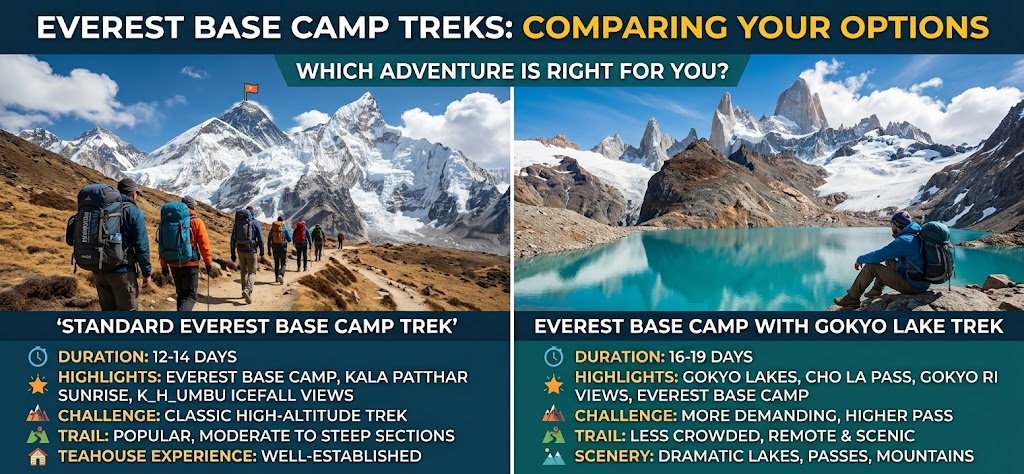
Every season we sit down with trekkers who have already decided they are going to the Everest region. What they have not decided is which route gets them there. The question almost always comes down to two specific trips: the standard Everest Base Camp Trek, twelve to fourteen days of the classic route people have been walking for decades, and the Everest Base Camp with Gokyo Lake Trek, seventeen days that add the Gokyo valley and a crossing of Cho La Pass into the mix.
This is not a marketing comparison designed to push you toward the longer, pricier option. Both trips sell out every season and both are genuinely good trips. Our job here is to lay out exactly what each one gives you and costs you, in plain numbers, so you can pick the one that fits your time, your budget, and your legs, not the one that just sounds more impressive on paper.
We are not neutral about this region, we run trips here every season and we want you booking the right trip for you, not the one with the higher price tag. That is the whole point of this comparison. Read the numbers, read the honest tradeoffs, and use the checklists further down to make your own call rather than taking anyone’s word for it, including ours.
Before we get into the detail, here is the short version for readers who want the answer first and the reasoning after.
- If you have twelve to fourteen days, want the single most famous mountain view on earth, and do not want any technical terrain, take the standard Everest Base Camp Trek.
- If you have seventeen or more days, have already done some trekking at altitude, and want two summit mornings instead of one plus a proper mountain pass crossing, take the Everest Base Camp with Gokyo Lake Trek.
- If neither of those quite fits, there are two other options worth knowing about, covered near the end of this article: the Everest Three Passes Trek and the Gokyo Lake Trek Only.
Side by Side Comparison: The Numbers That Actually Matter
Numbers settle arguments faster than opinions do, so here is the direct comparison using the real figures from both trip pages. Prices below are per person for the 2026 and 2027 seasons and depend on group size.
| Factor | Standard Everest Base Camp Trek | Everest Base Camp with Gokyo Lake Trek |
|---|---|---|
| Duration | 12 to 14 days | 17 days |
| Route shape | Out and back, same trail both ways | Split route, Gokyo side going in, classic EBC trail coming out |
| Approximate distance | Around 65 to 80 km round trip | Roughly 130 to 140 km total |
| Maximum altitude | 5555 m at Kala Patthar, 5364 m at Everest Base Camp | 5555 m at Kala Patthar, plus 5360 m at Gokyo Ri and 5420 m at Cho La Pass |
| Difficulty rating | Moderate to Challenging | Challenging |
| Number of dawn summit viewpoints | One, Kala Patthar | Two, Gokyo Ri and Kala Patthar |
| Technical terrain | None, trail walking throughout | Cho La Pass, a glacier and boulder crossing at 5420 m |
| Price solo traveler | Lower, see current rates on trip page | USD 1865 |
| Price for 2 to 3 people | Lower, see current rates on trip page | USD 1715 |
| Price for 4 to 9 people | Lower, see current rates on trip page | USD 1615 |
| Price for 10 to 14 people | Lower, see current rates on trip page | USD 1515 |
| Best suited for | People new to the Himalaya, tight schedules | Repeat visitors, people who want more terrain variety |
On the exact dollar gap: because the extra days on the Gokyo route add roughly three to five nights of lodge stays, extra crew days, and a permit fee for the Cho La section, the real world difference between the two trips generally lands between 150 and 250 US dollars per person once you compare equivalent group sizes on the two trip pages. That is not a small amount if you are backpacking on a strict budget, but spread across three to five extra trekking days it works out to somewhere around 30 to 60 dollars per additional day on trail, which most trekkers find reasonable once they see what those days actually contain.
Day by Day Route Differences: Where the Two Trails Actually Diverge
Both trips start exactly the same way, and that overlap is worth spelling out because it means the early days of either trek feel identical. The split only happens after Namche Bazaar, and understanding exactly where and how it happens makes the rest of this comparison much easier to picture.
- Shared opening days on both treks. Both routes begin with the short mountain flight into Lukla at 2840 meters, followed by a walk down to Phakding at 2610 meters, then a climb up to Namche Bazaar at 3440 meters, where both itineraries include an acclimatization day for altitude adjustment and short side hikes.
- Where the standard trek continues. From Namche, the standard Everest Base Camp Trek follows the Dudh Koshi river valley directly northeast, through Tengboche, Dingboche, and Lobuche, arriving at Everest Base Camp and Kala Patthar before returning down the exact same trail to Lukla.
- Where the Gokyo Lake route splits away. From Namche, the Gokyo Lake trip turns off the main trail toward Phortse Thanga at 3680 meters, then climbs through Machhermo at 4470 meters to reach Gokyo village itself at 4790 meters, sitting beside the Gokyo Lakes.
- The Gokyo Ri summit morning. From Gokyo village, trekkers climb before dawn to Gokyo Ri at 5360 meters for sunrise, then descend and continue on to Thangnak at 4700 meters, setting up for the pass crossing the next day.
- The Cho La Pass crossing. From Thangnak, the route crosses Cho La Pass at 5420 meters and descends into Dzongla at 4710 meters, the single hardest and longest day of the entire seventeen day itinerary.
- Rejoining the classic trail. From Dzongla, the Gokyo route joins the main Everest Base Camp trail at Lobuche, at 4910 meters, and from that point on both trips follow the same path to Gorak Shep, Everest Base Camp, and Kala Patthar.
- The return leg. Both trips descend through Dingboche, Tengboche, and Namche back to Lukla, so the final days of the Gokyo Lake trip and the final days of the standard trek look almost identical, which is one reason the two experiences feel more similar at the end than they did in the middle.
This structure is exactly why the Gokyo Lake trip does not feel like an out and back journey the way the standard trek does. You spend roughly the first half of the trip on ground the standard trekker never sees at all, then merge back onto the famous final approach to Base Camp for the second half. For a deeper walk through how the standard route breaks down stage by stage, our day by day Everest Base Camp itinerary covers that trail in full detail.
What You Actually Gain by Adding Gokyo Lake and Cho La Pass
The company line about this trip is simple: the standard route is out and back, meaning you walk the same trail twice, once heading up and once heading down. The Gokyo Lake version breaks that pattern. You go up through the quieter Gokyo valley, cross Cho La Pass at 5420 meters, then join the classic Everest Base Camp trail and come down through Dingboche, Tengboche, and Namche. You see almost twice the ground and you never retrace a full day’s walk. Here is what that actually buys you, point by point.
- A second summit morning at Gokyo Ri. At 5360 meters, Gokyo Ri delivers a sunrise view that regularly gets ranked alongside or above Kala Patthar by trekkers who have done both. From the top you can see four peaks over 8000 meters in one sweep, including Everest, Cho Oyu, Makalu, and Lhotse, depending on cloud conditions. Most standard EBC trekkers never see this view at all.
- The six Gokyo Lakes themselves. These turquoise, glacier fed lakes sit inside a designated Ramsar wetland of international importance, a protection status given to wetlands recognized as ecologically significant on a global scale. The lakes are quiet, still, and completely absent from the standard route.
- A genuine mountain pass crossing at Cho La. Cho La sits at 5420 meters and involves a crossing over rock and glacier ice, often requiring microspikes depending on season and recent snowfall. This is real mountain terrain, not a walking path, and it gives trekkers who want more than a trail hike something to actually test themselves against.
- Far more solitude on the way in. The Gokyo side of the Khumbu carries a fraction of the foot traffic that the main Everest Base Camp trail does, especially in the peak months of April, May, October, and November. Trekkers who have done the standard route before consistently describe the Gokyo section as feeling like a different, emptier Nepal.
- More varied villages and valleys. Instead of following one river valley the whole way, you pass through Phortse Thanga, Machhermo, and Gokyo village itself, each with a different feel, before rejoining the familiar Dingboche and Tengboche stretch on the way back.
- A better sense of the scale of the Khumbu. Seeing the region from two separate approach angles, rather than one straight line in and the same line back out, gives a far stronger mental map of how the valleys, glaciers, and peaks actually connect to each other.
None of this is exaggeration for sales purposes. We have watched enough trekkers finish the standard route and later ask, with real disappointment in their voice, whether they should have added Gokyo. That reaction is common enough that it shapes how we now explain both trips to first time inquirers.
What You Give Up or Add: The Honest Cost Side of the Ledger
Every upgrade has a price, and it is not just the dollar figure. Here is exactly what the Gokyo Lake addition costs you compared with the standard trek, stated plainly rather than buried in a highlights list.
- Three to five extra days on trail. The Gokyo Lake trip runs 17 days against 12 to 14 for the standard trek. If your annual leave or your travel window is tight, this alone may decide the question for you.
- Roughly 150 to 250 extra dollars per person. Using the published rates, the gap narrows as group size grows, so travelers going in a larger group absorb the difference more easily than solo travelers do.
- A technical section that the standard trek simply does not have. Cho La Pass is not dangerous for a reasonably fit trekker with a good guide, but it is a step up from walking on a maintained trail. Loose rock, glacier ice, and route finding in poor visibility are all real factors.
- More cumulative altitude exposure. You spend more nights above 4500 meters, cross two passes over 5000 meters instead of relying on a single high point, and generally carry more days of altitude strain in your legs and lungs by the time you reach Everest Base Camp itself.
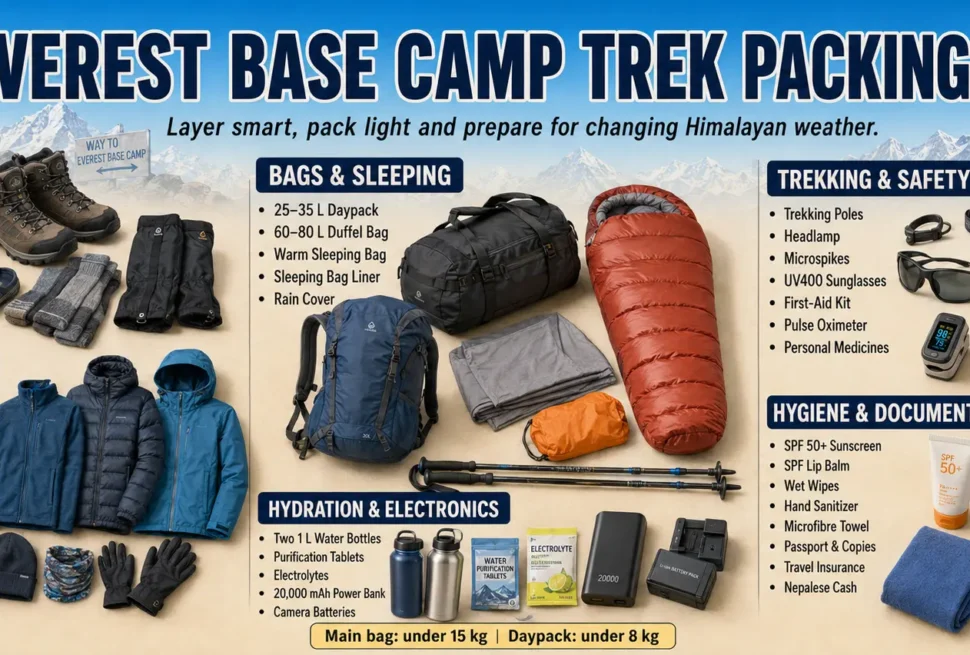
- More gear demands. Depending on conditions, you may need microspikes or crampons for Cho La, along with trekking poles and slightly warmer cold weather gear than the standard route usually calls for.
- Less flexibility if something goes wrong. On the standard out and back trek, turning around and heading back down the same trail is always straightforward. On the Gokyo route, once you commit to crossing Cho La, going back the way you came is a much longer and harder proposition, so the decision to cross needs to be made with a clear head and a guide you trust.
None of these points should scare off a reasonably fit trekker. They are simply the honest other half of the comparison that gets skipped in most marketing copy.
Who Should Choose the Standard Everest Base Camp Trek
The standard route earns its reputation as the best first Everest region trip for good reason. If any of the following describe you, this is very likely your trek.
- You are new to trekking in the Himalaya and want the classic, most recognized version of this journey before considering anything more elaborate.
- You have exactly twelve to fourteen days available for the whole trip, including flights into and out of Kathmandu.
- You want the single most famous sunrise view in the world, from Kala Patthar, without adding technical mountain terrain to the itinerary.
- You are working with a moderate budget and want the lower cost version of an Everest region trek without sacrificing the core experience.
- You are not looking for a pass crossing or glacier travel on this particular trip and would rather save that for a future visit.
- You want a trek with a strong safety margin for turning back early if altitude symptoms appear, since the out and back structure makes an early descent simple at almost any point.
- You are trekking with a partner, parent, or friend whose fitness level is solid but not extreme, and you want a route with a long, well established track record for a wide range of trekkers.
If you want to understand exactly how the days break down on this route, our detailed day by day Everest Base Camp itinerary walks through each stage from Lukla to Base Camp and back. And if you are still deciding whether this region is realistic for someone without previous high altitude experience, our article on whether Everest Base Camp Trek is good for beginners covers that question directly.
Who Should Choose the Everest Base Camp with Gokyo Lake Trek
The longer route rewards trekkers who are ready for a bigger, more varied trip. Consider this trek if you recognize yourself in the list below.
- You have already trekked in Nepal or another high mountain region before and know roughly how your body handles altitude over multiple days.
- You have seventeen days or more available and would rather use the extra time to see significantly more of the Khumbu than to save a few days at home.
- You specifically do not want to walk the same trail on the way in and the way out, and the idea of a loop style route appeals to you more than an out and back one.
- You want to add real technical interest to your trip, in the form of the Cho La Pass crossing, without committing to the full scale of the Everest Three Passes Trek.
- You are drawn to quieter trails and want to avoid the busiest sections of foot traffic that build up on the main Everest Base Camp trail during peak season.
- You want two separate sunrise summit experiences, at Gokyo Ri and at Kala Patthar, rather than building the whole trip around a single viewpoint.
- You are comfortable with a somewhat higher budget in exchange for a trip that most trekkers describe as noticeably more memorable and complete.
This is the route we now recommend most often to repeat clients who tell us they already have the classic Everest Base Camp photo and want the version of this trip that goes further. You can see the complete Everest Base Camp with Gokyo Lake Trek itinerary, daily altitude chart, and current pricing on the trip page.
Fitness and Experience: What Cho La Pass Actually Demands
The single biggest practical difference between these two trips is not the extra distance or the extra days, it is the Cho La Pass crossing itself. Trekkers considering the Gokyo route need an honest picture of what that day involves, so here is a direct breakdown.
- Terrain type. Cho La is a mix of loose rock scree on both approaches with a glacier and ice section near the top of the pass itself. This is not technical climbing, but it is not maintained trail walking either.
- Typical gear needed. Depending on the season and recent snowfall, guides will often ask trekkers to use microspikes or basic crampons for the ice section, along with trekking poles for stability on the scree.
- Physical demand. The crossing day is long, frequently eight to ten hours from Dzongla to Thangnak or the reverse direction, at altitude above 4700 meters the entire time and above 5000 meters for a significant stretch.
- Weather sensitivity. Cho La is far more weather dependent than the main Everest Base Camp trail. High wind, fresh snow, or poor visibility can delay or reroute a crossing, and a good guide will not force the pass in unsafe conditions.
- Prior experience that helps. Any previous trekking above 4000 meters, comfort using trekking poles on loose or icy ground, and general lower body endurance from multiple day hiking all translate directly to an easier Cho La day.
- What does not help as much as people expect. Gym fitness alone, without any hiking specific conditioning, tends to translate less well than trekkers assume. Leg strength on descents and general endurance over long days matter more than raw strength.
Compare that to the standard Everest Base Camp Trek, where the hardest single factor is simply altitude gain over consistent, well maintained trail with no technical terrain at any point. That difference alone is often the deciding factor for trekkers who are unsure which trip suits their actual fitness and trail experience, rather than their fitness in the abstract.
Acclimatization Differences Between the Two Routes
Altitude, not distance, is the real limiting factor on both trips, and the two routes handle acclimatization in noticeably different ways. Understanding the difference helps explain why the Gokyo Lake trip needs its extra days rather than simply adding them for scenery.
- Standard trek acclimatization pattern. The standard route relies mainly on the built in rest day at Namche Bazaar and a second rest or short acclimatization stop around Dingboche before the final push to Base Camp. The climb rate above Namche is steady and closely follows widely used altitude gain guidelines for the region.
- Gokyo Lake route acclimatization pattern. The Gokyo Lake trip spreads altitude gain across more days and more villages, with Phortse Thanga, Machhermo, and Gokyo village each acting as a natural step up in elevation before the Gokyo Ri summit push, which gives the body more gradual exposure before the harder days that follow.
- Extra high points mean extra adjustment. Because the Gokyo route includes two summits over 5300 meters and one pass over 5400 meters, rather than the single high point on the standard trek, trekkers spend more total nights sleeping above 4500 meters, which some find helps their acclimatization and others find simply extends the period of mild altitude discomfort such as reduced appetite or disrupted sleep.
- Descent as part of acclimatization. Both trips use the climb high, sleep low principle common in mountain trekking, but the Gokyo Lake trip applies it more often, since the trail profile naturally moves up and down more than the steadier climb of the standard route.
- Practical takeaway. Neither route removes altitude risk entirely, and both should be done with a guide who monitors symptoms daily and is prepared to adjust the schedule. The Gokyo Lake trip is not inherently safer for altitude simply because it has more days, but the extra days do give it more built in flexibility if a rest day needs to be added.
Packing and Gear Differences Worth Planning For
Most of the packing list for these two trips overlaps completely, since both involve multiple days at altitude in the Khumbu region during similar trekking seasons. A short list of real differences is worth flagging before you pack.
- Microspikes or light crampons. Needed for the Cho La Pass crossing on the Gokyo Lake trip depending on conditions. Not required for the standard trek under normal circumstances.
- Trekking poles. Useful on both trips, but close to essential on the Gokyo Lake trip given the loose rock and uneven ground around Cho La Pass and the Gokyo Ri ascent.
- Extra base layers. Because the Gokyo Lake trip spends more nights above 4500 meters, most trekkers pack one additional warm layer compared with what they would bring for the standard trek alone.
- Sun protection. Both trips demand strong sun protection, but the extended time above the tree line on the Gokyo side, with less shade and more exposed rock and ice, makes this even more important on the longer route.
- Battery and power planning. With three to five extra days away from reliable charging points, trekkers on the Gokyo Lake trip generally carry a larger power bank or a spare battery pack for cameras and phones.
- Everything else. Sleeping bag rating, boots, daypack, water purification, and personal medical kit stay essentially the same across both trips. If you already have a packing list from a previous Everest region trek, it will cover roughly ninety percent of what either trip requires.
Best Time of Year for Each Trek
Season matters slightly differently for the two routes because of the added pass crossing on the Gokyo Lake trip. The core trekking windows are similar, but the details shift.
- Spring, March through May. Good conditions for both trips. On the Gokyo Lake route, late season snow can still affect Cho La in early March, so April and May tend to be the more reliable window for that crossing.
- Autumn, late September through November. Widely considered the best window for both trips, with stable weather, clear mountain views, and generally the safest conditions for the Cho La crossing on the Gokyo Lake trip.
- Winter, December through February. Possible on the standard trek for experienced cold weather trekkers, but the Gokyo Lake trip becomes considerably harder in winter, since fresh snow and ice on Cho La significantly raise the difficulty and can force a delay or a change of plan.
- Monsoon, June through August. Generally avoided for both trips due to cloud cover blocking mountain views and wet trail conditions, though the standard trek is somewhat more forgiving during this window than the Gokyo Lake route with its pass crossing.
If your travel dates are fixed and fall outside the prime spring or autumn windows, it is worth a direct conversation with your guide about which of the two trips makes more sense for that specific time of year rather than assuming both are equally viable year round.
A Practical Decision Framework You Can Actually Use
Rather than trying to weigh every factor at once, work through the questions below in order. The first one that gives you a clear answer usually settles the whole decision.
- How many total days can you realistically commit to this trip, including travel to and from Nepal? If the honest answer is twelve to fourteen, the standard trek is your practical answer regardless of anything else on this list.
- Have you trekked above 4000 meters before? If no, and this is your first high altitude trip, the standard route is the safer and more proven starting point.
- Do you specifically want to avoid walking the exact same trail twice? If yes, that single preference points strongly toward the Gokyo Lake version.
- Is a 150 to 250 dollar difference per person a meaningful constraint on your trip budget? If yes, the standard trek delivers the core experience at a lower cost.
- Are you drawn to the idea of a mountain pass crossing, or does that sound like unwanted risk and complexity to you? Your honest gut reaction here is a genuinely useful signal.
- Do you want the single most iconic Everest photograph, or do you want the fuller regional experience even if it means a less singularly famous highlight moment? Both are valid goals, but they point to different trips.
- Are you already planning to return to the Everest region again in future years? If yes, some trekkers deliberately save Gokyo and Cho La for a second visit and use the standard trek as their introduction.
The table below condenses this into a fast reference you can use on your own or share with a travel partner who is weighing the same decision.
| If this describes you | Choose this trek |
|---|---|
| You have 12 to 14 days total and want the classic bucket list experience | Standard Everest Base Camp Trek |
| You have 17 or more days and want a fuller regional experience | Everest Base Camp with Gokyo Lake Trek |
| This is your first time trekking above 4000 meters | Standard Everest Base Camp Trek |
| You have prior high altitude trekking experience | Everest Base Camp with Gokyo Lake Trek |
| You want the lowest cost Everest region option | Standard Everest Base Camp Trek |
| You want more solitude and fewer crowded trail sections | Everest Base Camp with Gokyo Lake Trek |
| You do not want any technical terrain or pass crossings | Standard Everest Base Camp Trek |
| You want a real pass crossing without the full three pass circuit | Everest Base Camp with Gokyo Lake Trek |
| You want the absolute maximum challenge and have 20 days available | Everest Three Passes Trek |
| You want the lakes experience without Everest Base Camp itself | Gokyo Lake Trek Only |
Guide, Porter, and Group Logistics on Each Route
The extra days and the pass crossing on the Gokyo Lake trip also change the logistics behind the scenes, which affects both safety and price. It is worth understanding what actually changes on the ground, not just on paper.
- Guide to trekker ratio. Both trips run with an experienced local guide and, depending on group size, one or more assistant guides. On the Gokyo Lake trip, the Cho La Pass day in particular benefits from a slightly closer guide to trekker ratio, since route finding across the glacier section requires more direct attention than a normal trail day.
- Porter arrangements. Porter numbers scale with group size and duration on both trips, so the seventeen day Gokyo Lake trip naturally involves more porter days in total than the twelve to fourteen day standard trek, which is part of what accounts for the price difference between the two.
- Permits. Both trips require the Sagarmatha National Park entry permit and the local rural municipality permit. The Gokyo Lake trip additionally requires the correct permit coverage for the Gokyo valley and Cho La Pass section, which your operator arranges as part of the package price.
- Lodge availability. Because the Gokyo side of the route carries far less traffic, lodge rooms in villages like Machhermo and Gokyo are generally easier to secure even during busier weeks, whereas the classic Everest Base Camp trail can get genuinely crowded at teahouses during peak season dates.
- Emergency evacuation options. Both routes have helicopter evacuation available from key points along the trail in a genuine emergency, though the Gokyo side has fewer easy access points than the more heavily trafficked main trail, which is one more reason a properly guided trip matters more on the Gokyo Lake route than on the standard trek.
None of this needs to worry a trekker who books with a properly established local operator, since these are exactly the details a good operator handles as a matter of course. It is simply useful background for understanding where some of the price difference between the two trips actually goes.
Common Regrets We Actually Hear From Trekkers
Having guided both routes across many seasons, certain regrets come up often enough that they are worth stating plainly rather than leaving readers to discover them the hard way.
- Regret one, choosing the standard route and later wishing they had added Gokyo. This is the single most common piece of feedback we receive from repeat clients. Trekkers finish the standard Everest Base Camp Trek, see photographs of the Gokyo Lakes and Gokyo Ri sunrise from other travelers, and feel they missed a major piece of the region. Several of these trekkers return specifically to complete the Gokyo section on a second trip.
- Regret two, underestimating how demanding Cho La Pass actually is. A smaller but real group of trekkers on the Gokyo route tell us the pass crossing was harder than they expected, usually because they had built a mental picture of the whole trip as simply a longer version of a standard trail walk. Setting accurate expectations before you book solves this almost entirely.
- Regret three, running short on time and rushing the Gokyo section. A small number of trekkers try to compress the itinerary to save a day or two, which increases altitude risk and reduces enjoyment of exactly the sections they added the extra days to see in the first place.
- Regret four, not booking enough buffer days for weather. Because Cho La is genuinely weather sensitive, trekkers who build their flight schedule with zero spare days occasionally face a stressful choice between a delayed crossing and a missed flight home. A day or two of buffer removes almost all of this stress.
- Regret five, assuming gym fitness alone was enough preparation. Trekkers who arrive with strong gym conditioning but no actual multiple day hiking under their belt sometimes struggle more than expected on sustained descents, regardless of which of the two treks they chose.
None of these regrets are reasons to avoid either trek. They are simply the patterns worth knowing in advance so you can plan around them rather than discover them mid trip.
Where the Other Two Options Fit
If neither of the two main treks feels like an exact match, two further options from the same region are worth knowing about.
- Everest Three Passes Trek, 20 days, maximum altitude 5535 meters, rated Strenuous. This is the full circuit for experienced trekkers, crossing Kongma La, Cho La, and Renjo La in one continuous journey. If the idea of a single pass crossing on the Gokyo route sounds appealing rather than intimidating, and you have the full twenty days plus solid trekking experience, the Everest Three Passes Trek is the natural next step up. It is not a trip we recommend as anyone’s first Himalaya trek, but for the right trekker it is the definitive Everest region experience.
- Gokyo Lake Trek Only, 12 to 14 days, maximum altitude 5360 meters, rated Moderate. This is worth mentioning for a specific type of traveler, someone who wants the lakes, the Ramsar wetland scenery, and the Gokyo Ri sunrise, but has no particular attachment to standing at Everest Base Camp itself or crossing Cho La. It runs a similar length to the standard EBC trek but at a notably easier difficulty rating, which makes it a strong option for trekkers who want a quieter, less crowded trip without the full demands of either main option covered in this article.
Frequently Asked Questions
Is the Everest Base Camp with Gokyo Lake Trek harder than the standard Everest Base Camp Trek?
Yes. The company rates the Gokyo Lake version as Challenging against Moderate to Challenging for the standard trek, mainly because of the Cho La Pass crossing, the extra distance, and the additional days spent above 4500 meters.
How many extra days does the Gokyo Lake route actually add?
Three to five days, depending on your exact itinerary and rest day placement. The standard trek runs 12 to 14 days while the Gokyo Lake version runs 17 days.
How much more does the Gokyo Lake Trek cost compared with the standard trek?
Based on the two trips’ published rates, the real world difference typically falls between 150 and 250 US dollars per person, narrowing somewhat as group size increases.
Do both treks reach the same maximum altitude?
Both treks include the climb to Kala Patthar at 5555 meters and Everest Base Camp at 5364 meters. The Gokyo Lake route adds two further high points, Gokyo Ri at 5360 meters and Cho La Pass at 5420 meters.
Is Cho La Pass dangerous?
Not for a reasonably fit trekker with an experienced guide and appropriate gear, but it is genuine mountain terrain involving rock scree and glacier ice, not simple trail walking. Weather conditions matter a great deal on this crossing.
Which trek is better for someone trekking in the Himalaya for the first time?
The standard Everest Base Camp Trek is the better starting point for almost everyone trekking in the Himalaya for the first time, since it avoids technical terrain and keeps the trip length and cost lower while still delivering the classic experience.
Can I decide during the trip whether to add the Gokyo section, or do I need to choose in advance?
You need to choose in advance. The two trips follow different routes from Namche Bazaar onward, and the logistics, permits, and crew planning are set up differently for each one from the start.
Does the Gokyo Lake Trek visit Everest Base Camp itself, or only the Gokyo valley?
It visits both. The full Everest Base Camp with Gokyo Lake Trek includes Everest Base Camp and Kala Patthar on the return leg, after the Gokyo valley and Cho La Pass on the way in, so you get both experiences on one trip.
If I only have twelve days, should I try to squeeze in Gokyo anyway?
We would advise against it. Compressing the Gokyo Lake itinerary raises altitude risk and removes the acclimatization margin that makes the trip safe and enjoyable. If your schedule is fixed at twelve to fourteen days, the standard Everest Base Camp Trek is the trip built for that timeframe.
Which trek has better mountain views overall?
This depends on personal taste, but the Gokyo Lake route generally offers more varied and arguably superior views, since it includes the four eight thousand meter peak panorama from Gokyo Ri in addition to everything the standard trek offers. Trekkers who have done both routes usually describe the Gokyo Lake version as the more visually complete trip.
Do I need previous trekking experience for the Gokyo Lake route, or is general fitness enough?
General fitness helps, but some previous multiple day hiking or trekking experience, ideally at altitude, makes a real difference on the Cho La Pass day specifically. Trekkers with no trail experience at all can still complete this trip with a strong guide and a realistic pace, but they should expect the pass crossing to be genuinely demanding rather than a simple extension of the walking they have done on the rest of the trip.
Is the standard Everest Base Camp Trek too easy if I am already a fit, experienced hiker?
Not necessarily. The altitude alone makes the standard trek a real challenge for almost everyone, regardless of general fitness. That said, experienced trekkers who want more terrain variety and a technical section on top of the altitude challenge often prefer the Gokyo Lake version or, for the most experienced group, the Everest Three Passes Trek.
Which trek gives better value for the price, given the cost difference?
Value depends on what you are optimizing for. Per day, the standard trek is the lower cost option. Per experience gained, most trekkers who complete the Gokyo Lake trip consider the extra 150 to 250 dollars strongly justified by the added summit, the lakes, the pass crossing, and the reduced crowding, but that judgment is personal and tied to how much you value those specific additions.
Can guides help me decide on the day whether I am ready for Cho La Pass?
Yes. A good guide assesses how you have handled the trail and the altitude in the days leading up to the pass and will discuss the plan honestly with you before the crossing. This is one of the clearest reasons to trek with an experienced local operator rather than attempting either route unguided.
Making the Call
Both of these treks reach Everest Base Camp. Both include the sunrise from Kala Patthar. The real question is not which trip is better in some abstract sense, it is which trip matches the days you actually have, the trail experience you actually bring, and the kind of trip you actually want to remember five years from now. Trekkers who want the fastest, most proven route to the classic photograph should book the standard Everest Base Camp Trek. Trekkers who have the extra days, some trail experience already, and an appetite for a bigger, more varied journey should book the Everest Base Camp with Gokyo Lake Trek.
If you are still weighing the two, or you want a straight answer on which one fits your dates, your budget, and your fitness level, message us directly on WhatsApp at +977 9869225929 or email nexttripnepal@gmail.com. We have walked both routes with hundreds of trekkers and we would rather give you an honest recommendation before you book than have you choose the wrong trip for your situation. You can also reach us the same way, WhatsApp +977 9869225929 or nexttripnepal@gmail.com, to check current departure dates and group pricing for either trek before you commit.
\n
Related Reading
\n
- Climbing Gokyo Ri at Sunrise: The Complete Guide
- \n
- Everest Base Camp with Gokyo Lake Trek Pricing Explained
- \n
- Why Trek the Gokyo Lake and Cho La Pass Route With Next Trip Nepal
- \n
\n