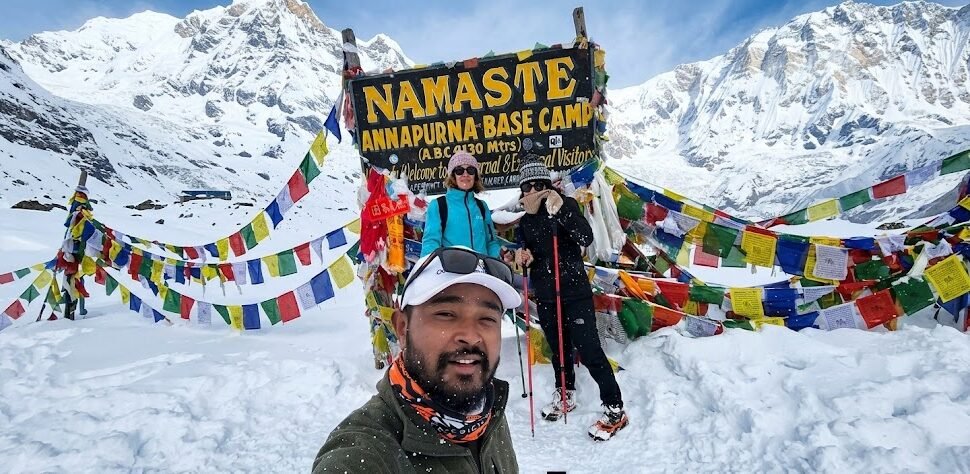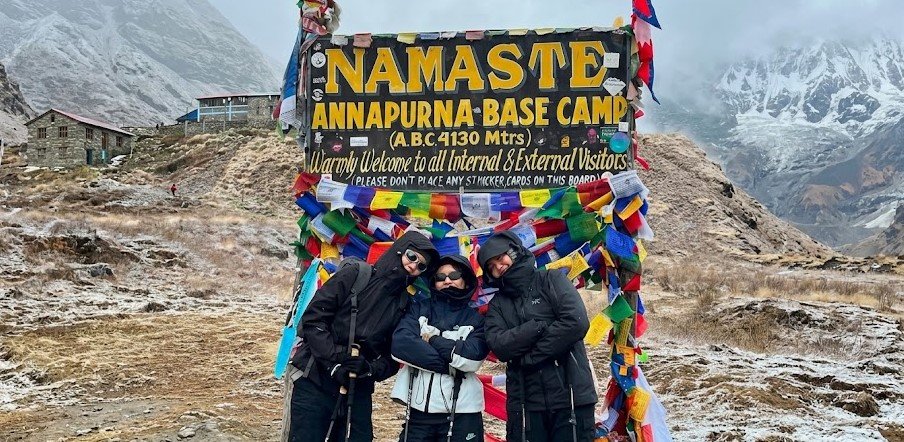
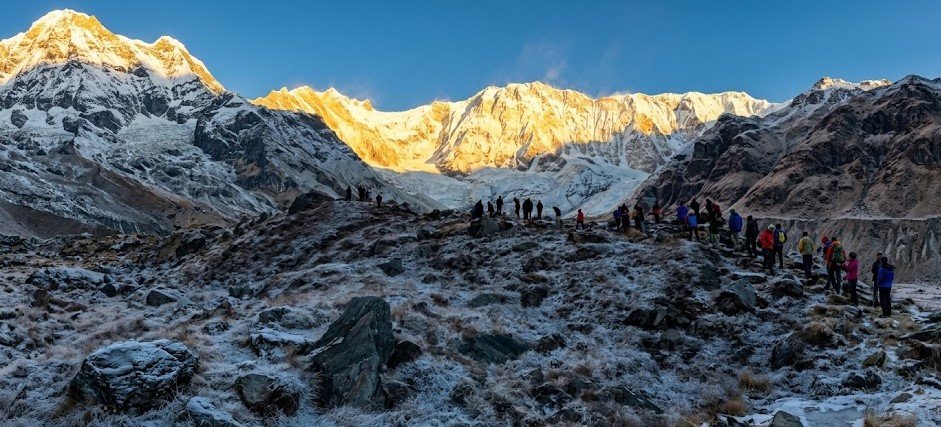
March is the month I recommend to trekkers who want to catch the very beginning of the rhododendron season without competing with April’s crowds. Annapurna Base Camp sits at 4,130m, and in March the sanctuary still carries genuine winter character, night temperatures around -12°C with days reaching about +2°C, and snow remaining on the ground at the highest elevations. Lower down, the first rhododendron blooms begin appearing from around 1,800m in mid March, building toward a fuller display by the end of the month. March sits right at the transition between winter and spring, and I think that transition itself is part of what makes it interesting to guide.
March ABC Trek at a Glance
| Season | Early spring, shoulder month transitioning toward peak |
| Recommended for | First time trekkers, families, photographers |
| ABC Temperature Range | -12°C to +2°C at 4,130m |
| Pokhara Temperature | 15°C to 27°C |
| Trail Conditions | Good below Deurali, snow possible above 3,200m in early March |
| Rhododendrons | Beginning to bloom from 1,800m by mid March, peak by late March |
| Teahouse Availability | All open, moderate crowds building toward April |
| Trek Duration | 7 to 10 days Pokhara to Pokhara |
| Guide Required | Yes, mandatory under ACAP regulations |
| Overall Difficulty | Moderate, trails well marked with generally good conditions |
March Weather Table by Location
| Location | Night Low | Day High | Conditions |
|---|---|---|---|
| Pokhara (827m) | 15°C | 27°C | Warm, mostly clear, humid by afternoon |
| Tikhedhunga (1,540m) | 10°C | 22°C | Pleasant, light breeze, rhododendrons starting |
| Ghandruk (1,940m) | 6°C | 18°C | Cool mornings, warm afternoons, rhododendron bloom beginning |
| Chhomrong (2,170m) | 4°C | 16°C | Similar to Ghandruk, good visibility of Annapurna South |
| Dovan (2,600m) | 0°C | 12°C | Cooler, forest zone, damp mornings |
| Himalaya (2,920m) | -3°C | 9°C | Cold nights, clear mornings |
| Deurali (3,230m) | -5°C | 7°C | Possible morning ice, snow patches in early March |
| MBC (3,700m) | -8°C | 4°C | Snow likely, exposed, wind from the west |
| ABC (4,130m) | -12°C | 2°C | Snow on the ground, cold mornings, spectacular views |
What this table tells me most clearly is that March genuinely splits into two different treks depending on elevation. Below Chhomrong, conditions feel close to April, warm, pleasant, with the first hints of the bloom. Above Deurali, March still belongs to winter, with snow a real and expected part of the final push to ABC. I brief every March group on this split explicitly, since packing for one half of the trek and not the other is the most common mistake I see.
Rhododendron Bloom Timing in March
The bloom begins at the lowest elevations first, typically from around 1,800m, with the earliest flowers opening in the first half of March in a normal year. By mid March, the lower forest sections around Tikhedhunga, Ulleri and Ghandruk show a genuine and growing display. By late March, the bloom is pushing up toward 2,500m and beginning to build into what becomes April’s full show. If catching the very first blooms with minimal crowds is your priority, late March is the window I recommend most. If you want the fuller, more widespread display, April remains the stronger choice, but March gives you a real preview at a fraction of April’s trail traffic.
March Trail Conditions: What the Route Actually Looks Like
Below Deurali, the trail in March is in good condition, dry stone steps with no mud and no leeches, similar underfoot to what October and April offer. Above 3,200m, early March can still carry meaningful snow, sometimes left over from the winter season, sometimes from a fresh system passing through. By late March this typically clears or at least reduces significantly as the season warms. The stretch from MBC to ABC across open moraine is where I pay closest attention in March, since this is the section most exposed to both residual snow and wind coming off the sanctuary walls.
I carry microspikes as standard kit for every March departure regardless of forecast, since the shaded gorge steps between Himalaya and Deurali can hold ice from overnight freezing even when the daytime temperature feels mild. This is not optional gear in March the way it might be in April, it is something I expect to use on most departures.
March Day by Day Itinerary
Day 1: Pokhara to Tikhedhunga (1,540m). A short drive to Nayapul then walking through the Bhurungdi Khola valley. The very first rhododendron blooms may already be visible at this elevation by mid to late March. Walking time 4 to 5 hours.
Day 2: Tikhedhunga to Ghorepani (2,860m). The 3,600 stone step climb through Ulleri. Cooler than the lower valley, with the forest still mostly in its winter state at this elevation in early March, showing more colour by late March. Walking time 5 to 6 hours.
Day 3: Poon Hill sunrise, on to Tadapani (2,630m). The 4am climb to Poon Hill for sunrise over Dhaulagiri and the Annapurna range, then descending toward Tadapani. March air clarity is generally excellent, comparable to the better autumn mornings. Total day around 7 to 8 hours.
Day 4: Tadapani to Chhomrong (2,170m). A shorter, more relaxed day descending into Chhomrong, with good views up toward Annapurna South and Hiunchuli along the way. Walking time 3 to 4 hours.
Day 5: Chhomrong to Himalaya (2,920m). Descending to the Chhomrong Khola then climbing into the gorge through Sinuwa and Bamboo. Walking time 5 to 6 hours.
Day 6: Himalaya to Deurali (3,230m). A shorter acclimatisation day, with ice becoming a more consistent feature on the shaded steps as we climb. Walking time 3 to 4 hours.
Day 7: Deurali to Annapurna Base Camp (4,130m) via MBC. The signature day, crossing into the upper gorge and reaching MBC before the final ascent across moraine, likely snow covered in March, to ABC. Walking time 5 to 6 hours.
Day 8: Annapurna Base Camp to Bamboo. Descending back through MBC and Deurali into the gorge. Walking time 6 to 7 hours.
Day 9: Bamboo to Jhinu Danda (1,780m) via Chhomrong. Continuing the descent to the natural hot spring by the Modi Khola. Walking time 4 to 5 hours plus hot spring time.
Day 10: Jhinu Danda to Nayapul, drive to Pokhara. The final walk out, 3 to 4 hours, then the drive back to Pokhara lakeside.
Teahouses on the ABC Route in March
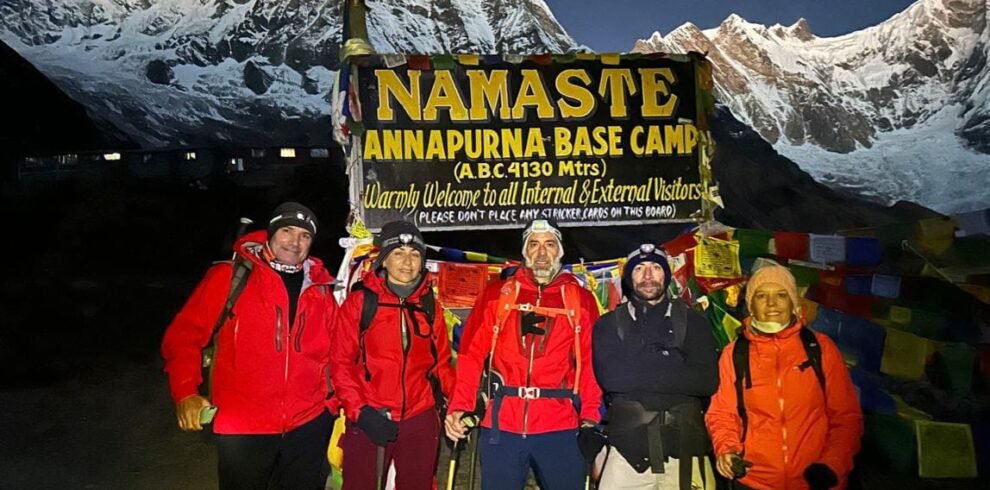
Every teahouse on the route is open in March, with no winter closures remaining by this point in the season. Crowds are noticeably lighter than April, building steadily through the month as the bloom progresses and word spreads, but still well below what the peak spring weeks bring. I rarely need advance booking for March departures outside of the very last week of the month, when the trail starts feeling more like an early April crowd level.
What to Pack for March on the ABC Trek
| Category | Item | Notes |
|---|---|---|
| Warmth | Down jacket, 700+ fill power | Essential for MBC and ABC nights |
| Warmth | Sleeping bag rated -15°C to -20°C | ABC nights reach -12°C regularly |
| Traction | Microspikes | Standard kit, not optional, for the gorge and moraine sections |
| Layers | Light layers for the lower valley | Pokhara and Tikhedhunga run warm by day |
| Layers | Heavyweight thermal base layer for altitude | For the MBC and ABC cold |
| Footwear | Waterproof, well broken in boots | Snow likely above 3,200m in early March |
| Eyes | Glacier rated sunglasses | Snow reflection risk near ABC and MBC |
| Sun protection | SPF 50+ sunscreen | Strong at altitude regardless of temperature |
Permits for the ABC Trek
Permit requirements are the same every month, the ACAP permit at NPR 3,000, about USD 22, and the TIMS Card at NPR 2,000, about USD 15. Both are arranged in Kathmandu or Pokhara, and I handle this for every guest before we leave the city so there is no paperwork to chase on the trail.
March Trek Costs: A Realistic Budget
March sits below April and October’s peak pricing, closer to the shoulder season rates seen in November. Guide rates run USD 30 to 45 per day, porter rates USD 25 to 30 per day. Accommodation runs USD 5 to 15 per room per night, meals for two trekkers USD 25 to 40 per day. Budget USD 850 to 1,200 per person for a 10 day guided March trek, all inclusive. We operate a no advance payment booking policy across both Manaslu Treks and Expedition and Next Trip Nepal, confirming your itinerary and teahouse plan before any payment changes hands.
Altitude Sickness Risk in March
The same acclimatisation principles apply as any month, the rest day built into the itinerary and the shorter days approaching the sanctuary matter regardless of how the weather looks. Cold at altitude in March can mask AMS symptoms in the same way it does in the colder months, sluggishness and poor coordination from cold overlapping with the same symptoms from altitude, so I keep a close watch on every guest through the MBC and ABC nights. Helicopter evacuation is generally available in March with reasonably stable weather, though a late winter storm system can occasionally ground flights temporarily, similar to the western disturbances that affect December and January.
March vs Other Months: How Does It Compare?
Compared to April, March is colder at altitude and has a less developed rhododendron bloom, but comes with noticeably lighter crowds and lower costs. Compared to February, March is warmer with a genuinely emerging bloom rather than the still fully wintry conditions February typically holds. Compared to October, March cannot match the reliability of clear skies, since late winter weather systems remain a real possibility, but it offers a completely different character to the trek, the anticipation of spring rather than the settled clarity of autumn. My honest take: March suits trekkers who want a genuine shoulder season experience, lighter trail traffic, lower costs, and the first signs of the bloom, and who do not mind a still properly cold sanctuary at the top.
Poon Hill in March
The Poon Hill sunrise in March benefits from generally clear late winter air, comparable in quality to good October mornings, combined with a viewpoint that is noticeably less crowded than either October or April peak weeks. Dhaulagiri and the Annapurna range at dawn in March light have a crispness that I genuinely enjoy guiding, and the approach trail through the forest, while not yet at peak bloom, often shows the first scattered blossoms by late March, a preview of what the fuller display will look like in the coming weeks.
Is ABC Worth the Trip in March?
Yes, and for a specific type of trekker in particular. If you want to avoid the peak crowds of April and October while still getting genuinely good trail conditions, reasonable views, and the first hints of spring, March delivers that combination well. If your absolute priority is the fullest possible rhododendron display or the most reliably clear mountain views of the year, April and October respectively remain the stronger choices. I guide March trekkers who specifically tell me they want something quieter and slightly different from the two headline months, and I have never had one come back disappointed with that trade off.
Can I Do the ABC Trek in March Without Prior High Altitude Experience?
Yes, March is entirely suitable for first time high altitude trekkers, provided you come with proper cold weather gear for the MBC and ABC nights and follow the acclimatisation schedule built into the itinerary. I guide a meaningful number of first timers through March specifically, and the combination of moderate crowds and a guide who can give more individual attention than during peak weeks often makes for a better learning experience than a crowded April or October departure.
How Cold Is It at Annapurna Base Camp in March?
Night temperatures at ABC in March regularly reach -12°C, with days warming to around +2°C in direct sun. This is colder than April and considerably colder than October, closer to what November delivers. A sleeping bag rated to -15°C or -20°C is what I recommend for genuinely comfortable March nights at the sanctuary.
What Is the Trail Like Between MBC and ABC in March?
This final section crosses open moraine with minimal shelter, and in March it commonly carries snow, sometimes a light dusting, sometimes a more substantial covering depending on how the winter season has gone. Wind from the west is also a regular feature here in March specifically, more so than in April or October. I always assess this section fresh each morning before committing the group to it, since conditions here can change meaningfully from one day to the next depending on overnight weather.
Is the Jhinu Danda Hot Spring Worth Visiting in March?
Genuinely yes, and perhaps more so in March than in the warmer months, since the contrast between the cold nights higher up the route and the warm spring water at Jhinu Danda feels particularly welcome after a week that included real winter conditions at the sanctuary. Entry costs around NPR 300, and I build proper time in here, usually an hour or more, on every March departure.
Why March Is Worth Choosing
I keep coming back to the same point about March, it rewards trekkers who value quiet trails and a genuine sense of a season changing over the guaranteed comfort of peak season conditions. Walking through a forest with the first rhododendrons just beginning to open, on a trail with a fraction of April’s foot traffic, then reaching a sanctuary that still carries proper winter cold and snow, gives March a character entirely its own. It is not the easiest month, and it is not the month with the fullest bloom or the clearest guaranteed skies, but for the right trekker it might be the most memorable one.
Book Your March ABC Trek
Every guest booking a March ABC trek with Next Trip Nepal starts with a stay at the Moonlight Hotel in Thamel, included in the package, and receives an NTC SIM card on arrival in Kathmandu. There is no advance payment required to hold your March date, we confirm the itinerary first. Message me directly on WhatsApp and I will help you choose the best window within March for your priorities, whether that is the earliest possible bloom or the lightest possible crowds.
Annapurna Base Camp Trek: Complete Monthly Guide
Use these month by month guides to plan your ABC trek around the exact conditions you want, or visit the Annapurna Base Camp Trek package page for the full itinerary, cost and booking details. Trek in January, February, March, April, May, June, July, August, September, October, November, or December.
Other Annapurna Region Treks Worth Considering
If a shorter trip suits your schedule better, our 6 Day Annapurna Base Camp Trek compresses the route for fitter trekkers with less time. For those who want the Poon Hill sunrise without continuing to the sanctuary, the standalone Ghorepani Poon Hill Trek is a shorter alternative. Trekkers seeking a different angle on the Annapurna range without the full ABC distance often choose the Mardi Himal Trek, and those with extra time in Pokhara can add the two day Australian Base Camp Trek.
What a Typical March Day Looks Like
Mornings start around 6am with breakfast, porridge, eggs or Tibetan bread, before setting off by 7am. Below Chhomrong, the March pace feels relaxed and warm by mid morning, similar to April. Above Deurali, I start groups slightly earlier on the days approaching MBC and ABC, since the cold and possible snow underfoot mean a slower, more careful pace than the lower sections require. Lunch is usually dal bhat at a teahouse along the route, and we aim to reach the overnight stop by mid afternoon, giving time to rest and take in the views before an early dinner and an early night ahead of the next day’s climb.
Physical Preparation for March
The fitness demands match any other month, roughly six to seven hours of daily walking with a net elevation gain of over 3,300m from Pokhara to the sanctuary. March adds the specific challenge of walking on potentially snow covered or icy ground above 3,200m, which is more physically taxing than dry trail conditions even over the same distance. I recommend guests build some familiarity with walking in cold, potentially slippery conditions before departure if possible, and practice using microspikes beforehand so the gear feels familiar rather than unfamiliar when it actually matters on the trail.
The Forest in Transition
What I find genuinely interesting about guiding March is watching the forest itself change day by day rather than encountering one static seasonal state. Early in the month, the lower forest still carries a mostly bare, late winter look, with only scattered colour. By the end of the month, entire slopes below 2,200m have shifted toward the fuller bloom that April is famous for. Guiding the same route twice in March, a week or two apart, genuinely shows two different versions of the same trail, which is not something October or a static winter month like December offers in the same way.
Group Size for March Departures
March departures typically run smaller than our peak April and October groups, often six to eight trekkers, reflecting the lower overall demand for this shoulder month. This smaller group size often means more individual attention from guides, particularly useful for the cold, potentially snow affected sections above Deurali where careful pacing matters. Solo travellers are placed into a scheduled departure to meet the ACAP guide requirement and share the experience with fellow trekkers.
What Past March Trekkers Tell Me
Guests who trek in March consistently mention two things afterward, how quiet the trail felt compared to what they expected from online research focused on October and April, and how genuinely satisfying it was to reach a sanctuary that still felt properly wild and wintry rather than the more settled, crowded version other months deliver. Several repeat guests who have since returned in April specifically told me they preferred the March atmosphere, even with the colder nights and less developed bloom, simply because of how much more personal the experience felt with fewer other trekkers sharing the same teahouses and viewpoints.
Flight and Road Logistics in March
Reaching the ABC trailhead follows the same pattern as any month, Nayapul is a short drive from Pokhara, and the Kathmandu to Pokhara connection, whether the 25 minute flight or the 6 to 7 hour road journey, runs reliably in March’s generally stable weather. Occasional late winter weather systems can very rarely affect flights, similar to the western disturbances that influence December and January, though this is a less frequent concern in March than in the depths of winter.
Should I book my March trek far in advance?
Not as urgently as April or October, given the lower demand this month, though I still recommend three to four weeks ahead for comfortable planning and to give me time to properly brief you on current snow conditions above Deurali.
Is travel insurance required for the March trek?
Yes, we require it for every guest regardless of season, covering trekking up to at least 4,500m and helicopter evacuation.
Food and Hydration in March
The teahouse menu remains consistent year round, dal bhat, noodles, pasta, soups, eggs and pancakes, though the lower elevation teahouses in March generally have better fresh vegetable availability than the depths of winter, as supply chains from Pokhara begin normalising with the approaching spring season. At altitude, hot drinks, ginger tea and garlic soup remain a genuinely useful part of staying warm through the cold MBC and ABC evenings, and I make sure my groups have a hot drink at every stop rather than relying purely on cold water. Water purification remains essential throughout, and boiled water is available at every teahouse for a small charge, which works especially well at altitude where purification tablets can act more slowly in near freezing water.
Mobile Signal and Charging in March
NTC mobile coverage reaches most of the route including the sanctuary in clear conditions, and every guest receives an NTC SIM card on arrival in Kathmandu. Charging is available at every teahouse for a fee, typically NPR 200 to 500 per device. March’s lighter crowds mean less competition for charging outlets at the busier stops compared to what April or October delivers, though I still recommend a power bank as backup for the higher elevation nights.
Wildlife in March
March sees increasing wildlife activity as temperatures rise from the winter lows, though not yet at April’s fuller level. Himalayan langur monkeys become more visible in the forest sections as the month progresses, and birdlife picks up noticeably in the second half of March as the first blooms begin attracting more activity in the canopy. This is one more reason I favour late March departures for guests who want a fuller natural experience alongside the trek itself, without waiting for April’s full display and larger crowds.
The View From Chhomrong in March
Chhomrong at 2,170m looks directly up toward Annapurna South and Hiunchuli, and March’s generally clear late winter air gives this view a sharpness comparable to good October conditions. I like to schedule a proper rest here on March departures, since the village has a genuine mountain character with terraced fields and stone houses, and this stop marks the last section of gentler, warmer trekking before the colder gorge and sanctuary sections begin above.
Tipping and Budgeting Extras for March
Beyond the core trek cost, guests should budget for tipping, drinks, snacks and charging fees. Tipping is customary though not mandatory, a general guideline is USD 8 to 12 per day for a guide and USD 5 to 8 per day for a porter, typically pooled and shared at the end of the trek. I recommend withdrawing sufficient Nepali rupees in Pokhara before departure, since there are no ATMs once you leave the city.
What is the elevation gain on the March ABC trek?
Roughly 3,300m net gain from Pokhara at 827m to Annapurna Base Camp at 4,130m, spread across the ascent days with acclimatisation stops built into the standard itinerary.
Can I combine a March ABC trek with other Nepal travel?
Yes, March has pleasant weather throughout much of Nepal, and many guests combine the ABC trek with time in Chitwan National Park or Kathmandu Valley sightseeing, both of which have comfortable conditions this month.
Clothing Layers for March’s Temperature Range
March’s temperature swing, from warm lower valley days to genuinely cold nights at MBC and ABC, means the same three tier layering approach I recommend for April applies here, arguably even more strictly given the colder sanctuary nights. A light, breathable set for the lower valley days, a mid weight layer for the forest sections between 2,000m and 3,000m, and a full down and heavyweight thermal system reserved specifically for the two coldest nights of the trip. I have seen guests underpack for March specifically because they researched April’s milder conditions and assumed March would be similar, when in fact the sanctuary nights this month are considerably colder and deserve their own dedicated preparation.
A Note on Solo and Family Trekkers in March
March’s quieter trail makes it a genuinely good choice for both solo trekkers and families. Solo travellers benefit from more personal interaction with guides and teahouse owners given the lighter overall traffic, while families with older children find the reduced crowding makes managing a group easier, less congestion at narrow trail sections and shorter waits at teahouse dining rooms. I do adjust pacing more conservatively for family groups given the cold sanctuary nights specifically, sometimes extending the itinerary by a day to allow more buffer around the coldest, potentially snow affected sections.
Renting Gear for March in Kathmandu and Pokhara
If you do not own a -15°C or -20°C sleeping bag, both Kathmandu’s Thamel district and Pokhara’s Lakeside area have reliable rental shops carrying genuine cold rated gear. A proper winter bag rents for roughly USD 1 to 2 per day, and I check the actual gear personally during our pre trek briefing rather than trusting a rental shop’s label alone. Renting locally also saves the hassle of transporting bulky winter gear through international luggage restrictions.
What should I do with valuables and my passport during the trek?
I recommend leaving passports and anything not needed on the trail in the hotel safe in Kathmandu or Pokhara, carrying only a photocopy plus your trekking permits, reducing what you need to manage at altitude.
Is there an age limit for the March ABC trek?
No strict limit, though I assess genuine fitness and cold tolerance more carefully for March given the sanctuary’s colder nights compared to April. I have guided both children over ten and trekkers in their seventies through March successfully with appropriate pacing.
My Closing Thought on March
Of all the months I guide on this route, March is the one that feels most like a genuine secret among trekkers who know the region well. It does not have October’s guaranteed clarity or April’s full bloom, and I will not pretend otherwise. What it has instead is a trail that still feels like it belongs mostly to the mountains rather than to other trekkers, and a sanctuary that meets you with real winter cold rather than a settled, comfortable version of itself. If that combination appeals to you more than the guaranteed comfort of the two headline months, March is worth serious consideration, and I say that as someone who has walked this exact route in every month it offers.
Does March have any risk of leftover winter storms affecting the trek?
Occasionally, particularly in the first half of the month, a late season storm system can bring snow to the higher elevations, similar to the western disturbances that affect December and January but generally less frequent and less severe by March. I monitor conditions closely and build appropriate buffer time into early March itineraries specifically.
What is the single biggest mistake March trekkers make?
Underpacking for the sanctuary cold after reading about April’s milder conditions. March nights at ABC run considerably colder than April, and I always brief guests on this specific difference before they finalise their packing list.
Is the trail muddy in March?
No, below Deurali the trail is dry and firm, similar to April and October. Above 3,200m, the concern is snow and ice rather than mud, which remains a monsoon season issue from June onward rather than a March one.
Can I do a shorter version of the ABC trek in March?
Yes, a 7 day version is possible for fitter trekkers with less time, combining some walking days and removing one acclimatisation stop. I still recommend the full itinerary for most guests, particularly in March given the added consideration of cold and possible snow near the sanctuary.
What is different about guiding March compared to other shoulder months?
Unlike November, which trends colder and quieter as the month progresses toward winter, March trends warmer and busier as it progresses toward spring. This means the character of a March trek depends heavily on which week within the month you choose, more than almost any other month on the route.
Do prices change much across March itself?
Slightly, with early March generally offering the lowest rates given the lightest demand, while late March rates begin approaching early April levels as crowds and bookings increase toward the peak spring season.
Is helicopter rescue reliable in March if needed?
Generally yes, given March’s mostly stable weather, though a late winter storm can occasionally cause short delays, similar to what December and January experience more frequently.
Frequently Asked Questions
Is March a good month for the ABC trek?
Yes, particularly for trekkers who want lighter crowds than April or October along with the first signs of the rhododendron bloom. It is colder at altitude than either of those months, so proper cold weather gear remains essential.
When do rhododendrons start blooming in March?
The earliest blooms typically appear from around 1,800m in the first half of March, with a growing display visible by mid month and building toward late March as the season progresses.
Is there snow on the ABC trail in March?
Possible above 3,200m, particularly in early March. The MBC to ABC moraine section is the most likely to carry snow, and I carry microspikes as standard kit for every March departure.
How does March compare to April for crowds?
March is noticeably quieter than April, with crowds building steadily through the month rather than starting at April’s already busy baseline. The last week of March begins approaching early April crowd levels.
Do I need a guide for the ABC trek in March?
Yes, current ACAP regulations require a licensed guide regardless of season or trekking experience, enforced at the permit checkpoints along the route.
What is the best week within March to trek?
Late March gives the fullest early bloom and the mildest conditions within the month, while still remaining quieter than April. Early March suits trekkers who specifically want minimal crowds and do not mind the bloom being at its very earliest stage.
Is March colder than October at Annapurna Base Camp?
Yes, noticeably. March nights at ABC average around -12°C compared to October’s -5°C, closer to what November typically delivers.
Can beginners handle the March cold at altitude?
Yes, with proper gear, a sleeping bag rated to -15°C or colder and a full layering system for the MBC and ABC nights specifically. The cold is manageable but should not be underestimated relative to April’s milder nights.
I am Kiran Basnet, founder of Next Trip Nepal and a licensed guide based in Kathmandu. March holds a specific place for me among the months I guide, the quiet anticipation of a season about to turn, with the mountains still wearing their winter coat. Message me directly on WhatsApp and I will help you plan the right March window for what you are looking for.
Plan your trip on the Annapurna Base Camp Trek package page, or compare conditions with our guides to ABC in April, ABC in October, and ABC in November. See also our complete Annapurna Base Camp Trek guide and costly mistakes to avoid before booking.