Annapurna Base Camp Trek in February: Tour at a Glance
| Best for | Experienced trekkers, photographers, solitude seekers |
| Season rating | Challenging with exceptional visibility (late winter) |
| Trail crowds | Very low to low (5 to 10% of October peak) |
| Snow on trail | Likely above Himalaya village, certain above Deurali |
| Temperature at ABC | Night: -12 to -18°C / Day: -4 to 2°C |
| Teahouses open | Open through Deurali; MBC and ABC variable but improving |
| Standard duration | 10 to 12 days from Pokhara |
| Permit cost | ACAP: NPR 3,000 + TIMS: NPR 2,000 (foreign trekkers) |
| Budget per day | USD 30 to 50 on the trail |
| Highlight | Crystal-clear skies and snow-capped peaks with almost no crowds |
February on the Annapurna Trail: The Hidden Window
February is the last full month of Nepal’s winter trekking season before the pre-monsoon warmth begins to build in March. For the Annapurna Base Camp trek, February occupies an interesting position: it shares the cold, quiet, and snow-covered upper sections of January, while beginning to show the first signs of the transition toward spring. By the final week of February at lower elevations, the earliest rhododendron buds are appearing. At Ghorepani, some trees may be flowering by late month. At Chhomrong and below, the valley begins to smell of wood smoke and new growth rather than pure winter cold.
Above 3,000 metres, however, February remains fully winter. The Annapurna Sanctuary above Deurali carries substantial snow throughout February and the overnight temperatures at Annapurna Base Camp remain well below zero. What February offers that January does not is a slight statistical improvement in weather stability: the deep midwinter pressure systems that bring multi-day snowfall events to the sanctuary tend to peak in December and January, and by February the windows of clear weather are marginally longer and more predictable.
For trekkers who want the winter experience of ABC, including the snow-covered sanctuary, the empty trail, the extraordinary clarity of cold-season mountain views, and the freedom from the crowded October and November trail, but who want slightly better odds on weather than January’s deepest winter, February is the strongest case in the winter season.
The complete guide to the Annapurna Base Camp Trek covers the route in full detail across all seasons, including the permit process, costs, and itinerary options.
February Weather at Annapurna Base Camp
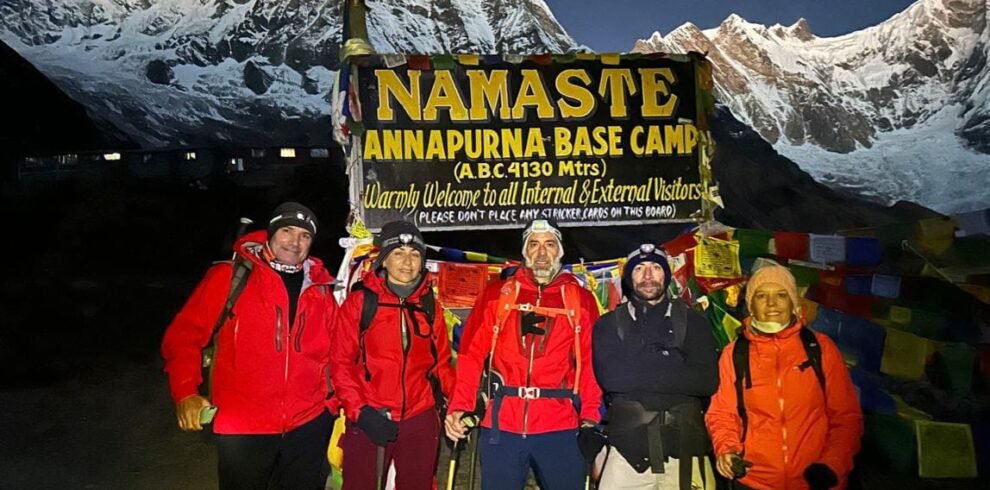
February temperatures are marginally warmer than January at most elevations on the route, but the difference is modest and should not lead trekkers to significantly downgrade their gear preparation. The upper sanctuary remains a cold, serious environment throughout February.
| Location | Altitude | Day Temp (°C) | Night Temp (°C) | Precipitation |
|---|---|---|---|---|
| Pokhara | 822m | 18 to 23 | 7 to 11 | Very low |
| Tikhedhunga | 1,540m | 14 to 19 | 4 to 8 | Low |
| Ghorepani | 2,860m | 5 to 10 | -3 to 1 | Light snow possible |
| Chhomrong | 2,170m | 10 to 16 | 2 to 6 | Low |
| Deurali | 3,230m | 0 to 6 | -7 to -3 | Snow likely |
| Machhapuchhre Base Camp | 3,700m | -3 to 4 | -10 to -6 | Snow likely |
| Annapurna Base Camp | 4,130m | -6 to 2 | -18 to -10 | Snow likely |
The February sky above the Annapurna region deserves specific mention. After the cloud-heavy monsoon season and the hazy transition months of September and early October, and through the reliably clear but extreme cold of January, February days with clear skies offer arguably the best photographic light of the year for the high peaks. The low winter sun angle creates long shadows and warm-toned light across the snow-covered faces of Annapurna I, Annapurna South, and Machhapuchhre. Many of the most striking photographs of the Annapurna Sanctuary that appear in trekking publications and travel media are taken in winter, frequently in February.
Wind is a notable factor in February, particularly above 3,500 metres. The transition from the deep winter pressure pattern toward the pre-monsoon pattern can produce periods of stronger winds in February, particularly in the exposed sections between MBC and ABC and on the approach to the sanctuary gorge. Wind at altitude with below-zero temperatures requires proper face and hand protection. Buff covering the face and waterproof outer gloves are not optional above Deurali in February.
February Trail Conditions
Trail conditions in February follow the same altitude-dependent pattern as January but with gradually improving lower-section conditions as the month progresses. By mid to late February, the trail below 2,500 metres is often entirely clear of ice and frost, and the lower villages feel noticeably warmer than in January.
Below Chhomrong (2,170m): dry and walkable throughout February. The rhododendron forest between Ghorepani and Tadapani begins to show the first buds in late February, and the lower approach trails carry the first signs of spring growth. Normal trekking gear with good waterproof boots is adequate for this section.
Chhomrong to Himalaya village (2,920m): conditions vary with recent weather. After a snowfall, sections of the gorge trail in shade can be icy, particularly the stone steps between Sinuwa and Bamboo and the sections approaching Himalaya. Trekking poles are recommended. Morning frost on stone can be a slip hazard until the sun reaches the gorge, which happens late on north-facing sections.
Himalaya to Deurali (3,230m): ice and snow increasingly certain as altitude rises. By Himalaya village and above, trekkers should expect to encounter snow on the trail after any precipitation event. Microspikes or lightweight crampons should be deployed from here. The section approaching Deurali from below passes through exposed terrain with slopes above the trail. In stable weather this is fine. After fresh heavy snowfall, the slopes above carry avalanche risk and this section should be traversed in the early morning before solar heating destabilises surface snow.
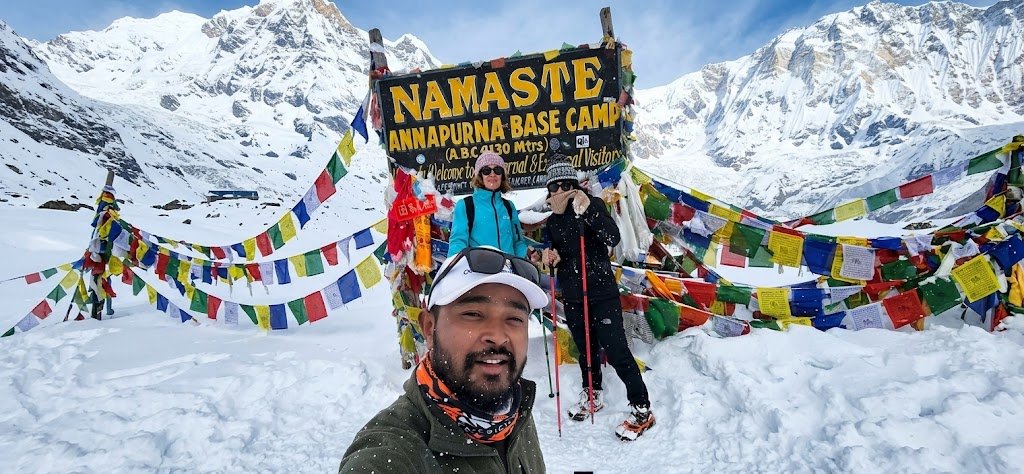
Deurali to MBC to ABC: full winter conditions persist through all of February. The Annapurna Sanctuary above Deurali carries significant accumulated snow throughout the month. By late February, some consolidation of the snowpack has occurred and the trail through the gorge is somewhat more packed and followable than in January’s fresh-snow conditions, but this is a general tendency rather than a guarantee. Individual snowfall events can rebury the trail at any point in February. Your guide’s knowledge of current conditions and the timing of your approach through the gorge remain critical.
One February-specific consideration: the afternoon sun angle in February is higher than in January and solar warming of snow-covered slopes increases. This means avalanche risk windows in the afternoon become more relevant in February than in January. Guides typically schedule the approach through the sanctuary gorge for early morning departures and aim to be through the most exposed sections before noon.
Day by Day Itinerary: Annapurna Base Camp Trek in February
The 10 to 12 day itinerary structure used for January ABC applies equally to February. The itinerary below uses 11 days from Pokhara, which is a comfortable pace that provides one buffer day for weather flexibility without being unnecessarily extended.
Day 1: Pokhara to Tikhedhunga (1,540m)
Drive from Pokhara to Nayapul and begin the walk into the Modi Khola valley. February days at this altitude are noticeably mild compared to January, with daytime temperatures in the mid-teens. The first views of Annapurna South above the southern ridge come into view from the trail above Birethanti. Distance: 14 km. Walking time: 4 to 5 hours.
Day 2: Tikhedhunga to Ghorepani (2,860m)
The stone staircase climb from Tikhedhunga through Ulleri and into the rhododendron forest above. By late February, the first of the rhododendron trees at lower elevations are beginning to show colour. The forest walk above Ulleri is one of the highlights of the Ghorepani approach and in February it has the quality of a forest emerging from dormancy. Ghorepani may have light snow and below-zero nights but is manageable. Distance: 12 km. Walking time: 5 to 7 hours.
Day 3: Poon Hill sunrise (3,210m) then Ghorepani to Tadapani (2,630m)
The Poon Hill sunrise hike in February delivers one of the most photogenic mornings of the trekking year. With the sun rising behind Dhaulagiri and illuminating the full sweep of Annapurna I, Annapurna South, Hiunchuli, and Machhapuchhre, the panorama from Poon Hill on a clear February morning is what makes this viewpoint one of the most visited in Nepal. Snow on the ridge above Ghorepani makes the 45-minute pre-dawn climb to Poon Hill slippery: use poles and go carefully. Continue to Tadapani through the rhododendron forest. Distance: 10 km. Walking time: 5 to 6 hours.
Day 4: Tadapani to Chhomrong (2,170m)
Descend through forest to the Kimrong Khola and climb the long stone staircase to Chhomrong. From Chhomrong, the full wall of Annapurna South and Hiunchuli fills the view above the gorge entrance. This is where the sanctuary character of the trek begins. Your guide should check on current conditions above Chhomrong before you commit to the upper itinerary. Distance: 10 km. Walking time: 4 to 5 hours.
Day 5: Chhomrong to Bamboo (2,310m)
Descent into the Modi Khola gorge and through forest to Sinuwa and Bamboo. The gorge trail in February is cold in the shade and mild in the sun, often varying dramatically within the same hour as you move between shaded and exposed sections. The river is full and audible throughout the gorge walk. Distance: 9 km. Walking time: 4 to 5 hours.
Day 6: Bamboo to Deurali (3,230m)
Through Dovan and Himalaya village, the trail climbs alongside the river through increasingly dramatic gorge walls. By Himalaya, snow is on the ground and the walls of Hiunchuli and Annapurna South are close enough to feel imposing. Deurali marks the threshold of the sanctuary. Overnight here is cold but the teahouse is warm and the anticipation of the next day’s push to ABC is palpable. Distance: 9 km. Walking time: 4 to 5 hours.
Day 7: Deurali to MBC (3,700m) to Annapurna Base Camp (4,130m)
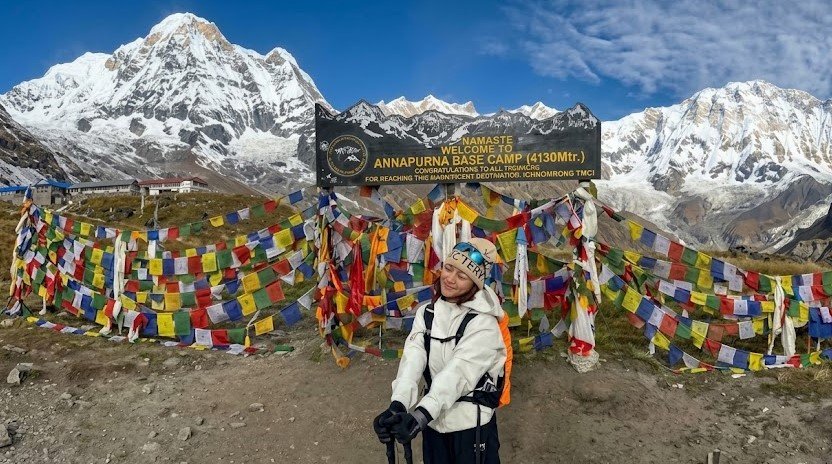
The sanctuary day. Early morning departure from Deurali while the snow is frozen and firm underfoot. The gorge walls above are vertical and the trail follows the river through the narrow entrance. MBC is reached in approximately 2 hours and the view of Machhapuchhre’s south face from here is one of the iconic images of the Annapurna region. The final push to ABC takes another 1.5 to 2 hours across snow-covered moraine. At ABC, the amphitheatre opens completely and Annapurna I’s south face fills the horizon directly ahead. In February, this space is very likely to be shared with only a handful of other trekkers, if any. Distance: 8 km. Walking time: 5 to 7 hours.
Day 8: ABC sunrise then descend to Bamboo (2,310m)
Stay at ABC for sunrise. The first light in February reaches the peaks by approximately 6:30am and the thirty minutes before and after sunrise produce extraordinary light across the cirque. After breakfast, the descent to Bamboo is a long day made easier by the familiar trail and the knowledge that altitude is dropping with every step. Distance: 17 km. Walking time: 6 to 8 hours.
Day 9: Bamboo to Chhomrong (2,170m)
The long climb back from the gorge to Chhomrong. This is the tiring day of the descent. The stone steps from Sinuwa to Chhomrong gain 630 metres and feel long after days at altitude. The teahouse at Chhomrong at the end of this day is one of the most appreciated meals of the trek. Distance: 9 km. Walking time: 4 to 5 hours.
Day 10: Chhomrong to Ghandruk (1,940m) then drive to Pokhara
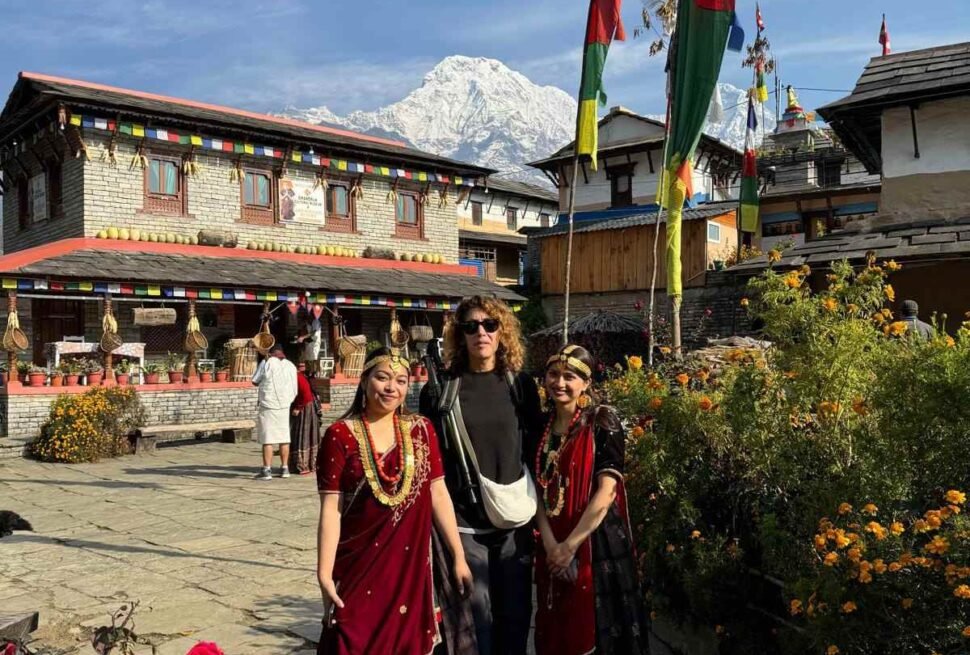
On a 10-day itinerary, this is the final walking day. Descend from Chhomrong via the trail to Ghandruk, one of the most attractive Gurung villages in the Annapurna foothills, with stone houses, mountain views, and a cultural museum documenting the Gurung way of life. From Ghandruk, drive to Pokhara. Distance: 10 km walking + 2 hour drive. Walking time: 3 to 4 hours.
Day 11: Buffer or departure day in Pokhara
A buffer day allows for any weather delays at Deurali or the sanctuary that shifted the itinerary by a day. February weather is more stable than January on average, but the buffer is still useful if you have a fixed onward flight from Kathmandu.
Teahouses and Services in February
February marks a gradual recovery in teahouse services compared to the deepest winter weeks of December and January. Lodge owners who reduced services or briefly closed in January begin returning to more complete operations as February trekker numbers, while still low, begin to tick upward toward the pre-spring season.
Below Chhomrong: fully operational. All lodges are open with complete menus, hot showers, and normal services. The lower section of the route sees consistent traffic year-round and winter has minimal impact on services here.
Chhomrong to Deurali: generally open and improving through February. Bamboo, Dovan, Himalaya, and Deurali lodges are typically running in February. Menu options may still be slightly reduced compared to peak season, and hot water is limited above Himalaya village. The lodges keep their common rooms heated with wood fires and trekkers gather here in the evenings. The social atmosphere in a February teahouse, with a small group of trekkers sharing a fire and talking through the day, is something that October trekkers never experience in the crowded peak season.
MBC and ABC: improving through February. By mid to late February, both MBC and ABC lodges are typically operational with reasonable services. Earlier in February, the situation is similar to January with some uncertainty. Your guide should confirm current lodge status at MBC and ABC before you commit to the upper itinerary from Deurali. As with January, a fallback plan of spending the night at MBC if ABC is closed is the sensible contingency.
February Packing List: Winter Gear Still Required
February packing requirements are essentially identical to January. The marginal warming at lower elevations does not reduce the cold weather gear requirement for the sanctuary section. Trekkers who pack lighter gear for February ABC based on the assumption that it is “almost spring” consistently encounter problems above Deurali.
Essential winter additions for February: microspikes or lightweight crampons for the trail above Himalaya village and essential from Deurali upward, a sleeping bag rated to minus 15 degrees Celsius comfort for MBC and ABC nights, a down jacket rated to minus 10 degrees Celsius or warmer, balaclava and face protection for the exposed sanctuary sections, waterproof outer gloves over liner gloves, gaiters for snow sections, and fully waterproofed Gore-Tex or equivalent boots.
One February-specific addition: sunscreen becomes more important in February than in January. The higher sun angle in February combined with snow reflection at altitude produces significant UV exposure during the midday approach to ABC. Apply SPF 50 or above to all exposed skin including the underside of the chin, which catches reflected UV from snow. The combination of altitude UV and snow reflection causes sunburn faster than most trekkers expect.
Layering remains the system at all altitudes. The temperature swing from Chhomrong (which can feel almost warm on a sunny February afternoon) to the sanctuary above MBC (where it can be minus 15 degrees Celsius with wind) in a single day requires the ability to add and remove layers efficiently throughout the walking day.
Permits, Costs and Practical Information
Permits for the February ABC trek are identical to all other months. The Annapurna Conservation Area Permit (ACAP) costs NPR 3,000 for foreign nationals and the TIMS card costs NPR 2,000 when trekking with a registered agency. Both are obtained in Kathmandu or Pokhara before the trek. The ACAP permit is required for any trekking in the Annapurna Conservation Area and is checked at the Nayapul checkpoint and at multiple stations along the route.
February trail costs run slightly below the October and November peak season rates. Lodge accommodation in February typically costs NPR 500 to 800 per person per night in dorm or private rooms on the lower sections, with meals costing NPR 300 to 800 per dish depending on altitude. Budget USD 30 to 45 per day for all trail expenses including accommodation, meals, and hot drinks. A complete guided ABC trek in February including guide, porter, permits, and trail expenses costs USD 700 to 1,100 per person depending on group size and operator.
The Pokhara to Nayapul transfer is either by tourist bus (1.5 to 2 hours, low cost) or private vehicle (1 to 1.5 hours, moderate cost). In February, road conditions are good and there are no weather-related transport disruptions at this stage of the journey. Transport to and from Kathmandu is via domestic flight (30 to 35 minutes) or tourist bus (6 to 8 hours). Domestic flights in February are generally reliable with low disruption rates due to stable winter weather at Kathmandu.
Altitude and Health Considerations for February
The Annapurna Base Camp altitude of 4,130 metres requires appropriate acclimatisation pacing regardless of the month. February’s standard 10 to 12 day itinerary provides adequate time for most trekkers to acclimatise without additional rest days, assuming they are in reasonable cardiovascular health and have no prior history of altitude sickness at this elevation range.
Key signs that the acclimatisation is not keeping pace with the itinerary: persistent headache that does not resolve with two ibuprofen tablets and a night’s sleep, vomiting, significant loss of coordination, or any respiratory symptoms including shortness of breath at rest. Any of these signs at altitude should trigger a descent to a lower elevation rather than a wait-and-see approach. The Himalayan Rescue Association post at Pheriche (4,280m), while above the point where most February trekkers are on the ABC route, has volunteer physicians during the trekking season who can assess altitude illness if needed.
Cold weather dehydration in February operates the same way as in January: the thirst sensation is suppressed by cold, but moisture loss through breathing at altitude is continuous. Three litres of fluid per day above 3,000 metres is the minimum. Hot lemon tea and hot black tea, both widely available at all teahouses, count toward this total and also help maintain core temperature in cold conditions.
Frequently Asked Questions: February ABC Trek
Is February a good month for the Annapurna Base Camp trek?
February is a good month for experienced trekkers who want winter conditions without the absolute peak cold of January. The trade-offs are real: the trail above Deurali carries significant snow, temperatures at ABC are still well below zero overnight, and some teahouses at MBC and ABC may have limited services. The compensations are significant: very low crowds, exceptional visibility, dramatic winter photography conditions, and the unique experience of the Annapurna Sanctuary in full winter snow. For a first-time Nepal trekker with limited cold weather experience, the October or November seasons are more appropriate. For an experienced trekker who has researched the conditions and packed properly, February is rewarding.
How does February compare to March for the ABC trek?
March is significantly more popular and comfortable than February for the ABC trek. By March, the rhododendrons are in full bloom at mid-elevations, trail conditions above Deurali are more settled, MBC and ABC teahouses are fully operational, and temperatures throughout the route are warmer. March is part of the spring trekking season rather than the winter season. If your choice is between February and March and you do not have a specific reason to prefer winter conditions, March is the easier and more comfortable option. If you specifically want the winter ABC experience including snow, solitude, and the visual drama of a fully snow-covered sanctuary, February is the month to choose.
Do I need crampons for February?
Microspikes or lightweight crampons are recommended from Himalaya village (2,920m) upward and are essential from Deurali to ABC. Full mountaineering crampons are not required. Lightweight microspikes that strap onto trail boots are adequate for the icy stone and packed snow conditions on the standard ABC route in February. They weigh under 300 grams and should be in your day pack from Dovan onward so you can deploy them immediately when the trail surface becomes icy.
Are there any festivals or cultural events in February that affect the trek?
Maha Shivaratri, one of Nepal’s most important Hindu festivals, typically falls in late February or early March. The festival is celebrated at the Pashupatinath Temple in Kathmandu with large gatherings, but it does not directly affect the Annapurna trekking route. Some teahouses may have reduced staff for a day or two if local employees travel to celebrate, but this is minor and rarely affects trek logistics. Losar, the Tibetan and Sherpa New Year, also falls in February in some years. In villages with significant Gurung and Tibetan Buddhist populations along the ABC route, including Ghandruk and some upper teahouses, you may encounter small local celebrations which add to the cultural experience of the trek.
What is the sunrise like at ABC in February?
ABC sunrise in February is one of the outstanding experiences on the Annapurna route. The sun rises from behind the Himalayan ridgeline to the east and its first light strikes Annapurna I’s south face at approximately 6:15 to 6:30am in February. The sequence unfolds from the highest peaks down: Annapurna I catches the first golden light while the sanctuary floor is still in blue shadow, and over 15 to 20 minutes the light gradually fills the cirque from above. The contrast between the warm orange gold of the sunlit peaks and the deep blue shadow of the snow-covered valley floor produces a visual effect that experienced Himalayan trekkers consistently describe as among the most powerful they have encountered. Winter conditions with deep snow on all surfaces intensify this effect compared to the partially snow-free conditions of autumn.
Why February Is Worth Considering
The honest answer about February is this: it is not the easiest or most convenient month for the Annapurna Base Camp trek. The conditions require preparation, appropriate gear, a licensed guide with winter experience, and a willingness to adapt the itinerary to weather. What it offers in return is an experience of the Annapurna Sanctuary that is qualitatively different from anything available in the crowded October season.
The ABC cirque in February, with every peak carrying full winter snow, the trail unmarked by hundreds of daily trekkers, the teahouse fire at Deurali the only warmth for kilometres in any direction, and the morning light on Annapurna I catching the first colour of a clear winter day, is a singular experience. The trekkers who do February ABC and return in October consistently describe the two experiences as almost incomparably different, each with its own character, both worth doing.
If you are deciding between months for your first ABC trek, October or November remain the practical recommendations. If this is not your first time in the Annapurna region, or if you have winter trekking experience elsewhere and are drawn to the conditions described above, February deserves serious consideration.
Plan Your February ABC Trek
Next Trip Nepal runs guided ABC treks in February with guides who know the winter sanctuary trail. We check lodge availability and current trail conditions before departure and build flexibility into February itineraries to handle weather windows. Get in touch to start planning your February ABC trek.
WhatsApp Us Email UsAnnapurna Base Camp Trek: Complete Monthly Guide
Use these month-by-month guides to plan your ABC trek, or visit the Annapurna Base Camp Trek overview page for full itinerary, costs and booking details.
Trek in: January | February | March | April | May | June | July | August | September | October | November | December