Ask most travel sites when to book a mountain flight in Nepal and you get the same four words: October to April. That answer is not wrong, but it is thin, and it skips almost everything a traveler actually needs to plan around. It does not explain why a 6:15am departure in November behaves so differently from a 9am flight in March. It does not say anything useful about June, July, August, or September, months when a huge number of people are actually in Kathmandu and still want to see Everest from the air. And it says nothing about how Nepal’s aviation regulator has tightened monsoon operating rules in a way that directly affects how these flights get scheduled right now, in 2026.
This guide is written from the operator’s side of that question. We run the Everest Scenic Flight for travelers through Next Trip Nepal, based in Kathmandu, and we watch the weather, the cancellations, and the rebookings every week of the year, not just in the photogenic months. What follows is a month by month, time of day breakdown of when a mountain flight by ATR plane actually delivers a clear view of Everest and its neighbors, why mornings matter far more than most guides admit, how the 2026 monsoon safety rules change what you should expect between June and September, and how to build a Kathmandu itinerary that does not fall apart if your first scheduled morning gets clouded out.
Why Morning Timing Matters More Than the Season
Before getting into months, it helps to understand the single biggest variable in whether a mountain flight by ATR plane gives you a clean, close view of the Himalaya: the time of day. Season decides your odds over a stretch of days. Time of day decides your odds on any single morning, and it decides them by a wide margin.
Mountain flights out of Kathmandu’s Tribhuvan International Airport are early morning flights by design, not by convention. Pickup from your hotel is typically around 5:30am, with takeoff usually falling somewhere between 6:15 and 7:00am, shifting by roughly 30 to 45 minutes depending on the season and the exact time of sunrise. In December, when sunrise comes later, departures slide a bit later. In April and May, when the sun is up earlier, airlines can push the first wave of flights earlier too. None of this is arbitrary. It is built entirely around a weather pattern that repeats itself almost every day of the year in the hills and mountains of Nepal.
Convective Cloud Building and Why It Ends Your Window
Overnight, the air over the mountains and the middle hills cools and settles. There is very little moisture lifting off the ground, humidity drops, and the atmosphere near the peaks is about as calm and transparent as it gets. This is the window every mountain flight by ATR plane is scheduled into. As the sun climbs, though, solar heating starts warming the valleys, river basins, and lower slopes. Warm air starts to rise. Where that rising air carries enough moisture, it condenses into cumulus cloud, and through the late morning those small puffs build, thicken, and start climbing the flanks of the hills. This process is called convective cloud building, and it is the single most reliable weather pattern in the Nepal Himalaya. It happens on sunny days, cloudy days, dry season days, and even many monsoon days. The only real variable is how early it starts and how aggressively it builds, which depends on ground moisture, humidity, and the season.
In practice, this means visibility along the Everest corridor is usually at its best in the hour or so after sunrise, stays workable through the mid morning, and then degrades, sometimes quickly, as the day goes on. By late morning on many days, especially in the warmer, wetter months, cloud has already crept up to obscure the lower ridgelines even if the summit zone of Everest, Lhotse, and Makalu stays visible above it. By early afternoon, on a meaningful share of days, the lower and middle mountains are socked in. This is also one of the big reasons mountain flights are never scheduled for the afternoon. It is not a scheduling convenience. It is a direct response to how Himalayan weather behaves on a daily cycle.
Why the Exact Takeoff Time Shifts by Season
Airlines adjust departure windows through the year to chase the best light and the clearest air relative to sunrise, not to a fixed clock time. In the cold season, mornings in Kathmandu can carry ground fog or a low haze layer that needs to burn off before flights can depart safely, which occasionally pushes the first wave of departures later than planned. In the warmer months, convective buildup starts earlier in the day, so airlines compress the morning schedule and try to get as many flights up and back as early as possible before the cloud climbs. If you book a mountain flight by ATR plane for sometime between 6:15 and 7:00am, understand that both ends of that window exist for a reason tied to actual atmospheric behavior that morning, not administrative convenience.
Autumn, October and November: The Benchmark Season
If someone forces us to name one period that most reliably delivers a clean mountain flight by ATR plane, it is October and November. This is the window right after the summer monsoon pulls out of Nepal, and it tends to leave behind a stable mass of high pressure sitting over the region. Under that high pressure, humidity drops sharply, the usual afternoon cloud buildup is weaker and later to form, and mornings are often close to perfectly clear from the runway all the way to the horizon line of peaks.
October in particular earns its reputation. Early October can still carry some lingering moisture from a slow retreating monsoon, so the first week or so is occasionally inconsistent, but by mid October the air mass has usually settled and stays settled through the rest of the month. November tends to be even more consistent day to day, with cold, dry, stable mornings that regularly deliver textbook visibility: sharp outlines on Everest, Lhotse, Nuptse, Makalu, and the long wall of peaks along the flight path, with almost no haze softening the distant ridgelines. If you only care about maximizing your odds and have flexibility in your travel dates, book your Kathmandu stay inside this window. This is also the busiest period for trekking and tourism generally in Nepal, so flights fill up, and booking slots can tighten during the Dashain and Tihar festival period specifically, which usually falls within this stretch. That is worth planning around on the hotel and flight side even if it does not change the weather logic at all.
It is worth being honest that even inside this best case season, not every single morning is perfect. A passing weather system can still roll through for a day or two, and ground fog in Kathmandu can occasionally delay an early departure by an hour. But judged across the whole season, autumn is the most dependable period of the year for a mountain flight Nepal travelers can count on seeing clearly, and it is the season we recommend first to anyone asking us when to schedule the Everest Scenic Flight if their dates are flexible at all.
Winter, December Through February: Cold, Clear, and Occasionally Foggy at the Start
Winter gets undersold in a lot of generic travel content, and that is a mistake. Cold, dry continental air sitting over Nepal in December, January, and February often produces mornings with almost no haze at all, sometimes even clearer in the far distance than autumn, because there is so little moisture in the air to scatter light near the horizon. On a good winter morning, the visibility toward the eastern Himalaya can be extraordinary, with peaks far beyond Everest itself resolving sharply against a deep blue sky.
The catch with winter is at the start of the day, not in the sky over the mountains. Kathmandu Valley is prone to temperature inversions on cold winter nights, where cool, dense air settles into the valley floor and traps a layer of fog or haze close to the ground until the sun has had time to warm it away. On a handful of mornings each winter, usually the coldest and calmest ones, this fog is thick enough to delay the earliest wave of flights at Tribhuvan International Airport until it lifts, sometimes by an hour or more. Once the fog clears, the air above it is often beautifully clean, so delayed winter flights still frequently deliver excellent views, but the delay itself eats into your morning and can occasionally push a flight close to, or past, the point where convective cloud is starting to build over the mountains on the other end.
If you are traveling in winter, the practical takeaway is to build a little slack into your morning rather than scheduling something time sensitive immediately after a planned mountain flight. Also pack for genuine cold at 5:30am pickup time. Kathmandu mornings in January are properly cold, and airport waiting areas are not always heated to a comfortable standard. Overall, winter deserves a solid second place behind autumn, and on its best mornings it can match or beat anything October or November produces.
Spring, March Through May: Reliable Flying, Softer Views
Spring is genuinely a good flying season for a mountain flight by ATR plane, and it is popular for a reason: trekking season is in full swing, the weather is warming, and operationally flights run on a normal, dependable schedule through most of March, April, and May. Where spring differs from autumn is in the clarity of the air itself rather than in cancellations or operational reliability.
By March, regional haze and dust start building across the Indo Gangetic plain and drifting north into the hill regions, and this haze tends to thicken through April and into May as temperatures rise and agricultural burning and dust activity increase across the broader region. The practical effect on a mountain flight is not that the mountains disappear. Flights still go, and the nearer peaks, Everest’s summit pyramid chief among them, are usually still sharply visible. What softens is the far distance and the overall contrast. Ridgelines that would look crisp and dark against the sky in November can look slightly washed out or hazy at the edges in late April, and the long chain of distant peaks beyond your immediate flight path can lose definition. Photographs taken in peak spring haze often come back a touch flatter and less saturated than autumn photographs from the identical flight path.
Early spring, meaning most of March, tends to be the clearer stretch within this season, before haze really builds. By late April and into May, combined with rising afternoon heat that speeds up convective cloud formation, the clear morning window can also close a little earlier in the day than it does in cooler months. None of this makes spring a bad choice. It is a perfectly reasonable season for a mountain flight Nepal visit, especially if your travel dates are fixed around trekking plans, but if you are choosing purely for maximum visual clarity and have a choice, autumn and winter both beat it.
Monsoon, June Through September: The Season Every Other Guide Skips
Here is where most competitor articles simply stop writing, usually with a line like “flights are suspended during monsoon.” That is not accurate, and it leaves a lot of travelers who happen to be in Nepal in July or August with no real information at all. The honest picture is this: June through September is the least reliable period of the year for a mountain flight by ATR plane, cancellations are meaningfully more frequent, and the odds on any given morning are worse than in any other season. But flights are not suspended outright. On genuinely clear mornings during monsoon, and there are more of these than people assume, the flight operates exactly as it would in October, with the same aircraft, the same route, and the same views when the sky cooperates.
The core issue in monsoon is moisture. The atmosphere is saturated, cloud forms earlier and more aggressively once the sun comes up, and large scale rain systems move through the region regularly, sometimes clearing out for a day or two of strong visibility, sometimes settling in for a stretch of grey mornings in a row. Early monsoon, June into early July, can still carry some leftover dry season stability from spring, so the first couple of weeks are occasionally better than people expect. Deep monsoon, late July through August, is usually the hardest stretch of the whole year to catch a clear flight, with the heaviest and most consistent cloud cover. September tends to start improving gradually as the monsoon begins to withdraw, though the exact date the monsoon retreats varies year to year, and early September can still behave like deep monsoon in a wetter year.
If you are in Kathmandu during these months and want to fly, the honest advice is to treat it as a real possibility worth attempting, not a lost cause, but to go in expecting a higher chance of weather related delay or cancellation than you would face in October. Build extra flexibility into your schedule specifically because of this, which we cover in more detail further down.
What the 2026 CAAN Monsoon Safety Circular Actually Changes
There is a newer piece of this picture that most existing guides online have not caught up with yet, because it is specific to 2026. Nepal’s Civil Aviation Authority, known as CAAN, approved a new monsoon safety circular on June 3, 2026, which took effect on June 15, 2026, and stays in force until Nepal’s Department of Hydrology and Meteorology formally declares the monsoon season over. The circular applies to every domestic carrier operating in Nepal, including the main airlines that fly mountain flights, Buddha Air, Yeti Airlines, and Shree Airlines.
The provisions most relevant to a traveler planning a mountain flight by ATR plane during monsoon are straightforward but meaningful. Pilots and dispatchers are now required to complete mandatory preflight technical and weather briefings before every flight during the monsoon period. Flights must maintain at least 20 nautical miles of separation from severe thunderstorms and other hazardous weather cells, which in practice means a flight that encounters a building storm cell along its route may divert around it, shorten its route, or in some cases turn back toward Kathmandu rather than push through. Where conditions warrant, pilots are directed to favor instrument approaches over visual ones on the way back into the airport, and a go around, meaning an aborted landing attempt followed by a second circuit, is mandatory any time a stable approach cannot be maintained on the first attempt.
None of this is cause for concern about safety. It is the opposite. It is Nepal’s aviation regulator formalizing a more conservative, more cautious approach to flying during the riskiest weather months of the year, and you can read the current framework directly on the Civil Aviation Authority of Nepal’s website if you want the regulatory detail rather than our summary of it. What it means practically for your trip planning is this: during monsoon, flights that do go ahead are flown more cautiously, with more margin built in around bad weather, and that caution translates into a higher chance of a delay, a rerouted flight path, or a cancellation and rebooking than you would see in any other season. It does not mean mountain flights are unsafe in monsoon. It means the airlines are, correctly, being more careful about which mornings they fly and how they fly them, which is exactly the outcome a safety regulator should want.
The Transition Weeks Nobody Talks About
There is a narrow band on either side of monsoon that almost no guide bothers to describe, and it deserves a mention because it catches a lot of travelers off guard. Late May and the first week or two of June sit right on the edge of monsoon onset, and the exact arrival date of monsoon moves around from year to year by a couple of weeks in either direction. In a year where monsoon arrives a little late, the final days of May and the opening days of June can fly beautifully, with warm, mostly settled mornings before the rains properly set in. In a year where monsoon arrives early, that same window can already feel wet and unstable. The same logic runs in reverse at the other end of the season. Late September and the first half of October are the mirror image, a transition stretch where the monsoon is winding down but has not fully released its grip, and the exact date it lifts varies enough that early October bookings carry a bit more uncertainty than mid or late October ones. If your trip happens to fall inside either of these transition windows, treat it as a coin flip that leans in your favor rather than a guaranteed clear period or a guaranteed washout, and lean even harder on the backup morning strategy described later in this guide.
Month by Month at a Glance
Here is the condensed version of everything above, useful as a quick reference once you have read the fuller explanation of why each season behaves the way it does.
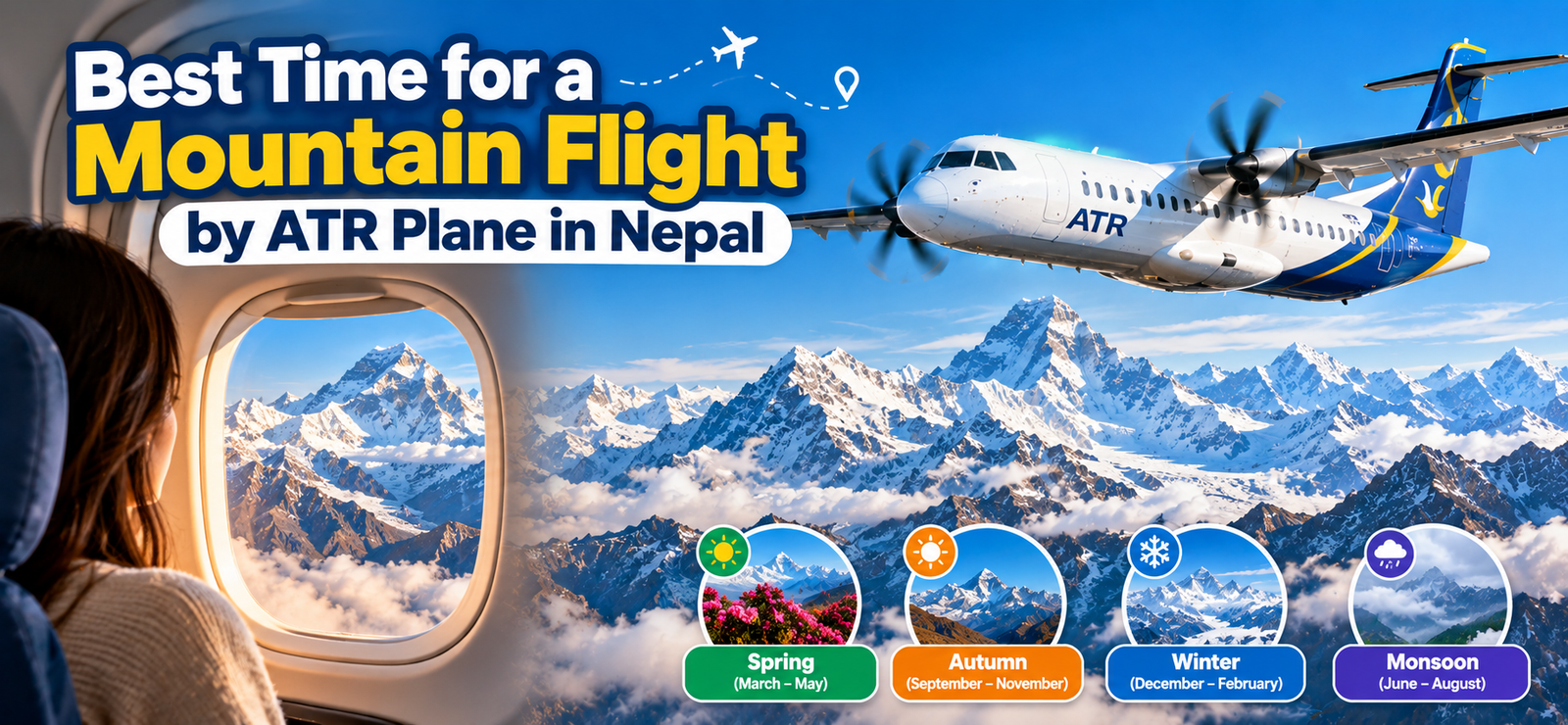
- October and November: the most reliable window of the year, stable high pressure, low haze, clearest skies, book early around festival dates.
- December to February: very clear air once the morning fog lifts, cold mornings, occasional short delays at the start of the day, strong second choice.
- March to May: dependable operationally, but increasing regional haze through the season softens distant views, March usually clearer than May.
- June to September: the least reliable period, more frequent cancellations under the 2026 CAAN monsoon rules, but clear mornings do occur and flights still operate on them.
Time of Day in Practice: What an Actual Morning Looks Like
It helps to walk through what a typical mountain flight by ATR plane morning looks like, because the time of day logic described earlier is easiest to understand when you see it laid out as a sequence rather than as an abstract rule.
Pickup from your Kathmandu hotel is usually around 5:30am, which feels early, and is supposed to. You check in at the domestic terminal, go through a short security process, and wait in a boarding area until your specific flight group is called. Because ATR planes used on this route typically carry somewhere in the range of 36 to 48 passengers depending on the operator and aircraft configuration, and because every passenger is meant to get a reasonable view from whichever side of the plane does not initially face the mountains, airlines usually rotate seating roughly halfway through the flight so everyone gets time on the mountain side. Takeoff itself usually happens somewhere between 6:15 and 7:00am, and the flight runs close to an hour out and back along the corridor past Everest and its neighboring giants, Lhotse, Nuptse, Makalu, and several others depending on the specific route flown that day.
The reason this entire schedule compresses into such a tight early window is the convective cycle described earlier. By the time a flight lands back in Kathmandu, often between 7am and 8:30am depending on the specific departure slot, cloud is frequently already starting to build over the lower hills on the route, even on a clear season day. A theoretical mountain flight scheduled for 10am or 11am, something no commercial operator actually offers for exactly this reason, would face dramatically worse odds of a clean view than the same flight at 6:30am, even on an otherwise good weather day. This is why, whatever season you are traveling in, the single most important piece of practical advice is simply this: take whatever early morning slot you are offered rather than requesting something later in the morning for convenience. A slightly inconvenient 5:30am pickup on a clear October morning will beat a more comfortable 8am pickup on the same date almost every time.
For readers who want the full operational picture of how these flights run, including boarding procedure, seating, and what the aircraft itself is like inside, our complete guide to the mountain flight by ATR plane in Nepal covers that ground in detail, and our separate piece on the ATR aircraft used on the Everest mountain flight explains the specific plane, its cabin layout, and why this aircraft type is used for this particular route rather than a jet.
Building a Flexible Kathmandu Itinerary Around the Flight
Everything above points toward one planning principle that matters more than any single calendar date: do not schedule your mountain flight for your only morning in Kathmandu. This sounds obvious once stated, and yet it is the single most common planning mistake we see, especially among travelers on a tight overall Nepal itinerary who fly into Kathmandu, do the mountain flight the next morning, and fly onward to Lukla or home the same day or the day after.
The reason this matters comes back to how these flights are actually scheduled on the ground. Mountain flight slots in Nepal are shared across a limited number of aircraft and a limited number of clear morning departure windows, and airlines confirm the exact day, and sometimes the specific airline operating your flight, only a few days before departure, because the whole system is weather dependent and slots shift as forecasts firm up closer to the date. This is not a quirk specific to one operator. It is how the entire mountain flight industry in Nepal functions, because nobody, including the airlines themselves, can reliably forecast Himalayan cloud cover two or three weeks out with enough precision to lock in a guaranteed clear morning that far in advance.
Given that reality, the practical move is to build at least one, ideally two, backup mornings into your Kathmandu schedule, particularly if you are traveling outside the core October and November window, or even inside it if your trip dates allow no flexibility at all. If your first scheduled morning is clouded out or cancelled for weather, having a second or third available morning before you need to leave the city means you are rebooked onto the next available clear slot rather than simply losing the flight altogether. Travelers who schedule their only free Kathmandu morning for the flight and then fly to Lukla or out of the country that same afternoon are the ones who occasionally miss the flight entirely when weather does not cooperate, and there is genuinely nothing an operator can do about weather after the fact.
A good general approach for a first time Nepal trip is to arrange your Kathmandu time so the mountain flight sits somewhere in the middle of your city days rather than at the very start or the very end, and so that at least one other low priority morning activity, something that can be moved or skipped without real cost, sits adjacent to it as a buffer. If you are combining the flight with a trek, for example an Everest Base Camp trek by foot or a shorter trek elsewhere, scheduling the mountain flight before you depart for the trek rather than immediately after you return gives you more flexibility, since trek return dates themselves can shift by a day due to weather or trail conditions in the hills.
How Next Trip Nepal Handles Booking and Weather Risk
Because weather dependence is baked into how this flight works, we structure our booking process around it rather than against it. Next Trip Nepal does not take advance payment for the mountain flight. You confirm the trip and pay once you have actually arrived in Nepal, which gives you, and us, a real chance to look at the current weather outlook together and talk through timing before anything is locked in, rather than committing to a date and payment weeks out based on a guess about what the sky will do.
If a scheduled flight gets cancelled for weather, and this happens more in monsoon than in autumn for exactly the reasons explained throughout this guide, our standard approach is to offer you the next available clear departure rather than leaving you stuck. Because no advance payment was taken in the first place, there is also nothing to refund or dispute in that scenario, which removes a layer of friction and anxiety that can come with prepaid, fixed date bookings on a flight this dependent on the sky cooperating. If you are weighing the mountain flight by ATR plane against other options, or want a clearer sense of what the flight actually costs and how the booking and payment process works in practice, our dedicated cost and booking guide for the mountain flight by ATR plane walks through current pricing and the booking steps in full. For the flight itself, including the route, the aircraft, and what you will see along the way past Everest, Lhotse, and the rest of the eastern Himalaya giants, you can see the full itinerary for the Everest Scenic Flight on our site.
Matching the Season to Your Trip Goals
Not every traveler is optimizing for the same thing, so it helps to close with a few direct recommendations depending on what matters most to you.
If maximum odds of a perfectly clear, sharp edged view is your only priority and your dates are flexible, choose November first, then October, then a clear cold morning in December or January. These months, in that order, represent the strongest run of consistently clean mornings across the calendar, driven by the stable high pressure pattern and low humidity that settles over Nepal once the monsoon has cleared out, a pattern well documented by Nepal’s own meteorological authorities, including the country’s Department of Hydrology and Meteorology, which tracks these seasonal transitions year over year.
If you are traveling for trekking season and your dates are effectively fixed around a specific trek, spring, particularly March, is a perfectly solid choice for the mountain flight, and you should simply go into it expecting slightly softer distant visibility than you would get in autumn, with the compensation that the near peaks, Everest above all, still show clearly on the great majority of mornings.
If you happen to be in Kathmandu during June, July, August, or September, our advice is to still try the flight rather than assume it is pointless. Treat it as a genuine attempt with real odds attached, build in a backup morning or two if your schedule allows it at all, and understand going in that the 2026 CAAN monsoon safety rules mean any flight that does operate will be flown with wider safety margins and a greater willingness to delay, reroute, or cancel if a storm cell or unstable approach shows up on a given morning. That caution is a feature of monsoon flying, not a flaw in it, and plenty of travelers do catch a genuinely clear monsoon morning and come away with the same view as someone flying in peak November.
Across every season, the time of day principle stays constant and matters more than almost anything else in this guide: take the earliest available morning slot, build at least one flexible backup morning into your Kathmandu schedule rather than scheduling the flight on your only available day, and do not assume that because a guidebook says October to April is the season, every other month is automatically a dead end. It is not. It is simply a different set of odds, and once you understand why those odds shift the way they do through the year, you are in a far better position to plan a mountain flight by ATR plane that actually delivers the view you came to Nepal for.