Most articles about the mountain flight by ATR plane spend their time describing how Everest looks out the window and then go quiet on the two questions that actually decide whether you book one: what it costs, and how the booking actually works once you are standing in Kathmandu trying to get a seat on tomorrow’s flight. This guide is the opposite. We are going to walk through real 2026 pricing, the three different ways people actually book this flight, what happens on the mornings when the weather does not cooperate, and the small logistical details, hotel pickup timing, security lines, camera batteries, that make the difference between a smooth morning and a stressful one. I run this flight for travelers out of Kathmandu for a living, and this is the version of the article I wish existed when I was first explaining the booking process to guests over breakfast.
If you want the fuller picture of the experience itself, what the flight feels like, how long it lasts, and why people keep recommending it, our complete guide to the mountain flight by ATR plane covers that side in depth. Here we are staying narrowly focused on money and logistics, the part almost nobody writes about in any useful detail.
What a Mountain Flight by ATR Plane Actually Costs in 2026
As of 2026, a mountain flight by ATR plane out of Kathmandu typically runs somewhere between 199 and 250 US dollars per person. That is a wide enough range that it deserves an explanation rather than a single flat number, because where you land within that range depends on which airline you fly, which season you fly in, and, most of all, how you book the seat. I want to be upfront that these figures are representative, not a locked in rate you should expect to see quoted to the exact dollar six months from now. Fuel surcharges, government fees, and airline pricing all shift over time, and the only way to know the precise price on your travel date is to confirm it directly, either with the airline or with whoever is arranging it for you, close to your actual dates.
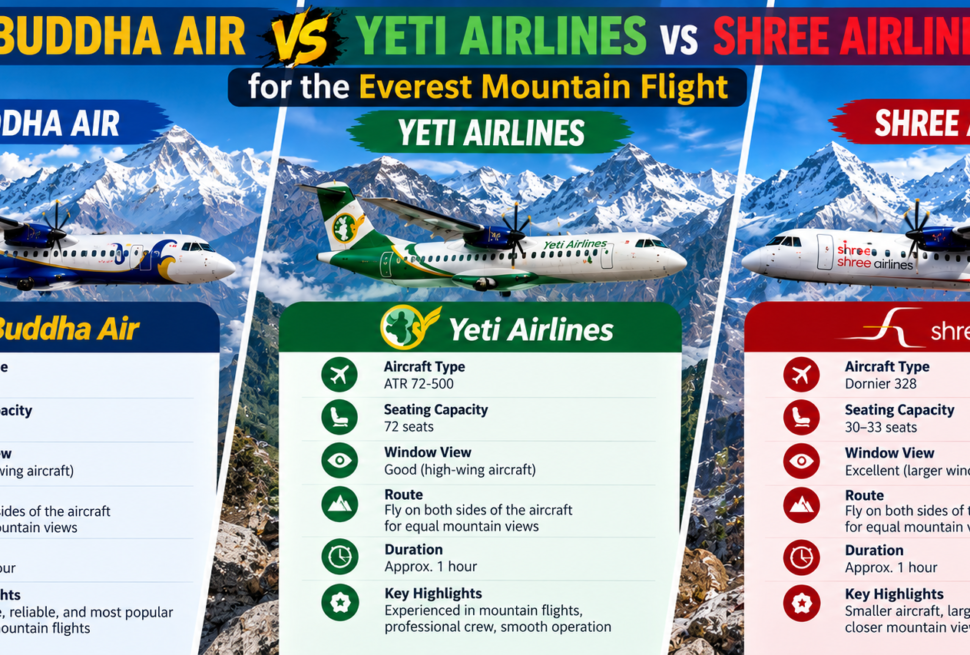
The flight itself does not change in length or route based on price. Every ticket, regardless of which of the three main operators you fly with, Buddha Air, Yeti Airlines, or Shree Airlines, buys you a seat on a twin engine ATR turboprop that takes off from Tribhuvan International Airport, flies a fixed scenic route along the Himalayan range with the aircraft reaching its closest point to Everest and the neighboring giants partway through, and lands back in Kathmandu roughly fifty minutes to an hour later. You are not paying more for a longer flight or a different route. You are paying for the seat, the season, and in many cases the convenience of how that seat was arranged for you.
A few things reliably push the price toward the higher end of that 199 to 250 dollar range. Flying during the clearest, most in demand months, generally October through December and again in parts of spring, tends to come with firmer pricing because demand peaks exactly when visibility is best. Booking through a channel that adds its own margin on top of the airline fare, which we will get into shortly, also pushes the number up. And booking at the last moment sometimes costs more simply because the cheaper seats in a flight’s allocation, if the airline uses any kind of tiered pricing, have already gone. On the other end, booking well ahead of your travel dates, flying in a shoulder season, and going through a local operator who works directly with the airline rather than through a reseller with no presence in Nepal, tends to land you closer to the lower end of the range.
Why the Price Changes From One Operator to the Next
This is the part most travelers find confusing, because on paper you are buying the identical product no matter who sells it to you: a seat on a mountain flight by ATR plane, same aircraft type, same route, same roughly one hour in the air. So why does one quote come in at 210 dollars and another at 265 dollars for what looks like the exact same flight on the exact same morning?
The answer is that you are not just paying for the airline seat. You are paying for whatever sits between you and that seat. When you book directly with Buddha Air, Yeti Airlines, or Shree Airlines through their own websites, you are paying close to the airline’s base fare, plus whatever card processing or booking fee it applies, and you are handling everything else yourself: getting to the airport, understanding which counter to check in at, and sorting out any changes on your own if the flight is delayed or cancelled for weather. When you book through a Kathmandu based ground operator, part of what you are paying for is someone who physically meets you at your hotel, manages the check in logistics, and most importantly, is reachable on the ground and can call the airline directly if your flight gets pushed to a different morning. When you book through a foreign third party platform, often a booking website based outside Nepal that resells domestic tours and flights, you are frequently paying the largest markup of the three, sometimes considerably more than the local operator rate, for a booking that still has to be handled by someone on the ground in Kathmandu whenever anything changes, except that the people handling it are not the people you actually paid.
There is also a quieter factor in pricing that is specific to this flight and easy to overlook: how far in advance you pay, and under what terms. A platform that charges your card in full months before your trip is pricing in the risk of refunding you if the flight is cancelled for weather, and some build a cancellation fee or a less generous refund policy into the fine print precisely because weather related disruption is common enough on this route that they need to protect their margin against it. A local operator working the way we do at Next Trip Nepal, where no advance payment is taken for this flight at all, has a completely different relationship with that risk, because there is no prepaid amount sitting on the table to argue about if the morning does not go as planned. We will come back to this, because it genuinely changes how much financial exposure you are carrying into the booking.
Three Ways to Book a Mountain Flight by ATR Plane
In practice, almost everyone booking this flight goes through one of three channels. None of the three is wrong, exactly, but each has a real tradeoff that matters more on this particular flight than it would on an ordinary domestic ticket, because this is a weather dependent, schedule shifting product. A flight from one city to another either goes or it gets rebooked onto the next available seat with minimal drama. A mountain flight by ATR plane depends on clear visibility along the entire route, and mornings in Kathmandu during shoulder seasons and the monsoon months can turn from clear to overcast within an hour. That single fact is why the booking channel you choose matters more here than it would for most other short flights.
Booking Directly With the Airline
Buddha Air, Yeti Airlines, and Shree Airlines all sell the mountain flight as a product on their own booking pages, and you can buy a ticket directly without going through any intermediary. This is the most straightforward option on paper, and it cuts out any markup beyond the airline’s own fare and fees.
The catch is that you are now your own logistics coordinator. You need to know, and confirm, where your hotel actually sits relative to the airport and how long the drive will realistically take at five in the morning, which counter handles the Mountain Flight or Everest Experience desk on the day, what identification you need to bring, and critically, what to do if you arrive at the airport and are told the flight is delayed an hour, or cancelled outright for weather. Airline staff at the counter are generally helpful, but they are managing a queue of travelers that morning, not personally shepherding your individual booking through a change. If you are comfortable handling all of that yourself, calling the airline’s office, understanding Nepali airport procedures, and you do not mind potentially standing in a terminal working out a rebooking on your own, direct booking works fine and saves you the local operator’s margin.
Booking Through a Kathmandu Based Ground Operator
This is the option most travelers end up preferring once they understand what it actually buys them, and it is also how we work at Next Trip Nepal. A local operator books your seat with the airline on your behalf, arranges hotel pickup at the right time for your specific hotel’s distance from the airport, briefs you on what to expect at check in and security, and most importantly, is the one making the phone call to the airline at five in the morning if the weather has turned and your flight needs to move to a different day.
That last point is the real value, and it is worth being specific about why. On a clear flying day, you do not need anyone’s help, the flight simply goes. The value of a ground operator shows up precisely on the mornings when things are not simple: when the airline’s own operations desk is juggling delays across three or four carriers at once, when you do not speak Nepali and the person at the counter is trying to explain a schedule change quickly in a crowded terminal, or when you are trying to decide whether to wait at the airport another hour or go back to the hotel and try again tomorrow. Someone who is physically in Kathmandu, knows the airline staff by name, and can get a direct answer by phone handles that situation in minutes. A traveler working it out alone, or a support contact in another country working it out by email, takes considerably longer, and sometimes you are already checked out of your hotel and leaving the country the next morning when the delay happens, which raises the stakes on getting a fast answer.
The other practical advantage, specific to how we handle it at Next Trip Nepal, is that we do not take advance payment for this flight. You confirm your preferred date, and you pay once you have actually arrived in Nepal, generally once your specific flight date is set and confirmed closer to departure. That single policy removes most of the financial anxiety that comes with booking a weather dependent flight, because there is no large prepaid sum sitting with a company on the other side of the world that you would need to argue to get back if your plans shift or the morning is cancelled. You can see current availability and get a date held, without paying anything up front, on our own Everest Scenic Flight trip page. More on the cancellation mechanics below, because it is genuinely one of the more underappreciated details in how this flight should be booked.
Booking Through a Foreign Third Party Platform
The third channel is booking through an international tour booking website, the kind of platform that lists tours and activities across dozens of countries and resells local products, including this flight, to travelers before they ever leave home. These platforms are convenient in the sense that you can book in your own language, on a familiar website, using your home country’s payment methods, often weeks or months before your trip even begins.
The honest downside is that you are very often paying a noticeable markup over what the same seat costs booked locally, and you are doing so in exchange for a layer of service that, on the ground in Kathmandu, is frequently thinner than what a direct local booking gives you. These platforms do not own airline relationships in Nepal. When your flight is delayed or cancelled for weather, the platform typically has to relay the problem to a local partner anyway, often the same kind of ground operator you could have booked with directly, except now there is an extra party in the communication chain, which tends to slow down exactly the kind of fast rebooking decision that matters most on a weather sensitive product. I am not going to claim these platforms never deliver a good experience, plenty of travelers use them without any issue on a clear flying day. But if you are choosing based on price and reliability on a flight that depends on weather, paying more for a longer chain of communication is rarely the better choice.
A Brief Note on the Three Airlines
Buddha Air, Yeti Airlines, and Shree Airlines all run broadly the same product on broadly the same aircraft type, so choosing between them is less about picking a better flight and more about which one has a seat available on your preferred morning, how its schedule lines up with your itinerary, and in some cases which one your booking channel has the strongest working relationship with. A good ground operator will generally steer you toward whichever airline has the smoothest availability for your dates rather than pushing one brand over another, and that flexibility is itself a small, underrated reason to book locally rather than fixing on a single airline’s own website and hoping that particular carrier has room on the exact morning you want.
How the Mountain Flight Booking Process Actually Works, Step by Step
Once you have decided on a channel, the mechanics of booking a mountain flight by ATR plane are fairly simple, but it helps to know what to expect at each stage so nothing catches you off guard.
You start by picking a preferred date, ideally one that falls early enough in your Nepal itinerary that if the first attempt is cancelled for weather, you still have days left to try again. This is one of the most practical pieces of advice I give every guest: never schedule your mountain flight for your very last morning in Nepal if you can avoid it. If the flight has to move because of weather and your last morning was the only morning left, you are out of options, not because the flight itself failed you, but because the schedule left no room for the one thing this flight is genuinely at the mercy of, which is visibility along the Himalayan range.
Once a date is set, the operator or airline confirms your seat, which on a small aircraft, these ATR planes seat somewhere between fifteen and thirty six passengers depending on the specific configuration, is generally straightforward outside of the absolute peak weeks of October and November. You will be asked for passport details or photo identification, since domestic flights within Nepal require photo identification at check in the same as international ones do, and you should have that ready rather than scrambling for it on the morning itself. If you booked through a ground operator, this is also when hotel pickup time gets confirmed based on exactly where you are staying, since pickup time shifts depending on how far your hotel sits from Tribhuvan International Airport and how predictable the morning traffic into that part of Kathmandu tends to be.
The evening before, a reliable operator will reconfirm the flight status with you, since weather forecasting for the next morning is reasonably accurate by that point, though not perfectly so, this remains a mountain weather system we are dealing with, not a scheduled train. Then the actual morning unfolds along the timeline described below.
What Happens When a Mountain Flight Is Cancelled for Weather
This is the section I think most competing articles skip entirely, and it is probably the single most important thing to understand before you book. Mountain flights by ATR plane are genuinely weather dependent. The aircraft needs clear visibility along essentially the entire route for the flight to be worth doing at all, since the entire purpose of the trip is the view, and outside the clearest months, particularly during the June to September monsoon window but also on scattered mornings in other months, cancellations and delays happen. This is not a rare edge case you can safely ignore. It is a normal, expected part of how this product works, and any article that does not say so plainly is not giving you the full picture.
When a flight is cancelled for weather, the standard approach across all three main airlines is to offer you the next available departure, essentially rebooking you onto a different morning during your stay, or to refund you if rebooking does not fit your schedule. That part is fairly consistent no matter who you book with. Where it gets more complicated is what actually happens to your money while that process plays out, and that depends entirely on when you paid and who you paid it to.
If you prepaid a foreign platform weeks or months before your trip and the flight is cancelled for weather on the morning in question, you are now relying on that platform’s refund process, which may involve a wait, a support ticket, currency conversion back to whatever you originally paid in, and occasionally a cancellation fee buried in terms you agreed to without reading closely. None of this is necessarily dishonest on the platform’s part, it is simply the mechanical reality of refunding money that already crossed borders and sat with a third party for weeks.
This is exactly the situation our advance payment policy at Next Trip Nepal is built to avoid. We do not take payment for this flight in advance. You confirm the date you want, and you pay once you have arrived in Nepal, typically once the specific morning is locked in and confirmed. If the weather cancels that morning before you have paid anything, there is nothing to refund in the first place, you simply move to the next available date during your stay, assuming you built in enough days, which goes back to the scheduling advice above. If weather forces a cancellation and you genuinely have no further days left in your trip to reschedule, you walk away having paid nothing for a flight you never took, rather than fighting for a refund from a company on another continent. That is not a minor convenience. On a flight where cancellation is a real, regular possibility, removing the financial exposure that comes with prepaying months in advance is one of the more meaningful practical advantages a local operator offers, and it is worth asking any operator you are considering, local or foreign, exactly when they charge you and exactly what their policy is if your flight does not go.
One more thing travelers sometimes get wrong: a weather cancellation is not the operator’s fault, and it is not the airline’s fault either, it is simply the Himalayas doing what the Himalayas do. The thing that separates a good booking experience from a bad one is never whether a cancellation happens, it is how quickly and how fairly it gets resolved once it does.
Day of Logistics: The Full Timeline From Hotel to Hotel
One of the things that surprises first time flyers is just how early the morning starts for a flight that only lasts about an hour. Here is roughly how the morning unfolds, based on the timing we actually run for guests in Kathmandu. Exact times shift by fifteen or twenty minutes depending on your hotel’s location and that day’s specific flight slot, but this is the general shape of it.
- Around 5:30am, hotel pickup, so you want to be dressed, have your camera charged, and your identification in hand before the vehicle arrives.
- Around 6:00 to 6:15am, airport check in and security, at the airline’s domestic Mountain Flight or Everest Experience counter, where you present your boarding information and photo identification. Security at Nepali domestic terminals runs separate lines for men and women, which is standard procedure here and not specific to this flight, so do not be surprised by it.
- Around 6:30 to 6:45am, boarding, including a short shuttle bus ride out to the aircraft itself, since mountain flights typically depart from a part of the airport reached by bus rather than a direct walk from the gate.
- Around 7:00am, takeoff, followed by roughly fifty minutes to an hour in the air, with the aircraft reaching its closest point to Everest and the surrounding giants partway through the route.
- Around 8:00am, landing back at Tribhuvan International Airport, followed by drop off back at your hotel by roughly 8:15 to 8:30am.
Add it up and you are looking at just under three hours, door to door, for an experience most people remember for years. The early start is genuinely the hardest part for most travelers, not the flight itself. I tell guests to treat the morning like any other early international departure: lay out your clothes and your camera gear the night before, and do not plan a late dinner or a few drinks the evening prior if you can help it, because a foggy, half awake five thirty wake up call is a worse start to the morning than the actual flight ever is.
It is also worth knowing that check in counters for this flight are specifically branded as the airline’s Mountain Flight or Everest Experience desk, separate from the general domestic check in counters at the terminal, so if you are navigating the airport on your own after a direct booking, look for that specific signage rather than queuing at a generic domestic counter, which can cost you time you do not have in an already tight morning.
Baggage Rules, Cameras, and What to Actually Bring
Because this is a short flight with no destination change, there is no checked baggage requirement in the way you might expect from a longer trip. You are not packing a suitcase for this. The entire experience happens in roughly three hours and you return to the same hotel room you left. What you actually need to think about is much smaller and more specific.
Bring whatever camera or phone you plan to use for photos, with its battery fully charged the night before and enough storage space cleared so you are not deleting old photos at seven thousand meters trying to make room for new ones. This sounds obvious, but it is the single most common regret I hear from guests after the flight: a dead battery or a full memory card discovered halfway through the route, with no realistic way to fix it once you are airborne. There is no time to troubleshoot a technical problem mid flight, you have roughly fifty minutes, and the window of best visibility on any given peak lasts only a minute or two as the aircraft passes it, so arrive with your gear already sorted rather than fiddling with settings once Everest comes into view.
Dress in layers you can manage easily, since the cabin is heated but the early morning outside, during pickup and the walk across the tarmac to the aircraft, is genuinely cold, especially in winter months. A light jacket you can take off once seated works better than something bulky you are stuck wearing for the whole flight.
The one document you absolutely cannot forget is photo identification, a passport for most international travelers, since domestic flight check in in Nepal requires it the same as an international departure would. I have seen more than one guest left scrambling at a hotel front desk at six in the morning because a passport was packed away in a different bag, so build the habit of keeping it on your person, not stowed, on travel mornings generally and this one specifically.
Booking a Mountain Flight for Couples, Families, and Larger Groups
Because this flight is priced per person rather than per group or per charter, it works equally well for a solo traveler, a couple, or a family of five. There is no minimum group size and no group discount structure to speak of, you are simply paying the per person rate multiplied by however many of you are flying.
Where it gets slightly more nuanced is seating. These are small aircraft, generally somewhere between fifteen and thirty six seats depending on the specific plane, and every seat on a mountain flight has a view, that is rather the point of the whole product, but seats on one side of the aircraft face the mountain range more directly during the pass, and cabin crew on these flights typically rotate passengers or call people forward toward the windows at the right moment specifically so everyone gets a turn at the best angle. Coordinating seats near each other as a family or a group booked together is usually possible to request, and we do request it on behalf of our guests when booking, but final seat assignment on the day is ultimately set by the airline’s cabin crew, not guaranteed in advance by any operator, local or otherwise. If you are traveling as a larger group, a tour party of eight or ten people for instance, give as much advance notice as you can when booking, since larger blocks of seats on a thirty something seat aircraft take more coordinating with the airline than a couple booking two seats, and the earlier the airline knows, the better the chance of keeping your group together.
Families traveling with young children should also know there is no separate child fare or age restriction specific to this flight beyond the general rules Nepali domestic carriers apply to infants, so it is worth asking your operator directly about current child pricing and any lap infant policy at the time of booking rather than assuming a flat per person rate applies uniformly across every age.
CAAN Regulations and the Monsoon Season Factor
A regulatory detail worth knowing, particularly if you are planning a trip during the June to September window, is that the Civil Aviation Authority of Nepal, the country’s aviation regulator, issued a new monsoon safety circular in June 2026 affecting all domestic carriers, including Buddha Air, Yeti Airlines, and Shree Airlines. The circular tightened preflight checks and weather avoidance rules across the board for domestic operations during the monsoon period.
For travelers, the practical upshot is straightforward: if you are booking a mountain flight by ATR plane during the monsoon months, you should expect a somewhat higher chance of delay or rescheduling as a direct result of airlines following stricter weather avoidance protocols, not less. This is a good thing from a safety standpoint, and it should be read as reassurance rather than as a deterrent, airlines being more conservative about which mornings they fly is exactly what you want from a regulator overseeing mountain aviation. But it does mean that monsoon season travelers in particular should build real flexibility into their schedule and should specifically favor a booking channel, whether that is a local ground operator or a direct airline booking, that makes rescheduling painless rather than one that penalizes you financially for a delay that is, by that point, entirely out of anyone’s control. You can read the regulator’s own published guidance and safety circulars directly on the Civil Aviation Authority of Nepal’s website if you want the source material rather than a summary of it.
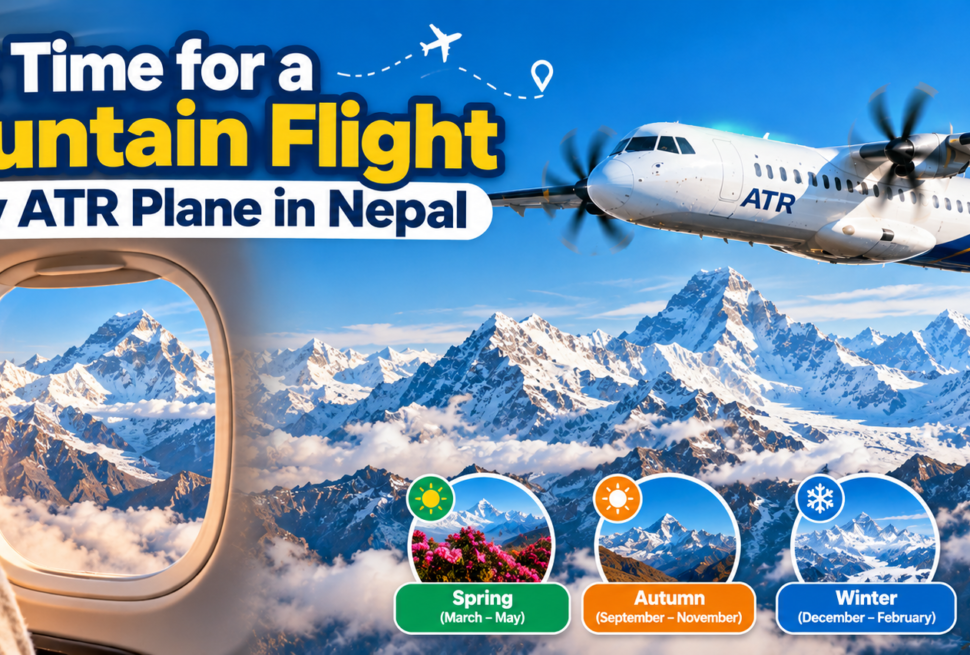
If you are trying to decide which months give you the best realistic shot at a clear flight with minimal disruption in the first place, we have laid out the month by month patterns in detail in our article on the best time of year for a mountain flight by ATR plane, which is worth reading before you lock in travel dates if your schedule has any flexibility at all.
How to Choose Between Operators: A Practical Checklist
After walking enough travelers through this booking process, a few questions reliably separate a good booking experience from a frustrating one, regardless of which channel you ultimately choose.
Ask directly when payment is actually charged. A company that charges your card in full the moment you book, months before your trip, is taking on none of the weather risk itself and passing all of it to you. A company that confirms your date and collects payment closer to or on arrival, the way we handle it at Next Trip Nepal, is implicitly sharing that risk with you in a way that should make you more comfortable, not less, about committing to a date early.
Ask who you actually talk to if something changes on the morning itself. If the honest answer involves an email address or a chat bot based outside Nepal, recognize that you are relying on that contact relaying your problem to someone on the ground anyway, so you are adding a step, and time, to a situation where minutes matter. If the answer is a phone number for someone physically in Kathmandu, that is the version of this booking built for the reality of how this flight actually operates.
Compare the quoted price against the roughly 199 to 250 dollar range outlined earlier, and if a quote comes in noticeably above that, ask specifically what the extra cost includes. Sometimes it is a genuinely better hotel pickup radius or an earlier confirmed seat allocation during peak weeks. Often it is simply margin from an extra party in the booking chain. There is nothing wrong with paying more for a service you value, but you should know what you are paying for rather than assuming price always maps cleanly to quality on this particular product.
And finally, ask how much notice they need for your preferred date, especially if you are traveling in a group or during October and November, the busiest stretch of the year for this flight. An operator who tells you plainly that a specific week is tight and recommends booking a particular date as early as possible in your itinerary is giving you more useful information than one who tells you everything is always available, because on this flight, it genuinely is not always available, and honesty about that upfront saves you a disappointing conversation later. It is also worth asking, in the same conversation, exactly what you will be able to see from your seat and when, since the route has a rhythm to it, certain peaks appear on certain sides of the aircraft at certain points in the flight, and a good operator should be able to tell you this before you ever board. We have broken the entire route down peak by peak, with timing, in our article on what you see on a mountain flight by ATR plane to Everest, which is worth a read the night before so you know what to look for and roughly when.
Booking Your Mountain Flight by ATR Plane
The mountain flight by ATR plane is one of the easiest adventure experiences in Nepal to actually get wrong on logistics, not because it is complicated, but because the weather dependent nature of it punishes a bad booking choice far more than it would on an ordinary flight. Know roughly what the flight should cost, somewhere in that 199 to 250 dollar range depending on season and channel, confirmed close to your actual travel dates rather than assumed from an old quote. Understand that booking direct saves money but puts the logistics on you, a foreign platform often costs more for a longer communication chain, and a local ground operator buys you someone on the phone with the airline at six in the morning when it matters most. Build a buffer day or two into your itinerary rather than scheduling this for your last morning in the country. And ask plainly about payment timing before you commit, because on a flight this weather sensitive, when you pay matters almost as much as what you pay.
If you want to see current pricing and availability and get this booked properly, with pickup, check in, and weather contingency handled on the ground, our Everest Scenic Flight trip page has the up to date details and lets you confirm a date without any advance payment. Between the guides in this series and a quick conversation with our team at Next Trip Nepal, you should have everything you need to book this with confidence rather than guesswork, and to actually get the seat, the morning, and the view you are hoping for.