
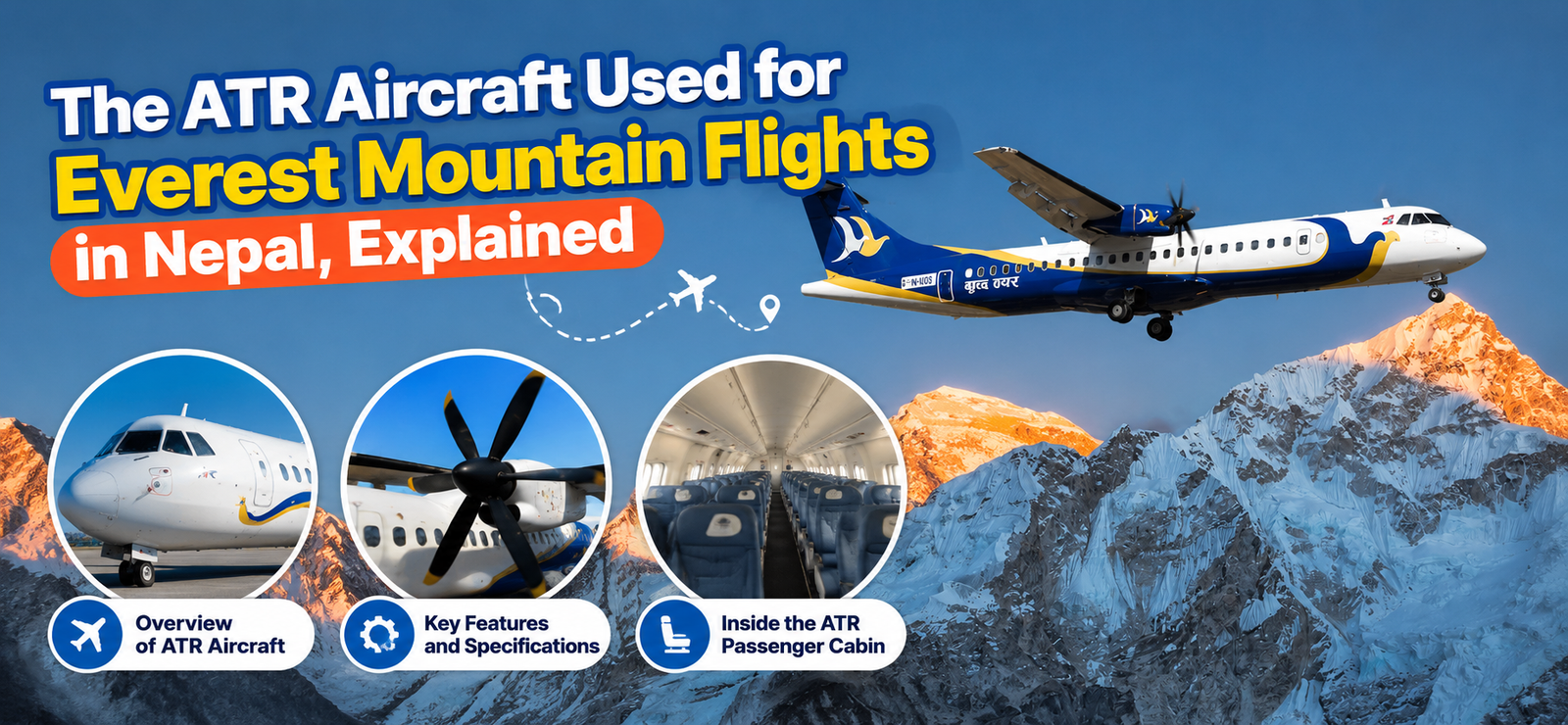
Most articles about the Everest mountain flight tell you which airline to book and then move on. They mention Buddha Air, Yeti Airlines, or Shree Airlines, show a photo of a small plane with mountains behind it, and stop there. Almost none of them explain the aircraft itself: what it actually is, why this particular type of plane was chosen for this particular job, or how it manages to climb to nearly 23,000 feet and keep thirty six strangers breathing comfortably while they stare out the window at Everest. If you are the kind of traveler who wants to understand what you are sitting inside of, not just where it is going, this article is for you.
The aircraft flying the mountain flight by ATR plane out of Kathmandu is, in almost every case, an ATR 42 or an ATR 72, a twin engine turboprop built by a French Italian manufacturer. That single fact, that it is a turboprop and not a jet, explains most of what makes this flight work the way it does: the altitude it can reach, the comfort inside the cabin, the way it handles Kathmandu’s short mountain ringed runway, and even why every passenger ends up with a window seat. We are going to go through all of it, including the parts that competitor sites tend to avoid, such as the 2023 accident involving this same aircraft type and what Nepal’s official investigation actually found.
What Is an ATR Plane, Actually
ATR stands for Avions de Transport Regional, a joint venture between the French company Airbus and the Italian company Leonardo, headquartered and assembled in Toulouse, France. The company exists for one purpose: building twin engine turboprop aircraft for regional air travel, the kind of routes that are too short or too thin for a full size jet to make economic sense. ATR does not build jets at all. Its entire product line, going back to the 1980s, has been variations on the same turboprop formula, refined generation after generation.
Two models from that lineup are the ones you will actually encounter on a Nepal mountain flight: the ATR 42 and the ATR 72. The numbers are not marketing flourishes, they refer loosely to the aircraft’s typical passenger capacity in its densest commercial seating configuration, meaning an ATR 72 can be configured to carry around 72 passengers on a standard commuter route, and an ATR 42 around 42. Nepali operators do not fly them that full. Buddha Air, for example, configures its ATR 72 500 for 36 passengers and its ATR 42 320 for 24 passengers on this route, roughly half the aircraft’s maximum density. That is not a safety requirement, it is a comfort choice, and it is the direct reason every seat on this flight ends up next to a window, which we will get to shortly.
Visually, an ATR plane has a distinct silhouette that is worth knowing before you see one on the tarmac at Tribhuvan International Airport. The wing sits high on top of the fuselage rather than low underneath it, the tail has its horizontal stabilizer mounted up on top in a T shape rather than at the base, and two turboprop engines hang from the wing, one on each side, each one turning a large multi blade propeller rather than a bare jet nozzle. None of this is cosmetic. The high wing keeps the propellers clear of the ground on shorter runways and, as a side benefit, keeps the wing out of your downward sightline when you are trying to photograph Everest. The T tail keeps the horizontal stabilizer out of the propeller wash. Every visible shape on this aircraft traces back to a design decision made for exactly this kind of short, rugged, regional flying. If you want the full technical rundown on the airframe family, ATR’s own manufacturer site at atr-aircraft.com and the detailed Wikipedia entry on the ATR 72 both go deeper into the engineering history than we have room for here.
Why a Turboprop, Not a Jet, Flies the Mountain Route
This is the question almost nobody answers, and it has a genuinely interesting technical answer. A turboprop is, at its core, a jet engine. It burns fuel in a gas turbine the same way a jet engine does. The difference is what happens to the energy coming out the back. In a pure jet engine, most of that energy leaves as high speed exhaust, and the reaction to pushing that exhaust backward is what pushes the aircraft forward. In a turboprop, the turbine is instead connected through a reduction gearbox to a propeller, and it is the propeller, not the exhaust, that does almost all of the work of pushing air backward and the aircraft forward. The exhaust leaving a turboprop is comparatively slow and cool. A propeller is simply a much more efficient way to move a large volume of air at the modest speeds and altitudes this kind of flying involves.
That efficiency is the whole reason ATR aircraft exist. Jets are optimized for cruising fast and high, often above 30,000 feet, over long distances, where their thin, swept wings and pure jet thrust pay off. Turboprops are optimized for the opposite case: shorter routes, lower cruise altitudes, and runways that are sometimes short, sometimes at elevation, sometimes both. Nepal’s domestic network is practically a textbook example of exactly that case. Tribhuvan International Airport in Kathmandu sits at roughly 4,400 feet above sea level, ringed by rising terrain on most sides, with a single runway that is respectable by regional standards but nowhere near the length a long range jet would want. A turboprop’s propeller bites into the air far more effectively at low speed than a jet engine does, which gives it stronger acceleration off a shorter runway and a steeper initial climb to get above the surrounding hills quickly. It also burns noticeably less fuel per hour at these altitudes and speeds than a jet of similar size would, which matters on a route where the entire flight, start to finish, lasts about an hour.
There is a reason you never see a Boeing or an Airbus narrow body jet doing this flight. A jet airliner is built to spend thirty minutes climbing to altitude and thirty minutes descending, with the efficient part of the flight happening somewhere in between at high altitude. A one hour sightseeing loop near the Himalaya never gives a jet the chance to reach the altitude or speed where it actually becomes efficient, and its wide turning radius and long runway requirements are simply the wrong tool for a short loop out of a mountain ringed airport. An ATR plane, by contrast, is comfortable climbing, cruising, and descending all within the kind of altitude band this flight actually uses, which is a large part of why every operator running this route, independently, arrived at the same answer: ATR 42 or ATR 72, turboprop, every time.
The ATR 42 and ATR 72 Compared: What’s Actually Different
Because both aircraft come from the same manufacturer and the same basic design family, people sometimes assume the ATR 42 and ATR 72 are more or less interchangeable, just with a different paint job. They are closely related, but there are real differences worth understanding if you want to know what you are booking.
The ATR 72 is, essentially, a stretched version of the ATR 42. Both share the same wing, the same general systems architecture, and largely the same flight deck philosophy, but the ATR 72’s fuselage is longer, which is where the extra seating capacity comes from. A longer fuselage also means a bit more cabin volume and, on the versions flying in Nepal, more powerful engines to handle the added weight and to keep climb performance and cruise speed broadly similar between the two types. Buddha Air’s fleet illustrates the split well: its ATR 72 500 is configured for 36 passengers on the mountain flight, while its smaller ATR 42 320 carries 24. Yeti Airlines and Shree Airlines fly comparable ATR turboprop types on the same route, all certified by Nepal’s Civil Aviation Authority, known as CAAN.
In practical terms, as a passenger, the difference between flying an ATR 42 and an ATR 72 on this route is small. Cruise speed is close enough between the two that the flight duration does not meaningfully change. Cabin width is identical, since both aircraft share the same fuselage cross section, just a different length, so the two seats and aisle and two seats layout is the same on either type. The main difference you might notice is simply that the ATR 72 is a slightly larger cabin with a few more rows, while the ATR 42 feels a touch more intimate with fewer seats between you and the cockpit. Neither one is the safer or more capable aircraft for this particular flight profile; they are sized differently for route economics, and an operator will typically assign whichever aircraft fits that day’s passenger numbers and schedule. If your focus is simply booking the flight itself rather than picking a tail number, Next Trip Nepal’s Everest Scenic Flight trip handles that assignment through the operating airline, and either ATR type will get you the same view of the mountains.
Pressurization: Why It Matters More Than People Realize
Here is a detail that almost never makes it into the brochure copy but genuinely matters: the ATR 42 and ATR 72 are pressurized aircraft. That single engineering fact is what allows the mountain flight to exist in the comfortable form travelers actually experience.
Pressurization works by taking air bled from the engines, cooling and conditioning it, and pumping it into the cabin faster than an outflow valve at the back of the fuselage lets it escape. By controlling how fast that valve opens, the aircraft keeps the air pressure inside the cabin far higher than the thin outside air at cruise altitude, even though the actual aircraft might be flying at 23,000 or 24,000 feet, an altitude at which unprotected air is too thin to support normal breathing for long. A pressurized cabin on an ATR plane typically keeps the equivalent cabin altitude somewhere around 6,000 to 8,000 feet, similar to a moderately high mountain town, which is a pressure your body handles without any trouble and without supplemental oxygen.
Why does this matter for the Everest route specifically? Because the whole point of the flight is to get high enough to see the summits of 8,000 meter peaks clearly without flying anywhere near their actual height. Everest’s summit sits at roughly 29,032 feet. The aircraft does not go anywhere close to that; the flight profile keeps the aircraft safely below the summits while still climbing high enough, generally into the low to mid twenty thousands of feet, to put those peaks in clear view at eye level or above. That altitude band is well beyond what a small unpressurized aircraft, like the light single engine planes used for shorter scenic hops elsewhere in the world, can offer passengers without masks or noticeable discomfort. Because the ATR is pressurized, you sit in your seat, look out a window, and have an ordinary conversation at an altitude where an unpressurized cabin would already be making people lightheaded. This is one of the quieter reasons the ATR plane became the standard aircraft for this flight rather than a smaller, cheaper, unpressurized alternative: it is the only practical way to combine real altitude with real comfort for a cabin full of sightseeing passengers.
The Cabin Layout That Makes Every Seat a Window Seat
This is the detail most people actually want to know before they book, and the explanation is refreshingly simple once you understand the aircraft. The ATR 42 and ATR 72 both use a narrow single aisle cabin arranged two seats on the left, an aisle, and two seats on the right. There is no middle seat configuration anywhere on this aircraft, unlike a wide body jet with its two aisles and middle sections, or even many standard narrow body jets that run three seats on one or both sides. On an ATR plane, every seat is either a window seat or an aisle seat, and because the cabin is only two seats wide on each side, every aisle seat is still immediately next to a window. Functionally, every single passenger gets a clear view outside.
This is not a special arrangement set up for tourists. It is simply how the ATR 42 and ATR 72 are built, for every route they fly anywhere in the world, sightseeing or not. The mountain flight by ATR plane just happens to be a case where that standard layout becomes a genuine selling point, since the entire purpose of the flight is to look out the window at a specific sequence of peaks as the aircraft flies along the Himalayan range. Add the high mounted wing, which sits above the windows rather than slicing across your view the way a low wing jet’s wing would, and you end up with a cabin that was never designed around sightseeing but turns out to be close to ideal for it anyway.
Operators typically also make a point of rotating which side of the cabin faces the mountains at some point during the route, or seat passengers based on booking so that everyone gets a reasonable view of the main peaks rather than only the people on one side. Exactly how each airline manages that, and precisely what you will see out the window in what order, is its own topic. If you want a full breakdown of the mountains you pass and the order you see them in, that is covered in detail in Next Trip Nepal’s guide on what you actually see on the mountain flight route, which pairs well with the aircraft details here.
How the ATR Handles Mountain Air and Nepal’s Terrain
Flying regularly in and out of a mountain ringed airport is a different operational problem than flying between two flat, sea level cities, and the ATR platform was built with exactly this kind of flying in mind from the start. A few specific features matter here.
First, engine performance at altitude and in thin air. The turboprop engines on an ATR plane are flat rated, meaning they are designed to deliver their full rated power across a range of altitudes and temperatures rather than losing noticeable thrust the moment conditions get thinner or warmer than sea level. That matters at a field like Tribhuvan, which already sits above 4,000 feet before the aircraft has done anything, and it matters again once the aircraft is climbing through the mountain flight’s cruise altitude, well above most of the terrain it is flying past.
Second, ice protection. At the altitudes this flight operates in, especially outside the warmer months, the aircraft can encounter icing conditions on the wings, tail, and propellers. ATR aircraft carry pneumatic de icing boots on the leading edges of the wings and tail, which inflate and deflate to crack off ice buildup, along with electrically heated propeller blades and heated engine inlets, so that ice accumulation does not degrade the aircraft’s aerodynamics or engine intake during a flight that spends real time at altitude in cold, thin air.
Third, and this is where the CAAN monsoon circular becomes relevant, several systems are specifically important for operating safely into and out of a field like Kathmandu. Weather radar lets the crew see and route around building convective weather, which matters during Nepal’s monsoon season when afternoon buildups are common. Anti skid braking prevents wheel lockup on a runway that might be wet, important given how short most Nepali domestic runways are relative to international standards. The slats and flaps, movable surfaces on the wing’s leading and trailing edges, extend to increase lift and drag at low speed, which is what lets the aircraft fly a slower, steeper approach into a short field without stalling. Engine reverse thrust, achieved on a turboprop by changing the pitch angle of the propeller blades so they bite into the air in the opposite direction, helps the aircraft slow down quickly after touchdown without relying purely on wheel brakes. And the Ground Proximity Warning System, or GPWS, continuously compares the aircraft’s altitude, speed, and descent rate against the surrounding terrain and sounds an alert if the aircraft is getting dangerously close to high ground before a pilot might otherwise notice, which is an obviously important safeguard when the surrounding terrain includes some of the tallest mountains on the planet.
Who Actually Operates These Aircraft on the Everest Route
Three airlines run the mountain flight by ATR plane out of Kathmandu: Buddha Air, Yeti Airlines, and Shree Airlines. All three are certified by CAAN and all three fly broadly similar ATR turboprop types on this route, which is part of why, from a traveler’s seat, the experience does not vary dramatically depending on which airline’s logo is on the tail. The aircraft, the altitude, the general route along the Himalayan front, and the one hour duration are all effectively standardized across operators, even though the specific tail number, livery, and exact passenger configuration will differ slightly from one carrier to the next.
Buddha Air has historically operated both the ATR 72 500, configured for 36 passengers on this flight, and the smaller ATR 42 320, configured for 24. Yeti Airlines and Shree Airlines fly comparable ATR aircraft in the same general size range. None of these operators run jets or helicopters on this particular product; the mountain flight, as distinct from the separate helicopter tour product that some operators also sell, is specifically and consistently an ATR turboprop operation. If you want a broader rundown of how the whole experience fits together, from check in to landing, Next Trip Nepal’s complete guide to the mountain flight by ATR plane in Nepal covers the full operator landscape and what to expect from each one.
Maintenance and Oversight: CAAN and the 2026 Monsoon Safety Circular
The aircraft itself is only half the safety picture. The other half is the regulatory system that decides when an aircraft is allowed to fly at all, and in Nepal that authority is the Civil Aviation Authority of Nepal, generally known by its initials, CAAN. CAAN sets and enforces the airworthiness, maintenance, and operating standards that Buddha Air, Yeti Airlines, Shree Airlines, and every other domestic Nepali carrier must meet, and its published regulations and circulars are available on its own site at caanepal.gov.np for anyone who wants to read the primary source rather than a summary.
A recent and specific example of CAAN tightening oversight is worth knowing about directly, because it shows how this system actually responds to operating conditions rather than treating every season the same. In June 2026, CAAN issued a monsoon safety circular, effective June 15, 2026, that requires a specific list of critical aircraft systems to be fully functional before any flight is permitted to operate at all. The listed systems are anti skid braking, weather radar, the slats and flaps, engine reverse thrust, and the Ground Proximity Warning System, the same systems described in the mountain flying section above. The circular is explicit that an aircraft with a known defect in any of these systems is barred from flying until it is fixed, full stop, with no conditional dispatch or deferred maintenance workaround allowed on these particular items. This rule applies across the board to Buddha Air, Yeti Airlines, Shree Airlines, and every other domestic Nepali carrier, not to one operator in isolation.
The reasoning behind singling out these five systems during monsoon season is straightforward once you understand what each one does, as covered above: they are precisely the systems that matter most when weather, wet runways, and terrain awareness all become higher stakes at the same time. A functioning weather radar and a working GPWS are far more valuable in July than in November. Anti skid brakes matter more on a rain slicked runway than a dry one. By naming these systems specifically, rather than issuing a vaguer general safety reminder, CAAN’s circular targets the actual risk factors that monsoon conditions introduce, and it gives ground engineers and pilots a concrete, checkable standard rather than a general exhortation to be careful. That kind of specific, enforceable requirement is a reasonable thing to want to know about before you fly, and it is a more useful safety signal than a vague assurance that an airline is safe.
Addressing the 2023 Yeti Airlines ATR 72 Accident Directly
Any honest technical article about the ATR aircraft flying in Nepal has to address this directly rather than skating past it, because it is the single most relevant real world data point about this aircraft type operating in this country, and brushing past it with a one line reassurance would be worse than not mentioning it at all.
What Actually Happened
In January 2023, a Yeti Airlines ATR 72 500, registration 9N ANC, crashed on approach to Pokhara while flying a scheduled domestic route from Kathmandu to Pokhara. Nepal’s official accident investigation, completed in December 2023, identified the probable cause as an inadvertent movement of both engine condition levers to the feathered position during the flight. That action feathered both propellers simultaneously, which caused a sudden loss of thrust on both engines and led to an aerodynamic stall from which the crew could not recover in the altitude and time available. The investigation also pointed to contributing factors, including a high crew workload operating into a newly opened airport with unfamiliar approach procedures, and weaknesses in crew resource management, meaning the coordination and cross checking between the two pilots in the cockpit.
What Condition Levers and Propeller Feathering Actually Do
To understand why this matters, and why it is a crew and procedure story rather than an aircraft design flaw, you need to understand what a condition lever actually does on a turboprop like the ATR. On most turboprop aircraft, including the ATR, the power controls in the cockpit are split into two separate sets of levers rather than a single throttle the way a car has one accelerator pedal. The power levers control how much fuel and thrust the engine is producing, similar in spirit to a jet’s throttle. The condition levers, positioned alongside them, control the propeller, specifically the blade pitch and effectively which operating mode the propeller is in: full fine pitch for ground operations, the normal flight range used for taxi, takeoff, climb, and cruise, and a feathered position used to shut an engine down in flight.
Feathering a propeller means rotating the angle of its blades so they turn nearly edge on to the airflow rather than biting into it. This is a deliberate, useful feature on a twin engine turboprop. If one engine genuinely fails in flight, feathering that side’s propeller is exactly what a pilot is trained to do, because an unfeathered, stopped or failing propeller held perpendicular to the airflow creates enormous drag, essentially acting like a flat disc dragging through the air, which can make the aircraft difficult or impossible to control on the remaining engine. Feathering removes that drag penalty and lets the aircraft fly safely and efficiently on the one engine still producing power. It is a standard, well understood emergency procedure, not a design weakness, and every ATR pilot trains on it specifically.
What went wrong on the Pokhara flight was not that the feathering mechanism malfunctioned or that the aircraft type has some flaw in how its propellers work. According to the investigation, both condition levers were moved into the feathered position during the flight when only one engine, at most, should ever have been treated that way, and the real engines were not failing at the time this happened. With both propellers feathered simultaneously, both engines stopped producing usable forward thrust at essentially the same time, at an altitude and configuration from which the crew could not recover before the aircraft stalled. That is a sequence rooted in how the levers were handled in the cockpit during a high workload approach into an airport the crew had limited experience with, compounded by weak cross checking between the two pilots, which is precisely what the investigation’s findings describe. It is a human factors and procedural failure, not evidence that the ATR 72 as a type has some inherent mechanical problem with its engines or propellers.
Why This Is a Different Flight From the Mountain Flight
It is also worth being plain about something that often gets blurred in casual retellings of this accident: the flight that crashed near Pokhara was a scheduled point to point domestic flight between Kathmandu and Pokhara, a different route, a different airport pairing, and a different flight profile entirely from the Everest mountain sightseeing flight this article series is about. The mountain flight is a loop that departs and returns to the same airport, generally Kathmandu, flying out along the Himalayan range and back, and it does not involve landing at a different, newly opened airport with approach procedures the crew might be less familiar with, which the investigation flagged as a contributing factor in the Pokhara accident. That does not mean the mountain flight is risk free, no flight is, but it does mean the specific chain of circumstances identified in that investigation, landing at an unfamiliar new airport under high workload, is not the operating pattern of the Everest sightseeing route.
The ATR 72’s Record Outside Nepal
Zooming out, the ATR 72 is one of the most widely used regional turboprops anywhere in the world, flying with airlines across Europe, the Americas, Asia, Africa, and Australia, carrying millions of passengers a year on short regional routes where a turboprop makes operational and economic sense. Its broader safety record across that global fleet is consistent with other mainstream regional turboprops of comparable age and role. A single accident investigation tracing back to a specific cockpit procedure error is a serious event worth understanding honestly, and Nepal’s investigators did their job thoroughly and published their findings rather than burying them, which is itself a reasonable thing to take some confidence from. It is not, on the evidence from that investigation, a reason to view the ATR 72 as a type as fundamentally less safe than any other aircraft doing comparable work elsewhere in the world.
The EU Air Safety List: What It Actually Covers
You may also come across the fact that Nepali certified carriers currently appear on the European Union’s Air Safety List. This is worth understanding precisely, because it gets misread fairly often. The EU list is not a ranking of specific aircraft types as unsafe, and it is not a finding of a defect in the ATR 42 or ATR 72 as machines. It reflects European regulators’ assessment of the regulatory oversight capacity of a country’s civil aviation authority, in this case CAAN, measured against the International Civil Aviation Organization’s safety oversight standards and audit findings. It is, in plain terms, a statement about institutional and administrative oversight capability as judged from outside the country, not a technical verdict on any specific airplane. It also has no bearing on domestic flights operating entirely within Nepal, including the mountain flight; its practical effect is limited to barring the listed carriers from operating flights into European airspace, which none of Nepal’s domestic mountain flight operators were doing in the first place.
Which Aircraft Will You Actually Fly On
If you book the mountain flight, you will not get to choose between the ATR 42 and ATR 72 specifically, and in practice there is little reason to want to. Airlines assign aircraft to a given morning’s flights based on passenger numbers, maintenance schedules, and fleet availability, and either type will fly the same route, the same altitude band, and the same one hour duration, with the same guaranteed window seat on the same two seats and aisle and two seats layout. The practical differences between the two aircraft (a few more seats and a slightly larger cabin on the 72, a touch more intimacy on the 42) are not the kind of thing that changes the experience of the flight itself in any meaningful way. What does change things, somewhat more, is the time of year you fly, since visibility and the likelihood of your flight going ahead at all vary with Nepal’s seasons, a subject covered in full in Next Trip Nepal’s article on the best time of year for the mountain flight by ATR plane.
Booking the Mountain Flight by ATR Plane
Understanding the aircraft is useful background, but at some point the practical question is simply how to get a seat on one. Next Trip Nepal, a Kathmandu based tour operator, books the Everest mountain flight across these same ATR operators and, unlike many booking channels, does not require advance payment to hold your reservation; you confirm your seat and pay only after you have arrived in Nepal, which removes a fair amount of the uncertainty that comes with pre paying for a weather dependent flight from overseas. If you have read this far because you wanted to actually understand the plane before you got on it, rather than just take an operator’s word for it, that is exactly the kind of informed booking decision this article was meant to support. You can see current availability and details directly on Next Trip Nepal’s Everest Scenic Flight trip page, where the ATR 42 and ATR 72 aircraft described throughout this article are the ones actually doing the flying.
The short version of everything above is this: the ATR plane was not chosen for this flight by accident. Its turboprop engines suit the short runway and modest altitude band this route requires far better than a jet would. Its pressurized cabin lets it climb high enough to put Everest and its neighboring giants in clear view without any discomfort to the people on board. Its narrow two seat, aisle, two seat cabin, built for ordinary regional routes everywhere else in the world, happens to guarantee every single passenger a window on this one. And the oversight system around it, CAAN’s certification and its specific, enforceable circulars like the 2026 monsoon safety requirements, is a regulatory framework that responds to real conditions rather than issuing blanket assurances. None of that erases the seriousness of what happened in 2023, and this article has not tried to wave it away, but understood with the actual mechanics of condition levers and propeller feathering in view, it reads as a cockpit procedure failure on a different flight entirely, not a verdict on the aircraft you will be sitting in in the cabin of an ATR plane.