Every clear morning before sunrise, a short line of travelers gathers in hotel lobbies across Kathmandu, most of them still half asleep, waiting for a van that will carry them to Tribhuvan International Airport for something many of them will talk about for years. That something is the mountain flight by ATR plane, a short scheduled flight that climbs out of the Kathmandu valley, turns east along the spine of the Himalaya, and brings Everest and roughly nineteen other peaks above 8000 meters past the window, all without the aircraft ever touching down anywhere other than Kathmandu itself. This guide covers the whole thing: how the booking actually works, what seat you end up in, what happens when the flight gets cancelled for weather, and an honest answer to the safety question almost every traveler eventually asks.
If you read only one article before booking, make it this one. Most of what gets published about the Everest mountain flight repeats the same three facts: it leaves early, it is short, and you see Everest. All true, but that leaves out the parts that matter once you are standing in an airport at 5 in the morning wondering why your flight has not been called, or comparing Buddha Air against Yeti Airlines against Shree Airlines with no idea whether it makes any real difference. We book this flight for travelers as part of our Everest Scenic Flight trip, and most of what follows comes from years of watching these flights load, delay, cancel, and depart from the domestic terminal in Kathmandu.
What the Mountain Flight by ATR Plane Actually Is
The mountain flight, sometimes called the Everest mountain flight or the Everest scenic flight, is a fixed wing sightseeing flight on a small turboprop airplane that takes off from Kathmandu, flies a scenic loop along the Himalayan range, and lands back at the same airport around an hour later. It never lands anywhere else. That single fact surprises a lot of first time visitors, who sometimes assume the flight ends somewhere near Everest Base Camp or at a mountain airstrip like Lukla. It does not. The entire point of the flight is the view from the window during a loop that starts and ends at the same runway.
This is fundamentally different from a trek to Everest Base Camp, a flight into Lukla to start a trek, or a helicopter tour, which is a separate product with a different price point, a different aircraft type, and in some cases an actual landing at altitude. This guide is about the fixed wing ATR plane flight only. If an article or a travel agent conflates the mountain flight with a helicopter tour, be skeptical of the rest of what they are telling you, because the two products have different safety profiles, different pricing, and different booking rules.
The appeal of the ATR mountain flight is really about efficiency and certainty of view. A trek to a vantage point with a similar panorama can take two weeks. The mountain flight does the same basic job, visually, in under an hour of flying time, which makes it a realistic option for travelers with limited time, travelers with mobility or health limitations that make trekking at altitude unrealistic, and families who want to show children a mountain panorama without days of walking. It is also popular as an add on for travelers who are already in Kathmandu for a short stopover between international flights, since the entire outing, door to door, usually wraps up in under three hours.
The Aircraft: ATR 72 and ATR 42 Turboprops
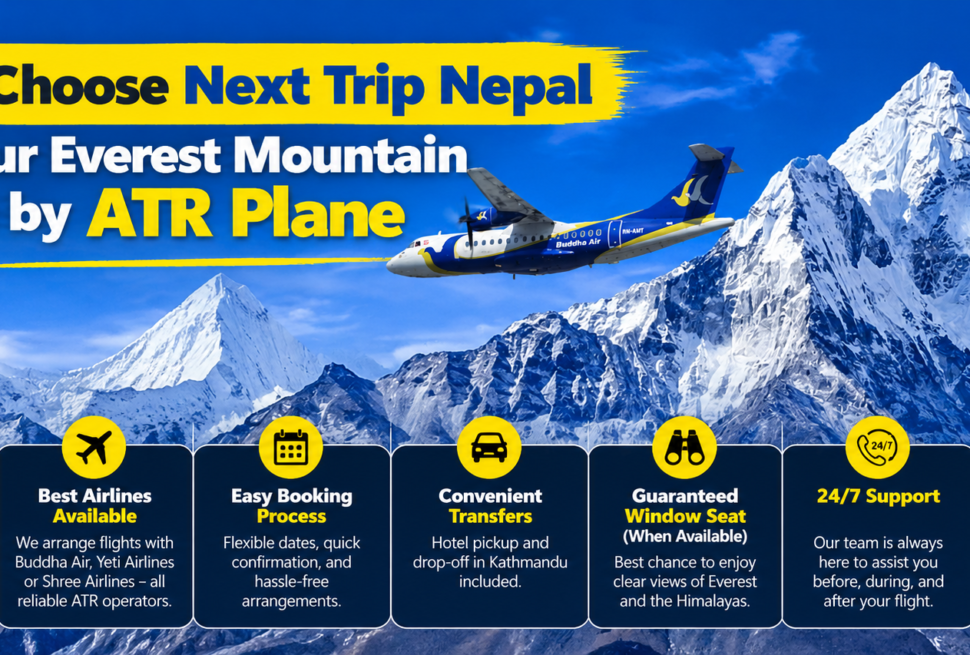
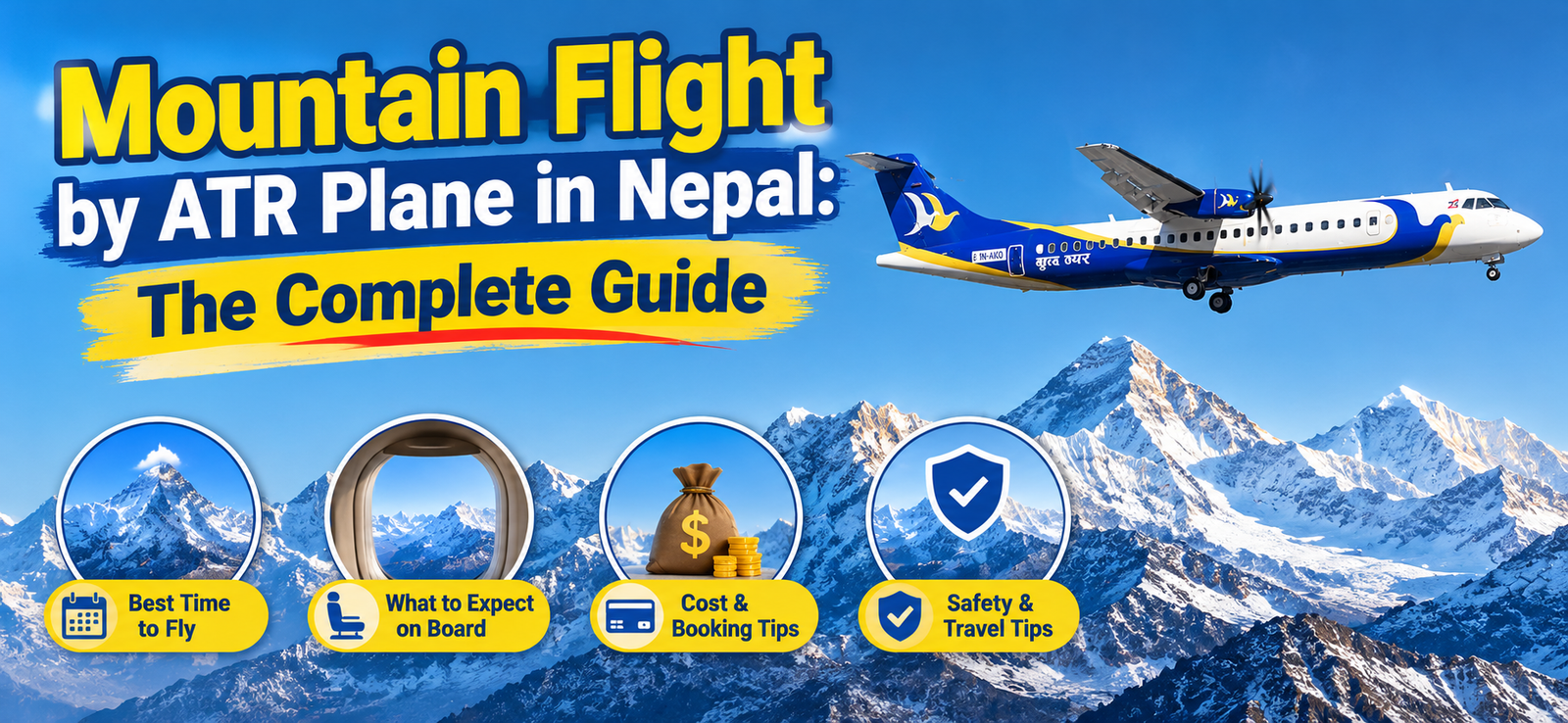
The aircraft used for this route are small twin engine turboprops built by ATR, a French Italian manufacturer that specializes in regional aircraft built for exactly this kind of short sector flying in mountainous terrain. Buddha Air, the carrier that has run this product the longest and in the largest volume, flies two versions on the mountain flight: the ATR 72 500, which seats 36 passengers, and the smaller ATR 42 320, which seats 24. Yeti Airlines and Shree Airlines also operate the route using comparable ATR turboprop aircraft of similar seating capacity. We go into the differences between these aircraft types, their cabin layout, and why this specific aircraft family suits mountain flying so well in a separate article, our guide to the ATR aircraft used on the Everest mountain flight, but the short version matters here too.
These are narrow body aircraft with a single aisle and two seats on each side of that aisle, which means every seat on the plane is a window seat. There is no middle seat on an ATR 72 or ATR 42 configured this way. This is one of the more reassuring facts for anyone booking a mountain flight, because it removes the anxiety of being assigned a bad seat. You will see the mountains regardless of where you sit, though which side of the plane you sit on does change which mountains pass closest to your window during each leg of the loop, something we explain fully in the route section below and in more detail in our companion piece on what you actually see on the mountain flight route.
Turboprops like the ATR 72 and ATR 42 are chosen for this work rather than jets for a few practical reasons. They cruise at a lower altitude and a slower speed than a jet, which matters when the entire commercial reason for the flight is giving passengers time to look out the window at specific peaks rather than just getting from one runway to another. They also perform well on the relatively short runways and in the thinner air found at Nepal’s airports, and they are the standard regional aircraft used across the country for domestic routes to mountain airstrips, so operators already have fleets, maintenance infrastructure, and trained crews built around this aircraft family. None of this is exotic or experimental equipment. It is the same basic airplane used on short regional hops around the world, just flying a scenic loop instead of a point to point route.
The Route: From Kathmandu Along the Himalaya and Back
The flight departs Tribhuvan International Airport and climbs northeast over the Kathmandu valley, giving an early view of the terraced hills and the city itself before the terrain starts rising in earnest. The aircraft then turns to track roughly along the main Himalayan range, passing Langtang Lirung first, then continuing east with the main wall of high peaks visible along one side of the aircraft for most of the flight. The route continues past the Everest and Lhotse massif, as far as Chamlang near the eastern end of the loop, before turning back toward Kathmandu for the return leg.
On a clear day you can expect to see something in the order of twenty peaks above 8000 meters from the window over the course of the flight, among them Cho Oyu, Shishapangma, Everest, and Lhotse. That is a genuinely unusual thing to be able to say about a single hour in the air anywhere in the world, since there are only fourteen peaks above 8000 meters on the planet and this one flight brings many of them, plus a long supporting cast of slightly lower giants, past the same set of windows. The crew typically gives a running commentary identifying peaks as they come into view, timed to the aircraft’s position, which helps passengers who are not familiar with Himalayan geography actually know what they are looking at rather than just seeing an undifferentiated wall of snow and rock.
Because the aircraft flies one direction out and the same direction back along essentially the same line, rather than circling each peak, the mountains tend to be visible primarily from one side of the cabin during the outbound leg and the other side during the return, which is part of why crews sometimes rotate window access or invite passengers to briefly cross the aisle for a look, depending on the aircraft, the load, and the individual flight attendant’s approach that day. We cover which side tends to get the better view on which leg, and how to think about seat choice within the booking you are given, in the companion article linked above. For most travelers the honest answer is that both sides see a great deal, and the difference matters less than people expect once they have been in the air on a genuinely clear morning.
How Booking Actually Works, and Whether It Differs by Operator
This is the part that most published guides skip entirely, and it is where most of the confusion actually lives. Booking a mountain flight by ATR plane works in one of two ways: directly through an airline’s own sales desk or website, or through a local tour operator who holds allocation across multiple carriers and handles the paperwork for you. Both routes get you onto the same aircraft type, operated under the same regulatory rules, for roughly the same money. The practical differences are in flexibility, in who absorbs the hassle when something changes, and in how payment is handled.
Pricing for the mountain flight typically runs somewhere between about 199 and 250 US dollars per person, depending on which operator you fly, the season, and how far in advance you book. That range should be treated as a planning figure rather than a quote, since airlines in Nepal adjust mountain flight pricing periodically and seasonal demand around the clearer months pushes prices toward the top of that range. Always confirm the current price directly before you commit, whether you are booking through an airline or through an agent. We keep a detailed, regularly checked breakdown of current pricing and what drives it in our dedicated mountain flight cost and booking guide for 2026, which is worth reading alongside this article if price is your main question.
Does Seat Quality or Price Really Differ by Airline
Not as much as the marketing of any one operator might suggest. Buddha Air, Yeti Airlines, and Shree Airlines all fly ATR turboprops of comparable vintage and configuration on this route, all seats are window seats on all three carriers, and all three operate under the same Civil Aviation Authority of Nepal rules and the same basic flight profile along the same general route. The honest differences are smaller and more operational: fleet size and schedule frequency (which affects how easily you can get rebooked if your original flight cancels), the specific aircraft variant you might be assigned on a given morning (the smaller ATR 42 at 24 seats versus the larger ATR 72 at 36 seats), cabin crew style and how actively they narrate the peaks, and, at the margins, ticket price on a given date. None of the three carriers has a track record of meaningfully worse views or meaningfully more cancellations than the others on this specific product. Anyone telling you one airline’s mountain flight is dramatically superior to another’s is usually selling you something.
Where it genuinely does matter which operator you fly, or more precisely which agent you book through, is flexibility when weather intervenes, which happens more often on this flight than most first time travelers expect. We go into exactly how that works in the next section, because it is one of the biggest gaps in existing guides and it is the single most common real world frustration travelers report with this product.
Booking Through Next Trip Nepal
As a Kathmandu based tour operator, Next Trip Nepal holds allocation across the main carriers running this route and books the mountain flight for travelers without requiring any payment in advance. You confirm the date and pay once you have actually arrived in Nepal, which removes the awkward situation of having paid a foreign airline in full weeks ahead of a flight that might move by a day or two for weather. This matters more than it sounds, because weather driven schedule changes are routine on this flight, not rare, and having a local operator who can shift you between flights or between carriers on short notice, in person, in your own time zone, is a real practical advantage over booking cold from abroad. If you want the full experience built around the flight itself, including hotel pickup and drop off, our Everest Scenic Flight trip page has current departure details and booking steps.
Best Time of Year for the Mountain Flight
Timing matters more for this flight than for almost anything else on a Nepal itinerary, because the entire value of the product depends on visibility. Broadly, October through April is the window serious operators and experienced travelers point to. October and November, right after the summer monsoon clears out, are usually the most reliable months of the year, with crisp air, minimal haze, and a strong track record of flights actually going as scheduled. Winter, December through February, tends to deliver very clear skies as well, often the sharpest mountain definition of the year, though mornings can bring ground fog at Kathmandu airport that delays the first wave of departures until it burns off, sometimes by an hour or two.
Spring, March and April, is still a workable season and a popular one because it lines up with trekking season for many visitors, but regional haze and agricultural burning in the hills tend to soften visibility compared to the crisp air of autumn. The June through September monsoon period is the season to avoid if the mountain flight is a priority, since cloud cover and storm activity during those months make cancellations and delays far more common than at any other time of year. None of this means a monsoon season flight is unsafe, it means the odds of actually seeing the mountains, rather than cloud, drop substantially. We break down each season in far more operational detail, including which weeks within each month tend to run best, in our dedicated article on the best time of year for the mountain flight by ATR plane.
Within any season, mornings are simply better than the rest of the day, and that is why this flight is scheduled at dawn rather than at a more civilized hour. Convection builds through the morning as the sun heats the valley floor, and by midday cloud regularly stacks up along the high peaks and obscures views that were crystal clear two hours earlier. That is the entire reason behind the early pickup times covered next. Nobody involved in running this flight enjoys a 5 30 in the morning schedule. It exists because the air is calmest and clearest before the day’s heat gets moving, and every operator on this route, Buddha Air, Yeti Airlines, and Shree Airlines alike, schedules around the same basic window for the same reason.
Airport Logistics: Check In, Baggage, Camera Rules, and Security
This is the section most competitor content skips almost entirely, and it is the part that actually determines whether your morning goes smoothly or turns into forty five minutes of confused standing around in a terminal you have never been in before. Here is how the morning typically runs.
Hotel pickup for the mountain flight is usually scheduled around 5 30 in the morning, which feels brutal the night before and entirely reasonable once you are actually watching Everest from 20,000 feet an hour and a half later. The vehicle takes you to Tribhuvan International Airport’s domestic terminal, which is a separate building from the international terminal most visitors arrived through, so if you are being dropped off by someone unfamiliar with Kathmandu, confirm they know this distinction, since the two terminals are a short drive apart and not interchangeable.
Check in at the domestic terminal for a mountain flight typically opens well before the scheduled departure, and your operator or the airline will usually want you there with enough buffer to clear the counter, security, and boarding gate comfortably before the stated takeoff time, which generally sits somewhere between 6 15 and 7 in the morning depending on the carrier and the day’s schedule. Bring the same passport you traveled into Nepal on, since domestic flights in Nepal still require photo identification at check in and security, and have your ticket or booking confirmation ready, whether that is a printed voucher from your tour operator or a confirmation on your phone.
Baggage is a minor consideration on this flight since it is a short scenic loop that returns to the same airport, not a one way trip with luggage to check through. Most passengers carry nothing more than a daypack, a camera, and a jacket, and airlines generally do not enforce the kind of strict baggage weight limits on a sightseeing flight that they would on a one way domestic sector to a mountain airstrip. That said, treat it like any other flight in terms of what goes through security: no large liquids past the standard limits, and anything questionable in a carry bag will be asked about at the checkpoint the same as on any other flight anywhere.
Camera rules are simple and liberal compared to a lot of other scenic flight products around the world: cameras, phones, and small camcorders are allowed and genuinely encouraged, since photographing the peaks is most of the point of the flight. There is no rule against photographing from your seat, and crew are generally used to a cabin full of people filming and shooting stills throughout. The practical limitation is not a rule, it is the window itself: ATR windows are small, slightly curved, and can pick up reflections and scratches, so a lens hood, a polarizing filter, or simply pressing the lens close to the glass and shielding stray light with your hand will do more for your photos than any amount of camera gear. Flash photography is pointless given the distances involved and best skipped.
Security screening at the domestic terminal follows the same basic pattern as international security: bags through an x ray scanner, a walk through a metal detector or a pat down, and a boarding pass and passport check at the gate. The process generally moves faster than international departures since domestic volume, while busy at peak season, is smaller scale and more routine. Boarding for a mountain flight is usually a short walk or a brief bus ride out to the aircraft on the tarmac rather than a jet bridge, standard for this size of airplane at this size of terminal.
Once boarded, the flight itself runs on a tight, well rehearsed schedule: taxi and takeoff, a climb toward the mountain range, roughly thirty five to forty minutes of the aircraft tracking along the peaks while the crew narrates, a turn back toward Kathmandu, and a descent and landing. Total flight time door to door at the aircraft itself runs about 50 minutes to an hour. Once you add hotel pickup, the check in and security process, and the drop off back at your hotel afterward, the whole morning usually wraps up in just under three hours from the moment the van first picks you up. That efficiency, more than almost anything else, is why this flight has become such a standard add on for travelers who have a free morning in Kathmandu and want a serious mountain view without committing days to it.
What You Receive Onboard
Most operators build a small, consistent set of extras into the mountain flight experience. Expect an in flight briefing from the crew identifying the major peaks as they pass, timed roughly to the aircraft’s position along the route. A brief cockpit visit is common on many flights, where the crew invites passengers up individually for a quick look and a photo near the flight deck, though this is not guaranteed on every departure and depends on the specific crew, the day’s schedule, and operational factors that have nothing to do with you personally, so treat it as a pleasant possibility rather than a promised inclusion. Most carriers also hand out a souvenir route map showing the peaks along the flight path, and a flight certificate noting that you flew the Everest mountain flight, which makes a nice small keepsake even if it is ultimately a marketing item rather than anything official.
Weather Cancellations: Refunds and Rebooking, Explained Properly
Here is the single most important practical fact about this flight that most articles leave out entirely: weather driven cancellations and delays are a normal, expected part of operating the mountain flight, not a rare failure. The flight depends entirely on clear visibility along the route, and Kathmandu mornings, especially in winter, can bring valley fog that takes an hour or two to clear. When that happens, airlines do not send the aircraft up to fly a loop through cloud with nothing to see. They hold the flight on the ground until conditions improve, or they cancel it outright if the fog or cloud is not expected to clear that morning.
From a passenger’s perspective, a weather delay on the morning of your flight usually means waiting at the airport, sometimes for an hour or more, while the airline monitors conditions. This is genuinely common enough that building a buffer into your schedule for that day, rather than planning a tight connection or an activity immediately afterward, is good practical advice that experienced travelers in Kathmandu follow as a matter of course.
If the flight is cancelled outright rather than merely delayed, the standard practice across operators is to rebook you onto the next available flight, which in practice usually means the following morning, subject to seat availability on that date. If your schedule in Kathmandu cannot accommodate another morning, or if a rebooking genuinely is not possible within your travel dates, a refund is the fallback, though the exact mechanics (full refund, partial refund, or credit) depend on the fare rules of the specific airline or the policy of the agent who booked it for you, so it is worth confirming this explicitly at the time of booking rather than assuming. This is exactly the kind of situation where booking through a local operator who can act on your behalf in person, in Kathmandu, during Nepal business hours, tends to produce a faster and less stressful outcome than trying to sort out a refund or rebooking by email from a foreign airline’s customer service desk after you have already left the country. It is also the main practical reason we do not ask for payment until travelers have arrived in Nepal: nobody should be out their money for a flight that has not actually happened yet.
One useful mental model: treat the mountain flight as a weather dependent activity from the start, the same way you would treat a scenic hot air balloon ride or a whale watching boat trip, rather than as a guaranteed, fixed departure like an international flight. Building one extra buffer morning into your Kathmandu stay, if your overall itinerary allows it, meaningfully increases the odds that you eventually get a genuinely clear flight rather than settling for a hazy one just because your onward travel date was fixed.
Health and Safety: What Actually Matters, and What Does Not
This section deserves to be read in full rather than skimmed, because it answers two different questions that people frequently mix up: is there altitude risk on this flight, and is Nepali aviation generally safe. The honest answers are straightforward, but they require actually explaining the facts rather than either hiding them or overselling them.
There Is No Real Altitude Exposure Risk on This Flight
A surprising number of travelers researching the mountain flight assume it carries some version of the altitude sickness risk associated with trekking to Everest Base Camp or similar high elevation treks. It does not, and this is worth stating plainly because the confusion is common and the underlying mechanism is completely different. Altitude sickness in trekkers develops over hours and days as the body struggles to adapt to reduced oxygen availability at elevations typically above roughly 2500 to 3000 meters, sustained over time, at ground level, where you are actually breathing that thinner air continuously while exerting yourself physically.
The mountain flight is a pressurized aircraft cabin. The plane climbs to altitude briefly during the loop along the Himalaya, but passengers inside the cabin are breathing air maintained at a cabin pressure altitude far lower than the actual outside altitude, the same basic principle that lets any commercial airliner carry passengers comfortably over high terrain or across oceans at cruising altitudes of 30,000 feet and more without passengers needing supplemental oxygen or acclimatization. You are in the cabin for under an hour, you are not exerting yourself, and the aircraft never lands at a high elevation airstrip where you would actually step out into thin air. There is no trekking style altitude exposure on this flight at all. If your only concern about joining this flight is whether it carries the same health risk as hiking to Base Camp, you can set that concern aside.
Regulation: The Civil Aviation Authority of Nepal
All domestic and mountain sightseeing flights in Nepal, across every carrier, are regulated by the Civil Aviation Authority of Nepal, generally known as CAAN, which sets operating rules, licenses carriers and crew, and oversees airworthiness and safety compliance across the industry. CAAN rules apply equally to Buddha Air, Yeti Airlines, and Shree Airlines on this route, and the regulatory framework has tightened meaningfully in recent years, including a specific update relevant to anyone flying during the wetter months of the year.
In June 2026, CAAN issued a new monsoon safety circular, effective from June 15, 2026, that tightens operating rules specifically around the kind of unstable weather that drives most mountain flight disruptions. The circular requires mandatory preflight technical and weather checks before any flight departs, a minimum buffer distance of 20 nautical miles from severe thunderstorm activity, functioning anti skid systems, weather radar, and Ground Proximity Warning Systems as mandatory equipment, and new monsoon safety and diversion training specifically for flight crews. This applies across all Nepali carriers, Buddha Air, Yeti Airlines, and Shree Airlines included, and it reflects a regulator actively tightening its own rules rather than standing still, which is the kind of detail that rarely makes it into older articles about this flight.
An Honest Look at the EU Air Safety List and the 2023 Yeti Airlines Accident
Two facts come up often enough in traveler research that avoiding them in a guide like this would be a disservice, so here they are, explained plainly rather than glossed over or sensationalized.
First, Nepali certified carriers currently appear on the European Union’s air safety list, which means they are barred from operating flights into EU airspace. It is worth being precise about what this actually measures. The EU list is built around an assessment of the regulatory oversight capacity of a country’s civil aviation authority, essentially a judgment about the depth and resourcing of the regulator itself, as evaluated against European aviation standards, not a flight by flight danger rating of any specific airline or any specific route within Nepal. It has no bearing on domestic flights operated within Nepal, including the mountain flight, and reflects an institutional assessment of CAAN’s international oversight framework rather than a statement that any particular Nepali flight is unsafe to board.
Second, in January 2023, a Yeti Airlines ATR 72 500 crashed on approach to Pokhara while operating a scheduled domestic flight between Kathmandu and Pokhara. This was a real accident with a serious loss of life, and acknowledging it plainly is the honest approach rather than avoiding the subject. Nepal’s official accident investigation, completed in December 2023, found the probable cause was pilot error, specifically an inadvertent movement of both engine condition levers into the feathered position while the aircraft was still in flight, which effectively shut down thrust from both engines. Contributing factors identified in the investigation included a high workload during approach to a newly opened airport that both pilots were still becoming familiar with, and weak coordination between the two crew members during a critical phase of flight. Readers who want the full technical detail can review summaries of the investigation through aviation safety reference organizations that track and archive accident reports from investigating authorities worldwide.
What matters for anyone considering the mountain flight is understanding how that accident differs operationally from the product described in this article. The Pokhara accident involved a scheduled point to point domestic flight, approaching an unfamiliar airport, during a landing phase, the single most demanding and workload intensive part of any flight, and the specific finding centered on a crew level error during that approach. The mountain flight is a different kind of operation: it departs from an airport the crews fly out of constantly, it does not approach or land at any airport other than the one it took off from, and it does not involve the specific landing phase workload at an unfamiliar runway that the investigation identified as a contributing factor in 2023. Mountain sightseeing flights over this route have a long operating history without anything resembling that kind of incident. None of this erases what happened in 2023, and it should not be used to pretend the accident did not occur. It simply means that treating a scheduled point to point domestic flight’s accident as equivalent, risk wise, to this specific sightseeing loop is not an accurate reading of what the investigation actually found. Good research means sitting with both facts at once rather than picking whichever one is more convenient.
Comparing the Operators: Buddha Air, Yeti Airlines, and Shree Airlines
With the safety picture laid out honestly, here is a practical, non alarmist comparison of the three carriers that actually fly this route, focused on what differs in ways that matter to a traveler booking this specific flight.
Buddha Air has run the mountain flight the longest and at the largest scale of any operator in Nepal, flying both the larger 36 seat ATR 72 500 and the smaller 24 seat ATR 42 320 depending on demand and schedule. Its scale generally translates into more frequent morning departures during peak season, which matters when weather forces a rebooking, since more flights in a day means more room to slot a displaced passenger onto a later departure the same morning or the next day.
Yeti Airlines also operates ATR turboprop aircraft of comparable configuration on this route and has a long history flying both this sightseeing product and its broader domestic network across Nepal, including to mountain airstrips most visitors have never heard of. Its mountain flight product runs on the same basic structure as its competitors: early morning departure, roughly an hour in the air, full window seating.
Shree Airlines rounds out the main three, also flying comparable ATR aircraft on broadly the same schedule and route profile as the other two. Shree has historically had a smaller footprint specifically in the mountain sightseeing segment compared to Buddha Air, though it remains a regularly available option.
For a traveler simply trying to get the clearest morning and the fewest headaches, the honest advice is to pick based on departure time availability on your actual travel dates and the flexibility of whoever books it for you, rather than any claimed superiority of one airline’s aircraft or crew over another’s. All three fly comparable ATR aircraft, all three answer to the same CAAN rules, and all three deliver the same basic view along the same general route on a clear morning. The meaningful variable is less which airline’s name is on the ticket and more whether your booking channel can move you smoothly to a different flight or a different morning when weather intervenes, which is a point worth returning to when you are actually booking.
Practical Tips for Getting the Best Experience
A short set of habits separates travelers who come away thrilled from travelers who come away mildly disappointed, and almost none of it is about which airline you pick.
- Fly in the clearest stretch of the season if your schedule allows any flexibility at all, favoring October and November, since visibility, not the airline or the aircraft, is what actually determines how good your flight is.
- Dress in light layers rather than heavy clothing, since you will be moving between a warm van, a crowded terminal, and a cool aircraft cabin all within the same hour, and bring a light jacket for the pre dawn pickup even though the cabin itself is comfortable.
- Charge your camera or phone the night before and clear storage space, since this is one of those flights where people routinely take more photos in fifty minutes than they do in the rest of a trip combined.
Beyond that short list, the single biggest lever most travelers do not think about is simply building a buffer day into their Kathmandu schedule rather than scheduling the mountain flight on the one morning before a tight onward connection. Given how routine weather delays and cancellations are on this specific product, that buffer is the difference between eventually getting a genuinely clear flight and settling for whatever happens to be available on a single fixed morning.
Frequently Asked Questions
Is the mountain flight the same as a helicopter tour?
No. This article covers the fixed wing ATR aircraft sightseeing flight only, which departs and lands at Kathmandu’s main airport without ever touching down elsewhere. Helicopter tours are a separate, different product with different pricing, different aircraft, and in many cases a landing at altitude, and they are not covered in this guide.
Do I need travel insurance or any medical clearance to take this flight?
Since there is no altitude exposure risk and the flight involves no physical exertion, the mountain flight does not require the kind of medical preparation or altitude acclimatization that a high elevation trek would. Standard travel insurance that covers your trip generally is sufficient, though as with any flight, check your specific policy if you have particular health concerns.
Can I choose which side of the plane I sit on?
Sometimes, depending on the operator and how the booking is handled, though it is not always guaranteed, since seating is often assigned at check in based on the aircraft’s balance and loading requirements rather than purely on passenger preference. Because every seat is a window seat on these aircraft, the practical impact of which side you end up on is smaller than many travelers assume, a point covered in more depth in our dedicated article on what you actually see along the route.
What happens if I am traveling with young children?
Children are welcome on the mountain flight, and the short duration makes it one of the easier Himalayan activities to do with a family compared to multi day trekking. Check with your booking operator on any age specific fare rules, since these can vary slightly by carrier.
Is the flight worth it if the forecast looks only partly clear?
Airlines will generally still operate the flight if conditions meet minimum visibility standards, even if the sky is not perfectly clear everywhere along the route, and many flights that depart under a partly hazy forecast still deliver strong views of the main peaks. If conditions are genuinely too poor to see anything meaningful, the flight is more likely to be delayed or cancelled outright rather than flown for nothing, which is covered in the cancellation section above.
Final Thoughts
The mountain flight by ATR plane is one of the more efficient, reliable ways to put twenty 8000 meter peaks in front of your own eyes without committing days of walking or a large travel budget to the experience. It is not a flawless, guaranteed product. Weather intervenes often enough that flexibility matters, the aircraft and crews are standard rather than exotic, and the honest safety picture, properly explained rather than hidden or exaggerated, is more nuanced than a one line marketing claim from any airline’s own website. Go in understanding how booking actually works, how check in and security at the domestic terminal actually run, what your realistic options are if weather cancels your morning, and what is and is not a legitimate safety concern, and the flight itself tends to deliver exactly what it promises on a clear Kathmandu morning: Everest, Lhotse, Cho Oyu, Shishapangma, and a long wall of lesser known giants passing steadily by your window for about fifty minutes, with a cup of tea and a certificate waiting for you back on the ground. If you are ready to put a date on the calendar, our Everest Scenic Flight trip page has current schedules, and we are glad to answer any specific question about your dates before you commit to anything.