October is the month I sell out first every year, and after guiding it season after season I understand exactly why. Annapurna Base Camp sits at 4,130m, and in October the sanctuary sees night temperatures around -5°C with days climbing to about +8°C under some of the clearest skies Nepal produces all year. Every condition that makes this trek famous lines up in October at once, dry trails, sharp mountain definition, comfortable temperatures at every elevation, and teahouses running at full capacity from Nayapul to the sanctuary itself. The cost of that convergence is crowds, and I will be honest about exactly what that means before you book.
October ABC Trek at a Glance
| Season | Post monsoon peak, the single best month of the year |
| Recommended for | Everyone, especially first time Himalayan trekkers |
| ABC Temperature Range | -5°C to +8°C at 4,130m |
| Pokhara Temperature | 17°C to 28°C |
| Trail Conditions | Dry, well maintained, no leeches |
| Teahouse Availability | Fully open, book ahead for Ghorepani and ABC |
| Crowds | Highest of the year, the trade off for ideal conditions |
| Guide Required | Yes, mandatory under ACAP regulations |
| Overall Difficulty | Moderate, best conditions of the year with no weather complications |
Why October Earns Its Reputation
The monsoon retreats from the Annapurna region by late September, and by the first week of October the weather pattern that defines the entire autumn season is fully established. A stable high pressure system settles over the Himalaya, bringing consistently clear skies, low humidity and minimal cloud formation. I have guided Octobers where the group saw the full Annapurna panorama clearly on every single day of a 10 day trek without a single obstructed sunrise, something I genuinely cannot promise in any other month.
At the sanctuary itself, October mornings begin cold, typically -5°C to -3°C at first light, then warm quickly under direct sun to +6°C or +8°C by early afternoon. The sky stays clear through most of the day, with only light afternoon cloud that rarely obscures the peaks. By 8pm the temperature drops back toward freezing, so nights at MBC and ABC still require a proper sleeping bag and full layer system despite the pleasant days.
October Weather Table by Location
| Location | Night Low | Day High | Conditions |
|---|---|---|---|
| Pokhara (827m) | 17°C | 28°C | Clear, dry, warm days, cool evenings |
| Tikhedhunga (1,540m) | 12°C | 24°C | Pleasant, dry trail, early autumn foliage |
| Ghorepani (2,860m) | 4°C | 16°C | Clear mornings, superb Poon Hill views |
| Chhomrong (2,170m) | 8°C | 20°C | Comfortable, dry, great valley views |
| Himalaya (2,920m) | 2°C | 13°C | Cool and clear, gorge forest at its best |
| Deurali (3,230m) | -1°C | 10°C | Cold nights, crystal clear skies |
| MBC (3,700m) | -3°C | 7°C | Cold, magnificent Annapurna South views |
| ABC (4,130m) | -5°C | 8°C | The best mountain views of the year, cold nights |
Wind is generally light on the main ABC route in October. The Kali Gandaki valley north of Ghorepani can channel strong afternoon winds down from the Tibetan plateau, but the sanctuary itself sits sheltered by the surrounding peaks and sees calmer conditions than the exposed ridgelines further west. I mention this because guests often ask about wind chill specifically, and on the ABC route itself it is rarely the dominant factor the way it can be on more exposed routes elsewhere in Nepal.
Mountain Views in October
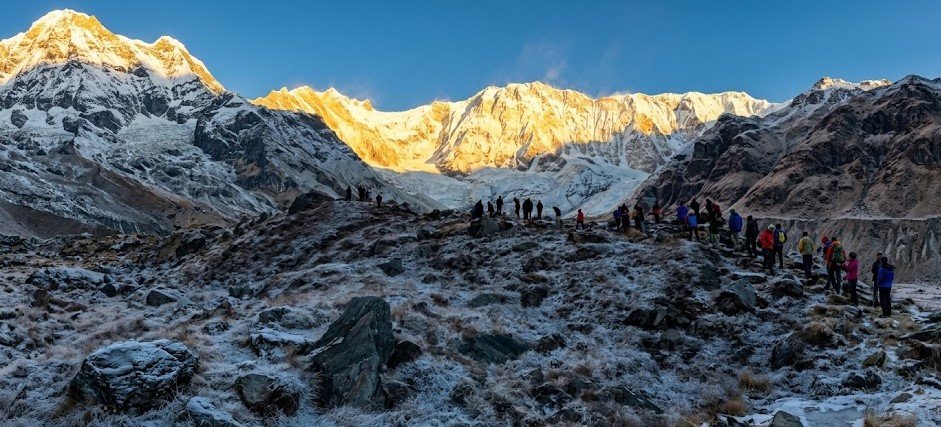
October delivers the most reliable mountain views of the entire trekking year. The post monsoon atmosphere has washed particulate matter out of the air, and the dry season dust haze that builds up by December and January has not yet developed. From ABC, the full amphitheatre of peaks, Annapurna I at 8,091m, Annapurna III, Annapurna South, Hiunchuli, Gangapurna and Machhapuchhre, stands visible from first light on the vast majority of October mornings without any cloud obstruction.
The Poon Hill sunrise at 3,210m is close to a guaranteed spectacle in October, with the probability of a fully clear view exceeding 85 to 90 percent on any given morning by my own tally over many seasons. Dhaulagiri to the northwest and the western Annapurna range to the east frame a horizon of 8,000m peaks at first light. The trade off, and I tell every guest this honestly, is that you will share that viewpoint with a genuinely large number of other trekkers on peak October mornings.
October Day by Day Itinerary
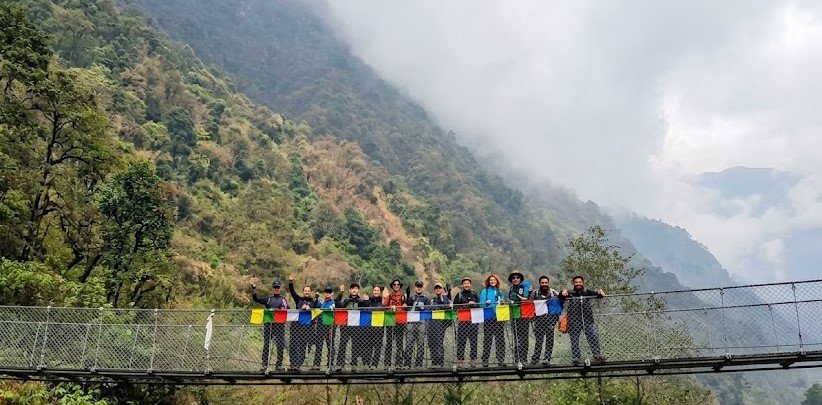
Day 1: Pokhara to Tikhedhunga (1,540m). A private vehicle takes us from Pokhara to Nayapul in 45 minutes to an hour, then we begin walking through the Bhurungdi Khola valley, passing terraced farms and small villages and crossing several suspension bridges. Elevation gain around 700m, walking time 4 to 5 hours. The lower valley in October is warm and clear with good early views of the foothills.
Day 2: Tikhedhunga to Ghorepani (2,860m). This is the defining climb of the lower route, roughly 3,600 stone steps through Ulleri at 1,960m and up to the ridge above. The forest is transitioning toward autumn colour in October, mixed green with early yellow tones. Elevation gain approximately 1,320m, walking time 5 to 6 hours.
Day 3: Poon Hill sunrise, on to Chhomrong (2,170m). We leave at 4am for the 45 minute climb to Poon Hill in the dark with headlamps, watching Dhaulagiri and the Annapurna range light up at sunrise. After breakfast back at Ghorepani we descend through Tadapani and continue down to Chhomrong, which looks directly up toward Annapurna South and Hiunchuli. Walking time after Poon Hill is 5 to 6 hours, total day around 8 to 9 hours.
Day 4: Chhomrong to Himalaya (2,920m). We descend to the Chhomrong Khola suspension bridge then climb through Sinuwa and Bamboo into increasingly dense forest with bamboo groves and rhododendron. In October this forest is at its autumn transition, early yellow tones against the evergreen rhododendron canopy. Walking time 5 to 6 hours.
Day 5: Himalaya to Deurali (3,230m). A deliberately shorter day, allowing acclimatisation before entering the sanctuary. We pass through Dovan and cross the Modi Khola several times on suspension bridges. Waterfalls that roar at full monsoon volume in July are down to a dry season trickle by October. Walking time 3 to 4 hours.
Day 6: Deurali to Annapurna Base Camp (4,130m) via MBC. The signature day. We enter the upper gorge, which squeezes between the walls of Hiunchuli and Machhapuchhre before opening into the sanctuary. MBC at 3,700m is reached after roughly 2 hours, then a further 2 hour ascent across moraine to ABC. The approach in October is extraordinary, Annapurna South fills the sky directly ahead while Hiunchuli and Gangapurna close in from either side. Walking time 5 to 6 hours.
Day 7: Full day at Annapurna Base Camp (4,130m). We wake at first light to watch the sun strike Annapurna I’s summit snowfields, turning them gold and orange before reaching the base camp floor. I walk guests along the moraine paths toward the glacier tongues and lateral moraines through the morning, then rest during the middle of the day when UV exposure at this altitude is at its most intense, SPF 50 plus sunscreen is essential throughout.
Day 8: ABC to Bamboo (2,310m). The first descent day, retracing the route through MBC and Deurali and down through the gorge. The descent feels faster than the climb but demands attention on the long staircase sections. Walking time 6 to 7 hours.
Day 9: Bamboo to Jhinu Danda (1,760m). We continue the descent through Sinuwa and up to Chhomrong, then down to Jhinu Danda on the Chhomrong Khola, where a natural hot spring by the river, entry around NPR 300, is an essential stop after a week on the trail. Walking time 4 to 5 hours plus hot spring time.
Day 10: Jhinu Danda to Pokhara. A final walking day from Jhinu Danda to Nayapul, 3 to 4 hours, then a vehicle back to Pokhara, 45 minutes to an hour. The trek concludes at Pokhara lakeside.
Teahouses in October
Every teahouse on the route operates at full capacity in October, including secondary stops that reduce service in the monsoon months. Ghorepani is the busiest non sanctuary night on the route, with 15 or more lodges that still fill completely on peak evenings, so I book ahead whenever possible. Chhomrong has a good range of options and is less likely to fill entirely than Ghorepani, though booking ahead in the second and third weeks of October is still advisable. Himalaya and Deurali have fewer options but solid main lodges at each. At MBC, two to three main teahouses serve a mix of lunch stops and overnight breaks. At ABC itself, three main teahouses serve the sanctuary and these are the most heavily booked accommodations on the entire route, reserved through our guide network before we even leave Pokhara.
Food quality is at its October best throughout the route. Fresh vegetables reach the high teahouses before the dry season supply difficulties begin, and the full menu of dal bhat, pasta, noodles, soups, pancakes, eggs and hot drinks is genuinely available at every stop, not a reduced version of it.
Managing the October Crowds
I will not pretend October crowds are not real, because they are, and I would rather you know exactly what to expect than be surprised on the trail. In peak mid October, the main teahouses at Ghorepani see 100 to 200 trekkers a night, and ABC’s teahouses fill their 40 to 60 rooms by mid afternoon on the busiest days. The trail itself feels shared but not unpleasant, since the route is long enough that groups string out naturally and you will still have stretches of solitude even in peak October.
What I do to manage this for my groups: start early. Most trekkers leave teahouses between 7am and 8am, so departing at 6am on the critical days, the Tikhedhunga to Ghorepani climb, the Deurali to ABC push, means arriving ahead of the main wave and getting the better rooms and quieter viewpoints. I book teahouses in advance for Ghorepani and ABC specifically for the peak weeks of October, roughly October 10 to 25. I also favour mid week departures where possible, since most organised treks leave Pokhara on a Saturday or Sunday, meaning the trail is most crowded mid week, so a Tuesday or Wednesday departure sits ahead of or behind the main wave rather than inside it.
For Poon Hill specifically, the standard 4am departure puts you at the viewpoint alongside dozens or hundreds of other trekkers at peak October. Those who arrive by 3:30am get the better position. An alternative I sometimes suggest is an afternoon visit to Poon Hill, 2pm to 4pm, for different but equally dramatic light on Dhaulagiri and Annapurna, with far fewer people and no pre dawn alarm required.
October Permits and Costs
Permit requirements are standard year round. The ACAP permit costs NPR 3,000, about USD 22, and the TIMS Card costs NPR 2,000, about USD 15, both arranged at the Nepal Tourism Board office in Kathmandu or the ACAP counter in Pokhara’s Damside or Lakeside area. I carry copies for every guest and present them at the checkpoints at Nayapul, Ghorepani, Chhomrong and inside the gorge.
October is peak season pricing on the trail. Guide daily rates run USD 35 to 50 for an experienced licensed guide, porter rates USD 28 to 35 for one porter carrying up to 20kg. Accommodation runs USD 5 to 20 per room per night, higher at ABC itself. Meals for two trekkers run USD 30 to 50 per day. A standard 10 day guided October budget per person ranges from USD 900 to 1,400, depending on group size, accommodation choices and whether you fly or drive between Pokhara and Kathmandu.
We operate a no advance payment booking policy across both Manaslu Treks and Expedition and Next Trip Nepal, meaning you do not need to send a deposit to hold an October date. We confirm your itinerary and teahouse bookings first, then agree payment terms together.
Packing List for October
| Category | Item | Notes |
|---|---|---|
| Footwear | Waterproof, well broken in trekking boots | Essential for stone steps all day |
| Footwear | Collapsible trekking poles | Essential for the descent days |
| Warmth | Down jacket, 750+ fill power | Essential for ABC nights around -5°C |
| Warmth | Sleeping bag rated -10°C | Teahouses provide blankets but a proper bag is safer |
| Warmth | Wool or fleece hat and gloves | Essential for the 4am Poon Hill start |
| Layers | Moisture wicking base layer x2 | Dry quickly at teahouses overnight |
| Layers | Fleece mid layer | Used most mornings above 2,500m |
| Sun protection | SPF 50+ sunscreen and lip balm | Critical at ABC, UV is extreme at altitude |
| Sun protection | UV400 sunglasses | Essential near glacier and snowfields |
| Navigation | Headlamp plus spare batteries | For the Poon Hill and ABC dawn starts |
| Health | Water purification tablets or filter | Never drink untreated water on the trail |
Altitude Sickness in October
Altitude sickness remains a genuine risk in October despite the ideal conditions. The ascent from Pokhara at 827m to ABC at 4,130m covers roughly 3,300m of gain in six days, an appropriate rate but not fast enough to prevent AMS in susceptible individuals regardless of fitness. The key acclimatisation stops in the standard itinerary are the short day between Himalaya and Deurali on Day 5 and the full rest day at ABC on Day 7. I do not let groups shorten these days to save time, even though October conditions make the trail feel deceptively easy and fast.
October has excellent helicopter evacuation conditions if something does go wrong, typically available within hours at MBC or ABC when weather permits, which it usually does this month. Descent on foot remains the primary response for mild to moderate AMS and should always be the first move rather than waiting on a helicopter. I discuss acetazolamide, Diamox, with guests before departure, many October trekkers use it prophylactically, along with ibuprofen for headache management and a hard rule of 3 to 4 litres of water a day regardless of thirst.
A Guide’s Perspective on October
People sometimes ask me if the crowds make October not worth it, given everything I have said above. My honest answer is no, not for most trekkers, and especially not for a first Himalayan trek. The crowds are real but manageable with the timing strategies I use, and what you get in exchange is the highest probability of clear views on every single day of your trip, which is not something I can promise in any other month. If you have already done ABC once and want something different, that is when I start steering people toward November or even December. But for a first trip, I still book October more than any other month, and I do it with a clear conscience about what you are getting.
October Compared to November
The practical difference comes down to warmth versus solitude. October nights at ABC run around -5°C, considerably milder than November’s -10°C. Teahouse availability is guaranteed in October versus a confirmation call needed for late November. Crowds in October run 40 to 60 percent higher than November. Views are comparable, with November sometimes edging ahead on clarity in the second half of the month. If maximum comfort and guaranteed teahouse access matter most, October wins. If solitude and atmosphere matter as much as the views themselves, November is worth strong consideration.
The Jhinu Danda Hot Spring in October
By the time an October group reaches Jhinu Danda on Day 9, the natural hot spring by the Modi Khola feels thoroughly earned. Entry costs around NPR 300, and I always build genuine time here, an hour or more, rather than rushing through. After nine days of walking, sitting in warm water with the river running past is one of the moments I watch groups properly relax for the first time on the whole trip, and it is a highlight worth protecting in the schedule even on a busy October itinerary.
Booking Your October Trek
October dates fill quickly, sometimes months in advance for the specific mid October window around Dashain and Tihar. Every guest booking with Next Trip Nepal starts with a stay at the Moonlight Hotel in Thamel, included in the package, and receives an NTC SIM card on arrival in Kathmandu. We handle all teahouse bookings for Ghorepani and ABC directly through our local network well ahead of your departure. There is no advance payment required to hold your date, we confirm the plan first and payment follows on agreed terms.
Annapurna Base Camp Trek: Complete Monthly Guide
Use these month by month guides to plan your ABC trek around the exact conditions you want, or visit the Annapurna Base Camp Trek package page for the full itinerary, cost and booking details. Trek in January, February, March, April, May, June, July, August, September, October, November, or December.
Other Annapurna Region Treks Worth Considering
If a shorter trip suits your schedule better, our 6 Day Annapurna Base Camp Trek compresses the route for fitter trekkers with less time. For those who want the Poon Hill sunrise without continuing to the sanctuary, the standalone Ghorepani Poon Hill Trek is a shorter alternative. Trekkers seeking a different angle on the Annapurna range without the full ABC distance often choose the Mardi Himal Trek, and those with extra time in Pokhara can add the two day Australian Base Camp Trek.
The Dashain and Tihar Factor
October often overlaps with Dashain and Tihar, Nepal’s two biggest festivals, and this affects the trek in ways worth knowing about before you book. Many Nepali guides and porters travel home to be with family during Dashain specifically, which can tighten staffing availability around the festival dates, so I plan our guide and porter rosters for these weeks well in advance rather than scrambling at the last minute. On the positive side, trekking through villages during Tihar means passing homes decorated with oil lamps and marigold garlands in the lower valley, and teahouse owners are often in a genuinely festive mood, sometimes sharing sel roti, a traditional rice doughnut, with trekking guests. If your October dates land during these festivals, I brief you on what to expect and we plan staffing accordingly so service quality does not slip.
What a Typical October Day Actually Looks Like
Beyond the route description, I think it helps to know the actual rhythm of a day. We wake around 6am, share a simple breakfast, usually porridge or eggs with toast and tea, and are walking by 7am to 7:30am on most days. A short break comes mid morning, then lunch at a teahouse along the route, typically dal bhat, which I genuinely recommend over lighter options since the unlimited refills provide real fuel for afternoon walking. We aim to reach the next teahouse by early to mid afternoon, giving time to rest, wash, and enjoy the views before an early dinner and an early night, since most groups are asleep by 8:30pm or 9pm given the early starts the following days require.
Physical Fitness Required for October
The ABC trek does not require technical climbing skill, but it does demand genuine cardiovascular fitness and stamina for sustained daily walking, often 5 to 7 hours on stone steps with significant elevation change. I recommend building up to comfortably walking 3 to 4 hours continuously on hilly terrain in the two to three months before departure, ideally with a loaded daypack to simulate trail conditions. October’s excellent weather removes one variable, you will not be fighting mud or rain on top of the physical demands, but the elevation gain and stone steps remain a real physical challenge regardless of season, and I do not want anyone arriving underprepared just because October has a reputation as the easiest month.
October and First Time Himalayan Trekkers
I guide a significant number of first time trekkers through ABC in October specifically because it removes so many variables that can complicate a first high altitude experience. There is no need to worry about leeches, no mud slowing the pace, no uncertainty about teahouse access, and a genuinely high probability of clear rewarding views at the end of each climbing day, which matters enormously for morale on a physically demanding trip. If this is your first time trekking above 3,000m anywhere in the world, October ABC is one of the most forgiving introductions to high altitude trekking that exists anywhere in Nepal.
Flight and Road Logistics in October
Reaching the ABC trailhead does not carry the mountain airstrip risk associated with Everest region treks, since Nayapul is a short drive from Pokhara rather than requiring a landing at a high altitude airfield. The Kathmandu to Pokhara connection in October is generally reliable whether you take the 25 minute scenic flight or the 6 to 7 hour road journey, since October weather in both cities tends to be stable. Occasional early morning valley fog in Kathmandu can delay the very first flights by an hour or so, which I account for by avoiding the earliest flight slot where possible.
Is October the most expensive month to trek ABC?
Guide, porter and accommodation rates run at their peak season level in October, generally the highest of the year, reflecting demand. The difference compared to shoulder months like November is modest, typically 10 to 15 percent, rather than dramatic.
Can I extend an October ABC trek with other activities in Pokhara?
Yes, Pokhara in October has excellent weather for paragliding, boating on Phewa Lake, and general lakeside relaxation. Many guests add two or three extra days in Pokhara either before or after the trek.
The Forest Transition in October
The gorge forest between Chhomrong and Himalaya undergoes a genuine visual transformation across October. Early in the month, the canopy still holds much of its monsoon green, dense and lush from the summer rains. By late October, the deciduous trees mixed among the rhododendron and bamboo begin showing the first real yellow and amber tones of autumn. I find this transition genuinely beautiful to walk through, and it gives October a different character depending on exactly which week you travel, something most guides do not mention but that I think matters for anyone choosing between early and late October dates.
What Past October Trekkers Tell Me
The feedback I hear most consistently after an October trek is relief, specifically relief that the weather cooperated exactly as promised and that the crowds, while real, did not detract meaningfully from the experience once we applied the early departure strategy I use with every group. Trekkers who arrived nervous about the reputation for crowds almost always tell me afterward that the actual trail experience felt more spacious than they expected, with the crowding concentrated mainly at the teahouse dining rooms and the Poon Hill viewpoint rather than the trail itself.
Group Size for October Departures
October is our busiest season, and group sizes on scheduled departures typically run eight to ten trekkers, our standard cap for maintaining a quality guiding experience and manageable teahouse logistics. Private and custom groups of any size are also available for October dates, and families or groups of friends often prefer this option for more flexibility around pace and rest stops. Solo travellers are placed into a scheduled group departure, which also tends to make the October crowd feel less anonymous, since you are trekking alongside a small group of people you get to know over the ten days rather than moving entirely alone through a busy trail.
Mobile Signal and Charging in October
NTC mobile signal reaches most of the ABC route including the sanctuary itself in clear conditions, and every guest receives an NTC SIM card on arrival in Kathmandu. Charging is available at every teahouse for a small fee, usually NPR 200 to 500 per device, though I recommend carrying a power bank as backup for the higher stops where demand is greatest during peak October occupancy and outlets can be limited.
Should I book my October trek far in advance?
Yes, I recommend booking at least two months ahead for October dates, particularly for the peak mid month window, since teahouse capacity at Ghorepani and ABC genuinely does sell out during the busiest weeks.
Is travel insurance required for the October trek?
Yes, we require it for every guest, covering trekking up to at least 4,500m and helicopter evacuation. This applies regardless of season and is non negotiable for anyone booking through Next Trip Nepal.
The View From MBC in October
Machhapuchhre Base Camp at 3,700m is sometimes treated as just a lunch stop on the way to ABC, but I think it deserves more attention than it gets. The close up view of Machhapuchhre’s fishtail summit from this angle is genuinely different from what you see once inside the sanctuary itself, sharper and more immediate given the proximity. In October’s clear conditions, I often slow the group down here deliberately, letting people take in the view properly rather than rushing straight through to ABC. Some of my favourite October photographs from years of guiding come from this exact spot rather than from the base camp itself.
What happens if my flight from Kathmandu to Pokhara is delayed in October?
October flight delays are uncommon given the stable weather, but if one occurs we simply adjust the start of the trek by a day, or switch to the road option if time is tight. I build a small buffer into every October itinerary for exactly this possibility.
Are there ATMs available along the route in October?
No, once you leave Pokhara there are no ATMs on the trail. I advise every guest to withdraw sufficient Nepali rupees in Pokhara before departure to cover meals, drinks, charging fees and any personal purchases along the route.
Can families with teenagers do the October ABC trek?
Yes, October’s stable conditions make it a good choice for families with reasonably fit teenagers. I adjust the daily pace and can extend the itinerary by a day or two if a family group needs a gentler schedule, and October’s reliable weather removes much of the unpredictability that would make family planning harder in other months.
What is the difference between the 7 day and 10 day October itinerary?
The 7 day version combines some walking days and removes one acclimatisation stop, suited to fitter trekkers with less time. I still recommend the full 10 day itinerary for most guests, since the extra acclimatisation time meaningfully reduces AMS risk even in October’s favourable conditions.
Do I need to carry cash for tipping guides and porters in October?
Tipping is customary and appreciated, though not mandatory. A general guideline is USD 8 to 12 per day for a guide and USD 5 to 8 per day for a porter, shared among the team at the end of the trek, though this varies by group size and personal discretion.
What is the single biggest mistake October trekkers make?
Underestimating the crowds and not booking teahouses in advance. Trekkers who assume they can simply walk up and find a room at Ghorepani or ABC during peak October weeks sometimes find themselves without accommodation. Booking through a guide with an established local network avoids this entirely.
Is there an age limit for the October ABC trek?
There is no strict age limit, and I have guided both children over ten years old and trekkers in their seventies through October ABC successfully. What matters more than age is genuine fitness level and prior trekking experience, which we assess honestly during trip planning before confirming any booking.
Does October have any risk of monsoon rain lingering into the trek?
Very rarely, only in the first few days of the month if the monsoon retreat runs slightly late that particular year. By the second week of October, the dry post monsoon pattern is reliably established, and I plan departures with this in mind, favouring dates from October 5 onward for the most consistent conditions.
Frequently Asked Questions
Is October the best month for ABC?
Yes, by most measures. October delivers the most reliable views, driest trail conditions, most comfortable temperatures and no leech concerns. The only real disadvantage is crowd levels, which peak this month. If you can only trek ABC once, October remains the standard recommendation.
How busy is the trail exactly in October?
In peak mid October, main teahouses at Ghorepani see 100 to 200 trekkers a night and ABC’s rooms fill by mid afternoon on the busiest days. The trail itself feels shared rather than crowded, since groups spread out naturally along the route.
Do I need to book ABC teahouses in advance for October?
Yes, for Ghorepani and ABC specifically. I handle this through our guide network in advance of your departure date, and I do not recommend attempting a self arranged October trek without confirmed bookings at these two stops.
What is the temperature at night at ABC in October?
Roughly -5°C to -2°C. Teahouses are unheated or offer limited electric blankets, so a personal sleeping bag rated to at least -10°C is essential, worn with a full layer system to bed.
Can I do the ABC trek without a guide in October?
No, current ACAP regulations require a licensed guide for the Annapurna Conservation Area. Beyond the legal requirement, a guide handles teahouse bookings, navigates crowded trail logistics and manages any altitude concerns promptly, which matters even more during the busiest month of the year.
Will I definitely see the mountains clearly in October?
Very likely but not guaranteed. Clear view probability exceeds 85 to 90 percent on any given October morning based on my own tally over many seasons, though occasional afternoon cloud can briefly obscure peaks.
How many days does the October ABC trek take?
Our standard itinerary runs 10 days Pokhara to Pokhara, including two built in acclimatisation stops. Some fitter groups compress this to 7 days, though I generally recommend keeping the full schedule for better acclimatisation.
What is the best week within October?
Early October, the first week, and late October, after the 25th, see somewhat lower crowds than the peak mid month window around October 10 to 25. If avoiding crowds is your priority within the month, these windows are worth considering.
I am Kiran Basnet, founder of Next Trip Nepal and a licensed guide based in Kathmandu. October is the month that built this route’s reputation, and after guiding it for years I still find the sanctuary genuinely spectacular every single time, crowds and all. Message me directly on WhatsApp and I will help you find the right October window and lock in your teahouse bookings early.
Plan your trip on the Annapurna Base Camp Trek package page, or compare conditions with our guides to ABC in November, ABC in December, and ABC in March. See also our complete Annapurna Base Camp Trek guide and costly mistakes to avoid before booking.