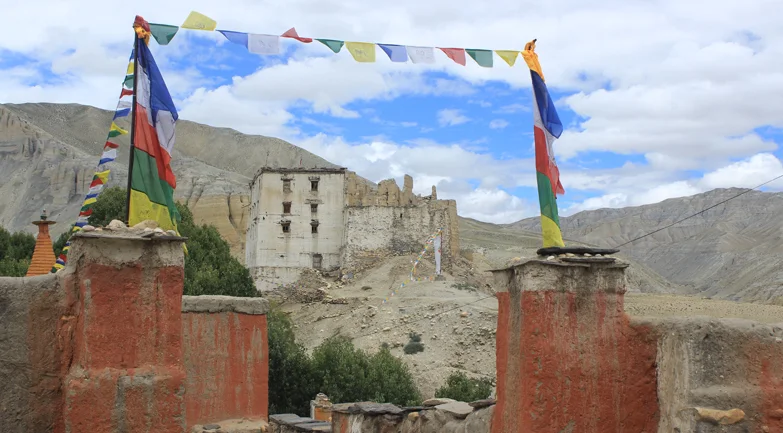
May in Upper Mustang means one thing to most experienced Himalayan travelers: Tiji Festival.
This guide covers what to expect on an Upper Mustang Trek in May, including the latest 2026 permit rules, Tiji Festival timing, and a day by day route.
The three day masked dance ceremony held at Lo Manthang’s Namgyal Monastery is the most spectacular cultural event in the Upper Mustang calendar and one of the most photographically extraordinary Buddhist festivals in the entire Himalayan region. May is when it happens in most years, drawing visitors from around the world who time their entire Nepal itinerary around the festival dates.
But Upper Mustang in May is not only about Tiji. The month also offers the last weeks of spring clear air before the pre monsoon haze builds, warm comfortable trekking temperatures, the full flower season at various altitudes, and the cultural energy of a Lo-pa community fully engaged with both the festival preparations and the spring agricultural season. The Kali Gandaki wind remains strong in May but the overall warmth and energy of the month compensates generously.
Planning your Upper Mustang Trek?
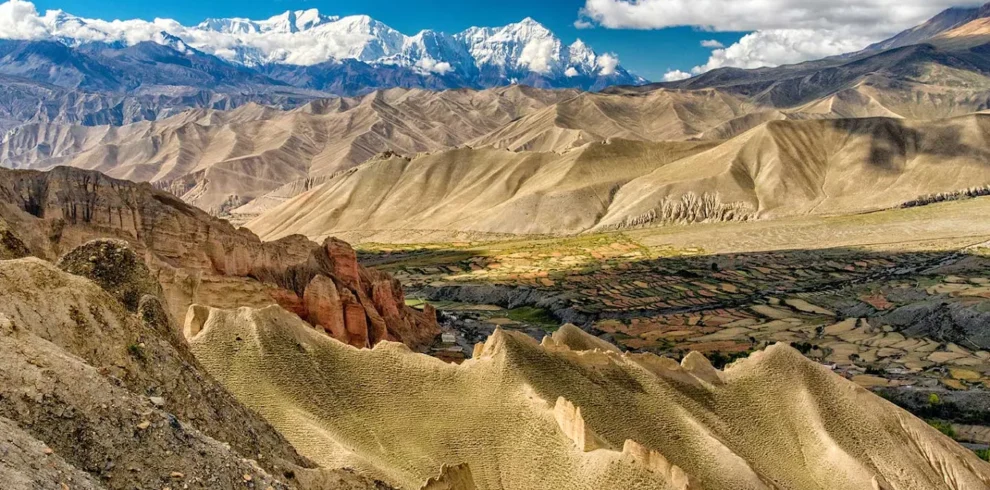
Upper Mustang Trek — Complete Guide 2026 Few places on earth stop you in your tracks the way Upper Mustang…
At a Glance: May Upper Mustang Trek
| Best for | Festival travelers, cultural photography, warm weather trekking |
| Temperature at Jomsom (2,720m) | Night: 8°C to 14°C | Day: 18°C to 26°C |
| Temperature at Lo Manthang (3,840m) | Night: 3°C to 10°C | Day: 10°C to 18°C |
| Precipitation | Still very dry (rain shadow), occasional clouds building in late May |
| Wind | Strong, similar to April |
| Crowd level | High during Tiji, moderate otherwise |
| Tiji Festival 2026 | Late May (confirm exact dates with agency) |
| UMAP Permit | USD 50 per day per person (no minimum) |
| Duration | 12 to 15 days typical |
| Overall rating | Outstanding if Tiji timing aligns, excellent otherwise |
Tiji Festival: Complete Guide
Tiji, formally known as Tenchi, is a three day ritual drama performed at Namgyal Monastery in Lo Manthang. The festival commemorates the legend of Dorje Jono, a deity born as the son of a demon who ultimately defeats his father to save the kingdom of Mustang from destruction.
The festival follows the Tibetan lunar calendar and falls on the 27th, 28th, and 29th days of the third Tibetan month. In 2026 this places Tiji in late May. The exact dates shift by a week or two year to year. Check with your trekking agency when booking to confirm the specific 2026 dates and plan your Lo Manthang arrival for Day 1 of the festival.
What happens each day:
Day 1 of Tiji opens with the preparation ceremonies. The monks, dressed in elaborate brocade robes and large masks representing the various deities and demons of the legend, begin the ritual dances in the monastery courtyard. The dancing is choreographed and deliberate, each movement carrying specific ritual meaning. The courtyard fills with the entire Lo Manthang community in their finest traditional dress, creating a cascade of color against the white monastery walls. International visitors often occupy the upper galleries around the courtyard.
Day 2 is the most dramatic. The ritual enacts the central confrontation between Dorje Jono and his demon father. The masked dances become more elaborate and the ceremonial music, deep long horns, clashing cymbals, and drums, reaches its most intense. This is the day for photography if you can position yourself well in the courtyard.
Day 3 concludes the festival with the symbolic victory of the deity. A ceremonial effigy representing the demon is destroyed as part of the ritual conclusion, symbolizing the protection of the kingdom for another year. The community celebration that follows, with food, music, and the general release of three days of ritual intensity, is genuinely joyful.
Photography during Tiji: you can photograph freely from the courtyard edges and galleries. Keep a respectful distance from the active ceremony space. A telephoto lens (at least 200mm equivalent) lets you capture the mask detail and the monks in motion without crowding the ceremony. The monastery courtyard in May afternoon light with the monks dancing against the white walls is one of the most compelling festival photography setups in Asia.
May Weather and Conditions
May is the warmest trekking month in Upper Mustang. Jomsom daytime temperatures reach 18°C to 26°C. At Lo Manthang (3,840 meters), days hit 10°C to 18°C. Walking in May in a single layer is completely comfortable during the main part of the day.
Nights are mild by Upper Mustang standards. Jomsom nights drop to 8°C to 14°C. Lo Manthang nights fall to 3°C to 10°C. A 0°C sleeping bag is adequate for May, unlike the heavier rated bags needed in winter. This makes May the most gear accessible month in Upper Mustang for travelers who do not want to invest in or carry extreme cold weather equipment.
The pre monsoon weather system begins building in late May. Occasional afternoon clouds appear over the southern peaks. The occasional distant rumble of the monsoon approaching can be heard on very late May evenings. Upper Mustang itself stays dry because of the rain shadow effect, but the atmospheric moisture content is higher than in April and some days have more cloud than the crystal clear days of autumn.
The wind remains strong in May, similar to April. The same morning early start strategy applies. Walk before noon, rest during peak wind, walk again in late afternoon.
Planning your Upper Mustang Trek?
Trail Conditions in May
Trail conditions in May are excellent. All snow is long gone. The trail surfaces are dry and firm throughout the route. No ice concerns. No mud concerns (the rain shadow keeps Upper Mustang dry even as the monsoon reaches the lower valleys of Nepal).
Dust is a significant consideration in May as in April. The afternoon wind carries fine particles from the dry plateau surface. Face and eye protection during windy periods is worth carrying.
The Kali Gandaki river in May is running higher than in winter as glacial melt increases with the warming temperatures. Riverbed crossings require attention but are not difficult at the standard crossing points used by the main trekking route.
Upper Mustang Trek — Complete Guide 2026 Few places on earth stop you in your tracks the way Upper Mustang…
Crowds and the Tiji Effect
May is the busiest month in Upper Mustang for trekkers. This is particularly concentrated around the Tiji Festival period when Lo Manthang sees more visitors than any other time of year. The 3 days of Tiji bring a surge in permit entries. International visitors who have specifically traveled to Nepal for the festival combine with the regular spring trekking traffic to create the highest crowd density Upper Mustang experiences.
During Tiji itself, the Lo Manthang accommodation situation is extremely tight. The walled city has a finite number of teahouse beds. Demand during the festival far exceeds supply. Many groups camp outside the city walls during Tiji because interior accommodation is fully booked. If you are planning to attend Tiji, your accommodation needs to be booked months in advance. This is not an exaggeration. Some popular guesthouses inside Lo Manthang book out 6 months before Tiji.
Outside of Tiji week, May crowds are high but manageable. The trail and teahouses between Jomsom and Lo Manthang see steady traffic but not the extreme density of the festival period.
Permits and Booking in May
Permit requirements are unchanged: UMAP at USD 50 per day per person with no minimum purchase, ACAP at NPR 3,000, TIMS at NPR 2,000. A licensed guide is mandatory, but solo travelers are welcome and simply hire one individually rather than travel as part of a larger group.
For May Tiji trekking, book your entire trip at least 4 to 6 months in advance. Experienced Upper Mustang guides book out for Tiji season well ahead. The combination of guide availability, Lo Manthang accommodation, and domestic flight seats all tighten around the festival dates.
Booking through Next Trip Nepal’s Upper Mustang Trek handles all permit, guide, and accommodation logistics and gives you the best chance of confirmed bookings for your target May dates, including during Tiji.
Accommodation During Tiji
The accommodation reality during Tiji deserves honest discussion. Lo Manthang has a limited number of teahouse beds inside the walled city and a few additional guesthouses just outside the main gate. During the three days of Tiji, every bed is taken weeks before the festival starts.
If you cannot get inside accommodation, camping is the alternative. Several flat areas outside Lo Manthang accommodate camping and some trekking agencies bring full camp setups (tents, cook, kitchen equipment) specifically for clients who could not get teahouse beds. This is a legitimate and actually rather pleasant option. Camping outside the city walls during Tiji means you can come and go freely, cook your own food schedule, and have privacy that the crammed teahouses cannot offer.
For non Tiji weeks in May, Lo Manthang accommodation is available with advance booking but not with the extreme pressure of festival week. Book 2 to 3 months in advance for non Tiji May dates.
The May Trekking Experience Beyond Tiji
May Upper Mustang beyond the festival is warm, clear (in the mornings), and culturally rich. The community in the weeks leading up to Tiji is preparing: monks rehearsing the dances, artisans working on the elaborate masks and costumes, the village organizing the supply logistics for the influx of visitors. This preparation activity is itself fascinating to observe.
The landscape in May lacks the dramatic mustard bloom of March and April but compensates with warmth and approachability. Walking in May feels easiest of the spring months. The temperature is comfortable, the days are long, the nights are mild enough that you do not dread leaving your sleeping bag in the morning.
The ancient cave systems north of Lo Manthang (Chhoser sky caves) are particularly accessible in May. The weather is warm enough for a comfortable day hike to the cave site and back. May visitors often report finding the caves more moving than they expected. Standing inside a chamber that humans have inhabited continuously for 10,000 years, looking out through an ancient window opening across a valley that has barely changed in that time, is a perspective shifting experience that upper Mustang delivers better than almost anywhere else on Earth.
Day by Day May Route
The standard 12 to 14 day route applies in May. Key timing considerations:
If attending Tiji, plan backward from the festival dates. You need to be in Lo Manthang by the evening before Day 1. From Jomsom to Lo Manthang takes 5 to 6 walking days minimum. Allow 7 to 8 days travel time from Jomsom to Lo Manthang to have flexibility if flights are delayed or if you want acclimatization rest days. Arriving in Lo Manthang tired after rushing the approach detracts from the festival experience. Arrive the day before Tiji Day 1, rested and ready.
After Tiji (3 days), you have the return journey of 5 to 6 days back to Jomsom. A total trip of 14 to 16 days covers the Tiji plan comfortably including travel days to and from Pokhara.
For non Tiji May trekkers, the standard 12 day route without festival timing pressure is straightforward. May conditions are the most physically comfortable of the spring months.
Packing for May
May packing is the lightest load of any Upper Mustang month. The temperature ranges are moderate and the gear requirements are lower than any other season.
Sleeping bag: a 0°C to +5°C rated bag is adequate for most May nights including at Lo Manthang. Bring a liner for the occasional colder night.
Clothing: a light base layer, a single mid layer fleece, and a windproof shell are all you need for active walking. A light down jacket for evenings and early mornings. Leave the heavy winter down at home for May.
Wind and dust: same as April. Neck gaiter, close fitting sunglasses, quick dry layers that you can pull on and off as conditions change.
Sun protection: May sun at altitude is the most intense of the year. SPF 50 sunscreen, quality UV sunglasses, sun hat, and UV blocking lip balm. Do not underestimate May altitude UV even when it feels pleasantly warm.
Camera extra: for Tiji Festival photography, bring extra memory cards and batteries. Three full days of ceremony creates a volume of photographic opportunities that fills cards quickly.
Getting to Jomsom
May domestic flights from Pokhara to Jomsom are in peak season demand. Book well in advance, both for the outbound and return flights. The Tiji Festival period sees particularly high flight demand. Morning flights remain the most reliable. The 25 minute flight is spectacular in May’s pre monsoon clear air.
The Beni to Jomsom road is fully operational in May. The 8 to 10 hour journey is the backup if flights are cancelled. In May this backup is less likely to be needed than in winter but always good to have planned.
Planning your Upper Mustang Trek?
Upper Mustang Trek — Complete Guide 2026 Few places on earth stop you in your tracks the way Upper Mustang…
Budget and Costs
May is peak season pricing. Tiji Festival week commands a premium on everything from guide rates to Lo Manthang accommodation.
| Item | May Cost (per person) |
|---|---|
| UMAP Permit (USD 50/day, no minimum) | USD 600 to 700 (12 to 14 days) |
| ACAP + TIMS | NPR 5,000 (approx USD 37) |
| Guide (12 to 14 days, Tiji specialist) | USD 450 to 650 |
| Lo Manthang accommodation during Tiji | USD 15 to 25 (if available) |
| Standard teahouse other stops | USD 10 to 18 |
| Meals per day | USD 12 to 25 |
| Pokhara to Jomsom flights return | USD 140 to 200 |
A complete May Upper Mustang Trek with Tiji Festival timing through Next Trip Nepal’s Upper Mustang Trek typically runs USD 2,500 to 3,500 per person for a 14 to 16 day trip including all permits, experienced festival guide, confirmed accommodation, and domestic flights. Book early for Tiji availability.
May Upper Mustang FAQ
How early should I book for the Tiji Festival?
6 months minimum for confirmed Lo Manthang accommodation. 4 months minimum for guide availability. If you are thinking about Tiji next May and it is already January, contact agencies immediately. Popular spots go that early.
Is Tiji genuinely worth the extra planning and cost?
For travelers who are interested in Buddhist culture and ceremony, absolutely yes. Tiji is not a performance staged for tourists. It is a living religious ritual that this community has conducted for centuries. The difference between being present for a genuine community ceremony of this scale and visiting a monastery any other month is significant. Most people who attend Tiji say it is one of the most extraordinary experiences of their lives.
What if the Tiji dates shift and my booking doesn’t align?
Work with an agency that monitors the lunar calendar and communicates the exact dates as soon as they are confirmed (usually 3 to 4 months out). Book with flexibility in your Nepal arrival date if possible. Most international travelers add 2 to 3 buffer days to their Nepal schedule to allow for date adjustments.
Can I hire a local guide in Lo Manthang during Tiji?
Your main licensed guide accompanies you from Jomsom. In Lo Manthang during Tiji, local knowledge guides who can explain the ceremony’s specific elements are sometimes available through guesthouses. These supplementary guides are not required but add significant depth to the festival experience.
Is May suitable for children on the trek?
May’s temperatures are the most child friendly of any Upper Mustang month. The warm days and mild nights remove the cold risk that makes January through March unsuitable for young children. Fit older children (12 and above) who enjoy walking can handle the May Upper Mustang route with appropriate support. The Tiji Festival itself is genuinely engaging for older children. The altitude (maximum 3,840 meters) requires careful monitoring for any signs of altitude sickness in younger trekkers.
Final Verdict
May with Tiji Festival timing is the peak cultural experience in Upper Mustang’s calendar. Nothing else in the trekking world quite compares to watching a living Buddhist kingdom perform a three day ceremony that has continued for centuries, in the medieval walled city that was their capital, surrounded by 8,000 meter peaks. The planning is complex, the crowds are real, and the costs are at their highest. None of that matters when you are sitting in the monastery courtyard watching the monks dance.
May without Tiji is still an outstanding Upper Mustang month: warm, clear mornings, the Kali Gandaki wind drama, and the cultural fullness of a community in its most active season. It is not the easiest Upper Mustang month in terms of crowds and logistics, but it rewards the effort generously.
Plan your May Upper Mustang Trek with full Tiji Festival support for the Upper Mustang Trek. Also consider reading our guides on the Manaslu Circuit Trek and Annapurna Circuit Trek for other May trekking options in Nepal.
The Rain Shadow Explained: Why Upper Mustang Stays Dry in May
One of the most common questions from first time Upper Mustang visitors is why this region stays dry when the rest of Nepal starts getting rain in May and is flooded by June. The answer is one of the most dramatic meteorological phenomena in the Himalayan world.
The Annapurna and Dhaulagiri massifs form a wall of some of the world’s highest peaks directly to the south of Upper Mustang. The south Asian monsoon, which drives moisture laden air north from the Bay of Bengal from June onward, hits these peaks and is forced upward. As the air rises it cools, the moisture condenses and falls as rain and snow on the southern slopes of the Himalaya. By the time the air mass crosses the main ridge and descends on the northern side into the Mustang plateau, it has lost most of its moisture. The plateau behind the peaks sits in a rain shadow, receiving only a tiny fraction of the precipitation that drenches the southern slopes.
This effect begins having measurable impact from about late April, and by May the contrast between the two sides of the range is stark. The rhododendron forests on the southern Annapurna slopes are getting heavy rain. Pokhara is dealing with daily afternoon showers. Kagbeni, just north of the main range on the Upper Mustang side, is dry and dusty. By June the contrast is dramatic: most Nepal treks are suspended due to monsoon flooding and trail damage while Upper Mustang’s plateau is clear, dry, and completely available for trekking.
Understanding this phenomenon helps explain why May and June (and July and August) are not to be dismissed as impossible trekking months in Upper Mustang the way they are elsewhere in Nepal. The rain shadow is one of Upper Mustang’s defining characteristics and one of its most underappreciated advantages for flexible season trekkers.
May Vs June: Which Month is Better for Upper Mustang?
If you have flexibility between May and June, here is the honest comparison.
May wins if the Tiji Festival falls in May for your target year. It also wins on sky clarity and lower atmospheric moisture. May mornings are generally clearer than June. Mountain views are slightly sharper in May than in the moister June air.
June wins on absolute solitude and value. The crowds that May generates around the festival period and the general spring season traffic vanish almost overnight in June. By early June the rain shadow trekking secret is known mainly to experienced and well researched travelers. Teahouse accommodation in June is negotiable. Guides who were booked solid in May are available. The trail is yours.
For photographers: May wins. For solitude and value: June wins. For festival seekers: May is mandatory. For repeat Upper Mustang visitors who have done the standard seasons: June is the revelation.
Planning your Upper Mustang Trek?
Acclimatization and Health in May
May’s warm temperatures and gradual ascent profile make it the easiest Upper Mustang month for acclimatization. The daily walking distances are the same as other months but the comfortable temperatures mean your body is not spending energy on temperature regulation as aggressively as in winter, which helps the acclimatization process.
The maximum altitude at Lo Manthang is 3,840 meters. This is well within the range that most healthy adults handle without significant issues if they ascend gradually. AMS (Acute Mountain Sickness) symptoms at this altitude are relatively uncommon but real. The standard protocol applies: ascend no faster than 300 to 400 meters per day above 3,000 meters, rest if headachy, stay hydrated, avoid alcohol in the first 3 days.
May specific health concerns: heat and dehydration at lower altitudes (the Jomsom and lower valley sections can be genuinely warm), sunburn and UV damage at altitude, and dust inhalation during wind events. Drink 3 to 4 liters of water daily and carry a lip balm and sunscreen everywhere.
The Tiji Festival period introduces a social health dimension: large gatherings in a confined space over three days. The festival courtyard in Lo Manthang has significant crowd density during the ceremony. If you are immunocompromised or have respiratory sensitivities, factor this in when planning your festival attendance strategy.
Shopping and Souvenirs in May Upper Mustang
May is when the Lo Manthang market and the guesthouses around the walled city have their best selection of locally produced and Tibetan sourced goods for sale. The Tiji Festival period brings additional sellers to Lo Manthang, some with goods not normally available in the village shops.
Thangkas (Buddhist scroll paintings) from Lo Manthang are among the most authentic available for purchase in Nepal. They are produced by trained artists who follow traditional techniques passed down through generations within the Lo-pa community. Prices vary enormously with size, quality, and provenance. A properly documented thangka from a recognized Lo Manthang artist is a meaningful purchase. Cheaper thangkas imported from Kathmandu or Chinese factories are also sold in some shops. Your guide can help distinguish them.
Locally produced handicrafts including wool weavings, singing bowls, ritual implements, and jewelry are available at various shops in and around Lo Manthang. In May these shops are well stocked and owners have time to talk. Negotiating prices politely is standard practice and expected. The local economy benefits directly from purchases made within the restricted area.
The Marpha apple products available at teahouses and small shops south of Jomsom on your return are worth picking up. Apple brandy (arak), dried apples, apple jam, and apple vinegar from the famous Marpha orchards are produced locally and make excellent gifts that connect directly to the Upper Mustang experience.
What Long Term Nepal Trekkers Say About May Upper Mustang
People who have trekked Nepal for years, who have done Everest Base Camp multiple times, who have crossed the Thorong La in three different seasons, who know the difference between a good and bad teahouse dal bhat at 4,000 meters, consistently put May Upper Mustang (Tiji timing permitting) among their top five trekking experiences anywhere in the world.
The reasons they give are consistent. The combination of landscape uniqueness (nothing else in Nepal or the broader Himalayan region looks like the Mustang plateau), cultural depth (a living Tibetan Buddhist kingdom rather than a heritage tourism experience), festival spectacle (Tiji is not a performance, it is a ritual that happens whether you watch or not), and manageable altitude (you reach extraordinary places without going to dangerous heights) adds up to something that more famous treks at higher altitudes cannot match.
The Everest Base Camp Trek goes higher and has more famous branding. The Annapurna Circuit has more altitude variety and the dramatic Thorong La crossing. The Everest Three Passes Trek has extraordinary high altitude challenge. Upper Mustang in May with Tiji has something none of those routes offers: a medieval walled city full of living history, an ancient Buddhist festival performed by monks who have been doing this for centuries, and a desert landscape that feels genuinely unlike anywhere else you have walked.
If you are a long term Nepal trekker who has done the standard circuits and is looking for what comes next, May Upper Mustang with Tiji timing is the answer most experienced trekkers would give you. Plan carefully, book early, and go.
Book your Upper Mustang Trek for current May availability, Tiji Festival 2026 exact dates, and to start building your Upper Mustang itinerary around this extraordinary event.
Planning Your May Upper Mustang Trek: Practical Checklist
Given the complexity of timing, booking, and logistics specific to May, here is a practical planning checklist for Upper Mustang in this month.
Confirm the exact Tiji Festival dates for your target year. The dates shift with the lunar calendar. Your trekking agency should be able to confirm them at least 4 months in advance, sometimes earlier. Build your entire Nepal itinerary around confirmed dates rather than estimated ones.
Book guide and accommodation as a package through a registered agency. Individual permit procurement is possible but the combination of festival accommodation difficulty and guide demand in May makes package booking through an established operator like Next Trip Nepal’s Upper Mustang Trek the most reliable approach.
Book domestic flights early. The Pokhara to Jomsom sector fills up in May, particularly the outbound departures timed to get trekkers to Lo Manthang for Tiji arrival. Book these as soon as your permit and guide are confirmed.
Plan arrival in Nepal at least 2 days before your Jomsom departure. This gives you buffer for flight delays, permit collection if needed, and gear shopping in Kathmandu or Pokhara. Arriving in Nepal and going directly to the airport the next morning for Jomsom is a risk management failure waiting to happen.
Acclimatize properly. Even though Lo Manthang is only 3,840 meters, AMS can affect anyone. A night in Pokhara at 800 meters before flying to Jomsom at 2,720 meters, then the gradual 5 to 6 day ascent to Lo Manthang, gives your body appropriate time. Do not shorten the approach for schedule reasons.
Prepare for the wind. May wind in the Kali Gandaki gorge is strong and consistent. Bring the dust and wind protection gear described in the packing section. The trekkers who struggle with May conditions are overwhelmingly those who underestimated the afternoon wind and packed accordingly.
Budget for the full experience. May is the highest cost month in Upper Mustang. Between UMAP permit fees of USD 50 per day, guide fees, flights, accommodation, and food over 14 to 16 days, a fully organized May Upper Mustang Tiji trip runs USD 2,500 to 3,500 per person or more from Kathmandu. This is not a budget destination and treating it as one by cutting corners on guide quality or accommodation leads to a diminished experience of one of Nepal’s most extraordinary places.
May Upper Mustang with Tiji Festival timing is genuinely one of the great trekking and cultural experiences available anywhere in Asia. Do it properly and it will be one of the most memorable weeks of your traveling life.
May Upper Mustang with Tiji Festival is a once in a lifetime experience for many travelers. Plan your Upper Mustang Trek today and let our team lock in your festival dates and guide well ahead of the crowds.
May Upper Mustang gives you the festival, the warmth, and the spring energy of a community fully alive. Whether or not Tiji falls in May for your year, the month delivers an outstanding trek in one of the world’s most extraordinary landscapes. Book for your Upper Mustang Trek and let us handle every detail from permits to Lo Manthang accommodation so your only job is to experience it fully.
Also see our guides on the Everest Base Camp Trek and Annapurna Circuit Trek for May comparisons across Nepal’s other great trekking routes. Upper Mustang in May stands apart from all of them in cultural depth and festival spectacle.
Upper Mustang Trek — Complete Guide 2026 Few places on earth stop you in your tracks the way Upper Mustang…