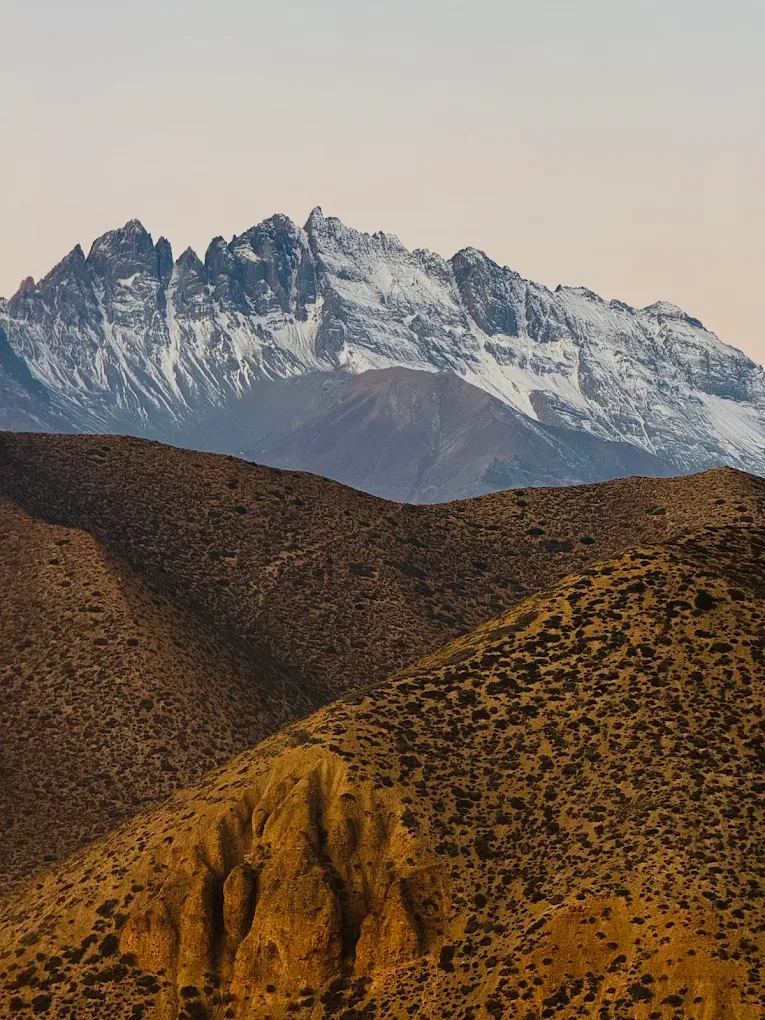
Most people trekking in Nepal in June have no idea that Upper Mustang is sitting dry, clear, and almost completely empty on the other side of the Annapurna wall.
This guide covers what to expect on an Upper Mustang Trek in June, including the latest 2026 permit rules, weather, and a day by day route.
The monsoon arrives in Nepal in early to mid June. Within a week of its arrival, the main trekking routes turn to mud. The Everest and Annapurna trails see significant trail damage. Flights to mountain airports face frequent cancellations. Most trekking companies suspend operations on the high altitude routes. The majority of international trekkers either leave Nepal or wait out the rain in Pokhara or Kathmandu.
Meanwhile, in Upper Mustang, the rain shadow effect is performing one of the most dramatic geographic tricks in the entire Himalayan region. The same monsoon clouds that are drenching the southern slopes of the Annapurna massif with heavy rain lose their moisture rising over the peaks. By the time air descends on the northern side into the Mustang plateau, there is almost nothing left to fall. June in Upper Mustang is dry. Not “drier than usual” dry. Bone dry desert dry.
June trekkers in Upper Mustang discover something that most Nepal trekking guidebooks either miss completely or bury in footnotes: the monsoon season in Upper Mustang is actually one of the most pleasant trekking experiences available in South Asia. This guide is for the traveler who has done their research and is ready to take advantage of the best kept secret in Himalayan trekking.
Planning your Upper Mustang Trek?
Upper Mustang Trek — Complete Guide 2026 Few places on earth stop you in your tracks the way Upper Mustang…
At a Glance: June Upper Mustang Trek
| Best for | Solitude seekers, budget travelers, well researched adventurers, those who dislike crowds |
| Temperature at Jomsom (2,720m) | Night: 10°C to 15°C | Day: 20°C to 28°C |
| Temperature at Lo Manthang (3,840m) | Night: 5°C to 12°C | Day: 12°C to 20°C |
| Precipitation in Upper Mustang | Very low (rain shadow effect), occasional light rain possible at Jomsom |
| Precipitation in rest of Nepal | Heavy monsoon rains |
| Wind | Decreasing compared to April/May, still moderate |
| Crowd level | Very low to none |
| UMAP Permit | USD 50 per day per person (no minimum) |
| Duration | 12 to 15 days typical |
| Overall rating | Excellent for those who know the secret |
Why June Is Actually a Great Month: The Rain Shadow
The rain shadow effect in Upper Mustang is the single most important geographical fact to understand before planning any trek here, but it is especially crucial for understanding June through August.
Nepal’s summer monsoon, driven by the temperature differential between the heated Asian landmass and the cooler Indian Ocean, pushes moisture saturated air northward from June through September. This air mass carries enormous amounts of water vapor. When it reaches the Himalayan chain, it has nowhere to go but up. The forced ascent cools the air, moisture condenses, and rain falls on the southern slopes of the Himalaya in volumes that are some of the highest annual rainfall totals on Earth. The Annapurna South face during monsoon receives 4,000 to 7,000 mm of rainfall per year. This is why the trails below and around these peaks become rivers and the bridges wash out and the trekking routes that run through this zone are suspended.
The air mass that has shed its moisture rising over the Himalayan wall then descends on the northern side as dry air. The Tibetan plateau behind the mountains, and Upper Mustang as the southernmost finger of that plateau, sits in the lee of the range. Upper Mustang receives around 250 mm of annual precipitation, and most of that falls in brief summer storms rather than the sustained monsoon rains of the south. In June the plateau is essentially bone dry. The occasional afternoon cloud that builds up and creates a brief shower is the extent of the precipitation that reaches this region.
This is not a marginal difference. It is the difference between a monsoon flooded trail and a perfectly walkable desert path. And most Nepal trekkers simply do not know it.
June Weather on the Plateau
June is the warmest month in Upper Mustang’s annual cycle. Daytime temperatures at Jomsom (2,720 meters) reach 20°C to 28°C. This is genuinely warm walking weather, and the lower sections of the route from Jomsom through Kagbeni can feel hot in the midday hours. Carry extra water and set a comfortable walking pace in the mornings.
At Lo Manthang (3,840 meters) the temperatures are more moderate. Daytime highs at Lo Manthang reach 12°C to 20°C, which is almost ideal trekking temperature. June Lo Manthang is warm enough to sit in a courtyard in the afternoon and cold enough that the evening remains comfortable rather than stuffy. This is actually a more comfortable temperature for walking long days than the colder months with their need to manage constant layering.
Nights in June are the most comfortable of any Upper Mustang month. Jomsom nights at 10°C to 15°C require only a light sleeping bag. Lo Manthang nights at 5°C to 12°C need a moderate bag, not the serious winter rated gear of January.
The wind that defined March, April, and May has decreased significantly by June. The pressure differential that drives the Kali Gandaki afternoon gale begins to equalize as the monsoon establishes itself across the broader region. June afternoons still have a breeze but nothing like the wind events of spring. This is another often overlooked advantage of the monsoon season in Upper Mustang: it is actually more comfortable walking weather than April or May in terms of wind exposure.
Planning your Upper Mustang Trek?
Trail Conditions in June
Trail conditions in Upper Mustang in June are excellent. The trails are dry throughout. There is no ice, no snow, no monsoon mud (which afflicts the routes south of the Himalayan wall), and no spring dust storms. The jeep road and the older trail are both in good condition. The Kali Gandaki river is running higher in June as glacial melt is at its seasonal peak, but the crossing points used by the standard trekking route are safe and well established.
The lower valley approaching Jomsom and Kagbeni may have occasional afternoon cloud buildup and very light rain. Jomsom airport area sometimes receives brief showers even in monsoon because it sits right at the transition zone between the rain shadow plateau and the wetter lower Kali Gandaki valley. The showers in Jomsom are brief and the trail dries within an hour. Think of them as a welcome break from the heat rather than a trail condition concern.
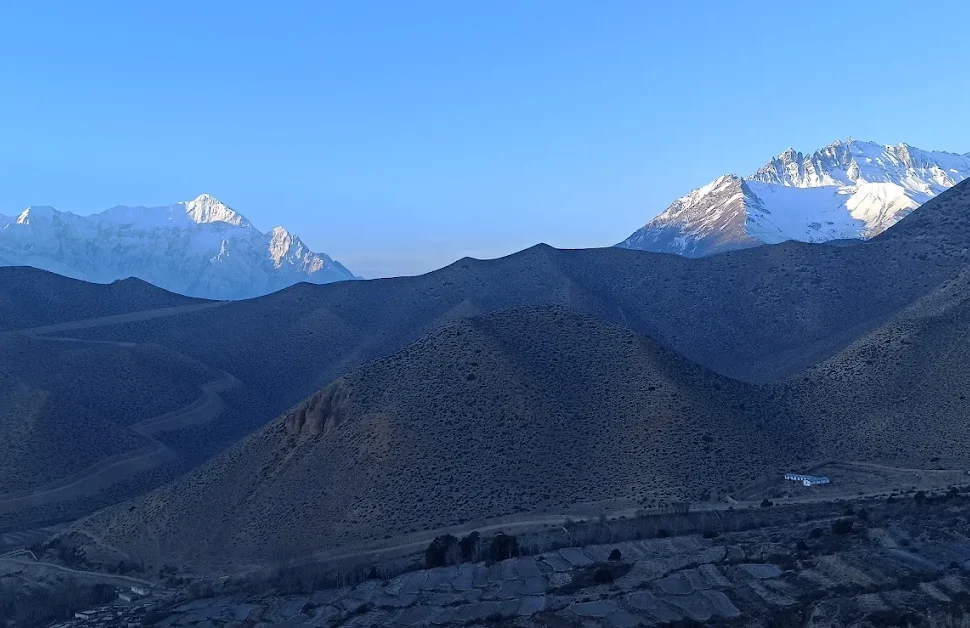
Once you pass Kagbeni into the restricted Upper Mustang area proper, the dryness becomes total. Chele, Syangboche, Ghami, Charang, Lo Manthang, all are completely dry in June. The trail surfaces are firm and clear. Walking conditions are objectively easier than in the windy spring months.
Upper Mustang Trek — Complete Guide 2026 Few places on earth stop you in your tracks the way Upper Mustang…
Crowds in June: The Real Story
June is one of the quietest months in Upper Mustang. Monthly permit entries are among the lowest of any month in the year. On most trail days in June you will walk for hours without seeing another trekking group. In Lo Manthang you may be the only foreigner in the entire city for multiple days.
The reason is simple: most international trekkers assume Nepal in June means monsoon and therefore impossible trekking. They have not researched the Upper Mustang rain shadow exception. Their loss. Your gain.
The June solitude is not just a preference preference. It fundamentally changes the quality of the experience. When you are the only trekker in Lo Manthang for three days, you are not a tourist in a tourist destination. You are a guest in someone’s home. The monks are not performing for a rotating audience of trekkers. The guesthouses are not managing check-in queues. The market sellers are not in tourist pitch mode. The cultural experience that Upper Mustang promises but can only partially deliver during its busiest months becomes fully available in June.
Permits and Logistics
Permit requirements are unchanged in June. UMAP at USD 50 per day per person with no minimum purchase, ACAP at NPR 3,000, TIMS at NPR 2,000.
One June specific logistics note: the mandatory guide rule applies just as in any other month, though solo travelers are welcome and simply hire a licensed guide individually rather than travel as part of a larger group. What changes in June is guide availability and flexibility. In April and May the best guides are fully booked months in advance. In June the same quality guides have more availability and sometimes more flexibility on itinerary customization. Booking 1 to 2 months in advance is generally sufficient for June.
The Upper Mustang Trek package from Next Trip Nepal is available with June dates and the guide quality remains identical to peak season. The logistics of June are actually simpler than peak season because there is no accommodation scramble, no flight seat competition, and no need for the multi month advance booking that April and May require.
Accommodation and Food
All main teahouses on the Upper Mustang route operate in June. The quiet season means you will often have an entire teahouse to yourself. Teahouse owners are relaxed and often more hospitable during the quiet months. You are more likely to be invited for tea and conversation, to see the family life behind the teahouse, and to have the kind of genuine cultural exchange that busy season traffic prevents.
Food quality in June is excellent. Supplies reach the teahouses regularly and the vegetable selection is at its broadest because the lower valley gardens and farms are producing in the summer warmth. Fresh greens, cucumbers, tomatoes, and local herbs appear on menus that would not have them in February. Dal bhat in June comes with more varied accompaniments. The quality of the cooking is consistent and the portions generous.
Prices in June teahouses are sometimes slightly lower than peak season. There is no shortage to drive prices up and owners are happy to keep guests well fed and comfortable. You will not find dramatic discounts but the overall value proposition is better than in October or May.
What Makes June Unique in Upper Mustang
June is when the contrast between Upper Mustang and the rest of Nepal is at its most dramatic. Walk south of Jomsom in June and you step into monsoon Nepal: heavy cloud, rain, slippery trails, leech infested lower sections. Walk north through the Kagbeni checkpoint and you are in a different climate zone entirely. The shift is surreal and experienced June trekkers describe it as one of the most geographically instructive moments in any trek they have done.
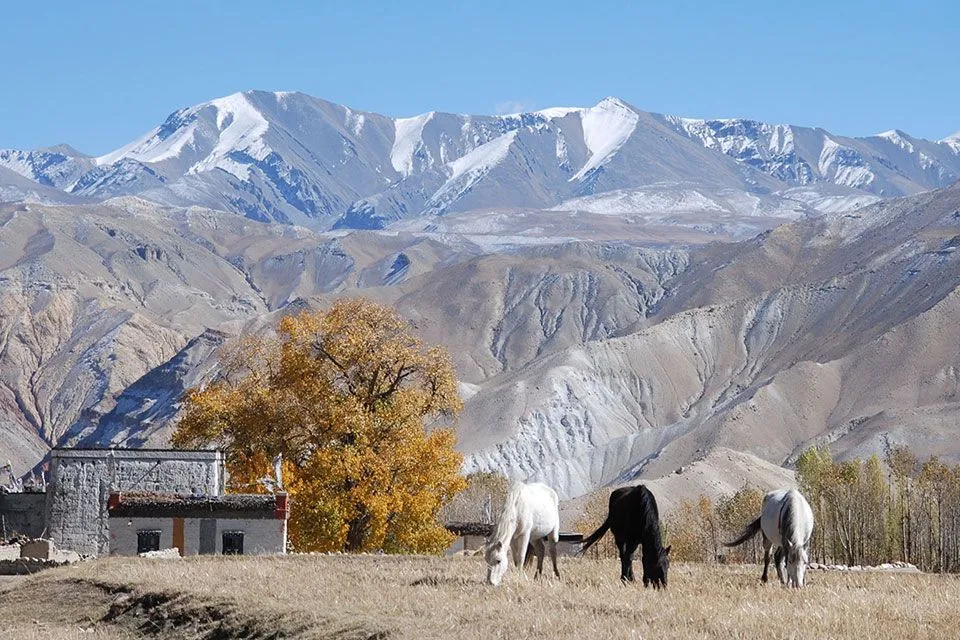
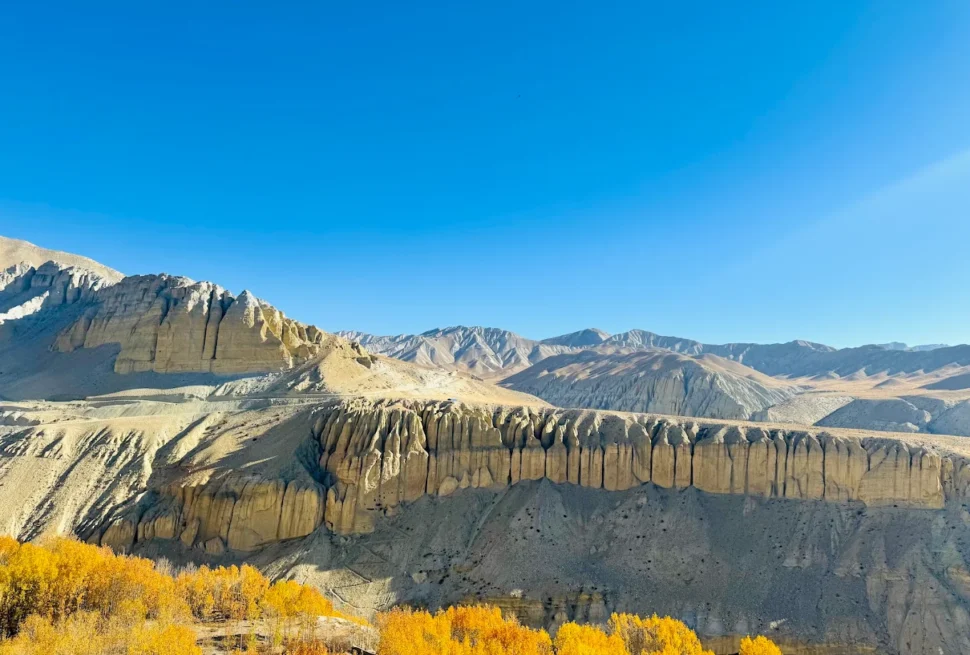
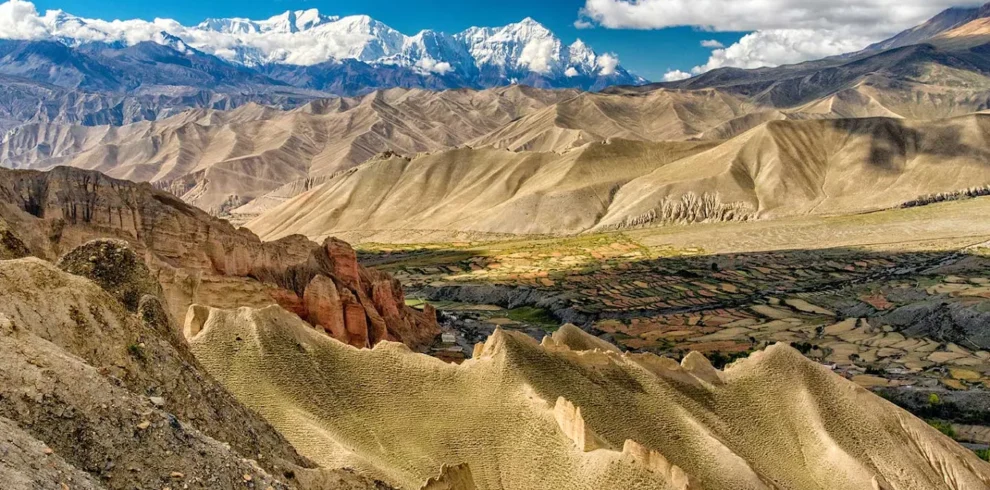
The vegetation in June tells the story of the rain shadow at every scale. The approach to Kagbeni from Jomsom passes through a zone where the lower valley has some green cultivation from river irrigation. Beyond Kagbeni the vegetation strips back rapidly to the desert scrub and the bare plateau. By the time you reach the higher sections, the landscape has the quality of a Tibetan thangka painting’s background: bare earth, striated rock in horizontal bands of color, and an enormous sky with just enough cloud for drama without the weight of monsoon.
The Kali Gandaki river in June is beautiful in a way that differs from other seasons. The winter low flow and the high velocity spring run have both given way to a steadier medium flow. The river’s famous geological importance, the Kali Gandaki gorge is the world’s deepest canyon by some measurements, between Dhaulagiri and Annapurna, is readable in the valley walls in a way that low water levels make visible. The exposed ammonite fossils (saligrams, sacred in Hinduism) on the river bed are accessible and visible in June’s moderate flow.
Day by Day June Route
The standard 12 to 14 day route works perfectly in June with one calendar adjustment: the longer daylight hours mean you can start slightly later and still cover good distance. Sunrise in June is around 5:30 AM and sunset around 7:15 PM. You have nearly 14 hours of daylight available, which gives more flexibility in daily schedule than the short winter days.
The practical effect is that the pressure to start walking at 7 AM sharp that applies in winter (to make distance before dark) and in spring (to miss the afternoon wind) is reduced in June. You can have a proper breakfast at 7:30, start walking at 8 AM, take a long midday break, and still reach your destination before 5 PM in most cases. This relaxed pace suits the June experience of Upper Mustang, which is less about efficient point to point trekking and more about deep immersion in a place you have largely to yourself.
The day by day stops are identical to other months: Jomsom, Kagbeni, Chele, Syangboche, Ghami, Charang, Lo Manthang. June trekkers often find they move faster than expected because the comfortable temperatures and light wind make the walking physically easier than in spring. This creates the pleasant problem of arriving at Lo Manthang a day early. Use the extra time for the Chhoser cave day trip or for extended Lo Manthang exploration rather than rushing the return.
Planning your Upper Mustang Trek?
Upper Mustang Trek — Complete Guide 2026 Few places on earth stop you in your tracks the way Upper Mustang…
Packing for June
June Upper Mustang packing is the lightest and most straightforward of any month. The temperature ranges are the most comfortable. The weather is the most predictable. The gear requirements are the most minimal.
Sleeping bag: a +5°C to +10°C comfort rated bag is adequate for June including at Lo Manthang. Travel light is the June mantra.
Clothing: light breathable trekking clothes for daytime walking. A mid layer fleece for mornings and evenings. A light windproof shell for the occasional breezy section. A light down jacket for Lo Manthang evenings. Shorts are comfortable in the lower valley sections in June’s warmth.
Rain protection: a lightweight packable rain jacket is worth carrying for the Jomsom area and the very occasional brief shower that might reach the lower valley. Once you are above Kagbeni the rain jacket goes to the bottom of your pack and probably stays there.
Sun protection: critical in June. The summer sun at altitude is fierce. SPF 50 sunscreen, quality UV sunglasses, sun hat, and daily reapplication are non negotiable. Sunburn and UV eye damage at altitude are serious risks in the intense June sun.
Hydration: carry more water capacity than in other months because the warm temperatures increase sweat loss. A 2 liter bottle capacity minimum, with regular refills at every teahouse stop.
Getting to Jomsom in June
Flights from Pokhara to Jomsom in June operate but require attention to weather. The monsoon creates cloud and visibility issues in the Pokhara area itself, which can delay or cancel Jomsom flights even though Upper Mustang itself is clear. The problem is the approach route: the aircraft flies from Pokhara through the cloud zone and only clears into the dry plateau once it crosses the main range. Poor visibility at the Pokhara end can ground flights that would have been fine at the Jomsom end.
June flight success rates at Jomsom are lower than spring and autumn. Build a 1 to 2 day flight buffer into your schedule at both ends of the trip. The Beni to Jomsom jeep road is fully operational in June and is a reliable backup option. The road itself stays clear because it runs through the same rain shadow zone as the Upper Mustang plateau.
The 8 to 10 hour Beni to Jomsom jeep journey in June is actually worth considering as the primary option rather than the backup. The road passes through the stunning Kali Gandaki gorge and gives you a ground level understanding of the transition from monsoon Nepal at Beni to rain shadow Upper Mustang as you climb north. Many June trekkers take the jeep road one way and fly the other, which works well when the flying window aligns.
Budget: June Value
June represents some of the best value trekking in Upper Mustang’s annual cycle. While the permit cost is unchanged (and is the largest single expense regardless of season), the other costs are at their most flexible.
| Item | June Cost (per person) |
|---|---|
| UMAP Permit (USD 50/day, no minimum) | USD 600 to 700 (12 to 14 days) |
| ACAP + TIMS | NPR 5,000 (approx USD 37) |
| Guide (12 to 14 days) | USD 300 to 500 |
| Teahouse accommodation per night | USD 5 to 12 |
| Meals per day | USD 10 to 18 |
| Pokhara to Jomsom flights return | USD 120 to 180 |
A complete organized June Upper Mustang Trek through Next Trip Nepal’s Upper Mustang Trek typically runs USD 1,800 to 2,500 per person for 12 to 14 days including all permits, guide, accommodation, and flights. This is the most competitively priced of the comfortable trekking months.
June Upper Mustang FAQ
Will it actually rain in Upper Mustang during the Nepal monsoon?
Rarely. The rain shadow effect keeps the Upper Mustang plateau dry throughout the monsoon season. Jomsom, at the southern edge of the restricted area, may get occasional brief showers because it sits at the transition zone. Beyond Kagbeni into the restricted area proper, the rainfall is minimal. You might experience a total of 3 to 5 brief rain events in 12 days of trekking, most of them lasting under 30 minutes. Plan for them with a rain jacket but do not plan your entire trip around them.
Are all the teahouses really open in June?
Yes. The main teahouses on the Upper Mustang route operate year round and are all open in June. The monsoon season does not close Upper Mustang teahouses the way it closes teahouses on the standard Nepal trekking routes in the monsoon zone. Your guide confirms specific teahouse availability before departure as always.
Can the Jomsom flight cancel during the Nepal monsoon?
Yes, and this happens more frequently in June than in October or April. The issue is typically cloud cover around Pokhara or in the approach corridor rather than conditions at Jomsom itself. Build buffer days into your schedule. The jeep road to Jomsom is always available as an alternative. Most June trekkers experience at most 1 to 2 day delays rather than complete cancellations.
What are other Nepal treks doing in June?
Most standard Nepal trekking routes are in their monsoon pause. The Everest Base Camp trail is muddy, leechy in the lower sections, and generally unpleasant in June. The Annapurna Circuit is similarly affected below the main range. Upper Mustang stands alone among Nepal’s great trekking destinations as genuinely excellent in June. This is its secret strength.
Is June the best time to visit Upper Mustang?
It depends on your priorities. June is the best month for solitude and value. October is best for comfort and reliability. April and May are best for drama and festivals. January is best for photography and extreme quiet. June is the best kept secret. If you value having an ancient Tibetan kingdom almost entirely to yourself, June is the answer.
Final Verdict
June Upper Mustang is the best kept secret in Himalayan trekking. While the rest of Nepal deals with monsoon season, you are walking through a dry, warm, quiet desert kingdom that feels like time has slowed to a gentler pace. The solitude is total. The temperatures are comfortable. The cultural encounters are unmediated by tourist infrastructure running at capacity. And the per day cost outside the unavoidable permit fee is the most reasonable of any good trekking month.
The flight reliability issue is the only real practical challenge of June. Plan for it, bring the flexibility of extra buffer days, and treat the jeep road as a legitimate option rather than a last resort.
June Upper Mustang rewards the traveler who has done their research. You are reading this guide, so that is you. Start planning for the Upper Mustang Trek and discover what trekking in a place that most people do not know is possible actually feels like.
Planning your Upper Mustang Trek?
The Green Lower Valley: What Changes Visually in June
Upper Mustang’s visual identity in most travel photography is the stark brown, red, and ochre of the dry plateau. June introduces a visual element that surprises visitors who have only seen photos of the place in the dry seasons: a band of green in the lower valley that exists nowhere else in the Upper Mustang color palette.
The river irrigation system that the Lo-pa community has maintained for centuries channels glacial meltwater through an intricate network of stone conduits into the terraced fields around each village. In June this irrigation system is running at full capacity because the glacial melt is at its peak. The fields that were brown earth in February and yellow mustard in March are now green with barley, buckwheat, and vegetable crops. The contrast between these intensely green irrigated fields and the surrounding bone dry desert plateau creates a visual tension that is unique to the summer months.
Coming over a ridge toward any of the main villages in June and seeing the green oasis below surrounded by brown desert is one of those moments that makes you stop walking and simply look. The geology, the human agricultural achievement, and the ecological drama of the rain shadow all visible in a single view. It is a landscape that looks arranged rather than natural, even though it is both.
The wildflowers that bloom at various altitudes in June add further color to the desert landscape. Low growing cushion plants, small yellow composites, and occasional patches of high altitude ground cover appear in cracks between rocks and on sheltered slopes that collect a little more moisture than the surrounding plateau. These are not the dramatic flower meadows of the Alpine zone or the rhododendron forests of lower elevations. They are subtle and require attention to notice. But they are part of the June visual experience that other seasons do not offer.
June as a Base for Extended Upper Mustang Exploration
The flexibility that comes with June’s low crowd situation and relaxed trail pace makes it the best month for trekkers who want to go beyond the standard Lo Manthang route and explore some of Upper Mustang’s less visited corners.
The valley north of Lo Manthang toward Nyphu and the Tibetan border area is accessible with extended permits and proper guide support. In June the plateau north of Lo Manthang is completely dry and walkable. The villages in this zone see very few visitors even during peak season and in June they are essentially unvisited. The experience of reaching a centuries old monastery in a valley where no other trekker has passed in weeks is available in June in a way that October, April, or May simply cannot offer.
The cave systems distributed throughout the Upper Mustang region extend well beyond the Chhoser site north of Lo Manthang that most trekkers visit. Caves with ancient Buddhist paintings, caves with archaeological deposits from thousands of years of habitation, and cliff face structures that still puzzle archaeologists are found throughout the side valleys of the plateau. June’s quiet allows guides to take routes that would be difficult to organize in busy season due to time pressure and accommodation logistics.
For trekkers interested in this extended exploration, speaking with your agency about a customized 16 to 18 day June itinerary that incorporates some of these less visited areas is worth discussing. The permit structure covers the restricted area broadly and additional days in the zone add only the per day permit cost and guide fees. The June solitude makes this extended format particularly rewarding.
Upper Mustang June Vs July: Which Month to Choose
June and July are the two most similar months in the Upper Mustang annual cycle. Both are dry, warm, quiet, and excellent value. The differences are subtle but worth understanding.
June has slightly more wind than July because the spring pressure gradient is still partially active in early June. June also has the Tiji Festival tail if the festival falls in very late May and you extend into June, which creates an interesting cultural overlap period.
July is marginally warmer, slightly less windy, and even more quiet than June. The monsoon in the rest of Nepal is fully established by July which means fewer casual trekkers attempting Upper Mustang. The trekking population in July Upper Mustang is almost entirely experienced and research driven visitors who specifically chose the monsoon exception. The community that shares the trail in July is a self selected group of experienced mountain travelers and the conversations and shared campfires at teahouses tend to be of a quality that the broad demographic spread of peak season prevents.
Choose June if you want the widest choice of logistics (guide availability, flight options, more teahouse rooms to choose from) and a slightly more active plateau atmosphere as the spring season’s residual energy dissipates. Choose July for absolute maximum solitude and the warmest temperatures. Both are excellent choices that most Upper Mustang trekkers will never make because they have not yet discovered the rain shadow secret. You have.
Meeting the Lo-pa People in June
Perhaps the most underrated aspect of June Upper Mustang trekking is what the quiet season does to your relationship with the communities you walk through.
The Lo-pa people of Upper Mustang are Tibetan Buddhist in culture and practice, with a distinctive identity that differs from both Nepali lowland culture and the Tibetan culture north of the border. Their community has lived in this plateau for centuries, maintaining a way of life that adapts slowly to the world’s changing pace. They have seen trekkers coming through in increasing numbers since the restricted area partially opened in 1992. They know the pattern. October and spring the trekkers come. In June they do not.
When you arrive in a village like Ghami or Syangboche in June, you are not the tenth trekking group to come through this week. You might be the first in two or three weeks. The local reception to your arrival has a different quality. Children who would be blasé about trekkers in October are genuinely curious about you in June. An elder sitting at the monastery gate on a June afternoon has time to sit and talk if you show the interest. The teahouse owner’s family, who would be invisible behind efficient service operations in peak season, is present and unhurried and often shares their table and their stories in June.
Learning a few phrases of Nepali or Tibetan before your trek pays dividends in these interactions in any month but especially in June. “Tashi Delek” (a Tibetan greeting), “Namaste,” and the willingness to sit and share tea are the social currency of genuine cross cultural encounter in Upper Mustang. In June you have the time and the space to spend that currency properly. Start planning now for the Upper Mustang Trek and ask our team about June availability.
June is the month that separates Upper Mustang enthusiasts from casual trekkers. If you want the ancient kingdom mostly to yourself in comfortable summer warmth, there is no better time. Reach out to Upper Mustang Trek to check June guide availability and book your monsoon season secret today.
Upper Mustang Trek — Complete Guide 2026 Few places on earth stop you in your tracks the way Upper Mustang…