
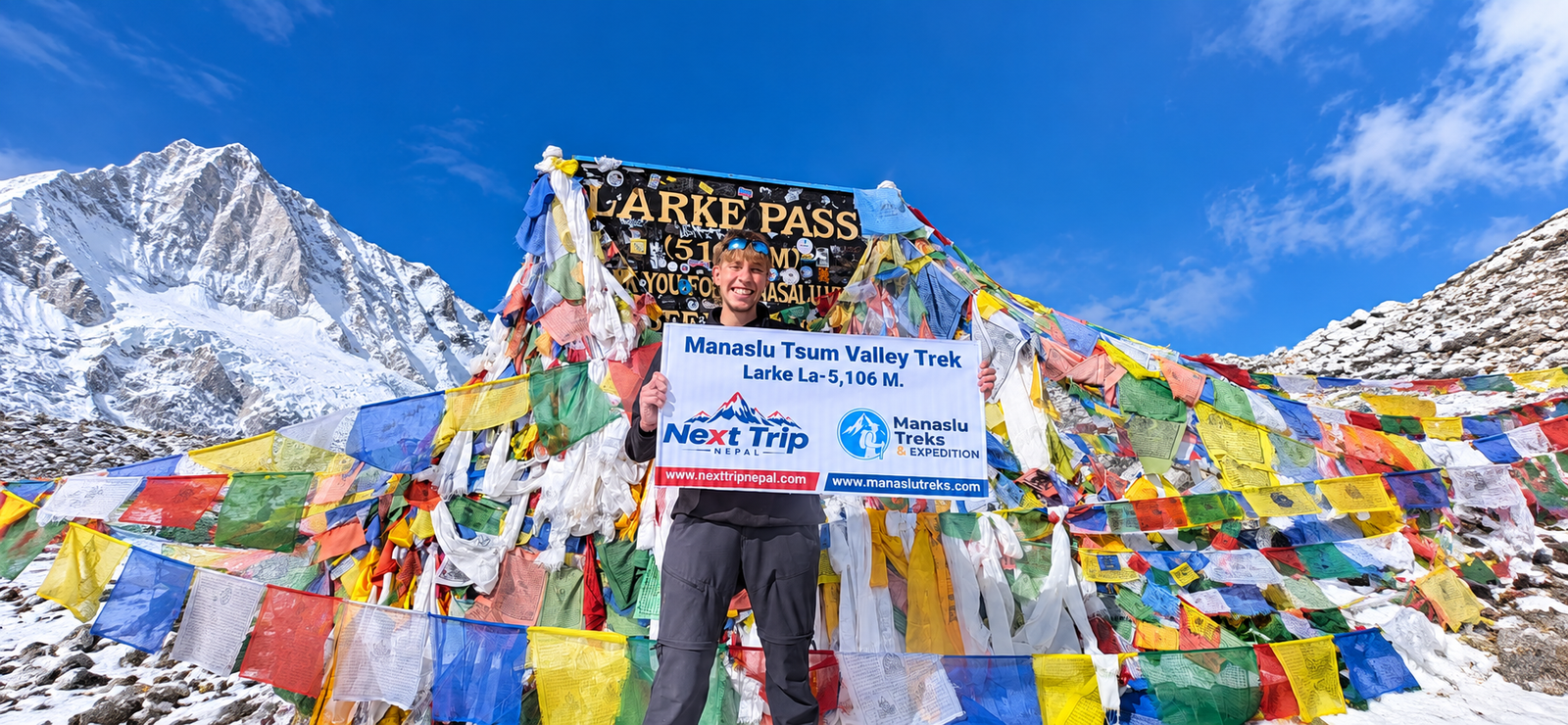
Every year a handful of trekkers turn back below Larke La, and a few more get carried over it on the back of a mule or a guide’s shoulders because they underestimated what twenty days in the Manaslu and Tsum Valley region actually demands. This is not a trek you wander into on fitness alone, and it is not a trek that fitness alone will fail on either. It is a mix of long days, a genuinely high pass, thin infrastructure, and a restricted, remote valley where help, if you need it, takes longer to arrive than it would on the Everest or Annapurna trails. We have written a separate Manaslu Tsum Valley Trek Guide that covers the itinerary day by day, the permits you need and what the trip costs, so we will not repeat that ground here. This article is about one question we get asked more than almost any other: how hard is this trek, and am I fit enough to do it.
We will go through the honest difficulty rating and why it earns it, who this route suits and who should give it a miss, how the walking hours and elevation gain actually stack up day to day, a training plan you can follow for real rather than a vague “get fit” suggestion, a proper explanation of altitude sickness with the numbers that are actually verifiable, a close look at the Larke La crossing itself, and a grounded comparison with Everest Base Camp and the Annapurna Circuit so you know where this trek sits relative to the two routes most people compare it to.
Overall Difficulty Rating, and Why It Earns It
Most trekking companies, ours included, rate the Manaslu Tsum Valley Trek as strenuous to challenging, generally a notch above the Annapurna Circuit and roughly on par with or slightly harder than Everest Base Camp depending on which factor you weigh most. There is no single official difficulty scale for Himalayan treks, so take any numeric rating (ours or anyone else’s) as a rough guide rather than a scientific measurement. What we can say with more confidence is why the trek sits where it does.
- Length and cumulative load: At around twenty days including the Tsum Valley extension, you are walking for roughly fifteen to seventeen days in a row with only a handful of rest or acclimatization days built in. Fatigue accumulates in a way a one week trek simply does not produce.
- Larke La at 5,106 meters: This is the trek’s single hardest day and the reason most people fail or succeed here rather than lower down. We go into this pass in detail further on.
- Restricted area terrain: The Manaslu region is a restricted area under Nepali regulation, which keeps numbers low but also means trail maintenance, signage and teahouse density are lighter than on Nepal’s two most popular routes.
- Remoteness and limited rescue infrastructure: There is no road access through the high sections, mobile coverage is patchy at best above Samagaon, and helicopter evacuation, while possible, is slower and weather dependent compared with Lukla or Manang, both of which sit on more established rescue corridors.
- Terrain underfoot: Stretches of the trail, particularly between Jagat and Namrung and again above Samdo, involve narrow suspension bridges, landslide prone sections, and rougher, less graded path than the well trodden Annapurna trail.
None of this means the trek is only for elite athletes. It means it rewards genuine preparation and punishes the assumption that “I hike sometimes” is enough. We have taken trekkers in their sixties over Larke La in good shape, and we have also turned back fit looking twenty five year olds who ignored their body’s signals on the way up. Fitness matters, but so does pacing, acclimatization discipline and a realistic sense of your own limits.
Who This Trek Suits, and Who Should Think Twice
This route suits people who already have at least one multi day trekking experience under their belt, even if it was a shorter or lower trip, and who are comfortable walking five to seven hours a day for a week or more without a rest day in between. It also suits people who want a quieter, more culturally rich alternative to the busier Everest and Annapurna trails and who are willing to accept a bit more uncertainty in exchange for that solitude. If you enjoyed the Annapurna Circuit, or completed Everest Base Camp without major altitude trouble, and want something wilder, this is very likely a good next step.
We would ask people in the following situations to think carefully, and ideally talk to a doctor familiar with travel and altitude medicine, before booking:
- Anyone with a diagnosed heart or lung condition, including controlled asthma that flares with exertion or cold, since both the exertion and the altitude compound respiratory and cardiac strain.
- Anyone who has previously suffered High Altitude Pulmonary Edema (HAPE) or High Altitude Cerebral Edema (HACE), even mildly. Prior history is one of the clearest risk factors for recurrence.
- People with no trekking or sustained hiking background at all who are considering this as a first trek. It is not impossible, but it is a tough place to learn the basics of pacing and altitude awareness for the first time.
- Anyone with significant knee, hip or ankle issues that are not well managed, given the sustained descents on loose, rocky terrain, particularly the long drop from Larke La down to Bimthang.
- Travelers who cannot commit two to three months to even modest training beforehand. This trek is forgiving of imperfect fitness; it is not forgiving of zero preparation.
Age by itself is a poor predictor. We regularly see trekkers in their late fifties and sixties complete this route comfortably, and we occasionally see very young, seemingly fit clients struggle. What matters more than age is cardiovascular conditioning, mental resilience under discomfort, and a willingness to listen to guides when they say slow down.
Daily Walking Hours and Elevation Gain: The Real Pattern
Rather than repeat the full itinerary (that lives in our Manaslu Tsum Valley Trek Guide), it is worth understanding the shape of the physical demand, because it is not a steady, predictable climb. It comes in distinct phases.
Phase One: The Lower Valleys (Days 1 to 7, roughly)
From Soti Khola up through Machha Khola, Jagat, Deng and on toward Namrung, you are walking five to seven hours a day on undulating river valley trail, gaining and losing elevation repeatedly as the path crosses side valleys and climbs around bluffs. Net elevation gain per day is modest, often three hundred to six hundred meters, but the terrain is uneven, with stone steps, suspension bridges and a fair bit of up and down that adds up in your legs even though the map suggests a gentle climb. Humidity and heat lower down can be more tiring than the cold higher up.
Phase Two: The Tsum Valley Side Trip
Branching off toward Chumling, Chhokangparo, Nile and Mu Gompa, you reach the trek’s secondary high point at around 3,700 to 3,800 meters near Mu Gompa, before a side excursion higher still toward the Tibetan border viewpoints for those who choose it. Days here run five to seven hours with real elevation gain, often eight hundred meters or more on the push into Mu Gompa, so this is where early altitude awareness starts to matter even though you are still well below Larke La.
Phase Three: Rejoining the Manaslu Trail and the Push to Samdo
Back on the main circuit through Lho, Shyala and Samagaon, you gain altitude more steadily, typically four hundred to seven hundred meters a day, with an acclimatization day usually built in around Samagaon (about 3,530 meters) that includes an optional side hike to Manaslu Base Camp or the Pungen Glacier viewpoint, both of which push well above the overnight altitude and back down again, exactly the pattern altitude doctors recommend.
Phase Four: Samdo to Dharmasala and the Pass
This is the sharp end. Samdo sits around 3,860 to 3,875 meters, Dharmasala (also called Larke Phedi) around 4,460 meters, and then the pass crossing day itself takes you over 5,106 meters before dropping to Bimthang at roughly 3,800 meters, all usually in a single, very long day covered in its own section below. In the two or three days leading into the pass, daily elevation gain can exceed five hundred meters even before the pass day’s far larger swing.
Phase Five: The Descent
From Bimthang down through Tilije to Dharapani and onward, you lose elevation quickly, often eight hundred to over a thousand meters in a single day, which is its own kind of hard on tired knees even though it feels like relief after the pass.
Across the whole route, average walking time is five to seven hours a day, with the pass day commonly running eight to eleven hours including breaks. Total elevation gain across the trek, counting every undulation rather than just net altitude, comfortably exceeds eight thousand meters of ascent, which is a meaningful number to hold in mind when you plan training.
A Realistic Training Plan for Manaslu Tsum Valley
We are going to be direct here: a generic “walk more” suggestion is not useful. What follows is the kind of plan we actually recommend to clients, built around the demands described above. Start this roughly twelve to sixteen weeks before departure if your baseline fitness is average, or eight to ten weeks out if you already hike or run regularly. Fitting a mountain trek around work and life is realistic; fitting it around zero cardio base in three weeks is not.
Months Three and Two Before Departure: Build the Base
- Cardio, three to four sessions a week: Mix steady state cardio (brisk walking, cycling, swimming, or an elliptical) with one or two slightly harder interval sessions. Thirty to fifty minutes per session is a sensible starting point, building toward sixty.
- Leg strength, two sessions a week: Squats, lunges, step ups and calf raises, using body weight to start and adding load as you progress. Strong quads and glutes are what save your knees on the long descents, not just your cardiovascular fitness.
- Stair climbing: If you have access to a stairwell, a stadium, or a stair machine, this is close to the best training available for a trek like this, since it mimics sustained vertical gain under load. Start with fifteen to twenty minutes and build toward forty five minutes to an hour, ideally with a daypack.
- One longer hike on a weekend day: Two to three hours on real trail if you can find it, on varied terrain, to start conditioning your feet, ankles and balance, not just your lungs.
Month Before Departure: Specificity
- Loaded pack hikes: This is the single most trek specific thing you can do. Carry a daypack weighing roughly six to ten kilograms (what you will actually carry trekking, since porters typically handle the main duffel) on hikes of three to five hours, including as much elevation gain and loss as you can find locally. If your area is flat, stairs or a treadmill set to a steep incline are a reasonable substitute.
- Back to back long days: In the final three to four weeks, try to do two consecutive days of longer hiking or stair work at least once, to get a feel for walking on legs that are already tired, which is exactly what days ten through fourteen of the trek will feel like.
- Break in your boots fully: By this point you should have forty or more kilometers in the actual boots you are bringing. New boots on day one of a twenty day trek is a reliable way to end up with blisters that make the rest of the trip miserable.
- Taper the final week: Cut volume back by half in the last five to seven days before flying out. You want to arrive rested, not freshly exhausted from a last minute training push.
What We Would Deprioritize
Heavy gym lifting for maximum strength is not the priority here, nor is pure running speed. This trek rewards aerobic endurance and muscular endurance (the ability to keep legs working for hours, not the ability to lift heavy once), so bias your limited training time toward volume and time on feet over intensity and one off max efforts.
If you are starting from a sedentary baseline, be honest with yourself and either extend the timeline to five or six months or discuss with us whether a slightly less demanding itinerary (fewer consecutive long days, more buffer) makes sense for your first Himalayan trek, with Manaslu Tsum Valley as a goal for a following season instead.
Altitude Sickness, Explained Properly
This is the section we think matters most, because most serious problems on this trek are altitude related rather than purely about fitness. We want to lay out what the medical literature actually says rather than the simplified version that gets repeated across trekking blogs.
The Three Conditions
Acute Mountain Sickness (AMS) is by far the most common altitude illness and the one almost everyone experiences in a mild form at some point above roughly 2,500 to 3,000 meters. The Centers for Disease Control and Prevention describes it as headache plus at least one of loss of appetite, dizziness, fatigue, nausea or occasional vomiting, usually starting two to twelve hours after arrival at a new altitude and resembling a hangover. It generally resolves within twelve to forty eight hours if you stop ascending and rest.
High Altitude Cerebral Edema (HACE) is a swelling of the brain and is considered the severe, end stage form of AMS. The CDC describes it as rare, particularly below about 4,300 meters, and it typically follows unresolved AMS or HAPE. Symptoms include confusion, loss of coordination (ataxia, which shows up as an inability to walk a straight line, heel to toe), altered mental status and drowsiness. Left untreated it can progress to coma within as little as twenty four hours, which is why descent is treated as urgent and non negotiable the moment it is suspected.
High Altitude Pulmonary Edema (HAPE) is fluid in the lungs rather than the brain. The CDC cites an incidence of roughly one in one hundred travelers above 4,300 meters on standard ascent profiles, higher than most people assume. Early signs are a persistent cough, reduced exercise tolerance and breathlessness out of proportion to the effort involved; advanced signs include breathlessness at rest, a cough producing frothy or blood tinged sputum, and blue tinged lips or fingertips. Oxygen saturation readings can fall dramatically, sometimes into the fifty to seventy percent range, and descent plus oxygen is considered mandatory and urgent.
Prevention: What Actually Works
- Ascent rate, the single biggest factor: The Wilderness Medical Society’s guidelines, summarized in American Family Physician, recommend that above about 3,000 meters, sleeping altitude should increase by no more than roughly 500 meters per night, with an extra acclimatization day added for every 1,000 meters of net gain. Our itinerary is built around this principle, with acclimatization days at Samagaon and generally one more before the pass, but the pattern only protects you if you actually rest on those days rather than pushing on because you feel fine that morning.
- Hydration: Altitude increases fluid loss through faster breathing and drier air, and dehydration mimics and worsens AMS symptoms. Three to four liters a day is a reasonable target, but the CDC is also clear that forced overhydration does not prevent AMS and carries its own risk (low blood sodium, or hyponatremia), so more is not automatically better.
- Diamox (acetazolamide): This is the most commonly used preventive medication, and both CDC and Wilderness Medical Society guidance describe a standard preventive dose of 125 milligrams twice daily, started the day before significant ascent and continued for the first few days at the new altitude. It works by encouraging faster acclimatization through mild changes to blood chemistry and breathing rate, not by masking symptoms. It is a prescription medication with potential side effects (tingling fingers, increased urination, an altered taste for carbonated drinks, and rare but serious allergic reactions in people with certain sulfa drug sensitivities), so we always tell clients: talk to your own doctor or a travel medicine clinic before your trip, get an actual prescription, and do not simply buy it informally in Kathmandu without medical advice, which is sadly still common practice among budget trekkers.
- Alcohol and sedatives: Both CDC and most wilderness medicine sources recommend avoiding alcohol for the first forty eight hours at any new altitude and being cautious with sleeping pills, since both can suppress the breathing rate increase your body needs to acclimatize and can mask early symptoms.
- Listening to your own body over your itinerary: This is the one most people get wrong. If you wake up with a mild headache and nausea, the correct response is to tell your guide and consider a rest day, not to push through because the schedule says you are moving today.
What Our Guides Actually Do
Every one of our guides on this route carries a pulse oximeter and checks oxygen saturation and resting heart rate at key points, particularly from Samagaon onward. If a client shows AMS symptoms, the first response is always the same: stop ascending, rest at the current altitude, hydrate, and reassess in a few hours rather than push on hoping it clears. If symptoms are mild and stable, we may wait a day at the same altitude before continuing. If symptoms worsen, involve confusion or loss of coordination, or do not improve with rest, the response is immediate descent, which is the only reliable treatment for anything beyond mild AMS. Guides also carry basic emergency oxygen and are trained in recognizing the early signs of HACE and HAPE specifically, because both can escalate from seemingly mild symptoms to serious within hours.
Evacuation Realities in This Valley
This is where we think honesty matters more than marketing. Helicopter evacuation is possible from several points along the Manaslu and Tsum route, and we maintain the contacts and insurance processes to arrange it. But it is genuinely less straightforward than on the Everest or Annapurna trails. Mobile network coverage is intermittent above Samagaon and largely absent in much of the Tsum Valley, so guides often rely on satellite phones, which we carry, to call for help. Weather in a narrow Himalayan valley can ground a helicopter for a day or more even when one is available and funded. There are basic health posts at a few villages including Samagaon, but nothing resembling the clinic density of Namche Bazaar or Manang. The honest takeaway is not that evacuation is impossible, it is reliably arranged when needed, but that the time between recognizing a serious problem and getting professional medical care is longer here than on the busier trails, which is exactly why prevention, early symptom recognition and a guide’s willingness to turn back matter more on this route than almost anywhere else in Nepal.
Comprehensive travel insurance that explicitly covers high altitude trekking and helicopter evacuation above 5,000 meters is not optional on this trek. Check your policy’s altitude cap specifically, since many standard travel insurance policies cap cover at 3,000 or 4,000 meters, well below Larke La.
Larke La: The Hardest Day of the Trek
If one single day defines this trek’s reputation for difficulty, it is the crossing of Larke La (also spelled Larkya La) at 5,106 meters, though it is worth noting that sources are not perfectly consistent, with some citing figures closer to 5,160 meters for the true high point. Either way, it is the trek’s highest point by a wide margin and one of the longer, more sustained passes in the Nepal Himalaya.
Why It Is So Hard
- Duration: Most groups are moving for eight to eleven hours including breaks, starting well before dawn, often between four and five in the morning, to cross before afternoon weather and wind pick up and to reach Bimthang with enough daylight left.
- Thin air at the top: At just over 5,100 meters, atmospheric oxygen is roughly half what it is at sea level. Even well acclimatized trekkers typically feel short of breath, slow and mentally foggy at the summit, and this is normal rather than a sign that something is wrong, provided it matches how you have felt on previous high points rather than representing a sudden worsening.
- Cold and wind: Pre dawn starts mean temperatures well below freezing, frequently minus ten to minus twenty degrees Celsius or colder at the highest point in peak trekking seasons, combined with wind that makes it feel colder still. Fingers and toes are at real risk of frostbite if not properly protected, particularly during photo stops at the summit when gloves come off.
- Possible snow and ice underfoot: Depending on season and recent weather, sections of the approach and the descent toward Bimthang can hold snow or verglas (a thin ice layer), making footing unreliable exactly when fatigue is highest. This is more likely in the shoulder seasons and after fresh snowfall even in the main trekking months.
- The descent, not just the ascent: People focus on reaching the pass, but the drop afterward, roughly 1,300 meters down to Bimthang on steep, often loose or icy terrain, is where tired legs and ankles are most likely to be injured. This is one of the best arguments for trekking poles and for not treating the summit as the finish line mentally.
- No easy bail out: Once you are committed from Dharmasala toward the pass, there is no quick way down to a lower village. You are on the mountain for the full day, which is part of why guides take the decision to attempt the crossing seriously and will delay a day if weather or anyone’s condition looks marginal.
What to Actually Expect on the Day
You will be woken in the dark, likely before 4am, for a quick breakfast (often just tea, biscuits and porridge, since appetite is commonly suppressed at this altitude) before setting out with headlamps. The initial climb from Dharmasala is steady but unrelenting, gaining roughly 650 meters to the pass itself over several hours. Pace is deliberately slow, the classic small, steady steps rather than bursts of effort, because at this altitude going out too fast simply forces you to stop and recover more often, which costs more time overall than moving slowly and consistently. Layering matters enormously: you will likely start in a down jacket and several layers and shed some of it once the sun is up and you are working hard on the final push, then add it back for the long, exposed descent. Most groups spend a brief fifteen to twenty minutes at the summit for photos and prayer flags before starting down, since lingering at that altitude in the cold offers no benefit. The descent to Bimthang, while lower in altitude, often takes nearly as long as the ascent because of the terrain and accumulated fatigue.
Timing the crossing well is partly a function of season, which is why we have a separate Best Time to Trek Manaslu Tsum Valley guide that goes through month by month conditions in detail. Broadly, the main spring and autumn trekking windows offer the most stable conditions for the pass, while winter brings a higher chance of heavy snow closing or seriously complicating the crossing, and monsoon season brings its own risks lower down the valley even before you reach the high pass.
How This Compares to Everest Base Camp and the Annapurna Circuit
We get this comparison question constantly, so here is our honest take, cross checked against independent route descriptions rather than just our own opinion.
In terms of maximum altitude reached, Everest Base Camp trekkers typically push on to Kala Patthar at around 5,545 meters for the classic sunrise viewpoint, which is higher than Larke La, and Base Camp itself sits around 5,364 meters. The Annapurna Circuit’s Thorong La pass sits at roughly 5,416 meters, also higher than Larke La on paper. So by raw altitude alone, Manaslu Tsum Valley is not actually the highest of the three. What makes it feel, and generally rate, as the hardest of the three comes down to other factors.
Everest Base Camp has excellent infrastructure by Himalayan standards: frequent teahouses, reliable (if not cheap) supplies flown or carried in regularly, strong mobile coverage through much of the route, and a well established helicopter rescue corridor, since Lukla sees constant air traffic. The trail itself is not technically difficult; the challenge is almost entirely altitude and the psychological pressure of the famous, sometimes hairy, Lukla flight. The Annapurna Circuit is often considered the most forgiving of the three for a first timer, with a more gradual ascent profile, strong teahouse infrastructure, and the added safety net of partial road access that did not exist a couple of decades ago, meaning there are more realistic bail out points if something goes wrong.
The Manaslu Tsum Valley Trek, by contrast, combines a high pass with noticeably thinner infrastructure, a restricted area classification that keeps crowds low but also keeps teahouse density and rescue response lower, rougher and less maintained trail in sections, and a longer overall itinerary once the Tsum Valley extension is included. Independent trekking guides and route comparison sites we have reviewed consistently describe Manaslu as the more remote and generally more physically demanding of the three once you weigh infrastructure and terrain alongside raw altitude, even though its highest point is technically a little lower than the other two. If you have done Everest Base Camp or the Annapurna Circuit without serious altitude trouble and found the walking itself manageable, Manaslu Tsum Valley is a sensible and rewarding next step. If either of those trips was a real struggle for you, we would suggest more preparation time, not necessarily avoiding Manaslu altogether.
Practical Tips for Managing the Difficulty
Hiking Poles
We consider these close to essential on this route, not optional. They take meaningful load off your knees on the long descents (Bimthang after the pass especially), improve stability on the narrower, less maintained sections of trail, and give you something to lean on during the slow, grinding sections of the pass climb when every bit of balance assistance helps.
Pacing
The single most common mistake we see is trekkers walking too fast on the early, easier days because they feel strong and the terrain allows it, then paying for it with fatigue that compounds as the trail gets harder and higher. Guides deliberately set a pace that feels almost too slow on day two or three. Trust it. The trek is won or lost on consistency over twenty days, not speed on any single day.
Rest Days
Do not skip the built in acclimatization days even if you feel completely fine, and do not treat them as wasted time. A rest day at Samagaon with a short side walk to Manaslu Base Camp or a glacier viewpoint is doing real physiological work: pushing your body to a higher altitude briefly during the day before returning to sleep lower, which is one of the most effective acclimatization strategies there is.
Mental Preparation
Twenty days is a long time to be tired, cold some mornings, occasionally bored on long walking stretches, and without the comforts of home. Expect that some days simply will not feel good, physically or emotionally, and that this is normal rather than a sign you made a mistake coming. Trekkers who do well mentally tend to break the trip into phases rather than fixate on the full twenty days, and lean on the social side of trekking, guides, porters, and fellow trekkers, to get through the harder stretches.
Teahouse Conditions at Altitude
Be ready for basic conditions the higher you go: shared cold bathrooms (sometimes a simple drop toilet outside), minimal heating beyond a single stove in the dining room that the whole group gathers around in the evening, thin walls, and food options that narrow considerably above Samagaon compared with the lower villages. Sleep can also be lighter and more broken at altitude regardless of how tired you are, which is a normal physiological response and not necessarily a symptom of altitude sickness by itself, though it is worth mentioning to your guide if combined with other symptoms. A good sleeping bag rated well below the temperatures you expect, warm layers for the evening, and a headlamp for middle of the night bathroom trips make a real difference to comfort. We cover the specific gear list in detail in our Manaslu Tsum Valley Trek Packing List, so we will not repeat the full kit list here, but good quality, well broken in boots and a warm enough sleeping bag are the two items most worth investing in properly.
Age and Experience: What Actually Matters
We are asked constantly whether a particular age is too old, or whether someone with no trekking background can manage this trip as a first attempt. On age, our honest experience is that physiological fitness and consistent training matter far more than the number of years you have been alive. We have guided trekkers in their late sixties and even early seventies over Larke La who trained properly and paced themselves, and we have seen fit, young clients struggle because they assumed general gym fitness would transfer directly to multi day mountain walking, which it does not always do.
On experience, complete beginners can and do complete this trek, but we would not recommend it as literally your first ever hike. What helps most is any experience with multi day exertion, whether that is a shorter Himalayan trek like Poon Hill or the Annapurna Base Camp trek, a demanding multi day hike elsewhere in the world, or even just a consistent pattern of long, hilly day hikes at home over a sustained period. What matters less than you might think is prior high altitude experience specifically, since altitude response is highly individual and someone with no prior altitude exposure who ascends carefully and listens to their body often does better than someone with altitude experience who gets overconfident and pushes the pace.
If you are genuinely new to trekking and drawn to this particular route for its remoteness and cultural richness rather than a more crowded alternative, our honest advice is to extend your training timeline, be scrupulous about the ascent rate guidance above, and communicate openly and often with your guide about how you are feeling. This trek is demanding, but it is not reserved for an elite few; it is reserved for people who prepare for it like it deserves preparation.
Frequently Asked Questions
Is the Manaslu Tsum Valley Trek harder than Everest Base Camp?
In most practical respects, yes, even though Everest Base Camp and its Kala Patthar viewpoint reach a higher maximum altitude. Manaslu Tsum Valley involves thinner infrastructure, a more remote restricted area setting, rougher trail sections, and a longer overall itinerary, which together generally make it feel more demanding than Everest Base Camp’s well supported, well maintained trail.
Can a beginner trekker do the Manaslu Tsum Valley Trek?
A complete beginner with no prior hiking or multi day walking experience can complete it, but we do not recommend this as a literal first trek. Some prior experience with long, hilly day hikes or a shorter multi day trek makes a meaningful difference, combined with a genuinely serious training block of at least three months beforehand.
What is the highest point on the Manaslu Tsum Valley Trek?
Larke La (also written Larkya La) at 5,106 meters is the trek’s highest point, with some sources citing figures closer to 5,160 meters. Either figure makes it one of the higher trekking passes in Nepal, though still lower than Everest Base Camp’s Kala Patthar viewpoint or the Annapurna Circuit’s Thorong La pass.
Do I need Diamox for this trek?
Many trekkers choose to take acetazolamide (Diamox) preventively, typically 125 milligrams twice daily starting the day before significant ascent, based on Wilderness Medical Society and CDC guidance. It is not mandatory and some trekkers complete the route without it, but it is not a decision to make alone. Talk to your doctor or a travel medicine clinic before your trip to get a proper prescription and to check it is appropriate for your health history.
How many rest days are built into the itinerary?
Our standard itinerary includes a dedicated acclimatization day around Samagaon and generally one more before the Larke La push, in line with Wilderness Medical Society guidance on adding rest days for significant altitude gain. The full day by day breakdown, including these rest days and optional side excursions, is covered in our Manaslu Tsum Valley Trek Guide.
What happens if someone gets altitude sickness on the trek?
Mild symptoms (headache, nausea, fatigue) are managed with rest at the current altitude, hydration, and close monitoring rather than continued ascent. If symptoms worsen or involve confusion, loss of coordination, or breathlessness at rest, our guides initiate immediate descent, which is the only reliable treatment for serious altitude illness, and arrange evacuation support if needed, accounting for the longer response times typical of this remote valley.
Is travel insurance required, and what should it cover?
Yes, and this is not something to skip or cut corners on for this particular trek. You need a policy that explicitly covers trekking above 5,000 meters and helicopter evacuation, since many standard travel policies cap altitude cover well below Larke La’s elevation. Check the fine print specifically rather than assuming a generic travel policy covers Himalayan trekking.
When is the best time to attempt the Larke La crossing?
The main spring and autumn trekking seasons generally offer the most stable conditions for the pass, with lower odds of the heavy snow that can complicate or close the crossing in winter. Our Best Time to Trek Manaslu Tsum Valley guide breaks this down month by month if you want the full seasonal picture before booking.
The Manaslu Tsum Valley Trek is not a trek to take lightly, but it is also not an unreasonable goal for a well prepared, moderately experienced trekker. Train seriously for a few months, take the altitude guidance in this article as more than a formality, and go in with realistic expectations about long days and basic conditions higher up, and this becomes one of the most rewarding, least crowded treks in Nepal rather than an ordeal. If you are ready to put a date on it, our team can talk you through booking your Manaslu Tsum Valley Trek and matching the itinerary to your fitness and experience level.


