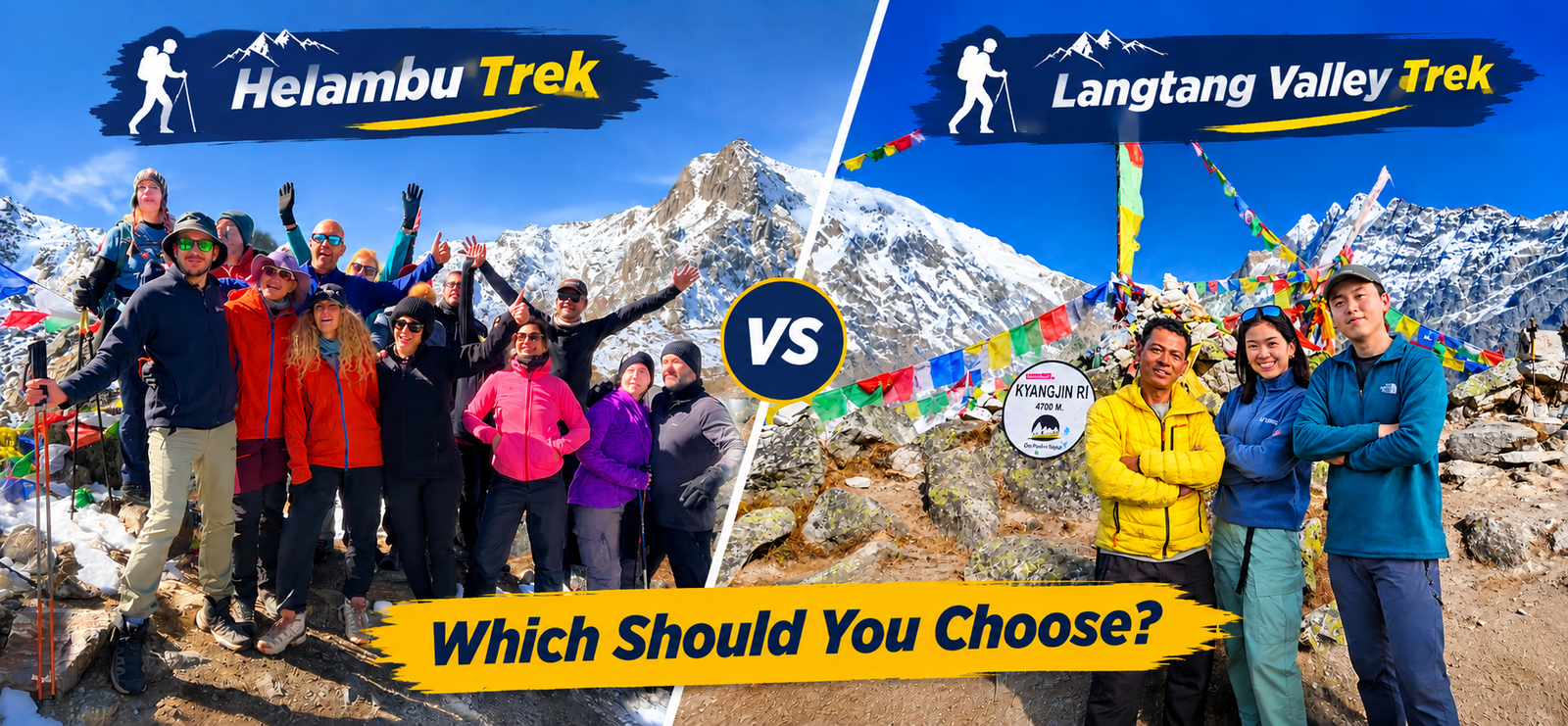
Trekkers planning a trip into the hills north of Kathmandu almost always end up comparing the same two routes. The Helambu Trek and the Langtang Valley Trek start within an hour or two of each other, both sit outside the Everest and Annapurna crowds, and both get recommended constantly by guesthouse owners, trekking agencies, and online forums as “the other good option near Kathmandu.” That leads a lot of people to treat them as near interchangeable, two short treks that will scratch the same itch if time is tight.
Part of the confusion is understandable. Both routes get marketed as short, accessible alternatives to the big name treks, both involve teahouse style lodging rather than camping, and both let you come back from the mountains having genuinely spent time in Tibetan Buddhist hill communities. A quick glance at a brochure or a search results page does not always make the gap between them obvious, and plenty of first time visitors to Nepal book one or the other based on whichever trekking agency happened to answer their email first, without really understanding what they were choosing between.
They are not interchangeable. We touched on this briefly in our own Helambu trek cost and permits guide, in a short section comparing it to Langtang, but that article was built to answer cost and permit questions, not to settle the bigger decision. This one is. Below we go through everything that actually separates these two routes: real travel times to each trailhead, the altitude each one actually reaches (and where sources disagree on that), the kind of scenery and culture you will walk through, what permits each one requires, how crowded each gets, and who should pick which. By the end you should know which trek fits your trip, rather than guessing based on a paragraph in a blog post.
Helambu Trek vs Langtang Valley Trek at a Glance
Before the detail, here is the short version. Treat the numbers below as typical ranges rather than fixed facts. Trek duration depends heavily on which itinerary variant you choose, cost depends on season and how many services you book through an agency versus arranging independently, and even altitude figures vary a bit from one source to the next, which we address directly in the next section.
| Factor | Helambu Trek | Langtang Valley Trek |
|---|---|---|
| Typical duration | 5 to 8 days, depending on whether you do the short Sundarijal loop or the fuller circuit through Tarke Ghyang and Melamchi | 7 to 10 days for the standard out and back route to Kyanjin Gompa, longer if you add Gosainkunda |
| Maximum altitude | Around 3,600 to 3,650 meters at Tharepati, the trek’s highest regular point | Around 3,870 meters at Kyanjin Gompa itself, with optional side hikes to roughly 4,773 meters (Kyanjin Ri) and nearly 5,000 meters (Tserko Ri) |
| Difficulty | Easy to moderate. Long ridge walking days, but no scrambling and limited altitude exposure | Moderate, tipping toward challenging if you add the side peaks. Sustained climbing and real altitude to manage |
| Typical cost | Roughly 380 to 480 dollars for a shorter budget style trip, 500 to 650 dollars for a fuller guided circuit | Roughly 500 to 900 dollars for a standard guided teahouse trek, more if extended toward Gosainkunda or booked as a fully serviced package |
| Permits required | Shivapuri Nagarjun National Park entry ticket plus a TIMS card, totaling well under 20 dollars | Langtang National Park entry permit plus a TIMS card, together running close to 35 to 40 dollars for most foreign nationalities |
| Reaching the trailhead | Taxi from central Kathmandu to Sundarijal, usually 30 to 60 minutes depending on traffic | Bus or jeep from Kathmandu to Syabrubesi, roughly 6 to 9 hours by road |
| Crowd levels | Quiet to moderate. Noticeably fewer trekkers than Langtang on most of the route | Busier, especially around Kyanjin Gompa in peak season, though still far calmer than Everest or Annapurna trails |
| Scenery | Rolling mid hill ridgelines, dense rhododendron and oak forest, terraced farmland and stone village rooftops | A narrow glacial valley with close, dramatic views of Langtang Lirung and the surrounding ice walled peaks |
| Dominant local culture | Hyolmo, a Tibetan Buddhist community with its own language and identity | Tamang, also Tibetan Buddhist, with a distinct language and its own long standing culture |
Getting to the Trailhead: Sundarijal vs Syabrubesi
This is the single biggest practical difference between these two treks, and it shapes almost everything else about the trip.
The Helambu Trek begins at Sundarijal, a small dam and reservoir settlement tucked into the northeastern corner of the Kathmandu Valley rim. You can reach it by taxi directly from Thamel or wherever you are staying, and on a normal traffic day that ride takes somewhere between thirty minutes and an hour. There is also a local bus route if you want to save money and do not mind a slower, more crowded ride. Either way, you can realistically have breakfast in Kathmandu and be on the trail by mid morning the same day. There is no overnight travel involved, no early alarm for a long bus ride, and no dependence on road conditions outside the city. This is one of the main reasons agencies describe Helambu as one of the most accessible treks near Kathmandu.
Something worth appreciating if you have limited vacation days: that short approach means every day of your trip is a trekking day, not a travel day.
Langtang works very differently. The trailhead sits near Syabrubesi, a village roughly 120 kilometers from Kathmandu by road, in Rasuwa district close to the Tibet border. Getting there means several hours on winding mountain roads. Local buses typically take somewhere around 7 to 9 hours, bumping along a route that climbs out of the Kathmandu Valley, runs through Trishuli and Dhunche, and finishes on a stretch of road that turns to gravel in places. A private or shared jeep is faster and more comfortable, usually covering the same distance in 5 to 6 hours, and is the option most trekkers choose if budget allows. A newer route through Tokha and Dhikure has reportedly improved travel times somewhat by avoiding some of the older road’s traffic, though conditions still vary by season and by exactly which stretch of road you hit on a given day. Landslide prone sections near Dhunche can slow or occasionally close the road during the monsoon months, which is one more reason this route is less forgiving on a tight schedule than Sundarijal.
Practically, that means a Langtang trip almost always eats up the better part of a full day just getting to the start, and another full day getting back. Most itineraries budget two travel days on top of the days actually spent walking, which is part of why a Langtang Valley Trek itinerary often runs longer overall than a Helambu one even when the walking distances are not wildly different. On price, a seat on a local bus to Syabrubesi generally runs somewhere in the range of 500 to 700 Nepali rupees, while a seat in a shared jeep costs more, and a fully private jeep for your own group costs considerably more again, often several thousand rupees each way depending on the season and how much bargaining happens at the bus park. A taxi to Sundarijal, by contrast, is a short, cheap city fare that barely registers as a line item in your trip budget.
A Day by Day Shape: What Each Itinerary Actually Looks Like
Numbers on a comparison table only tell you so much. It helps to picture what an actual week looks like on each route.
A typical Helambu itinerary runs something like this: drive to Sundarijal and climb through forest to Chisapani on day one, continue along the ridge to Kutumsang on day two, push up to Tharepati on day three for the trek’s highest point, then drop down into the Hyolmo heartland through Melamchigaon and on to Tarke Ghyang, often with a night in each, before finishing through Sermathang and down to Melamchi Pul Bazaar for the drive back to Kathmandu. Shorter versions cut the loop down to five days by skipping the Tarke Ghyang extension and simply looping back toward Sundarijal through the Helambu Rural Municipality area instead.
A typical Langtang itinerary looks different in shape. Day one is almost entirely travel, the drive to Syabrubesi. Day two is the first real walking day, usually to Lama Hotel through dense forest. Day three continues up to Langtang village itself, and day four pushes on to Kyanjin Gompa. Most sensible itineraries then build in a full rest and acclimatization day at Kyanjin Gompa, used for the Kyanjin Ri or Tserko Ri side hike, before retracing the route back down to Lama Hotel and then Syabrubesi over two more days, followed by a final travel day back to Kathmandu. That structure, with two travel days bookending five or six walking days, is why Langtang often reads as a seven to ten day commitment even though the actual trekking distance is not dramatically longer than Helambu’s.
Altitude and Acclimatization: How High Do You Actually Go
If you only compare one number between these two treks, make it this one, because it drives almost every other difference in difficulty, risk, and physical demand.
Helambu stays comparatively low. Most itineraries top out at Tharepati, a ridge and pass area generally cited at somewhere between 3,600 and 3,650 meters depending on which source and which exact itinerary variant you are reading. Some operators list a slightly different figure for a nearby high point, and side trips such as a visit to Ama Yangri, a peak around 3,771 meters in the wider Helambu region, can push a particular day’s walk a little higher still. None of this gets you anywhere near the altitude where serious mountain sickness becomes a major concern for a reasonably fit, properly acclimatized trekker. You will feel thinner air on the ridge days, and a short, mild headache is not unusual, but Helambu sits well below the altitudes where severe acute mountain sickness, high altitude pulmonary edema, or high altitude cerebral edema become a real statistical risk on a sensible itinerary. For a full breakdown of exactly how Helambu’s elevation profile affects pacing and symptoms day by day, our separate Helambu Trek Difficulty and Altitude Guide covers that in more depth than we will here.
Langtang is a different animal. The standard trek itself, ending at Kyanjin Gompa, already reaches about 3,870 meters, higher than anything Helambu’s main route touches. From there, most multi day itineraries build in one or two optional peak hikes. Kyanjin Ri, the more commonly climbed of the two, is usually cited around 4,700 to 4,800 meters, though you will see it listed anywhere from about 4,600 to 4,773 meters depending on the source and on which of its two summit points is being described. Tserko Ri, the bigger objective, is more consistently cited close to 4,984 meters, essentially the edge of 5,000 meters, though at least one source we checked lists it as high as 5,033 or even 5,200 meters. We are being direct about that spread because it is real. Different operators and even different official looking pages disagree by a few hundred meters on these specific summits, likely because of imprecise older surveys, GPS variation, and confusion between neighboring points that share similar names. What is not in dispute is the broad picture: Langtang’s high points sit comfortably above 4,500 meters, firmly in the altitude range where mild Acute Mountain Sickness becomes common and where a sensible pace, proper hydration, and a rest day at Kyanjin Gompa before attempting either peak genuinely matter.
So the honest summary is this. Helambu tops out in the mid 3,000 meter range and carries low altitude risk for most reasonably fit trekkers. Langtang’s core route already exceeds that, and its popular side hikes push well past 4,500 meters, into territory where altitude needs to be actively managed, not just mentioned in passing. If altitude sickness is a particular worry for you, whether from past experience or general caution, that difference alone might settle this decision before you even get to scenery or culture.
Scenery: Rolling Hills and Rhododendron vs Glaciers and Granite
This is where people most often misjudge what they are signing up for, because online photos from both treks can look superficially similar at a glance. In person, they feel like genuinely different trips.
Helambu is a mid hill trek. You spend your days on forested ridgelines, through dense stands of rhododendron and oak that turn brilliant red and pink in spring, past terraced fields cut into hillsides that have clearly been farmed the same way for generations, and through stone and timber villages that still function as working farming and herding communities rather than tourist stops. The views are wide and layered rather than dramatic and close. You get long looks across valleys, glimpses of distant snow peaks on clear days, and a constant sense of walking through inhabited, cultivated land rather than high wilderness. It is genuinely beautiful country, and for a lot of travelers, especially those who enjoy village life and slower, human scaled landscapes, it is exactly the right register.
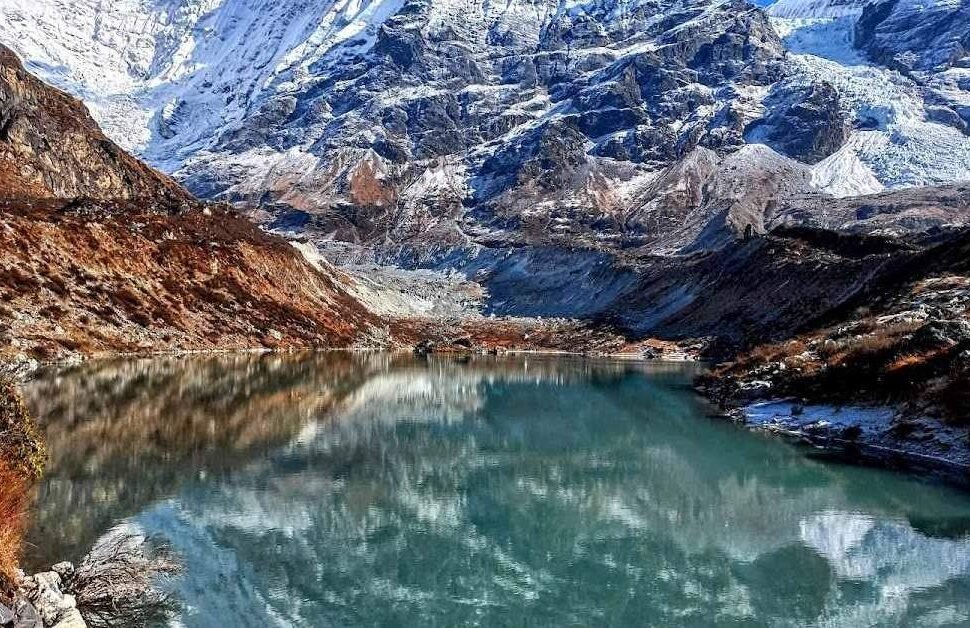
Langtang puts you inside the mountains themselves. The valley is narrow and glacially carved, and once you clear the thick forest below Lama Hotel, the peaks close in around you. Langtang Lirung, rising to roughly 7,245 meters, dominates the upper valley and is visible at close range for much of the walk from Langtang village onward. Side valleys reveal hanging glaciers, and the ground around Kyanjin Gompa is classic high mountain terrain: moraine, yak pasture, glacial streams, and a backdrop of ice and rock that feels considerably bigger and closer than anything on the Helambu route. This is big mountain scenery in a genuinely compact package, which is part of why Langtang has built such a strong reputation despite being a shorter trek than many of Nepal’s more famous routes.
Neither of these is simply a better version of the other. They are different registers of landscape, and the honest answer to “which has better scenery” depends entirely on what kind of scenery you are after. If you want glaciers, close range high peaks, and the feeling of being inside serious mountain terrain, Helambu will read as pleasant but comparatively tame. If you want long ridge walks through forest and farmland, with villages that feel lived in rather than built around trekking tourism, Langtang’s high alpine drama can feel slightly impersonal by comparison, all rock and ice and relatively few people actually living up where you are walking.
Culture: Hyolmo Villages of Helambu vs Tamang Villages of Langtang
Both regions are home to Tibetan Buddhist communities, and both get casually and inaccurately lumped together with “Sherpa” by outsiders who associate any Himalayan trekking culture with that one well known name. In reality, neither group is Sherpa, and each has its own distinct identity, language, and history.
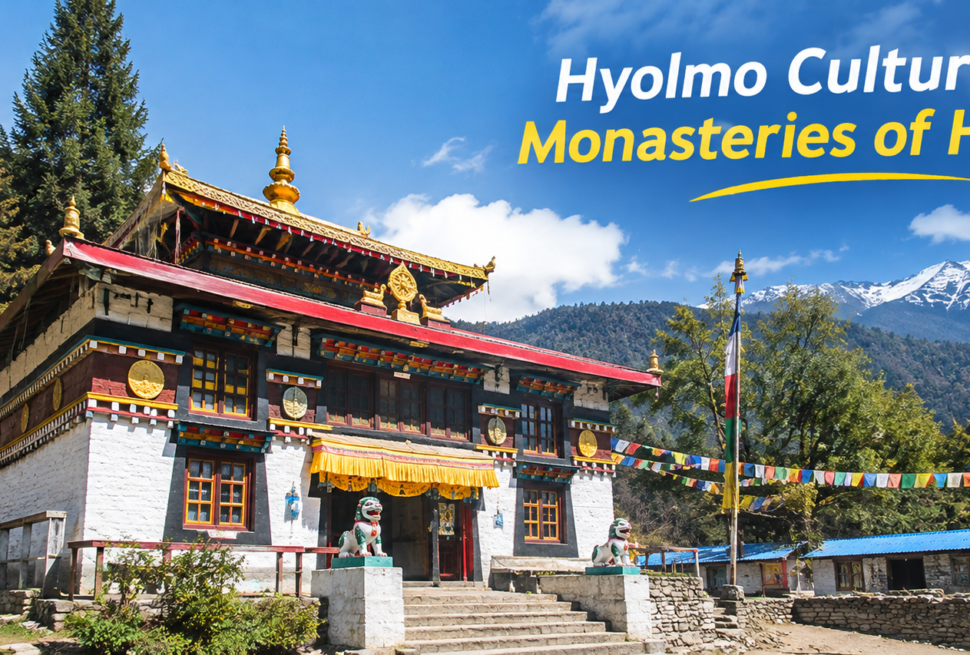
Helambu is home to the Hyolmo people, sometimes spelled Yolmo, after whom the region is largely named. They practice Tibetan Buddhism, maintain active monasteries in villages such as Tarke Ghyang and Sermathang, and speak their own Tibeto Burman language distinct from both Tamang and the Sherpa language spoken in Solu Khumbu. Older generations in particular maintain close religious and cultural ties stretching back toward Tibet, and the monastery at Tarke Ghyang has reportedly seen more or less continuous religious use for a very long time, making it one of the more culturally significant stops on the route. If you want a deeper look at this specific side of the trek, we cover the monasteries, religious practice, and daily village life in a dedicated piece called Hyolmo Culture and Monasteries of Helambu, which goes well beyond what fits naturally here.
Langtang’s villages, by contrast, belong primarily to the Tamang people, a Tibetan descended group with their own language and customs found across several hill districts of central Nepal, not only in Langtang. Tamang Buddhist practice centers on monasteries like the one at Kyanjin Gompa, and the community in Langtang has a particularly significant and painful recent history: the 2015 earthquake triggered a massive avalanche that destroyed Langtang village itself and killed well over a hundred people, including many residents and a number of trekkers. The village has since been rebuilt slightly uphill from its original site, and the community’s recovery is now part of what you see and hear about when you walk through, a sobering thread running through what is otherwise a spectacular stretch of trail.
The similarities between the two cultures are real. Both are Tibetan Buddhist, both maintain monasteries as genuine centers of community life rather than museum pieces, and both get mentally filed under “mountain people” by travelers who do not look closely enough to notice the differences. But the differences are just as real. Different languages, different histories, different relationships to Tibet and to the rest of Nepal, and in Langtang’s case, a very recent, very specific shared trauma that shapes how the community talks about its own valley today. Treating either as a generic stand in for “Himalayan culture” does both communities a disservice.
Permits and Paperwork Compared
Permit requirements differ meaningfully between these two routes, and the gap is bigger than most trekkers expect.
| Permit | Helambu Trek | Langtang Valley Trek |
|---|---|---|
| Area permit | Shivapuri Nagarjun National Park entry, around 250 Nepali rupees, paid at the gate near Sundarijal | Langtang National Park entry, around 23 US dollars for most foreign nationals, roughly 10 dollars for SAARC nationals |
| TIMS card | Required, around 15 to 17 dollars equivalent, obtained from the Nepal Tourism Board office in Kathmandu | Required, around 15 dollars, obtained the same way or at the Dhunche checkpoint |
| Approximate total | Under 20 dollars | Roughly 35 to 40 dollars for most non SAARC nationalities |
The practical upshot is that Helambu’s permit process is simpler and noticeably cheaper, since only a portion of the route even sits inside a protected national park and the entry fee for that park is modest. Langtang requires a full national park permit for essentially the whole trek, priced closer to what you would pay for entry into Nepal’s other major conservation areas, on top of the same TIMS card every foreign trekker needs regardless of which of these two routes they choose. Neither permit system has moved fully online as of this writing, so for both treks you will likely still need to visit the Nepal Tourism Board office in Kathmandu in person, or have a trekking agency handle the paperwork for you, before you set off. If you want the full walkthrough of exactly where to go, what to bring, and how the Helambu side of this works step by step, that detail lives in our existing Helambu trek cost and permits guide linked earlier in this article, rather than repeated here.
Guides, Porters, and the Changing Rules on Solo Trekking
This is a genuinely moving target, so treat the following as a snapshot rather than a permanent rule, and confirm current requirements with the Nepal Tourism Board or a licensed agency before you travel. In April 2023, Nepal introduced a rule requiring foreign trekkers to hire a licensed guide for most trekking regions outside Everest and Annapurna’s most developed sections, effectively ending fully independent, guideless trekking for a lot of routes, Helambu and Langtang included. That rule was reportedly walked back not long after, following pushback from parts of the tourism industry and from long time independent trekkers, and the practical situation on the ground for a while afterward was inconsistent depending on who you asked and which checkpoint you passed through.
More recently, some operators report a separate rule, dated around February 2025, specifically restricting guideless trekking in the Langtang region following a trekking guide requirement. Other sources describe the overall national picture differently, and the various trekking company blogs covering this topic do not fully agree with each other on dates or on exactly which routes are affected. What is consistent across nearly every source we checked is the direction of travel: Nepal has been steadily moving away from fully independent trekking and toward requiring at least a licensed guide, if not a full agency booking, on most routes including both of the treks in this comparison. In practice, most trekkers on either route now travel with a guide anyway, whether required by current law or simply because it makes the permit paperwork, the route finding, and the overall experience considerably easier. Porters are optional on both treks and mainly a matter of personal preference and budget rather than regulation, typically costing somewhat less per day than a guide on either route.
Crowds and Teahouse Standards
Neither of these treks feels remotely as crowded as the main trails in Everest or Annapurna, but they are not identical on this front either.
Langtang has built a strong, specific reputation over the past decade and sees a steady and fairly dense stream of independent trekkers, particularly in the main spring and autumn seasons. Kyanjin Gompa in particular can feel busy during peak weeks, with teahouses filling up and a noticeable queue of hikers on the trail up to the viewpoints on a clear morning. That popularity has also driven real investment in infrastructure. Teahouses along the Langtang route are generally well established, many with reliable solar power, paid wifi in the bigger villages, and hot showers available for a small extra fee almost everywhere. Food menus tend to be broader than on quieter routes, simply because there is enough consistent trekker traffic to justify stocking more variety.
Helambu sees meaningfully fewer trekkers overall. It is far from empty, and you will share the trail and the teahouses with other hikers, especially in peak season, but the atmosphere tends to feel calmer and less commercial. Teahouses are generally simpler and more basic than their Langtang counterparts, often smaller, family run operations with fewer rooms, more limited menus, and less reliable wifi or hot water, particularly once you get past the first day or two out of Sundarijal. This is not necessarily a downside depending on what you want from a trek. Many travelers find Helambu’s lower key village atmosphere more appealing precisely because it has not been as thoroughly built up around trekking tourism, and conversations with lodge owners tend to feel less transactional and more like genuine hospitality.
Food, Water, and Daily Costs on the Trail
Day to day spending on both treks follows the same basic teahouse model used across most of Nepal. You pay modestly for a room, often just a few dollars a night, and the lodge recoups its real income from the meals you order, so you are more or less expected to eat breakfast and dinner where you sleep. Dal bhat, the standard rice, lentil, and vegetable curry plate, remains the best value meal on either route and is usually refillable, which matters on long walking days. Expect to spend somewhere in the range of 20 to 35 dollars a day on food and lodging combined on either trek, before adding a guide or porter, with Langtang trending toward the higher end of that range simply because prices climb with altitude and with the extra cost of hauling supplies up a longer, rougher approach road, and Helambu trending slightly cheaper thanks to its shorter supply chain back to Kathmandu.
Bottled water gets progressively more expensive the higher and further from a road you go on both routes, so most experienced trekkers carry a filter or purification tablets and refill from boiled or treated water that teahouses sell at a fraction of the bottled price. Snacks, chocolate, and extras like phone charging or a hot bucket shower typically cost a bit more in Langtang simply because there is more infrastructure there to charge for in the first place. Neither trek requires bringing much food from Kathmandu, since teahouses on both routes are stocked well enough for a standard trekking diet, though variety narrows noticeably the higher you climb on either one.
Best Season for Each Trek
Full seasonal detail for Helambu, month by month, lives in our separate Best Time to Trek Helambu guide, so we will keep this section brief and focus mainly on Langtang, with a short comparison back to Helambu where it matters.
Langtang’s best windows are the same two seasons that dominate Nepal trekking generally: spring, roughly March through May, when rhododendron forests lower down the valley bloom and temperatures are comfortable, and autumn, roughly late September through November, which tends to offer the clearest mountain views and the most stable weather. Winter is possible but brings real cold at altitude, particularly around Kyanjin Gompa, and can close some of the higher side trips depending on snowfall. Monsoon, from roughly June through August, is generally avoided, both for the leech heavy lower forest sections and for the landslide risk on the access road to Syabrubesi mentioned earlier.
Helambu’s lower overall altitude gives it a slightly wider comfortable window. Spring and autumn remain the strongest choices for the same reasons as Langtang, good weather and good visibility, but Helambu’s lower elevation makes winter trekking considerably more forgiving there than on the Langtang side, and even the shoulder months tend to be workable for a trek that never climbs much past 3,650 meters. If the exact timing of your trip is flexible and you are choosing partly based on season, that flexibility is itself a point in Helambu’s favor.
Who Should Choose the Helambu Trek
Pick Helambu if you are short on vacation days and do not want to burn one or two of them just getting to and from a trailhead. Pick it if this is your first trek in Nepal and you want a genuine introduction to village life and Himalayan Buddhist culture without taking on serious altitude risk or a long physical slog. Pick it if you are traveling with a companion whose fitness level is uncertain, or if you simply prefer walking through inhabited, cultivated hill country over walking through high alpine wilderness. It also suits travelers combining trekking with a broader Kathmandu Valley itinerary, since the short approach from Sundarijal means you can genuinely fit a worthwhile multi day trek into a trip that also includes several days of sightseeing, without the logistics overwhelming the rest of the plan. In terms of fitness, if you can comfortably manage several hours of hill walking on consecutive days, you are already prepared for most of what Helambu will ask of you.
Who Should Choose the Langtang Valley Trek
Pick Langtang if big, close range mountain scenery is the actual point of your trip and you are willing to trade a longer, bumpier approach road and a bit more physical and altitude difficulty to get it. Pick it if you have slightly more days available, since the travel time alone adds at least a day on each end compared to Helambu, and if you want the option of pushing higher on a side trip to Kyanjin Ri or Tserko Ri for views that genuinely rival much longer, more expensive treks elsewhere in Nepal. It is a better fit for trekkers who have done at least one previous multi day hike, or who are otherwise confident in their fitness and have given some thought to how their body handles altitude above 4,000 meters, since the optional peaks above Kyanjin Gompa are a real step up from anything on the standard Helambu route. Spend at least a few weeks before departure building cardiovascular fitness with hill walking, stairs, or a loaded pack, since a reasonable base level of conditioning makes the Lama Hotel to Langtang village day, generally considered the hardest single day on the route, noticeably more manageable.
Want Both? The Langtang, Gosainkunda, Helambu Combination
You do not actually have to choose only one of these, and plenty of trekkers do not. A well established longer route links all three: starting in Langtang, climbing over the Lauribina pass area to the sacred lakes of Gosainkunda, and then descending through the Helambu region back toward Kathmandu, most commonly finishing near Sundarijal or Melamchi. This combined trek typically runs somewhere in the range of two to three weeks depending on pace and exact route choices, and it genuinely delivers the best of both worlds covered in this article: Langtang’s close up glacier and peak scenery, Gosainkunda’s high alpine lakes, and Helambu’s lower altitude villages and Hyolmo culture, all in one continuous walk rather than two separate trips.
It is a serious undertaking, both in terms of time and in terms of the altitude range it covers, climbing well above 4,500 meters at the Gosainkunda lakes before dropping back down through Helambu, so it is not something to attempt casually or without decent trekking fitness. But for travelers who have the time and the inclination, it solves the entire Helambu versus Langtang dilemma by simply removing the need to choose. If this route interests you, this site has a dedicated Langtang Valley Trek guide and a separate Gosainkunda trek guide covering each leg in more depth, worth reading alongside this comparison if you are seriously weighing the combined option rather than picking just one of the two shorter treks.
There is also a shorter middle path some trekkers choose instead of the full three region combination: walking Langtang as a dedicated out and back trip, then, on a separate occasion or later in the same holiday, doing Helambu on its own as a quick, low commitment add on given how close Sundarijal sits to Kathmandu. This avoids the extended altitude exposure of the full Gosainkunda crossing while still letting you experience both regions, just not stitched into a single continuous walk. It costs a bit more overall than the combined trek, since you effectively pay for two separate sets of permits and two separate approaches, but it gives you more flexibility on timing and lets you decide how you felt about the first trek before committing to the second.
The Honest Verdict
If someone asks us directly which of these two treks they should book, our answer genuinely depends on what they tell us they want, not on which one we would rather sell.
If you want big mountains up close, do not mind a long and occasionally bumpy road journey to get there, have a few extra days to spend, and are reasonably comfortable managing some altitude exposure, book the Langtang Valley Trek. It delivers scenery that punches well above its relatively modest trek length, and the side hikes above Kyanjin Gompa are genuinely among the better short high altitude viewpoints accessible from Kathmandu without a much longer, much more expensive expedition.
If you are tight on time, traveling with people of mixed fitness levels, more interested in culture and village life than in glaciers, or simply want a trek you can start and finish without losing a day of your trip to road travel, book the Helambu Trek. It will not give you the same jaw dropping close range peak views, and you should go in understanding that honestly rather than expecting a miniature version of Langtang. What it gives you instead is real access, real Hyolmo village culture, manageable altitude, and a genuinely good trek that does not demand nearly as much from your schedule or your body to deliver a satisfying few days in the hills.
And if you cannot decide and have the time to spare, the combined Langtang, Gosainkunda, Helambu route is sitting right there as the obvious answer. Before you commit to any of these options, it is worth reading our Helambu Trek Packing List alongside whichever route guide applies to your trip, since gear needs shift noticeably once altitude and trek length change, and packing for a short Helambu loop is a genuinely different exercise from packing for a three week combined trek through three regions.