A Trek Through a Living Culture, Not Just a Trail
Most people who look into the Helambu Trek start with the numbers. How many days, how high, how hard. Those questions matter, and we answer them elsewhere on this site. But if you walk from Sundarijal up over the Shivapuri ridge and down into the Melamchi valley without understanding who actually lives along that path, you will miss most of what makes this particular trek worth doing. Helambu is not scenery with people incidentally standing in it. It is the home valley of the Hyolmo people, a Tibetan Buddhist community with its own language, its own clans, its own festivals, and a history that is older and more specific than most trekking brochures let on.
Our earlier post on Helambu Trek cost, permits, and the best time to go mentioned in passing that the region is populated by what it called the Hyolmo Sherpa people. That phrase is extremely common in trekking marketing, and it is not entirely wrong, but it flattens a genuinely interesting and somewhat contested piece of Himalayan ethnography into a convenient label. This guide goes deeper. We will look at who the Hyolmo actually are, how they relate to and differ from the Sherpa of the Everest region, what village life and farming look like along the route, what the major monasteries actually are (as opposed to what trekking blogs like to claim about them), the everyday religious practices you will see every single day on the trail, the real festivals tied to this specific community, and how tourism and the 2015 earthquake have reshaped village life here. Where sources disagree, or where a claim is repeated everywhere online without anyone actually citing where it came from, we say so plainly rather than pretending to a certainty nobody has earned.
Who Are the Hyolmo People
The Hyolmo, also written Yolmo and sometimes Helambu Sherpa in less careful sources, are an indigenous Tibetan Buddhist community native to the Helambu and Melamchi valleys north of Kathmandu. Nepal’s 2011 census recorded just under eleven thousand Yolmo people nationwide, spread across eleven districts, with the Helambu valleys themselves home to a population in a similar range. That makes them a small community by Nepali standards, smaller than most people assume given how prominently their home valley features in Kathmandu trekking itineraries.
The name itself carries some of the region’s own mythology. In the Tibetan Buddhist understanding, Yolmo (or Yol mo) refers to a place encircled by high mountains, protected by a goddess, one of several hidden valleys, or beyul, that the fifteenth century treasure revealer Rigzin Godem described in his writings as sanctuaries where Tibetan Buddhists could take refuge from war, persecution, or spiritual decline. Tibetan religious texts call the area sBas yul Yolmo Gangra, the hidden land of Yolmo’s snow enclosure, a phrase that places Helambu within the broader Nyingma tradition of sacred hidden valleys rather than treating it as an ordinary administrative district. The ethnonym Hyolmo itself, with that initial H, is a comparatively recent adoption. Community leaders and cultural organizations began using it more consistently over the past couple of decades, drawing the spelling from these older religious texts, while most outsiders and the Nepali state continue to use Helambu for the place and Yolmo or Hyolmo somewhat interchangeably for the people. You will see both spellings used by scholars, and neither is simply wrong.
Hyolmo oral and textual tradition traces the community’s ancestry back to the Kyirong region of southern Tibet, close to the present day border with Nepal. This is an important point to hold onto, because it is the first real thread separating the Hyolmo from the Sherpa, who trace their own ancestry to a different part of Tibet entirely. The Hyolmo language belongs to the Kyirong branch of the Tibetic languages within the wider Sino Tibetan family. It shares a great deal of vocabulary with Tibetan and is traditionally written in Tibetan script, though many contemporary writers and researchers also use the Devanagari script to render it. Linguists estimate that close to the entire Hyolmo population still speaks the language, although the number of people who speak only Hyolmo, without also speaking Nepali, is shrinking fast as schooling, migration, and mixed marriage spread Nepali and English further into daily life. The closely related Kagate language, also called Syuba by some of its own speakers, is spoken by a community descended from Hyolmo papermakers who migrated southeast into Ramechhap district more than a century ago, a detail that researchers studying the group have used to track how Hyolmo identity shifts and is renegotiated once people leave the home valley.
Hyolmo religion is predominantly Nyingma Tibetan Buddhism, the oldest of the four major schools of Tibetan Buddhism, and it coexists in practice with older shamanic and animist traditions loosely grouped under Bon. Anthropologists who have spent extended time in Helambu, including Robert Desjarlais, whose ethnographic work on Hyolmo healing, emotion, and later on death and memory remains one of the more detailed outside accounts of the community, and Davide Torri, who has written specifically on the relationship between Buddhism and shamanism among the Hyolmo, describe a religious life where lamas and shamans operate side by side rather than one simply replacing the other. Torri’s own framing is that Hyolmo villages run on what he calls a unified yet asymmetrical system, in which Buddhist lamas hold the higher formal status but shamans continue to be the ones called on for specific kinds of healing, protection, and negotiation with local spirits and deities tied to the mountains and forests around the villages. If you spend any real time in a Helambu teahouse, you will likely hear about both a local lama and a local healer in the same conversation, often for different problems, and nobody in the village treats that as a contradiction.
Socially, Hyolmo communities are organized into clans, with names including Nyingma Lama, Terngilinpa, and Lhalungpa recorded among the recognized groupings, and descent runs patrilineally. Some clan names, such as Shyangba and Dongba, are shared with the neighboring Tamang community, a reminder that ethnic boundaries in this part of the Himalaya have never been as sharply drawn as a simple list of distinct peoples might suggest. The Nepal government officially recognizes the Yolmo as one of the country’s fifty nine indigenous nationalities, and the group also appears on India’s list of Scheduled Tribes, reflecting Hyolmo communities who settled in Darjeeling, Sikkim, and elsewhere in the eastern Himalaya generations ago.
Hyolmo or Sherpa: Why the Two Get Confused, and Why It Matters
Here is where a lot of otherwise decent trekking content goes soft. Search for Helambu online and you will find the phrase Helambu Sherpa, Yolmo Sherpa, or Hyolmo Sherpa used constantly, often by reputable sounding travel sites and occasionally even by data sources that should know better. One widely cited international people group database lists the group under the heading Sherpa Helambu while separately describing their primary language as Hyolmo and noting, almost in passing, that they speak a different language from the larger Sherpa community. That single sentence, buried in an entry that otherwise calls them Sherpa throughout, captures the whole problem rather neatly.
So let us be precise about what the actual Sherpa people are, so the comparison means something. The Sherpa are a Tibetan origin ethnic group whose own oral history traces descent from several clans who migrated out of Kham, in eastern Tibet, and settled in the Solukhumbu region of what is now eastern Nepal, the area that includes the Khumbu valley below Mount Everest. That migration is generally placed sometime around the fifteenth or sixteenth century, and Buddhist oral tradition frames it, much like the Hyolmo story, as a search for a beyul, a hidden sanctuary valley blessed by religious masters. The name Sherpa itself is widely understood to come from Tibetan words roughly meaning easterners or eastern people, a reference to their geographic origin relative to central Tibet. Today the great majority of Sherpa people live in Solukhumbu, Sankhuwasabha, and Taplejung in eastern Nepal, with Solukhumbu alone accounting for the heaviest concentration, and smaller Sherpa communities exist elsewhere, including, in fact, within parts of the Helambu and Sindhupalchok area and in Rasuwa and Dolakha. That last point matters: a small Sherpa presence in and around Helambu is real, not invented. The error is not that there are zero Sherpa anywhere near Helambu. The error is treating the whole valley, its dominant language, and its best known villages as Sherpa, when the documented majority community, its language, and its specific history are Hyolmo.
The language difference is the clearest, most checkable piece of evidence. Sherpa is a Tibeto Burman language in the southern branch of that family, blending elements of eastern Khams Tibetan and central Tibetan dialects, and it is not mutually intelligible with the Lhasa dialect of standard Tibetan. Hyolmo, as already described, sits in the Kyirong branch, tied to a different corner of the Tibetan plateau and carrying its own separate ISO language code in international linguistic classification. These are recognized as two distinct languages, not two dialects of one language, by the researchers who actually study them, including work published through SOAS in London and in the WikiJournal of Humanities’ grammatical description of Yolmo. A Sherpa speaker from Khumbu and a Hyolmo speaker from Tarkeghyang cannot simply understand each other by virtue of both being broadly Tibetan Buddhist highlanders. They would most likely fall back on Nepali.
What the two groups genuinely do share is real, and it is probably the actual source of the confusion rather than any deliberate mislabeling. Both are Tibetan origin, Nyingma leaning Buddhist communities who frame their own migration history around sacred hidden valleys. Both built their traditional economies around high altitude agriculture and herding before tourism arrived. Both wear broadly similar traditional dress, build broadly similar stone and timber houses, and both groups’ villages are strung with the same prayer flags and mani walls that give the whole Himalayan Buddhist cultural zone its visual identity to outside eyes. And critically, both groups have, for decades, worked in Nepal’s trekking and mountaineering industry, which is precisely where the labeling problem compounds itself. Sherpa became, through the specific history of early Everest expeditions and Western mountaineering writing from the 1920s onward, something close to a job title in English, a generic word tourists use for a mountain guide or porter regardless of that person’s actual ethnicity. A Hyolmo man carrying a pack on the Helambu Trek has, for generations, been liable to get called Sherpa by trekkers simply because that is the word foreign visitors learned to use for anyone doing that job in the Nepali hills, whatever his actual home village or language.
None of this means the two communities are unrelated or that pointing out the distinction is pedantic. It means a careful piece of writing about Helambu should use Hyolmo, or Yolmo, as the name for the region’s own people, reserve Sherpa for the actual Sherpa ethnic group of Solukhumbu and the small Sherpa communities genuinely present in parts of Sindhupalchok, and treat Helambu Sherpa as a popular shorthand with a real history behind why it caught on, rather than as an accurate ethnographic label. Our own Helambu Trek Difficulty and Altitude Guide and other posts in this series use Hyolmo for exactly this reason, in the same spirit as this article, even where the older post you may have already read used the more casual phrasing.
Villages Along the Trail: Houses, Streets, and Daily Rhythm
The Helambu Trek typically runs from Sundarijal at the edge of the Kathmandu valley, over the Shivapuri ridge near Chisapani and Burlang Bhanjyang, through Kutumsang and Tharepati, down into Melamchighyang and the Melamchi valley, and on to Tarkeghyang and Sermathang before descending toward the roadhead near Melamchi Pul Bazaar. Along the way you pass through, or near, Tamang villages like Mulkharkha as well as the specifically Hyolmo villages that give this trek its cultural weight, principally Tarkeghyang, Melamchighyang, and Sermathang, plus smaller settlements such as Nakote, Kakani, and Timbu.
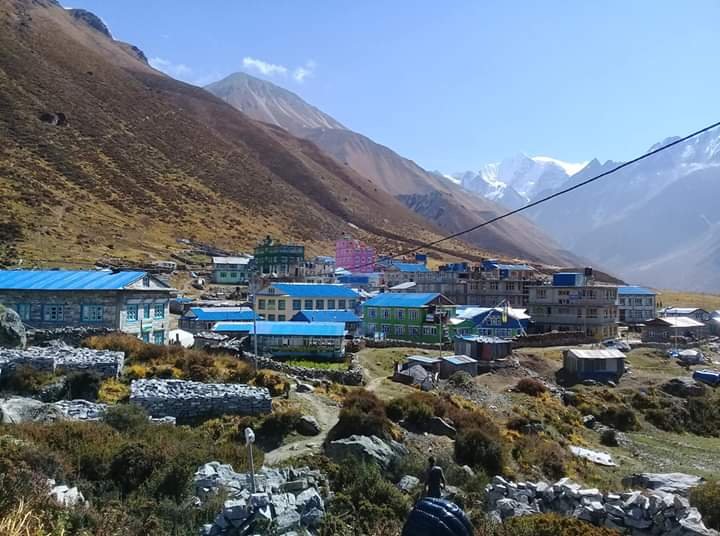
Village houses in this part of Helambu are built along broadly similar lines from one settlement to the next, though with real variation depending on altitude and how recently a particular house was rebuilt. Lower walls are typically stone, sometimes plastered and whitewashed, sometimes left as bare fitted stonework, with timber used for upper floors, window frames, and balconies. Older roofs were traditionally wood shingle or slate, though corrugated metal sheeting has become common across the region over the last couple of generations, partly because it is cheaper and easier to transport up the trail, and partly because many roofs were rebuilt in a hurry after the 2015 earthquake, which we come back to later. Window and door frames are frequently carved, and many homes are kept noticeably neat and freshly decorated, a point several visitors who have written about Tarkeghyang specifically have remarked on, describing the Hyolmo as houseproud in a way that stands out even by the generally tidy standards of rural Nepali hill villages.
Streets in villages like Tarkeghyang and Sermathang are narrow, often paved with flat stones, and wind between houses built close enough together that courtyards double as shared working space. You will see chilies, corn, and barley laid out to dry on roofs and courtyard walls depending on the season, firewood stacked under eaves, and small kitchen gardens tucked wherever there is a spare patch of soil. Livestock, mostly cattle and the occasional yak or yak hybrid at higher elevations, are kept in ground floor stalls or small sheds rather than roaming loose through the village center. Prayer flags are strung from nearly every rooftop and across courtyard entrances, not as decoration for visitors but because putting up fresh flags, especially around the new year, is simply what households here do.
Village life still runs on an agricultural clock even where tourism income has become significant. Mornings start early, with water collection, animal feeding, and cooking fires lit well before most trekkers are awake. Teahouses that host trekkers are, in the great majority of cases, simply someone’s home with extra rooms and a larger kitchen, not purpose built hotels, which is part of why staying in one feels different from a generic guesthouse elsewhere. The family running it is very often also farming a few terraced plots on the slope just outside town and keeping a couple of animals, with the teahouse as one income stream layered on top of a subsistence base that has not disappeared, even if it has become less central to daily survival than it was a generation or two ago.
Agriculture: What Actually Grows in Helambu
It is worth being specific here, because a lot of generic trekking copy about the Himalaya describes crops in vague terms without checking what is actually farmed at a given elevation. In Helambu specifically, the staple crops reported by people who have documented village life along this route are potatoes, barley, wheat, maize, millet, and root vegetables such as carrots, with sweet apples grown at the lower and middle elevations of the trek, roughly in the zone around Melamchi and the lower valley villages rather than up near Tharepati. Potatoes in particular do well at the altitudes most Helambu villages sit at, generally somewhere between about two thousand and three thousand meters, and along with barley they have long been described as the backbone crop of Yolmo agriculture generally, not just in Helambu but among Yolmo communities elsewhere in Nepal too.
Terracing is the basic farming technology that makes any of this possible on hillsides this steep. Fields are cut into narrow stepped shelves along the slope, retained with stone or packed earth edges, and planted according to a rotation that depends on elevation and household need rather than any single crop dominating. Higher up, closer to Tharepati and the ridge toward Ama Yangri, farming gives way more to grazing, with sheep and yak or yak hybrid cattle kept for wool, milk, and meat, and butter tea, made from that milk, offered to guests as a matter of basic hospitality in almost every Hyolmo home you are likely to visit.
Lower down, in and around the Melamchi valley, the apple orchards that have developed over recent decades represent one of the more concrete, documentable changes to the local agricultural economy, shifting some households toward a cash crop that can be sold down toward Kathmandu rather than grown purely for household consumption. This sits alongside, rather than replacing, the older subsistence pattern of potato, grain, and vegetable plots that still surrounds every village on the route. None of this is dramatic or exotic farming by world standards. It is careful, labor intensive hill agriculture adapted to a cold, steep, rain dependent environment, and it is worth noticing as you walk past it, because it is still what underwrites most households here even where tourism income has grown.
The Monasteries of Helambu: What Is Actually Known
This is the section where it pays to be honest about the limits of what is documented, because the gap between what trekking websites claim and what can actually be traced to a real historical source is wide.
Tarkeghyang
Tarkeghyang is routinely described, including by Nepal’s own tourism promotion material, as one of the largest and oldest cultural villages of the Hyolmo community, and it sits at roughly 2,600 meters with a fairly small resident population, by most recent accounts somewhere in the range of fifty to sixty households clustered around the village center. Trekking blogs frequently claim the village and its monastery date back around six hundred years, usually tied to a story that the eighth century Buddhist master Guru Rinpoche, also called Padmasambhava, meditated in the area and at the nearby peak of Ama Yangri. That claim appears again and again across trekking sites with no citation attached to it anywhere we could find, and it should be read as a traditional, devotional belief rather than a documented fact. It also does not actually add up on its own terms: Guru Rinpoche is a figure the Nyingma tradition places in the eighth century, which would make a site connected to him well over a thousand years old, not six hundred, so the six hundred year figure floating around online appears to be a rough, unsourced guess rather than a number tied to any specific event, textual record, or archaeological finding.
What does have a documented source is considerably more specific, and more interesting. Tibetan biographical literature on the Northern Treasure Nyingma lineage, the tradition that specifically describes Helambu as a sacred hidden valley, credits a figure named Terbon Nyima Sengge, who lived from roughly 1687 to 1738, with founding Tarkeghyang as a village after the Kathmandu valley’s Malla era king Jagajjaya Malla, who reigned from about 1722 to 1734, granted him land in gratitude for help containing an epidemic in the Kathmandu valley. If that account is accurate, Tarkeghyang as a settled village dates to the early decades of the eighteenth century, making it roughly three hundred years old rather than six hundred, a notable village with a real and specifically documented founding story, just not the one most casual sources repeat. We would rather give you that more modest, better sourced number than repeat the bigger, vaguer one simply because it sounds more impressive. The devotional connection to Guru Rinpoche and Ama Yangri as a sacred landscape almost certainly predates the village’s formal founding as a settlement, since the whole valley was already considered a blessed hidden land in Nyingma tradition well before Terbon Nyima Sengge arrived, and the two kinds of history, legendary and civic, are simply answering different questions.
Melamchighyang
Melamchighyang, sometimes written Melamchi Ghyang, sits within Langtang National Park along the lower stretch of the trek and is likewise described by Nepal’s tourism promotion material as one of the largest and oldest Hyolmo cultural villages, with a resident population locals put at around six hundred and fifty people, considerably larger than Tarkeghyang. Local legend places its founding as far back as the eighth or ninth century, which again lines up suspiciously neatly with the traditional dating of Guru Rinpoche rather than with any specific documented event, so we would treat that date the same way, as a devotional tradition rather than a verified founding date. The village is home to an Amitabha temple and the Nyinda Rangjon meditation cave, associated in local tradition with Guru Rinpoche’s own meditation retreats in the area, and it has had a monastery rebuilt in recent years after the older structure was damaged, a point we return to below.
Interestingly, Wikipedia’s own entry on the Helambu area describes Melamchighyang specifically as a Sherpa village, in contrast to most other sourcing, which treats it as Hyolmo. We flag that discrepancy deliberately, because it is itself a small, concrete example of exactly the labeling confusion discussed earlier in this guide, visible even within reference sources that are usually fairly careful.
Sermathang
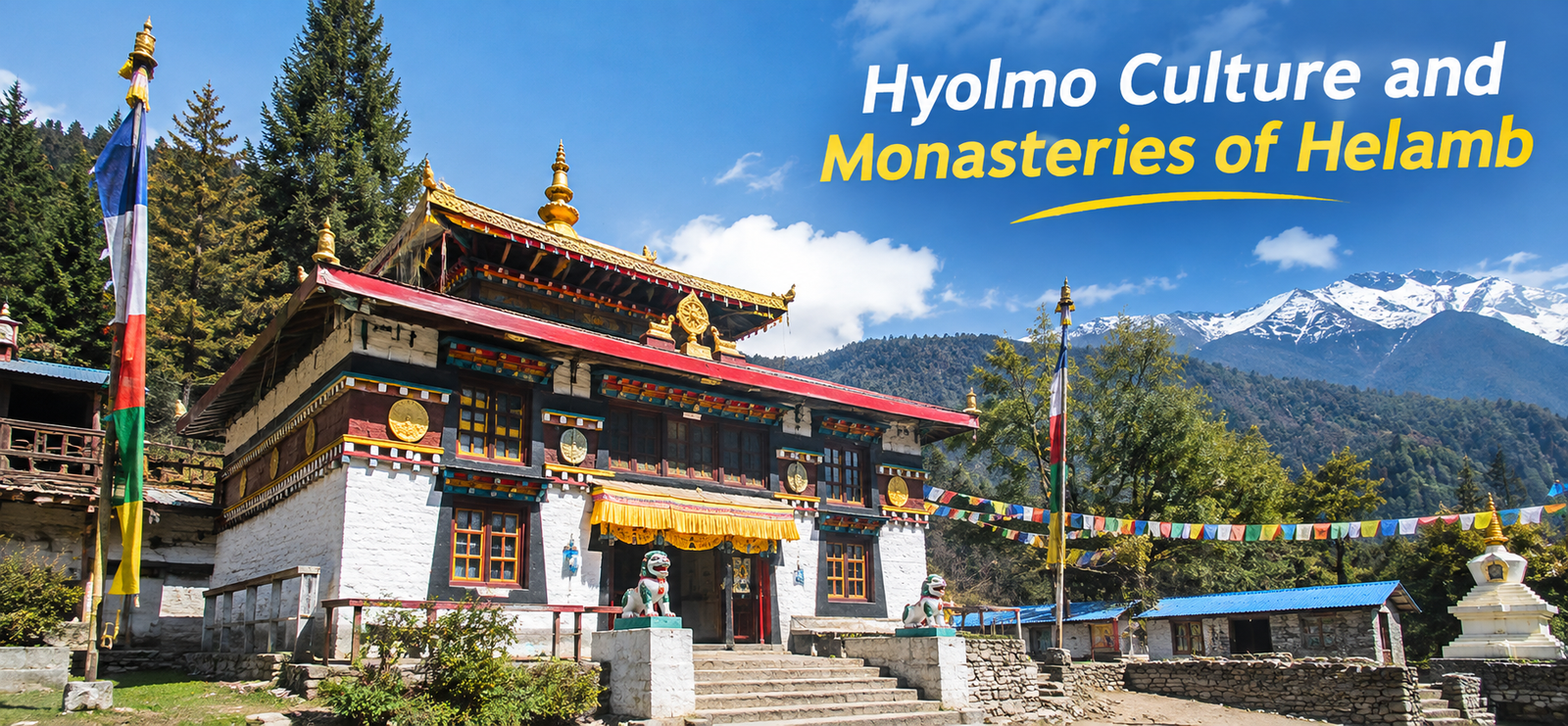
Sermathang sits further along the ridge at around 2,500 meters, with a small population that locals put at roughly two hundred people, and it too appears in Nepal Tourism Board material among the largest and oldest Hyolmo cultural villages. Its older monastery was destroyed in the 2015 earthquake, and a newer monastery has been built in the years since to replace it, a rebuilding effort that mirrors what happened across much of this district. The village remains an active pilgrimage stop for Tibetan Buddhists, tied to nearby sites associated with Guru Rinpoche’s meditation, along with a Buddha statue and a line of stupas along the approach to the village that most trekkers pass without necessarily knowing their significance.
Chiri Gompa and the question of what is genuinely old
If there is one site in the region with a real claim to serious age, documented through actual Tibetan biographical sources rather than repeated online folklore, it may be Chiri Gompa, also recorded as Tshiri Gonpa, which some sources describe as one of the oldest Buddhist religious sites in Helambu. Tibetan biographical writing on the figure Ngagchang Sakya Zangpo, active in the early sixteenth century, credits him with restoring the great stupa at Boudhanath and separately building what is described as the first Buddhist temple in the Helambu area, identified with the present day Chiri Gompa, around 1512. That is a specific date tied to a specific named religious figure and a specific textual source, which puts it on noticeably firmer ground than most of the age claims attached to the better known village monasteries.
The honest summary across all of these sites is this: the sacred landscape of Helambu, tied to Guru Rinpoche and the Nyingma concept of Yolmo as a hidden valley, is genuinely old, likely predating any of the standing structures by a long way. The actual buildings and formally founded villages are, as far as anyone has been able to document, considerably younger, mostly dating to the seventeenth and eighteenth centuries, with Chiri Gompa as a possible earlier exception from the early sixteenth century. Treat any specific round number age you read for a particular gompa, especially the ever popular six hundred years, as a traditional claim worth repeating as local belief, not as settled history.
Everyday Religious Objects You Will See, and How to Pass Them
None of the above requires you to become a scholar of Nyingma lineage history before you set out. What matters more for an actual walk through Helambu is recognizing the religious objects you will pass constantly, every single day, and knowing the basic etiquette around them.
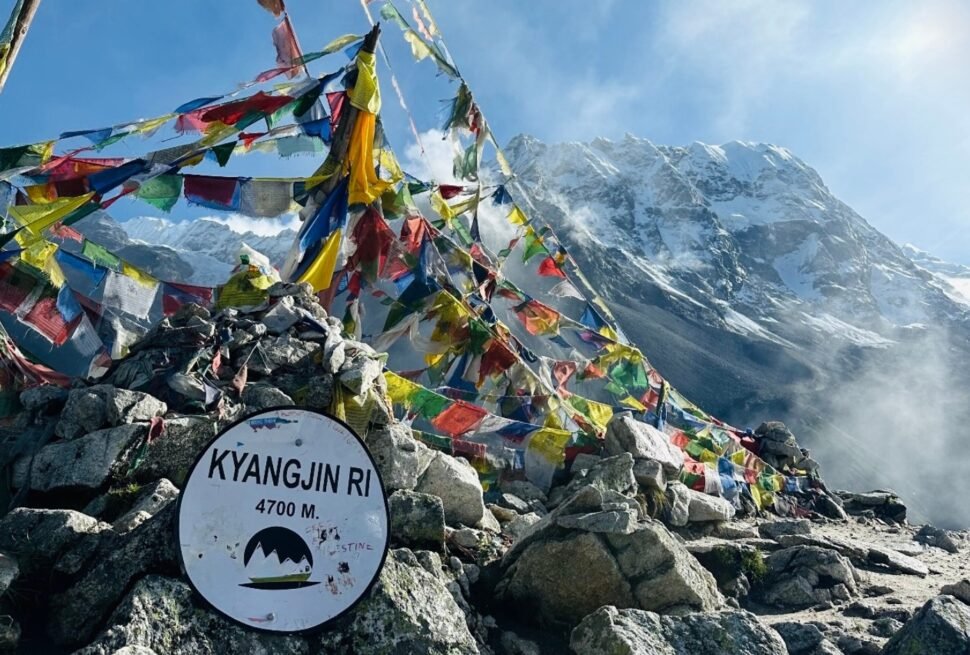
- Prayer flags, usually in five colors representing the elements, are strung above houses, across trail junctions, and along ridgelines. They are not decorations. Each carries printed mantras and images believed to be carried outward on the wind as the fabric weathers and fades, which is why Hyolmo and other Himalayan Buddhist households deliberately leave old, faded flags in place rather than removing them, and simply add new ones alongside.
- Mani walls are long stone structures, usually built along the approach to a village or chorten, made up of flat stones carved with the mantra Om Mani Padme Hum, sometimes alongside images of deities. The basic rule, and this holds for every religious structure of this type across the Himalaya, is to pass with the wall on your right hand side, meaning you walk clockwise around it rather than counterclockwise. Where a trail splits around a mani wall or chorten, take the path that keeps the structure on your right.
- Chortens, the Tibetan term for the structures often called stupas elsewhere, are solid, usually whitewashed monuments that can mark a village entrance, a holy site, or the remains of a respected lama. The same clockwise rule applies: circle a chorten clockwise, never counterclockwise, and never climb on one.
- Prayer wheels, whether the large fixed cylinders you find set into monastery walls or smaller handheld ones carried by elderly villagers, are spun clockwise with the right hand, each full turn understood as repeating the mantra contained inside.
Inside an actual monastery, a few extra points of etiquette matter. Remove your shoes before entering the main prayer hall, keep your voice down, and avoid walking directly in front of someone who is prostrating or in active prayer. Dress modestly, covering shoulders and knees, which is worth planning for when you are putting together your Helambu Trek Packing List, since a lightweight long sleeved layer earns its space for monastery visits even if you would otherwise trek in short sleeves. Ask before photographing the interior of a shrine room, and if monks are present and seem to be in the middle of a ritual rather than simply going about ordinary business, it is generally better to wait outside or ask quietly whether it is acceptable to come in and look. Small donations left in the box near the altar are appreciated and are the normal way a visitor contributes to the upkeep of a working religious building rather than a museum piece, and a brief, genuine moment of quiet before you leave matters more than lingering for photographs.
Festivals: What Is Actually Hyolmo Specific
Trekking sites love to list generic Himalayan festivals without checking which community actually celebrates which one, so it is worth separating what is specifically documented for Hyolmo Helambu from what is simply a broader regional practice shared with Tamang, Gurung, or other Tibetan Buddhist communities nearby.
Sonam Lhosar is the clearest case of a shared festival. It is the new year celebration followed by several Tibeto Burman communities in Nepal, including the Tamang and Gurung as well as the Hyolmo, and it begins on the new moon day of the lunar month of Magh, which generally falls in late January or February, running roughly fifteen days to the following full moon. In Helambu specifically, reporting on the festival describes households preparing a nine ingredient dish called Ku Thukpa in the days beforehand, fetching water from a natural source before dawn on the first and most important day to offer to household deities, visiting maternal relatives, and raising new prayer flags, while families who have lost a close relative in the preceding year deliberately scale back their own celebration out of respect for mourning.
Tshechu is the festival that appears specifically and repeatedly in connection with Hyolmo villages in particular, including Sermathang, Tarkeghyang, Melamchighyang, Nakote, and Kutumsang. It follows directly on from Sonam Lhosar, beginning on the fifth day of the lunar month and running eleven days to the following full moon, which in practice usually lands somewhere in February. Tshechu commemorates the birth anniversary of Guru Rinpoche and includes a five day sequence of puja with lamas reciting scripture, communal feasting with households taking turns hosting, mask dances representing deities and protective or demonic figures, and a community circle dance called Syabru in which villagers join hands and dance together. The festival closes with a blessing given by the presiding lama to the assembled community. Hyolmo communities who have moved to Kathmandu continue to mark the festival at a dedicated Hyolmo monastery in the Tinchuli area of Boudha, after a month of observance back in the home villages, which says something about how seriously the diaspora still treats a festival tied specifically to their home valley rather than to Tibetan Buddhism in general.
Losar, the broader Tibetan new year, is also observed in Hyolmo villages, sometimes described in slightly overlapping terms with Sonam Lhosar depending on who you ask, with homemade millet or grain alcohol, flatbreads, and meat dishes shared among visitors during the period. If you are planning your trip specifically around festival timing, our Best Time to Trek Helambu guide covers the practical seasonal tradeoffs in more depth, but broadly speaking, trekking through in the window around Sonam Lhosar and Tshechu, typically somewhere in that January to February stretch, gives you the best realistic chance of being in a village during an actual community celebration rather than simply reading about one afterward.
Tourism, Cash, and What Has Actually Changed
It is tempting to write either a rosy story about tourism lifting a poor mountain community out of hardship, or a gloomy story about tourism eroding tradition, and neither extreme holds up well against the actual reporting available on Helambu. What seems more accurate is a mixed, uneven picture.
Trekking in this part of Nepal grew substantially from the later decades of the twentieth century onward, as Helambu’s relative closeness to Kathmandu, a few days’ walk rather than a flight and a long drive, made it one of the more accessible cultural trekking routes near the capital. Over that period, a meaningful share of Hyolmo households shifted at least part of their income toward tourism, running teahouses, working as trekking guides and porters, or selling food and goods to passing trekkers, layered on top of, rather than replacing, the older base of potato, grain, and vegetable farming described earlier. News reporting on the area in recent years describes a genuine, if gradual, recovery and growth in this tourism economy, with one 2020s report describing forty to fifty tourists arriving daily in the Helambu area during active trekking seasons, new trails being developed toward areas like Ganjala Pass and Langtang, and steady hotel bookings supporting local business.
At the same time, academic work on the Hyolmo paints a picture of substantial internal migration that predates mass tourism and continues alongside it. Research on Hyolmo communities who moved into Lamjung and Ramechhap districts, in some cases more than a century ago as papermakers, and separate ethnographic work on modernization in medical practice among rural Hyolmo communities, both point to a group whose economic and social life has been changing steadily across generations, through migration, through contact with lowland Nepali institutions, and more recently through tourism income, rather than tourism being some sudden single disruption to an otherwise unchanging village life. What anthropologists studying the region’s religious life have found more persistent is the coexistence of Buddhist monastic practice and older shamanic healing traditions side by side, described by at least one researcher as a stable, if asymmetrical, working arrangement between lamas and shamans that has not simply dissolved as cash income, better roads, and outside medical care have become more available. In other words, the economy has modernized considerably. The underlying religious and social structure has proven more durable than that shift alone would predict, even if it is not frozen in place either.
A more visible and recent change is infrastructure. Villages like Sermathang are now connected by gravel roads to Melamchi and from there to Kathmandu, with bus services running, particularly in the dry winter months, a stark contrast to a route that not long ago was accessible only on foot or by mule. That road access cuts both ways for trekkers and for residents: it has made parts of the lower Helambu route easier to reach and resupply, while also meaning the trekking experience in the lowest villages is somewhat less isolated than it once was, which is one reason many operators now design the Helambu Trek to spend more time in the higher, less road accessible stretches around Tharepati and Tarkeghyang.
The 2015 Earthquake: What Is Documented and What Is Not
We want to be careful here rather than invent a tidy village by village damage report that does not actually exist in reliable sourcing. The magnitude 7.8 Gorkha earthquake of April 25, 2015, was centered well to the west of Helambu, but Sindhupalchok, the district that contains Helambu and the Melamchi valley, was among the very hardest hit districts in the entire country. District level figures recorded more than 3,550 deaths in Sindhupalchok by August of 2015, with thousands more injured, and close to ninety seven percent of the roughly sixty six thousand houses counted across the district reported destroyed. Those are district wide statistics, not figures specific to Tarkeghyang, Sermathang, or Melamchighyang individually, and we have not found reliable sourcing that breaks the damage down village by village for Helambu specifically, so we will not pretend otherwise by inventing a precise local death toll or casualty count that we cannot actually verify.
What is documented at the more local level is damage to religious buildings specifically. Reporting from roughly a year after the earthquake described monasteries and shrines across Helambu and nearby Shermathang still unrepaired, with local leaders at the time pressing the government to prioritize rebuilding those sites and to help displaced families move out of temporary shelter, and with trekker numbers, previously around one hundred and fifty arrivals a day by one local estimate, having dropped sharply as a direct result. Sermathang’s older monastery is specifically reported to have been destroyed in the earthquake, with a new monastery built in the years since to replace it, and Melamchighyang’s monastery likewise appears to have been rebuilt or substantially renewed in the period since, based on more recent visitor accounts describing a newer structure there. More recent reporting, from the tourism recovery period that followed both the earthquake and later the COVID nineteen pandemic, describes rebuilt homes, hotels, and monasteries across Helambu and a genuine recovery in visitor numbers.
So the honest version of this story is: Sindhupalchok as a whole suffered catastrophic, well documented destruction in 2015, Helambu’s own religious buildings were clearly affected, with at least Sermathang’s monastery specifically confirmed destroyed and later rebuilt, reconstruction was frustratingly slow in the immediate years afterward by local residents’ own account, and the picture today, roughly a decade on, is one of rebuilt structures and recovering tourism rather than visible ruins along the main trekking route. If you want a precise count of exactly how many homes or temples were destroyed in Tarkeghyang itself as opposed to Sermathang, we have to tell you plainly that general information at that specific level is limited in what is publicly available, rather than guess at a number to sound more authoritative than the evidence allows.
Visiting Respectfully: Families, Teahouses, and Monks
Most of what makes a visit to Helambu go well has less to do with grand gestures and more to do with small, consistent habits of courtesy, the kind that matter more here than they might in a city hotel because you are, quite literally, a guest inside someone’s home for most of your nights on the trail.
- Ask before photographing people, particularly older villagers, anyone at prayer, or anyone inside a monastery, rather than assuming a camera is automatically welcome.
- Accept tea or food when it is offered in a home, even briefly, since turning it down outright can read as a small rebuff of hospitality that costs the household very little to extend and matters more to them than it might seem to you.
- Use your right hand, or both hands together, when giving or receiving food, money, or any object, rather than passing something with your left hand alone.
- Avoid pointing your feet toward people, toward a household hearth, or toward an altar or image of the Buddha, and be mindful about where you point your feet generally when seated on the floor of a teahouse common room.
- Keep voices down inside and near monasteries, and do not lean on, sit on, or climb chortens or mani walls, however tempting a stone wall looks as a place to rest a pack.
- Avoid handing out sweets or money directly to children along the trail. It feels generous in the moment, but repeated giving of this kind has a documented tendency to encourage begging behavior in villages that depend on trekkers passing through, and it is generally better to support a family’s income through fair payment at their teahouse, through a local guide, or through a school or community project if you want to give something more lasting.
- Pay teahouse prices without aggressive bargaining. Margins on a small family run lodge in a village this size are thin, and the price of a meal or a room here is rarely the place to practice hard negotiation.
- Ask before entering a monk’s private living quarters, as opposed to the public prayer hall, and follow whatever instruction a resident monk or caretaker gives you about where in a monastery compound you may walk.
- A simple Namaste, said with hands together, is understood and appreciated everywhere on this route, and in more specifically Tibetan Buddhist contexts you will also hear Tashi Delek used as a greeting and a blessing, which visitors are welcome to use back.
None of this requires you to be an expert in Hyolmo culture before you arrive. It mostly requires paying attention, slowing down a little, and treating the villages you pass through as places where people actually live their whole lives, not as a backdrop assembled for the benefit of whoever happens to be walking the Helambu Trek that week.
Bringing It Together
Helambu rewards exactly the kind of attention this guide has tried to model. The Hyolmo people who live here are their own community, with their own language, their own clans, and a documented history distinct from the Sherpa of Solukhumbu, even though decades of trekking industry habit have blurred that line in casual conversation and in some surprisingly careless reference sources. The villages along the route, Tarkeghyang with its roughly three centuries of documented history beneath a much older devotional legend, Melamchighyang with its rebuilt monastery and larger population, Sermathang with its newer gompa standing on the site of one lost to the 2015 earthquake, are not interchangeable stops on a checklist. They are specific places with specific, partially documented, partially legendary histories, farmed with potatoes, barley, and millet, dressed every year in fresh prayer flags for Sonam Lhosar and Tshechu, and still finding their way, unevenly but steadily, through a changing cash economy that has brought roads, teahouses, and trekkers without erasing the older rhythm of lamas, shamans, and terraced fields underneath it. Walk it slowly, pass the chortens on the correct side, and you will come away with a far better sense of the place than the word Sherpa, used loosely, was ever going to give you.