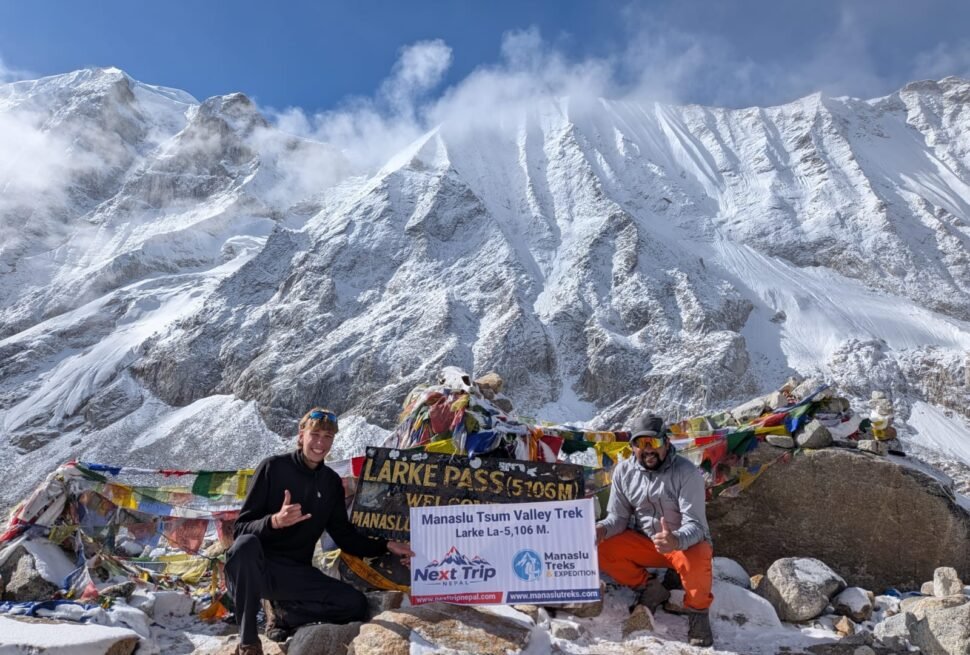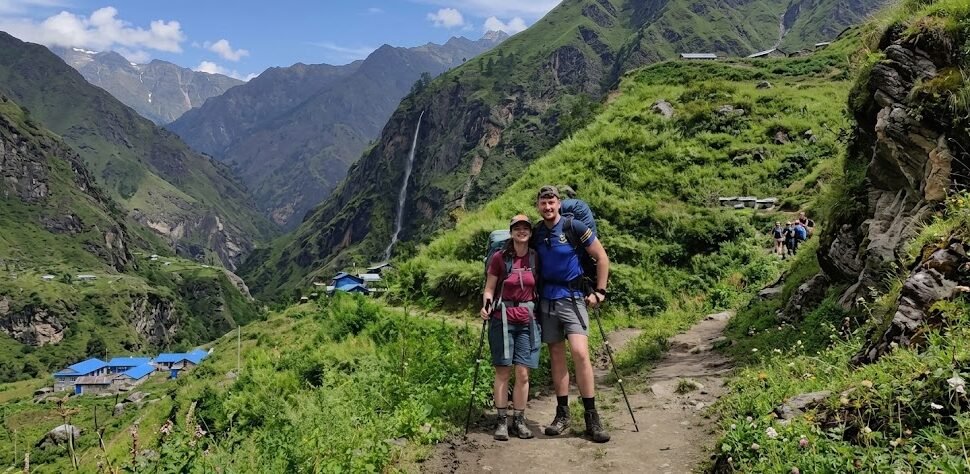
Pick the wrong month for the Manaslu Tsum Valley Trek and you will not just have a grayer photo album. You could be stuck in Samagaon for three extra days waiting for a storm to clear, turned back at Larke La by fresh snow, or slogging through leech country in the lower Budhi Gandaki gorge wondering why nobody warned you. This trek rewards good timing more than almost any other route in Nepal, because it mixes a deep, humid, subtropical valley at the start with a 5,106 meter glacier pass near the end, and because it is a restricted area that cannot be trekked on a whim the way Everest Base Camp or Annapurna sometimes can.
We already cover permits, the day by day itinerary, and total cost in our separate Manaslu Tsum Valley Trek Guide, so we will not repeat that here. This article is about one question we get asked constantly: when should you actually go? Below is a genuine, month by month breakdown of weather, temperature, snow, rain, trail conditions and crowd levels for this specific route, built from real seasonal patterns in the Manaslu Conservation Area and Tsum Valley rather than generic Nepal trekking advice copied from an Everest blog.
The Two Main Trekking Seasons in Nepal, and Why They Fit This Route So Well
Nepal’s trekking calendar really comes down to two reliable windows: spring, roughly March through May, and autumn, roughly September through November. Everything else, winter and the monsoon, is either a compromise or a specialist choice. That basic framework applies to the Manaslu Tsum Valley Trek too, but the route’s particular geography sharpens the case for these two seasons even further.
Autumn arrives right after the summer monsoon has washed the dust and haze out of the atmosphere. Stable high pressure tends to settle over the Himalaya from late September onward, humidity drops, and the mountains that were hidden behind cloud all summer suddenly stand out crisp against a deep blue sky. Rainfall becomes rare, river crossings in the lower gorge calm down from their monsoon surge, and daytime temperatures across most of the route are comfortable for walking. For a trek that climbs from under 1,000 meters near Machha Khola to over 5,000 meters at Larke La, autumn’s combination of dry trails low down and generally settled weather up high is close to ideal.
Spring works for a different set of reasons. By March, the harshest winter cold has eased, snow at the pass begins to consolidate and partially melt back from its deepest winter levels, and the forests on the lower and middle sections of the trail burst into rhododendron and magnolia bloom. Days are longer, which matters on a trek with some genuinely long walking days in the Tsum Valley side trip and on the approach to Samagaon. Spring air is often a little less crystal clear than autumn air because pre monsoon haze and dust start building from April onward, but the trade off is color, warmth and a livelier feeling on the trail.
Both seasons share one more advantage specific to this trek: they are when the Manaslu and Tsum region’s limited teahouse infrastructure is actually staffed and stocked. Several lodges along the route, particularly in Tsum Valley and around Samdo and Dharamshala, scale back or close entirely outside these two windows, simply because there is not enough trekking traffic to justify staying open through a long cold winter or a wet, quiet monsoon.
Why Manaslu and Tsum Valley Have a Narrower Window Than Everest or Annapurna
People who have trekked Everest Base Camp or the Annapurna Circuit sometimes assume Manaslu works the same way and are surprised when an agency pushes back on a December or late June departure date. There are two real reasons this route has a tighter practical calendar, and both are worth understanding before you lock in dates.
The first is the restricted area permit system. Manaslu and Tsum Valley sit in a government designated restricted area, which means every foreign trekker needs a Restricted Area Permit, an MCAP (Manaslu Conservation Area Project) permit, and for the side trip, a Tsum Valley permit, on top of the usual ACAP overlap near Annapurna at the end of the route. For years, the rule was that these permits could only be issued to a group of at least two foreign trekkers traveling with a licensed guide, which meant true solo, independent trekking was not an option here the way it sometimes is on unrestricted routes. That rule shaped the whole season, because agencies built fixed departure group trips around spring and autumn, when enough travelers wanted to go to form a group easily.
Nepal’s tourism authorities eased this rule in 2026, dropping the strict two person minimum for restricted areas including Manaslu and Tsum Valley, so a single trekker can now hold a permit in their own name. A licensed guide is still mandatory though, no exceptions, and that single fact still narrows the window in practice. Guides are a finite, skilled resource, and the ones who know this route well are booked solid through the two main seasons. Outside spring and autumn, it becomes harder to arrange a guide and crew at short notice, lodges along the route may be closed, and the agency side of things, permit paperwork, Manaslu Conservation Area Project registration and so on, is generally geared toward spring and autumn departures. If you want the full detail on how permits and group logistics work, that is covered properly in our Manaslu Tsum Valley Trek Guide rather than here.
The second reason is Larke La itself. At 5,106 meters, it is higher than the Thorong La pass on the Annapurna Circuit and considerably higher than anything on the standard Everest Base Camp trek. It is also a genuine glacier crossing, not just a high dirt pass, with snowfields, occasional crevassed sections, and a long, exposed approach on both sides. Larke La is notably prone to heavy snowfall, and Nepali news outlets have reported it being blocked by snow on several occasions in recent years, stranding trekkers on one side or the other until crews could break trail or conditions improved. Because there is really only one viable route over this section of the Himalaya on this trek, unlike some passes that have alternative lower routes nearby, a snow closure at Larke La does not just mean a harder day. It can mean the trek simply cannot continue until the snow eases or clears enough for a safe crossing. That single bottleneck is the biggest reason Manaslu’s trekking window feels shorter and less forgiving than Everest or Annapurna, where multiple route options and lower key passes give a bit more flexibility.
Month by Month Weather Guide for the Manaslu Tsum Valley Trek
The numbers below are typical averages built from a combination of regional meteorological patterns and the experience of guides who run this route repeatedly. Mountain weather is genuinely variable from year to year, and we want to be honest that no agency can guarantee exact temperatures or a snow free pass on any specific date. Treat every figure here as a realistic range, not a promise.
January
January is the depth of winter and the coldest month on the route. At low elevation around Machha Khola and Soti Khola, daytime temperatures are still mild by comparison, often somewhere in the 10 to 18 degree Celsius range with cold, clear mornings, while nights can dip close to freezing. At Samagaon, daytime highs typically sit somewhere around 0 to 5 degrees Celsius with full sun, dropping to perhaps minus 10 to minus 15 at night. Up at Larke La and the approach lodges at Dharamshala, nighttime temperatures regularly fall well below minus 15, and cold snaps can push considerably lower. Snow risk at the pass is at its highest in January, and this is the month most likely to see Larke La closed for days at a time after a heavy storm. Trail conditions on the lower gorge are generally good and dry, but ice on the trail near Samdo and on the approach to Dharamshala is common and requires care, ideally with microspikes. Crowds are minimal, you will likely have teahouses to yourself, but several lodges above Samagaon reduce services or close outright. We consider January trekking here a specialist option for well prepared, flexible groups rather than a first choice, and honestly do not recommend it for a first time Himalayan trekker.
February
February is a slight improvement on January but still firmly winter at altitude. Lower elevation days remain pleasant, often 12 to 20 degrees Celsius with good visibility, since winter haze is generally lower than the pre monsoon spring haze that builds later. Samagaon days warm marginally compared to January, perhaps 2 to 7 degrees Celsius, with nights still commonly below minus 10. Snow accumulation at Larke La can be substantial by this point in the season, and closures remain a real possibility, sometimes for extended stretches after a big system moves through. Late February can occasionally show the first hints of a thaw in milder years, but this varies a great deal and should not be relied upon. Trail conditions in Tsum Valley, which sits at somewhat lower average elevation than the main Manaslu side, are usually more manageable than the pass approach itself. Crowds remain very light. This is still a month we would only recommend to experienced winter trekkers traveling with a guide who knows current pass conditions well, and we build in extra contingency days for any winter departure.
March
March is where spring genuinely begins and conditions start shifting in trekkers’ favor. Early March can still carry winter’s tail, with occasional snowfall at altitude, but by mid to late March the trend is clearly toward warmer, more settled weather. Lower elevation daytime temperatures climb into a comfortable 15 to 22 degree Celsius range, and the first rhododendron blooms begin appearing in the mid elevation forests around Jagat, Deng and the lower Tsum Valley approach. At Samagaon, daytime temperatures typically improve to somewhere around 5 to 10 degrees Celsius, with nights still cold but less brutal than deep winter, often in the minus 5 to minus 10 range. Larke La remains genuinely risky in early March, with meaningful snow still present and occasional fresh storms, so late March crossings need an experienced guide reading recent conditions rather than a calendar date alone. Crowds begin picking up noticeably from almost nobody in January and February to a modest but real trickle of trekkers by the end of the month. March is a reasonable choice for trekkers who want spring colors and lighter crowds and who are comfortable with somewhat higher uncertainty at the pass than April or May offer.
April
April is one of the two or three best months on this route and a genuine favorite among our own departures. Rhododendron forests across the mid elevations are often at their most spectacular, with reds, pinks and whites lighting up the trail between roughly 2,000 and 3,000 meters. Lower elevation daytime temperatures run warm, commonly 18 to 25 degrees Celsius, occasionally hotter in the gorge sections near Machha Khola and Jagat. At Samagaon, days are pleasant, typically 8 to 13 degrees Celsius, with nights usually above the harshest winter lows, perhaps minus 2 to minus 7. Larke La by April has generally shed much of its deepest winter snow load, though fresh spring snowfall is still possible and the crossing should never be treated as guaranteed easy. Afternoon cloud build up becomes more common as the month progresses, which can obscure distant peak views later in the day even on an otherwise clear morning, so early starts matter more in April than in autumn. Crowds rise to a solid level, particularly in the back half of the month, and this is one of the two seasons where booking ahead for teahouse rooms and permits genuinely matters.
May
May continues the spring pattern with rising warmth and increasing humidity as the pre monsoon builds toward June. Lower elevation temperatures can become quite hot, sometimes pushing past 28 or even 30 degrees Celsius in the gorge on a clear afternoon, which surprises trekkers who pictured Nepal as uniformly cold. At Samagaon, daytime highs often reach a comfortable 10 to 15 degrees Celsius, and nighttime lows are the mildest of the spring season, frequently no colder than freezing. Larke La is generally at its most snow free of the year by mid to late May, making this arguably the easiest technical crossing of the season, though afternoon thunderstorms and increasing cloud cover become a real factor, especially from mid May onward as monsoon moisture starts arriving in pulses. Trail conditions lower down can turn muddy after these early rains. Rhododendron blooms have usually moved higher up the mountainside by this point, with lower forests past their peak and upper elevation blooms, where present, just starting. Crowds are moderate to busy depending on the exact week, generally easing off toward the very end of the month as trekkers begin avoiding the approaching monsoon.
June
June is a genuine transition month and, by the second half, is effectively the start of monsoon trekking conditions. Early June can still offer decent weather with the last clear windows of the spring pattern, but by mid June the southwest monsoon typically arrives across most of Nepal, bringing daily rain to the lower and middle sections of the trail. Lower elevation daytime temperatures are hot and humid, often 25 to 32 degrees Celsius with high moisture in the air, while rainfall becomes frequent, usually arriving as afternoon or overnight downpours rather than constant rain. At Samagaon, days remain mild, roughly 10 to 15 degrees Celsius, with increasing cloud cover limiting mountain views. Larke La is typically passable in June without major snow issues, but persistent cloud can make the crossing feel socked in and visually underwhelming even when technically safe. Leeches become active in the lower forested sections once the rains properly set in, usually from mid June. Crowds drop off sharply through the month as word spreads that monsoon has started. We generally advise against booking a Manaslu Tsum Valley Trek for late June unless you have a specific reason and realistic expectations about rain and limited views.
July
July is the wettest month of the year across most of Nepal, and the Manaslu region is no exception. This is deep monsoon season, with substantial daily rainfall, saturated trails, and the Budhi Gandaki river running high and fast through the lower gorge. Daytime temperatures at low elevation stay warm and sticky, typically 23 to 30 degrees Celsius, but the defining feature of the month is moisture, not heat. At Samagaon, temperatures are mild, often 8 to 14 degrees Celsius during the day, but cloud cover is near constant and mountain views are the exception rather than the rule. Landslide risk on the lower trail sections rises meaningfully in July, since saturated slopes above the trail between Machha Khola and Namrung are more prone to slipping, and trail sections can be temporarily blocked or rerouted after a heavy storm. Leeches are at their most active and numerous in the lower forested zones. Larke La is usually passable from a snow standpoint, since July snowfall at the pass is less common than in winter, but the approach can be wet and the whole upper route feels remote and quiet with few other trekkers around. We do not run scheduled group departures in July and only support custom trips for travelers who fully understand and accept monsoon conditions.
August
August remains solidly within monsoon season, though by the back half of the month there are sometimes early hints of the pattern beginning to weaken. Rainfall stays high through most of the month, similar in character to July, with regular afternoon and overnight downpours across the lower and middle trail sections. Daytime temperatures at low elevation continue in a warm, humid 23 to 30 degree Celsius range. At Samagaon, days typically run 8 to 14 degrees Celsius with persistent cloud. Landslide risk remains elevated on the lower trail, particularly after multi day rain events, and leeches remain a real nuisance in the forested middle sections. Larke La is usually open and passable, but views from the top are a genuine gamble, often limited to whatever gap appears in the cloud for a few minutes. Crowds are at their lowest point of the year. The one argument for August is price and solitude, teahouses are empty and some agencies offer reduced rates, but we are honest with clients that this is a trade off against a real chance of seeing very little of the actual mountains.
September
September is where the picture improves fast, though the timing of that improvement varies year to year and should not be treated as fixed to a calendar date. Early September often still carries meaningful monsoon moisture, with rain and cloud similar to August, while the back half of the month typically sees the monsoon begin to retreat, bringing drier air and the first properly clear mountain views of the autumn season. Some guides and operators have noted that monsoon withdrawal has trended slightly later and less predictable in recent years, so a flexible itinerary with a buffer day or two is a sensible hedge for an early September booking. Lower elevation daytime temperatures are warm and pleasant, generally 20 to 27 degrees Celsius, with rainfall tapering through the month. At Samagaon, days run roughly 10 to 15 degrees Celsius with increasingly stable weather as the month progresses. Larke La is usually snow free or close to it in September, and crossing conditions are generally favorable from a technical standpoint. Crowds start building from very light early in the month to a moderate autumn flow by the end of September. For trekkers specifically chasing clear views, late September onward is a safer bet than the first week or two of the month.
October
October is widely considered the single best month on this route, and for good reason. The monsoon has typically withdrawn fully by now, leaving stable high pressure, dry trails, and some of the clearest mountain views of the entire year. Lower elevation daytime temperatures are comfortable, usually 18 to 24 degrees Celsius, with cool, pleasant mornings and evenings. At Samagaon, days typically sit around 8 to 13 degrees Celsius with full sun common, and nights cool but manageable, often around minus 2 to minus 6. Larke La is usually in its best condition of the year in October, with minimal fresh snow and generally stable crossing conditions, though an early season snowfall is always possible this high up and should never be ruled out entirely. Trail conditions throughout the gorge and up through Tsum Valley are typically excellent, dry and firm underfoot. This is also, predictably, the busiest month on the route, with the most trekkers, the fullest teahouses, and the highest demand for permits and guides. If you want October dates, book well ahead, this is the month we see the most pressure on availability for group departures and for private Manaslu Tsum Valley Trek bookings alike.
November
November continues much of October’s good weather while temperatures steadily cool as winter approaches. Early to mid November often remains excellent, with clear skies, dry trails and comfortable daytime walking temperatures at lower elevation, typically 14 to 20 degrees Celsius. At Samagaon, daytime temperatures run cooler than October, perhaps 4 to 9 degrees Celsius, with nights dropping further, commonly minus 5 to minus 10 by late in the month. Larke La remains generally passable through most of November, though snowfall risk rises steadily as the month goes on, and late November crossings can occasionally meet the first serious winter storm of the season. Crowds are still solid through the first half of the month, then thin out noticeably in the back half as colder temperatures and shorter days push most trekkers toward earlier dates. We consider November, particularly the first three weeks, nearly as good as October and a smart choice for trekkers who want strong autumn weather with somewhat lighter crowds and often better last minute lodge availability.
December
December marks the shift back into winter, and conditions deteriorate meaningfully as the month progresses. Early December can still offer reasonable weather with clear, cold days at lower elevation, typically 10 to 16 degrees Celsius, but this window closes quickly. At Samagaon, daytime temperatures by mid December often sit around 0 to 5 degrees Celsius, with nights regularly falling to minus 10 or colder. Snow begins accumulating at Larke La through December, and while early month crossings are sometimes still manageable with good conditions and an experienced guide, risk rises steadily as the month goes on, with December storms capable of dumping significant snow and closing the pass for days. Trail conditions on the lower gorge remain generally fine and dry. Crowds thin rapidly through the month, dropping to near nothing by Christmas. Some lodges in Tsum Valley and around Samdo and Dharamshala begin closing for the season from mid December onward. We generally recommend December departures only in the first week or two of the month, and even then with built in flexibility, rather than as a default choice.
Monsoon Season in Depth: Why Most Trekkers Skip June to August Here
We get asked fairly often whether monsoon trekking on Manaslu is really as bad as everyone says, usually by someone hoping to hear that it is not. Honestly, for this particular route, the standard advice holds up well, and here is the specific reasoning rather than a blanket warning.
- Leeches. The lower and middle trail sections between Machha Khola and roughly Namrung pass through dense, humid forest that becomes genuinely leech prone once the monsoon rains set in from mid June onward. They are not dangerous, but they are unpleasant, they find their way into boots and socks with surprising persistence, and dealing with them repeatedly through a long hot humid day wears on morale.
- Cloud cover blocking views. This is arguably the biggest loss. The entire point of pushing up to Samagaon and over Larke La is the mountain scenery, Manaslu itself, Himlung Himal, the glaciated walls around the pass. Through most of the monsoon, persistent cloud sits over the high peaks for days at a stretch, and trekkers can walk the entire route and see almost nothing above roughly 4,000 meters except mist.
- Landslide risk on the lower trail. The Budhi Gandaki gorge has steep, loose slopes above several sections of trail, and sustained monsoon rainfall raises the real risk of slides, particularly in July and August. Trails can be temporarily blocked, bridges can be damaged by swollen rivers, and local crews sometimes need days to clear or reroute a section after a bad storm.
- River levels. Several crossings over the Budhi Gandaki and its tributaries that are straightforward in autumn and spring become genuinely higher and faster flowing in monsoon, adding a layer of risk and occasional delay at bridges under repair.
None of this means monsoon trekking here is reckless with a good guide and sensible expectations, and we do run occasional custom trips for photographers chasing dramatic cloud scenes or travelers whose only available window falls in summer. But as a general recommendation for most people planning a Manaslu Tsum Valley Trek, June through August is the season to actively avoid rather than simply tolerate.
Winter Trekking: Is It Actually Possible?
Yes, with real caveats. Winter trekking on Manaslu and into Tsum Valley is genuinely possible and some experienced trekkers specifically seek it out for the solitude, the clean cold light, and the near total absence of other groups on the trail. But it is not a casual decision, and it is worth being direct about why.
The central issue is Larke La. Snow accumulation at the pass builds through December, peaks in January and February, and the risk of a closure severe enough to block crossing entirely is at its highest during these months. A closure here is not a minor inconvenience the way it might be on a lower pass with an alternate route nearby. There is essentially one way across this section of the route, so a bad storm can mean waiting several days at Samagaon or Dharamshala, adjusting the itinerary significantly, or in rare cases turning back without completing the circuit.
Cold is the other factor. Samagaon in deep winter sees daytime temperatures hovering not far above freezing even in full sun, with nights commonly falling to minus 10 to minus 15 degrees Celsius. Dharamshala, the basic high camp used before the pass crossing, is colder still and more exposed, with winter nights that can drop well below minus 15. This is manageable with proper below freezing rated sleeping bags, good insulated clothing and sound acclimatization, but it is a meaningfully harder physical experience than the same stretch in October.
Who actually attempts it successfully tends to be a fairly specific group: experienced high altitude trekkers who have done cold weather trips before, photographers after a particular kind of light and empty trail, and occasionally very flexible travelers who have built in several contingency days and are genuinely at peace with the possibility of a delayed or aborted pass crossing. For a first Himalayan trek, or for anyone on a tight fixed schedule who cannot absorb a multi day weather delay, we steer people toward spring or autumn instead. If winter genuinely interests you, that conversation is worth having directly with an experienced operator rather than deciding from a blog post alone, since current snow conditions change year to year and week to week.
Spring Versus Autumn: The Real Comparison for This Trek
Since spring and autumn are the two seasons that actually make sense here, the real question most people are weighing is which of the two to pick. There is no single correct answer, it depends on what you value, but here is an honest breakdown.
Rhododendron blooms belong to spring. If forest color matters to you, specifically the reds and pinks of rhododendron forest through the mid elevation sections around Jagat, Deng and lower Tsum Valley, that is a spring exclusive, concentrated mainly in April with earlier blooms in March and later blooms into May at higher elevation. Autumn forests are attractive in their own right, with turning leaves at mid elevation, but they do not offer the same saturated color.
Autumn generally wins on mountain clarity. After the monsoon washes dust and particulate out of the air, autumn skies, especially through October and into November, tend to be noticeably clearer than spring skies, which build up haze and humidity as the pre monsoon approaches, particularly by late April and May. This is not an absolute rule, some spring mornings are perfectly crisp before afternoon cloud rolls in, but as a pattern across many seasons, autumn delivers more consistently clear long range mountain views.
Temperatures run slightly warmer in spring at altitude, cooler and more stable in autumn. Spring’s later months, particularly May, offer milder nights at Samagaon and a more snow free Larke La than any point in autumn, though at the cost of increasing afternoon cloud and the first stirrings of pre monsoon instability. Autumn, particularly October, offers a sweeter balance of cold but manageable nights and very stable daytime weather.
Crowds are heavy in both, with autumn usually busier. October in particular is the single busiest month on this route, followed closely by April. If you are specifically trying to avoid other trekkers, the quieter edges of each season, early and late in spring, or November rather than October in autumn, are worth considering.
Which season do we run most often? Honestly, autumn, and October and November specifically account for the largest share of our Manaslu Tsum Valley Trek departures, simply because that combination of dry trails, stable weather and a reliable Larke La crossing gives clients the most predictable experience. Spring is a close second and genuinely wonderful in its own right, especially for anyone drawn to the rhododendron forests, and we would not talk a client out of April if that is what excites them. If pressed for one blanket recommendation that fits the widest range of trekkers, we would point most people toward October or early November first, and April second.
Packing Implications by Season
We cover gear in full detail in our separate Manaslu Tsum Valley Trek Packing List, so this is just a quick seasonal note rather than a complete list.
- Spring (March to May): Layer for a big daily temperature swing, hot and humid lower down, genuinely cold at Samagaon and the pass. Bring rain protection for occasional afternoon showers, especially from mid May onward, and sun protection, since spring UV at altitude is intense even on hazier days.
- Autumn (September to November): Similar layering logic, with a heavier cold weather kit needed the later into autumn you travel, since November nights at altitude are noticeably colder than September ones. Dry trail conditions mean less need for serious waterproofing, though a rain shell is still sensible early in September.
- Winter (December to February): This is where gear stops being optional. A sleeping bag rated well below freezing, proper insulated down clothing, good eyewear for bright snow glare, and crampons or microspikes for icy sections near the pass are essentially mandatory, not nice to have additions.
- Monsoon (June to August): Waterproofing becomes the priority, a genuinely good rain jacket and pack cover, quick drying clothing, and leech protection such as gaiters or treated socks for the lower forested sections.
For a full breakdown of exactly what to bring layer by layer, our Manaslu Tsum Valley Trek Packing List goes into the detail that would overload this article.
Frequently Asked Questions About Timing This Trek
What is the single best month to trek Manaslu and Tsum Valley?
October is the most consistently recommended month, offering the clearest mountain views, the most stable weather and generally the most reliable Larke La crossing of the year. Its main downside is that it is also the busiest month, so booking well ahead matters.
Can I trek Manaslu and Tsum Valley in winter?
Yes, but it requires real experience, cold weather gear and genuine flexibility around the real possibility of a Larke La snow closure, which peaks in January and February. We recommend it mainly to experienced winter trekkers rather than first timers.
Is the Manaslu Tsum Valley Trek open during the monsoon?
Technically yes, the trail and permits are available, but June through August bring heavy rain, leeches in the lower forests, landslide risk on the lower trail sections and persistent cloud that blocks most mountain views. We do not recommend it except for specific custom trips with clear expectations set in advance.
How cold does it get at Larke La?
Even in the popular spring and autumn seasons, nights near the pass regularly fall well below freezing, and winter nights can drop to roughly minus 15 to minus 20 degrees Celsius or colder. Crossing happens early morning specifically to avoid afternoon weather changes, not because of warmth.
Does Larke La ever close completely?
Yes. Heavy snowfall has blocked the pass on multiple documented occasions in recent years, sometimes stranding trekkers for several days until conditions improved enough to cross safely or until trail breaking crews could clear a path. This risk is highest from December through March and is the main reason this trek has a narrower safe window than some other Nepal routes.
Is spring or autumn better for views of Manaslu itself?
Autumn generally offers clearer, more consistent long range views thanks to the dust free air left behind by the monsoon. Spring views can be excellent too, particularly in the morning, but increasing haze and afternoon cloud as the season progresses make autumn the safer bet if clear photos of the mountain are your main priority.
Do I need a minimum group size to get a permit?
Nepal eased this rule in 2026, and the previous requirement of a minimum of two foreign trekkers for restricted area permits including Manaslu and Tsum Valley was dropped, meaning solo travelers can now get a permit in their own name. A licensed guide remains mandatory regardless of group size. Full current detail on permits and costs is in our Manaslu Tsum Valley Trek Guide.
How fit do I need to be for the pass crossing, and does season affect that?
Fitness requirements do not change by season, but the experience does. Winter and early spring crossings involve more snow, ice and cold, which raises the physical and technical demand on the same body that would handle an October crossing more easily. Our separate article on Manaslu Tsum Valley Trek Difficulty covers fitness and training expectations in full.
If you are ready to pick dates, our team can match a departure to whichever priority matters most to you, clear views, rhododendron blooms, lighter crowds or budget off season pricing, and talk through current Larke La conditions before you commit. Browse our upcoming Manaslu Tsum Valley Trek departures or get in touch and we will help you land on the month that actually fits what you want from this trek.