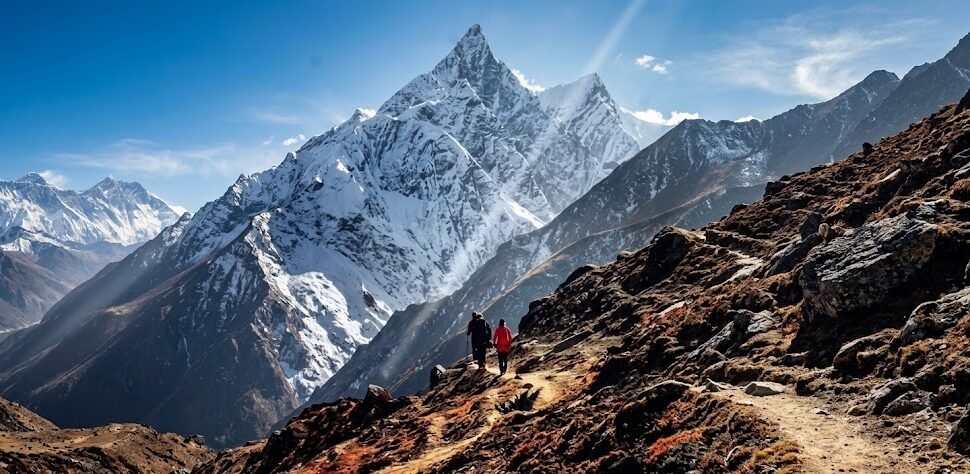
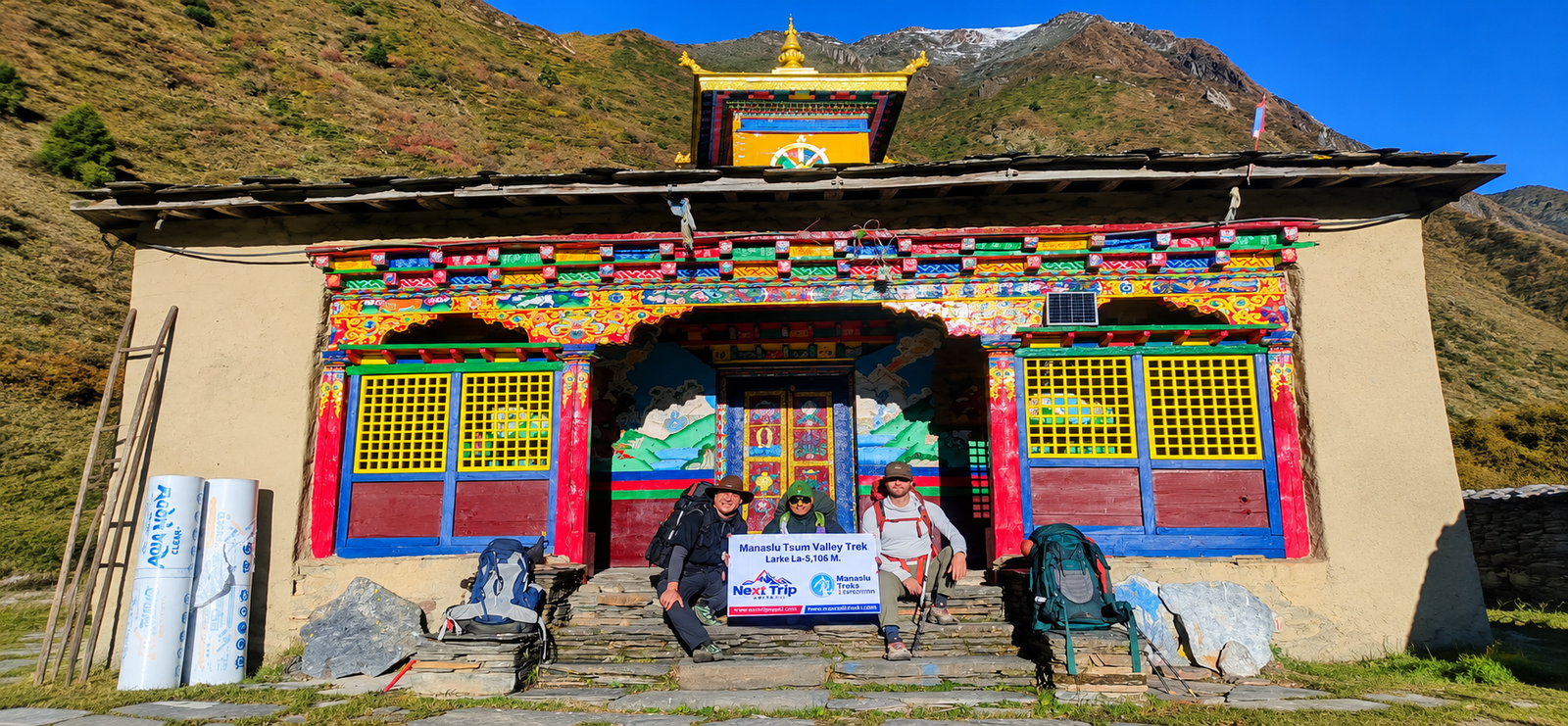
There is a particular kind of quiet that settles over Tsum Valley once you cross the suspension bridge out of the main Budhi Gandaki gorge and turn north into its side valley. The trail changes character almost immediately. Mule trains carrying rice and kerosene give way to maroon robed monks walking between villages, mani walls begin lining the path instead of the odd carved stone here and there, and the air itself seems to carry fewer engines, fewer shouted phone calls, fewer of the ordinary noises of a busy trekking route. Tsum Valley is often described by trekking companies as a hidden Buddhist kingdom, and for once the marketing phrase is not far from the truth. This is a place that stayed closed to outsiders long after most of Nepal had opened up, and that long isolation shaped a culture that is still, by Himalayan standards, remarkably intact.
This guide exists because our general Manaslu Tsum Valley Trek Guide already covers the practical side of the trip in depth: permits, itinerary days, costs and logistics. What we want to do here is slower and more specific. We want to walk you through the history of this valley, the Buddhist saints and lamas connected to it, the two gompas every itinerary is built around, the smaller shrines and mani walls you will pass daily, and the people who actually live there, the Tsumba. We also want to be honest about where reliable information runs thin, because a lot of what gets written about Tsum online is recycled marketing copy rather than researched fact. We have cross checked the claims in this article against independent sources, including the valley’s own community organisations, academic writing on the region, Buddhist studies publications and conservation area documentation, and we flag it clearly whenever a detail could not be confirmed with confidence.
A Valley That Stayed Hidden: The History of Tsum
Tsum Valley sits in the far north of Gorkha district, tucked against the Tibetan border and wedged between the Ganesh Himal, Sringi Himal and Boudha Himal ranges. Geographically it is a side valley off the main Manaslu Circuit route, branching north from the Budhi Gandaki near the village of Lokpa rather than continuing on toward Samagaun and the Larkya La pass. That branch in the trail is also, in a sense, a branch in time. While the main Budhi Gandaki corridor has functioned for centuries as a trade route between Nepal and Tibet, with salt, wool and grain moving back and forth, Tsum sits slightly apart from that main artery, protected by its own geography and by the simple fact that it does not lead anywhere else. It is not a through route to a pass or a popular peak. It is a dead end valley that rewards the people who make the effort to turn into it and nothing more, which for most of its history meant almost nobody did.
That isolation is the single most important fact for understanding Tsum’s culture today. Nepal only opened the valley to foreign trekkers in 2008 (some sources cite 2007, and the exact administrative date is not entirely consistent across government and tourism board records, so we treat it as the late 2000s rather than pin it to a single day). Before that, Tsum was fully closed to outside visitors and accessible only to local residents, pilgrims and a handful of researchers with special permission. Even now, well over a decade after opening, Tsum remains classified by the Nepal government as a restricted area, which is a formal designation separate from an ordinary trekking permit. Restricted area status in Nepal exists mainly along sensitive border regions and means trekkers cannot simply buy a permit and walk in alone. You need a licensed trekking agency, you need to travel as part of an organised group (the usual minimum is two trekkers), and your permit is issued jointly through the Department of Immigration rather than the park office alone. It is a bureaucratic detail, but it has an outsized cultural effect, which we will come back to later in this article, because it is a large part of why Tsum looks and feels the way it does today.
Before the era of trekking, Tsum had its own political identity worth knowing about. Local tradition refers to the valley historically as Tsum Tso Chuksum, usually translated as something like thirteen provinces or settlements ruled as one territory. Remains connected to this older Tsum polity, sometimes referred to loosely as the Tsum Kingdom, are still visible in parts of the valley, though detailed archaeological documentation of this period is thin and we would not want to overstate how much is firmly established versus locally remembered. What is clear is that this was never simply an empty, undiscovered place waiting for trekkers. It was an organised Tibetan Buddhist society with its own governance, long before tourism gave it a second identity as a trekking destination.
What Does “Tsum” Actually Mean?
Ask five guides what the word Tsum means and you may get slightly different answers, which is fairly normal for a name that has passed through Tibetan and local dialect over centuries rather than sitting in a single fixed written record. The explanation we found most consistently, including on community run heritage sites for the valley itself, traces the name to the Tibetan word tsombo, loosely rendered in English as vivid. Other local accounts connect it to a quieter, more contemplative meaning closer to silent or still, which fits just as naturally with how the valley feels and how it has been used for meditation retreat for generations. We would treat both as plausible oral traditions rather than a single settled linguistic fact, and we think that ambiguity is honestly more interesting than a tidy one line definition would be. A name that locals themselves describe in more than one way tells you something true about how old and how orally transmitted this culture is.
What is not ambiguous is the valley’s spiritual status. Tsum is widely described, by locals and by outside Buddhist scholars who have written about the region, as a beyul, a Tibetan Buddhist term for a hidden land or sacred sanctuary, traditionally understood as a place blessed by enlightened masters and set aside as a refuge for practice, protected from conflict and worldly disturbance. Beyul sites appear across the Himalaya, usually in remote, hard to reach valleys exactly like this one, and the concept is part of why a difficult, isolated location was treated historically as an asset for spiritual life rather than simply an obstacle. The valley’s own tourism literature calls it the Hidden Valley of Happiness, which leans a little toward slogan, but the underlying beyul concept behind that phrase is a genuine piece of Tibetan Buddhist cosmology, not an invention for brochures.
Milarepa’s Connection to Tsum
No single figure matters more to Tsum’s religious identity than Milarepa, the eleventh century Tibetan yogi and poet who is one of the most important saints in the Kagyu lineage of Tibetan Buddhism. Milarepa’s life story is well documented in Tibetan Buddhist literature far beyond Tsum itself. As a young man he studied black magic and used it to take revenge on relatives who had wronged his family, then spent the rest of his life in intense remorse and practice under his teacher Marpa the Translator, eventually reaching realization through years of solitary meditation in caves across the Himalaya. He survived at times on nothing but nettles, and tradition holds that prolonged nettle eating turned his skin a pale green, which is where the nickname the Green Yogi comes from. His teaching songs, gathered as what is often translated as the Hundred Thousand Songs, remain central texts for Kagyu practitioners today.
Tsum Valley is one of several sites across the Himalaya associated with Milarepa’s meditation retreats, and local tradition points to caves in the upper valley, generally located near Mu Gompa and above Rachen Gompa, as places where he sat in retreat. One cave is commonly pointed out to visiting trekkers as his meditation site, with a rock formation inside said to resemble a seat where he meditated, and the path leading to it lined with mani stones carved with the mantra Om Mani Padme Hum. We want to be straightforward about the limits of what can be independently verified here. Milarepa lived roughly a thousand years ago, Tibetan hagiography of saints tends to multiply meditation sites across a wide geography, and precise, document backed proof that this specific cave in this specific valley was visited by the historical Milarepa is not something we can confirm from outside sources. What we can confirm is that the association is old, consistently held by local monastic communities, and treated with genuine devotion rather than invented for tourism. Monks from both Mu Gompa and Rachen Gompa still visit the site to chant and perform rituals, which is a strong sign this is lived religious practice, not a recent prop.
Rachen Gompa: The Nunnery of Tsum Valley
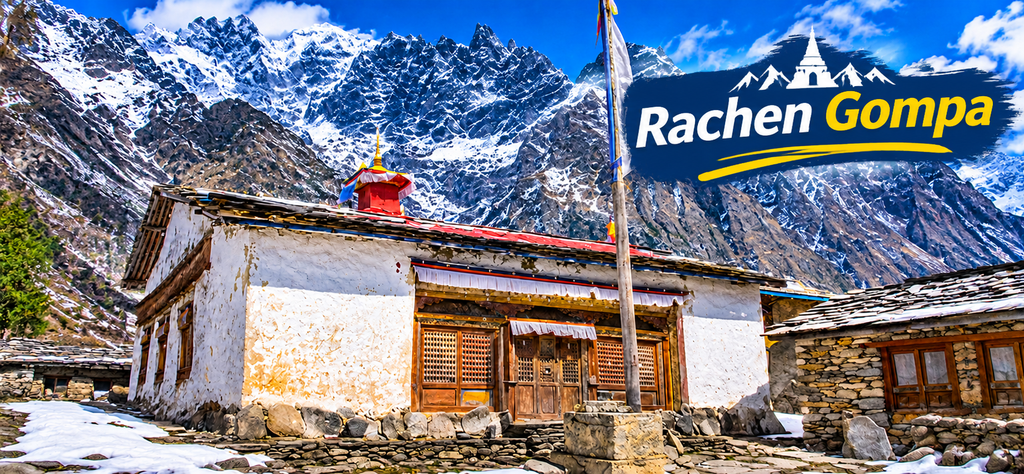
Rachen Gompa sits on a plateau in the lower to middle part of the valley, at roughly 3,240 meters, flanked by steep cliffs. It is a nunnery, home to a community of Buddhist nuns rather than monks, and it is one of the two religious sites that almost every Tsum Valley itinerary is built around.
The nunnery was founded in 1936 by a Bhutanese lama, Drupa Rinpoche, and has functioned as a center of female monastic life in the valley ever since. In 2005, the sitting Drupa Rinpoche asked the respected teacher Lama Zopa Rinpoche to take on responsibility for the welfare of both Rachen Gompa and Mu Gompa, the monastery further up the valley. Lama Zopa Rinpoche in turn assigned that responsibility to Kopan Monastery, a well known Tibetan Buddhist monastery near Boudhanath in the Kathmandu Valley, which now administers and supports both communities. That link to Kopan matters practically as well as spiritually, since it has brought resources for building maintenance, education and, more recently, heritage conservation work into a community that would otherwise be almost entirely cut off from outside support.
Today Rachen Gompa is home to roughly three dozen nuns, ranging from young girls to elderly women, living under the guidance of an abbot. For many of the women who join, the nunnery represents a genuine alternative to the traditional path of marriage and household life that still defines most options for women in this part of the Himalaya. Life inside follows a disciplined rhythm of prayer, study of Buddhist philosophy and scripture, and a full calendar of pujas and ceremonial offerings that was originally set by the founding lama and has continued largely unchanged. The youngest nuns also receive basic secular schooling alongside their monastic education, which the community sees as part of its broader role in preserving both religion and ordinary life skills in the valley.
Trekkers who stop at Rachen Gompa, and almost every itinerary does, can usually see the main prayer hall, rows of butter lamps, wall paintings and thangka scrolls, and, timing permitting, the nuns themselves at prayer or at daily chores around the compound. A striking recent addition is a large World Peace Stupa under construction in the grounds, reported at around 21 meters tall, along with ongoing conservation work on older clay votive offerings, known as tsa tsa, depicting the bodhisattva of compassion Avalokiteshvara. If you visit with a guide who knows the community, you may also hear about the nunnery’s broader outreach, including teaching visits to lay villagers and plans for a dedicated meditation retreat space. None of this is staged for visitors. It continues whether or not any trekkers come through that week, which is worth remembering when you are standing quietly at the back of the prayer hall during a ceremony.
Mu Gompa: The Highest Monastery in the Valley
Mu Gompa sits further up the valley than Rachen, close to the Tibetan border, at around 3,700 meters, making it both the highest and the largest monastery in Tsum. The walk up to it from the main village cluster around Chhokangparo is a highlight of most itineraries in its own right, a long but gentle climb across open, wind scoured high country with increasingly dramatic views back down the valley and toward the peaks that wall it in.
Local tradition dates the monastery’s founding to around 1895, when Buddhist monks and Tibetan lamas sought out a secluded, high altitude site suited to serious meditation practice, well away from the villages below. Mu Gompa belongs to the Gelugpa school of Tibetan Buddhism, often called the Yellow Hat tradition and most widely associated internationally with the lineage of the Dalai Lama, which sets it apart from some of the other Kagyu and Nyingma influenced sites elsewhere in the valley. Inside, the monastery holds a set of Kangyur scriptures (one of the core canonical collections of Buddhist teaching translated into Tibetan), carved printing woodblocks, thangka paintings and a statue of Avalokiteshvara. It also functions as a shedra, a monastic school where young monks study scripture and philosophy, which means the building is still doing the job it was built for rather than existing purely as a historic sight.
Mu Gompa’s setting close to the Ngula Dhojyang Pass, at roughly 5,093 meters on the border with Tibet, places it firmly at the edge of Nepal’s accessible Buddhist world, and that border proximity is part of why the whole area carries such a strong restricted feel. The pass itself is not generally open for crossing by foreign trekkers, but simply standing within sight of a route that has carried pilgrims and traders into Tibet for centuries is part of what makes the walk up here feel different from an ordinary day on the trail. Nearby, the cave associated with Milarepa, sometimes referred to locally as Namkading, adds another layer of pilgrimage significance to the same stretch of high ground.
A detail we think deserves more attention than it usually gets in trekking blogs is Mu Gompa’s connection to a formal nonviolence pledge dating to the early twentieth century, which we cover in its own section below because it reaches far beyond the monastery itself and shapes daily life across the whole valley.
Smaller Gompas, Chortens, Mani Walls and Prayer Wheels Along the Trail
Rachen and Mu Gompa get most of the attention because they anchor the main itinerary, but neither one exists in isolation. The entire route through Tsum is studded with smaller religious structures, and learning to read them even a little will change how the trek feels.
- Gompa Lungdang sits at the base of a distinctive conical hill below the Ganesh Himal, reached by a side trail that some itineraries include as an extra day. It is smaller and quieter than either Mu or Rachen, which some of our clients end up preferring precisely because it gets so few visitors.
- Village gompas and shrine rooms exist in most of the settlements you pass through, from Chumling and Chhokangparo to smaller hamlets like Nile and Dharapani (not to be confused with the larger Dharapani on the Annapurna Circuit). These are usually modest single room buildings looked after by a village lama or caretaker, and many are happy to open the doors for respectful visitors.
- Chortens, the Himalayan equivalent of a stupa, mark the entrance and exit of almost every village, representing the enlightened mind of the Buddha in architectural form and often containing relics or sacred texts sealed inside.
- Mani walls, long low stone walls built from flat slabs carved with the mantra Om Mani Padme Hum, line long stretches of trail, especially approaching villages and monasteries.
- Prayer wheels, cylindrical drums inscribed with mantras and often filled with tightly wound paper scrolls of the same prayer, sit at village entrances, monastery courtyards and, increasingly, along the trail itself, some turned by hand and some by water power from a nearby stream.
There is one custom tied to all of these structures that every trekker in Tsum should know before setting foot on the trail: you pass chortens, mani walls and stupas on your left, moving in a clockwise direction around them. This mirrors the Buddhist practice of circumambulation, walking around a sacred object as an act of devotion and merit, and it is treated as a basic point of etiquette rather than an optional nicety. Walking past on the right, in a counterclockwise direction, is considered disrespectful by local and Tibetan Buddhist custom alike. The same logic applies to prayer wheels: give them a gentle clockwise spin with your right hand as you pass, never counterclockwise, and never spin one aggressively or for amusement. Our guides will remind you of this on day one, but it is worth internalising early, because on a trek through Tsum you will encounter these structures dozens of times a day, and getting into the habit quickly means you stop having to think about it.
The Tsumba People: Culture, Dialect and Daily Life
The people who live permanently in the valley are known as Tsumba. They are of Tibetan origin, and the connection shows clearly in language, dress, religion and architecture, but it would be a mistake to treat Tsumba identity as simply a transplanted copy of Tibetan culture. Centuries of relative isolation inside this specific valley, cut off even from many of their closest neighbours in other side valleys of Gorkha, have let Tsumba culture develop its own distinct character.
Linguistically, Tsumba speak their own dialect, closely related to Tibetan but distinct enough that it is generally treated as its own local variant rather than simply a regional accent of standard Tibetan. This sets Tsumba apart from several of the other well known Himalayan ethnic groups trekkers in Nepal are more likely to have already heard of, such as Sherpa communities around Everest or Gurung and Manangi communities further around the Annapurna region. Each of these groups has its own language, and the fact that Tsumba has stayed a living, spoken dialect in daily use, rather than fading toward Nepali, is itself a sign of how insulated the valley remained for so long.
Dress, Social Structure and Belief
Traditional Tsumba dress follows broader Tibetan Himalayan patterns, built around heavy woven wool for warmth at altitude, with women often wearing long wrap style dresses and colourful aprons similar in spirit, if not identical in detail, to Tibetan chuba style clothing, and men in simpler wool tunics and trousers suited to herding and farm labour. On an ordinary trekking day you will see a mix of traditional and modern clothing, since practical imported fleece and synthetic jackets have made real inroads here as everywhere else in rural Nepal, but traditional dress still appears regularly, especially among older residents and during religious observances.
Social organisation in parts of the valley has historically included polyandry, where brothers in a family share a single wife, a practice also documented among some other Tibetan influenced communities in the Nepal Himalaya. The practical logic behind it is usually explained as a way of keeping limited arable land and livestock holdings within one household rather than dividing them across multiple family units in an environment where farmable land is extremely scarce. This is becoming less common as Tsumba life modernises, and we would not want to present it as either universal across the valley today or as some kind of exotic curiosity to be gawked at. It is simply part of the valley’s documented social history, worth knowing about rather than ignoring, and not something trekkers should ask villagers about directly out of curiosity.
Farming and Herding at Altitude
Most Tsumba households rely on a combination of subsistence farming and animal husbandry, adapted carefully to a valley where good farmland is limited and the growing season is short. Buckwheat and potatoes are the staple crops at the higher elevations in the valley, both well suited to thin soil and a short, cool growing window, alongside barley and maize lower down where conditions allow. These crops show up directly in what you eat on trek. Buckwheat flatbread and potato based dishes are staples at the teahouses and homes you pass through, a far more honest reflection of what Tsumba families actually eat day to day than the more generic trekking menus found on busier routes elsewhere in Nepal.
At higher elevations, yak herding becomes central to household economy, supplemented by sheep and, in some households, Himalayan cattle and their hybrid breeds. Yaks provide milk, butter and cheese, wool for weaving, and transport for goods across terrain that would be impossible for standard pack animals. Herding families often move seasonally with their animals between lower winter settlements and higher summer pasture, a pattern of life that predates trekking tourism by centuries and continues largely unaffected by it, since the tourist season and the herding calendar run on entirely separate logic. Limited trade with Tibet across the high passes has also continued in some form for generations, though it has shrunk considerably compared to historical trade volumes, and tourism income has become an increasingly important part of the valley’s economy since the 2008 opening, alongside, rather than replacing, farming and herding.
The Shyagya Tradition: A Century of Nonviolence
One of the most distinctive and, we think, under reported aspects of Tsum Valley culture is a formal, community wide commitment to nonviolence toward animals known locally as Shyagya. This is not a vague cultural value. It is a documented local tradition with a known starting point, written principles and, more recently, formal legal backing.
Local accounts place the origin of the pledge around 1920, when a lama in upper Tsum led the eleven settlements of what is now considered upper Tsum in declaring the area a nonviolence zone, committing residents to give up hunting and the killing of animals. Lower Tsum’s twenty two settlements joined this commitment later, formally renewing it during a Shyagya festival in 2012. The valley marked a full century of this tradition with centennial celebrations, originally planned for 2020 but disrupted by the COVID 19 pandemic and eventually held in 2023, when the local government, Tsum Nubri Rural Municipality, passed the Shyagya Tradition Preservation Act. Nepal’s then Prime Minister attended the renewed festival and spoke in support of the tradition, which gives some sense of how seriously it is now taken well beyond the valley itself.
The practical content of Shyagya includes a clear set of prohibitions still observed today: no hunting and no setting of traps, no harvesting of wild honey, no selling of livestock for slaughter, and protection extended specifically to calves and to aquatic as well as land animals, alongside a ban on burning forest and mountain vegetation. Local hotels and lodges in the valley are reported to serve vegetarian food as a matter of course, consistent with this broader commitment, which is a point worth knowing if you are planning meals on trek. The stated goals behind Shyagya, as expressed by community leaders during the recent centennial events, are threefold: protecting local wildlife and biodiversity, promoting a message of peace that the community sees as having wider relevance, and strengthening social and cultural unity among Tsum’s scattered villages.
We mention Shyagya in this cultural guide rather than leaving it to a conservation focused article because it is, at its core, a religious and cultural practice as much as an environmental one. It grew directly out of Buddhist values around compassion and nonharm, led originally by a lama rather than a government office, and it has shaped daily behaviour, diet and local law in the valley for roughly a century now. Very few places in Nepal, or arguably anywhere in the Himalaya, have a nonviolence commitment this formalised, this old, and this actively renewed by the community itself.
Local Customs and Etiquette for Trekkers
None of the history above matters much if it does not translate into how you actually behave on the trail. Tsum is not a theme park version of Buddhist culture. It is a living religious community that happens to welcome a modest number of trekkers each year, and the single best thing you can do as a visitor is behave as a respectful guest rather than a tourist checking off photo stops. A few specific points matter more here than on many other Nepal treks, precisely because Tsum has stayed so culturally intact.
- Dress modestly, particularly around monasteries and villages. Shoulders and knees covered is a safe standard for both men and women, and this matters more here than it might on a strictly scenic trek elsewhere in Nepal, since you are frequently walking directly through village centres and monastery courtyards rather than past them at a distance.
- Remove your shoes before entering a monastery’s main prayer hall or a shrine room, following the lead of your guide or whoever is accompanying you. This applies at Rachen Gompa, Mu Gompa and the smaller village gompas alike.
- Ask before photographing monks or nuns, and accept a no gracefully. Many monastics are entirely comfortable being photographed going about ordinary activities, but a prayer hall during active ceremony is generally not the place for flash photography or phones held up at face level, and some interior shrine spaces prohibit photography outright. When in doubt, ask your guide first rather than the monk or nun directly, since they can read the situation faster than you can.
- Never touch religious objects without specific invitation. That includes statues, thangka paintings, ritual instruments, prayer books and the stones making up mani walls. These are not museum exhibits behind glass, which makes it tempting to pick something up for a closer look, but they remain active objects of worship and should be treated accordingly.
- Keep quiet and keep your distance during active prayer or ceremony. If you arrive at a monastery during a puja, it is fine to sit quietly at the back of the room and observe, but loud conversation, phone calls or wandering around mid ceremony is not appropriate.
- Pass chortens, mani walls and prayer wheels on your left, moving clockwise, and spin prayer wheels clockwise with your right hand if you choose to spin them at all. We covered the reasoning for this above, but it bears repeating as a practical rule you will use constantly.
- Avoid public displays of affection and generally dial down behaviour that might read as boisterous in villages and near religious sites. Rural Nepal in general leans conservative in this respect, and Tsum, with its stronger monastic presence, more so.
- Ask before entering someone’s private home, even when a doorway is open and inviting looking, and accept hospitality (particularly tea) graciously when it is offered, since refusing outright can read as rude even if you mean no offence.
One more point our guides raise often: donations at monasteries are welcome but never required, and small, genuine gestures, a quiet contribution left near a shrine, a donation toward a specific project like the stupa construction at Rachen Gompa, tend to be appreciated far more than an awkward photo request or an attempt to barter down the price of a handicraft from a nun or monk, which happens more often than it should.
Festivals and Religious Life in Tsum Valley
We want to be upfront here rather than padding this section with invented specifics. Reliable, detailed information about the Tsum Valley’s festival calendar is genuinely limited compared to better documented regions such as Khumbu or the Kathmandu Valley, and we would rather tell you that plainly than invent dates or ritual details we cannot support.
What is documented, at least in outline, is that Tsumba communities observe several festivals tied to the wider Tibetan Buddhist and Himalayan calendar, including Lhosar, the Tibetan new year celebrated across many Himalayan Buddhist communities with family gatherings, feasting and monastery visits, and Saka Dawa, a deeply significant month in the Tibetan Buddhist calendar marking the Buddha’s birth, enlightenment and passing, typically observed with increased merit making activity, pilgrimage and visits to sacred sites like Milarepa’s cave. Local sources also mention festivals known as Dhachyang and Faning as part of the valley’s calendar, though we were not able to find detailed, independently verifiable descriptions of what these specifically involve, how they are dated, or how widely they are still practised today, so we present them here as named local observances rather than fully described events.
The clearest and best documented religious event tied specifically to Tsum, rather than borrowed from the wider Tibetan Buddhist calendar, is the Shyagya festival described above, held periodically to renew the valley’s century old nonviolence commitment, most recently and most prominently during the 2023 centennial celebrations. Beyond named festivals, the steady rhythm of monastic life at Rachen and Mu Gompa, daily prayer, periodic pujas, and seasonal retreat practice, continues regardless of the calendar of named public festivals, and it is this everyday religious practice, more than any single festival date, that a trekker passing through is actually most likely to witness firsthand.
If festival timing specifically matters to your trip, including the chance of overlapping with Lhosar or Saka Dawa, our Best Time to Trek Manaslu Tsum Valley guide goes into the seasonal calendar in more detail, and we would also suggest asking your trekking agency directly before booking, since exact lunar calendar dates shift from year to year and the most current information tends to come from recent on the ground contacts in the valley rather than from any single published source.
Wildlife and the Manaslu Conservation Area
Tsum Valley sits entirely within the Manaslu Conservation Area, a protected area established in 1998 covering roughly 1,663 square kilometers of the wider Manaslu region, and that conservation status is tightly bound up with the valley’s cultural story rather than separate from it. The Shyagya nonviolence tradition described above, with its ban on hunting and trapping that predates the formal conservation area by around eighty years, means Tsum had functioning, community enforced wildlife protection in place long before any government agency arrived to formalise it.
The conservation area is home to snow leopard, Himalayan tahr and blue sheep in the higher reaches, musk deer and, in the lower forested elevations below the main Tsum trail, red panda habitat, alongside a wide range of high altitude bird species. Exact population figures for species like snow leopard are difficult to pin down precisely and change with new survey work, so we would treat any specific number you see quoted online with some caution, including our own marketing materials elsewhere, and focus instead on the broader point that this is a genuinely significant habitat corridor, not a nominal protected status on paper only.
For trekkers, the practical upshot is mostly indirect. You are unlikely to spot a snow leopard, which are elusive by nature and mostly active in terrain well off the standard trail, but you stand a reasonable chance of seeing blue sheep on open slopes near Mu Gompa and the higher sections of the route, and the overall sense of a landscape that is lightly used and carefully protected adds something real to the walk, even when you cannot point to a specific animal sighting as proof of it.
Why Tsum Valley Has Kept Its Culture So Well
It is worth asking directly why Tsum feels so different from busier Everest or Annapurna trails, where monasteries exist too, mani walls exist too, but the whole experience can feel comparatively thinned out by the sheer volume of foot traffic passing through. The honest answer is mostly bureaucratic rather than mystical, and we think that is actually a more interesting explanation than a vague claim about untouched culture.
Tsum’s restricted area status, the same permit system that adds cost and paperwork to planning your trip, is the main reason visitor numbers have stayed low relative to the scale and beauty of the valley. Because every trekker needs a licensed agency, a minimum group size, and a special permit issued through immigration rather than a simple park entry fee, Tsum has never attracted the kind of large scale, loosely organised tourist flow that transformed parts of the Khumbu and Annapurna regions over the past few decades. Lower numbers mean less pressure on monasteries to perform for visitors rather than simply continue their own religious calendar, less commercial infrastructure built specifically around tourist expectations, and a slower pace of cultural change generally.
This is not an argument against visiting. Tourism income genuinely supports the valley now, alongside farming and herding, and thoughtful, well guided trekking can coexist with, and in places actively help fund, the preservation work happening at sites like Rachen Gompa. It is simply useful context for understanding why a valley only three or four days’ walk from one of Nepal’s most popular trekking corridors still feels, by comparison, like stepping backward into an earlier version of Himalayan travel. If you are drawn to Tsum specifically because it still feels this way, the most useful thing you can do is keep behaving like the kind of visitor the restricted area system was designed to filter for: someone travelling in a proper group, with a licensed guide, moving through respectfully rather than rushing to tick off sights.
Frequently Asked Questions About Tsum Valley Culture
What does Tsum Valley mean, and why is it called the Hidden Valley of Happiness?
Local tradition traces the name Tsum to the Tibetan word tsombo, generally translated as vivid, though some local accounts lean toward a meaning closer to silent or still. The Hidden Valley of Happiness is a more recent descriptive phrase tied to the valley’s status as a beyul, a Tibetan Buddhist hidden sanctuary believed to be a place of spiritual refuge and blessing.
When did Tsum Valley open to foreign trekkers?
Tsum Valley opened to foreign trekkers in 2008 (occasionally cited as 2007 depending on the source), after being closed to outside visitors for generations as a restricted border area. It remains a formally designated restricted area today, which means trekkers still need a special permit, a licensed agency and a minimum group size to enter.
What is the connection between Tsum Valley and Milarepa?
Milarepa, the eleventh century Tibetan Buddhist saint and poet central to the Kagyu lineage, is believed by local tradition to have meditated in caves in the upper part of Tsum Valley, generally associated with the area near Mu Gompa and Rachen Gompa. Monks from both monasteries still visit the associated cave site to chant and perform rituals, and it remains an active place of pilgrimage.
Who lives at Rachen Gompa?
Rachen Gompa is a nunnery, home to roughly three dozen Buddhist nuns ranging from young girls to elderly women. It was founded in 1936 by a Bhutanese lama, Drupa Rinpoche, and has been administered since 2005, alongside Mu Gompa, by Kopan Monastery near Kathmandu, under the guidance of Lama Zopa Rinpoche.
How high is Mu Gompa, and is it hard to reach?
Mu Gompa sits at roughly 3,700 meters, making it the highest and largest monastery in the valley. The walk up from the main village area around Chhokangparo is long but not technically difficult, mostly a steady, gradual climb across open high country, and it forms one of the highlight days on most Tsum itineraries.
What is the Shyagya tradition in Tsum Valley?
Shyagya is a formal, roughly century old community commitment to nonviolence toward animals, originating around 1920 and renewed through local festivals and, more recently, a 2023 legal act. It bans hunting, trapping, honey harvesting and the slaughter sale of livestock, and it reflects Buddhist values around compassion that are woven directly into daily life and local law in the valley.
Do I need special permission to visit Tsum Valley’s monasteries?
No separate permission is needed beyond the restricted area trekking permit required for the valley as a whole, but visitors should always check with their guide about appropriate times to visit, dress modestly, remove shoes before entering prayer halls and ask before taking photographs, particularly during active prayer or ceremony.
Is Tsum Valley culture different from other trekking regions in Nepal, like Everest or Annapurna?
Yes, meaningfully so. Tsum’s Tsumba residents speak their own distinct dialect, separate from Sherpa, Gurung or other well known Himalayan languages, and the valley’s late opening to tourism in 2008, combined with its ongoing restricted area status, has kept visitor numbers far lower than on Everest or Annapurna routes, which most researchers and longtime guides point to as the main reason its monastic life and village culture remain comparatively undiluted by mass tourism.
Tsum Valley rewards the kind of traveller who is willing to slow down and actually look at what is in front of them rather than simply log the miles between campsites. The monasteries, the mani walls, the nuns at Rachen, the Shyagya tradition still being renewed by village leaders today, none of this is backdrop. It is a culture that has kept going on its own terms, mostly because the bureaucracy of a restricted area permit, of all things, happened to buy it a few extra decades of being left alone. If this side of the trek is what draws you in, our full Manaslu Tsum Valley Trek Guide covers the permits, costs and day by day itinerary you will need to plan around it, and when you are ready to put dates on the calendar, our team can help you book the Manaslu Tsum Valley Trek itself and build in the time at Rachen and Mu Gompa that a trip like this really deserves.