
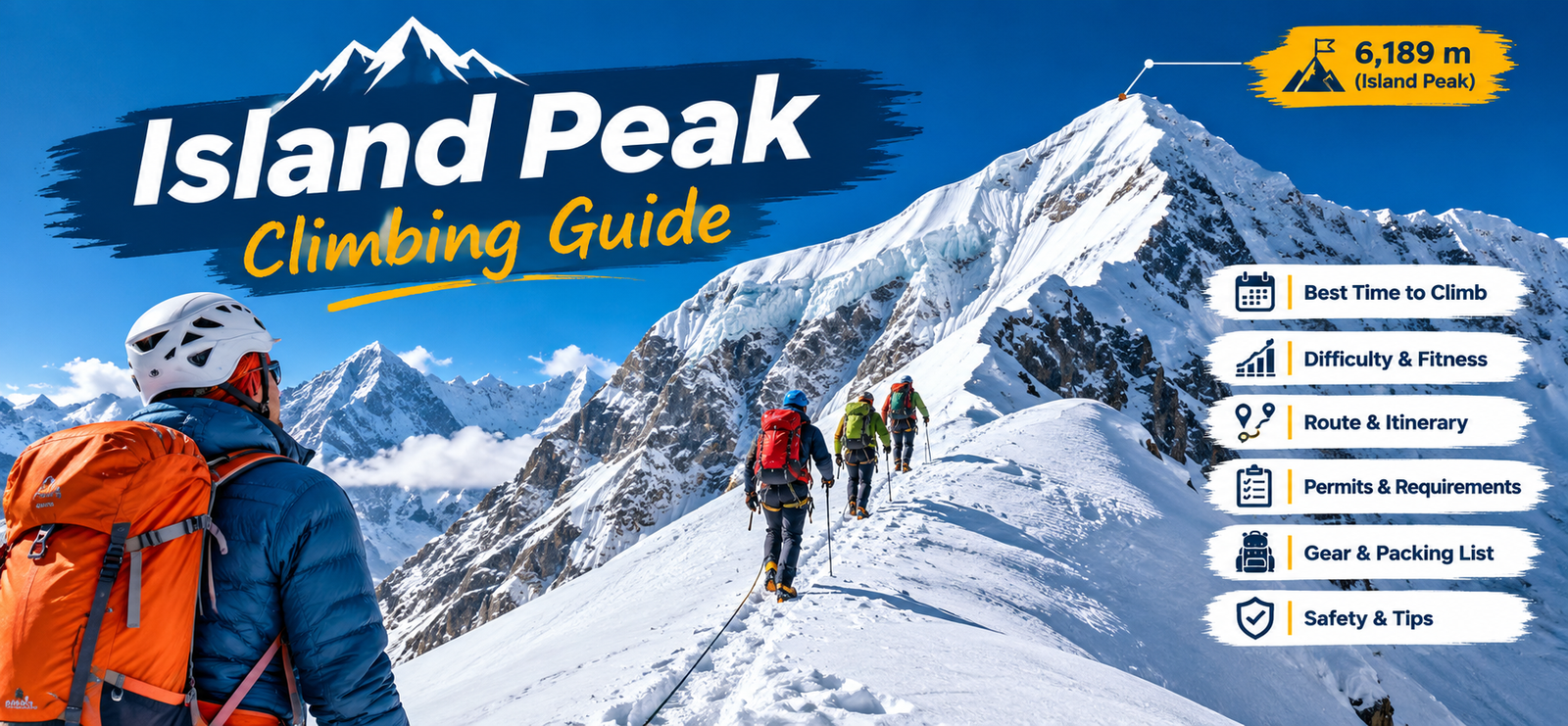
Island Peak climbing takes you to the summit of a 6,189 meter mountain in the Khumbu region of Nepal, right in the shadow of Everest, Lhotse and Nuptse. It is widely regarded as the most popular entry point into Himalayan mountaineering anywhere in Nepal, because it combines a genuine glacier and fixed rope climb with a trekking approach that does not require prior technical climbing experience to attempt, provided you train properly and climb with a qualified guide.
This guide covers everything a prospective climber actually needs to plan the trip: the full seventeen day itinerary, what the climbing route itself looks like section by section, the real permit costs and where they come from, an honest comparison with the other two trekking peaks climbers most often weigh against it, and the acclimatization, fitness and equipment planning that determines whether a summit attempt succeeds. Historical details below were checked against independent sources rather than repeated from a single operator’s page, since several commonly repeated facts about this mountain turn out to be mixed up across the industry.
Island Peak Climbing at a Glance
- Official elevation commonly cited: 6,189 meters, though some independent references list a slightly different figure closer to 6,165 meters, a known discrepancy across sources that is worth knowing about rather than a sign either number is simply wrong
- Local name: Imja Tse
- Region: Khumbu, Sagarmatha National Park, Solukhumbu District
- Typical package length: 17 days from Kathmandu back to Kathmandu
- Climbing grade: PD+ on the French and Swiss Alpine classification system, meaning peu difficile, or somewhat difficult
- Technical crux: a fixed rope headwall of snow and ice at roughly 50 to 60 degrees
- Base camp elevation: approximately 5,100 meters
- Guide requirement: a licensed climbing guide is mandatory, and a technical briefing on crampon and jumar technique is standard practice before the climb
- Permits required: Island Peak Climbing Permit from the Nepal Mountaineering Association, Sagarmatha National Park entry permit, and a Khumbu Pasang Lhamu Rural Municipality fee
- Best seasons: autumn, specifically October and early November, and spring from March through May
- Prior mountaineering experience: not strictly required, but strong cardiovascular fitness and comfort on steep, exposed terrain are essential
What Island Peak Is and Why It Is Called That
Island Peak sits above the Imja Khola valley near Dingboche, and the name comes from exactly what it looks like from the village below. When members of the British Mount Everest Expedition passed through the area in 1953, the mountain appeared to rise out of the surrounding sea of glacial ice like an island, and the name stuck. The mountain was formally renamed Imja Tse in 1983 to better reflect its position above the Imja glacier, but Island Peak has remained the name almost everyone uses, including on official Nepal Mountaineering Association documentation.
The climbing history of Island Peak is a detail that gets repeated inconsistently across trekking company websites, so it is worth stating carefully here. In 1953, as part of acclimatization training ahead of the first successful ascent of Everest that same year, a team that included Tenzing Norgay, Charles Evans, Alfred Gregory and Charles Wylie, along with Sherpa climbers, reached what is technically a subsidiary summit of the mountain. The true main summit was not climbed until 1956, when Hans Rudolf von Gunten, a member of a Swiss expedition, reached the top with two Sherpa climbers. Several commercial sites online attribute the 1956 ascent to a British team, which appears to be a mix up with the 1953 training climb rather than an accurate account of who actually stood on the main summit first.
Island Peak is classified by the Nepal Mountaineering Association as a trekking peak rather than an expedition peak, which is a regulatory distinction that matters practically: it means the mountain can be climbed on a trekking peak permit with a simpler application process than the expedition permits required for Nepal’s higher mountains, while still requiring a licensed guide and proper technical preparation.
Where Island Peak Sits in the Khumbu
- Island Peak rises above the Imja Valley, a side valley that branches off the main Everest Base Camp trail near Dingboche at 4,360 meters
- The approach follows the standard Everest region trekking route as far as Dingboche, then turns east up the Imja Khola toward Chukkung and the mountain itself
- Island Peak sits close enough to Lhotse and Nuptse that climbers get an unusually close view of Lhotse’s enormous south face from the upper sections of the route
- Base camp, known locally as Pareshaya Gyab, sits at approximately 5,100 meters on moraine terrain below the mountain’s glacier
- The entire route from Lukla to base camp and back follows established teahouse trekking trails except for the final approach from Chukkung, which uses a more basic camping setup
Full 17 Day Itinerary for Island Peak Climbing
The itinerary below reflects the standard structure most Nepal based operators, including Next Trip Nepal, build an Island Peak expedition around. It assumes a fly in, fly out approach via Lukla, two full acclimatization days before the climb, a base camp rest day, and a reserve day held in case weather delays the summit push.
Day 1: Arrival in Kathmandu
Arrival at Tribhuvan International Airport, transfer to a hotel in Thamel, and an evening briefing covering the full itinerary, equipment checklist and what to expect at altitude.
Day 2: Kathmandu Preparation Day
A full day in Kathmandu used for final equipment checks, permit paperwork, and in many cases a short city visit, before departure the next morning.
Day 3: Fly Kathmandu to Lukla, Trek to Phakding
A short, scenic flight to Lukla’s mountain airstrip followed by an easy afternoon walk down to Phakding, which eases climbers into the trail before the steeper days ahead.
Day 4: Phakding to Namche Bazaar
A longer day climbing through pine forest and crossing the Dudh Kosi on several suspension bridges, finishing with a steep final climb into Namche Bazaar, the main trading hub of the Khumbu.
Day 5: Namche Bazaar Acclimatization Day
A planned rest day that still includes activity, typically a day hike up to around 3,880 meters for views of Everest before returning to sleep at Namche’s lower elevation.
Day 6: Namche Bazaar to Tengboche
The trail undulates along the Dudh Kosi valley before a steep climb to Tengboche, home to the region’s most famous monastery and some of the best mountain views on the entire route.
Day 7: Tengboche to Dingboche
A descent through rhododendron forest followed by a climb into the drier, more open landscape of Dingboche at 4,360 meters, where the character of the trek shifts noticeably toward high altitude terrain.
Day 8: Dingboche Acclimatization Day
A second planned rest day, usually built around a day hike toward Nangkartshang peak to around 5,050 meters, following the same climb high, sleep low principle used at Namche.
Day 9: Dingboche to Chukkung
A shorter day turning off the main Everest Base Camp trail and heading up the Imja Valley to Chukkung, the last proper village before the approach to Island Peak itself.
Day 10: Chukkung to Island Peak Base Camp
The trail leaves teahouse infrastructure behind and climbs over rough moraine terrain to base camp at approximately 5,100 meters, where the expedition’s tented camp is set up for the following days.
Day 11: Base Camp Rest and Acclimatization
A full rest day at base camp used for final technical briefings on crampon and jumar use, equipment checks, and route planning with the climbing guide team ahead of the summit attempt.
Day 12: Summit Day, Island Peak 6,189 Meters, and Return to Chukkung
A predawn start, typically leaving base camp well before sunrise to reach the summit in calmer morning conditions, followed by the descent all the way back down to Chukkung the same day, making this the longest and most demanding single day of the entire trip.
Day 13: Reserve Summit Day
A buffer day built into the itinerary specifically to absorb a weather delay on the actual summit attempt, since conditions on the headwall can change quickly and a single clear window is not always guaranteed on the planned date.
Day 14: Chukkung to Namche Bazaar
A long descent day retracing the trail back down through Dingboche and Tengboche to Namche Bazaar, with noticeably easier breathing as the elevation drops.
Day 15: Namche Bazaar to Lukla
The final trekking day, descending back through Phakding to Lukla, often celebrated with a last dinner together as a climbing team before flying out the next morning.
Day 16: Fly Lukla to Kathmandu
A return flight to Kathmandu, with the rest of the day free for rest, laundry and a well earned shower after two weeks on the trail.
Day 17: Final Departure from Kathmandu
Transfer to the airport for an onward international flight, or the start of an extension trip for climbers continuing on to another region.
The Climbing Route Explained
The standard and effectively only regularly used route on Island Peak approaches from base camp on the mountain’s southwest side. It breaks naturally into three sections, each with a different character and a different set of demands.
Base Camp to High Camp Plateau, 5,100 to 5,600 Meters
From base camp the route crosses boulder and scree terrain before reaching the lower edge of the glacier. A short scramble over rock leads onto the ice itself. This section of glacier is relatively gentle, though some crevasse navigation is required, and most teams put crampons on from this point even though the lower glacier is not steep. The route threads across a broad upper glacier plateau toward the base of the headwall, taking roughly two hours from base camp and offering the first clear views back down the valley toward Lhotse’s south face.

The Headwall Fixed Rope Section, 5,600 to 5,950 Meters
This is the technical crux of the climb. A rope fixed by guides, or left in place from earlier in the season, runs up approximately 200 vertical meters of steep snow and ice at a consistent 50 to 60 degree angle. Climbers ascend clipped to this fixed rope using a jumar, with an ice axe in hand for balance rather than for lead climbing, since the rope itself provides the main security. A short aluminum ladder is used to cross a crevasse partway up this section in some years, depending on how the glacier has shifted. Climbers do not need advanced technical climbing skills for this section, but comfort and practiced technique with a jumar matters, which is exactly what the technical briefing at base camp is meant to establish before anyone leaves camp on summit morning.
Summit Ridge and Final Approach, 5,950 to 6,189 Meters
Above the headwall the angle eases onto an upper snowfield that leads to the summit ridge. The ridge itself is corniced on its north side, so careful route finding along the safer southern aspect matters here more than raw technical difficulty. The final approach to the highest point is a narrow but short ridge walk, and most climbers describe the summit itself as a small platform with room for only a handful of people at a time, which is part of why queuing can become a real factor on a busy autumn morning.
How Difficult Is Island Peak
- Island Peak is graded PD+ on the French and Swiss Alpine classification system, which translates roughly to somewhat difficult, a step above a straightforward trekking peak but well short of a technical expedition climb
- No prior rope or ice climbing experience is strictly required, since the entire technical section is protected by a fixed rope and ascended with a jumar rather than through lead climbing
- The main physical demand is sustained cardiovascular effort at altitude on summit day, which typically runs ten to twelve hours round trip from base camp, combined with exposure to a 50 to 60 degree ice slope that requires calm, confident movement rather than raw strength
- Altitude is arguably the bigger challenge than the technical climbing itself, since base camp alone sits at 5,100 meters and the summit is nearly 1,100 meters higher again
- Queuing on the fixed rope during busy periods of the autumn season can add real time and cold exposure to summit day, which is one reason experienced operators favor an early, predawn departure from base camp
- A short technical briefing and practice session with crampons and a jumar before the climb is standard practice among reputable operators, and climbers who have never used this equipment before should not skip it
Island Peak Compared With Mera Peak and Lobuche East
Island Peak sits in the middle of the three trekking peaks climbers most often compare against each other in the Everest and Khumbu region. Here is how the comparison generally holds up based on independent climbing sources, not just a single operator’s opinion.
- Mera Peak, at 6,476 meters, is higher than Island Peak but technically easier, graded F for facile on the same Alpine classification system, with a gentler summit approach and no fixed rope headwall equivalent to Island Peak’s. The tradeoff is that Mera’s greater elevation makes altitude management a larger factor, even though the climbing itself asks less of you technically.
- Lobuche East, at 6,119 meters, is generally considered the hardest of the three, with a more sustained technical section and a narrower, more exposed summit ridge than Island Peak. Most operators recommend climbing Island Peak first and treating Lobuche East as a logical next step for climbers who want more technical challenge.
- Island Peak occupies the middle ground: more technical than Mera Peak thanks to its fixed rope headwall, but generally regarded as less serious than Lobuche East, which is a large part of why it remains the most climbed of the three and the most common first Himalayan summit for trekkers moving into mountaineering.
- All three peaks sit in the same general region and share a similar permit structure through the Nepal Mountaineering Association, so the choice between them usually comes down to how much technical challenge you want rather than logistics or cost.

Permits You Need for Island Peak
Three separate fees apply to an Island Peak climb, and all of them should be arranged through a registered trekking agency in Kathmandu before departure rather than at any point along the trail.
Island Peak Climbing Permit, Nepal Mountaineering Association
The core climbing permit is issued by the Nepal Mountaineering Association and is priced by season. Rates for foreign climbers are commonly quoted as:
- Spring, March through May, the peak climbing season: USD 250 per person
- Autumn, September through November: USD 125 per person
- Winter and summer, the quieter months: USD 70 per person
Worth flagging honestly here: some operator websites, including figures found during research for this guide, describe autumn and spring as sharing the same higher rate rather than spring alone carrying the peak price. The season by season breakdown above reflects the structure given by independent fee reference sources rather than any single operator, but permit pricing from the Nepal Mountaineering Association is also the kind of detail that gets revised from year to year, so confirm the current rate directly with your operator or the NMA before budgeting around any published figure, including this one.
Sagarmatha National Park Entry Permit
A flat entry fee for Sagarmatha National Park, which the entire approach trail from Lukla through Dingboche passes through. This is typically arranged in Kathmandu along with your other paperwork rather than purchased at the park entrance itself.
Khumbu Pasang Lhamu Rural Municipality Fee
A local municipal fee collected separately from the national park and climbing permits, covering the local government area the trek passes through. Keep this distinct in your mind from the Sagarmatha National Park fee, since the two are easy to conflate but are charged by different authorities.
TIMS Card
A Trekkers Information Management System card is generally included as part of a full Island Peak package by most operators, since the approach trail follows the same route used by standard Everest Base Camp trekkers, where TIMS registration is standard practice.
Acclimatization Strategy
- Proper acclimatization is the single biggest factor in both summit success and basic safety on Island Peak, since base camp alone sits above 5,000 meters and the summit adds another 1,100 meters on top of that
- The standard itinerary builds in two dedicated rest days, the first at Namche Bazaar at 3,440 meters and the second at Dingboche at 4,360 meters, each paired with a day hike to a higher elevation before returning to sleep lower
- This climb high, sleep low approach is a well established principle in mountain medicine, giving the body time to adjust to reduced oxygen levels before pushing to the next elevation band
- A further rest day at base camp itself, used for technical briefings rather than idle waiting, adds a third acclimatization buffer immediately before the most demanding day of the trip
- Climbers who arrive already fatigued, dehydrated or sleep deprived from travel often struggle more with acclimatization than their underlying fitness would predict, so arriving in Kathmandu a day or two early rather than rushing straight onto the trek is worth considering
Best Season to Climb Island Peak
- Autumn, September through November: Widely regarded as the most reliable season, with October and early November considered the single best window thanks to stable high pressure systems after the monsoon, strong visibility, and generally firm, consolidated snow on the climbing sections. This is also the busiest season, so expect company on the fixed rope on a clear summit morning.
- Spring, March through May: The second strongest window, with warmer temperatures, blooming rhododendron forest lower on the trail, and a lively atmosphere since spring overlaps with the main Everest expedition season. Afternoon cloud tends to build more in May as the monsoon approaches, though morning climbing windows generally remain reliable.
- Winter, December through February: Possible but cold, with reduced teahouse services at some higher stops and a real chance of heavy snow affecting conditions on the headwall. Fewer climbers attempt the mountain in this window, which some experienced climbers actually prefer for the quieter trail.
- Summer or monsoon, June through August: Generally discouraged for Island Peak specifically, since cloud cover regularly obscures views and wet snow conditions on the glacier and headwall increase risk beyond what most operators consider acceptable for this climb.
Altitude Sickness and Safety on Island Peak
Because this trip spends extended time above 4,000 meters and summit day pushes past 6,000 meters, altitude awareness matters as much as technical climbing skill. None of the following replaces advice from a doctor familiar with your own health history, and it should not be treated as personal medical advice.
- Acute mountain sickness can begin as low as roughly 2,400 meters, though the more serious risk window on this route opens from Dingboche upward, around 4,360 meters and higher
- A commonly used guideline in mountain medicine is to avoid increasing sleeping altitude by more than around 300 to 500 meters per day once above 3,000 meters, which is the logic behind the rest days built into the standard itinerary
- Mild symptoms include headache along with nausea, fatigue, loss of appetite, dizziness or poor sleep, and reporting these early to your guide rather than pushing through them is the correct response
- Serious warning signs that require immediate descent rather than monitoring include confusion, loss of coordination, a severe headache that does not respond to basic pain relief, and in the case of fluid in the lungs, breathlessness at rest, a persistent cough, or a gurgling sound when breathing
- Descent remains the only reliable treatment for worsening symptoms at altitude. No medication is a substitute for moving down when symptoms become serious
- Acetazolamide, commonly known as Diamox, is sometimes used preventively to assist acclimatization, but it is a prescription medication that should be discussed with a travel medicine doctor well before departure rather than decided on the trail
- On summit day specifically, cold injury risk rises sharply during the predawn start and the extended time spent on the fixed rope, so proper hand and foot protection is as important as altitude awareness itself
Accommodation and Food on the Approach
- Teahouse accommodation is used for the entire approach from Lukla to Chukkung, with no camping required until base camp itself
- Rooms at Namche Bazaar and Tengboche tend to be relatively comfortable by trekking standards, sometimes with private bathrooms and hot showers for an extra charge
- Rooms at Dingboche and Chukkung are simpler, typically with shared bathroom facilities and limited electricity
- From base camp onward, accommodation shifts to a proper tented camp, including a mess tent for meals and sleeping tents, run by the expedition’s support crew
- Meals follow the standard teahouse menu found across the Khumbu, built around dal bhat, noodle and rice dishes, soups and simple breakfast options, with full board camp meals taking over once the trek transitions to base camp
Equipment and Packing List
Island Peak genuinely requires technical mountaineering equipment in addition to standard trekking gear, so packing for this trip means preparing for both a multi day teahouse trek and a glacier climb in the same itinerary.
Technical Climbing Gear
- Insulated mountaineering boots compatible with crampons, rather than standard trekking boots
- 12 point crampons fitted to your mountaineering boots before departure
- A mountaineering ice axe
- A sit harness and two locking carabiners
- A jumar, or rope ascender, for the fixed rope section
- A climbing helmet
- Most of this technical equipment can be rented in Kathmandu if you do not want to carry it from home, and operators typically arrange this as part of booking
Clothing and Layers
- A down jacket rated for high altitude cold, worn over insulated mid layers
- A waterproof and windproof outer shell jacket and trousers
- Moisture wicking base layers rather than cotton
- Warm gloves plus a lighter liner pair for dexterity with technical gear
- A balaclava or warm hat plus sun hat and glacier rated sunglasses for the climb itself
Trekking and Personal Gear
- A four season sleeping bag rated to around negative 20 degrees Celsius for base camp nights
- High altitude trekking poles
- A headlamp with spare batteries for the predawn summit start
- A basic personal first aid kit along with any personal medication you take regularly
- Water purification tablets or a filter for the trekking days before base camp
Physical Fitness and Training
- Island Peak demands strong cardiovascular fitness and muscular endurance, since summit day alone can run ten to twelve hours and most trekking days before that run five to eight hours
- A realistic training benchmark is being able to trek six to eight hours a day for multiple consecutive days while carrying a ten to twelve kilogram daypack at altitudes between 3,000 and 5,600 meters
- In the months before departure, regular cardiovascular training four to five days a week, through running, cycling, swimming or stair climbing, builds the aerobic base this trip demands
- Hill walking with a loaded pack is the single most directly relevant training activity, since it mirrors the actual demands of the trek far better than flat ground cardio alone
- A useful personal readiness check is whether you can comfortably complete a full day hike of around 20 kilometers with significant elevation gain, which suggests the baseline fitness needed for this expedition
- Prior technical climbing experience helps but is not mandatory, since the fixed rope system is specifically designed to make the technical section achievable for climbers with solid fitness and a short pre climb briefing rather than years of mountaineering background
Guides, Porters and Group Requirements
- A licensed climbing guide is mandatory for Island Peak, and reputable operators use guides with UIAA level training specifically for technical trekking peaks rather than general trekking guides alone
- A high altitude porter typically carries shared group and technical equipment, separate from any personal porter you may hire for your own bag
- Group sizes vary by operator, and a smaller private group generally allows more flexibility around pacing and summit timing than a larger fixed departure group
- A technical pre climb briefing covering crampon and jumar technique is standard practice before the approach to base camp begins, and should not be skipped even by climbers with some prior experience, since route conditions change from season to season
- Emergency evacuation planning matters more on this trip than on a standard trek, given the altitude involved, and confirming your travel insurance specifically covers helicopter evacuation above 5,000 meters is essential before you book
Cost of Island Peak Climbing
Package pricing for a standard seventeen day Island Peak climb commonly starts in the region of USD 2,750 per person with an established Nepal based operator, though the exact figure depends on group size, season, and exactly what is bundled into the package.
- Commonly included: airport transfers in Kathmandu, hotel accommodation in Kathmandu on a bed and breakfast basis, teahouse accommodation on full board during the trek, tented camp accommodation and meals at base camp, Kathmandu to Lukla flights, all three climbing and entry permits, a certified climbing guide, a high altitude porter, base camp camping equipment, fixed rope and group technical gear for the summit, and a first aid kit including altitude sickness medication
- Commonly excluded: international flights, Nepal visa fees, personal travel and medical evacuation insurance covering high altitude up to at least 6,500 meters, personal climbing equipment such as boots, crampons, harness and helmet unless specifically rented through the operator, personal trekking gear, meals and extra nights in Kathmandu beyond what is included, hot showers and WiFi charges at teahouses, and tips for your guide and porter team
- Personal travel insurance with high altitude and helicopter evacuation cover is not optional in any practical sense for this trip, even when it is listed as excluded from the package price, since any serious altitude emergency above base camp would otherwise mean paying for evacuation entirely out of pocket
- Contact a registered operator directly for a firm quote against your specific dates and group size, since season and group size both move the final number noticeably for a trip like this
Frequently Asked Questions
Do I need previous climbing experience for Island Peak?
No prior technical climbing experience is strictly required, since the main technical section is protected by a fixed rope and climbed with a jumar rather than through lead climbing. Strong cardiovascular fitness and comfort with exposure on steep terrain matter more than a climbing resume, though any prior experience with crampons or a jumar is genuinely helpful.
How many days does Island Peak climbing take?
Most operators, including Next Trip Nepal, build the standard package around 17 days from Kathmandu back to Kathmandu, including two acclimatization days, a base camp rest day and a reserve summit day to absorb weather delays. Shorter packages exist but cutting acclimatization days is generally not recommended, since it directly affects both safety and summit success.
What is the real elevation of Island Peak?
Most commercial and government linked sources cite 6,189 meters, which is the figure used throughout this guide. A small number of independent references list a figure closer to 6,165 meters instead. This kind of minor discrepancy is not unusual for Himalayan peaks measured and remeasured over different survey periods, and it does not affect how the mountain is climbed or permitted.
Is Island Peak harder than Mera Peak or Lobuche East?
Island Peak sits between the two. Mera Peak is higher at 6,476 meters but technically easier, with a gentler route and no equivalent fixed rope headwall. Lobuche East at 6,119 meters is generally considered the more demanding climb of the three, with a more sustained technical section. Most climbers treat Island Peak as the natural first step, with Lobuche East as a logical next challenge.
What permits do I need and what do they cost?
Three fees apply: the Nepal Mountaineering Association Island Peak Climbing Permit, priced by season, the Sagarmatha National Park entry permit, and a Khumbu Pasang Lhamu Rural Municipality fee. Published seasonal rates for the climbing permit vary across sources, so confirm the current figure with your operator or the NMA directly before finalizing your budget.
When is the best time to climb Island Peak?
Autumn, particularly October and early November, is generally considered the most reliable season for stable weather and firm climbing conditions. Spring from March through May is a strong second option. Winter is possible but cold and quieter, while the summer monsoon months are generally discouraged for this specific climb.
How fit do I need to be to climb Island Peak?
You should be able to comfortably trek six to eight hours a day for multiple consecutive days while carrying a ten to twelve kilogram daypack at altitudes up to 5,600 meters. Regular cardiovascular training in the months before departure, combined with loaded hill walking where possible, is the most effective preparation.
Can I climb Island Peak as part of a larger Everest region trek?
Yes, and this is actually the most common way climbers approach Island Peak, since the route follows the standard Everest Base Camp trail as far as Dingboche before turning off toward Chukkung. Some operators offer combined itineraries that add Island Peak onto a full Everest Base Camp trek, though this extends the total trip length considerably and adds further acclimatization demands on top of an already long trek, so it is worth discussing honestly with your operator rather than assuming more days automatically means better preparation.
What happens if bad weather blocks the planned summit day?
This is exactly why a reserve summit day is built into the standard seventeen day itinerary. If conditions on the fixed rope or summit ridge are unsafe on the primary date, the team simply waits a day at Chukkung or base camp and attempts the climb on the reserve day instead. Experienced guides make this call based on direct observation of conditions rather than a forecast alone, and a willingness to wait a day, rather than pushing ahead regardless of conditions, is one of the clearest signs of a responsible operator.
Final Planning Notes
Island Peak earns its reputation as Nepal’s classic first Himalayan summit by asking real things of climbers, sustained altitude exposure, a genuine fixed rope technical section, and a long summit day, without requiring years of prior mountaineering background to attempt safely with the right guide and preparation. Build your training around sustained cardiovascular fitness and loaded hill walking rather than technical climbing drills alone, confirm your permit costs and insurance cover directly with your operator before booking, and treat the acclimatization days in the standard itinerary as essential rather than optional. Done that way, Island Peak remains one of the most achievable serious mountain summits in the world for a well prepared trekker ready to take the next step into technical climbing.