
September marks the true turning point on the Manaslu Circuit, the month when the monsoon finally lets go and the trail begins its transformation into the clear, stable conditions that make autumn the most popular trekking season in Nepal. At Next Trip Nepal we watch September closely every year, since it is a month of real transition rather than a fixed, predictable stretch of weather. This guide walks through exactly what to expect, based on what our guides observe on the ground each season, so you can plan a September trip with realistic expectations and make the most of this genuinely rewarding shoulder month.
We cover weather and rainfall through the month, how conditions change from early to late September, Larkya La pass conditions, permit costs for 2026, packing advice, and honest answers to the questions clients most often ask about trekking Manaslu in September.
Why September Is The Start Of The Autumn Window
Nepal’s monsoon typically begins retreating from the country through September, and the Manaslu region usually feels this shift within the first two to three weeks of the month. Early September can still carry the tail end of monsoon weather, with occasional heavy rain and limited visibility similar to a late August trek. By the middle to end of the month, the air clears meaningfully, humidity drops, and the clean, stable weather that defines autumn in the Himalayas becomes the dominant pattern.
This makes September a genuinely two sided month. The first half still requires the same preparation and flexibility as a monsoon trek, while the second half increasingly delivers the clear skies, crisp air and long distance mountain views that draw trekkers to Manaslu in the first place. Our guides pay close attention to the specific week a client is departing when giving advice on what to expect, since a September 5th departure and a September 25th departure can feel like genuinely different trips.
We are upfront with every client that September carries more uncertainty than October or November, but for trekkers with flexible dates who want to catch the transition into autumn, often with noticeably quieter trails than the following peak months, September offers a genuinely compelling window that many visitors overlook entirely.
Every year is a little different, and our guides watch conditions closely rather than relying purely on the calendar when advising clients. Some years the monsoon retreats quickly and cleanly, and by the second week of September the trail already feels like autumn. Other years the transition drags out longer, with occasional rain showing up even in the final days of the month. We share this honestly with every client rather than promising a specific date will guarantee clear weather, since the region simply does not work that way.
September Weather And Temperature On The Manaslu Circuit
At lower elevations from Soti Khola through Jagat and Deng, daytime temperatures in September typically range from 19 to 28 degrees Celsius. Early in the month, humidity remains noticeably higher and rain is still a real possibility on any given day. By late September, the air dries out considerably and mornings often start with genuinely clear skies.
Higher up the valley through Namrung, Lho and Samagaon, daytime temperatures settle into a cooler range, generally between 10 and 18 degrees Celsius depending on the week. At high altitude camps like Samdo and Dharamsala, and on Larkya La itself at 5106 meters, daytime temperatures typically range from 0 to 8 degrees Celsius, dropping well below freezing overnight.
Rainfall becomes progressively less frequent and less intense as September progresses. Early month departures should still pack and plan for real rain, while late month departures increasingly resemble the reliable, mostly dry conditions of October. This gradual shift is one of the more predictable patterns in the Manaslu trekking calendar, even if the exact timing varies somewhat from year to year.
Temperature swings between day and night also grow more pronounced as September advances. A warm, sunny afternoon at Samagaon can give way to a genuinely cold evening once the sun drops behind the surrounding ridgelines, and this gap between daytime comfort and nighttime chill only widens as the trek climbs higher toward Samdo and Dharamsala. Packing layers that can be added and removed quickly through the day matters just as much as packing for the cold nights themselves.
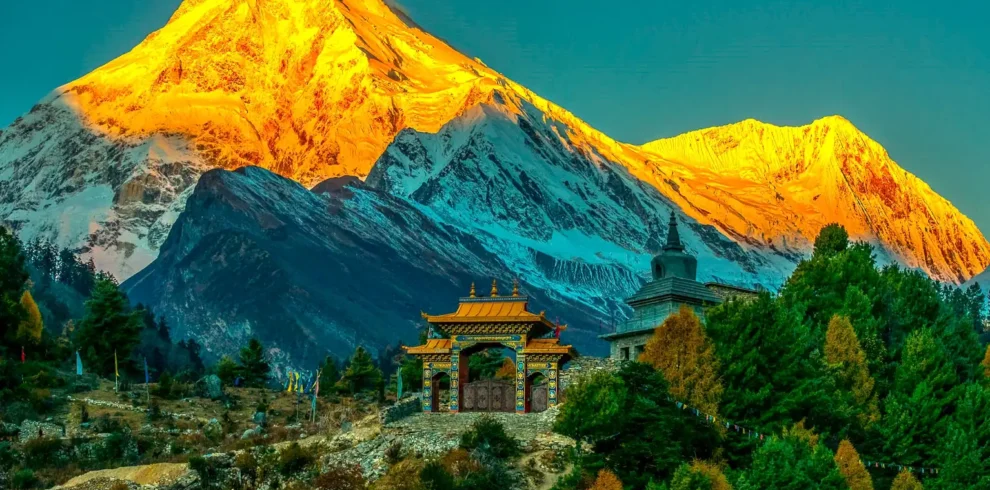
Visibility improves dramatically through the month. Where early September mornings might still carry lingering cloud from the retreating monsoon, late September regularly delivers the crisp, long distance mountain views that define the autumn trekking season in this part of Nepal.
Wind patterns also shift noticeably through September. Early in the month, air movement tends to be gentle and humid, carrying the last traces of monsoon moisture up the valley. By late September, drier, cooler air begins moving through more consistently, particularly in the afternoons at higher elevations. This shift is part of what drives the improving visibility, since drier air simply holds less of the haze and cloud that obscures mountain views during the wetter months.
Larkya La Pass Conditions In September
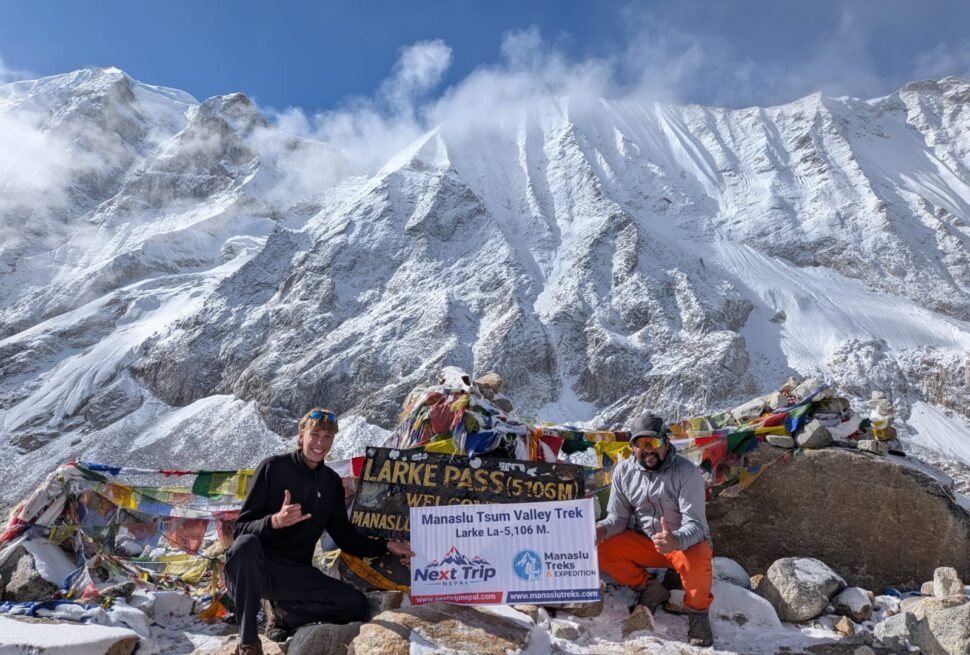
Crossing Larkya La in early September still carries some of the same considerations as a late August crossing, with a real possibility of reduced visibility or a short weather related delay. By mid to late September, crossings become progressively more reliable, and our guides generally report far fewer weather delays during this window than during the monsoon months.
Snow can still be present at the pass, particularly early in the month or after a late season storm, and our guides continue to assess visibility, recent snowfall and group condition at Dharamsala before any crossing attempt, regardless of how settled the weather has looked in the days leading up to it.
The pre dawn start typical of a Larkya La crossing feels genuinely different in September compared with the monsoon months. Rather than setting out under uncertain cloud cover, September crossings, particularly later in the month, often begin under clear starlit skies, with the first hints of sunrise catching the surrounding peaks as the group climbs steadily toward the highest point of the trek. Trekkers who have crossed the pass in both seasons consistently describe this as one of the more memorable differences between a monsoon trip and an autumn one.
We still recommend building at least one buffer day into any September itinerary around the pass crossing, particularly for departures in the first half of the month, since the transition out of monsoon does not follow a strict calendar and can vary from one year to the next.
The descent from Larkya La toward Bimtang also benefits from the drying trail conditions that September brings, particularly later in the month. Where an August or early September descent might involve careful footing on slick, muddy ground, a late September descent is often firm and straightforward, letting the group enjoy the dramatic scenery on the far side of the pass without needing to focus quite so intently on every step.
Trail Conditions From Machha Khola To Samagaon
The lower trail sections gradually dry out through September as rainfall eases. Early in the month, mud and elevated stream levels remain a real consideration, similar to August. By the later weeks, the trail firms up considerably, stream crossings become more manageable, and the forest sections take on the fresher, cleaner feel that follows the end of monsoon.
Leech activity drops off noticeably as September progresses, though early month trekkers should still expect some presence in the lower forest sections, particularly after recent rain. By late September, leeches are rarely a significant concern along the route.
Suspension bridge crossings also become noticeably calmer as September advances. Water levels beneath the bridges drop steadily from their monsoon peak, and the loud, forceful rush that can unsettle first time trekkers in July and August gradually gives way to a quieter, more manageable flow by the later weeks of the month.
How Busy Is The Trail In September
September sits in an interesting position on the crowd calendar. Early in the month, trail traffic remains low, similar to August, since many trekkers are still waiting for more reliably dry conditions. As the month progresses and word spreads that conditions are improving, trail traffic gradually increases, building toward the genuinely busy conditions of October.
For trekkers who want a taste of autumn conditions without the crowded teahouses and fully booked lodges of peak season, the back half of September often represents one of the best kept secrets on the Manaslu calendar, offering meaningfully improved weather over August while still avoiding the trail congestion of October and early November.
Our team still confirms teahouse availability directly along the route before finalizing any September booking, since demand can shift quickly once the weather clearly stabilizes and word travels among trekkers and agencies alike.
Guides and porters also tend to be a little more available in September compared with the fully booked October window, which can occasionally make it easier to arrange a private trek on relatively short notice. Clients who value flexibility in their planning timeline sometimes find September a genuinely practical choice for this reason alone, separate from any consideration of weather or crowds.
Permits Required For The Manaslu Circuit In 2026
Every foreign trekker needs three permits to complete the Manaslu Circuit, and all three must be arranged through a registered trekking agency rather than independently.
The Restricted Area Permit, or RAP, moves into the autumn peak season pricing window starting in September, costing 100 US dollars for the first week and 15 US dollars per day after that. This is higher than the December through August rate of 75 dollars for the first week and 10 dollars per day.
The Manaslu Conservation Area Permit, or MCAP, costs around 3000 Nepali rupees for foreign nationals, roughly 30 US dollars. The Annapurna Conservation Area Permit, or ACAP, carries the same fee structure and is required because the standard route exits through Dharapani and Besisahar into Annapurna Conservation Area territory.
Following the March 2026 update from the Department of Immigration, solo trekkers can now obtain the Restricted Area Permit without needing a second person in their group. A licensed guide remains mandatory regardless of group size, and permits must still be processed through a registered agency ahead of the trek.
What To Pack For A September Manaslu Trek
- A waterproof jacket and trousers, particularly important for early month departures
- Warm layers for the pass crossing, including a down jacket and insulated gloves
- A sleeping bag rated to at least minus 10 to minus 15 degrees Celsius for nights at Samdo and Dharamsala
- Sturdy, broken in trekking boots suited to both wet trail sections early in the month and firmer ground later on
- Quick drying clothing plus a few warmer layers for the increasingly cool evenings
- Sun protection, since clearer skies bring stronger UV exposure at altitude
- A headlamp with spare batteries, water purification tablets or a filter
- A comprehensive first aid kit including altitude sickness medication
- Trekking poles for stability on both muddy early month trail and uneven high altitude terrain
- A lightweight duffel bag for porters plus a daypack for personal items
Most of this gear can be rented in Thamel in Kathmandu before your trip begins. Since September packing needs vary depending on your specific departure date, our team is happy to advise on what to prioritize based on exactly when you are traveling.
Physical Preparation For The Trek
The physical demands of the Manaslu Circuit remain consistent regardless of season, and a solid base of cardiovascular fitness combined with regular hiking in the months before departure remains the best preparation for a September trek. Building up to hikes of five to seven hours with a loaded pack gives a realistic sense of what full trekking days on the route will feel like.
Stair climbing or hill repeats added to a regular training routine build the specific leg strength the route demands, particularly on the long climbs between Jagat and Namrung and the final push up to the pass itself. Trekkers who arrive having trained on varied terrain, rather than flat ground alone, generally find the up and down rhythm of the trail far more manageable than those whose preparation was limited to a treadmill or level walking paths.
Trekkers with some experience at altitude tend to have an easier adjustment during the acclimatization stages, though this is not a strict requirement. What matters most is arriving with genuine cardiovascular fitness and a realistic understanding of the demands of eight to ten hours of walking on some days, particularly around the pass crossing itself.
A sensible training plan for a September departure includes three to four sessions of cardiovascular exercise per week for at least two months beforehand, combined with at least one longer hike on the weekend that gradually builds toward five or six hours on your feet. Adding a loaded pack to these training hikes, even a modest ten to twelve kilograms, helps condition your shoulders and legs for the demands of a multi day trek far more effectively than unloaded walking or running alone.
Cost Breakdown For A September Manaslu Circuit Trek
| Item | Approximate Cost (USD) |
|---|---|
| Restricted Area Permit, first week | 100 |
| Restricted Area Permit, additional days | 15 per day |
| Manaslu Conservation Area Permit | 30 |
| Annapurna Conservation Area Permit | 30 |
| Licensed guide, per day | 25 to 35 |
| Porter, per day, optional | 20 to 25 |
| Teahouse accommodation, per night | 5 to 15 |
| Meals, per day | 20 to 30 |
| Gear rental in Thamel, full set | 60 to 100 |
| Travel insurance covering high altitude trekking | Varies by provider |
These figures are approximate and will vary depending on your itinerary length and the number of days your Restricted Area Permit needs to cover. Our team is happy to walk through a realistic budget for your specific September dates during a booking consultation.
Acclimatization And Altitude Safety
Altitude sickness risk depends on ascent rate and individual physiology rather than the season, so the standard acclimatization protocol applies in September exactly as it does throughout the year. The itinerary builds in a rest day at Samagaon around 3530 meters, and the optional Manaslu Base Camp side trip is genuinely worth attempting in September, since visibility improves considerably as the month progresses.
Many trekkers choose to carry Diamox as a preventive measure against altitude sickness, a decision that should be discussed with a doctor before travel. Our guides watch closely for early symptoms of acute mountain sickness throughout the trek and encourage open, honest communication about how you are feeling at each stage of the ascent, particularly as the itinerary climbs above 4000 meters.
Staying properly hydrated matters just as much in September as in any other month, even as temperatures cool and the urge to drink water regularly can fade. We encourage clients to keep drinking consistently throughout each walking day regardless of how cool or comfortable the weather feels, since dehydration at altitude contributes to fatigue and headache in ways that are easy to mistake for simple tiredness from the day’s walking.
Food And Accommodation Along The Route
Teahouses along the route are well stocked through September, with fresh supplies becoming easier to transport as trail conditions improve and trekking traffic gradually picks up. The standard menu of dal bhat, noodles, soup and basic staples is supplemented by a somewhat wider selection than during the quieter monsoon months.
Evenings grow noticeably cooler as September progresses, particularly at higher elevations, and teahouse dining rooms with a central stove become a genuinely welcome gathering point at the end of each trekking day.
A hot bowl of garlic soup, a local staple often recommended for its supposed benefits at altitude, tends to make its first regular appearance on teahouse menus as the weather cools through September, and many trekkers come to look forward to it as a comforting end to a long day on the trail. Whatever the scientific merit of its altitude benefits, there is no denying it tastes exactly right after a cold afternoon crossing toward Samdo or Dharamsala.
Sample September Itinerary
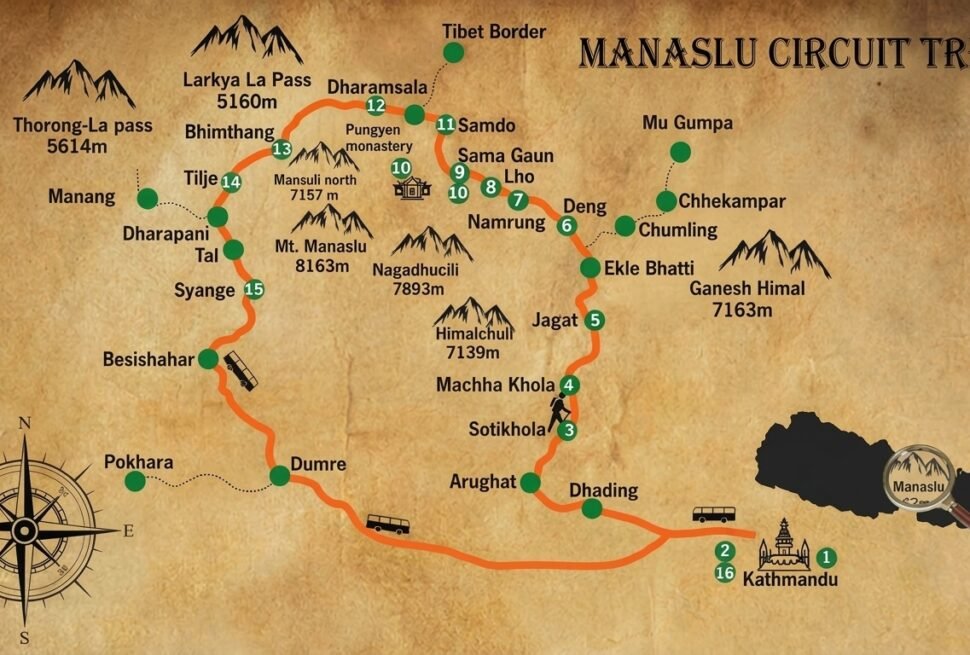
A September itinerary follows the standard Manaslu Circuit structure. Day one, drive from Kathmandu to Machha Khola. Day two, trek to Jagat. Day three, trek to Deng. Day four, trek to Namrung. Day five, trek to Lho. Day six, trek to Samagaon. Day seven, acclimatization day with an optional Manaslu Base Camp side trip. Day eight, trek to Samdo. Day nine, trek to Dharamsala. Day ten, cross Larkya La and descend to Bimtang. Following days, continue to Tal or Dharapani and make your way back toward Kathmandu.
For early September departures, we still recommend keeping one buffer day in reserve around the pass crossing. For late September departures, this buffer becomes less critical, though our guides always prefer to have it available rather than needed and unavailable.
We also encourage clients booking a September trek to think about their return flight schedule with the same care as the trekking itinerary itself. Even a late September trip, with its generally reliable weather, can still encounter an unexpected delay, and a flight booked with only a day of buffer after the trek ends removes any real margin for handling that kind of surprise gracefully.
Manaslu Base Camp Side Trip
The optional side trip to Manaslu Base Camp from Samagaon becomes increasingly rewarding as September progresses. Early month attempts still carry some risk of limited visibility, while late September regularly delivers clear, striking views of the mountain. This makes the timing of your departure genuinely relevant if the base camp side trip is a priority for your visit.
Travel Insurance For High Altitude Trekking
Proper travel insurance covering high altitude trekking up to at least 5500 meters, including helicopter evacuation, is essential for any Manaslu Circuit trek regardless of the month. Confirm your policy covers your specific travel dates and keep a copy of your policy number and emergency contacts with you throughout the trek.
Getting To The Trailhead
Most itineraries begin with a drive from Kathmandu to Machha Khola or Soti Khola. Road conditions generally improve through September as the effects of monsoon rain on the route ease, though early month departures should still allow some buffer time in case of lingering road damage from the tail end of the rainy season.
September Compared To Other Months
| Month | High Altitude Daytime | Crowd Level | Notable Feature |
|---|---|---|---|
| August | Variable, easing late month | Very low | Monsoon still active, easing in second half |
| September | 0 to 8 C | Low to moderate | Monsoon retreats, air clears, start of autumn window |
| October | Minus 5 to 5 C | High | Clearest views of the year, busiest month, book ahead |
Should You Trek Manaslu In September
September genuinely rewards trekkers with flexible dates and a bit of patience. An early September departure should be planned and prepared for much like a late August trek, with real potential for rain and reduced visibility. A late September departure often delivers a very close approximation of October conditions, minus the crowded trail and fully booked teahouses that come with peak season.
For trekkers who prioritize a quieter, more personal trekking experience and are willing to accept a slightly higher chance of weather related uncertainty compared with October or November, the final two weeks of September represent one of the most underrated windows on the entire Manaslu calendar.
We sometimes hear from clients weighing a late September trip against simply waiting a few extra weeks for October instead. If guaranteed clear weather and the most reliable conditions of the year are the top priority, October remains the safer choice. If a quieter trail, more personal attention from guides and teahouse hosts, and a genuine sense of catching the season before everyone else arrives matter more, late September can deliver an experience that October, with its fully booked lodges and busier trail, simply cannot replicate.
Photography In September
Photography opportunities improve steadily through September. Early month conditions can still deliver dramatic, moody cloud and forest shots reminiscent of the tail end of monsoon, while late September increasingly offers the crisp, long distance mountain views and clear light that define autumn photography in the Himalayas. The freshly washed landscape following the end of monsoon rain often produces particularly vivid greens in the lower forest sections during the first half of the month.
Wildlife And Nature Along The Trail
The forest remains lush through early September, gradually taking on the drier, clearer character of autumn as the month progresses. Birdlife remains active throughout the route, and the improving visibility of late September makes wildlife spotting, including occasional sightings of Himalayan tahr on higher slopes, noticeably easier than during the cloud covered monsoon months.
Health And Hygiene On The Trail
Basic hygiene practices remain important throughout September, particularly early in the month while humidity is still elevated. Wash your hands regularly, carry hand sanitizer, and treat all drinking water either with a filter, purification tablets, or boiled water. As the air dries out later in the month, dry skin and chapped lips become a more relevant concern than the dampness related issues of the monsoon months, so a good lip balm and moisturizer are worth adding to your kit.
Village Life And Culture Along The Route
The Nubri and Tsum valleys carry strong Tibetan Buddhist traditions, visible in the mani walls, prayer wheels and chortens that line the trail throughout the year. September often overlaps with harvest activity in the lower villages, adding a layer of visible local life to the trek as families work in the fields between Jagat and Namrung.
Walk clockwise around mani walls and stupas as is customary, and ask before photographing people or ceremonies, a small courtesy that goes a long way in these close knit mountain communities.
With trail traffic still building rather than at its peak, September visitors often find teahouse hosts have a bit more time to talk, share stories about the region, or explain a local custom in more detail than they might during the busiest weeks of October. Clients frequently mention these small, unhurried interactions as a genuine highlight of a September trek, one that adds real texture to the trip beyond the scenery alone.
Tips From Our Guides
Check the specific week of your departure date carefully when preparing, since early and late September genuinely differ in what to expect. Pack for both rain and increasingly cold, clear nights, since a single September itinerary can encounter both. Keep a flexible mindset around the pass crossing, particularly for early month departures, and trust your guide’s judgment on timing. Bring a good camera and extra battery power, since improving visibility later in the month often produces some of the best photography conditions of the entire year.
Group Departures Versus Private Treks
Fixed group departures become more common as September progresses and demand picks up ahead of the October peak. Early month dates still often work best as a private trek, given lower overall demand during this transitional window. Both options work well in September, and our team can advise on what fits your specific dates and preferences.
Frequently Asked Questions About Trekking In September
Is September a good month for the Manaslu Circuit Trek? Yes, particularly the second half of the month. Early September still carries some monsoon influence, while late September often closely resembles the clear, stable conditions of October with meaningfully quieter trails.
Will I still encounter rain in September? Early month departures should expect a real possibility of rain. This becomes progressively less likely as the month goes on, with late September usually delivering mostly dry conditions.
Is the Larkya La crossing reliable in September? Crossings become progressively more reliable through the month. Early September still carries some of the uncertainty of a monsoon crossing, while late September crossings are usually straightforward, weather permitting.
How busy are the trails in September? Early September remains fairly quiet, similar to August. Trail traffic builds steadily through the month as more trekkers arrive for the improving weather, though it typically stays below the peak crowds of October.
Can solo trekkers get a permit in September 2026? Yes, following the March 2026 immigration update, the two person minimum for the Restricted Area Permit has been removed, so solo trekkers can obtain the permit provided they trek with a licensed guide through a registered agency.
Should I book early or late September if I have a choice? Late September generally offers more reliable weather and better mountain visibility. Early September can still be a good choice for trekkers who specifically want quieter trails and do not mind some added uncertainty around rain.
How many days should I budget for the trek? We recommend a fourteen day core itinerary, with an additional buffer day recommended for departures in the first half of the month.
Do I need previous trekking experience for a September departure? No, though a reasonable level of cardiovascular fitness and some prior multi day hiking experience make the trek considerably more enjoyable. First time trekkers who train properly and choose an experienced guide generally complete the route without major difficulty, regardless of which week of September they choose.
Booking A September Manaslu Circuit Trek With Next Trip Nepal
September offers a genuinely rewarding window for trekkers willing to embrace a bit of transitional uncertainty in exchange for quieter trails and a front row seat to the shift from monsoon into autumn. Our guides know this month well and can help you choose the right departure date based on what matters most to you, whether that is avoiding crowds, catching clear mountain views, or simply finding a date that fits your schedule.
Reach out to our team if you are considering a September departure, and we will walk you through exactly what to expect based on your specific dates, help you prepare properly, and build an itinerary with the right amount of buffer time for a smooth, well managed trek.
We are also happy to compare a September date directly against October or November if you are still weighing your options, since the right choice really does depend on what matters most to you personally, whether that is guaranteed clear weather, a quieter trail, or simply a date that fits around your other travel plans. There is no single correct answer, only the trip that best matches what you are hoping to get out of it.
Whatever week of September you choose, this transitional month rewards trekkers who come prepared for a bit of variability and leave with some of the freshest, most vivid trail conditions of the entire year. We are always happy to talk through the details of your specific dates before you commit, so you know exactly what you are walking into from the very first day.
Our guides have led groups through every stage of this transition, from early September departures that still carried real monsoon uncertainty to late month trips that felt indistinguishable from a clear October morning, and that range of experience is exactly what we draw on when advising a new client on the right dates for their own trip. September is not a month to approach with rigid expectations in either direction, but for trekkers who come with a genuinely open mind about what the mountain will show them on a given day, it consistently delivers one of the more memorable versions of this trek available anywhere on the calendar.
Explore Other Months
Curious how the Manaslu Circuit Trek compares at a different time of year? Read our guide to trekking Manaslu in August or trekking Manaslu in October, or see our full Manaslu Circuit Trek overview for general route details, difficulty and highlights.