Tenzing Hillary Airport, universally known by the name of the town it serves, Lukla Airport, is the single busiest mountain airstrip in Nepal and the gateway that roughly forty thousand trekkers and mountaineers pass through every year on their way to Everest Base Camp, Gokyo, the Three Passes, and every other route through the Khumbu region. It is also, by wide agreement among aviation writers, documentary makers, and the pilots who fly there, one of the most demanding commercial airports on earth to operate. This guide pulls together the complete picture of the airport itself, its history, its physical design, its safety record, its airlines, its costs, and the seasonal rules that now govern how almost every trekker actually reaches it, based on official aviation data, Nepal’s Civil Aviation Authority records, and the detailed history documented on Wikipedia’s entry for Tenzing Hillary Airport.
If you are planning a trek into the Everest region, or simply curious about the small mountain airstrip that appears in nearly every Everest documentary ever made, this article is built to be the single most complete reference on Lukla Airport available anywhere, covering the facts, the history, the numbers, and the practical details that actually affect a traveler booking a flight there today.
Quick Facts About Lukla Airport
| Detail | Information |
|---|---|
| Official name | Tenzing Hillary Airport |
| Common name | Lukla Airport |
| IATA code | LUA |
| ICAO code | VNLK |
| Location | Lukla, Khumbu Pasanglhamu Rural Municipality, Solukhumbu District, Koshi Province, Nepal |
| Coordinates | 27°41’16” N, 86°43’53” E |
| Elevation | 2,845 meters, approximately 9,334 feet above sea level |
| Runway length | 527 meters, approximately 1,729 feet |
| Runway width | 20 to 30 meters, approximately 66 to 98 feet |
| Runway gradient | 11.7 percent uphill toward the north |
| Runway surface | Asphalt, paved in 2001, originally packed earth and gravel |
| Year opened | 1964 |
| Year renamed | January 2008 |
| Airport type | Public, STOL only, no scheduled jet service |
| Air traffic control | Visual, no radar, no instrument landing system |
| Operating hours | Daylight only, generally 6 in the morning to early afternoon |
The History of How Lukla Airport Was Built
Lukla Airport exists because of Sir Edmund Hillary, the New Zealand mountaineer who, alongside Tenzing Norgay, became the first person confirmed to reach the summit of Mount Everest in 1953. After his ascent, Hillary spent decades working with the Sherpa communities of the Khumbu through his Himalayan Trust, building schools, hospitals, and infrastructure across the region. An airstrip near the trailhead to Everest was part of that vision, since it would cut what had been a multi week walk from Kathmandu down to a matter of days.
Hillary’s original plan was to build the airstrip on flatter farmland closer to the valley floor. According to the detailed history recorded on Wikipedia, the local farmers who owned that land refused to sell it, unwilling to give up productive fields for an airstrip whose value they could not yet see. Hillary and his team instead purchased a smaller, steeply sloped plot of land higher up from local Sherpas, reportedly for around 2,650 US dollars, and enlisted local labor to clear and level it by hand through 1964. The result was not a flat runway but a short, sloped strip cut into the mountainside, a compromise that, largely by accident, produced the very design that makes Lukla both famous and formidable today.
For nearly four decades the runway remained an unpaved surface of packed earth and gravel, difficult to maintain and prone to becoming slick or rutted after rain. It was finally paved with asphalt in 2001, a major upgrade that improved braking performance and reduced the frequency of runway related incidents. In January 2008, on the anniversary of Tenzing Norgay’s birth, the Nepali government officially renamed the airstrip Tenzing Hillary Airport, honoring both men for what the renaming ceremony described as their contribution to opening the Khumbu to the world.
Where Lukla Airport Actually Sits
Lukla town sits in the Khumbu Pasanglhamu Rural Municipality of Solukhumbu District, part of Nepal’s Koshi Province in the country’s northeast. The airport occupies a narrow shelf on the mountainside above the Dudh Kosi river valley, at a point where the terrain drops away steeply to the south and rises into forested slopes and eventually the high Himalaya to the north. This position is precisely why the runway behaves the way it does, and why almost every fact about how the airport operates traces back to its physical geography rather than any design choice an engineer would have made on flatter ground.
Lukla sits roughly 138 kilometers northeast of Kathmandu as the crow flies, though the actual flight path winds through mountain valleys rather than a straight line, and driving there is not practically possible since no road network currently reaches the town. Every person, and nearly every kilogram of building material, food supply, fuel canister, and piece of expedition equipment used in the upper Khumbu arrives either by aircraft through Lukla or on the back of a porter or yak train walking in from a roadhead several days away.
Why the Runway Is Built the Way It Is
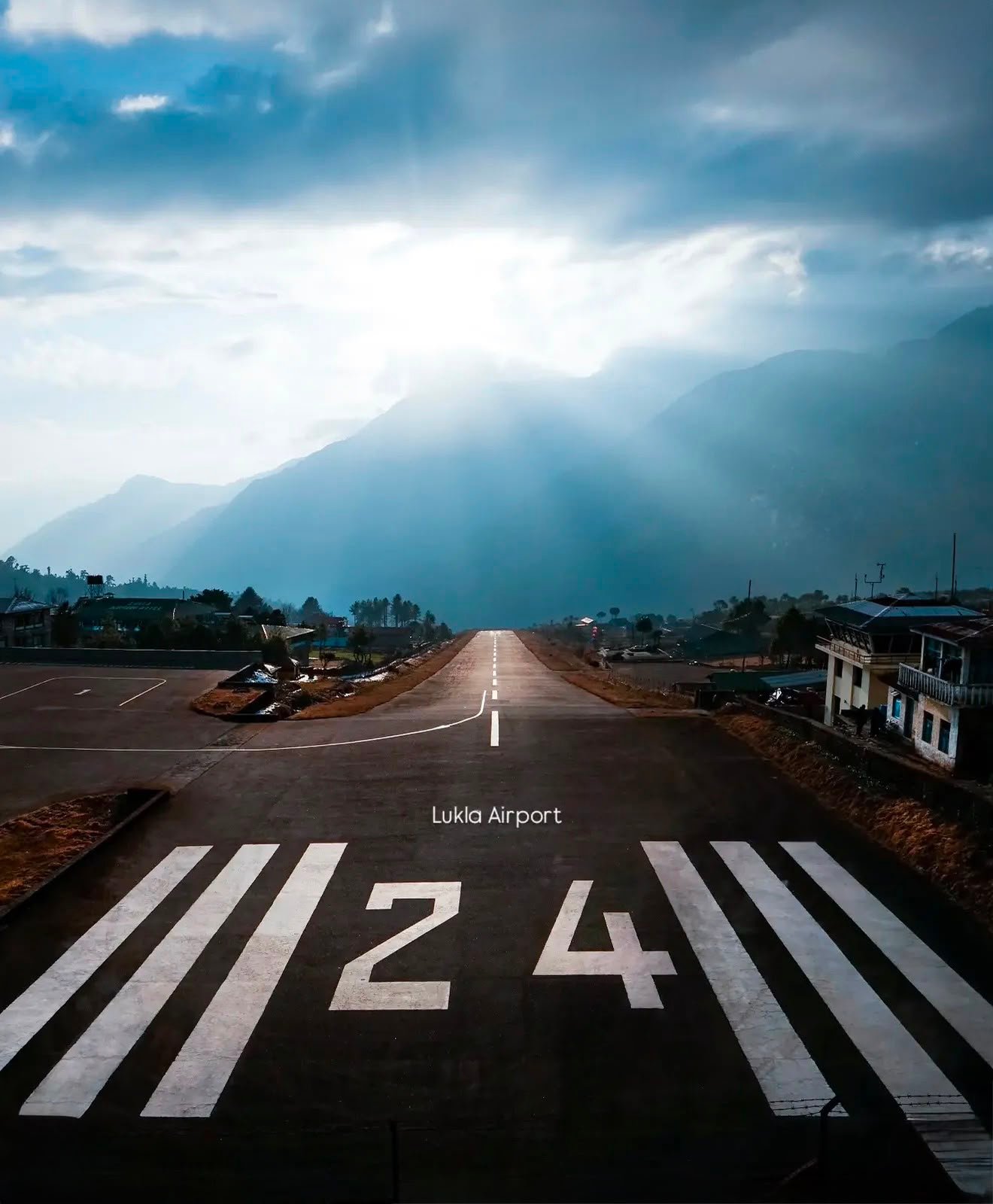
The single most distinctive feature of Lukla Airport is its runway design. At only 527 meters long, it is far shorter than almost any paved runway used for scheduled commercial flights anywhere in the world, a length that would be unremarkable for a private airstrip but is extraordinary for a runway handling dozens of passenger flights a day in peak season. To compensate for that short length, the runway is built on an 11.7 percent gradient, sloping steeply uphill from south to north.
This gradient does two things simultaneously. On landing, aircraft touch down at the lower, southern end of the runway and the upward slope itself acts as a natural braking force, helping a small STOL aircraft stop within the short distance available even without heavy use of the brakes. On takeoff, aircraft start at the upper, northern end and use the downward slope to accelerate toward the southern edge, gaining speed with the help of gravity before the runway simply ends at a sharp drop into the valley below, at which point the aircraft is airborne whether the pilot intended it or not.
Because of this design, Lukla operates in only one direction at a time for both landing and takeoff, always uphill to land and always downhill to depart, regardless of wind direction, which is unusual for an airport of any size. There is also no possibility of a standard go around on final approach the way there would be at a normal airport, since the high terrain immediately beyond the northern end of the runway leaves no safe path to climb away and circle back if an approach is not stabilized. A pilot committing to land at Lukla is, in a very real sense, committing fully, which is part of why the qualification standards for flying there are unusually strict.
Why Lukla Is Called the World’s Most Dangerous Airport
In 2010, a History Channel documentary series profiling extreme airports around the world rated Lukla as the most dangerous airport on the planet, a label that has stuck in travel writing and popular culture ever since, appearing in countless articles, videos, and even quiz shows over the years since. Aviation writers generally point to a combination of factors rather than any single flaw.
- A runway only 527 meters long, among the shortest used anywhere for scheduled passenger service
- A steep 11.7 percent gradient that leaves no flat margin for error on touchdown
- High terrain directly beyond the runway on the landing end, removing any option for a go around once an approach begins
- A sheer drop at the opposite end, meaning a takeoff that fails to gain sufficient speed has essentially nowhere safe to go
- Mountain weather that changes rapidly and with little warning, turning a clear morning into a socked in afternoon within an hour
- No radar coverage and no instrument landing system, meaning every approach and departure is flown entirely on visual reference by the pilot
- High air traffic volume in a small space during peak trekking season, with dozens of light aircraft arriving and departing within a short morning window
It is worth being precise about what this reputation does and does not mean. Lukla is not dangerous in the way a road with poor safety barriers is dangerous to an ordinary driver, since virtually every flight in and out is flown by specially qualified pilots operating aircraft built and maintained specifically for this kind of terrain. The reputation reflects how unforgiving a single serious error would be given the physical constraints of the runway, not a claim that flights routinely go wrong. The vast majority of the tens of thousands of flights operated into Lukla each year land and depart without incident.
Aircraft Types Certified to Fly Into Lukla
Because of the short, sloped runway and high elevation, Lukla can only accept small short takeoff and landing aircraft, commonly referred to as STOL aircraft, along with helicopters. No jet aircraft and no standard turboprop airliner of the kind used on Nepal’s longer domestic routes can operate here safely. The aircraft cleared for Lukla operations are purpose built or specifically modified for mountain flying at altitude.
| Aircraft | Typical Seats | Manufacturer | Notes |
|---|---|---|---|
| De Havilland Canada DHC 6 Twin Otter | 15 to 19 passengers | Canada | The most widely used aircraft on the route for decades, prized for short field performance |
| Dornier Do 228 | 15 to 19 passengers | Germany, later built under license in India | Common with several Nepali carriers, similar short field capability to the Twin Otter |
| LET L 410 Turbolet | 17 to 19 passengers | Czech Republic | A newer addition to several fleets, slightly larger cabin than the Twin Otter |
| Pilatus PC 6 Turbo Porter | Up to 10 passengers | Switzerland | Used historically and still occasionally seen for smaller charters and cargo runs |
| Various helicopters, including AS350 and Airbus H125 | 5 to 6 passengers typically | France and elsewhere | Used for both scheduled shared flights and private charters, more flexible on weather and landing sites |
Every one of these aircraft types shares a few traits that matter for this specific airstrip: strong short field takeoff and landing performance, engines that retain adequate power output at high density altitude, and a proven service history across Nepal’s mountain airstrips, not just Lukla itself. None of them are large by international airline standards, which is also why flight capacity into the Khumbu is naturally limited and why seats sell out quickly during the busiest weeks of spring and autumn.
Which Airlines Operate the Lukla Route Today
Several carriers have flown the Kathmandu to Lukla route over the decades, and the specific lineup shifts periodically as Nepal’s Civil Aviation Authority adjusts licensing and as individual airlines expand, merge, or suspend operations following incidents. As of the current trekking seasons, three carriers make up the great majority of scheduled Lukla flights.
| Airline | Aircraft Typically Used | Notes |
|---|---|---|
| Tara Air | DHC 6 Twin Otter, LET L 410 | A sister airline to Yeti Airlines, one of the most established operators on mountain routes across Nepal |
| Summit Air | LET L 410, Dornier Do 228 | A private carrier focused heavily on STOL routes in the Everest and Annapurna regions |
| Sita Air | Dornier Do 228 | A long running operator on the Lukla route, though its schedule and fleet size have varied over the years |
Helicopter charter companies operate alongside these fixed wing carriers, offering both shared seat flights on a fixed schedule and fully private charters. Because helicopters can often fly in marginal weather that grounds fixed wing aircraft, and because they can land at a wider range of sites beyond the main runway, they have become an increasingly common backup option for travelers whose fixed wing flight has been delayed or cancelled, as well as a first choice for private groups who prioritize a guaranteed departure time over cost.
Pilot Training and Certification for Lukla
Nepal’s Civil Aviation Authority applies specific, stricter qualification requirements to pilots flying into Lukla than to pilots on Nepal’s other domestic routes, reflecting the genuine skill the runway demands. Before a pilot is permitted to fly passengers into Lukla, the following are generally required.
- A minimum of 100 completed short takeoff and landing missions on other qualifying routes within Nepal
- At least one full year of STOL flying experience specifically within Nepal’s mountain terrain
- A minimum of ten supervised missions into Lukla itself, flown alongside a certified training captain before being released to fly the route independently
This layered requirement means every pilot landing at Lukla has already spent a meaningful amount of time flying other demanding Nepali airstrips before ever attempting this particular one, and has then been personally checked out on Lukla specifically by an experienced instructor rather than simply being briefed on the runway’s characteristics from a manual. Airlines operating the route also generally require ongoing recurrent training and route currency, meaning a pilot who has not flown into Lukla recently may need a refresher flight before resuming the route.
Weather Rules and the Daily Flying Window
Every flight into or out of Lukla is flown under visual flight rules, meaning the pilot must be able to see the terrain and the runway directly rather than relying on instruments to navigate the approach, since the airport has no instrument landing system and no radar coverage to guide aircraft through cloud. This single fact shapes nearly everything about how Lukla flights are scheduled and why delays are so common.
Mountain weather in the Khumbu can shift dramatically within a single hour, and conditions at Lukla frequently differ sharply from conditions in Kathmandu at the same moment, a pattern locals describe simply as it being possible for rain to fall steadily in Lukla while the sun shines in the capital. Because of this, flights operate only during a narrow morning window, typically from around 6 in the morning until sometime between late morning and early afternoon, after which rising valley temperatures tend to generate cloud and wind that make safe visual approaches unreliable. Afternoon flights into Lukla are rare and are avoided by every responsible operator, which is why trekkers are always advised to take the earliest possible flight rather than a later scheduled departure.
When cloud sits over the runway or wind exceeds safe limits, flights are delayed on the ground rather than attempted, and delays can stack through an entire morning as aircraft and crews wait for a viable window. During the busiest parts of spring and autumn, a single morning of poor weather can leave hundreds of trekkers waiting at either end of the route, which is why most experienced trekking operators build at least one full buffer day into any itinerary that depends on a Lukla flight.
The Ramechhap and Manthali Diversion Explained
One of the most important practical changes to affect Lukla travel in recent years has nothing to do with the airport itself, but with where flights actually depart from. Since October 2022, and formally from April 2023 onward, Nepal’s aviation authorities have required that during the busiest weeks of the year, all Lukla flights operate not from Kathmandu’s main domestic terminal but from Manthali Airport in Ramechhap District, roughly 132 kilometers east of the capital.
The reason for this shift is straightforward. Kathmandu’s Tribhuvan International Airport handles both Nepal’s full international schedule and its domestic network from a single, increasingly congested runway. During peak trekking season, adding dozens of small STOL flights to Lukla on top of that existing traffic created serious bottlenecks and long delays for every flight using the airport, not just those headed to the mountains. Shifting Lukla departures to the quieter Manthali airport removed that congestion and, as a side benefit, actually shortened the flight itself, since Manthali sits closer to Lukla than Kathmandu does.
| Factor | Kathmandu Route | Ramechhap or Manthali Route |
|---|---|---|
| Flight time to Lukla | Approximately 30 to 35 minutes | Approximately 15 to 20 minutes |
| Ground travel required first | None, airport is within Kathmandu city | 4 to 5 hours by road from Kathmandu, roughly 132 kilometers |
| Typical departure time from Kathmandu by road | Not applicable | Around 2 in the morning to reach Manthali before sunrise |
| When this route applies | Off peak months, roughly December through February and June through August | Peak season, roughly mid March through mid May and late September through November |
| Main advantage | Simple, no extra ground transport needed | Far less congestion, fewer weather related backlogs, quicker recovery after a delay |
For trekkers, this means that anyone flying to Lukla during the two main trekking seasons should expect to be picked up from their Kathmandu hotel in the middle of the night for the drive to Manthali, rather than simply heading to Kathmandu’s airport in the morning. Reputable trekking companies build this into the itinerary and arrange the transport directly, but travelers researching independently are sometimes caught off guard by the requirement if they have not read about it in advance. Because the rule is tied to Nepal’s aviation congestion rather than the airport itself, it has remained in place for several consecutive seasons and shows no sign of reverting until Kathmandu’s own airport capacity improves.
What a Lukla Flight Actually Costs
Ticket prices for the Lukla route are set within a range by Nepal’s Civil Aviation Authority rather than freely priced by each airline, though the exact figure charged to any individual traveler can vary by season, airline, and nationality, since Nepali and Indian citizens are charged substantially lower fares than other foreign visitors under a long standing tiered pricing structure.
| Route or Service | Approximate Price in US Dollars |
|---|---|
| Kathmandu to Lukla, direct, off peak season | 215 to 240 per person one way |
| Ramechhap or Manthali to Lukla, peak season | 170 to 190 per person one way |
| Ground transport, Kathmandu to Ramechhap by shared vehicle | 20 to 30 per person |
| Helicopter, shared seat | 500 to 650 per person one way |
| Helicopter, private charter | 2,000 to 4,000 total, depending on aircraft and group size |
These figures represent typical market rates rather than a fixed published tariff, and prices can shift from one season to the next as fuel costs and demand change. Most trekkers booking through a trekking company have these flights arranged and included as part of a package price rather than purchasing tickets directly, which also gives the company more flexibility to rebook a trekker onto another available flight or a helicopter if weather causes cancellations, something that is considerably harder to arrange as an independent traveler holding a single ticket.
Baggage Rules at Lukla
Because every kilogram carried on a Lukla flight directly affects how much fuel margin and safety buffer the aircraft has on such a short runway, baggage allowances here are considerably stricter than on a typical domestic flight elsewhere in the world.
- Checked baggage allowance, typically 10 kilograms per passenger
- Hand carried cabin baggage allowance, typically 5 kilograms per passenger
- Combined total allowance, typically 15 kilograms per passenger
- Excess baggage, charged per kilogram when space allows, or left behind to be sent on a later flight or by porter when the aircraft is at capacity
Trekking companies generally advise clients to pack strategically around this limit, sending any non essential luggage ahead by road to Lukla via a separate cargo service, or storing it in Kathmandu for the duration of the trek, so that only true trekking essentials need to fit within the flight’s weight allowance.
The Full Safety and Accident Record
Understanding Lukla’s safety history requires looking at the actual documented record rather than relying on its dramatic reputation alone. According to the accident and incident history compiled on Wikipedia’s page for the airport, ten notable accidents and incidents have occurred at or near Lukla between 1973 and 2017, spanning more than four decades of operation.
| Date | Aircraft and Operator | Outcome |
|---|---|---|
| October 15, 1973 | Royal Nepal Airlines, DHC 6 Twin Otter | Aircraft damaged beyond repair, no injuries reported |
| June 9, 1991 | Royal Nepal Airlines, DHC 6 Twin Otter | Crashed during landing, all aboard survived with injuries |
| September 26, 1992 | Royal Air Nepal, Harbin Yunshuji Y 12 II | Aircraft damaged beyond repair, all aboard survived |
| May 25, 2004 | Yeti Airlines, DHC 6 Twin Otter | Crashed into Lamjura Hill, three crew members killed |
| October 1, 2004 | Sita Air, Dornier Do 228 | Nose gear collapsed on landing, runway closed for two days |
| June 30, 2005 | Gorkha Airlines, Dornier Do 228 | Runway excursion, nine passengers and three crew injured, aircraft written off |
| October 8, 2008 | Yeti Airlines Flight 103, DHC 6 Twin Otter | Crashed on final approach with fire, 18 people killed, one survivor |
| October 12, 2010 | Sita Air, Dornier Do 228 | Braking failure caused nose damage, no injuries |
| September 26, 2013 | Air Dynasty helicopter | Rear rotor struck barbed wire, all four aboard survived |
| May 27, 2017 | Summit Air Flight 409, LET L 410 | Struck trees on approach, two crew members killed, one injured |
The most serious single event in this record remains the October 2008 crash of Yeti Airlines Flight 103, which struck the ground on final approach in poor visibility and caught fire, killing 18 of the 19 people aboard and remaining, by a wide margin, the deadliest accident in the airport’s history. It was this crash, more than any other single event, that helped cement Lukla’s reputation in international media in the years that followed, feeding directly into the History Channel’s 2010 ranking of the airport as the most dangerous in the world.
Looking at the record as a whole, several patterns stand out. Most incidents cluster around the landing and takeoff phases specifically, consistent with the runway’s design constraints, rather than occurring during the flight itself. Several incidents caused aircraft damage without any loss of life, reflecting both improvements in aircraft design over the decades and, in some cases, simple fortune. The most severe outcomes, including the 2004 and 2008 crashes, involved either weather related visibility issues or terrain contact during approach, the two hazards that pilot training and the airport’s strict operating rules are specifically designed to guard against.
Nepal’s Broader Aviation Safety Standing
Lukla’s safety record does not exist in isolation. It sits within Nepal’s wider civil aviation safety picture, which has faced sustained international scrutiny for over a decade. The European Union placed Nepali carriers on its Air Safety List, effectively banning them from operating in European airspace, in December 2013, and as of the most recent reviews through 2025 that ban remains in place. The EU’s stated concerns center on Nepal’s regulatory oversight, including gaps in how consistently flight time limitations, crew rostering, and safety training requirements are enforced across operators, factors identified during a formal audit in September 2023.
Nepal’s own Civil Aviation Authority has made real progress on this front. In 2017 the International Civil Aviation Organization removed Nepal from its list of countries with what it terms significant safety concerns, recognizing improvements in pilot licensing standards, aircraft operations oversight, and airworthiness certification. However, meeting the European Union’s specific threshold for removal from its separate Air Safety List has proven a longer process, and Nepal has not yet achieved that milestone even as neighboring countries facing similar restrictions, such as Pakistan in 2024, have been delisted. For travelers, the practical implication is mainly relevant to insurance and to understanding why domestic Nepali flights, Lukla included, operate under somewhat different regulatory oversight than flights in Europe or North America, rather than indicating that any specific flight is unsafe to take.
Airport Facilities and Security
Lukla’s terminal building is modest by any international standard, reflecting both its remote location and the practical reality that most passengers spend only a short time there before continuing on foot into the Khumbu. The facility includes a small check in counter, a basic waiting area, and simple food and tea service for passengers waiting out a weather delay, which, given how often delays occur, is more heavily used than the terminal’s small size might suggest.
- A dedicated helicopter parking and landing zone situated separately from the main fixed wing runway, roughly 140 meters from the terminal building
- A chain link perimeter fence around the airfield
- Round the clock security patrol by Nepali police, both armed and civil units, reflecting the airport’s importance as critical regional infrastructure
- Basic cargo handling facilities, since the airport also serves as the delivery point for the great majority of construction material, food, and fuel used throughout the upper Khumbu
There is no instrument landing system, no radar, and no facility for night operations, consistent with the airport’s strictly visual, daylight only operating rules described earlier in this guide.
The Airport’s Role as the Khumbu’s Lifeline
It is easy to think of Lukla Airport purely as a trekker’s gateway, but for the roughly six thousand permanent residents of the Khumbu region and the many more who work there seasonally, it functions as something closer to a lifeline. No road network reaches Lukla or any settlement further into the Khumbu, and building one across this terrain remains, for now, both economically and physically impractical. Nearly everything used to build and supply the region, from corrugated roofing sheets and construction timber to packaged food, medical supplies, and cooking fuel, arrives either by aircraft through Lukla or on the backs of porters and yaks walking in from a roadhead several days away.
This dual role, passenger gateway and cargo lifeline, means the airport’s usefulness extends well beyond tourism. Even during periods when trekking traffic is naturally lower, cargo flights continue to keep villages throughout the Khumbu supplied, and the airport’s ongoing operation is genuinely tied to the basic functioning of daily life for the communities living along the trail to Everest Base Camp.
Alternatives to Flying Into Lukla
Because flights can be delayed or cancelled by weather, and because a small number of travelers prefer not to fly on such a short mountain runway at all, several alternative ways to reach the Khumbu exist, each with real tradeoffs in time, cost, and comfort.
| Alternative | What It Involves | Main Tradeoff |
|---|---|---|
| Helicopter charter | Direct flight from Kathmandu or Ramechhap, often able to fly in marginal weather that grounds fixed wing aircraft | Considerably more expensive than a fixed wing ticket |
| Drive to Jiri or Salleri, then trek in | A long road journey followed by several additional days of walking to reach the standard Lukla trailhead point | Adds roughly a week to the total trip, though it follows the classic original approach route used before the airport existed |
| Fly to Phaplu Airport | A lower elevation, longer runway airstrip further from the high mountains, followed by two to three days of additional walking | Considered somewhat less weather sensitive than Lukla itself, but adds significant trekking time |
| Wait out the delay at either end | Simply remain in Kathmandu or Lukla until weather clears enough for the scheduled flight to operate | Requires a flexible schedule and spare days built into the itinerary |
Phaplu Airport in particular deserves a mention here, since it is Solukhumbu District’s other airstrip and is occasionally used as a fallback destination when Lukla itself is closed to fixed wing traffic for an extended period. Sitting at a lower elevation with a longer runway than Lukla, it is generally regarded as a somewhat easier airfield to operate, though it adds meaningful trekking time to reach the standard trail networks used by most Everest region itineraries. The overland approach through Jiri or Salleri, meanwhile, is the route every trekker used before Lukla Airport existed at all, and a small number of trekkers still choose it deliberately today, both to avoid flying and to experience the lower, less visited valleys the classic route passes through on the way toward Lukla and the main Everest trail.
Practical Tips for Trekkers Flying Through Lukla
Having flown thousands of trekkers through this exact airport, a few practical points consistently make the difference between an easy transit and a frustrating one.
- Always build at least one, and ideally two, buffer days into your overall itinerary specifically to absorb a possible weather delay, both on the way in and on the way out
- Book the earliest possible morning flight, since the daily weather window narrows as the morning goes on and later flights carry a meaningfully higher risk of delay or cancellation
- Pack to the 15 kilogram combined baggage limit deliberately, sending anything non essential ahead separately rather than discovering the limit at check in
- Carry a printed or offline copy of your flight confirmation and trekking company contact details, since phone signal and connectivity can be unreliable at both Lukla and Manthali during a delay
- If traveling during peak season, confirm with your trekking company whether your flight departs from Kathmandu or from Ramechhap, and plan for a possible very early departure from your hotel to reach Manthali on time
- Consider travel insurance that explicitly covers flight delay and trip interruption, since a multi day weather delay can otherwise disrupt onward international travel plans
- If a fixed wing flight is cancelled and time is tight, ask about helicopter availability as a backup, since helicopters can frequently operate in conditions that ground the smaller STOL aircraft
Records, Recognition, and Media Coverage
Lukla Airport’s combination of dramatic setting and genuinely demanding operating conditions has made it a recurring subject in travel and aviation media for years. The History Channel’s 2010 television program profiling the world’s most extreme airports named it the most dangerous airport on earth, a ranking that has been repeated, referenced, and debated across countless subsequent articles, videos, and online lists. It regularly appears in roundups of the world’s most extreme or most scenic runways, and its dramatic uphill landings and downhill takeoffs have been filmed extensively by documentary crews covering Everest expeditions, since virtually every climbing or trekking documentary about the mountain passes through this airstrip at some point in its story.
Beyond its media reputation, the airport holds a quieter but arguably more meaningful distinction as the single piece of infrastructure that made large scale Everest tourism and mountaineering possible in the first place. Before 1964, reaching the base of the world’s highest mountain required weeks of walking from Kathmandu. The airstrip Edmund Hillary and local Sherpa laborers cut into a Khumbu hillside collapsed that journey to a matter of days, and in doing so reshaped the economy and daily life of the entire region in ways that are still visible in every teahouse, lodge, and shop lining the trail today.
Frequently Asked Questions About Lukla Airport
Is Lukla Airport really the most dangerous airport in the world?
It earned that specific ranking from a 2010 History Channel program, largely because of its extremely short runway, steep gradient, high terrain at one end, and lack of any go around option on approach. In practice, the airport operates thousands of flights safely every year, and the strict pilot qualification standards and daylight only, visual flight rules operating procedures exist precisely to manage the risks the runway’s design creates.
Can I fly directly from Kathmandu to Lukla year round?
Only during the quieter months. During the two main trekking seasons, roughly mid March through mid May and late September through November, all scheduled flights depart instead from Manthali Airport in Ramechhap District, a drive of four to five hours from Kathmandu, because of congestion at Kathmandu’s main airport.
Why do Lukla flights only operate in the morning?
Because the airport has no instrument landing system and no radar, every flight must be flown under visual flight rules. Mountain weather in the Khumbu typically stays clearest in the early morning and deteriorates as the day warms, generating cloud and wind that make safe visual approaches unreliable later in the day.
What happens if my Lukla flight is cancelled due to weather?
You wait for the next available weather window, which may come later the same day or may require waiting until the following day. Trekking companies typically try to rebook affected passengers onto the next available seat, and helicopter transfers are sometimes used as a faster alternative when fixed wing flights remain grounded for an extended period.
How short is the Lukla runway compared to a normal airport?
At 527 meters, it is a small fraction of the length of a typical international runway, which commonly measures 3,000 meters or more. The steep 11.7 percent gradient compensates for this short length by using the slope itself to help aircraft slow down on landing and gain speed on takeoff.
Is there another airport near Everest besides Lukla?
Phaplu Airport, also in Solukhumbu District, is the closest alternative, sitting at a lower elevation with a longer runway, though it adds two to three additional days of walking to reach the main Everest Base Camp trail compared with starting from Lukla directly.
Who built Lukla Airport and why is it named Tenzing Hillary Airport?
Sir Edmund Hillary directed its construction in 1964 as part of his broader work supporting Khumbu communities through the Himalayan Trust. It was officially renamed Tenzing Hillary Airport in January 2008 to honor both Hillary and Tenzing Norgay for their roles in opening the region, Hillary through building this airstrip and Norgay as the Sherpa mountaineer who summited Everest alongside him in 1953.
Final Word
Lukla Airport is, in every practical sense, the front door to the Everest region, and understanding how it actually works, from its steep gradient runway and strict visual flying rules to the seasonal shift to Manthali and the realistic chance of a weather delay, is genuinely useful preparation for anyone planning to trek there. Its reputation as one of the world’s most demanding airports is well earned by its physical design, but that same reputation has also driven the strict pilot training standards, aircraft qualification rules, and daylight only operating procedures that have kept the overwhelming majority of its flights safe across more than sixty years of operation. For trekkers, the practical takeaway is simple: build a buffer day into your schedule, book the earliest flight you can, and treat a possible delay as a normal part of visiting one of the most spectacular and genuinely remote regions on earth, not as a sign that anything has gone wrong.
How Lukla Compares to Other Extreme Airports
Lukla is often mentioned in the same breath as a handful of other famously demanding airports around the world, including Paro Airport in Bhutan, Courchevel Altiport in the French Alps, and Barra Airport in Scotland, which uses a tidal beach as its runway. What sets Lukla apart within that group is the specific combination of a very short runway, a steep permanent gradient, and genuinely high traffic volume, with dozens of flights a day during peak season rather than the occasional flight these other airstrips typically handle. Paro shares Lukla’s mountain surrounded approach and strict pilot certification requirements, but operates a considerably longer runway using larger aircraft. Courchevel’s runway carries an even steeper gradient than Lukla’s, but sees a fraction of the annual flight volume. This combination of scale and terrain difficulty is a large part of why Lukla specifically, rather than any of these other airstrips, has become the most widely cited example of extreme mountain aviation in popular media.
Seasonal Patterns and Reliability Through the Year
Flight reliability at Lukla is not constant across the calendar, and understanding the seasonal pattern helps explain why the two main trekking seasons exist in the first place. Spring, from March through May, and autumn, from late September through November, offer Nepal’s most stable high pressure weather patterns, with clearer mornings and more predictable cloud behavior, which is exactly why these windows carry the heaviest flight traffic and why the Ramechhap diversion applies specifically during these months. The monsoon months of June through August bring heavy afternoon rain and persistent low cloud that make flying considerably less reliable, and winter, from December through February, brings clearer but colder conditions with occasional multi day closures caused by high altitude winds and snow. Trekkers flying during the shoulder months just outside the main seasons often find flights less crowded, though the tradeoff is a somewhat higher chance of weather related delay compared with the peak windows.
Further Reading on Everest and the Khumbu Region
- Lukla Airport: Flights, Weather Delays and Everything You Need to Know, our companion guide focused specifically on trekker logistics for this route
- What Happens If Weather Cancels Your Everest Base Camp Helicopter Return
- Everest Base Camp Helicopter Return Trek Itinerary Day By Day
- What Really Happens on Helicopter Return Day: A Complete Guide From Gorakshep to Kathmandu
- Kala Patthar: Altitude, Views, and Complete Guide
- Everest Base Camp Trek, the standard walking itinerary through Lukla
- Everest Base Camp Trek with Helicopter Return, walk in through Lukla and fly back