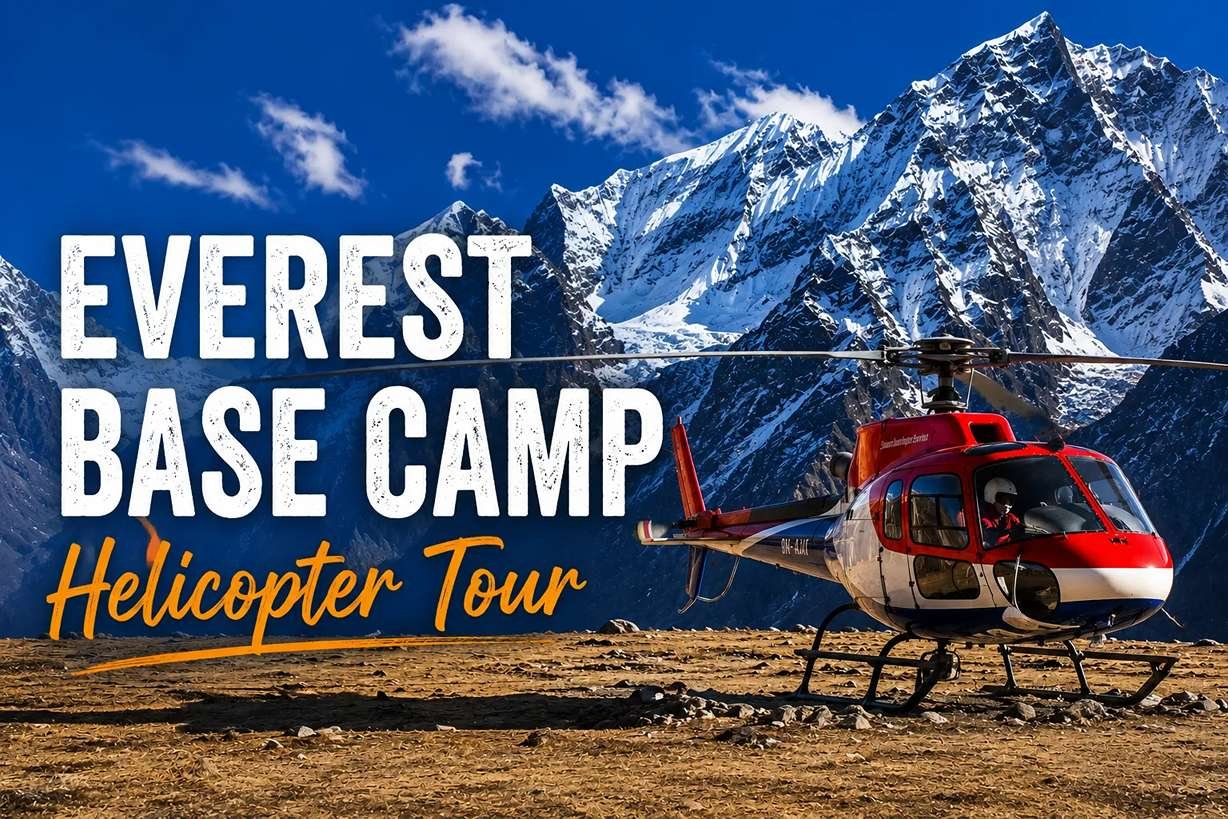
What it is, what you actually see, where you land, how much it costs, how the safety regulations work, and everything else you need to decide and book with confidence.
If you would rather walk in through the Khumbu Valley and only skip the descent, our Everest Base Camp Trek with Helicopter Return combines both, and our day by day itinerary shows exactly what that version of the trip involves.
The Everest Base Camp Helicopter Tour is the fastest and most accessible way to witness Mount Everest at close range from the air, land at one of the highest viewpoints in the Khumbu region, and return to Kathmandu within a single day. For trekkers who have spent weeks on the Everest Base Camp trail, it is a route that takes 14 to 16 days on foot and covers this journey in approximately four to five hours by helicopter.
More people book this tour every year, and with good reason. Nepal’s aviation regulations, the technology of modern high-altitude helicopters, and the operational experience accumulated by reputable Nepal-based operators have made this one of the safest, most efficiently run aerial experiences available anywhere in the Himalayas. At the same time, there is a significant amount of misleading information circulating about what you actually see, where you actually land, what the safety restrictions involve, and what the difference between a shared and private tour means in practice.
This guide is written by the team at Next Trip Nepal to give you the honest, detailed picture before you book. We cover what the tour is, where the helicopter flies, the specific altitude regulations that govern landing points, the weight limits that affect how groups are divided, the cost breakdown, the best season, what to bring, and who this tour is genuinely suitable for. No overstatement, no vague reassurances. Just the information that allows you to make an informed decision.
1,250+
What the Everest Base Camp Helicopter Tour Actually Is
The Everest Base Camp Helicopter Tour is a one-day aerial excursion that departs from Tribhuvan International Airport’s domestic terminal in Kathmandu and flies into the Khumbu region of northeastern Nepal, covering the same geographic ground as the Everest trekking region but in a fraction of the time.
The flight covers approximately 150 km from Kathmandu to the Everest region and back, passing over the mid-hills terrain of the Solukhumbu district, the forest-covered ridges above Lukla, the terraced farmland around Namche Bazaar, and the high glacial landscape of the upper Khumbu valley before reaching the vicinity of Everest Base Camp at 5,364 m and Kala Patthar at 5,545 m.
The tour is fundamentally an aerial sightseeing experience with strategically placed ground stops. It is not a trekking alternative that delivers the same outcome in less time. The experience of arriving at the Khumbu on foot after 10 days of walking through Sherpa villages, forest, and rocky moraine is profoundly different from arriving by helicopter in 45 minutes. Both experiences have genuine value. They are just different things.
What the helicopter tour does deliver, uniquely and definitively, is visual access to the upper Khumbu for people who cannot or do not want to spend two weeks on a high-altitude trail. This includes older travelers, those with physical limitations that preclude multi-day trekking, families with young children, business travelers with limited time in Nepal, and trekkers who have already done the Everest Base Camp trek and want to revisit the region from a completely different perspective.
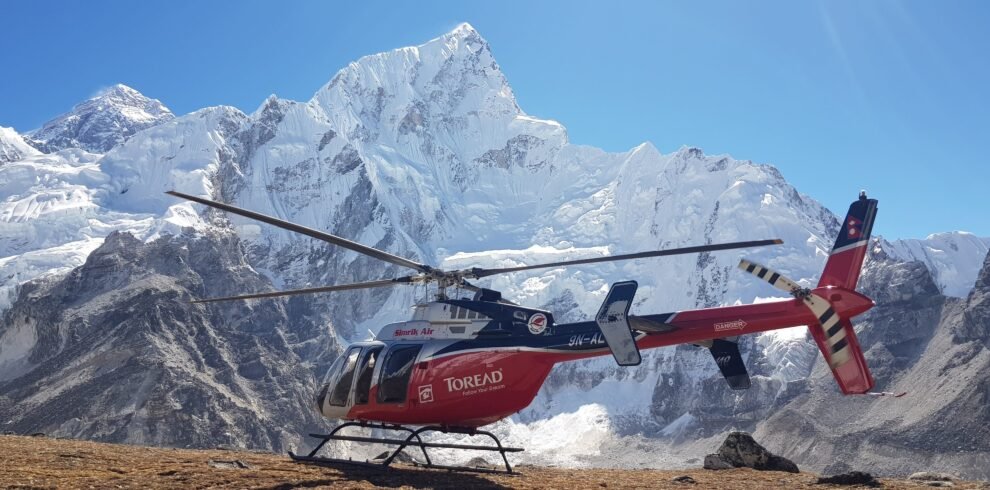
The helicopter does not land directly at Everest Base Camp (5,364 m) during standard commercial tours. The base camp sits on active glacier ice with no safe helipad and is heavily restricted during climbing season due to active expedition operations. The standard route flies over the base camp area and lands at Kala Patthar (5,545 m) and Hotel Everest View (3,880 m). Some private tours can arrange specific base camp proximity stops under certain conditions. This distinction matters and any agency that advertises a ground stop at the literal base camp without clarification deserves a direct question before you book.
The Complete Flight Route and Stops
The standard Everest Base Camp Helicopter Tour from Kathmandu follows a consistent route with established stops. The specific landings depend on whether you have booked a group sharing or private charter, but the aerial route is the same for all tour types.
The Kathmandu to Lukla leg takes approximately 40 to 45 minutes, flying over the mid-hill terrain of the Solukhumbu district with views of the Langtang, Ganesh, and Gaurishankar Himalayan ranges becoming visible on clear mornings. The stop at Lukla is purely operational: refueling, weight verification, and coordinating the onward flight plan. Passengers typically remain on the helicopter during this stop.
At Pheriche (4,371 m), groups of more than two to three passengers are divided into smaller shuttles for the high-altitude sections. This is a regulatory requirement, not an operational preference. The full explanation of why this happens is in the safety regulations section below. After the Kala Patthar landing and the Hotel Everest View breakfast stop, the return to Kathmandu follows the same route in reverse, with a final Lukla refueling before the last 45-minute sector back to Tribhuvan Airport.
Altitude Stops and Landing Points Explained
Understanding what each stop delivers, and why the altitude limits are structured the way they are, removes the most common source of confusion and disappointment in post-tour reviews. People who arrive knowing exactly what to expect at each point have a significantly better experience than those who arrive with unclear expectations.
Kala Patthar Landing: What the 10 to 15 Minutes Gives You
Kala Patthar at 5,545 m is the highest landing point on the standard commercial Everest helicopter tour and the best ground-level viewpoint for Mount Everest in the entire Khumbu region. Trekkers who reach Kala Patthar on foot after 13 to 14 days of walking confirm that the view from this exact spot is exceptional. From here, Everest’s summit pyramid is directly visible above the Nuptse ridge, with Lhotse and the Khumbu Icefall spread across the panorama below.
The landing time is limited to 10 to 15 minutes for three specific reasons. First, the thin air at 5,545 m means helicopter engines cannot be shut down at this altitude. The aircraft must keep its rotors turning throughout the stop, which creates both noise and rotor wash that limits comfortable standing time. Second, the helicopter must maintain ready-to-depart status for immediate weather-related departure if conditions change. Third, the altitude poses a real if brief AMS risk to passengers who are not acclimatized, and limiting ground time reduces exposure to acute altitude discomfort.
Ten to fifteen minutes at Kala Patthar is enough for clear photographs of the full panorama, a physical moment of standing at over 5,500 m above sea level, and the satisfaction of being at an altitude that less than 0.01 percent of the global population will ever reach. It is not enough to hike up to the prayer flags or explore beyond the immediate landing area. Manage that expectation correctly and you will not be disappointed.
Hotel Everest View: Where You Actually Spend Time
The Hotel Everest View at Syangboche (3,880 m) is the longest stop on the tour and the one that most travelers describe as the most enjoyable. This is the world’s highest-altitude hotel built for permanent occupancy. It opened in 1971 and has been welcoming visitors ever since from its ridge position above Namche Bazaar with a direct sightline to Everest, Ama Dablam, Lhotse, and Thamserku.
Breakfast here typically runs 45 to 60 minutes. The menu covers continental and local options. The cost of breakfast is approximately USD 35 to 40 per person and is usually separate from the tour package unless specifically stated as included. The stone-walled terrace with the mountain panorama visible through the windows and across the open balcony is where most of the tour’s photography happens, simply because there is enough time to compose properly and because the altitude (3,880 m) is comfortable enough to think clearly and move at a normal pace.
What You Actually See From the Helicopter
The aerial perspective from a helicopter flying at 5,000 to 6,000 m in the Khumbu is unlike any ground-based viewpoint. The scale of the high Himalayan landscape becomes comprehensible in a way that photographs do not capture and that ground-level perspectives obscure. You are looking across a visual field that contains four of the world’s fourteen eight-thousanders simultaneously.
Peaks Visible on a Clear Day
| Peak | Altitude | World Rank | Visibility from Flight |
|---|---|---|---|
| Mount Everest (Sagarmatha) | 8,848 m | 1st | Direct view of north and southeast faces from Kala Patthar approach |
| Lhotse | 8,516 m | 4th | Directly connected to Everest; South Face visible in full |
| Makalu | 8,485 m | 5th | Visible to the east from Pheriche altitude and above |
| Cho Oyu | 8,188 m | 6th | Visible to the northwest above the Nangpa La |
| Nuptse | 7,861 m | Fills the view southwest of Everest; the ridge that partially frames the summit | |
| Ama Dablam | 6,812 m | The most photographed peak from this tour; distinctive double-summit profile | |
| Pumori | 7,161 m | Directly adjacent to Kala Patthar; often at eye level during approach | |
| Thamserku | 6,608 m | Dramatic south face visible from Syangboche and Namche approach |
Other Landmarks Visible
- The Khumbu Icefall: The notorious, constantly moving glacier section between Base Camp and Camp 1 is visible from the air in detail that ground trekkers at Base Camp cannot fully appreciate. The scale of the seracs and crevasses is apparent from altitude in a way that perspective photographs cannot convey.
- Namche Bazaar: The Sherpa capital visible as a semicircle of buildings in the hillside bowl, with yak trains on the connecting trails visible to the sharp eye.
- Tengboche Monastery: The largest monastery in the Khumbu, located on a ridge above the valley floor, passes directly beneath the flight path.
- Gokyo Lakes: The turquoise high-altitude lakes of the Gokyo valley are sometimes visible to the west on clear days, appearing as gemstones against the ochre and grey of the high-altitude landscape.
CAAN Safety Regulations and Weight Limits Explained
The Civil Aviation Authority of Nepal (CAAN) governs all commercial helicopter operations in Nepal. Following a fatal helicopter accident in the Solukhumbu district in July 2023, CAAN implemented substantially updated safety regulations for Everest region helicopter operations. These regulations directly shape how the Everest Base Camp Helicopter Tour operates in 2026.
The Weight Limit Regulations by Altitude
Every helicopter type has performance envelopes that define its maximum safe payload at specific altitudes. As altitude increases, air density decreases, which reduces rotor lift efficiency. This is physics, not policy. The CAAN regulations codify these physical realities into mandatory operational limits.
What the Pheriche Split Actually Means for Your Tour
If you have four or five people in a group sharing tour, your group will be divided at Pheriche (4,371 m) into two shuttles for the Kala Patthar sector. The first group of two to three passengers flies to Kala Patthar, lands for 10 to 15 minutes, and returns to Pheriche. The second group then makes the same flight. The total additional waiting time for the second group at Pheriche is approximately 30 to 45 minutes. This is standard operating procedure for all commercial Everest helicopter operators in 2026, not a problem specific to any particular company.
For private charters, the same regulations apply. A private charter does not mean you can exceed the weight limits at altitude. It means the entire aircraft capacity from Kathmandu to Pheriche is yours. Above Pheriche, the 250 kg ceiling for the Kala Patthar shuttle applies to every flight regardless of booking type.
Provide your accurate body weight when booking. The Pheriche weight checks are conducted by flight crew and are not negotiable. If a group’s combined weight at altitude exceeds permitted limits, either a passenger waits at Pheriche or an additional helicopter must be arranged at full additional cost. Being accurate about weight at booking is both a safety requirement and a practical logistics necessity.
Group Sharing Versus Private Charter: The Real Differences
This comparison generates more confusion and booking regret than any other aspect of the Everest helicopter tour. The decision deserves an honest analysis rather than a sales pitch for the higher-margin option.
| Factor | Group Sharing Tour | Private Charter |
|---|---|---|
| Cost per person | USD 1,200 to 1,395 | USD 4,500 to 6,500 (for the whole helicopter) |
| Passengers | Up to 5 per aircraft (Kathmandu to Lukla); 2 to 3 above Pheriche | Same weight limits apply at altitude |
| Departure time flexibility | Fixed group departure windows | Flexible within weather and ATC windows |
| Flight route | Identical standard route | Can be customized with additional stops |
| Kala Patthar landing | Yes; group split required above Pheriche | Yes; same 250 kg altitude limit applies |
| Hotel Everest View breakfast | Typically optional at additional cost | Fully customizable |
| Best for | Solo travelers, couples, small groups; cost efficiency | Families, larger groups, special occasions, total privacy |
| Waiting time at Pheriche | 30 to 45 min for second group shuttle | Shorter if group small enough for one shuttle |
| Booking lead time needed | 3 to 7 days in peak season | 2 to 4 weeks recommended for preferred dates |
For most solo travelers and couples, the group sharing tour is the straightforward choice. The route, the views, the landing points, and the safety protocols are identical. The only substantive difference is whether you share the aircraft with strangers for the Kathmandu to Lukla sector. Above Pheriche, everyone is in groups of two to three regardless.
The private charter is the right choice when: you have a group of four to six and the per-head cost mathematics close the gap with the group sharing price; when the flexibility to choose departure time matters (sunrise over the Khumbu is genuinely different from mid-morning light); or when the occasion, be it a family milestone, anniversary, or business hospitality, warrants the exclusivity.
Full Day Itinerary: Hour by Hour
The Everest Base Camp Helicopter Tour is a one-day experience. Departure is early, deliberately, because morning conditions in the Everest region are consistently clearer than afternoons. By mid-morning, convective cloud begins building over the high peaks, and afternoon flights frequently encounter cloud cover at precisely the altitudes where you want visibility.
5:00 to 5:30 AM: Hotel Pickup
Private vehicle transfers all passengers from their Kathmandu hotels to the domestic terminal of Tribhuvan International Airport. Carry your passport, permit documentation your agency has provided, and a light daypack. The airport itself is a short drive from Thamel.
5:30 to 6:00 AM: Airport Formalities and Briefing
Check-in at the domestic terminal, weight verification, document processing for national park permits, and safety briefing by the flight crew. The briefing covers boarding procedures, seatbelt protocol, helicopter approach and departure rules, and the 10 to 15 minute conduct guidelines for the Kala Patthar stop.
6:00 to 6:45 AM: Kathmandu to Lukla (2,860 m)
Takeoff from Kathmandu. The first minutes of flight offer an aerial overview of the Kathmandu valley and its ring of hills, followed by the mid-Himalayan terrain transition as the aircraft heads northeast. Langtang, Jugal Himal, Gaurishankar, and Rolwaling peaks come into view on the northern horizon. Lukla appears as a narrow airstrip cut into a steep hillside. Landing here for refueling takes 10 to 20 minutes.
6:45 to 7:15 AM: Lukla to Pheriche (4,371 m)
After Lukla, the flight passes above Namche Bazaar (3,440 m), the Sherpa capital clearly visible as a semicircle of development in a hillside amphitheater. Tengboche Monastery appears on its ridge above the valley confluence. Ama Dablam’s dramatic profile rises directly ahead. The terrain becomes more austere and alpine as you approach Pheriche at the base of the Khumbu valley.
7:15 to 7:45 AM: Pheriche Group Split and Kala Patthar Shuttle
At Pheriche, the crew assesses combined passenger weights and divides groups into shuttles of two to three passengers for the Kala Patthar sector. Each shuttle takes 20 to 25 minutes for the high-altitude flight to and from Kala Patthar. Ground time at Kala Patthar is 10 to 15 minutes with helicopter engines running. Views from this point encompass Everest, Nuptse, Lhotse, Pumori, Changaste, and the Khumbu Icefall below.
7:45 to 9:00 AM: EBC Area Overfly and Syangboche Landing
The flight passes over the Everest Base Camp zone (5,364 m) with the Khumbu Icefall directly visible below the aircraft. This is the closest aerial approach to the base camp itself. The helicopter then descends to Syangboche airstrip (3,880 m) adjacent to Hotel Everest View for the breakfast stop.
9:00 to 10:00 AM: Breakfast at Hotel Everest View
The breakfast stop at the world’s highest-altitude operational hotel gives 45 to 60 minutes for a sit-down meal with a panoramic view of Everest, Ama Dablam, Thamserku, and the Khumbu valley. This is the most comfortable stop of the tour and the best opportunity for unhurried photography. Breakfast costs USD 35 to 40 per person, payable separately unless your package includes it.
10:00 to 11:30 AM: Return to Kathmandu via Lukla
Departure from Syangboche, return flight above the familiar landmarks in reverse, Tengboche, Namche, the Dudh Koshi valley, and the Solu Khumbu hills. Brief Lukla refueling stop, then the final 45-minute sector back to Tribhuvan International. Ground transfer from the domestic terminal back to your hotel. Tour complete by 11:30 AM to noon.
Full Cost Breakdown for 2026
The cost of the Everest Base Camp Helicopter Tour depends on three variables: whether you book group sharing or private charter, the season you travel, and what is genuinely included in the package versus what is listed as optional or additional.
| Cost Item | Group Sharing | Private Charter | Notes |
|---|---|---|---|
| Helicopter flight (main tour package) | USD 1,200 to 1,395 per person | USD 4,500 to 6,500 per helicopter | 5 passengers max from KTM; private charter regardless of how many fly |
| Sagarmatha National Park permit | NPR 3,000 (~USD 23) | NPR 3,000 per person | Mandatory; sometimes included in package; sometimes payable in cash on day |
| Khumbu Pasang Lhamu Rural Municipality fee | NPR 2,000 (~USD 15) | NPR 2,000 per person | Local government tax; usually bundled in the quoted “airport tax” figure |
| Domestic airport departure tax | Included in total NPR 7,000 levy | Same per person | Total government taxes and permits approximately NPR 7,000 per person |
| Breakfast at Hotel Everest View | USD 35 to 40 per person (optional) | As above | Some packages include this; confirm before booking |
| Hotel pickup and drop transfer | Usually included | Usually included | Confirm your hotel address is within the pickup zone |
| Additional passengers above weight threshold | Additional helicopter at full cost | Same | Provide accurate weights when booking to avoid day-of surprises |
| Travel insurance with helicopter evacuation | USD 80 to 200 (you arrange) | Same | Strongly recommended; you are flying to 5,545 m |
Most agencies quote an additional NPR 7,000 (approximately USD 50 to 55) per person payable on the tour day. This covers the Sagarmatha National Park entry permit, the Khumbu Pasang Lhamu Rural Municipality fee, and the domestic airport tax. This is not a company margin. It is a mandatory government levy that must be paid in cash at or before the airport on the tour day. Carry the equivalent in Nepalese Rupees. No ATMs are at the domestic terminal departure area.
Permits and Documentation Required
The Everest region falls within Sagarmatha National Park, a UNESCO World Heritage Site since 1979. Entry requires specific permits regardless of whether you arrive on foot or by helicopter. Your trekking or tour agency arranges all of these. You need to provide passport copies in advance and carry the originals on the tour day.
| Document | Required? | Cost | Where Obtained |
|---|---|---|---|
| Passport (original) | Mandatory | Free | Carry your own; needed at every checkpoint |
| Sagarmatha National Park Permit | Mandatory | NPR 3,000 (~USD 23) | Agency arranges; payable on tour day in cash or included in package |
| Khumbu Pasang Lhamu Rural Municipality Permit | Mandatory | NPR 2,000 (~USD 15) | Collected at Lukla or Monjo checkpoint |
| TIMS Card | Verify with agency | If applicable, USD 10 | Not required for helicopter tours as of current regulations; confirm |
| Passport copy (for agency permit processing) | Mandatory | Free | Provide to agency 24 to 48 hours before tour day |
Best Season and Months for the Everest Helicopter Tour
The Everest Base Camp Helicopter Tour runs throughout the year, weather permitting. However, seasonal conditions significantly affect visibility, cloud cover, wind speeds at altitude, and the overall quality of what you see. Choosing the right time of year is one of the most impactful decisions you can make.
| Month | Visibility | Temperature at 5,545 m | EBC Climbing Season | Recommendation |
|---|---|---|---|---|
| January | Excellent; crisp and clear | -20 to -25°C | No | Very Good |
| February | Good to excellent | -18 to -22°C | Pre-expedition | Good |
| March | Good; clearing from winter | -15 to -18°C | Expedition approach | Very Good |
| April | Excellent most mornings | -10 to -15°C | Active season (Base Camp busy) | Best for seeing climbers |
| May | Good early; cloud builds late May | -8 to -12°C | Summit push period | Good in early May |
| June to August | Poor to very poor (monsoon) | -2 to -8°C | No | Avoid |
| September | Improving; excellent from Week 3 | -8 to -12°C | No | Good from late September |
| October | Best of year; 90%+ clear days | -10 to -15°C | No | Absolute Best |
| November | Excellent to very good | -15 to -20°C | No | Excellent |
| December | Clear and sharp | -18 to -25°C | No | Very Good |
Who This Tour Is Suitable For
One of the most valuable contributions this guide can make is a clear-eyed assessment of who the Everest Base Camp Helicopter Tour genuinely serves well. The marketing for this tour sometimes implies it delivers the same outcome as the trek but faster. That is not accurate. What it delivers is different from the trek: an aerial experience, a ground stop at 5,545 m, and a mountain breakfast. For the right traveler, that is exactly what they need.
Travelers with Limited Time
The most common profile. Nepal is in the itinerary for three to five days and the Everest Base Camp trek is a 14-day commitment. The helicopter tour delivers the high Khumbu experience within a single morning.
Senior Travelers
Physical condition rather than age determines suitability, but many travelers in their 60s and 70s for whom sustained multi-day walking at altitude is no longer realistic find this tour an ideal alternative.
Families with Young Children
Children too young for a 14-day high-altitude trek can experience the Himalayas from the air and at the Hotel Everest View breakfast stop without the physical demands and altitude exposure of the full circuit.
Trekkers Extending Their Experience
The helicopter tour is a genuinely different view of a region you may know from the ground. Trekkers who have done EBC by foot often book the helicopter tour on a second Nepal visit to experience the same landscape from altitude.
Travelers with Physical Limitations
A previous knee injury, cardiovascular considerations, or general fitness level that makes 13 days of high-altitude trekking impractical does not preclude flying over the world’s highest peak.
Photographers on a Time Constraint
The aerial perspective on the high Himalaya produces images unavailable from any ground viewpoint. For photographers whose primary interest is the mountain landscape, the helicopter delivers the vantage point that matters.
Trekkers expecting a deeply cultural, immersive experience in Sherpa villages should book the Everest Base Camp Trek. The helicopter tour passes over these communities at altitude. The human experience of the Khumbu, the monasteries, the yak caravans, the teahouse evenings, the acclimatization rest days, the summit push at 4 AM, is not accessible from a helicopter window. Both experiences have profound merit. They are simply different things.
Altitude Considerations and AMS Risk on the Helicopter Tour
Altitude sickness is a genuine consideration on the Everest helicopter tour, though the risk profile is very different from a multi-day trek. The brief exposure at 5,545 m and the rapid return to 3,880 m limits cumulative altitude exposure significantly compared to the trekking route.
Most passengers experience no altitude symptoms during the 10 to 15 minute Kala Patthar stop. The most common complaint is mild lightheadedness on stepping out of the aircraft, which resolves immediately on return to lower altitude. However, anyone with cardiovascular conditions, recent respiratory illness, or known altitude sensitivity should consult a doctor before the tour.
- Do not run or move quickly at Kala Patthar (5,545 m). Walk slowly, breathe regularly, and do not exert yourself during the brief ground stop.
- Most tour operators carry emergency oxygen on board. Confirm this when booking.
- If you begin feeling dizzy, nauseated, or breathless at any stop, tell the pilot or ground crew immediately. The standard response is to return to lower altitude, which resolves most symptoms within minutes.
- Avoid alcohol the night before the tour. Even mild dehydration from alcohol amplifies altitude symptoms.
- Stay well-hydrated on the tour day. Drink water before and during the flight.
What to Wear and Bring for the Helicopter Tour
The day-pack for a one-day helicopter tour is very different from multi-day trekking kit, but altitude and temperature still demand specific preparation. This is the single most overlooked aspect of preparation for first-time participants.
Essential Clothing
- Down jacket rated to minus 15°C (non-negotiable; it is around minus 15 at Kala Patthar)
- Thermal base layer top and bottom
- Warm fleece or wool mid-layer
- Warm trekking trousers or insulated pants
- Warm hat and balaclava or neck gaiter
- Warm gloves (your hands are outside at Kala Patthar)
- Sturdy footwear: boots or thick-soled shoes (no flip-flops or thin-soled shoes)
- Sunglasses with UV protection (high-altitude glare is intense)
Gear and Documents
- Passport (original — checked at airport and potentially at stops)
- Permit documentation (your agency provides this)
- Cash in Nepalese Rupees: NPR 8,000 to 10,000 (permits, breakfast, tips)
- Camera with fully charged battery (cold kills battery at altitude)
- Spare camera battery kept inside your jacket to stay warm
- Memory card with sufficient capacity
- Smartphone fully charged
- Small daypack or backpack for above items
Health and Safety
- Travel insurance confirmation document
- Any personal medication you take regularly
- Pain relief (altitude headache is possible)
- Lip balm with SPF (UV at altitude is extreme; lips exposed to cold and sun crack fast)
- Sunscreen SPF 50+ for hands and face
- Water bottle (stay hydrated before and during flight)
- Snack: energy bar or nuts (you are leaving early and breakfast is mid-tour)
What Not to Bring
- Large luggage or full-size backpacks (weight-sensitive aircraft)
- Alcohol before or during the tour (altitude + alcohol = bad combination)
- Sandals or thin-soled footwear for Kala Patthar
- Drone (not permitted in Sagarmatha National Park airspace)
- Excessive cash (security risk; you only need enough for permits and breakfast)
Photography Tips for the Helicopter Tour
The Everest Base Camp Helicopter Tour produces some of the most dramatic travel photographs in the world when shot correctly. The combination of high-altitude clarity, extraordinary subjects, and aerial perspective is unmatched. Prepare specifically for this and you will come home with images that are genuinely hard to take anywhere else.
In-Flight Photography
- Request a window seat when booking if you are the designated photographer in your group. Most tour operators allocate window seats per helicopter capacity. Ask directly.
- Shoot through the window glass if needed, but clean the glass with a cloth before shooting. Helicopter windows carry oil and smear marks that destroy image sharpness.
- Use a fast shutter speed (1/1000s or faster) to eliminate vibration blur from rotor movement. Even a silky-smooth helicopter vibrates enough to blur at slow shutter speeds.
- Set your aperture to f/5.6 to f/8 for in-flight shots: enough depth of field to keep foreground mountains sharp while the background remains clear.
- ISO sensitivity: do not fear ISO 800 or 1600 at altitude. The high-altitude light is intense and noise is far less destructive than motion blur.
At Kala Patthar (5,545 m)
- You have 10 to 15 minutes. Plan your shots before the helicopter lands. Know what you want: Everest with foreground prayer flags (immediately visible), the Khumbu Icefall below (requires walking 10 to 15 steps toward the valley edge), the group photograph at the summit marker.
- Keep your camera warm. In minus 15 to minus 20 degrees Celsius, a cold camera battery can fail within minutes. Keep it inside your jacket until the moment you shoot.
- The light direction in early morning (7 to 8 AM) at Kala Patthar illuminates the southeast face of Everest and the Nuptse ridge directly. This is the best directional light for mountain photography here.
At Hotel Everest View (3,880 m)
This is your best photography stop. You have 45 to 60 minutes, the altitude is comfortable, and the mountain lineup of Everest, Ama Dablam, Thamserku, and Lhotse is spectacular in morning light. Use this time for considered, unhurried composition rather than the rushed shooting that the Kala Patthar stop requires.
What to Confirm Before You Book
Before confirming a booking for the Everest Base Camp Helicopter Tour, these are the questions to ask any operator. The answers reveal both whether the package is honestly described and whether the operator has the operational competence to deliver what they promise.
| Question to Ask | Why It Matters |
|---|---|
| Is the Kala Patthar landing included, or is this a flyover-only package? | Some packages advertise EBC helicopter tours with landing but mean the Hotel Everest View landing only, not Kala Patthar. Ask specifically about Kala Patthar ground stop. |
| Is breakfast at Hotel Everest View included or additional cost? | The USD 35 to 40 breakfast cost is significant across a group. Know in advance whether you are paying it separately on tour day. |
| What is the weather cancellation policy? | Mountain weather is unpredictable. Confirm what happens if the tour is cancelled: full refund, rescheduling at no cost, or partial credit. Ask specifically. |
| What are the exact permits included and what must I pay separately? | The NPR 7,000 government levy (national park + municipality + airport tax) is sometimes included in the quoted price, sometimes payable in cash on tour day. Know which applies to your booking before you arrive at the airport. |
| What type of helicopter is used? | Reputable operators use H125 (AS350 B3e), Bell 407, or similar high-altitude certified aircraft. Ask. Operators who cannot name their aircraft type or deflect the question warrant caution. |
| How many years of Everest region helicopter experience does the assigned pilot have? | High-altitude mountain aviation is a specialty. Pilots with 10+ years of Khumbu operations have a safety record and route knowledge that newer pilots cannot replicate. |
| Is emergency oxygen on board? | It should be. Any reputable operator confirms this without hesitation. |
| What happens if my weight exceeds the Pheriche limit for a single shuttle? | Know in advance whether additional shuttle cost falls to you or is absorbed by the operator. Provide accurate weights when booking to make this a non-issue. |
Other Nepal Experiences Worth Combining With This Tour
The Everest helicopter tour leaves you in Kathmandu by noon on a clear morning. For travelers spending several days in Nepal, here are the experiences that complement it most naturally.
Trekkers who want to go beyond an aerial overview and spend time in the Khumbu on foot should explore the Everest region trekking options in full detail. The Everest Three Passes Trek is the most comprehensive Khumbu circuit for experienced trekkers. For those interested in peak climbing within the Everest region, Island Peak Climbing and Lobuche East Peak Climbing are outstanding options that combine the approach with a genuine summit experience.
For travelers exploring beyond the Everest region, the Annapurna region offers the Annapurna Circuit and Annapurna Base Camp as alternative trekking destinations with distinct cultural and geographic character. The Manaslu region is Nepal’s most rewarding restricted area trek for travelers seeking genuine wilderness and low crowd levels.
Cultural travelers based in Kathmandu between active Himalayan experiences will find the Kathmandu valley far richer than most visitors anticipate: three UNESCO World Heritage Sites within a short drive of the city center, the living goddess temple of Kumari, the Bodhnath Stupa Buddhist community, and the Pashupatinath temple complex on the Bagmati river. City tours from Next Trip Nepal cover each of these sites in structured day programs.
Families traveling to Nepal who want a multi-environment experience combining culture, wildlife, and mountains should look at family trip options that combine the Kathmandu valley, Chitwan National Park for a jungle safari, and the Everest helicopter tour as the Himalayan centrepiece of a 7 to 10 day Nepal visit.
Next Trip Nepal is a Kathmandu-based tour and trekking company with deep expertise across all of Nepal’s major destinations. Our team includes certified guides, pilots liaisons, and destination specialists who have operated in the Everest region, Langtang, Annapurna, and Manaslu across all seasons. All pricing is transparent and confirmed before your tour day. For detailed trip information, current availability, and custom itinerary planning, contact our team directly or browse verified traveler reviews from previous clients.
Book the Everest Base Camp Helicopter Tour
Next Trip Nepal’s local team handles permits, airport transfers, and all logistics. Shared and private charter options available for 2026.
View Full Package Details Customize Your Nepal TripNext Trip Nepal | Registered Nepal Tour Operator | Kathmandu
10 Facts About Everest Base Camp Helicopter Tour
1. You Do Not Actually Land at Everest Base Camp
Despite the name, most Everest Base Camp Helicopter Tours do not land at Everest Base Camp itself. Helicopters usually land at Kala Patthar (5,545m) if weather and conditions allow, because it offers better views of Mount Everest and safer landing conditions.
2. Kala Patthar Gives Better Everest Views
Many travelers expect Everest Base Camp to provide direct Everest views, but Kala Patthar actually offers one of the closest and best panoramic viewpoints.
3. Most Helicopter Flights Start From Kathmandu
Most tours begin early in the morning from Kathmandu Airport. During busy seasons some flights may operate via Manthali Airport.
4. The Entire Tour Usually Takes Around 4–5 Hours
The Everest helicopter experience is usually completed within four to five hours including landing stops and refueling.
5. Passenger Weight Matters at High Altitude
Helicopters often split passengers into smaller groups before flying to higher elevations because high altitude affects aircraft performance.
6. Weather Can Change the Plan Quickly
Everest region weather changes fast. Delays, waiting times, or cancellations can happen even during peak trekking seasons.
7. Morning Flights Usually Have Better Conditions
Flights operate early because mornings generally offer clearer mountain views and more stable weather conditions.
8. Many Tours Include Hotel Everest View
Some Everest helicopter tours stop at Hotel Everest View where guests can enjoy breakfast or tea surrounded by Himalayan scenery.
9. High Altitude Symptoms Are Still Possible
Even though the journey is short, travelers can still feel mild effects of altitude because the tour reaches over 5,000 meters.
10. It Is the Fastest Way to Experience Everest
The helicopter tour allows travelers to see the Everest region in just a few hours instead of trekking for nearly two weeks.