1. Introduction: Your Gateway to the World’s Highest Peak
For many travelers, seeing Mount Everest is a dream that has been on their bucket list for years. The challenge is that reaching Everest Base Camp usually requires almost two weeks of trekking through the Himalayas, along with good fitness, careful acclimatization, and enough vacation time.But there is another way. An Everest Helicopter Tour lets you experience the beauty of the world’s highest mountain in just a few hours. Instead of spending days on the trail, you’ll fly over Sherpa villages, deep valleys, glaciers, and some of the highest peaks on Earth before landing at Kala Patthar, one of the best viewpoints of Mount Everest. On most tours, you’ll also enjoy breakfast at the famous Hotel Everest View before returning to Kathmandu the same day.
Booking logistics are broadly similar for trekkers combining this flight with time on the trail. Our Everest Base Camp Trek with Helicopter Return page and its season by season booking guide cover the same international booking questions for that longer itinerary.
This experience has become one of Nepal’s most popular luxury adventures for travelers from the USA, UK, and Europe. Whether you’re short on time, traveling with family, celebrating a special occasion, or simply prefer a comfortable way to see Everest, a helicopter tour offers a perspective that very few people ever experience. In this guide, you’ll learn exactly how to book an Everest Helicopter Tour from the USA, UK, or Europe, including prices, payment options, the best time to fly, what the tour includes, and important tips to help you choose a reliable local operator for your trip.
Who This Guide Is For
This guide is written specifically for international travelers searching for reliable booking information from their home country. If you are sitting in New York, Manchester, or Paris and wondering how to book an Everest helicopter tour from the USA, the UK, or Europe, you are in exactly the right place.
You might be a first-time visitor to Nepal, planning your dream Himalayan experience. Maybe you have never been to South Asia before and the idea of arranging a helicopter flight in a foreign country feels overwhelming. Do not worry. This guide walks you through every single step.
You might also be someone who has already done the research but got confused by conflicting prices, different operators, and unclear policies. I have been there. Sorting through all the options for an Everest helicopter tour Nepal booking can feel like a maze. That is why I created this complete guide to cut through the noise and give you clear, actionable information.
What You Will Learn in This Guide
By the time you finish reading this complete guide, you will know exactly how to book Everest helicopter tour packages from the comfort of your home. Whether you want an Everest helicopter tour from Europe, the States, or the UK, we have you covered.
Here is what we cover:
- The complete booking process from USA, UK, and Europe, including which operators accept international bookings, what payment methods work best, and how to secure your spot with no advance payment required
- Detailed pricing breakdowns so you know exactly what you are paying for, what is included, and what costs extra
- A full day by day itinerary so you know where you fly, where you land, and what happens at each stop
- A practical packing list with exactly what to bring and what to wear for high altitude helicopter flights
- Insider tips that only experienced Nepal travel experts know, from the best seats in the helicopter to how to handle altitude changes
- Seasonal advice to help you pick the perfect month for crystal clear mountain views
- Safety information, cancellation policies, and honest advice about who this tour is perfect for (and who should consider alternatives)
Planning your Everest Helicopter Tour?
Chapter 2: What Is the Everest Base Camp Helicopter Tour
Overview of the Experience
The Everest base camp helicopter tour is a 4 to 5 hour aerial adventure that takes you from Kathmandu deep into the heart of the Himalayas and back again. You will fly over terraced hills, ancient villages, rushing rivers, and some of the most dramatic mountain scenery on the planet before circling the roof of the world itself.
The total flight time is about 2.5 to 3 hours, spread across several legs with two incredible landings along the way. You do not just fly over Everest and go home. You actually get out of the helicopter, stand in the shadow of the world’s tallest peak, and breathe the thin, crisp air at altitudes most people will never reach.
There are two main types of tours to understand:
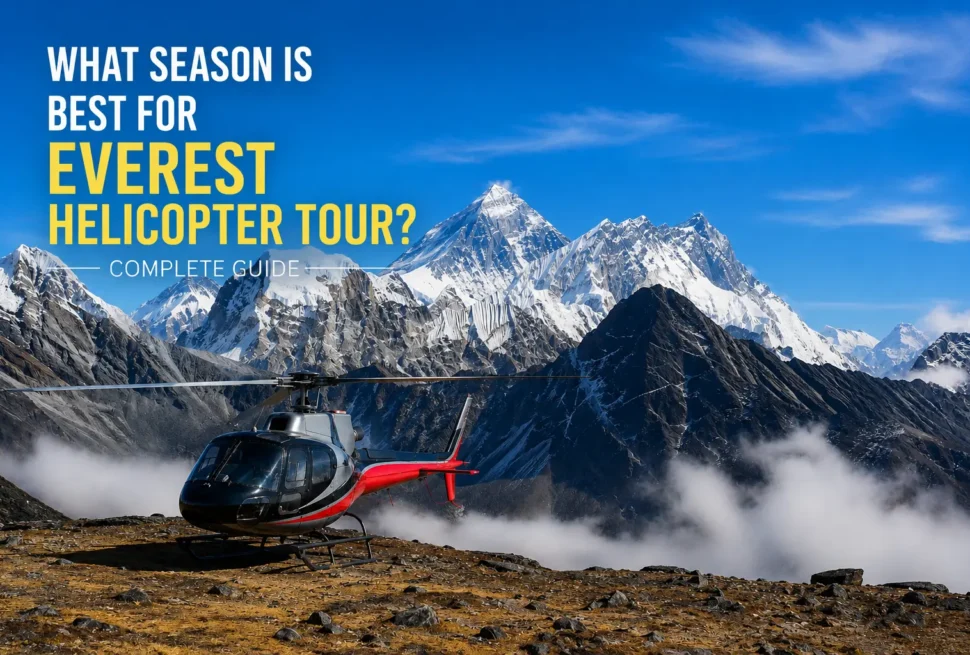
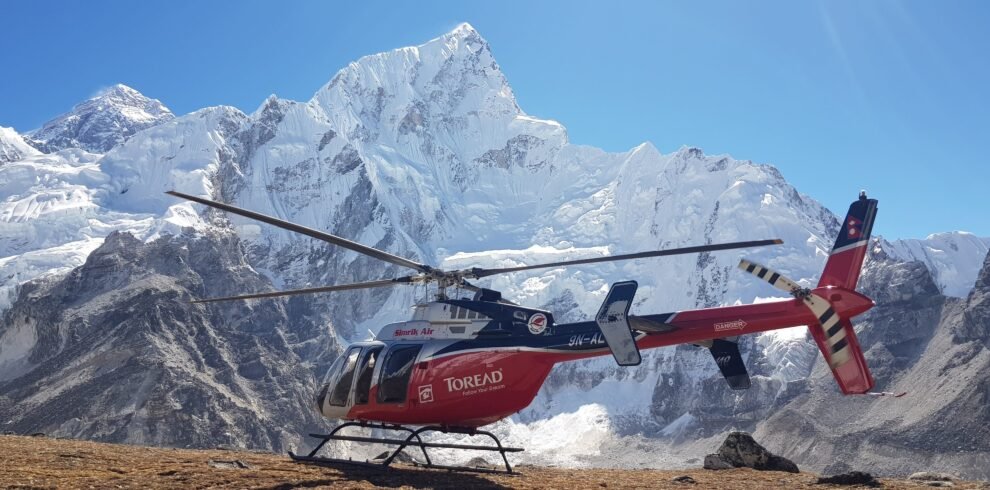
The Landing Tour (Recommended): This is the full experience. You fly from Kathmandu to Lukla for a brief fuel stop, then continue into the Khumbu region, landing at Kala Patthar (5,545m) for those iconic Everest photos right in front of the peak. After that, you fly to Hotel Everest View at Syangboche (3,880m) for a mountain breakfast with what is widely considered the best view of Everest from any hotel in the world. Then you fly back to Kathmandu. This is the version most people book and the one this guide focuses on.
The Flyover Only Option: We also offer a shorter flight that circles the Everest region without landing. It is cheaper, but it is not the same experience. Standing on the ground at Kala Patthar, looking up at that massive pyramid shaped peak, is what makes this trip memorable, so if you can, book the landing tour. If you would rather combine hiking with a helicopter exit, our Everest Base Camp trek with helicopter return pairs both experiences.
The helicopters used for these tours are specifically designed for extreme altitude. The Airbus H125 AS350 B3e is the industry standard, certified to fly above 7,000 meters. These are the same helicopters used for high altitude rescue missions, so you are in extremely capable aircraft.
Key Facts of Everest Heli Tour
| Feature | Detail |
|---|---|
| Total Duration | 4 to 5 hours (door to door from Kathmandu) |
| Total Flight Time | 2.5 to 3 hours |
| Maximum Altitude | 5,545 meters at Kala Patthar |
| Helicopter Type | Airbus H125 AS350 B3e (high altitude certified above 7,000m) |
| Group Size | 1 to 5 passengers per helicopter |
| Starting Point | Kathmandu, Nepal |
| Landing Stops | Lukla (refueling), Kala Patthar (Everest views), Hotel Everest View (breakfast) |
| Fitness Required | Minimal. Basic mobility to walk on uneven ground at altitude |
| Age Limit | Suitable for all ages, from children to seniors |
| Best Seasons | Spring (March to May) and Autumn (September to November) |
| Booking Window | 2 to 3 months recommended for peak season |
| Payment Option | No advance payment required. Pay on your flight day |
Why This Tour Beats the 12 Day Trek
I want to be honest here. The trek to Everest Base Camp is an incredible experience. If you have two weeks to spare and you love walking, it might be the right choice for you. But for the vast majority of travelers from the USA, UK, and Europe, the Everest helicopter tour is the smarter option. Here is why:
| Factor | Everest Helicopter Tour | Everest Base Camp Trek |
|---|---|---|
| Time Required | 4 to 5 hours | 12 to 14 days |
| Physical Demand | Minimal fitness needed | High. 6 to 8 hours walking daily |
| Training Required | None | Months of cardio and strength training recommended |
| Altitude Acclimatization | Not required (short exposure) | Essential. Several acclimatization days needed |
| Comfort Level | High. Heated helicopter, hotel breakfast | Basic teahouses, sleeping bags, shared facilities |
| Age Accessibility | Suitable for all ages | Best for ages 15 to 60 with good fitness |
| Cost for Two Weeks | One time tour fee | 14 days of food, lodging, permits, guide, porter |
| Weather Risk | One day to reschedule | Entire trek can be disrupted by weather |
| Views of Everest | Panoramic aerial views from all angles | Ground level views only from select points |
| Photography | 360 degree aerial shots, landing photos | Trail and viewpoint photos only |
The biggest advantage? Time. Most working professionals from America or Europe cannot take two or three weeks off for a trek. With the helicopter tour, you can have breakfast with a view of Everest and be back at your hotel in Kathmandu by early afternoon. That leaves the rest of your Nepal trip free for exploring Kathmandu’s temples, going on a jungle safari in Chitwan, or relaxing in lakeside Pokhara.
The second huge advantage is accessibility. You do not need to be an athlete. You do not need months of training. Seniors in their 70s, families with children, and people with physical limitations that would make trekking impossible can all enjoy this experience. As long as you can walk a short distance on rocky terrain at altitude for the Kala Patthar landing, you are good to go.
One more thing to consider. The trek takes you to Everest Base Camp, which is at about 5,364 meters. But the best view of Everest is not from base camp. It is from Kala Patthar, which is higher at 5,545 meters. The helicopter tour lands you right there, at the absolute best viewpoint. That is something even many trekkers miss because the Kala Patthar sunrise hike is an extra climb on an already exhausting trek.
Chapter 3: Best Time to Book Your Everest Helicopter Tour
Peak Seasons for Clear Views
Timing matters enormously for your Everest helicopter tour in Nepal. The Himalayas create their own weather patterns, and flying among the world’s tallest mountains requires clear skies and stable conditions. Luckily, Nepal has two distinct peak seasons that offer absolutely spectacular flying weather.
Spring Season (March to May)
Spring is the first peak window and it is genuinely beautiful. The weather warms up after winter, skies are predominantly clear, and something magical happens in the lower hills. The rhododendron forests burst into bloom, painting the hillsides in vivid shades of red, pink, and white as you fly out of Kathmandu. The visibility for mountain views is excellent, with long daylight hours giving operators flexibility in scheduling morning flights.
April and early May are particularly popular because the temperatures are comfortable and the chances of clear skies are at their highest during this window. This is also the pre monsoon period, so conditions tend to stay stable right up until late May.
Autumn Season (September to November)
If you ask any Nepal aviation expert or local pilot which season they prefer, most will tell you autumn is the winner. The monsoon rains have washed all the dust and haze out of the atmosphere, leaving behind crystal clear skies with visibility that can stretch for hundreds of kilometers. The air feels crisp and sharp. The mountain views on an autumn morning are simply unreal.
October is widely considered the single best month to book an Everest helicopter tour. The weather is at its most stable, the skies are at their clearest, and the chances of flight cancellation due to weather are at their lowest. If you have flexibility in your travel dates, aim for October. It is no coincidence that this is also the busiest month, so you will want to book well in advance.
November is also excellent, though temperatures start dropping toward the end of the month as winter approaches. September can be wonderful too, especially in late September after the monsoon has fully cleared, though there is a slightly higher chance of lingering cloud cover early in the month.
Off-Season Considerations
Winter (December to February)
Winter flying in the Everest region is absolutely possible and actually has some real advantages. The skies are often incredibly clear, sometimes even clearer than autumn. The mountains look spectacular with fresh snow covering the peaks. And here is the best part: you can often find discounts of 15% to 20% compared to peak season pricing.
The trade off? It is cold. Really cold. Temperatures at Kala Patthar can drop well below freezing, and the wind chill factor at 5,545 meters is no joke. But if you dress properly (we cover exactly what to wear in a later chapter), winter flights can be an amazing way to experience Everest with fewer crowds and lower prices.
The main risk in winter is not actually snow. It is morning fog and cloud buildup that can delay or cancel flights. But experienced operators monitor conditions closely and will reschedule to the next clear morning when needed.
Monsoon (June to August)
Do not book your Everest helicopter tour during monsoon season. The months of June, July, and August bring heavy rainfall, thick cloud cover, and unpredictable weather patterns to Nepal. Flight cancellations are frequent, and even when flights do go ahead, the cloud cover often obscures the mountain views that you are paying so much to see.
Visibility can drop to near zero. Safety standards mean pilots will not fly into cloud covered mountain valleys. Your odds of a successful flight drop dramatically during monsoon. If you are planning a Nepal trip during these months, schedule your helicopter tour for another time of year.
How Far in Advance to Book
This is one of the most common questions I get from travelers in America and Europe planning their Nepal trip. How early should you book your Everest helicopter tour booking from UK or the USA or Europe?
For Peak Season (March to May, September to November): I recommend booking 2 to 3 months ahead. October fills up fastest, sometimes 3 to 4 months in advance for specific dates. Spring season, especially April, also books up early. The demand is high and there are a limited number of helicopters and certified pilots available. Booking early also gives you more flexibility to choose your preferred date and secure better pricing.
For Winter (December to February): You have more flexibility. Booking 3 to 6 weeks ahead is usually sufficient, though earlier never hurts.
Last Minute Booking Options: Spontaneous travelers can take heart: we do accept last minute bookings in Kathmandu, sometimes even 24 to 48 hours in advance. This works because weather dependent flights often have natural gaps in the schedule. However, there are real risks with last minute booking. Your preferred date might be full. You might not get your first choice of operator. And during peak season, last minute availability is much harder to find.
If you are flying all the way from the USA, UK, or Europe specifically for this experience, I would not risk a last minute booking. Plan ahead, secure your spot, and travel with peace of mind knowing your Everest adventure is confirmed.
One final tip. Next Trip Nepal offers no advance payment booking, which means you can reserve your spot without sending money upfront and pay on arrival in Kathmandu. This is fantastic for international travelers because it eliminates concerns about overseas transfers and gives you flexibility if your travel plans change. We cover exactly how this works in the booking chapter coming up next.
Chapter 4: How to Book Everest Helicopter Tour from USA
So you are ready to book Everest helicopter tour from USA? Great choice. This is the adventure of a lifetime, and getting everything booked from the United States is actually simpler than you might think. Whether you are flying out of New York, Los Angeles, or anywhere in between, this section walks you through every step.
American travelers make up a large percentage of Everest helicopter tour guests each year. The process has been fine tuned over the years to be simple and fast.
Step by Step Booking Process from the USA
Booking your Everest helicopter tour from the United States follows a simple 4 step process:
Start by choosing your flight type. The first thing you need to decide is whether you want a shared group flight or a private charter. A shared flight means you join a group of up to 5 people, all booked directly through Next Trip Nepal. You split the cost, which makes it much more affordable. The downside? You have less flexibility with timing.
A private charter gives you the entire helicopter to yourself (and whoever you bring). You get full control over the schedule. You can spend more time at Everest Base Camp or Kala Patthar. This option costs more but is absolutely worth it if you are traveling with family or want the VIP experience.
Next, get in touch with Next Trip Nepal. WhatsApp is our primary communication tool. Save our number and send a message, and we reply within minutes during Nepal business hours (roughly 10 to 12 hours ahead of most US time zones), making it easy to book your Everest helicopter tour without any complicated portals or forms. You can also reach out via email or our website contact form, though WhatsApp is the fastest way to get answers. Our team speaks fluent English, so there is no language barrier for American travelers.
Then share a few details. Once you have picked your tour type and dates, we will ask for a few things:
- A copy of your passport (for permit processing)
- Your body weight (helicopters have strict weight limits for safety)
- Your preferred tour dates (always book 2 to 3 backup dates for weather flexibility)
- Hotel details in Kathmandu for pickup
That is it. No complicated forms. No lengthy paperwork.
Finally, confirm your booking with no money down. Next Trip Nepal offers a no advance payment option. You secure your booking and pay in cash on arrival in Kathmandu, which removes the stress of international wire transfers before your trip. If your travel plans change, you are not out any money.
Flights from USA to Kathmandu
Let us talk about getting there. There are no direct flights from any US city to Kathmandu, so flights to Kathmandu always require at least one connection, usually through the Middle East or Turkey.
Here is a breakdown of the best flight routes from major American cities:
| US City | Airline | Route | Total Flight Time | Notes |
|---|---|---|---|---|
| New York (JFK) | Qatar Airways | JFK to Doha to KTM | 18 to 22 hours | Most popular choice for East Coast |
| New York (JFK) | Turkish Airlines | JFK to Istanbul to KTM | 19 to 23 hours | Great alternative with Istanbul layover |
| Los Angeles (LAX) | Qatar Airways | LAX to Doha to KTM | 20 to 24 hours | Best West Coast option |
| Los Angeles (LAX) | Turkish Airlines | LAX to Istanbul to KTM | 21 to 25 hours | Slightly longer but often cheaper |
| San Francisco (SFO) | Qatar Airways | SFO to Doha to KTM | 20 to 24 hours | Good for Bay Area travelers |
| Chicago (ORD) | Qatar Airways | ORD to Doha to KTM | 19 to 23 hours | Midwest connection through Doha |
| Chicago (ORD) | Turkish Airlines | ORD to Istanbul to KTM | 20 to 24 hours | Alternative Middle East routing |
Pro tip: Book your international flights about 40 days (6 weeks) in advance for the best prices. Tuesday, Wednesday, and Saturday are typically the cheapest days to fly. Use Google Flights or Kayak to set price alerts and snag a deal.
One thing to keep in mind: Kathmandu is 10 hours ahead of New York. So when you land, you will feel that jet lag. Give yourself at least one full day in Kathmandu to rest before your helicopter tour. If you want to make good use of that day, our guide to the best day hikes near Kathmandu has some good short options. Trust me on this one. Flying straight into the Himalayas, exhausted, is not fun.
Currency and Payment from the USA
Here is some good news for American travelers: USD is accepted everywhere in Nepal. Seriously. You do not need to convert dollars into Nepalese Rupees before you go. Bring crisp, clean $100 and $50 bills and you are golden. Hotels, restaurants, and tour operators all happily take US dollars.
For your helicopter tour specifically, here are your payment options:
- Cash in USD. No conversion fees. No surcharges. This is what we prefer for USD payment.
- Credit cards (Visa, MasterCard, AmEx). Accepted, but expect a 3.5% to 4% surcharge on top of the tour price. That can add $50 to $100 or more, so factor that in.
- Wise (formerly TransferWise). This is hands down the best option for electronic payment. You get real exchange rates with tiny fees. Much better than a bank wire transfer.
Insider Tip: If you are booking in advance and want to send money electronically, use Wise instead of a bank wire. Your bank will charge $30 to $50 for an international wire and give you a terrible exchange rate. Wise saves you money on both ends.
Chapter 5: How to Book Everest Helicopter Tour from UK
British travelers have it easier than you might think when it comes to booking an Everest helicopter tour from UK. The flight time is shorter than from the US, the booking process is identical, and there are excellent flight options from London.
The UK to Nepal route has become incredibly popular over the last few years. In fact, roughly 30% of all Everest helicopter tour bookings through Next Trip Nepal come from London. There is a reason for that, and we will get into it below.
Step by Step Booking Process for UK Travelers
The booking process for British travelers is essentially the same as for Americans, with one key difference: currency conversion. Otherwise, the international booking process is identical.
Start by picking your tour and flight type. Decide between a shared group flight (more affordable, fixed schedule) or a private charter (full flexibility, higher cost). If you are traveling from the UK with friends or family, a private charter starts to make a lot of financial sense when you split it 4 or 5 ways.
Then reach out to us on WhatsApp. WhatsApp is our number one communication method for booking Everest helicopter tours from the UK. It is instant, free, and our team checks it constantly. Send a message, introduce yourself, and ask about availability for your dates. Most UK travelers get a reply within a few hours, even accounting for the time difference. Kathmandu is 5 hours and 45 minutes ahead of London, so when it is 9 AM in London, it is 2:45 PM in Kathmandu, which works out well for communication since morning messages from the UK tend to get answered during Nepal business hours.
Share your details and convert your currency. You will need the same documents: passport copy and body weight. We will quote you a price in USD, so you will want to convert that to GBP mentally (or use a quick Google check). As a rough guide, most Everest helicopter tours range from $1,000 to $5,000 depending on the package. So you are looking at roughly £800 to £4,000.
Confirm your booking without any money down. Like US travelers, UK visitors can take advantage of no advance payment booking with Next Trip Nepal. Lock in your dates, book your flights, and pay in cash when you arrive. No international transfers needed.
Flights from UK to Kathmandu
The flight from London to Kathmandu covers 4,553 miles. No airline flies direct, but the connections are well timed and comfortable. Here are your options:
| UK City | Airline | Route | Total Flight Time | Popularity |
|---|---|---|---|---|
| London Heathrow | Qatar Airways | LHR to Doha to KTM | 12 to 15 hours | Most popular (30% of all UK bookings) |
| London Heathrow | Turkish Airlines | LHR to Istanbul to KTM | 14 to 18 hours | n: left;”>Great alternative with Istanbul stopover |
| London Heathrow | Air India | LHR to Delhi to KTM | 14 to 16 hours | Budget friendly option |
| Manchester | Qatar Airways | MAN to Doha to KTM | 13 to 16 hours | Best for Northern England |
| Birmingham | Qatar Airways | BHX to Doha to KTM | 13 to 16 hours | Midlands connection |
Qatar Airways consistently wins here. The Doha connection is smooth, the Hamad International Airport is world class, and the total travel time is the shortest at 12 to 15 hours. Turkish Airlines is a solid second choice, especially if you want to break up the trip with a longer layover in Istanbul.
UK Traveler Tip: If you have time, plan a stopover in Doha or Istanbul on the way back. Both Qatar Airways and Turkish Airlines offer free or low cost stopover programs. Turn your Everest trip into a two destination holiday.
Currency and Payment from the UK
Paying for your Everest helicopter tour from UK requires a bit of currency awareness, but nothing complicated.
- Cash in USD. This is still the king. Bring US dollars with you from the UK, or pick some up at a bureau de change before departure. Most operators price in USD, so paying in dollars means zero conversion confusion.
- Bank transfer from UK banks. Possible, but your bank will charge you £15 to £30 for an international transfer and give you a poor exchange rate. Not recommended unless you have no other option.
- Credit cards. Visa and MasterCard are widely accepted. Remember that 3.5% to 4% surcharge though. On a £3,000 tour, that is an extra £105 to £120.
- Wise (TransferWise). This is the best electronic option for UK travelers. You get the real mid market exchange rate, the fee is tiny (usually under 1%), and the transfer is fast. If you want to pay electronically, use Wise. Full stop.
Money Saving Tip: Do not convert GBP to NPR (Nepalese Rupees) before your trip. Convert GBP to USD instead, or just use your Monzo or Starling card in Nepal. Those cards offer great exchange rates with no foreign transaction fees.
Planning your Everest Helicopter Tour?
Chapter 6: How to Book Everest Helicopter Tour from Europe
European adventurers are flocking to Nepal in record numbers, and the Everest helicopter tour Europe market has exploded. Whether you are flying out of Paris, Frankfurt, Amsterdam, Rome, or Munich, booking a Nepal helicopter tour from Europe is straightforward and well supported by operators.
One of the biggest advantages for European travelers? Most major operators now offer multi language support. While English is universally spoken, you can often find support in French, German, Spanish, and Italian. This makes the booking process feel a lot more comfortable if English is not your first language.
Step-by-Step Booking Process for European Travelers
Start by choosing your package. Most of our team is comfortable in English, and we can often arrange support in French, German, Spanish, or Italian on request. Pick between a shared flight or private charter. If you are traveling as a group of 4 or 5, the private option often works out to a similar per person price as a shared flight.
Then contact us on WhatsApp for the fastest response.
Just like travelers from the USA and UK, Europeans should use WhatsApp as the primary booking tool. It is fast, free, and works well across time zones. From Central Europe, Kathmandu is about 4 hours and 45 minutes ahead, and from Western Europe it is 5 hours and 45 minutes ahead. That is not a big gap, and we respond quickly regardless.
Prepare your documents. You will need:
- Passport copy (Schengen travelers use the same visa on arrival process as everyone else)
- Accurate body weight
- Preferred tour dates (always provide 2 to 3 alternatives for weather)
- Kathmandu hotel information for pickup arrangements
Book with full flexibility. European travelers can also access the no advance payment booking option. This is a huge advantage. You do not need to send money across borders before your trip. Just confirm your spot, show up in Kathmandu, and pay in cash.
For European travelers, booking 24 to 48 hours in advance of your preferred tour date is the sweet spot. This gives the operator time to arrange permits while keeping the booking fresh enough to account for weather.
Flights from Europe to Kathmandu
Europe has excellent connectivity to Kathmandu through the Middle East. Here are the top routes:
| European City | Airline | Route | Total Flight Time | Notes |
|---|---|---|---|---|
| Paris (CDG) | Qatar Airways | CDG to Doha to KTM | 13 to 16 hours | Best for France, Belgium, Switzerland |
| Frankfurt (FRA) | Qatar Airways | FRA to Doha to KTM | 13 to 16 hours | Ideal for Germany and Central Europe |
| Amsterdam (AMS) | Qatar Airways | AMS to Doha to KTM | 13 to 16 hours | Great for Netherlands and Northern Europe |
| Munich (MUC) | Turkish Airlines | MUC to Istanbul to KTM | 14 to 17 hours | Alternative routing via Istanbul |
| Rome (FCO) | Turkish Airlines | FCO to Istanbul to KTM | 14 to 17 hours | Best for Italy and Southern Europe |
| Zurich (ZRH) | Qatar Airways | ZRH to Doha to KTM | 13 to 16 hours | Premium option for Swiss travelers |
| Madrid (MAD) | Qatar Airways | MAD to Doha to KTM | 14 to 17 hours | Best for Spain and Portugal |
Qatar Airways dominates the European market for Nepal travel, just like they do from the UK and USA. Their Doha hub connects beautifully with almost every major European city. Turkish Airlines is a strong alternative, particularly for travelers from Germany, Austria, Italy, and Eastern Europe.
Flight times from Europe range from 13 to 17 hours total, which is quite reasonable for a trip to the Himalayas. Much better than the 20+ hours required from the US West Coast.
Currency and Payment from Europe
For European travelers, payment requires one extra step: converting your Euros to USD. Here is how to handle it:
- Cash in USD. Same advice as UK and US travelers. Bring US dollars. They are accepted everywhere in Nepal, including by all helicopter tour operators. Exchange some EUR to USD before you leave Europe, or withdraw USD from select ATMs in Kathmandu.
- Credit cards (Visa, MasterCard). Accepted by most operators with the standard 3.5% to 4% surcharge. Your card will handle the EUR to USD conversion automatically. Just make sure you have a card with no foreign transaction fees.
- SEPA transfer. Some European operators accept SEPA bank transfers if you book through a European based reseller. Direct SEPA to Nepal is not common, so check with your operator first.
- Wise (TransferWise). Again, this is your best electronic option. Wise supports EUR to USD transfers with excellent rates and low fees. Much better than a traditional bank wire.
- PayPal. Available with some operators. Ask when you book.
European Traveler Tip: If you are from a Eurozone country, the EUR to USD conversion is straightforward. At current rates, factor in roughly a 1.08 to 1.10 conversion rate. A $4,000 private helicopter tour works out to approximately €3,600 to €3,700. Always check the live rate before budgeting.
One more thing worth noting for European travelers: the Nepal visa on arrival process is identical whether you hold a Schengen passport, a UK passport, or a US passport. Fill out the online form before arrival, bring a passport photo, pay $30 for 15 days or $50 for 30 days, and you are in. No embassy visits required. No pre approved visas. The whole process takes about 15 minutes at Tribhuvan International Airport.
No matter where in Europe you are flying from, booking an Everest helicopter tour from Europe has never been easier. Great flight connections, flexible payment options, and simple visa rules mean you can focus on what really matters: getting airborne and seeing Mount Everest with your own eyes.
Planning your Everest Helicopter Tour?
Chapter 7: Why Book Your Everest Helicopter Tour with Next Trip Nepal
Choosing who to trust with your Everest helicopter tour is one of the most important decisions you will make when planning your Himalayan adventure. Your safety, your money, and your once-in-a-lifetime experience all depend on it. Here is exactly why Next Trip Nepal is the right choice for travelers booking from the USA, UK, and Europe.
CAAN Certified and Fully Licensed
Next Trip Nepal is a CAAN-certified helicopter tour operator, meaning we meet every safety standard set by the Civil Aviation Authority of Nepal for aircraft maintenance, pilot qualification, and flight operations. Our pilots have thousands of hours of high-altitude flying experience in the Himalayas, and every flight follows strict weather protocols. Before you book with anyone, always confirm CAAN certification. We are happy to provide proof upon request.
Zero Deposit, Pay on Flight Day
This is what sets Next Trip Nepal apart from almost everyone else in the industry: you pay nothing until the morning of your flight. You confirm your booking, receive instant confirmation, and your seat is held with no deposit and no upfront payment. Your money stays in your account until you are literally standing at the helipad ready to fly. We cover exactly how this works in the next chapter.
If you join a shared group flight, every passenger in your group is booked directly through Next Trip Nepal. We organize, confirm, and manage the entire group ourselves from start to finish, so there is no confusion about who is responsible for your booking, your itinerary, or your crew on the day. Our shared flights typically range from 1,200 to 1,400 USD per person, competitive with the best rates in the industry.
Years of Experience with International Travelers
We have helped hundreds of travelers from the United States, the United Kingdom, and across Europe experience Mount Everest from the air. Our team understands the needs of international visitors, speaks fluent English, and responds quickly on WhatsApp. We handle all permits, airport transfers, and logistics so you can focus entirely on enjoying the experience.
How to Evaluate Any Helicopter Tour Company (Including Us)
Before booking with anyone, here is a practical checklist worth running through:
Verify CAAN Certification
Always confirm that your chosen operator is certified by the Civil Aviation Authority of Nepal (CAAN). This certification means the company meets Nepal’s official safety standards for helicopter operations, pilot qualifications, and aircraft maintenance. Any reputable company will display this certification proudly. If they cannot or will not provide proof, walk away.
Read Recent Reviews on TripAdvisor and Google
For a deeper look at what can go wrong at altitude and how reputable operators handle it, our Everest Base Camp safety guide covers the same ground in more detail.
Ratings matter, but the content of reviews matters more. Do not just look at the star rating. Read what recent travelers are actually saying. Look for comments about punctuality, pilot professionalism, aircraft condition, weather communication, and how the company handled delays or cancellations. Reviews from travelers who booked from the USA, UK, or Europe are especially relevant because they reflect the experience of someone in your exact situation.
Verify Booking Policy and Cancellation Terms
Before you send a single dollar (or pound, or euro), understand exactly what happens if you need to cancel or postpone. Ask these specific questions:
- What percentage deposit is required, and is it refundable?
- What is the cancellation deadline for a full or partial refund?
- Can you postpone your flight if weather is bad, and for how long?
- What payment methods do they accept from international clients?
- Will they provide a written confirmation and receipt?
Next Trip Nepal eliminates most of these concerns with our no deposit policy. You pay nothing upfront, so there is nothing to lose if your plans change.
Pro Tip from the Field: Book your Everest helicopter tour at least 2 to 3 weeks in advance during peak seasons (March to May and September to November). The best flights fill up quickly, and last minute availability is never guaranteed. If you want a private charter, book at least 4 to 6 weeks ahead.
Chapter 8: Complete Pricing Breakdown for 2026 and 2027
Let us talk numbers. One of the most common questions I get from travelers planning their trip from the USA, UK, and Europe is: “How much does an Everest helicopter tour actually cost?” The answer depends on several factors, including whether you join a shared group flight or book a private charter, what time of year you visit, and which additional fees apply.
In this chapter, I will give you the complete Everest helicopter tour cost breakdown for 2026 and 2027, including all the extra fees that most websites conveniently forget to mention until checkout. By the end, you will know exactly what to budget for your once in a lifetime flight to Everest Base Camp.
Shared flights are the most popular and affordable way to experience the Everest helicopter tour. You will be grouped with other travelers (usually 4 to 5 passengers total) to split the cost of the helicopter. Every passenger in your group is booked directly through Next Trip Nepal, so your flight, itinerary, and crew are organized entirely by our own team rather than pooled together across different agencies. Here is how pricing typically breaks down based on group size.
| Group Size | Price Per Person (2026) | Price Per Person (2027)* | Notes |
|---|---|---|---|
| 1 passenger (waiting to join group) | 1,350 to 1,395 USD | 1,420 to 1,470 USD | Must wait until group fills; may pay premium for single spot |
| 2 passengers booking together | 1,300 to 1,350 USD | 1,365 to 1,420 USD | Better rate than solo; faster confirmation |
| 3 passengers booking together | 1,280 to 1,320 USD | 1,345 to 1,390 USD | Good balance of price and flexibility |
| 4 passengers (full group booking) | 1,240 to 1,280 USD | 1,300 to 1,345 USD | Best shared rate; equivalent to half a private charter |
| 5 passengers (maximum capacity) | 1,200 to 1,240 USD | 1,260 to 1,300 USD | Lowest per person price for shared flights |
*2027 prices reflect a projected 5 to 8% increase due to rising aviation fuel costs, permit fee adjustments, and inflation in Nepal’s tourism sector.
The average Everest helicopter tour price for shared group joining flights in 2026 falls between 1,240 and 1,395 USD per person. If you are flexible on dates and willing to join a group of strangers (who will likely become friends by the end of the flight), this is your most budget friendly option.
Most operators need a minimum of 4 to 5 passengers to confirm a shared flight. If you book as a solo traveler or pair, you may need to wait until the remaining seats fill up. Some companies offer guaranteed departure options at a slightly higher rate if you do not want to wait.
Private Charter Prices
Want the helicopter all to yourself? A private Everest helicopter tour charter gives you complete control over the schedule, more time at each stop, and an intimate experience with your chosen group. This is the option I recommend for families, honeymooners, photographers who need extra time for shots, or anyone celebrating a special occasion.
| Charter Type | Total Price (2026) | Total Price (2027)* | Passengers | Cost Per Person (Divided) |
|---|---|---|---|---|
| Standard private charter | 5,800 to 6,000 USD | 6,100 to 6,380 USD | Up to 5 | 1,160 to 1,200 USD (5 pax) |
| Premium private charter | 6,000 to 6,500 USD | 6,300 to 6,800 USD | Up to 5 | 1,200 to 1,300 USD (5 pax) |
| Luxury extended charter | 6,500+ USD | 6,800+ USD | Up to 5 | 1,300+ USD (5 pax) |
*2027 prices estimated with 5 to 8% annual increase.
If you have a group of 4 or 5 people, the private charter cost per person can actually be comparable to or even cheaper than shared flights. For example, a 5,800 USD private charter split 5 ways comes to just 1,160 USD per person. That is less than many operators charge for shared flights. If you are traveling with family or a group of friends, crunch these numbers. You might be surprised.
Private charters also offer flexibility that shared flights cannot match. Want to spend an extra 15 minutes hovering near Everest Base Camp for photos? No problem. Want to adjust the landing sequence based on weather? Your call. The helicopter is yours for the duration of the tour.
Additional Costs You Need to Budget For
Many travelers get caught off guard here, because the quoted Everest helicopter tour price almost never includes all the costs you will actually incur. Here are the additional fees you should factor into your budget.
| Cost Item | Price (USD) | Required? | Notes |
|---|---|---|---|
| Sagarmatha National Park Entry Permit | 23 to 30 USD | Yes | Mandatory for all visitors to the Everest region; arranged by most operators |
| Khumbu Pasang Lhamu Municipality Fee | 15 to 25 USD | Yes | Local municipality entrance fee; supports regional infrastructure |
| Airport Tax (Domestic) | 4 to 8 USD | Yes | Charged at Kathmandu domestic airport departure |
| Breakfast at Hotel Everest View | 31 to 50 USD | Optional but recommended | Buffet breakfast at the world’s highest hotel with panoramic mountain views |
| Tips for Pilot and Ground Crew | 10 to 20 USD | Optional (but appreciated) | Standard tipping range; bring small USD bills or Nepali rupees |
| Travel Insurance (helicopter coverage) | 50 to 150 USD | Highly recommended | Ensure policy covers helicopter evacuation and high altitude activities |
| Photography/Video Services | 100 to 300 USD | Optional | Some operators offer professional photo packages |
Total additional costs range from 73 to 113 USD per person for the mandatory and recommended items (permits, fees, airport tax, breakfast, and tips). This does not include travel insurance, which varies by provider and coverage level.
That breakfast at Hotel Everest View? It costs 31 to 50 USD, which is expensive for a meal in Nepal. But you are sitting at 3,880 meters with uninterrupted views of Everest, Lhotse, Ama Dablam, and Thamserku spread out before you while you eat fresh pancakes and drink hot coffee. It is worth every single dollar. Skip the breakfast only if you are truly on a bare bones budget.
Total Budget Calculator: What Will Your Everest Helicopter Tour Actually Cost?
Here is the realistic total budget you should plan for, depending on your travel style.
| Budget Level | Shared Flight Total (Per Person) | Private Charter Total (Per Person) | What It Includes |
|---|---|---|---|
| Minimum Budget | 1,350 USD | N/A | Shared flight at lowest rate (1,200 USD) + all mandatory fees (73 USD) + basic breakfast (31 USD) + tips (10 USD) + airport tax (4 USD). No frills, no extras. |
| Comfortable Mid Range Budget | 1,450 to 1,550 USD | 1,350 to 1,500 USD (5 pax) | Shared flight at average rate (1,300 USD) + all fees (113 USD) + Hotel Everest View breakfast (50 USD) + crew tips (20 USD). The sweet spot for most travelers. |
| Premium Experience Budget | 1,600 to 1,750 USD | 1,500 to 1,700 USD (4 to 5 pax) | Higher end shared or private charter + all fees + upgraded breakfast + travel insurance + comfortable buffer for unexpected costs. |
| Luxury Private Experience | N/A | 6,000 to 6,500 USD (total helicopter) | Full private charter + premium add ons + extended flight time + VIP ground handling. Cost per person drops significantly with 4 to 5 passengers. |
For the vast majority of travelers booking an Everest helicopter tour from the USA, UK, or Europe, I recommend budgeting around 1,450 USD per person for a shared flight experience. This gives you a comfortable buffer above the base flight price and covers all the fees, breakfast, and tips without worrying about every dollar.
If you are traveling with a group of 4 or 5, seriously consider the private charter option. At roughly 1,160 to 1,300 USD per person when split 5 ways, you get the entire helicopter to yourselves, complete schedule flexibility, and a more intimate experience. The math works surprisingly well in your favor.
2027 Price Outlook: Should You Book Now or Wait?
The Everest helicopter tour cost is not going down. Based on industry trends and conversations with operators, I expect prices to rise by 5 to 8% in 2027. Here is what that looks like in real numbers:
- Shared flights: 1,300 to 1,380 USD per person (up from 1,240 to 1,395 USD in 2026)
- Private charters: 6,200 to 6,800 USD per helicopter (up from 5,800 to 6,500 USD in 2026)
The reasons are straightforward. Aviation fuel prices continue to climb globally. Nepal’s tourism infrastructure is expanding, which means higher operational costs. Permit fees and municipal charges get adjusted periodically. And demand keeps growing as more travelers from Europe and North America add Everest helicopter tours to their bucket lists.
My advice? If you are planning a 2027 trip and find a good operator with a fair cancellation policy, book in late 2026 to lock in current pricing. Some operators honor the price at the time of booking even if rates increase before your travel date. It never hurts to ask.
Money Saving Insider Tip: If you are flexible with dates, consider booking for late November or early December. This is technically the “shoulder season” after the main October rush. You will often find slightly lower prices, fewer crowds at Hotel Everest View, and crystal clear winter visibility that rivals the peak months. Just pack an extra layer. It is colder up there.
Now that you know why Next Trip Nepal is the right choice and what your Everest helicopter tour will cost, it is time to dive into the most exciting part: what you will actually see and experience on flight day. Get ready, because the next chapter is going to have you counting down the days until takeoff.
Chapter 9: Booking Policy: No Advance Payment Required
One of the biggest worries travelers face when booking an international adventure is the financial commitment. What happens if your plans change? What if the weather turns bad and your flight gets cancelled? Will you lose your deposit?
Next Trip Nepal offers something truly rare in the adventure tourism industry: a no advance payment booking policy for Everest helicopter tours. You can book your Everest helicopter tour today and pay on the day of your flight. No deposit. No money transferred upfront. No financial risk.
How the Next Trip Nepal Flexible Booking Policy Works
The concept is refreshingly simple. Most tour operators demand a chunk of money weeks or even months before your flight. Next Trip Nepal flipped that model on its head.
The process is simple. Reach out on WhatsApp with your travel dates and group size, receive instant confirmation with a booking reference and your date held, then pay the full amount on your flight day before boarding, either in cash or by card.
That is it. There are no wire transfers to arrange from your home country, no credit card charges to worry about, and no deposit forms to fill out. Your spot is held, and you only hand over payment when you are literally standing at the airport ready to fly.
This flexible booking approach is perfect for travelers flying from the USA, UK, and Europe who often deal with unpredictable work schedules, visa processing delays, or simply want to keep their travel plans flexible.
Why No Advance Payment Benefits You
The zero deposit policy is not just convenient. It genuinely protects you in several important ways:
Protection against weather cancellations. Mountain weather is famously unpredictable. Dense fog, high winds, or sudden storms can ground helicopters for hours or even days. With no money paid upfront, you are not fighting to get a refund if Mother Nature says no. Your funds stay safely in your pocket until the conditions are right.
Flexibility for travel plan changes. Maybe your boss moved a meeting. Maybe your connecting flight got rescheduled. Perhaps you decided to spend a few extra days in Pokhara. Whatever the reason, your Everest helicopter tour booking policy here means you can adjust dates without penalty or stress.
No deposit loss risk. If life throws you a curveball and you cannot make the trip at all, you walk away without losing a single dollar. There is no deposit to forfeit. No cancellation fee to swallow. Your financial exposure is exactly zero.
Peace of mind from the moment you book. Knowing your booking is secure yet your money is not tied up allows you to plan the rest of your Nepal itinerary with total freedom. That mental freedom is priceless when organizing a complex multi country trip.
The Industry Standard vs. Next Trip Nepal
To fully appreciate how rare a genuine no advance payment policy is, it helps to understand how most of the industry works. Deposit requirements across Nepal’s helicopter tour operators typically range from 10% to 50% of the total cost, paid weeks or months before your flight. On a tour costing 1,200 to 5,000+ USD, that can mean sending 300 to 2,500 USD upfront to a company on the other side of the world, often with no refund if you need to cancel within a certain window, and sometimes additional cancellation fees on top of that.
Next Trip Nepal takes a different approach: 0% deposit, pay on flight day only. The book Everest helicopter tour and pay later approach removes every one of these headaches. You are not sending money abroad months in advance and hoping everything works out. You confirm your date, and you pay when you are standing at the airport ready to fly.
How to Secure Your Booking Without a Deposit
Getting your spot locked in takes less than ten minutes. Send a WhatsApp message to Next Trip Nepal with your name, preferred flight date, number of passengers, and whether you want a private charter or shared flight. You will receive your booking confirmation within minutes, complete with a unique reference number, your flight date, and a detailed itinerary, and your date is officially held. On the day itself, you simply show up at Tribhuvan International Airport, meet your crew, and complete payment before boarding.
You can pay in US dollars, euros, or Nepalese rupees. Both cash and major credit cards are accepted. A WhatsApp confirmation is all the security you need. There are no contracts to sign, no forms to scan, no international wire fees to pay.
For travelers from the USA, UK, and Europe, this low risk booking method is a game changer. You can plan your Everest helicopter tour months in advance without tying up your travel budget or worrying about exchange rates, transfer fees, or refund timelines.
Chapter 10: What Is Included and Not Included
Before you book any adventure tour, you need to know exactly what you are paying for. Nobody likes surprise costs that blow up a carefully planned budget. This chapter breaks down every single item included in your Everest helicopter tour package, plus the extra costs you should plan for separately.
Standard Inclusions in Your Everest Helicopter Tour Package
Here is the complete list of what is included when you book with Next Trip Nepal:
| Item | Included | Details |
|---|---|---|
| Hotel pickup and drop off in Kathmandu | Yes | Private vehicle transfers from your hotel to the airport and back |
| Round trip helicopter flight | Yes | Kathmandu to Everest region and return, approximately 4 hours total |
| Scenic flyover of Everest Base Camp | Yes | Aerial views of Base Camp, Khumbu Glacier, and surrounding peaks |
| Landing at Kala Patthar (5,545m) | Yes | 10 to 15 minutes on the ground for photos at this iconic viewpoint |
| Landing at Hotel Everest View | Yes | 40 to 60 minutes for breakfast with panoramic mountain views at 3,880m |
| Emergency oxygen cylinder | Yes | Available on board for safety at extreme altitude |
| Aviation and passenger insurance | Yes | Covers all passengers during the flight |
| All government taxes | Yes | Includes 13% VAT and applicable airport taxes |
| Airport transfers | Yes | Ground transport between terminal and helipad |
That is a solid list of inclusions. Your Everest helicopter tour included package covers all the essential elements: transport, flight time, both landings, safety equipment, insurance, and taxes. When you pay your tour price, you are getting the full experience without hidden add ons for the core services.
The landing at Kala Patthar at 5,545 meters is the absolute highlight. You step out of the helicopter onto a rocky ridge with the entire Himalayan range stretching before you. Mount Everest, Lhotse, Nuptse, and Pumori rise in every direction. The air is thin and cold, but the view is worth every second.
The second landing at Hotel Everest View at 3,880 meters gives you time to warm up, enjoy breakfast, and soak in the scenery from the highest placed hotel in the world. The terrace overlooks Ama Dablam, Thamserku, and Everest herself. It is the kind of dining experience no Michelin starred restaurant can compete with.
Exclusions You Should Know About
While the core package covers a lot, there are several costs that are not included. These are standard across the industry, and every traveler needs to budget for them separately. Here is the full breakdown:
| Item | Cost | Notes |
|---|---|---|
| Nepal visa fee | $30 to $125 | Depends on duration: 15 days ($30), 30 days ($50), or 90 days ($125). Available on arrival at Kathmandu airport |
| International flights to Kathmandu | Varies | Round trip flights from USA/UK/Europe typically $800 to $1,800 depending on season and origin city |
| Hotel accommodation in Kathmandu | $15 to $300/night | Budget guesthouses to luxury hotels. Thamel area has options for every budget |
| Travel insurance | $50 to $200 | Must cover helicopter evacuation and high altitude activities. Not the same as aviation insurance |
| Breakfast at Hotel Everest View | $31 to $50 | Paid directly to the hotel. Optional but highly recommended |
| Sagarmatha National Park permit | $23 to $30 | Required for all visitors entering the Everest region |
| Khumbu municipality fee | $15 to $25 | Local entry fee supporting community infrastructure |
| Airport tax | $4 to $8 | Small domestic departure tax at Kathmandu airport |
| Personal expenses and tips | Varies | Souvenirs, snacks, crew tips (customary but not required) |
Let us talk through the most important of these Everest helicopter tour hidden costs so you can plan accurately.
The Nepal visa is the first thing you will pay for when landing at Tribhuvan International Airport. Most travelers from the USA, UK, and Europe opt for the 30 day tourist visa at $50. Bring crisp US dollars in exact change. The visa on arrival process is simple, but having passport sized photos ready speeds things up.
Your Kathmandu hotel is another essential cost. The good news is that Kathmandu offers incredible value. Clean, comfortable guesthouses in Thamel start around $15 to $25 per night. Mid range hotels with breakfast included run $40 to $80. If you want luxury, the Dwarika’s Hotel and Hyatt Regency offer five star comfort for $150 to $300 per night. Most travelers spend 2 to 3 nights in Kathmandu before and after their helicopter tour.
Travel insurance is absolutely non negotiable. Your package includes aviation insurance that covers accidents during the helicopter flight itself. But you also need full travel insurance that covers medical evacuation, trip cancellation, and activities at high altitude. Make sure your policy explicitly covers helicopter tours and altitudes above 5,000 meters. Providers such as World Nomads, SafetyWing, and IMG offer policies designed specifically for adventure travel in Nepal. Budget $80 to $150 for a solid two week policy.
The permits (Sagarmatha National Park and Khumbu municipality) total approximately $40 to $55 combined. These are required by law and your tour operator will help arrange them. They are not included in the base price because not every passenger needs them in exactly the same way, depending on the specific flight routing.
Breakfast at Hotel Everest View costs $31 to $50 and is technically optional. You could sit inside and skip the meal. But honestly, breakfast on that terrace with Mount Everest staring back at you is one of the most memorable meals you will ever eat. Factor this into your budget. It is worth every cent.
Your Complete Budget at a Glance
For a traveler from the USA, UK, or Europe planning a standard Everest helicopter tour, here is what your total trip budget might look like in addition to the core tour price:
- Nepal visa: $50
- Travel insurance: $100
- Kathmandu hotel (2 nights at $50/night): $100
- Permits and fees: $50
- Breakfast at Hotel Everest View: $40
- Tips and personal expenses: $50
That adds approximately $390 to your core tour cost. Flights to Kathmandu are extra and vary wildly based on your departure city and booking timing.
Chapter 11: Complete Hour by Hour Everest Helicopter Tour Itinerary
So you have booked your Everest helicopter tour and now you are wondering what the actual day looks like. This chapter walks you through every single hour from the moment your alarm goes off in Kathmandu to the moment you are back at your hotel with a camera full of once in a lifetime photos.
Knowing your Everest helicopter tour day schedule helps you prepare mentally and practically. There are no surprises, just pure excitement building hour by hour.
Before Dawn: The Early Morning Pickup
5:00 to 5:30 AM: Hotel Pickup in Private Vehicle
Your day begins before the sun even thinks about rising over Kathmandu. At around 5:00 AM, a private vehicle will arrive at your hotel to collect you. Most operators use comfortable cars or small vans depending on your group size. The streets of Kathmandu at this hour are wonderfully quiet. The usual honking and bustling energy of the city has faded, replaced by a peaceful stillness that feels almost magical.
You will want to have your camera bag ready, your passport accessible, and layers of warm clothing already on. Do not make the mistake of dressing for Kathmandu weather. By the end of this morning, you will be standing at 5,545 meters above sea level where temperatures regularly drop to -10 degrees Celsius or colder. Dress like you are heading to the Arctic, not to a subtropical city.
Your driver knows the route to Kathmandu’s domestic airport well. The transfer takes roughly 20 to 30 minutes depending on where your hotel is located. Use this time to mentally prepare. Sip some water. Take a few deep breaths. Today is the day you will see Mount Everest with your own eyes.
At the Airport: Check In and Pre Flight Preparation
5:30 to 6:00 AM: Arrival at Kathmandu’s Domestic Terminal
You will arrive at Tribhuvan International Airport’s domestic terminal, a smaller and far less chaotic building than the international section you likely passed through on arrival in Nepal. Your tour coordinator will be waiting for you near the entrance, typically holding a sign with your name or your tour company logo.
This is where the adrenaline really starts to kick in. The coordinator will guide you through the check in process, verify your passport details, and collect any remaining documentation. Security screening at the domestic terminal is straightforward and much quicker than international standards. Keep your passport handy and your camera equipment accessible.
The early morning atmosphere inside the terminal is electric with anticipation. You will see fellow travelers, trekkers heading to Lukla for their multi day walks to Everest Base Camp, and other helicopter passengers just like you. Everyone shares the same excited energy. Everyone is about to experience something extraordinary.
6:00 to 6:45 AM: Pre Flight Safety Briefing
Once you are through security, your pilot and ground crew will gather your group for the mandatory pre flight safety briefing. This is not a box ticking exercise. Pay close attention because the information could save your life at extreme altitude.
The briefing covers several critical topics. You will learn about helicopter safety protocols, emergency procedures, and how to use the supplemental oxygen system that is on board. The crew will conduct a weight check and assign seating positions in the helicopter based on passenger weights. This weight distribution is essential for safe flying in the thin mountain air.
Your pilot will also explain what to expect during the flight, the route you will follow, and the altitudes you will reach. Feel free to ask questions here. Good pilots love engaged passengers who want to understand the adventure ahead. They will also explain what to do if you feel symptoms of altitude sickness during the Kala Patthar landing.
By the end of the briefing, the sun will just be starting to color the eastern sky. It is almost time to fly.
The Flight Experience: Every Leg of the Adventure
6:45 to 7:15 AM: Kathmandu to Lukla Flight
Your helicopter lifts off from Kathmandu and immediately the magic begins. The city falls away beneath you as you climb over the Kathmandu Valley, surrounded by terraced hillsides and traditional villages that look impossibly small from above. The morning light hitting the valley creates a golden glow that photographers dream about.
This first leg takes approximately 45 minutes and covers the distance from Kathmandu’s urban sprawl to the legendary Tenzing Hillary Airport at Lukla. As you fly eastward, the scenery transforms dramatically. The gentle green hills of the midlands give way to steeper terrain. The air gets crisper. You can feel the helicopter working harder as the altitude increases.
Keep your camera ready but also take moments to simply look out the window and absorb what you are seeing. This is not a flight to zone out on. Every minute brings new scenery, a new perspective, a new reason to smile.
7:15 to 7:45 AM: Lukla Landing and Refueling
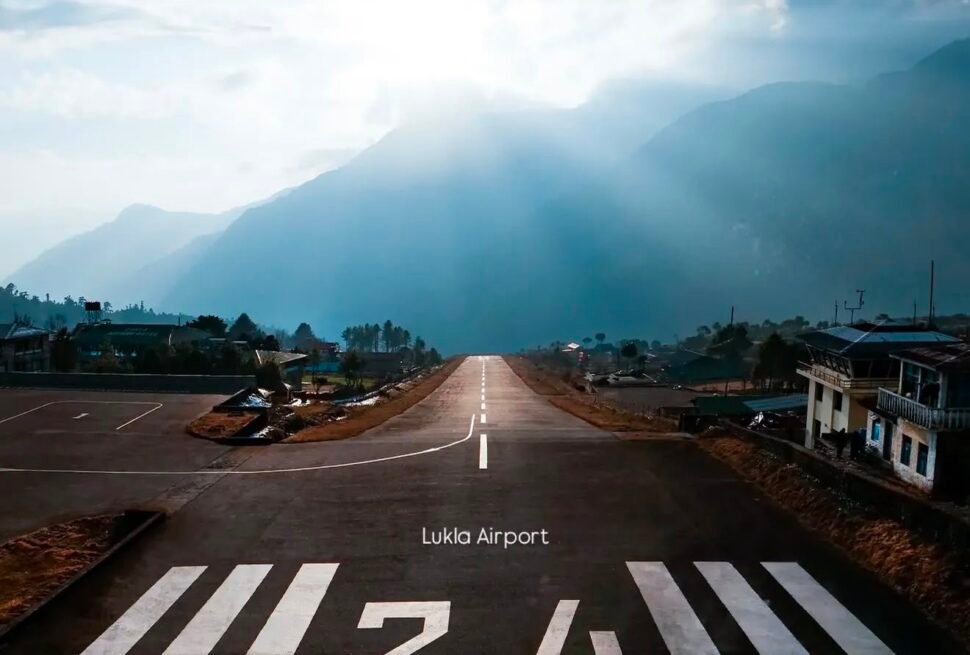
Your helicopter touches down at Tenzing Hillary Airport, widely regarded as the most exciting airport in the world. The runway here is just 527 meters long, sloped at a dramatic 12 degree angle, and perched on the edge of a cliff at 2,840 meters elevation. Watching your pilot nail this landing will give you enormous confidence in their skill.
During the 30 minute stop, the ground crew refuels the helicopter while passengers can stretch their legs, use the restroom facilities, and soak in the mountain atmosphere. Lukla is the gateway to the Everest region, and you will see trekkers arriving and departing, porters carrying impossibly heavy loads, and the general buzz of Himalayan adventure.
The surrounding peaks feel close enough to touch here. Look up and you will already see impressive mountains framing the airport. This is just a preview of what is coming.
7:45 to 8:15 AM: Lukla to Everest Region Over Namche Bazaar
Back in the air, and now things get serious. This leg takes you deep into the heart of the Khumbu region, flying over some of the most spectacular terrain on our planet. You will pass directly over Namche Bazaar, the famous Sherpa capital that sits in a natural amphitheater at 3,440 meters.
From above, Namche looks like a cluster of colorful buildings clinging to a hillside bowl. You will spot the famous Saturday market area, the numerous tea houses and lodges, and the trails that radiate outward toward Everest Base Camp. Seeing Namche from the air gives you a perspective that trekkers on the ground simply cannot match.
Beyond Namche, the terrain becomes progressively more dramatic. The valleys narrow. The mountains grow taller and more imposing. The glaciers begin to appear, ribbons of ice winding down between the peaks. Your pilot will likely be pointing out landmarks and peaks through your headset. Do not be shy about asking for identifications if you are not sure what you are looking at.
8:15 to 8:30 AM: Pheriche Shuttle for Weight Management
For groups of three or more passengers, a shuttle stop at Pheriche is typically required. This is a standard weight management procedure, not something to worry about. At these extreme altitudes, helicopters have strict payload limits, and splitting groups ensures safe operations.
Pheriche sits at 4,371 meters and offers stunning views in its own right. If you do make this stop, enjoy the crisp air and the dramatic surroundings. You are now well above the tree line, and the terrain has transformed into a rugged, high altitude wilderness of rock, ice, and sky.
If you are flying in a smaller group, you may skip this step and proceed directly to Kala Patthar. Either way, the main event is just minutes away.
The Main Event: Kala Patthar Landing
8:30 to 9:00 AM: Landing at Kala Patthar, 5,545 Meters
This is the moment you have been waiting for. Your helicopter descends toward Kala Patthar, the famous black rock viewpoint that offers the single best panoramic view of Mount Everest accessible without weeks of trekking.
The landing itself is part of the thrill. There is no proper helipad here, just a somewhat flat section of rocky ground that pilots have been using for years. As the skids touch down, you will feel a rush unlike anything else. You have just landed at 5,545 meters above sea level. The air is thin. The wind is biting. And the view is absolutely staggering.
You will have 10 to 15 minutes on the ground at Kala Patthar. That might not sound like much, but at this altitude, it is the perfect amount of time. The temperature here typically ranges from -5 to -15 degrees Celsius, so every exposed piece of skin will feel it immediately.
The oxygen level at this elevation is roughly 50 percent of what you breathe at sea level. Moving quickly or even walking a few steps can leave you breathless. Take it slow. Let your body adjust to the altitude for the first minute or two before trying to walk around for photos.
The 360 degree panoramic views from Kala Patthar are genuinely life changing. Mount Everest dominates the eastern horizon, so close you feel you could reach out and touch its icy summit. Below you, the massive Khumbu Glacier snakes its way down the valley, a river of ancient ice that has shaped this terrain for millennia. In every direction, Himalayan giants rise toward the sky.
Photography tips for Kala Patthar: Move efficiently. Have your camera settings dialed in before you land. Wide angle lenses capture the scale of the panorama, while zoom lenses let you isolate specific peaks. Take a few quick shots when you first step out, then pause to simply stand in awe. The memory of being here will outlast any photograph.
When your pilot signals that it is time to board, do so promptly. The helicopter cannot linger at this altitude for extended periods. As you lift off and bank away from Kala Patthar, you will already be replaying those moments in your mind.
Breakfast at the Top of the World
9:30 to 10:30 AM: Breakfast at Hotel Everest View
From Kala Patthar, your helicopter flies a short distance to Hotel Everest View, perched at 3,880 meters on a ridge above Namche Bazaar. This legendary hotel holds the Guinness World Record as the highest placed hotel in the world, and breakfast here is one of the most memorable dining experiences you will ever have.
You will spend approximately one hour here, and that hour will feel like a dream. The hotel’s terrace offers direct, unobstructed views of Mount Everest and the surrounding peaks. While trekkers typically need days of hard hiking to reach this spot, you have arrived by helicopter with energy to spare and appetite fully intact.
The breakfast menu includes both Western and Nepali options. Expect choices like eggs, toast, pancakes, porridge, fresh fruit when available, and traditional Nepali breakfast items. Hot coffee and tea taste especially delicious at this altitude, and the dining room’s warmth is a welcome contrast to the cold at Kala Patthar.
Take your time eating. Walk out to the terrace between courses. Watch the clouds drift past the summit of Everest. Chat with fellow travelers about what you all just experienced at Kala Patthar. This is one of those travel moments that you will be talking about for decades.
Return Flight: Flying Back to Kathmandu
10:30 AM to 12:30 PM: Return Flight via Lukla to Kathmandu
After breakfast, you board the helicopter for the return trip. The flight back follows roughly the same route, but the light has changed completely since your outbound leg. Mid morning sun illuminates the mountains differently, revealing details and colors you might have missed earlier.
You will stop again at Lukla for a brief refueling, then continue the flight back to Kathmandu. Use this return leg to review your photos, but also keep looking out the window. The descent from the high Himalayas back to the green valleys of Nepal is beautiful in its own way.
12:30 to 1:00 PM: Hotel Drop Off
Your private vehicle will be waiting at Kathmandu’s domestic terminal to transfer you back to your hotel. By 1:00 PM, you will be back in the city, probably still wearing the same clothes, definitely still buzzing with adrenaline.
The entire Everest helicopter tour itinerary spans roughly 8 hours from pickup to drop off, yet it feels like you have lived a lifetime of experiences in that single morning. You have stood at over 5,500 meters. You have seen the highest point on Earth. You have breakfasted at the highest hotel on the planet. And you still have the entire afternoon free in Kathmandu to process it all.
Chapter 12: What You Will See: Mountains, Glaciers, and Scenery
One of the most common questions from travelers booking from the USA, UK, and Europe is simple: what mountains will I actually see? The answer is: more than you can possibly take in. This chapter breaks down exactly what sights await you during your Everest helicopter tour and helps you identify the peaks, glaciers, and cultural landmarks visible from your aerial vantage point.
The Himalayan Peaks Visible During Your Flight
Your Everest helicopter tour sights include some of the most iconic mountains on Earth. From your helicopter window, you will see peaks that climbers spend weeks or even months trying to reach. Here is the complete list of what to look for:
| Peak Name | Elevation | Description |
|---|---|---|
| Mount Everest | 8,848.86m | The world’s highest mountain. The main event. Seeing this iconic pyramid shaped summit from Kala Patthar is the reason you are here. |
| Lhotse | 8,516m | The 4th highest mountain in the world. Lhotse sits directly beside Everest and shares the same South Col route. Its massive south face is one of the most intimidating walls in the Himalayas. |
| Nuptse | 7,861m | The massive wall that appears to stand shoulder to shoulder with Everest from most angles. Nuptse forms a dramatic ridge that frames the western side of the Everest massif. |
| Ama Dablam | 6,812m | Often called the “Matterhorn of the Himalayas” for its stunningly symmetrical pyramid shape. Many travelers agree it is the most beautiful peak in the region. You will see it multiple times during your flight. |
| Pumori | 7,161m | This graceful peak towers directly over the Kala Patthar viewpoint. Pumori looks deceptively climbable from a distance, but it is a serious mountaineering objective that requires technical skills. |
| Cho Oyu | 8,188m | The 6th highest mountain in the world. Cho Oyu appears on the left side of your flight path. It is considered the most accessible of the 8,000 meter peaks, though “accessible” is relative in the Himalayas. |
| Makalu | 8,485m | The 5th highest mountain on Earth. Makalu is visible on exceptionally clear days, sitting further to the east. Its distinctive four sided pyramid shape makes it instantly recognizable. |
| Thamserku | 6,608m | Visible during your approach to Lukla, Thamserku is a striking peak with a distinctive double summit. It dominates the skyline as you fly toward the Everest region. |
| Island Peak | 6,189m | Also known as Imja Tse, this is one of the most popular trekking peaks in Nepal. Its name comes from its appearance: an island of rock and ice rising above the surrounding glaciers. |
| Kongde | 6,187m | Visible during your approach to Lukla, Kongde forms an impressive backdrop to the Tenzing Hillary Airport area. Its rugged profile is a taste of what lies ahead. |
| Kangtega | 6,782m | Visible from the Lukla area, Kangtega is another beautiful peak with a distinctive shape that sets it apart from its neighbors. |
| Taboche | 6,367m | The neighbor of Ama Dablam, Taboche sits nearby and often appears in the same frame as its more famous companion. Together they create one of the most photographed mountain pairings in Nepal. |
| Lobuche | 6,119m | Visible within the Khumbu Valley, Lobuche is actually two peaks (Lobuche East and West) and serves as a landmark for trekkers heading to Everest Base Camp. |
That is thirteen major peaks visible during a single morning. No other tourist experience on Earth offers this density of superlative mountain scenery in such a short time. Three of the world’s six highest mountains are visible during your flight. The sheer scale of what you are seeing is almost impossible to process in the moment.
The Terrain and Natural Features
Beyond the named peaks, your Everest helicopter tour reveals extraordinary terrain that few people ever witness.
The Khumbu Glacier and Icefall
The Khumbu Glacier is one of the most dramatic features visible from your helicopter. This massive river of ice flows directly from the Western Cwm near Everest’s summit down through the valley below Kala Patthar. From above, you can trace its entire length, watching as it fractures and breaks into deep crevasses.
At the upper end of the glacier sits the infamous Khumbu Icefall, a chaotic jumble of towering ice seracs and deep crevasses that every Everest climber must negotiate. From your helicopter, the icefall looks like a frozen waterfall frozen in time. The scale of these ice blocks is hard to comprehend. Some seracs are the size of apartment buildings. Seeing this terrain from above gives you enormous respect for the climbers who cross it on foot.
Sherpa Villages from Above
One of the most charming aspects of the flight is spotting the Sherpa villages that dot the terrain below. From the air, these settlements look like tiny clusters of colorful buildings in a sea of rugged terrain.
Namche Bazaar is the largest and most recognizable, sitting in its natural amphitheater. You will also spot Khumjung with its famous Hillary School, Phortse perched on a hillside above the Dudh Koshi river, Pangboche with its ancient monastery, and Pheriche on the open valley floor. Each village has its own character and story, and seeing them from above gives you a unique perspective on how the Sherpa people have thrived in this challenging environment for generations.
Tengboche Monastery
Keep your eyes peeled for Tengboche Monastery, the largest and most important gompa (Buddhist monastery) in the Everest region. It sits on a forested ridge at 3,867 meters, surrounded by mani walls and prayer flags. The monastery complex is visible from the air as a collection of traditional buildings with distinctive golden and red rooftops.
Tengboche holds deep spiritual significance for the local Sherpa community and serves as the site of the annual Mani Rimdu festival. From your helicopter, you can appreciate how strategically and beautifully it was placed on its ridge, with commanding views of Everest, Ama Dablam, and the surrounding peaks. Many trekkers visit this monastery on foot during their treks, but seeing it from above offers a completely different appreciation of its setting.
Photography Tips for Capturing the Sights
With so much incredible scenery passing by, you need a strategy to capture it effectively. Here are some practical tips:
- Shoot in burst mode when passing peaks. The helicopter is moving, and burst mode increases your chances of getting sharp shots.
- Use a polarizing filter if your camera supports it. This cuts through atmospheric haze and makes the mountains pop against the sky.
- Do not spend the whole flight behind your camera. Take a few shots, then put the camera down and simply look. The memory of seeing Everest with your own eyes is worth more than any photograph.
- Ask your pilot about the route beforehand. Knowing which side of the helicopter each major peak will appear on helps you position your camera.
- Clean your windows. If possible, clean the helicopter window before takeoff. Smudges and dust become very apparent in photos against bright mountain backgrounds.
- Capture the human moments too. Photos of your fellow passengers’ reactions, the pilot at the controls, and your own breakfast at Hotel Everest View complete the story.
How Clear Does It Need to Be?
Weather in the Himalayas is unpredictable, and visibility varies from day to day and even hour to hour. The best conditions for what mountains are seen on an Everest helicopter tour are crisp, clear mornings following a night of stable weather. Clouds tend to build in the afternoons, which is exactly why these tours depart so early.
Even on partially cloudy days, the views can still be spectacular. Some clouds below the peaks create dramatic layering effects. Some mist in the valleys adds mystery and depth to the scenery. But if heavy cloud sits directly on the summits, your pilot may adjust the route or wait for conditions to improve. Safety always comes first, and no view is worth unnecessary risk.
The Kala Patthar landing experience is particularly weather dependent. High winds at the landing site can make it unsafe to touch down. In such cases, pilots will do an extended hover or fly an alternate route that gives you the best possible mountain views from the air. Trust your pilot’s judgment. They know these mountains intimately and make decisions based on decades of combined experience.
Final Thoughts on What You Will See
An Everest helicopter tour from Kathmandu is not just a sightseeing flight. It is a concentrated dose of the most spectacular mountain scenery on our planet. In a single morning, you will see more world class peaks than most people see in a lifetime of alpine hiking. You will witness glaciers that have existed for thousands of years. You will look down on villages where a unique and resilient culture has thrived for centuries.
The memories of what you see during this tour will stay with you forever. The pyramid shape of Everest against a clear blue sky. The impossibly symmetrical perfection of Ama Dablam. The raw power of the Khumbu Icefall. The prayer flags fluttering at Tengboche. These are not just sights. They are moments of genuine wonder that remind us how extraordinary our world truly is.
When you return home to the USA, UK, or Europe and friends ask what you saw, you will not know where to begin. The honest answer is everything. You saw everything.
Chapter 13: Safety Information and Regulations
When I first looked into booking an Everest helicopter tour, safety was my number one concern. Flying to 5,545 meters above sea level in a helicopter sounds intense, right? So I dug deep into the safety standards, regulations, and protocols before I ever stepped foot on that tarmac. Here is everything you need to know about Everest helicopter tour safety so you can book with total confidence.
Helicopter Safety Standards
All Everest helicopter tours operate under strict oversight from the CAAN (Civil Aviation Authority of Nepal). This is the official government body that regulates every single aspect of aviation in Nepal, and they do not mess around when it comes to high altitude flights.
The standard helicopter used for virtually all Everest tours is the Airbus H125 (AS350 B3e). This aircraft is specifically certified to operate above 7,000 meters, which gives you a significant safety margin since your landing at Kalapatthar sits at 5,545 meters. The H125 B3e is widely regarded as one of the best high altitude helicopters in the world and has been used for countless Himalayan rescue missions and commercial flights.
Your pilot will have extensive experience in Himalayan high-altitude flying. These are not fresh pilots learning on the job. They are professionals who have logged hundreds, often thousands, of hours navigating the tricky wind patterns, narrow valleys, and unpredictable conditions of the world’s highest mountain range. Many have military or mountain rescue backgrounds. When you are flying between peaks that tower over 8,000 meters, that level of expertise matters enormously.
Before every single flight, you will receive a pre flight safety briefing that covers seatbelt use, headset communication, emergency procedures, and what to expect during takeoff and landing. Pay close attention. It only takes a few minutes and could make your flight smoother and safer.
Weather Safety Protocols
Here is the thing about Everest helicopter tour safety that actually made me feel better. Flights only operate in safe weather conditions with excellent visibility. If the weather is not absolutely suitable, the flight does not go. Full stop.
This means weather cancellations are a normal part of the business. During monsoon season from June to August, cancellations are most common because cloud cover, rain, and poor visibility make flying unsafe. Even during the best months, morning fog or afternoon winds can ground flights.
Morning flights are strongly preferred for good reason. The winds in the Himalayas are typically calmer in the early hours, giving you the smoothest possible ride and the best visibility. Most operators schedule departures between 7:00 AM and 9:00 AM for this exact reason.
If your flight gets cancelled due to bad weather, do not panic. Reputable operators will offer you a full refund or the option to reschedule for the next available day. This is standard industry practice, and it is exactly why you should build a buffer day or two into your Nepal itinerary.
High Altitude Safety
Let us talk about altitude because this is where most people have questions. At 5,545 meters, the oxygen level is roughly half of what you breathe at sea level. That is no joke.
Every helicopter carries onboard emergency oxygen cylinders as standard equipment. If anyone on board starts feeling the effects of altitude, oxygen is immediately available. This is a mandatory safety requirement, not an optional extra.
The brilliant part of the Everest helicopter tour design is that your ground time at Kalapatthar is intentionally brief. You will typically have 10 to 15 minutes on the ground for photos and to soak in that incredible view. This short exposure dramatically reduces the risk of altitude sickness compared to trekkers who spend days at similar elevations.
Before your flight, you will receive a pre flight health briefing covering the symptoms of altitude sickness, how to communicate any discomfort to your pilot, and what the emergency oxygen protocol looks like. Know the symptoms: headache, dizziness, nausea, and shortness of breath. Tell your pilot immediately if you experience any of these.
Quick Safety Tips
- Book with a CAAN licensed operator only. Ask for their license number if it is not displayed on their website.
- Always keep your seatbelt fastened during flight unless instructed otherwise.
- Do not drink alcohol the night before or morning of your flight. It dehydrates you and worsens altitude effects.
- Morning flights offer the safest and smoothest conditions.
- Build at least one extra day into your Nepal schedule in case of weather delays.
Planning your Everest Helicopter Tour?
Chapter 14: Physical Requirements and Restrictions
One of the best things about the Everest helicopter tour is that it opens up the Himalayas to people who would never be able to complete a multi day trek. But there are still some important physical requirements and restrictions you need to know about before booking.
Who Can Take This Tour
The honest answer is: almost everyone. This tour is suitable for all fitness levels because absolutely no trekking is required. You walk from the vehicle to the helicopter, fly to Everest Base Camp and Kalapatthar, take your photos, and fly back. That is it. No hiking. No climbing. No physical endurance test.
The typical age range runs from 5 years old all the way up to seniors in their 70s and even 80s. There is technically no maximum age limit. If you are mobile enough to board a helicopter and your doctor has cleared you for high altitude exposure, you are good to go.
For families traveling with little ones, here is the breakdown. Children under 2 years old fly free and sit on a parent or guardian’s lap. Children 2 years and older pay the full adult fare and occupy their own seat. I have seen families with kids as young as 5 have an absolutely magical time on this tour.
Weight Limits and Restrictions
This is where things get specific. Weight matters enormously in high altitude helicopter flying. At 5,545 meters, the air is thin and the helicopter has far less lift capacity than it does at sea level. Every kilogram counts for safety.
Here is exactly what you need to know about weight restrictions:
| Weight Category | Limit | Notes |
|---|---|---|
| Individual weight maximum | 120 kg (265 lbs) | Strictly enforced per person |
| Group weight: 3 passenger shuttle | 250 kg total | Used when flying above 4,500m with more passengers |
| Group weight: 5 passenger flight | 460 kg total | Used at lower altitude segments of the route |
| Daypack limit | 5 kg maximum | Small bag only, no large luggage |
Why is weight such a big deal at high altitude? It comes down to simple physics. Helicopters generate lift by pushing air through their rotors. At Everest level elevations, the air density is roughly half what it is at sea level. That means the rotor blades have far less air to push against, and the total weight the helicopter can safely lift drops a lot. This is why operators may ask all passengers to step on a scale before the flight. It is not embarrassing. It is a critical safety calculation.
If your group exceeds the total weight limit, operators will typically split the group across multiple shuttle flights. This is completely normal and standard practice.
Health Considerations
While most people can enjoy this tour safely, there are a few health conditions you should take seriously.
If you have existing heart or lung conditions, you must consult your doctor before booking. See our guide to altitude sickness in Nepal for a full breakdown of symptoms and prevention. Conditions like severe asthma, COPD, heart disease, or recent cardiac surgery can be seriously aggravated at high altitude where oxygen levels are low. Your doctor can assess your specific situation and advise whether this tour is appropriate for you.
Pregnancy is not recommended above 5,000 meters. The reduced oxygen levels at Kalapatthar can be risky for both mother and baby. Most operators will not accept pregnant passengers for this reason. If you are in early pregnancy and still want to experience the Himalayas from the air, ask your operator about scenic flights that stay at lower altitudes.
For mobility requirements, you should be able to step up into the helicopter cabin unassisted. The step is typically 12 to 18 inches high. If you use a wheelchair or have limited mobility, contact your operator in advance. Some can accommodate passengers with reduced mobility, but they need advance notice to arrange appropriate assistance.
Chapter 15: Permits Required for Everest Helicopter Tour
Permits. Nobody loves thinking about paperwork on vacation, but the permits for your Everest helicopter tour are mandatory and non negotiable. The good news is that this is usually the easiest part of your entire trip. Let me walk you through exactly what you need, what it costs, and how to get it.
Sagarmatha National Park Entry Permit
The Sagarmatha National Park Entry Permit is your golden ticket into the Everest region. Sagarmatha is the Nepali name for Mount Everest, and this permit grants you entry into the protected national park that surrounds the world’s highest peak.
The cost is 3,000 NPR, which works out to approximately 23 to 30 USD depending on current exchange rates. This permit goes toward conservation efforts, trail maintenance, and protecting the fragile high altitude ecosystem of the Khumbu region.
You will need a copy of your passport to process this permit, so bring one along on the day of your flight. Your tour operator will typically handle all the paperwork for you, but having a passport copy ready speeds things up.
Khumbu Pasang Lhamu Rural Municipality Permit
In addition to the national park permit, you also need the Khumbu Pasang Lhamu Rural Municipality Permit. This is a local government permit that was introduced in recent years to support regional infrastructure and community development in the Everest area.
This permit costs between 2,000 and 3,000 NPR, approximately 15 to 25 USD. The exact price can vary slightly depending on current regulations. Like the national park permit, this one is also usually arranged by your tour operator on your behalf.
Airport Tax
There is also a mandatory airport tax of 1,000 NPR (about 8 USD) that applies to all domestic flights departing from Kathmandu or Ramechhap. This is collected at the airport on the day of your flight.
Total Permit Costs
Here is your complete permit budget at a glance:
| Permit / Fee | Cost (NPR) | Cost (USD Approx.) |
|---|---|---|
| Sagarmatha National Park Entry Permit | 3,000 NPR | $23 to $30 |
| Khumbu Pasang Lhamu Rural Municipality Permit | 2,000 to 3,000 NPR | $15 to $25 |
| Airport Tax | 1,000 NPR | ~$8 |
| TOTAL PERMITS AND FEES | ~6,000 to 7,000 NPR | $45 to $60 per person |
The vast majority of reputable tour operators will arrange all permits for you. You typically pay the permit costs in cash on the day of your flight. Some operators include permit fees in their package price, so always ask what is included when comparing quotes.
One important note: permits are non transferable and non refundable. If your flight gets cancelled due to weather, the permits you purchased are usually valid for several days, so they can be used on your rescheduled flight. But if you cancel entirely, you will likely lose the permit fees. Factor the 45 to 60 USD per person permit budget into your total trip cost when planning.
Chapter 16: Complete Packing List for Everest Helicopter Tour
Packing for an Everest helicopter tour is completely different from packing for a trek. You are not hauling a 15 kg backpack up a mountain for two weeks. You are flying up, spending a short time on the ground, and flying back down. But that 15 minutes at 5,545 meters can be brutally cold and windy if you are not dressed properly. Here is exactly what to bring and what to leave behind.
Essential Clothing
The temperature at Kalapatthar can be well below freezing even on sunny days. Factor in wind chill, and it can feel absolutely bitter. Dress in layers so you can adjust as needed.
Clothing Checklist:
- Thermal base layers (top and bottom) for essential warmth against your skin
- Warm mid layer such as a fleece or lightweight down jacket for insulation
- Windproof and waterproof outer shell jacket to block the fierce Himalayan wind
- Warm trousers with windproof fabric preferred over regular hiking pants
- Warm gloves that are windproof and ideally touchscreen compatible for camera use
- Woolen hat or warm beanie that covers your ears completely
- Warm socks in merino wool or thick synthetic material
- Sturdy closed toe shoes with good grip for the rocky, uneven ground at Kalapatthar
Layering is the name of the game here. You might be comfortable in Kathmandu at 15 degrees Celsius wearing a light jacket. At Kalapatthar, the wind can feel like it is cutting straight through you. Having those thermal base layers plus a warm mid layer and a windproof shell gives you the flexibility to stay comfortable no matter what the conditions throw at you.
Accessories and Gear
The accessories you bring can make the difference between an incredible experience and a miserable 15 minutes. Do not skip the sun protection. The UV exposure at 5,545 meters is roughly 50% stronger than at sea level, and the reflection off snow and rock amplifies it even more.
Accessories Checklist:
- Sunglasses with UV protection (absolutely essential, the glare is intense)
- Sunscreen SPF 50+ formulated for high altitude UV exposure
- Lip balm with SPF to prevent painful cracking in the dry, cold air
- Small daypack (5 kg limit) to carry your essentials
- Camera or smartphone with a fully charged battery
- Extra camera battery or power bank (cold drains batteries rapidly)
- Passport and permit documents required for check in
- Light snacks and water bottle for the 4 to 5 hour total trip
- Cash in NPR for tips, permit fees, or incidentals
Pro tip for photographers: cold temperatures drain lithium ion batteries incredibly fast. That fully charged battery that lasts all day in normal weather might die in 30 minutes at Kalapatthar. Bring a spare battery and keep it warm inside your jacket pocket until you need it. Trust me on this one. I have seen too many people miss epic shots because their phone died the second they landed.
What NOT to Bring
Just as important as what you pack is what you leave behind. The helicopter has strict weight limits, and you do not want to be the person holding up the flight because your bag is overweight.
Leave these items behind:
- Large luggage or heavy bags. The daypack limit is strictly 5 kg. A small backpack is all you need.
- Alcohol before the flight. Do not drink alcohol the night before or the morning of your tour. It dehydrates you badly and increases your risk of altitude sickness. Save the celebration drinks for after you are safely back in Kathmandu.
- Drones without a special permit. Flying drones in the Everest region requires specific permits from CAAN and the Nepali government. Most tourists cannot obtain these easily. Do not bring your drone unless you have secured all necessary permits in advance. Your operator can advise on the current drone regulations.
- Trekking poles. Unless you have specific mobility needs, you will not be doing enough walking to justify bringing them.
- Heavy books or non essential electronics. Every gram counts. Keep it light.
Packing Pro Tips
Here are a few insider tips I wish someone had told me before my first flight.
Wear your heaviest layers on the flight rather than packing them. Your jacket, your boots, your hat. This saves weight in your bag and keeps you warm during the flight. The helicopter cabin is heated, but getting in and out at various stops means you will be exposed to cold air.
Keep your camera or phone accessible, not buried at the bottom of your bag. The flight offers incredible photo opportunities the entire time, and you do not want to miss a shot fumbling through your pack while a stunning ridgeline passes by your window.
Use the bathroom before you leave the hotel. There are no facilities at Kalapatthar or most of the landing stops. Your last chance for a proper restroom break is at Lukla Airport during the fuel stop.
Bring a little cash for tipping. If your pilot and ground crew do a great job, a small tip in NPR is always appreciated. 500 to 1,000 NPR per passenger is a reasonable guideline if you are happy with the service.
Finally, double check that your travel insurance covers helicopter tours and high altitude activities up to 5,545 meters. Not all standard policies include this, and it is one of those details that is easy to overlook until you need it.
Chapter 17: Travel Insurance for Everest Helicopter Tour
Would you drive a car without insurance? Of course not, so why would you fly to 5,545 meters over the Himalayas without proper coverage?
Travel insurance for your Everest helicopter tour is not optional, it is essential. Our complete guide to travel insurance for Nepal covers policy requirements in more depth, but here is what matters most for a helicopter tour specifically. Getting the right travel insurance Nepal coverage is one area where cutting corners can turn a dream trip into a financial nightmare.
Why Standard Travel Insurance Will Not Cut It
Here is the problem most travelers do not realize until it is too late. Standard travel insurance policies, even those marketed as high altitude insurance, typically stop covering you at 3,000 to 4,000 meters. That sounds high, right? It is not.
Your Everest helicopter tour will take you to Kala Patthar at 5,545 meters (18,192 feet). If something goes wrong up there and your insurance does not cover high altitude activities, you are personally on the hook for every single dollar.
And those dollars add up fast. A helicopter evacuation in Nepal costs between 4,000 and 12,000 USD without insurance coverage. That is not a typo. We are talking about the price of a used car just to get you off the mountain safely. In some remote areas, actual evacuation costs can range from 3,000 to 10,000 USD depending on weather conditions and landing zone accessibility.
So yes, specialized travel insurance for Nepal is non negotiable. It is the smartest money you will spend on this entire trip.
Required Coverage for Everest Helicopter Tours
Not all adventure travel insurance policies are created equal. You need to check the fine print carefully. Here is exactly what your policy must include:
| Coverage Type | Minimum Amount | Notes |
|---|---|---|
| Altitude coverage | Up to 6,000m minimum | Standard policies cap at 3,000m to 4,000m |
| Emergency evacuation | 100,000 USD+ | Must include helicopter evacuation specifically |
| Trip cancellation | Full tour cost | Protects against weather cancellations |
| Medical expenses | 100,000 USD+ | Hospital treatment in Nepal or medical repatriation |
| Personal accident | 25,000 USD+ | Disability or accidental death coverage |
| Gear and equipment | 2,000 USD+ | Camera, electronics, cold weather clothing |
It is worth repeating: your policy must explicitly cover helicopter evacuation and activities above 6,000 meters. Do not assume. Do not hope. Read the policy document word for word. Call the insurance company and ask directly if you need to.
Altitude sickness can strike anyone, regardless of fitness level or prior hiking experience. The helicopter is your lifeline, and you need insurance that covers that lifeline.
Recommended Insurance Providers
The good news? Several reputable companies specialize in adventure travel insurance that covers exactly what you need for an Everest helicopter tour.
World Nomads is probably the most popular choice among adventure travelers worldwide. They offer coverage for activities up to 6,000 meters on their Explorer plan, and they have a solid reputation for paying claims quickly. Their policies are flexible and can be purchased or extended while you are already traveling.
True Traveller is a fantastic option if you are a UK citizen. They offer excellent coverage for high altitude activities and helicopter evacuation, and their customer service gets consistently great reviews from British travelers heading to Nepal.
SafetyWing is ideal for digital nomads and long term travelers. Their Nomad Insurance covers adventure activities and is designed for people who travel frequently. The monthly subscription model makes it convenient if you are combining Nepal with other destinations.
Global Rescue (GORP) is another strong option, particularly for US citizens who want medical evacuation focused coverage. They specialize in rescue and evacuation services and have extensive experience in the Himalayas.
Insurance costs will range from 90 to 550+ USD depending on your age, trip duration, coverage limits, and home country. Yes, it adds to your trip cost. But compared to a 12,000 USD helicopter evacuation bill, it is the bargain of the century.
Pro Tip: Purchase your insurance within 14 to 21 days of making your first tour deposit. Many providers offer “pre existing condition waivers” and better trip cancellation coverage if you buy early.
Chapter 18: Nepal Visa Requirements
Visa paperwork is nobody’s favorite part of trip planning. But the great news for US, UK, and European travelers is that Nepal makes it surprisingly easy. In fact, getting your Nepal visa is one of the simplest parts of the entire process.
Visa on Arrival for USA, UK, and EU Citizens
Citizens of the United States, United Kingdom, and all European Union countries are eligible for a visa on arrival at Tribhuvan International Airport in Kathmandu. No embassy visits. No weeks of waiting. No complicated paperwork.
You simply land, fill out a short form, pay the fee, and get your visa stamped in your passport. The whole process usually takes 15 to 30 minutes depending on how many flights have arrived at the same time.
That said, I strongly recommend completing online pre registration before you fly. Visit the official Nepal Immigration website at nepaliport.immigration.gov.np and fill out the application form. You will upload a passport photo and receive a barcode to present on arrival. This saves you from filling out paper forms at the airport and gets you through faster.
Nepal Visa Fees and Duration Options
Nepal offers tourist visas in three standard durations. All visas are multiple entry, which is handy if you plan side trips to India or Bhutan during your stay.
| Duration | Fee (USD) | Entry Type | Best For |
|---|---|---|---|
| 15 days | 30 USD | Multiple entry | Quick Everest helicopter tour only |
| 30 days | 50 USD | Multiple entry | Helicopter tour plus sightseeing |
| 90 days | 125 USD | Multiple entry | Extended Nepal adventure or multiple trips |
For most travelers booking an Everest helicopter tour, the 30 day visa at 50 USD is the sweet spot. It gives you enough time to arrive a day or two early, take your helicopter tour, and visit Kathmandu’s temples and markets without feeling rushed.
If you fall in love with Nepal (and trust me, you might), you can extend your visa up to 150 days total per calendar year. Extensions cost around 45 USD minimum and can be handled at the immigration office in Kathmandu.
What You Need for Your Nepal Visa
Getting your visa is easy, but you still need to come prepared. Here is your checklist:
- Passport valid for at least 6 months beyond your entry date. If your passport expires in 4 months, they will turn you away. Check this today.
- At least 1 to 2 blank passport pages for the visa stamp and entry/exit stamps.
- One passport sized photo (if you did not upload one during online pre registration).
- USD cash is strongly recommended for payment. Card readers at the visa counter can be unreliable, and you do not want to start your trip with a payment headache. Bring crisp, undamaged bills.
Nepal visa for US citizens and Nepal visa UK citizens follow the exact same process. No special requirements, no additional paperwork, no invitation letters needed. Just your passport, your photo, and your cash.
Pro Tip: Keep a photocopy or photo of your visa on your phone. Some hotels and trekking checkpoints may ask to see it. Also, remember that visa rules can change, so double check current requirements a few weeks before departure.
Planning your Everest Helicopter Tour?
Chapter 19: Payment Methods and Currency
So you have picked your tour operator, confirmed your dates, and now comes the question. How exactly do you handle Everest helicopter tour payment from overseas? Let me walk you through your payment options Everest helicopter tour operators actually accept, so you can choose what works best for you.
Accepted Payment Methods for Everest Helicopter Tours
Most reputable tour operators offer several ways to settle your bill. Each has its own pros, cons, and costs. Here is the breakdown:
| Payment Method | Processing Fee | Best For | Notes |
|---|---|---|---|
| Credit/debit card (Visa, MasterCard, AmEx) | 3.5% to 4% surcharge | Convenience and security | Widely accepted by major operators |
| Bank transfer / SWIFT | 15 to 50 USD wire fee | Large deposits and balances | Secure but takes 3 to 5 business days |
| PayPal | Varies by operator | Fast online payment | Available with select operators only |
| Wise (TransferWise) | Low conversion fee | Best exchange rates | Excellent for international travelers |
| Cash (USD, EUR, NPR) | None | Avoiding all fees | Pay in Kathmandu before the tour |
Credit and debit cards are the most convenient option for most travelers. Visa and MasterCard are widely accepted, and some operators take American Express too. The 3.5% to 4% card surcharge is standard in Nepal, so factor that into your budget. For a 4,500 USD tour, that surcharge adds about 160 to 180 USD. Worth it for the fraud protection? Many travelers say yes.
Bank transfers via SWIFT are popular for paying deposits. They are secure, trackable, and work well for large amounts. The downside is the wire fee charged by your bank and the 3 to 5 day processing time. Plan ahead if you choose this route.
Wise (formerly TransferWise) has become a favorite among smart international travelers. They offer near market exchange rates with transparent, low fees. If your tour operator accepts Wise, this can save you significant money compared to card surcharges or bank wire fees.
Cash payment in Kathmandu is always an option if you want to avoid fees entirely. USD payment Nepal operators accept is the most reliable, though some will also take EUR or NPR. Bring clean, undamaged bills. Old, torn, or marked bills may be refused.
Currency Exchange Tips for Nepal
You will need Nepali Rupees (NPR) for day to day expenses in Kathmandu. Meals, taxis, tips, souvenirs, and temple entrance fees all require local currency.
The exchange rate as of July 2026 is approximately 1 USD = 152 to 153 NPR. Rates fluctuate slightly, so check a reliable source like XE.com before you travel.
Where should you exchange money?
The Thamel area of Kathmandu is your best bet. This tourist hub has dozens of licensed money exchange counters, and competition keeps rates fair. Look for shops with posted rates and official licenses displayed. Avoid exchanging money with random individuals on the street. That is asking for trouble.
You can also exchange a small amount at Tribhuvan International Airport when you arrive. The rates there are not as competitive as Thamel, but it is convenient for getting your first taxi and meal sorted.
ATMs in Thamel are plentiful and generally reliable. NRB (Nepal Rastra Bank) affiliated ATMs are your safest choice. Most ATMs dispense NPR and accept international Visa and MasterCard. Daily withdrawal limits typically range from 30,000 to 50,000 NPR (about 200 to 330 USD). Your home bank may also charge foreign transaction fees, so check before you go.
Pro Tip: Bring a mix of payment methods. Keep some USD cash as backup, use your card for the tour payment, and withdraw NPR from ATMs for daily spending. Notify your bank before traveling so they do not block your card for “suspicious activity” when you swipe it in Kathmandu.
Chapter 20: Cancellation and Refund Policy
Life happens. Plans change. Flights get delayed. Weather turns nasty. Before you hand over your hard earned money for an Everest helicopter tour, you need to know exactly what happens if things do not go according to plan. Let us break down the Everest helicopter tour cancellation policy and refund rules so there are no surprises.
Weather Related Cancellations
Here is the good news. If your flight cannot operate because of bad weather, every single operator in Nepal offers a 100 percent refund. No questions asked. No admin fees deducted. The Civil Aviation Authority of Nepal (CAAN) sets strict weather minimums that all pilots must follow, and if conditions do not meet those safety standards, the flight gets grounded.
You can also reschedule to the next available day at no extra cost. This is why we always recommend building a buffer day or two into your Nepal itinerary. If you have a tight schedule with an international flight the next evening, one weather cancellation could derail your entire plan.
Weather cancellations are most common during the monsoon season from June to August, when clouds and rain roll in almost daily. They can also happen in early September and late May. October through April see far fewer weather related cancellations, which is another reason these months are considered peak season.
Passenger Cancellation Timeline and Refunds
What if YOU need to cancel? Maybe your Nepal visa got delayed. Maybe a family emergency came up. Maybe you simply changed your mind. Because Next Trip Nepal does not collect any deposit or advance payment, this is refreshingly simple: if you cancel or reschedule before your flight day, you have not paid anything, so there is nothing to refund and nothing to lose. Just let us know as early as you can via WhatsApp so we can free up your seat for other travelers and, if you would like, help you rebook for a new date.
No Show Policy
This one is simple but painful. If you do not show up for your flight, you pay the full amount. No exceptions. No partial refunds. The helicopter, pilot, fuel, and permits were all reserved for you, and the operator cannot resell that seat at the last minute.
The key here is communication. Running late because your hotel breakfast took forever? Text your operator. Stuck in traffic on the way to the airport? Call them. Feeling slightly off and worried about altitude? Let them know. Most operators will work with you if you communicate honestly and promptly. Radio silence is what triggers the no show penalty.
The Next Trip Nepal Advantage
Here is where booking with Next Trip Nepal really pays off. Because they offer zero advance payment booking, you literally have nothing to lose if your plans change. No deposit to forfeit. No cancellation fee to worry about. You only pay on the day of your flight, after you have already checked the weather and confirmed you are good to go. This removes almost all the financial risk from your booking.
Chapter 21: Insider Tips for the Best Experience
After talking to dozens of pilots, photographers, and repeat travelers, we have collected the absolute best Everest helicopter tour tips that most first timers never hear about. These small details can be the difference between a good flight and the most incredible morning of your life.
Before the Flight
Book the first flight of the day. The 6:00 AM to 7:00 AM departure window offers the calmest winds, the clearest skies, and the most stable flying conditions. As the morning progresses, warm air rises from the valleys and creates turbulence. Early flights also mean softer golden light for photography. The afternoon flights? Bumpier, hazier, and more likely to face delays.
Get a proper night’s sleep. You will be picked up from your hotel around 5:00 AM, which means a 4:30 AM wake up call if you need to shower and grab coffee. A well rested body handles altitude better too. You want to feel sharp and energized, not groggy and headache prone at 5,545 meters.
Avoid alcohol for at least 24 hours before your flight. Alcohol dehydrates you, worsens altitude symptoms, and can leave you feeling rough at Kala Patthar. Save the celebratory beers for your return to Kathmandu that afternoon.
Eat a light breakfast. Something simple like toast, fruit, or eggs. Heavy, greasy food sitting in your stomach at altitude is not fun. Your hotel can usually pack a takeaway breakfast if you explain your early departure.
Use the restroom at Lukla. This is your last chance for a proper bathroom break. The tea houses at Kala Patthar have basic facilities, but Lukla airport has much cleaner options. Trust us on this one.
During the Flight
The left side of the helicopter gets the best Everest views. On the flight from Kathmandu toward the mountains, Everest and the Khumbu Icefall are visible from the left hand windows. The return flight offers great views from either side. If you are booking a private charter, you can arrange seating. On shared flights, arrive early and politely request a left side seat.
Bring an extra camera battery. Cold temperatures at Kala Patthar drain lithium ion batteries incredibly fast. A battery that shows 80% at Lukla might drop to 20% after twenty minutes in the freezing air at 5,545 meters. Keep your spare battery warm inside an inner jacket pocket, not in your backpack where it gets cold.
Set your camera to a minimum 1/500 second shutter speed. Helicopters vibrate. Even on smooth days, there is constant subtle movement. A slow shutter speed will give you blurry photos no matter how steady your hands are. Use shutter priority mode if your camera has it, and bump your ISO rather than dropping below 1/500s.
Photography Tips
Getting incredible photos from a helicopter is not as easy as it looks. Here are the Everest helicopter tour photography tips that the pros use.
Get close to the window. Press your lens right up against the glass to eliminate reflections. Wear dark clothing (black or navy) to reduce your own reflection showing up in the shot. A rubber lens hood helps create a seal against the window.
Capture the landing approach. Some of the most dramatic footage happens during the descent to Kala Patthar. The mountains seem to rise up around you as the helicopter drops into the bowl. Have your camera rolling during the final two minutes of approach.
Must capture moments at Kala Patthar include: the 360 degree panoramic view from the landing zone, the group photo with Everest directly behind you, the helicopter framed against the mountain backdrop, the prayer flags fluttering in the wind, and the terrace at Hotel Everest View with your breakfast spread and mountain views. Each of these shots tells a different part of your story.
Shoot in RAW format if possible. The bright snow, dark rock, and deep blue sky create extreme contrast that is easier to correct in post processing with RAW files. Your phone will do fine for social media, but if you have a proper camera, use it.
Take turns stepping out at Kala Patthar. The pilot manages weight distribution carefully. Only one or two passengers should step out at a time while the others stay seated. This keeps the helicopter balanced and safe. It also means each person gets their moment in front of Everest without photobombing each other.
Chapter 22: Frequently Asked Questions
We get hundreds of questions every month from travelers in the USA, UK, and Europe planning their Everest helicopter adventure. This Everest helicopter tour FAQ section answers the most common ones in one place.
Cost and Booking Questions
How much does an Everest helicopter tour cost?
A shared Everest helicopter tour costs between $1,240 and $1,395 USD per person. This includes your National Park permit, breakfast at Hotel Everest View, and hotel transfers in Kathmandu. A private charter for up to five people ranges from $5,800 to $6,500 USD total. Split five ways, that works out to roughly $1,160 to $1,300 per person for complete privacy and flexibility.
How do I book an Everest helicopter tour from the USA?
Booking from the USA is straightforward. Contact Next Trip Nepal via WhatsApp or email, provide a copy of your passport and your body weight (needed for weight distribution calculations), confirm your preferred dates, and receive your booking confirmation. You pay nothing upfront. Your payment is collected on the morning of your flight.
Can I book without paying in advance?
Yes! Next Trip Nepal offers zero deposit booking. You confirm your spot without sending any money beforehand. You simply pay on the day of your flight in Kathmandu. This eliminates the risk of losing a deposit if your plans change.
What currency is accepted for payment?
USD is preferred and accepted. We also accept EUR, GBP, and Nepali Rupees (NPR). Credit cards are accepted but carry a 3.5% to 4% processing fee. Cash in USD gets you the best rate with no extra charges.
Safety and Experience Questions
Is the Everest helicopter tour safe?
Yes. All Everest helicopter tours operate under strict Civil Aviation Authority of Nepal (CAAN) regulations. The helicopters are maintained to international standards, pilots have thousands of hours of high altitude flying experience, and every flight carries emergency oxygen. Pilots follow rigid weather protocols and will cancel or turn back if conditions are not safe. Statistically, helicopter tours in Nepal are extremely safe.
How long is the entire tour?
The total experience takes 4 to 5 hours from hotel pickup to drop off. Your hotel pickup is around 5:00 AM, the flight itself is roughly 3.5 to 4 hours including the Kala Patthar landing and breakfast stop, and you are back at your hotel by approximately 1:00 PM. You still have the whole afternoon free in Kathmandu.
Do helicopters land at Everest Base Camp?
No. Helicopters land at Kala Patthar at 5,545 meters (18,192 feet), which actually offers far better views than Everest Base Camp. From Kala Patthar, you get a direct, unobstructed view of Everest’s summit, the Khumbu Icefall, and the surrounding peaks. Base Camp sits lower and does not offer the same panoramic vantage point. Kala Patthar is the superior experience.
What should I wear?
Dress in warm layers. Start with a thermal base layer, add a fleece or down mid layer, and top it with a windproof outer jacket. Bring warm gloves, a wool hat, sunglasses, and strong sunscreen (SPF 50+). The sun at 5,545 meters is intense, and the wind can be biting. Sturdy, closed toe shoes are essential. Avoid sandals or flip flops.
Can anyone do this tour?
The tour is suitable for ages 5 to 70s and accommodates most fitness levels. You do not need to be an athlete. The only physical requirement is being able to walk a short distance on uneven ground at Kala Patthar. There is a maximum passenger weight of 120kg (265 lbs) for safety and weight distribution reasons. People with serious heart or respiratory conditions should consult their doctor first.
Logistics and Planning Questions
What permits do I need?
You need two permits for this tour: the Sagarmatha National Park Entry Permit ($23 to $30 USD) and the Khumbu Pasang Lhamu Rural Municipality Permit ($15 to $25 USD). Your total permit cost will be between $45 and $60 USD. Next Trip Nepal includes these in your package price and handles all the paperwork for you.
Do I need travel insurance?
It is strongly recommended. Your travel insurance must specifically cover helicopter evacuation and activities above 6,000 meters. Standard travel insurance policies often exclude high altitude activities. Expect to pay between $90 and $300 USD for a comprehensive policy that covers helicopter tours. Providers such as World Nomads and SafetyWing offer Nepal specific plans.
What happens if the weather is bad?
If weather prevents your flight from operating, you receive a full refund or the option to reschedule to the next available day at no extra cost. Weather decisions are made by the pilot on the morning of your flight based on official weather briefings and visual assessments. These decisions are final and made purely for passenger safety.
How early should I book?
For peak season months (October, November, March, and April), book 2 to 3 months in advance to secure your preferred date. These months fill up quickly, especially the first flight of the day. During quieter months (December, January, February), you can often book with just a few days notice. Last minute bookings are sometimes possible year round if there is availability.
Chapter 23: Conclusion, Book Your Everest Adventure Today
Why Next Trip Nepal Is Your Best Choice
You have read the complete guide. You now know exactly how to book an Everest helicopter tour from the USA, the UK, or anywhere in Europe. You know the prices, the itinerary, what to pack, and what to expect. Let us talk about why Next Trip Nepal stands out as the best choice for your booking.
No Advance Payment Required. This is the biggest advantage. Many operators in Nepal ask for 20% to 50% of your tour cost as a deposit weeks or months before you even arrive in the country. With Next Trip Nepal, you pay nothing upfront. You book your date, you receive confirmation, and you pay on the day of your flight. This means zero financial risk if your plans change, if your flight to Nepal is delayed, or if the weather does not cooperate.
Protection Against Weather Cancellations. The Himalayas have unpredictable weather. Even during the best months, morning fog or high winds can ground helicopters. When you book with no advance payment, a weather cancellation does not cost you a single dollar. You simply reschedule for the next clear day or receive a full refund.
Years of Experience Organizing Everest Helicopter Tours. Next Trip Nepal has helped hundreds of travelers from the United States, the United Kingdom, and across Europe experience the magic of Mount Everest from the air. The team understands the needs of international visitors. They speak fluent English. They respond quickly on WhatsApp. They handle all permits, airport transfers, and logistics so you can focus entirely on enjoying the experience.
Simple Booking Process with WhatsApp Support. You do not need to fill out complicated forms or send money through international wire transfers. Send a message on WhatsApp. Share your name, passport details, body weight, and preferred date. Receive instant confirmation. Your booking is held without any deposit. Show up at your hotel lobby at 5:00 AM on tour day, pay in cash or card, and fly to Everest. It really is that simple.
Ready to Book Your Everest Helicopter Tour
If you have been dreaming of seeing Mount Everest with your own eyes, the time to act is now. Seats on the best morning flights fill quickly, especially in October and April. Here is what you should do next.
Choose your travel dates. Look at your calendar and pick 2 to 3 potential dates for your helicopter tour. Build in at least one extra day in Kathmandu as a buffer in case of weather delays. October and April offer the best conditions. March, May, September, and November are also excellent choices.
Book your international flights to Kathmandu. Use the flight route information from this guide to find the best connections from your city. Qatar Airways through Doha and Turkish Airlines through Istanbul offer the most reliable service from the USA, the UK, and Europe.
Contact Next Trip Nepal to reserve your seat. Message the team on WhatsApp or through the website. Provide your passport copy, body weight, and preferred dates. Your spot will be held with no deposit required. You will receive a detailed confirmation with pickup time, what to bring, and contact numbers.
Prepare for the adventure of a lifetime. Use the packing list from this guide. Buy your travel insurance with 6,000 meter altitude coverage. Get your Nepal visa on arrival at Kathmandu Airport. Rest well the night before your flight. Wake up before dawn and get ready to witness the most incredible mountain scenery on planet Earth.
Mount Everest has stood for millions of years, watching over the Himalayas. In just a few hours, you can stand at 5,545 meters on Kala Patthar, breathing the thin mountain air, gazing up at the highest point on Earth, and knowing that you made this dream a reality. Do not wait another year, do not let this remain just a bucket list item. Book today. Fly tomorrow. Experience Everest.