
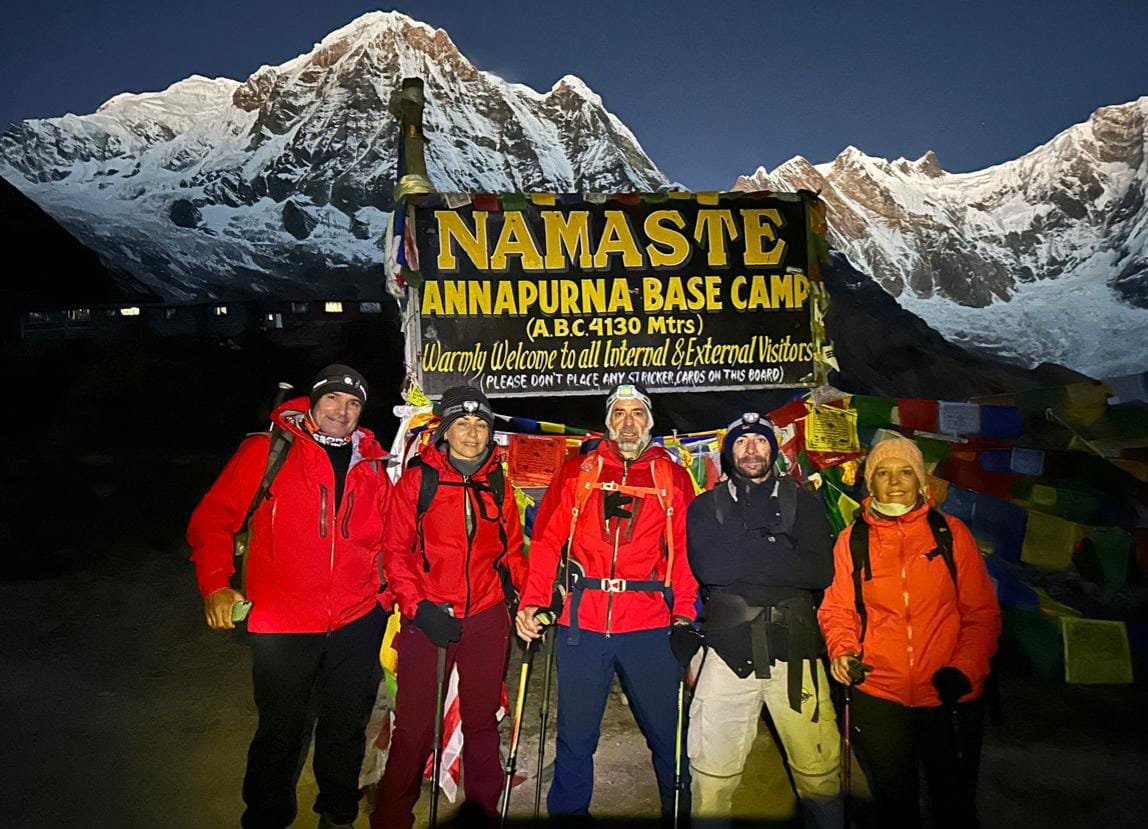
If you have been searching for a group join Annapurna Base Camp Trek, you have probably already noticed the problem. Most trekking company websites throw a single word, group joining, at you without explaining what it actually means, who you will be walking with, what it costs compared to a private trip, or whether it is even a good idea for someone traveling alone. This guide answers all of that honestly, based on how we actually run group departures at Next Trip Nepal, what our guides see on the trail every season, and real pricing and dates for 2026.
We wrote this because we kept getting the same questions in email after email. What is a group join trek. Will I be stuck with strangers I do not like. Is it cheaper than a private trip. Can I still get a good guide. Is the pace too fast or too slow for me. So instead of a short FAQ, we decided to answer everything in one place, with real numbers and real trail experience, not vague marketing language.
What Is A Group Join Annapurna Base Camp Trek
A group join Annapurna Base Camp Trek means you book a seat on a scheduled departure that already has a fixed start date, rather than paying a private guide to build a custom itinerary around your own calendar. You show up on the departure date, you are placed with other trekkers who booked the same date, and you walk the trail together with one shared guide, sometimes with an assistant guide or porters depending on group size.
This is the same idea as a fixed departure trek, and you will see both terms used across the industry. The core benefit is cost. A guide, porters, permits, and transport all get shared across everyone in the group instead of being paid for by one person or one couple, which brings the per person price down significantly compared to a private trek on the exact same route.
At Next Trip Nepal, our group join Annapurna Base Camp departures run on set dates throughout the main trekking seasons, and the price is a flat rate per person regardless of whether you are the only solo trekker who joins or one of twelve. You are not penalized for traveling alone, and you are not charged a mysterious surcharge that only gets explained after you have already paid a deposit.
It helps to picture how this actually plays out on the ground. Say four different bookings come in for the same October date, a solo trekker from Canada, a couple from Germany, and two friends traveling together from Singapore. On the departure morning, all of you meet at the same briefing in Kathmandu, get introduced to the same guide, and set off together the next day toward Pokhara. Nobody is treated as a smaller or lesser booking because they came in alone. Everyone is simply part of the same trek from that point forward.
Why Trekkers Choose To Group Join Instead Of Booking Private
Cost is the most obvious reason, but it is rarely the only one once people actually think it through. A private Annapurna Base Camp Trek with your own dedicated guide can run considerably higher per person than a group departure, since you alone are covering the full cost of the guide, porter, and vehicle rather than splitting it with seven or eight other trekkers.
Beyond money, a lot of solo travelers specifically want the company. Thirteen days is a long time to spend without anyone to share a meal with or laugh about the cold shower with. Group departures solve that naturally. You do not need to already know someone to have people to talk to on this trip.
There is also a simple logistics reason. Fixed departure dates remove the back and forth of negotiating your own custom schedule. You pick a date that already exists on our calendar, you confirm your seat, and everything from permits to teahouse bookings to guide assignment happens automatically because the departure is already organized around that date.
We also hear from a fair number of first time trekkers who simply feel more confident joining a group for their first ever high altitude walk. Not knowing exactly what to expect from teahouse life, altitude, or long walking days is a lot easier to handle when you are surrounded by other people going through the same learning curve at the same time, rather than facing every new experience alone with only your guide for company.

Trek at a Glance Duration6 days (Pokhara to Pokhara) Max Altitude4,130m / 13,549ft (Annapurna Base Camp) Start and End PointPokhara…
The Real Benefits Of Trekking Annapurna Base Camp In A Group
Lower cost per person is the headline benefit, but it is worth breaking down why the savings are real rather than a marketing trick. Permits, guide salary, porter salary, and Kathmandu to Pokhara transport are mostly fixed costs regardless of group size. When eight people split those costs instead of one, the math genuinely works in your favor.
You also get a built in social experience. Most of our repeat clients tell us the same thing, that the people they met on their group departure ended up being one of the best parts of the trip, sometimes better remembered than the mountain views themselves. Sharing a dining hall with seven strangers who become friends by day three is a specific kind of experience that a private trek simply does not offer.
Safety is another underrated factor. A larger group on the trail means more eyes watching for altitude symptoms in each other, more hands available if someone needs help, and a guide who is managing a full group and therefore paying close attention to pace and wellbeing rather than assuming one strong trekker is fine on their own.
Group departures also come with a set schedule, which forces a kind of discipline that some trekkers actually prefer. You know exactly which village you will sleep in each night before you even leave Kathmandu. There is no ambiguity, no last minute itinerary changes, and no pressure to make decisions on the trail that you are not equipped to make.
There is also a quieter benefit that does not show up on any pricing page, which is motivation. On a long climb, especially a steep one like the stone staircase above Ulleri, walking alongside other people genuinely makes the effort easier. Trekkers who might stop and second guess themselves on a private trek tend to keep moving when there is a small group setting the pace around them, and that shared momentum carries people through the harder sections of the trail more often than you would expect.
Are There Any Real Downsides To Group Joining
We would rather tell you the honest downsides than pretend group joining is perfect for everyone, because it is not. The biggest one is pace. A group moves at the pace of its average member, not at your personal pace. If you are significantly faster or slower than most of the group, you may find yourself waiting around or feeling rushed at points during the day.
You also do not choose who you are trekking with. Most groups get along fine, since people who book the same trek tend to share similar interests and expectations, but there is always a small chance of a personality clash or a group dynamic that does not suit you. Thirteen days is long enough that this matters if it happens.
Room sharing is another factor to plan for. Teahouse rooms on this route are almost always twin share, meaning two beds per room. If you book solo, we pair you with another solo trekker of the same gender unless you pay a single supplement for a private room, which is worth asking about directly if privacy matters to you.
Finally, your departure date is fixed. If your flights or work schedule shift even slightly, you cannot simply push the trek back a few days the way you could with a private booking. This is the tradeoff for the lower price, and it is worth confirming your travel dates are solid before you commit to a specific group departure.
None of these downsides are dealbreakers for most trekkers, but they are worth sitting with honestly before you book. If you read through this list and still feel comfortable with the tradeoffs, group joining is very likely the right choice for you. If the idea of a fixed pace or a shared room genuinely bothers you, that is useful information too, and a private trek will probably suit you better even at the higher price.
Group Join Annapurna Base Camp Trek Cost For 2026
Our group join Annapurna Base Camp Trek is priced at 950 US dollars per person for the standard 13 day itinerary, which includes the two extra days in Kathmandu and Pokhara at the start and end of the trip. This is a single flat rate. We do not use the sliding scale you see on some competitor sites where solo trekkers pay more and larger groups pay less. Whether you are the first person to book a departure or the eighth, the price stays the same.
That price covers airport pickup, two nights in a three star Kathmandu hotel with breakfast, two nights in a three star Pokhara hotel with breakfast, all teahouse accommodation on the trail, three meals a day while trekking, your licensed guide, a porter, all permits, ground transport between Kathmandu, Pokhara, and Nayapul, a first aid kit, a farewell dinner, and a Next Trip Nepal t shirt, cap, and duffel bag.
What is not included is your international flight, your Nepal visa fee, travel insurance, lunch and dinner while in Kathmandu and Pokhara specifically, alcoholic and non alcoholic drinks on the trail, hot showers and device charging at teahouses, and tips for your guide and porter. A reasonable extra budget for these is between 150 and 200 US dollars for the full trip, depending on how many hot showers and cold beers you want along the way.
Compared to what many other companies quote for a group join Annapurna trip, our flat 950 dollar rate holds up well, especially once you notice how much some competitors leave out of their advertised price. A few sliding scale packages we have compared look cheaper at first glance for larger groups, but they exclude porters entirely, exclude internal transport, or quietly increase once you are down to a group of two or three. We would rather quote one honest number that already includes the things you will actually need.
Fixed Departure Dates For The Group Join Trek
We run group departures throughout the main trekking seasons, with the highest frequency in September, October, and November, which is when demand and trail conditions are both at their best. As of this writing, confirmed September 2026 departures include dates on the 10th, 11th, and 12th, each priced at 950 US dollars per person with eight seats available per departure and a group discount applied automatically once enough trekkers join the same date.
Additional departures continue through October, November, and into December, since these months offer the clearest mountain views and the most stable weather of the year. Spring departures resume in March and run through May, covering the rhododendron blooming season, which is the second most popular window for this trek.
Because dates fill up, particularly the popular October and early November slots, we recommend checking current availability directly on our booking calendar rather than assuming any specific date will still be open by the time you are ready to commit. A departure with only one or two seats left can sell out within days during peak season.
If you are booking well in advance, it is worth glancing at our calendar for the whole season rather than fixating on one exact date. Two or three departures often sit close together in the same week during autumn, so if your first choice fills up, there is usually a nearby alternative that still fits your travel window without forcing you into a completely different month.
How Big Are Our Group Join Departures
Group sizes on our Annapurna Base Camp departures typically range from four to twelve trekkers, depending on the season and specific date. Autumn departures, especially in October, tend to run larger since that is the busiest month of the year. Shoulder season dates in early spring or late autumn often run smaller, sometimes with just four to six people, which some trekkers actually prefer for a quieter, more personal trail experience.
We do not overbook departures purely to maximize group size. Once a departure reaches a comfortable number for one guide to manage safely, we either close that date or bring on an assistant guide so pace and attention are not compromised. If group size matters to you specifically, whether you want the energy of a bigger group or the intimacy of a smaller one, ask us directly before booking and we can tell you the current headcount for any given date.
Who You Will Actually Be Trekking With
Our group departures typically draw a genuine mix of ages and backgrounds. It is common to see a range from people in their early twenties through trekkers in their sixties on the same departure, along with a fairly even split between solo travelers, couples, and small groups of friends who booked together. Most nationalities you would expect on a popular international trekking route show up regularly, from Europe, North America, Australia, and increasingly from across Asia.
What tends to bring people together more than nationality or age is shared motivation. Everyone on the departure chose the same trek for roughly the same reasons, which usually means a group of people who are reasonably fit, genuinely interested in the mountains and the culture, and willing to be a bit uncomfortable for thirteen days in exchange for the experience. That shared mindset does more to create a good group dynamic than any deliberate matching process could.
Our guides have noticed the same pattern year after year. By the second or third day, small talk turns into genuine conversation, and by the time the group reaches Chhomrong, most people have already swapped contact details with at least one person they met on the trail. It is common for two or three trekkers from the same departure to end up extending their Nepal trip together afterward, whether that means a few extra days in Pokhara or a side trip neither of them had originally planned.
Full 13 Day Itinerary For The Group Join Trek
Day one is arrival in Kathmandu with an airport transfer to your hotel. Day two is the drive from Kathmandu to Pokhara, roughly six to seven hours by road, followed by a free evening at Lakeside. Day three is the drive from Pokhara to Nayapul and the start of the actual trek, walking to Ulleri at 1,900 meters, a climb that includes the well known stone staircase of over three thousand steps.
Day four continues from Ulleri to Ghorepani at 2,860 meters. Day five is an early climb to Poon Hill for sunrise views of the Annapurna and Dhaulagiri ranges, followed by the trek onward to Chuile. Day six moves from Chuile to Upper Sinuwa, and day seven continues from Sinuwa to Deurali at 3,200 meters, where the trail starts to feel genuinely alpine.
Day eight is the big one, the walk from Deurali to Annapurna Base Camp itself at 4,130 meters, standing directly beneath Annapurna I, the tenth highest mountain on earth. Day nine is the descent from base camp down to Bamboo, dropping nearly 1,800 meters in a single day, which also happens to be one of the best natural treatments for any mild altitude symptoms from the day before.
Day ten continues down through Chhomrong to Jhinu Danda, home to a genuinely excellent natural hot spring beside the Modi Khola river, which is exactly what your legs will want after nine days of climbing and descending stone steps. Day eleven walks back out to Nayapul and drives back to Pokhara. Day twelve drives from Pokhara back to Kathmandu, and day thirteen is your international departure.
What Makes This Itinerary Work For A Group
This particular pacing is not arbitrary. The two nights around Ghorepani give the group its first real altitude exposure at a manageable pace, which matters even more in a group setting since your guide needs everyone adjusting reasonably well before pushing higher. The gradual daily elevation gain from village to village follows the standard climb high, sleep low approach that keeps altitude sickness risk low for the group as a whole.
The rapid descent from base camp to Bamboo on day nine is also a deliberate safety feature, not just an efficient use of time. If anyone in the group is feeling the altitude at base camp, getting back down 1,800 meters in one day resolves most mild symptoms almost immediately, which is one of the reasons this trek carries a lower overall risk profile than higher routes like Everest Base Camp.
This itinerary also builds in enough buffer that a group can absorb one slower day without the whole schedule collapsing. If a couple of trekkers need extra rest at Ghorepani, or the group simply wants a slower morning after the Poon Hill sunrise hike, there is enough flexibility in the pacing between Chuile and Deurali to make that adjustment without threatening the overall return date. Your guide manages this in real time based on how the specific group is doing that week.
Permits Required For The Group Join Trek
Two permits are required for anyone trekking Annapurna Base Camp, group join or private. The Annapurna Conservation Area Permit, known as ACAP, costs 3,000 Nepali rupees for foreign nationals, roughly 22 to 25 US dollars depending on the exchange rate at the time. This permit funds conservation work across the Annapurna Conservation Area, Nepal’s largest protected area, supporting local schools, health posts, trail maintenance, and reforestation.
The second requirement is the TIMS card, short for Trekkers Information Management System. For group departures like ours, the TIMS card is issued at the group rate of 1,000 Nepali rupees per person, roughly 8 US dollars, compared to the higher individual rate charged to trekkers who are not part of an organized group. This is one of the small but real financial advantages of booking a group join trek rather than trekking independently without an agency.
Both permits are included in your 950 dollar package price and are arranged for you before the trek begins. You simply need a valid passport and passport sized photographs, which our team collects during your pre trek briefing in Kathmandu.
Altitude And Fitness Considerations For Group Trekking
Annapurna Base Camp tops out at 4,130 meters, which is over 1,200 meters lower than Everest Base Camp. That difference matters a lot in a group setting, since lower altitude means a lower overall risk of serious altitude sickness across the group as a whole, and a faster, easier recovery if someone does start to feel unwell.
That said, moderate altitude does not mean no altitude. Most trekkers experience some mild symptoms around Ghorepani or Deurali, typically a headache or slight nausea that resolves within a day. Your guide checks in with the group regularly, and anyone who genuinely needs to slow down or descend will never be pressured to keep pace with the group at the expense of their safety.
In terms of physical preparation, you do not need to be an athlete, but you should be able to walk for five to seven hours a day with a daypack for multiple consecutive days. Training with hill walks carrying some weight for six to eight weeks before you arrive in Nepal makes a genuine difference in how much you enjoy the trek rather than simply survive it.
What Accommodation And Food Look Like On A Group Departure
Accommodation throughout the trek is in teahouses, family run lodges rather than hotels, with twin share rooms as the standard setup. Rooms get simpler and food gets more expensive as you climb higher, since everything above Chhomrong has to be carried up by porter or mule rather than delivered by road.
Meals are eaten together in the dining hall, which is genuinely one of the best parts of a group trek. The wood stove in the dining hall is the warmest place in the building most evenings, and that is where the group actually bonds, over card games, shared plates of dal bhat, and stories from the day’s walk. Solo trekkers in particular tend to find this communal dining setup makes the trip feel far less isolating than they expected.
Bring a sleeping bag rated to at least minus ten degrees Celsius regardless of season. Teahouse blankets are not warm enough at altitude, especially above 3,000 meters, and this is one detail that catches unprepared trekkers off guard every year.
How Group Join Compares To A Private Annapurna Base Camp Trek
A private trek gives you complete control. You choose your own start date, your own daily pace, your own rest days, and you get a guide entirely focused on you rather than managing a full group. If you have specific mobility needs, a tight schedule that does not match any fixed departure, or you simply prefer privacy, a private trip is worth the extra cost.
What you give up with a private trek is the social dimension and the lower price. Private Annapurna Base Camp treks with Next Trip Nepal typically cost more per person than a group join departure, since you are covering the full cost of a dedicated guide and support team by yourself rather than sharing it across a group.
Our honest advice is this. If your schedule is flexible and you are traveling alone or as a couple, group joining is almost always the better value and often the more memorable experience. If your dates are fixed and cannot move, or you specifically want full control over your daily itinerary, book a private trip instead. Both options use the same guides, same quality of service, and same safety standards, so neither is a compromise.
Best Time To Join A Group Departure
September through November is autumn, the most popular and most reliable season for group departures. The monsoon has cleared, skies are consistently clear, and temperatures are comfortable during the day with cold but manageable nights. This is also when group sizes tend to be largest, since demand peaks alongside the best weather.
March through May is spring, the second most popular window, known for rhododendron forests in full bloom along the lower trail. Group sizes in spring are usually a bit smaller than autumn, which some trekkers specifically prefer for a quieter trail with the same reliable weather.
Winter departures from December through February run smaller still, often just a handful of trekkers per date, appealing to those who want cold, clear skies and a near empty trail. Monsoon season from June through August is not recommended for this trek regardless of group size, since heavy rain, leeches on the lower trail, and poor visibility make the experience genuinely unpleasant rather than simply less scenic.
How To Book Your Group Join Departure
Booking is straightforward. Check our current departure calendar for a date that fits your travel plans, confirm your seat with our team, and we handle the rest, including permits, teahouse bookings, and guide assignment. No advance payment is required to hold your place in most cases, and our team will walk you through exactly what is needed to confirm your specific date.
If your preferred date is close to selling out, book early. Popular autumn dates, particularly in October, tend to fill several weeks ahead of the departure itself. If no current date works for your schedule, ask us directly. We can sometimes open a new departure date if enough interest exists, or point you toward the closest available alternative.
Frequently Asked Questions About Group Joining This Trek
Will I be charged more for traveling alone? No. Our group join price is a flat 950 US dollars per person regardless of whether you book alone, as a couple, or as part of a larger group.
What if nobody else books my chosen date? We guarantee our published departure dates. If a specific date does not attract enough other trekkers, your trek still runs as scheduled with the guide and support team it needs.
Can I get a private room instead of sharing? Yes, for an additional single supplement. Let our team know when booking and we will confirm availability and cost for your specific dates.
How fit do I need to be? You do not need to be an athlete, but you should be comfortable walking five to seven hours a day for multiple consecutive days. A few weeks of hill training beforehand makes a real difference.
Is the group pace too fast for beginners? Our guides set a pace that suits the group as a whole, and this itinerary is specifically designed to be approachable for first time trekkers with a reasonable baseline of fitness. Nobody is left behind.
Do I need previous trekking experience? No. Many of our group join trekkers are on their first ever multi day trek. Basic fitness and a willingness to walk slowly at altitude matter more than prior experience.
What happens if I get sick during the group trek? Your guide monitors everyone daily and will adjust pace or arrange descent if needed. Serious cases are managed with helicopter evacuation, which is why travel insurance covering evacuation up to 6,000 meters is mandatory.
Can families with teenagers join a group departure? Yes, this trek works well for families with children aged fourteen and up who have trained for the walking demands. Younger children generally struggle with both the daily distance and the altitude.
Why Choose Next Trip Nepal For Your Group Join Trek
We run our group departures with a flat, transparent price that does not change based on how many other people happen to book your date. Our guides are licensed, experienced on this specific route, and trained to recognize altitude symptoms early rather than waiting for a problem to become serious. Permits, transport, and teahouse arrangements are handled entirely by our team before you arrive, so your only real job once you land in Kathmandu is to show up ready to walk.
We also stay honest about what group joining is and is not. It is a genuinely good way to trek Annapurna Base Camp at a lower cost with built in company along the way. It is not the right fit for every traveler, and we would rather tell you that directly than oversell a private experience as something it is not.
Ready To Join A Group Departure
If a group join Annapurna Base Camp Trek sounds like the right fit for your travel plans, you can see our current 2026 departure dates, full pricing, and everything included on our Annapurna Base Camp Trek package page. Reach out to our team directly if you have questions about a specific date, group size, or whether this trek is the right match for your fitness level and travel schedule.
Thirteen days from now, you could be standing at the foot of Annapurna I, surrounded by strangers who by then will not feel like strangers anymore, having just walked one of the most rewarding trails in Nepal together. That is what a group join trek actually offers, and we would be glad to help you book your seat.