Culture and Monasteries of the Pikey Peak Trek
Most people who search for the Pikey Peak Trek are looking for one thing first: that wide, open view of Everest, Lhotse, Makalu, and the long wall of peaks that Edmund Hillary is popularly, though not provably, quoted as calling the best mountain panorama in Nepal. The viewpoint earns its reputation. But the trail that leads to it, running from Kathmandu through the Solu region to Junbesi and Phaplu, passes through a part of Nepal that has its own story independent of mountain views. This is Sherpa country, and along this particular route sit two monasteries, Thupten Choling near Junbesi and Chiwong near Phaplu, that carry real religious weight in the region and a history that is, in places, genuinely tangled and disputed rather than neatly packaged.
This article is written for trekkers who want to understand what they are walking through, not just past. It covers who built these two monasteries and why, how each one does or does not connect to the wave of Tibetan refugees who crossed into Nepal after 1959, the Mani Rimdu festival tradition both monasteries keep, what daily life inside a working monastery in this region actually looks like, how these institutions fit into the wider Sherpa community of Solu, and practical guidance for visiting both sites with the right conduct. Where the historical record is genuinely contested or incomplete, this piece says so plainly rather than inventing a tidy answer. That is a deliberate choice, because the honest version of this history is more interesting than a smoothed over one, and because trekkers deserve to know which details are solid ground and which are reported differently depending on the source.
The Sherpa World of the Solu Region
Solu sits south of the better known Khumbu region, which stretches up toward Everest itself and includes famous stops like Namche Bazaar and Tengboche. Solu is lower, greener, and less visited by comparison, even though it is historically and culturally the older heartland of Sherpa settlement in this part of Nepal. Villages such as Junbesi and Phaplu, both directly on the Pikey Peak Trek route, are Sherpa villages in the fullest sense: built around farming terraces, prayer walls, chortens at the village edges, and a working relationship with the monasteries that sit above them on the hillsides.
Sherpa identity here is tied closely to Tibetan Buddhism, specifically to the Nyingma school, the oldest of the four major schools of Tibetan Buddhist practice. Nyingma teaching places heavy emphasis on tantric practice, on the figure of Guru Rinpoche, also known as Padmasambhava, as the founder who first brought Buddhism into the Himalayan region from India, and on a lineage of teachers passed down from master to student across centuries. Both Thupten Choling and Chiwong sit within this Nyingma tradition, and understanding that shared foundation helps explain why the two institutions, despite being founded decades apart under very different circumstances, feel recognizably part of the same world when a trekker visits them back to back.
It is worth being precise about who actually lives along this specific trail, because trekking content on the wider Solu Khumbu district often blurs this. The district as a whole is home to Rai, Chhetri, Tamang, and Magar communities in addition to Sherpa, and all of these groups have a long presence in eastern Nepal generally. On the specific villages that make up the Pikey Peak route, though, the Sherpa presence is the one that is well and consistently documented, including the two monasteries this article covers. Claims about other ethnic communities being central to this particular trail, as opposed to the broader district, are not something that can be stated with confidence from the sources reviewed for this piece, so this article focuses on what is solidly known, which is the Sherpa character of Junbesi, Phaplu, and the villages around them.
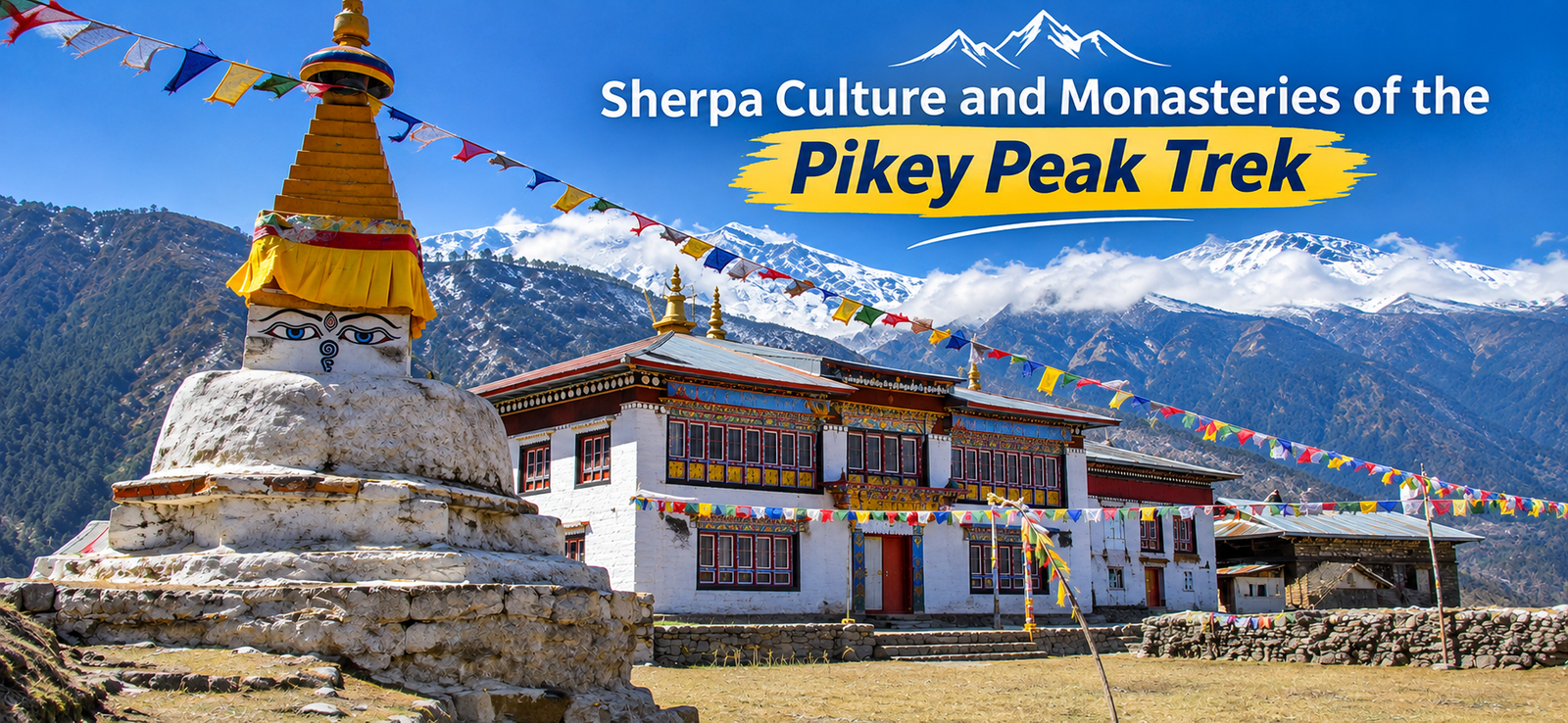
Walking through this region, the signs of that Sherpa Buddhist culture show up constantly and without needing to be sought out. Mani walls built from stones carved with the mantra Om Mani Padme Hum line sections of trail. Chortens, the whitewashed stone structures that mark the edges of settlements or significant points on a path, appear at village entrances. Prayer flags, strung across rooftops and bridges, carry printed prayers that are meant to be released into the wind rather than read. None of this is staged for visitors. It is simply how daily religious life is expressed in this part of Nepal, and it has been for a very long time.
Thupten Choling Monastery Near Junbesi
Thupten Choling sits above the village of Junbesi, at roughly 3,000 meters, reached by a walk up from the village that most trekkers complete in about an hour. It is, by most accounts, the larger and more actively populated of the two monasteries on this route, and its history is bound up with one of the defining events of twentieth century Tibetan Buddhist history, the flight of senior lamas and their communities out of Tibet after the Chinese occupation.
Founding and the Figure of Trulshik Rinpoche
Thupten Choling was founded by Trulshik Rinpoche, who lived from 1923 to 2011 and became one of the most senior teachers in the Nyingma school, eventually serving as its head starting in 2010, and counting the fourteenth Dalai Lama among those he taught. Several trekking and travel sources give 1968 as the specific founding year, built on donated land near Junbesi. Wikipedia’s account of Trulshik Rinpoche’s life is less precise on this point, stating only that he founded the monastery of Thubten Choling in Nepal without attaching a specific year to the event. Readers researching this further should expect to see 1968 repeated often, but should understand that the single original source pinning down that exact year has not been independently verified across every account consulted for this article.
What is not in dispute is the broader arc of the story. Trulshik Rinpoche left Tibet in 1959, the same year the Dalai Lama himself crossed into exile, as Chinese forces moved to consolidate control over Tibet. He traveled with a group of followers that included both monks and nuns, people who had trained and lived alongside him in Tibet and who chose to leave with their teacher rather than remain. The name of the monastery he left behind in Tibet is itself a point of inconsistency across the sources reviewed for this piece. One source names it Dza Rongphu, another gives Rongbuk Gompa. These two names may well refer to the same site under different transliterations into English, since Tibetan place names are rendered in a wide range of spellings depending on the source and the era, but no source reviewed here confirms that directly, so this article treats the two names as an open question rather than assuming they match.
Where Trulshik Rinpoche and his followers went immediately after crossing into Nepal is also reported in more than one way. One account has him residing first among the monasteries of the Khumbu region, naming Thame specifically. Another account instead describes him spending years at Chiwong and other monasteries in the area. It is entirely possible that both are true at different points in a complicated decade of movement and resettlement, since a senior teacher arriving as a refugee with a sizable following would likely have needed to find temporary shelter in more than one place before a permanent home could be built. This article is not going to flatten that into a single clean narrative. The honest summary is that Trulshik Rinpoche’s path through the years between leaving Tibet and establishing Thupten Choling involved more than one monastery, and the exact sequence is not settled across the available accounts.
Rebuilding, the 2015 Earthquake, and Permanent Construction
The buildings Trulshik Rinpoche and his community first put up were understood at the time to be temporary, which makes sense given the circumstances of arrival as refugees without resources for permanent stone construction. Those original structures deteriorated over the following decades, as temporary buildings tend to do when they are asked to serve far longer than intended. Permanent rebuilding at the site began in 2001, reportedly supported by Swiss funding, and this is when Thupten Choling took on something closer to the form it has today, with proper stone and timber construction replacing the earlier makeshift buildings.
That rebuilding effort was tested again in April 2015, when the major earthquake that struck Nepal that year damaged structures at the monastery. Reports describe residents living in tents through the rainy season that followed while repair and reconstruction work continued. This mirrors what happened across much of rural Nepal after that earthquake, where religious and community buildings, often older and less structurally reinforced than newer construction, took some of the heaviest damage and the longest time to fully repair.
Life at Thupten Choling Today
Figures on how many people actually live and practice at Thupten Choling vary noticeably depending on the source. One account describes several hundred nuns and monks in residence, with roughly 80 percent identified as Tibetan refugees or descendants of that original refugee community. Another account gives a wider range, somewhere between 400 and over 900, while also citing that same 80 percent figure for Tibetan refugee background in its own frequently asked questions section. These two figures do not reconcile cleanly, and this article is not going to pretend they do. What can be said with reasonable confidence is that the resident population numbers in the hundreds, that it is a substantial community by the standards of Himalayan monasteries, and that a large majority of residents trace their presence there back to the 1959 exodus from Tibet rather than to local Sherpa recruitment alone, though the precise headcount depends on which source a reader happens to consult and probably on exactly when that source’s figures were gathered.
Thupten Choling is often described as one of the largest nunneries in Nepal, or sometimes specifically in the Everest region. This is a claim worth flagging rather than repeating as settled fact. It appears in only one of the sources reviewed for this piece, which does not make it false, but does mean it should be understood as a commonly repeated characterization rather than something independently confirmed by multiple separate sources. Trekkers who read this claim elsewhere should treat it the same way this article does, as plausible and widely stated, not as a verified ranking.
Daily life inside the monastery follows a pattern that is commonly described in general accounts of this community, though not independently documented in granular detail by the sources behind this article. Mornings begin before sunrise with prayer and chanting. The hours that follow are given over to religious study, a structured curriculum of texts, debate, and memorization that forms the backbone of monastic education in the Nyingma tradition. Communal chores, the unglamorous daily work of keeping a large residential community fed, clean, and functioning, fill out much of the rest of the day. Evenings bring another round of chanting. This rhythm, prayer, study, labor, prayer again, is recognizable across Tibetan Buddhist monastic communities generally and is consistent with what is reported specifically about Thupten Choling, even if the finer details of any single day are not laid out moment by moment in available sources.
Mani Rimdu at Thupten Choling
Thupten Choling celebrates Mani Rimdu, the best known festival tradition among Sherpa Buddhist monasteries in this part of Nepal. In its full traditional form, Mani Rimdu runs across roughly 19 days, though the portion that draws public attention and visitors is a shorter stretch of masked dances, ritual performance, and public blessing that caps the longer private preparation period. One source suggests the festival often falls around May at Thupten Choling specifically, but the exact dates shift from year to year according to the lunar calendar that governs the timing, so travelers hoping to catch it should treat any specific month as an estimate rather than a fixed date to plan around without confirming closer to the time of travel.
The Walk Up From Junbesi
For trekkers on the Pikey Peak route, Thupten Choling is a short detour rather than a major diversion. The climb from Junbesi village up to the monastery grounds is commonly described as somewhere between one and a half and two and a half kilometers, taking roughly an hour on foot. The exact distance varies slightly depending on which source is reporting it and presumably on exactly which starting point in Junbesi is used as the reference, but an hour each way is a reasonable planning figure, meaning the full round trip with some time spent at the monastery itself fits comfortably into an afternoon without disrupting the rest of a trekking day’s schedule.
Chiwong Monastery Near Phaplu
Chiwong Monastery occupies a cliffside position above Phaplu and the village of Chiwong itself, at an altitude of roughly 2,938 meters. Where Thupten Choling’s story is inseparable from the 1959 Tibetan exodus, Chiwong’s founding story is a different and older one, and keeping the two histories separate matters for anyone trying to understand this region accurately.
Founding by Sangey Tenpa Lama
Chiwong was established sometime between 1919 and 1923 by a lama named Sangey Tenpa, who had himself taken refuge in Nepal after leaving Tibet, decades before the much larger refugee movement that followed the Chinese occupation in 1959. At the time of its founding, a monastic community formed around Sangey Tenpa Lama numbering roughly 50 monks. This detail matters because it is easy, given how closely associated Tibetan Buddhist monasteries in Nepal are with the 1959 exodus in popular understanding, to assume every such monastery traces back to that single event. Chiwong does not. It predates that exodus by several decades and represents a separate, earlier wave of movement and settlement, tied to its own founder and its own circumstances rather than to the later and much better documented refugee crisis.
Mani Rimdu and the Guru Rinpoche Story
Chiwong also observes Mani Rimdu, the same 19 day festival tradition kept at Thupten Choling and at other monasteries across the wider Solu Khumbu region, most famously at Tengboche further north in Khumbu, where the autumn observance draws large numbers of visitors. The festival’s underlying story centers on Guru Rinpoche’s establishment of Buddhism in Tibet, expressed through masked dance performances that dramatize the triumph of Buddhist teaching over earlier belief systems. Different monasteries hold their observance of Mani Rimdu at different points in the year, and while Tengboche’s autumn timing is well known, the exact timing of Chiwong’s own observance is not confirmed in the sources reviewed for this article. Trekkers interested in witnessing it should treat it the same way as the Thupten Choling dates, as something to confirm locally or with a trekking operator closer to the time of travel rather than something to assume from a fixed calendar date found online.
A Reported, Not Confirmed, Connection to Trulshik Rinpoche
One detail connects Chiwong back to the Thupten Choling story discussed earlier in this article, though it needs to be presented with appropriate caution. One source states that Trulshik Rinpoche, after arriving in Nepal from Tibet in 1959, spent time residing at Chiwong among other monasteries before eventually establishing Thupten Choling. This is plausible given that Chiwong was already an established, functioning monastic community by 1959, decades old by that point, and would have been a reasonable place for an arriving teacher and his followers to find temporary shelter. However, this claim is not confirmed by every source consulted for this piece, and it should be understood as a reported connection rather than a settled historical fact. It is the kind of detail that sits in genuinely uncertain territory between folk history and documented record, and this article is presenting it exactly that way rather than upgrading it to firm fact for the sake of a cleaner story.
Are Thupten Choling and Chiwong Formally Linked
Given that both monasteries sit along the same trekking route, belong to the same Nyingma lineage, observe the same Mani Rimdu festival tradition, and may share this loosely reported connection through Trulshik Rinpoche’s travels after 1959, it is natural to wonder whether the two institutions are formally connected today, perhaps through shared governance, a teaching lineage that runs between them, or some kind of sister monastery relationship.
No source reviewed for this article confirms any such formal institutional link. There is no documented shared governance structure, no confirmed lineage relationship that ties the leadership of one monastery to the other, and no clear evidence of the kind of sister monastery arrangement that does exist between some Buddhist institutions elsewhere in the Himalayan region. The honest position, based on what is actually documented, is that Thupten Choling and Chiwong are two distinct monasteries that happen to sit on the same general trekking corridor through Solu, that share a broad religious tradition common to most Sherpa Buddhist institutions in this part of Nepal, and that are connected historically only through the loosely reported detail of Trulshik Rinpoche possibly having spent time at Chiwong before founding his own monastery nearby. That is a real and interesting historical thread. It is not, on the evidence available, proof of an ongoing formal relationship between the two institutions as they exist today.
For trekkers, this distinction matters less for logistics than for understanding. Visiting both monasteries on the same trek is entirely reasonable and rewarding precisely because they represent two separate strands of the same broader Sherpa Buddhist world rather than two branches of a single institution, giving visitors a genuinely fuller picture of monastic life in Solu than either site would provide alone.
| Feature | Thupten Choling | Chiwong |
|---|---|---|
| Nearby village | Junbesi | Phaplu and Chiwong village |
| Approximate altitude | 3,000 meters | 2,938 meters |
| Founder | Trulshik Rinpoche | Sangey Tenpa Lama |
| Founding period | Commonly cited as 1968, though not fixed in every source | Between 1919 and 1923 |
| Relation to 1959 exodus | Directly founded by a teacher who fled Tibet in 1959 | Predates the 1959 exodus by several decades |
| Religious lineage | Nyingma school | Nyingma school |
| Festival tradition | Mani Rimdu | Mani Rimdu |
| Walk from the village | Roughly one and a half to two and a half kilometers, about an hour | A shorter climb above Phaplu |
What Daily Monastic Life Actually Involves
It helps to understand, in general terms, what the rhythm of life inside a Nyingma monastery like either of these two actually consists of, since this is the backdrop against which any visit happens. Monastic days in this tradition are structured around a cycle of ritual practice, study, and work rather than around a single service the way a visitor from a different religious background might expect.
Chanting sessions, often beginning before dawn, form the backbone of the day. These are not quiet, private moments but communal recitations, sometimes accompanied by long horns, cymbals, and drums, performed in the main assembly hall by the full resident community seated in rows. Between formal prayer sessions, monks and nuns engage in study, which in the Nyingma tradition includes memorization of texts, instruction from senior teachers, and for more advanced students, structured philosophical debate conducted in a distinctive rhythmic style involving clapping and stepping forward to punctuate each point.
Alongside religious practice, a monastery of several hundred residents requires an enormous amount of ordinary labor simply to function. Cooking for a large community, maintaining buildings in a climate that brings snow in winter and heavy rain in monsoon, managing the practical business of running what amounts to a self contained village, all of this falls to the residents themselves, organized through rotating duties. Younger monks and nuns typically take on more of this physical work, while senior residents focus more heavily on teaching and advanced study, though everyone participates in the collective life of the community to some degree.
Visitors sometimes arrive expecting a monastery to feel like a museum, a static preserved space meant for viewing. The reality at both Thupten Choling and Chiwong is the opposite. These are working religious communities with their own internal schedule and purpose, and a respectful visit means fitting into that reality rather than expecting the institution to pause for sightseers.
The Role These Monasteries Play in Solu’s Sherpa Community
Monasteries in this part of Nepal are not separate from village life, set apart purely for religious specialists. They function as the religious, educational, and in some cases social center of gravity for the Sherpa communities around them. Families in Junbesi and the surrounding villages have historically sent sons and daughters to monasteries like Thupten Choling for religious education, a path that in earlier generations often represented one of the only forms of formal schooling available in a remote mountain district, alongside its primary purpose of spiritual training.
Major life events in Sherpa communities, including funerals, blessings for new undertakings, and the timing of important festivals, are frequently organized around guidance from monastery lamas. Mani Rimdu itself, beyond its draw for outside visitors, functions as a genuine community gathering for local Sherpa families, who attend not as spectators of a cultural performance but as participants in a religious observance that carries real meaning for them. The masked dances performed during the festival are understood within the community as actual ritual transmission, not theater staged for an audience, even though outside visitors are generally welcomed to observe.
This matters for how trekkers should think about visiting. The presence of travelers at these sites, including on a trek like this one operated commercially, is accommodated by both monasteries, but the institutions themselves exist first and fundamentally for the religious life of the Sherpa community in Solu, not as tourist attractions that happen to also serve a religious function. Keeping that priority straight in one’s own mind shapes good conduct more effectively than any list of specific rules could.
Visiting Thupten Choling and Chiwong Respectfully
Both monasteries welcome visitors, and a visit to either one, done thoughtfully, adds genuine depth to a trek that might otherwise be remembered mainly for its mountain views. The guidance below reflects general, well established etiquette for visiting working Tibetan Buddhist monasteries in Nepal, consistent with how both of these specific sites are commonly described as operating.
Appropriate Conduct Inside the Grounds
Dress modestly. Shoulders and knees covered is a safe standard, and this is not a difficult requirement given that trekkers are already dressed for cold mountain weather most of the year. Remove shoes before entering the main prayer hall or assembly room, following the lead of local visitors and any signage or guidance from monastery staff. Speak quietly inside halls where chanting or study may be taking place, and avoid walking directly in front of someone engaged in prayer or prostration.
When walking around chortens, stupas, and mani walls, the traditional direction of movement is clockwise. This is a small detail, easy to get wrong without thinking about it, and easy to get right once a visitor knows to look for it. Avoid touching sacred objects, statues, or ritual items unless specifically invited to do so by a monk or nun. If monks or nuns are eating or resting, this is not the moment to approach with questions, no matter how genuinely curious a visitor might be about the life they are observing.
Donations are generally welcomed and support the upkeep of these communities, many of which, as discussed earlier in this article, operate with hundreds of residents to feed and house in a remote mountain setting with limited income sources. A modest donation left respectfully, often in a designated box near the main shrine, is an appropriate way to acknowledge the welcome extended to visitors, though it should never feel like a transaction or an entry fee, since it is not treated that way by the community itself.
Photography Etiquette
This is the area where well meaning visitors most often get it wrong without realizing it. The exterior grounds of both monasteries, the architecture, the surrounding mountain views, and the prayer wheels and chortens outside the main buildings are generally fine to photograph freely. Photographing inside the main prayer hall, particularly during an active ceremony or chanting session, is a different matter and should not be assumed to be acceptable without checking first, ideally by asking a monk, nun, or accompanying guide rather than simply raising a camera and seeing if anyone objects.
Photographing individual monks or nuns directly, especially in a close or posed way, deserves the same courtesy any person would want extended to them, which means asking first rather than treating a person in religious robes as a photographic subject to be captured without consent. During Mani Rimdu specifically, photography of the public masked dance performances is typically welcomed, since this portion of the festival is explicitly open to outside observation, but flash photography and disruptive positioning to get a better shot should be avoided out of basic consideration for everyone else present, local and visiting alike.
The Side Hikes in Practical Terms
For trekkers planning around the fixed structure of the Pikey Peak Trek itself, which runs seven days and six nights from Kathmandu back to Kathmandu using overland jeep transport at both ends rather than a flight, the detour to Thupten Choling near Junbesi is the more straightforward of the two to build into a day’s schedule. Figure roughly an hour of walking each way from Junbesi village, with the distance commonly cited somewhere between one and a half and two and a half kilometers depending on the exact starting point. That makes a comfortable addition to an afternoon once the day’s main walking is finished, rather than something that needs its own dedicated day.
Chiwong, reached from the area around Phaplu, involves its own short climb up to the cliffside site above the village. Exact distance and time figures for this specific walk were not found with the same consistency across sources as the Junbesi to Thupten Choling figures, so trekkers should treat the Chiwong visit as a shorter side excursion best confirmed with a guide on the day, who will know current trail conditions and the most efficient timing given wherever the group happens to be staying around Phaplu.
A good guide, the kind that comes standard with an organized trek through an established operator like Next Trip Nepal, makes a real difference here beyond simply knowing the way. Local guides on this route typically have personal or family connections to the Sherpa communities around Junbesi and Phaplu, and can offer context, make introductions, and read the appropriate moment to visit that a trekker navigating independently would likely miss entirely. Nepal’s broader licensed guide requirement, introduced from 2023 onward for most trekking routes, mainly changes things for independent trekkers rather than for anyone booking through an agency, since licensed guides have long been standard practice for agency bookings in any case.
Why the Cultural Layer Changes This Trek
A trek built purely around a mountain viewpoint, however good that view genuinely is, tends to flatten into a single memorable afternoon surrounded by a lot of walking that mostly serves to get a person there and back. What the Thupten Choling and Chiwong detours add to the Pikey Peak Trek is a second thread running alongside the mountain views, one built on actual history, living religious practice, and a community that has occupied this landscape for generations rather than existing solely as scenery along a trail.
This is also part of why Pikey Peak works well as an early high altitude trek for people newer to trekking in Nepal, alongside its already established reputation for being easy to moderate, free of glacier crossings or technical passes, and limited to only a brief stretch above 4,000 meters near the summit itself. A trekker on this route is not just training for altitude or earning a photograph at the top. They are passing directly through two genuinely significant religious sites with real, if sometimes incompletely documented, history, in a region, Solu, that receives far less trekking traffic than the more famous Everest Base Camp route further north, which means quieter encounters at both monasteries and a less rushed, less crowded version of this kind of cultural stop than a trekker would typically find at a site like Tengboche during its own well attended autumn Mani Rimdu observance.
Next Trip Nepal builds its Pikey Peak itinerary with enough flexibility around Junbesi and Phaplu that these monastery visits fit naturally into the schedule rather than feeling like a rushed add on squeezed between longer walking days. Travelers booking the trek who have a particular interest in this cultural side of the route are generally well served by saying so at the planning stage, since timing around something like a Mani Rimdu observance, uncertain as the exact dates are from year to year, is far easier to plan for in advance than to improvise once already on the trail.
A Few Honest Caveats Worth Repeating
Because so much of this article has been about holding multiple reported versions of the same event side by side rather than picking one, it is worth collecting the main points of genuine disagreement in one place before closing. The exact founding year of Thupten Choling is commonly given as 1968 but is not pinned down with full certainty across every source, including the most detailed biographical account of Trulshik Rinpoche’s own life. The name of the Tibetan monastery Trulshik Rinpoche left behind in 1959 appears under two different names in the sources reviewed, which may or may not refer to the same place. Where he lived in the years immediately after arriving in Nepal, whether primarily in Khumbu, primarily at Chiwong, or genuinely across both over time, is not settled. Population figures for Thupten Choling today range from several hundred up toward 900 depending entirely on which source is consulted. And whether Thupten Choling and Chiwong share any kind of formal institutional connection today, beyond the historical and still only loosely confirmed detail of Trulshik Rinpoche’s own travels, is not supported by any source reviewed for this piece.
None of this uncertainty should discourage a visit to either site. If anything, it reflects the reality of trying to document mountain monastery history in a region where written record keeping has never been the primary way knowledge gets passed down, oral tradition and lived practice have always carried more weight, and the people who could give the most authoritative answer are the monks, nuns, and lamas living at these monasteries today rather than any website, this one included. A respectful conversation with a resident monk or nun, where circumstances and language allow it, will likely tell a curious visitor more than any amount of reading beforehand, and that openness to learning directly from the people who actually live this tradition is itself part of visiting well.
Final Thoughts for Trekkers
The Pikey Peak Trek earns its growing reputation on the strength of its summit view, a wide and genuinely remarkable sweep of the Everest massif reached without the flight delays, crowding, or extended altitude exposure that come with the Everest Base Camp route further north. But the two monasteries along the way, Thupten Choling above Junbesi and Chiwong above Phaplu, give this particular trek something that a mountain view alone cannot, a direct encounter with a religious community that has occupied this landscape through exile, rebuilding after earthquake damage, and generations of ordinary daily practice, long before any trekker arrived to look at it.
Visiting both sites with the conduct and awareness described in this article, understanding the history as it is actually documented rather than as a simpler story might prefer it, and treating the monks and nuns encountered along the way as residents of a living community rather than as part of the scenery, turns a good trek into a genuinely well rounded one. Next Trip Nepal runs the Pikey Peak Trek with exactly this balance in mind, pairing the mountain objective with real time built in for Junbesi, Phaplu, and the monasteries that sit above them, so that travelers come away with both the photograph at the summit and a real sense of the Sherpa world they walked through to get there.