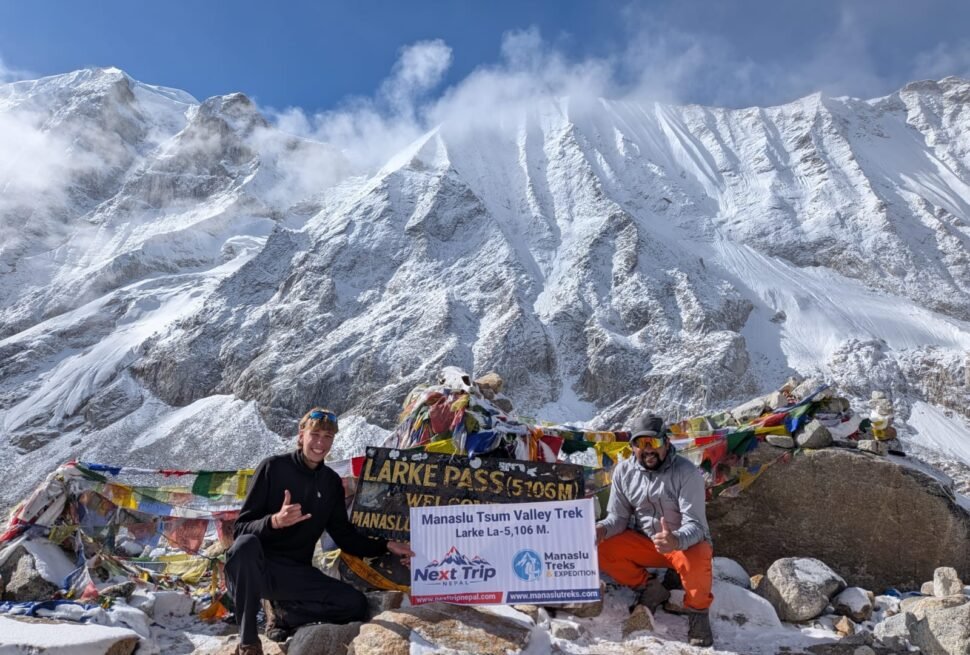
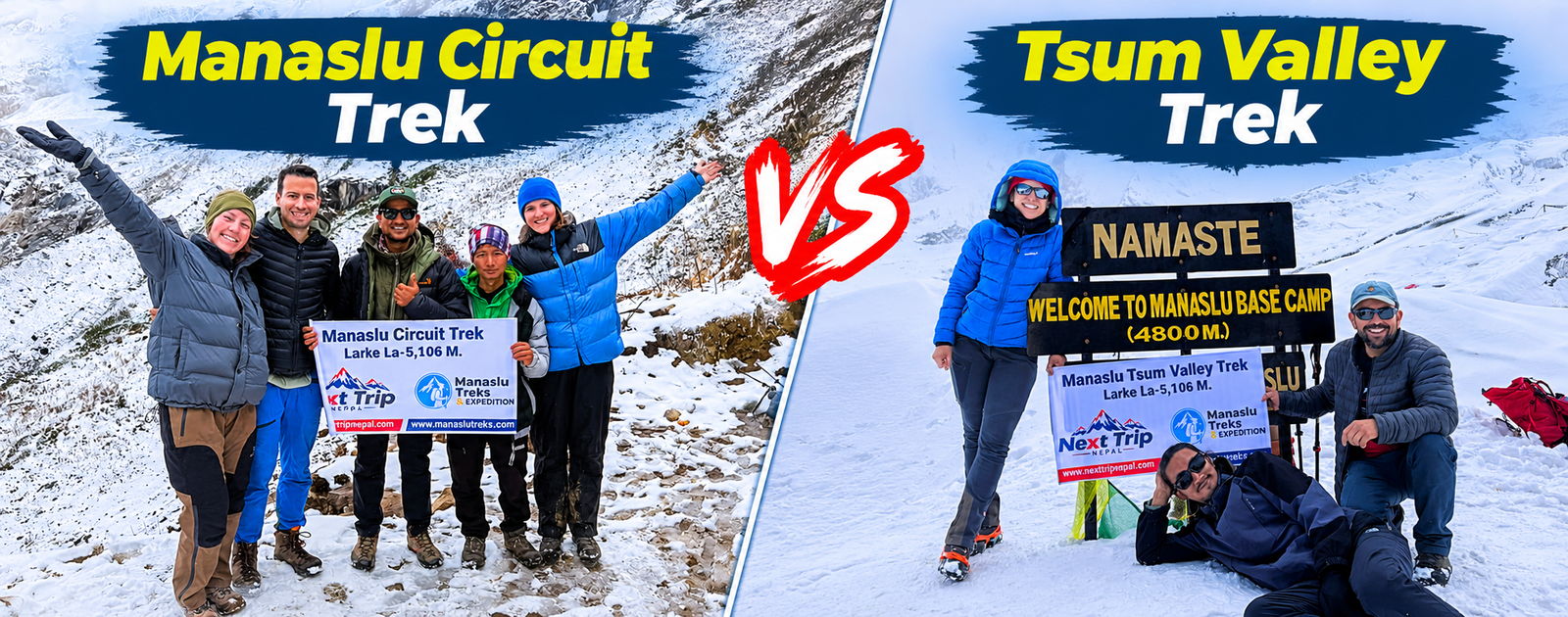
If you have spent any time researching trekking in the Manaslu region, you have probably run into two trip names that sound related but are not quite the same thing: the Manaslu Circuit Trek and the Manaslu Tsum Valley Trek. Both circle the eighth highest mountain in the world. Both climb through the Budhi Gandaki river valley. Both cross the same high pass. And both require special paperwork that most other Nepal treks do not. So which one should you actually book?
This is the question we get asked constantly, usually from trekkers who have already read our general itinerary guide and now just want a straight answer about which version fits their time, budget and interests. We are not going to repeat the full day by day breakdown here (that lives in our Manaslu Tsum Valley Trek Guide, which covers permits, cost and the complete itinerary in detail). Instead, this article is a decision tool. We will walk through how the two routes actually relate to each other on the map, how many days each one really takes, what the permit situation looks like, how the difficulty compares, and who tends to be happiest on each trip. By the end you should know, with some confidence, which trek belongs on your calendar.
We want to be upfront about something before we go further. Neither trek is objectively the better trek. We get emails every season from trekkers worried they are about to make the wrong choice, and almost always the honest answer is that both choices are good ones, suited to slightly different priorities. Our job in this article is not to talk you into the longer, more expensive version, it is to give you enough real detail on both trips that you book the one that actually matches your calendar, your budget and what you personally want out of three or four weeks in the Himalaya.
Two Routes, One Mountain: How They Actually Relate Geographically
The easiest way to understand the relationship between these two treks is to stop thinking of them as two separate trips and start thinking of them as one trail system with an optional branch. Both treks begin the same way, from the roadhead near Soti Khola or Machha Khola in the Gorkha district, following the Budhi Gandaki river north. You pass through a string of lower villages, cross a series of exposed suspension bridges, and gradually climb into terrain shaped by the Manaslu massif itself. Both routes pass through Jagat, Deng (sometimes spelled Dyang), and continue up toward Samagaon, the main acclimatization village under Manaslu’s south face, before pushing on to Samdo and Dharamsala (also called Larke Phedi) and finally crossing the high pass.
That high pass is Larke La, sometimes written Larkya La, sitting at an elevation generally cited around 5,106 meters (a handful of sources put it slightly higher, closer to 5,160 meters, which is a normal amount of variation for a remote Himalayan pass where GPS readings and old survey data do not always agree). Larke La is the single hardest day on either trek and the reason both itineraries build in careful acclimatization before the crossing. After the pass, both routes descend into the Marsyangdi valley near Bimthang and eventually connect with the Annapurna region road network around Dharapani or Tal, where most groups end the trek by vehicle.
So where does the Tsum Valley actually fit in? The detour happens early, before Samagaon. Somewhere around Lokpa or just past Deng, the Manaslu Tsum Valley Trek route breaks off the main Budhi Gandaki trail and climbs north into a side valley that most Manaslu Circuit trekkers never see at all. This is the Tsum Valley, a long, narrow, historically isolated valley that was only opened to foreign trekkers in 2008. The Tsum detour passes through Chhekampar, Nile, and the remarkable monastery at Mu Gompa near the valley’s upper end, close to the Tibetan border, before looping back down through villages like Rachen and Gumba Lungdang and rejoining the main circuit trail near Chumling or further down toward Lokpa and Deng.
In practical terms, if you draw it on a map, the Manaslu Circuit Trek is a relatively direct line up one valley and down the other side of a pass. The Manaslu Tsum Valley Trek is that same line with a loop stitched into the lower third of it, a there and back excursion into a second valley before the trek continues on to the part both itineraries share. Every traveler doing the combined version eventually walks the exact same stretch of trail that the standalone circuit trekkers walk, including the climb to Samagaon and the crossing of Larke La. The Tsum detour is additive, not a replacement for any part of the circuit.
It helps to picture the whole system as a capital letter Y lying on its side. The base of the Y is the shared lower trail along the Budhi Gandaki. One arm of the Y branches north into Tsum Valley and dead ends at Mu Gompa before doubling back. The other arm continues northeast up toward Samagaon, Samdo, Larke La and down into the Marsyangdi valley. A standalone circuit trekker only ever walks the base and that second arm. A combined trek trekker walks the base, detours up the first arm and back, then continues along the second arm exactly as the circuit trekker does. Thinking about it this way makes it much easier to understand why the two itineraries share so much trail time and so many of the same villages near the bottom of the route.
Duration: How Many Days Do You Actually Need
This is usually the first practical filter for most trekkers, because duration determines how much vacation time you need to request and how much the trip is going to cost in guide and porter wages alone.
The standalone Manaslu Circuit Trek is commonly sold in the range of roughly 14 to 16 days total, counting arrival and departure days in Kathmandu and a buffer day or two for weather or altitude. Some operators offer tighter 12 day versions for strong, time pressed trekkers, and some stretch it to 17 or 18 days with extra rest days in Samagaon or an extra night near the pass for safety. There is real variation across companies here, driven by how many acclimatization days are built in, whether the trek starts from Soti Khola or a point further up the new road, and how the itinerary handles the exit toward Besisahar or Kathmandu. If you see a company advertising an 8 or 9 day Manaslu trek, read the fine print carefully, because that is almost always flying time or a partial itinerary rather than a full circuit with the pass crossing.
The combined Manaslu Tsum Valley Trek runs noticeably longer. Our own itinerary for the combined trip, laid out in full in the Manaslu Tsum Valley Trek Guide, comes in at around 20 days including the Kathmandu bookend days. That length is consistent with what we see across the industry generally. The Tsum detour alone typically adds somewhere between five and seven extra trekking days, since you are walking up one side of the Tsum valley, spending a night or two around Nile and Mu Gompa to acclimatize and explore the monasteries, then walking back down the other side before rejoining the circuit trail. Add that to a circuit that already needs 14 to 16 days and you land squarely in the 19 to 21 day range that most combined itineraries quote.
The honest takeaway here is simple arithmetic. The Tsum Valley portion costs you roughly five to seven additional days on trail compared with doing the circuit alone. If you have three weeks or more free, that is a reasonable trade. If you are working with a strict two week window, including flights, the standalone circuit is going to be the more realistic option, and trying to squeeze the combined trek into that window usually means cutting acclimatization time you should not be cutting.
It is also worth thinking about how those days are actually distributed, not just the total count. On the standalone circuit, nearly every day moves you forward along the same line, up one valley and down the other. There is very little backtracking. On the combined trek, roughly a third of the extra time is effectively a there and back loop, meaning you walk the same lower stretch of trail twice, once heading up toward Tsum and once coming back down to rejoin the main route. Some trekkers love this because it means a second, closer look at villages like Lokpa and Chumling under different light and at a different point in their trip. Others find it slightly repetitive. Either way, it is useful to know going in that the combined itinerary is not simply a longer straight line, it has a genuine loop built into its lower section, and your guide will plan rest days and acclimatization around that shape rather than around a single steady climb.
Permits and Paperwork: What Each Trek Actually Requires
Both treks sit inside a restricted border area, which means the permit process is more involved than a standard Annapurna or Everest region trek where an independent trekker can often just show up and buy a permit locally.
For either version of the trip you will need two core permits. The first is the Manaslu Restricted Area Permit (commonly abbreviated RAP), issued by Nepal’s Department of Immigration, which allows foreign trekkers into the restricted northern section of the Manaslu region at all. This permit can only be arranged through a registered trekking agency, is priced on a weekly basis with a higher daily rate for any days beyond the first week, and requires a minimum of two trekkers traveling together (solo trekkers typically need to be paired with another trekker or guide to satisfy this rule). The second is the Manaslu Conservation Area Permit (MCAP), which funds conservation work in the area and is required for both route versions as well. Many itineraries, depending on exactly where the trek exits near the Annapurna side, also pick up an Annapurna Conservation Area Permit (ACAP) for the final stretch of trail.
If you add the Tsum Valley detour, there is one more document: the Tsum Valley Restricted Area Permit. This is a separate permit from the Manaslu RAP, covers your days inside the Tsum valley specifically, and carries its own fee structure and local conservation fees collected on behalf of the Tsum Welfare Committee. Because this is an additional restricted area permit rather than an add on stamp to the Manaslu permit, it means more paperwork for your agency to prepare, more lead time required before departure (your passport details, photos and trip dates generally need to be submitted to the relevant offices in advance), and, in practice, less flexibility to decide last minute that you want to add the Tsum detour once you are already on the trail. If visiting Tsum Valley matters to you, it is worth confirming with whichever company you book that this permit is being arranged from the start, not improvised once you reach Gorkha.
One thing that has not changed for either trek is the guide requirement. Nepal requires a licensed guide for all travel in the Manaslu restricted area, so there is no fully independent, guideless version of either trip, unlike some other Nepal treks where solo trekking without a guide is technically possible. Budget and plan for a guide (and usually porters) on both the circuit alone and the combined trek.
Lead time is another practical difference worth flagging. Because restricted area permits require advance paperwork through the Department of Immigration and local offices, we generally ask trekkers booking either trip to confirm dates and send passport details at least a few weeks before departure, longer in peak spring and autumn months when permit offices are busier and agencies are processing a higher volume of applications. Adding the Tsum Valley permit on top of the Manaslu paperwork does not usually change that lead time dramatically, but it does mean one more document moving through the system, and we would rather build in a comfortable buffer than ask you to rush a visa run or a last minute passport scan right before you fly.
Cost Differences Between the Two Treks
We want to be careful here and not pretend to know exact current pricing down to the dollar, because permit fees, park fees and operator rates shift from season to season and we would rather be honest than hand you a number that is stale by the time you read this. What we can say with confidence is the direction of the difference and the reasons behind it.
The combined Manaslu Tsum Valley Trek costs more than the standalone circuit, for three straightforward reasons. First, it simply runs longer, and every extra day on trail means an extra day of guide and porter wages, teahouse accommodation, and meals, which make up a meaningful share of any trekking budget in this region. Second, it requires an additional restricted area permit (the Tsum Valley permit on top of the Manaslu RAP), and that permit fee is a real added cost on top of the baseline Manaslu permits both treks share. Third, the Manaslu RAP itself is charged on a weekly basis with a jump in the daily rate once you pass the first week, so a longer combined itinerary can land in a higher per day permit bracket than a shorter standalone circuit does.
None of this means the combined trek is dramatically more expensive in a way that should scare anyone off. It means, directionally, that you should expect the Tsum Valley version to sit meaningfully above the standalone circuit in total price, largely in proportion to the extra days and the extra permit. For exact current figures we would always point you toward the specific trip pages for the Manaslu Circuit Trek and the Manaslu Tsum Valley Trek, since pricing is kept current there and depends on group size, season and exactly which services are included.
Difficulty and Remoteness: How the Two Treks Actually Compare
Both treks are demanding by general trekking standards. Neither one is a casual walk, and neither should be anyone’s first ever multi day hike. The Larke La crossing alone, a long summit day typically starting in the dark, climbing to just over 5,100 meters before a long knee jarring descent to Bimthang, is a serious day on any version of this trek and the main reason Manaslu has a reputation as a tougher, more committing alternative to Everest Base Camp or the Annapurna Circuit.
Where the two trips diverge is in what comes before that pass day. On the standalone Manaslu Circuit Trek, the acclimatization strategy is fairly linear: you climb steadily through the Budhi Gandaki valley, take a planned rest day in Samagaon to acclimatize and typically hike up toward Manaslu Base Camp or the Pungen glacier viewpoint, then continue to Samdo and Dharamsala before the pass. It is demanding, but it follows a single, well trodden acclimatization pattern that guides on this route know extremely well.
The Tsum Valley detour adds its own layer of complexity before you even reach that stage. You are now gaining and losing altitude inside a separate valley system, visiting Chhekampar, Nile and Mu Gompa (itself sitting at a respectable altitude near 3,700 meters), before dropping back down and rejoining the main circuit trail to begin the climb toward Samagaon and Larke La all over again. This is not technically harder trail in terms of terrain, the Tsum valley paths are generally gentler than the exposed, landslide prone sections lower in the Budhi Gandaki gorge, but it is a longer overall physical commitment, with its own acclimatization curve, layered on top of the climb and pass crossing that the standalone trek already demands. For a full breakdown of fitness expectations and a suggested training timeline specifically for the combined route, our Manaslu Tsum Valley Trek Difficulty guide goes into this in more depth than we have room for here.
Remoteness is the other half of this comparison, and it is where Tsum Valley genuinely earns its reputation. The standalone Manaslu Circuit already sees meaningfully less traffic than Everest or Annapurna, since the restricted permit and guide requirement filter out a lot of casual trekkers. Tsum Valley takes that quietness a step further. Lodge numbers are smaller, villages are more spread out, and on a lot of days you will share the trail with very few other foreign trekkers, mostly local traders, pilgrims and monks moving between gompas. If solitude and a genuine sense of being somewhere lightly visited matter to you, the combined trek delivers noticeably more of that than the circuit alone, which, while still quiet by Everest or Annapurna standards, has gotten busier in recent years as the Manaslu region’s reputation has grown.
There is a practical, less romantic side to that remoteness too, and we think trekkers deserve to hear it plainly rather than only the scenic version. Fewer lodges in Tsum Valley means fewer choices if a particular teahouse is full, fewer backup options if weather forces a change of plan, and in general a thinner safety net than the main circuit trail offers, where traffic volume has supported a slightly larger network of lodges, shops and, in some villages, better phone or internet connectivity. None of this is a reason to avoid Tsum Valley. It is simply part of what remoteness actually means on the ground, and a reputable guide who knows the valley well becomes even more valuable on this stretch than on the busier lower trail.
Scenery and Culture: What You Actually See on Each Route
Even without the Tsum detour, the standalone Manaslu Circuit Trek is a genuinely rich trip, scenically and culturally. The lower villages along the Budhi Gandaki are largely Gurung, giving way as you climb to a strongly Tibetan influenced culture around Samagaon, Samdo and the upper valley, where chortens, mani walls and prayer flags frame the trail and Manaslu’s south face dominates the skyline for days. The Manaslu Conservation Area itself protects a huge range of terrain, from subtropical forest low down to high alpine desert near the pass, and the mountain views, not just of Manaslu but of Himlung Himal, Cheo Himal and the peaks around Larke La, rank among the best in Nepal. You finish by descending into the Marsyangdi valley with views back toward Annapurna II and Lamjung Himal. None of that scenery or cultural texture is lost by skipping the Tsum detour.
What the Tsum Valley adds is a genuinely different cultural layer rather than more of the same. Because the valley was closed to outsiders until 2008 and remains lightly visited, the Buddhist culture there has developed with very little outside influence, and the valley has a reputation among older Tibetan Buddhist scholars as a place of particular spiritual significance, associated with the meditator Milarepa. You pass through villages like Chhekampar and Nile that feel noticeably older and quieter than the lower Manaslu villages, visit monasteries including Rachen Gompa, Mu Gompa, and the nunnery and retreat center at Gumba Lungdang, and get a far closer look at everyday rural Tibetan Buddhist life than the main circuit trail offers. The scenery inside Tsum itself is a little different in character too, a wider, gentler valley floor with its own backdrop of peaks, rather than the tighter gorge walking lower in the Budhi Gandaki. Trekkers who care specifically about monastery visits, prayer wheel lined village lanes and a slower, more contemplative pace will find the detour worth the extra days. We go into the valley’s history, festivals and individual monasteries in a lot more depth in our separate Tsum Valley Culture and Monasteries guide, which is worth reading before you go either way, since it will help you decide how much that cultural layer actually matters to your own trip.
Who Should Choose the Standalone Manaslu Circuit Trek
The standalone circuit tends to suit a particular kind of trekker, and there is nothing wrong with recognizing yourself in this list rather than assuming you need the longer version.
- Time constrained trekkers. If you have two weeks or less of usable vacation time once flights are factored in, the roughly 14 to 16 day circuit fits a tighter schedule far more comfortably than a 20 day combined trip.
- First time high altitude trekkers who still want a serious challenge. The circuit and the Larke La crossing are demanding enough to feel like a real accomplishment without adding the extra days and logistics of a second restricted valley on top.
- Budget conscious trekkers. Fewer days and one less permit mean a lower overall cost, which matters if Manaslu is one stop on a longer multi country trip rather than the sole focus of your travel budget.
- Trekkers mainly drawn to the mountain views and the pass itself. If Larke La and Manaslu’s south face are the main draw rather than deep cultural immersion, the standalone circuit delivers that core experience efficiently.
- Anyone who has already visited Tibetan Buddhist valleys elsewhere in Nepal, such as Upper Mustang or parts of Dolpo, and would rather prioritize new terrain than another monastery heavy side valley this time around.
If you recognize yourself in that list, the standalone Manaslu Circuit Trek booking page has full details on the trip we run, including group departure dates and what is included.
Who Should Choose the Combined Manaslu Tsum Valley Trek
The combined version earns its extra days and extra cost with a different kind of trekker in mind.
- Trekkers who want maximum cultural depth from a single trip. If monasteries, village life and genuine Tibetan Buddhist culture matter as much to you as mountain scenery, the Tsum detour is specifically built to deliver that.
- Anyone with three weeks or more available. A trip in the 19 to 21 day range needs real time on the calendar, and trying to compress it defeats the purpose of adding the detour in the first place.
- Repeat Himalaya trekkers looking for something quieter than Everest or Annapurna. If you have already done the big name treks and want a region that still feels genuinely under visited, the combined trek pushes further into that territory than the circuit alone.
- Photography and culture focused travelers. The light, the architecture and the slower pace of daily life in Tsum Valley reward travelers who want to linger, photograph and actually spend time in villages rather than just pass through them.
- Trekkers who may not return to this specific region again. If this is a once in a lifetime trip to the Manaslu area, a lot of past trekkers tell us they would rather see both the circuit and Tsum Valley in one visit than wonder later whether they should have added the detour.
If that sounds like your trip, the combined Manaslu Tsum Valley Trek package is the one to book, and our Manaslu Tsum Valley Trek Guide has the complete itinerary, permit checklist and cost breakdown to help you plan the logistics once you have decided.
Side by Side: The Two Treks at a Glance
To pull everything above into one place, here is a direct comparison of the two trips across the factors that actually drive most people’s decision.
- Route: The Manaslu Circuit Trek follows the Budhi Gandaki valley directly to Samagaon and over Larke La. The Manaslu Tsum Valley Trek follows that same lower trail but detours north into the Tsum valley through Chhekampar, Nile and Mu Gompa before rejoining the circuit near Chumling or Deng and continuing over the same pass.
- Typical duration: The standalone circuit generally runs around 14 to 16 days including Kathmandu days, with some shorter and longer variations across operators. The combined trek generally runs around 19 to 21 days, commonly marketed as 20 days.
- Permits required: Both trips need the Manaslu Restricted Area Permit and the Manaslu Conservation Area Permit (plus often an Annapurna Conservation Area Permit near the exit). The combined trek additionally requires the Tsum Valley Restricted Area Permit and associated local fees.
- Relative cost: The combined trek costs more overall, driven mainly by the extra days on trail and the extra permit, though exact figures vary by season and operator and should be confirmed on current trip pages.
- Difficulty: Both treks share the demanding Larke La crossing near 5,100 meters. The combined trek adds a genuinely remote secondary valley with its own altitude and acclimatization considerations before that crossing, making it the bigger overall physical and logistical undertaking.
- Crowd levels: The standalone circuit is already quieter than Everest or Annapurna. The Tsum detour is quieter still, with some of the least trafficked trail and lodges in the broader Manaslu region.
- Cultural depth: The circuit alone passes through Gurung and Tibetan influenced villages with strong mountain views throughout. The combined trek adds a historically isolated Tibetan Buddhist valley with its own distinct monasteries, festivals and village culture on top of everything the circuit already offers.
- Best suited to: The standalone circuit suits time constrained, budget conscious or first time high altitude trekkers. The combined trek suits trekkers with three or more weeks, repeat Himalaya travelers wanting something less crowded, and anyone prioritizing culture and photography alongside mountain scenery.
The Honest Truth: This Is One Trail System With One Meaningful Detour
We think it is worth saying plainly, because a lot of marketing around these two trips makes them sound like entirely different adventures when they are not. Underneath the branding, the Manaslu Circuit Trek and the Manaslu Tsum Valley Trek share the vast majority of their route, their permit structure, their guide requirements and their signature challenge at Larke La. The real decision is not between two wildly different trips to two different parts of Nepal. It is between walking a there and back loop into one additional valley or skipping that loop and getting to the pass and back a bit sooner, for a bit less money and a bit less paperwork.
That framing matters because it takes a lot of pressure off the decision. You are not going to pick wrong in some dramatic sense either way. Choose the standalone circuit and you still get genuine Manaslu culture, a serious high pass crossing and some of the best mountain scenery in Nepal, in a tighter, more affordable window. Choose the combined trek and you get all of that plus a deeper, quieter cultural detour, at the cost of roughly a week more time and a somewhat higher price tag. The right call really comes down to three practical questions: how much time do you actually have, what is your budget comfortable with, and how much do you personally care about the kind of slow, monastery centered cultural immersion that Tsum Valley specifically offers. Answer those three questions honestly and the choice tends to make itself.
Frequently Asked Questions
Is the Manaslu Tsum Valley Trek just a longer version of the Manaslu Circuit Trek?
Essentially, yes. The combined trek follows the same lower trail as the standalone circuit, adds a detour north into the Tsum valley, then rejoins the circuit route and finishes over Larke La exactly the same way the standalone trek does. It is not a different mountain or a different pass, just an additional valley stitched into the itinerary.
Can I add the Tsum Valley detour onto a Manaslu Circuit Trek after I have already booked it?
Not easily, and we would not recommend planning on it. The Tsum Valley Restricted Area Permit is a separate document that generally needs to be arranged in advance alongside your other permits, with passport and trip details submitted ahead of departure. If there is any chance you want to see Tsum Valley, tell your operator before booking rather than trying to decide on the trail.
Which trek is harder, the Manaslu Circuit or the Manaslu Tsum Valley Trek?
Both share the same hardest single day, the Larke La crossing near 5,100 meters, so neither trek avoids that challenge. The combined Tsum Valley version is the bigger overall undertaking because it adds extra days, extra altitude changes inside the Tsum valley, and a longer cumulative physical load before you even reach the circuit’s main climb toward the pass.
How many extra days does the Tsum Valley detour actually add?
Generally somewhere between five and seven additional trekking days compared with the standalone circuit, depending on the specific itinerary and how many acclimatization or exploration days are built in around Nile and Mu Gompa.
Do both treks require the same permits?
They share the Manaslu Restricted Area Permit and the Manaslu Conservation Area Permit (and often an Annapurna Conservation Area Permit near the end of the route). The Manaslu Tsum Valley Trek additionally requires the Tsum Valley Restricted Area Permit, which the standalone circuit does not need.
Is the Manaslu Circuit Trek less crowded than Everest Base Camp or the Annapurna Circuit?
Generally, yes. The restricted permit and mandatory guide requirement keep numbers lower than on Nepal’s two most popular trekking routes, though the Manaslu region has grown steadily more popular in recent years. If you want fewer trekkers still, the Tsum Valley detour goes a step further.
What is the best time of year to do either trek?
Both treks run on broadly the same seasonal windows as most Nepal high altitude treks, primarily spring (roughly March through May) and autumn (roughly September through November), when weather and visibility over the pass are generally most reliable. Winter brings heavy snow risk at Larke La and summer brings monsoon rain and landslide risk lower in the Budhi Gandaki gorge, so both are generally avoided for either version of the trip.
Do I need previous trekking experience for either route?
Previous multi day trekking experience at altitude is strongly recommended for both trips, since neither one should be a first ever hike. The standalone circuit is a reasonable next step up for trekkers who have completed a shorter teahouse trek elsewhere in Nepal and are ready for a bigger pass. The combined Tsum Valley trek, given its extra length and added remoteness, generally suits trekkers who already have at least one serious high altitude trek behind them.
Can beginners do either the Manaslu Circuit Trek or the Manaslu Tsum Valley Trek?
Trekkers with zero previous multi day hiking experience can and do complete both treks successfully, usually with a well paced itinerary, a strong guide and a realistic training plan in the months before departure. That said, we would still steer a true first time trekker toward something shorter and lower, like a classic Annapurna teahouse route, before taking on either Manaslu trip, simply because Larke La is a genuinely serious pass and this region sees far less rescue infrastructure than Everest or Annapurna if something goes wrong.
Which trek has better mountain views, the circuit or the combined trip?
The core mountain views, Manaslu’s south face, the climb to Samagaon and the panorama from Larke La itself, are identical on both trips, since the combined trek simply adds the Tsum valley on top of the same circuit route. Tsum Valley adds its own scenery, a gentler, wider valley with a different character, but it does not replace or improve on the circuit’s core mountain views, it adds an additional, different kind of view alongside them.
Whichever version fits your trip, the good news is you cannot really go wrong. Both routes put you on one of the most rewarding, least crowded trekking circuits in Nepal, under a genuinely spectacular mountain. If you still are not sure after reading this, our team is always happy to talk through your dates, fitness level and interests directly and help you land on the right one before you book either the Manaslu Circuit Trek or the Manaslu Tsum Valley Trek.