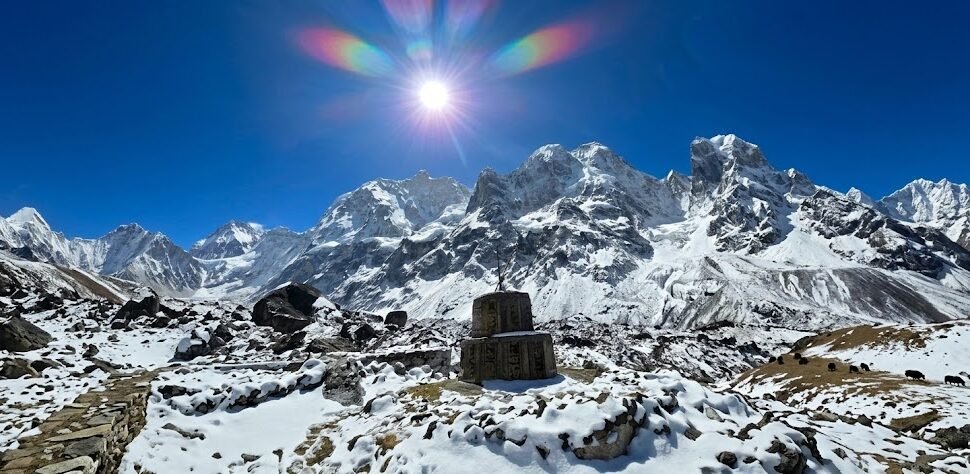
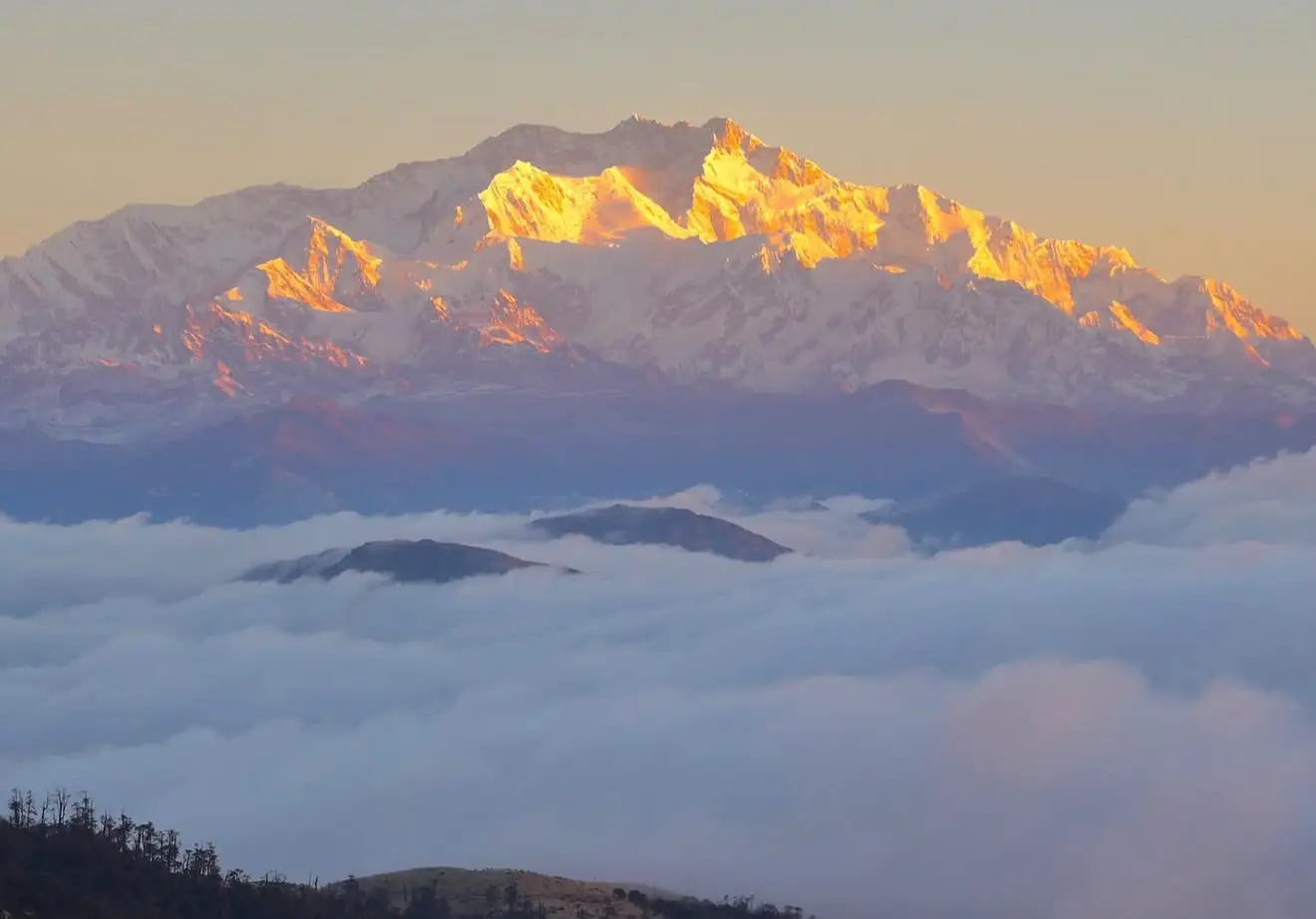
Yes, April is one of the two strongest months of the year for the Kanchenjunga Circuit Trek, and for a reason that is easy to miss from a spreadsheet of temperature ranges: this is the month the forest itself becomes part of the scenery. Between Sekathum and Ghunsa, the lower and middle sections of the Kanchenjunga Conservation Area fill with blooming rhododendron, oak and mixed broadleaf forest, layered under snow peaks that are still fully in their winter coat. Nowhere else on this circuit do the two halves of the trip, the flowers below and the ice above, sit this close together.
April is spring’s peak month here, the direct counterpart to October on the autumn side of the calendar. It shares October’s basic appeal, a workable window between winter snow and the June monsoon, but the two months arrive at that window from opposite directions and feel genuinely different on the ground, particularly in how the afternoons behave. This guide covers Kanchenjunga weather in April week by week, exactly how the elevation gradient changes what you need to pack, current cost and permit figures, and an honest three way comparison against March and May so you can decide with real information rather than a generic “spring is nice” summary.
Kanchenjunga Trek in April at a Glance
| Factor | April on the Kanchenjunga Circuit |
|---|---|
| Daytime temperature | Roughly 8 to 18 degrees Celsius in the lower and middle valleys, cooler above Ghunsa |
| Night temperature | Roughly 2 to 5 degrees Celsius lower down, down to about 8 to 12 degrees below freezing at Lhonak and Ramche |
| Rain | Occasional light afternoon showers possible by late April, otherwise mostly dry |
| Cloud and visibility | Mornings usually clear, afternoon cloud building becomes a daily pattern by mid to late April |
| Rhododendron bloom | Near or at peak through the lower and middle forest zone, roughly Sekathum to Ghunsa |
| Crowd level | Low by most trek standards, moderate for Kanchenjunga, noticeably quieter than October |
| Permit note | Kanchenjunga Restricted Area Permit, Kanchenjunga Conservation Area Permit and TIMS all required, guide mandatory |
| Overall rating | Excellent, one of the two best months of the year alongside October |
Those numbers describe an average day, not every day. The real value of an April trek is understanding how the month changes shape as it goes, and how conditions at Ghunsa’s 3,450 meters relate almost not at all to conditions at Lhonak’s 4,780 meters on the same date. Both of those threads run through the rest of this guide.
Kanchenjunga Weather in April: Temperature, Cloud and Visibility
Next Trip Nepal’s own operating range for the spring season on this route puts daytime temperature at roughly 5 to 18 degrees Celsius and night temperature at roughly 5 degrees below freezing to 5 degrees above, across March, April and May combined. April sits in the warmer half of that spread. Early April still carries some of March’s crisp, settled character. By the last third of the month, daytime warmth at the lower villages is real, shorts and a light shirt weather in the early afternoon at Sekathum or Amjilosa, even while Lhonak two long days above is still a place where water left outside a teahouse freezes overnight.
| Element | Typical pattern in April |
|---|---|
| Daytime, lower and middle valleys (Sekathum to Ghunsa) | 10 to 18 degrees Celsius, often warmer in direct sun at midday |
| Daytime, upper route (Kambachen, Lhonak, Sele La, Ramche) | 2 to 10 degrees Celsius, colder in wind and on the pass day itself |
| Night, lower and middle valleys | 2 to 8 degrees Celsius |
| Night, upper route | Commonly 5 to 12 degrees below freezing, occasionally colder at Lhonak |
| Rain | Light and occasional, more likely as an afternoon shower in the last week of April than earlier in the month |
| Snow at high elevation | Possible above about 4,000 meters, especially early in the month or during a passing weather system, less likely and generally lighter than in March |
| Visibility | Reliably good in the morning through most of April, afternoon haze and cloud building becomes the norm by mid month onward |
| Wind | Moderate, strongest around the Sele La ridge system and at Pang Pema and Oktang |
The single most useful thing to understand about April weather here is the daily rhythm, not the monthly average. Mornings are the reliable window. Cold, still air overnight settles the atmosphere, and cloud that builds through the previous afternoon tends to clear out by early morning, leaving the first several hours after sunrise as the clearest and calmest part of the day for mountain views and photography. Warm air rising off the valleys through the late morning and early afternoon then starts pulling moisture upward, and by early to mid afternoon a layer of cloud has typically built over the ridgelines and higher peaks, sometimes clearing again toward evening, sometimes not.
This is a genuinely different visibility pattern than autumn’s. October, the other peak month on this circuit, tends to deliver clearer days from morning through afternoon with fewer disruptions, because the atmosphere right after monsoon withdrawal carries less moisture overall. April’s spring air, warmed by a sun that is climbing toward its highest angle of the year, holds more moisture and convects more readily in the afternoon. Neither pattern is wrong for trekking Kanchenjunga, but they call for different habits. In April, plan photography, pass crossings and any specific base camp viewpoint attempts for the morning hours whenever the itinerary allows it, and treat a clouded over afternoon as completely normal rather than a sign the trip is going badly.
None of this changes the fact that a four season sleeping bag rated to at least 15 degrees below freezing remains standard equipment for this route in April, exactly as it is in every other month. Warm days at Ghunsa do not translate into warm nights at Lhonak or Ramche, and a late season snow event at the higher elevations, while less likely than in March, is not impossible in April. More on exactly how that plays out by elevation below.
Early, Mid and Late April on the Kanchenjunga Circuit
Treating April as one uniform block misses most of what makes it worth choosing. The month has three distinct characters, and which third of April your trip lands in genuinely changes what you should expect and pack for.
| Period | Character | Practical note |
|---|---|---|
| Early April (roughly days 1 to 10) | Generally the most stable stretch of the month, cooler than late April, closest in feel to a settled tail end of March without March’s higher snow risk on the passes | Best odds for consistently clear conditions through more of the day, still requires full cold weather gear above Ghunsa |
| Mid April (roughly days 11 to 20) | Rhododendron bloom typically approaching or at its best through the lower and middle forest, daytime warmth building noticeably in the valleys, afternoon cloud starting to become a regular feature rather than an occasional one | Strong window for combining flower season with reasonably reliable morning mountain views, plan key viewpoints for the morning |
| Late April (roughly days 21 to 30) | Warmest part of the month at lower elevations, afternoon cloud building is now close to a daily pattern, first hints of pre monsoon humidity begin appearing by the very end of the month | Mornings still reliably clear for views and photography, afternoons less so, occasional light shower possible, still cold and occasionally snowy at Lhonak, Ramche and on the Sele La crossing |
Early April rewards trekkers who most want dependable mountain visibility and are willing to accept slightly less advanced rhododendron bloom at the lower elevations in exchange for it. Mid April is arguably the sweet spot for most travelers, catching strong flowering forest while conditions are still closer to early April’s stability than late April’s afternoon cloud pattern. Late April suits trekkers most drawn to the fullest expression of the bloom and the warmest, most comfortable lower valley walking of the whole spring, provided they accept that afternoon views become noticeably less reliable and plan their itinerary, and their expectations, around clear mornings rather than all day visibility.
One thing does not change across any third of April: everything from Ghunsa upward still operates on its own separate weather system. A traveler who books in the third week of April expecting Sekathum’s warmth to extend all the way to Pang Pema is planning for a trek that does not exist. The elevation gradient section below covers this directly.
Rhododendron Season: Why April Is Different
This is the section that actually separates April from every other month on the Kanchenjunga calendar, so it is worth spending real time on rather than a single line.
The Kanchenjunga Conservation Area’s forest zones run in bands with elevation, exactly as the fact sheet for this trek describes: rhododendron, oak and mixed broadleaf forest at lower elevations, giving way to birch and juniper further up, then sparse alpine vegetation and bare moraine near Lhonak and both base camp areas. The rhododendron and mixed broadleaf band sits roughly between Sekathum, at about 1,650 meters, and Ghunsa, at about 3,450 meters, with the richest and most visually dense stretches generally found through Amjilosa and Gyabla. April is the month that band is at or near its best bloom, well ahead of the alpine zones above Ghunsa, which show essentially no flowering forest at all since the vegetation there is too sparse and the elevation too high.
The practical result is a trek that changes character completely depending on which day you are on. Days one through four or five, from Sekathum through Amjilosa and Gyabla into Ghunsa, walk through forest that in a strong April can be genuinely spectacular, red and pink rhododendron blooms layered against dark green oak canopy, with occasional gaps in the trees opening onto the first big mountain views of the trip. This is also, honestly, the busiest the trail gets all trip, since day trekkers, photographers and other April travelers concentrate in this same lower band for the same reason.
Bloom timing is never exact and shifts a little year to year with how warm or cool the preceding winter was, but April as a whole is the reliable window for it on this route, more reliable than March, when lower elevation blooms are often only just beginning, and considerably more reliable than May, when the lower forest bloom has typically already faded even though flowering at slightly higher elevations can still be found in early May. If seeing the rhododendron forest in genuine bloom is a real priority rather than a nice bonus, April is the month to build the trip around, and mid to late April specifically tends to show the fullest flowering at these elevations.
Two honest caveats. First, bloom is a natural event, not a scheduled one, and no operator can guarantee peak flowering on any specific date, only give you the strongest statistical window, which is what this section does. Second, the reward comes with a cost in comfort: the same warmth that pushes the bloom forward also means the lower valley days in April run noticeably warmer and more humid at midday than the same days in March, so lighter layers and good sun protection matter more in this stretch of the trek than most people expect from a trip that ends above 5,000 meters.
Route Conditions by Elevation and Why the Trek Stays Strenuous in April
April’s elevation gradient is the single most useful piece of practical information for packing decisions this month, because the trek genuinely runs through three different climates in the space of about a week of walking.
| Section | Approximate elevation | Conditions in April |
|---|---|---|
| Lower trail (Sekathum to Ghunsa) | 1,650 to 3,450 meters | Warm, increasingly green, rhododendron and mixed broadleaf forest at or near peak bloom, busiest section of trail, daytime warmth building through the month |
| Middle section (Ghunsa to Kambachen) | 3,450 to 4,050 meters | Noticeably cooler than below, forest thinning to birch and juniper, first genuinely cold nights of the trip, full insulated layers needed from here on |
| High altitude section (Kambachen to Lhonak, plus Sele La Kharka, Cheram, Ramche) | 4,050 to 4,780 meters | Cold by day, well below freezing at night, sparse alpine vegetation and bare ground, wind exposure on open sections, a late season snow event remains possible here even in April, rarer than in March but genuinely not impossible |
| Base camp areas (Pang Pema and Oktang) | 4,730 to 5,140 meters | Cold, exposed, best visited early in the morning before afternoon cloud builds, full winter level clothing required regardless of how warm the lower valleys felt days earlier |
Put simply, a trekker who packs based only on the warm, green photographs typical of lower April Kanchenjunga content is under equipped for Lhonak, Ramche and the Sele La crossing, all of which sit above 4,000 meters and behave like a cold season environment regardless of the calendar date. The reverse mistake, packing as if the entire trek matches Lhonak’s conditions, means carrying unnecessary bulk and overheating badly on the warm lower days. Neither extreme is right; the trek asks you to pack for both climates and use each layer where it belongs.
Difficulty itself does not soften in April compared with any other trekking month, since it comes from the route’s structure rather than the season, as our full Kanchenjunga trek difficulty notes explain in more depth. This is a genuine circuit, not an out and back, roughly 200 to 220 kilometers of total walking depending on side trips and how much of the road section at either end is covered by jeep, reaching Kanchenjunga North Base Camp at Pang Pema around 5,140 meters on one side and Kanchenjunga South Base Camp at Oktang around 4,730 meters on the other, linked by the Sele La crossing, a ridge system of four named passes, Sele La, Sinion La, Mirgin La and Sinelapche La, each in the rough range of 4,170 to 4,660 meters, crossed mostly in a single long day of 8 to 10 hours with heavy undulation. Daily walking hours regularly run 5 to 9 hours across the whole itinerary, and the trail stays above roughly 3,400 meters for several consecutive days from Ghunsa onward, passing 4,000 meters again around Kambachen and Lhonak.
Two dedicated acclimatization days are built into the standard 22 day itinerary for our Kanchenjunga Circuit Trek, one at Ghunsa and one at Kambachen, plus a contingency and weather buffer day ahead of the Sele La crossing, and April benefits from that buffer as much as any other month, since a late snow event or a socked in pass day is still possible and the schedule needs room to absorb it. This route is graded strenuous, best suited to fit trekkers with prior multi day mountain trekking experience, and it is not recommended as anyone’s first ever high altitude trek, in April or otherwise. If you want the fuller breakdown of pass elevations, daily distances and why this route is rated the way it is, our page on Kanchenjunga trek difficulty covers it in more depth.
Kanchenjunga Trek Cost and Permits in April
Season does not change the headline price of the trip, since the itinerary length and services included are the same year round, but it is worth planning group size and dates with cost in mind, since group size is the biggest lever a traveler actually controls.
| Group size | Price per person (22 day Kanchenjunga Circuit Trek) |
|---|---|
| 1 traveler | USD 2,095 |
| 2 to 4 travelers | USD 1,995 |
| 5 to 8 travelers | USD 1,895 |
| 9 to 13 travelers | USD 1,795 |
This is Next Trip Nepal’s own current group pricing and typically includes permits, a licensed guide and porter, teahouse accommodation and meals on trek, and the domestic flight and jeep transfers described in the itinerary. See the full Kanchenjunga trek cost and inclusions breakdown for the complete list of what is and is not covered before you book. Always confirm exactly what is and is not included before booking, since packages vary by operator. Beyond the package price, expect to budget roughly the following for the trip’s separately itemized components, useful whether you are checking a quote or estimating your own trip.
- Restricted Area Permit and Conservation Area Permit combined: roughly USD 90 to 130 per person depending on trip length
- Kathmandu to Bhadrapur flights: roughly USD 130 to 200 per sector
- Teahouse accommodation on trek: roughly USD 3 to 10 per night
- Meals on trek: roughly USD 4 to 10 per dish, more at higher elevation where supplies must be carried in
- Guide and porter services: normally quoted as part of a package rather than priced separately, since independent trekking without a guide is not legally possible on this route
Do not expect to find a genuinely budget, self guided version of this trip. A licensed guide is mandatory for the Kanchenjunga region regardless of season, so there is no legitimate unguided path that would let a solo traveler undercut package pricing significantly. Our full page on Kanchenjunga trek cost and inclusions breaks down what typically drives a quote up or down, including group size, itinerary length and whether flights are included.
Permits and Guide Requirements
Every trekker on this route needs three things arranged before departure, and all three are handled through the agency rather than independently.
- Kanchenjunga Restricted Area Permit: USD 20 per person per week for the first four weeks, USD 25 per person per week beyond that, arranged only through a government registered trekking agency in Kathmandu
- Kanchenjunga Conservation Area Permit: NPR 2,000 per person for foreign nationals on Next Trip Nepal’s own current figures, though some third party sources cite NPR 3,000, so confirm the exact current fee with your agency rather than treating either number as fixed
- TIMS card, arranged by the agency alongside the other two permits
A licensed trekking guide is mandatory throughout the restricted area, and this has not changed for the 2026 season. What has changed is who can obtain a permit at all: in March 2026, Nepal’s Department of Immigration removed the old minimum requirement of two foreign trekkers for restricted area permits. Solo foreign trekkers can now obtain a Kanchenjunga restricted area permit, provided they are accompanied by a licensed guide and the trip is arranged through a registered agency. This is a genuinely useful change for April specifically, since it means a solo trekker no longer needs to find a travel partner or join a fixed group to book a spring departure, only needs to book with an agency that can supply the guide. It does not mean solo, unguided trekking through the restricted area is now permitted; the guide requirement stands regardless of group size.
Because permits are processed in Kathmandu ahead of departure, your agency needs your passport details and photographs several working days ahead of time at minimum, so book and submit documents well before your planned April departure rather than assuming permits can be arranged on short notice. Our page on Kanchenjunga trek permits has the fuller current breakdown if you want more detail before booking.
What to Pack for the Kanchenjunga Trek in April
April’s split personality, warm forest below, cold alpine terrain above, means the packing list has to cover both ends genuinely rather than compromise toward the middle. Layering, not a single do everything jacket, is what actually works here.
Clothing
- Lightweight moisture wicking shirts for the warm lower valley days between Sekathum and Ghunsa
- A midweight fleece or insulated layer for cooler mornings, evenings and the middle section
- A genuine down jacket for Kambachen, Lhonak, Ramche and the Sele La crossing, rated for temperatures well below freezing
- Waterproof, wind resistant outer shell, useful against both a late afternoon shower lower down and wind at altitude
- Trekking trousers, plus a lightweight pair for warm lower valley days
- Thermal base layers for high altitude nights and the pass crossing day
- Warm hat, sun hat and buff or neck gaiter
- Insulated gloves plus a lighter pair for warmer, lower sections
Footwear
- Broken in, waterproof trekking boots with ankle support
- Warm wool or synthetic trekking socks, several pairs
- Gaiters, genuinely useful if any late season snow is encountered above 4,000 meters
- Lightweight camp shoes or sandals for evenings at lower elevation teahouses
Sleep
- A four season sleeping bag rated to at least 15 degrees below freezing, essential regardless of how warm the lower valleys feel
- A sleeping bag liner for added warmth and hygiene
Rain and Sun Protection
- Compact umbrella or rain cover, mainly useful in the lower forested section by late April
- High factor sunscreen and lip balm with sun protection, sun exposure at altitude is strong even on a cloudy afternoon
- UV protective sunglasses, essential for the pass day and both base camp viewpoints
Documents
- Passport with at least six months validity and spare passport photographs for permits
- Printed and digital copies of your restricted area permit, conservation area permit and TIMS card once issued
- Travel insurance documents confirming cover for high altitude trekking to at least 5,500 to 6,000 meters plus helicopter evacuation
First Aid
- Personal medications plus a basic first aid kit, blister care, altitude sickness medication as advised by your doctor, rehydration salts
- Water purification tablets or a personal filter as backup to boiled water bought at teahouses
Electronics
- Power bank, charging above Ghunsa becomes increasingly solar dependent and is not always reliable
- Headlamp with spare batteries, useful for an early departure toward Pang Pema or Oktang to beat afternoon cloud
- Camera with spare batteries kept warm inside your jacket overnight, cold drains batteries fast at Lhonak and Ramche
If you want a broader reference packing list beyond this month specific version, our Annapurna Circuit Trek packing list covers the same category structure and general principles, even though the specific climate details there apply to a different route.
April Advantages and Disadvantages, and the Final Verdict
| Advantages of April | Disadvantages of April |
|---|---|
| Rhododendron and mixed broadleaf forest at or near peak bloom through the lower and middle route | Afternoon cloud building becomes a daily pattern by mid to late month, reducing all day visibility |
| Warmer, more comfortable walking at lower and middle elevations than March | Busier lower trail than most other months, since flower season draws extra day traffic to the same stretch |
| Reliable morning mountain visibility through most of the month | Still requires full cold weather gear above Ghunsa, no shortcut on equipment despite warm valleys below |
| Lower snow risk on the high passes than March | A late season snow event at Lhonak, Ramche or on the Sele La crossing remains possible, though less likely than in March |
| Quieter overall than October, especially above Ghunsa | Occasional light afternoon showers possible by the final week of the month |
| Solid stable window before June’s monsoon onset | Peak bloom timing varies slightly year to year and cannot be guaranteed for an exact date |
April earns its place as one of the two best months of the year for the Kanchenjunga Circuit Trek, and it does so on genuinely different strengths than October. Where October wins on all day visibility and the most settled weather of the year, April wins on the forest itself, on a lower valley section that is warmer and greener to walk through, and on slightly better acclimatization comfort at the middle elevations before the cold sets in properly above Ghunsa.
The trekker who should choose April is someone who wants to see the Kanchenjunga Conservation Area’s forest in genuine bloom, is comfortable planning big views around morning windows rather than assuming all day clarity, and is properly equipped for a trip that runs from t shirt weather at Sekathum to well below freezing nights at Lhonak within the same week. The trekker who should look elsewhere, specifically toward October, is someone whose top priority is the most consistently clear mountain photography across full days rather than mornings, since that is where the autumn season still has a real edge over spring.
March vs April vs May: The Three Way Comparison
All three spring months share the same broad character, comfortable lower valleys, rhododendron somewhere in the picture, real cold above Ghunsa, but they are not interchangeable, and the differences matter enough to plan around.
| Factor | March | April | May |
|---|---|---|---|
| Rhododendron bloom | Just beginning at lower elevations, less advanced | At or near peak through the lower and middle forest zone | Fading at lower elevations, sometimes still active slightly higher |
| Daytime temperature, lower valleys | Cooler, often needing an extra layer at midday | Warm and comfortable, the warmest of the three at lower elevation | Warmest of the three, approaching pre monsoon humidity by late month |
| High pass snow risk | Highest of the three spring months | Lower than March, a late event remains possible but less likely | Generally lowest of the three, passes typically clearer |
| Visibility pattern | Often clear but can be affected by residual winter weather systems | Reliable mornings, afternoon cloud building common by mid month | Reliable mornings early in the month, afternoon cloud and building pre monsoon haze more frequent later on |
| Crowd level | Low, quieter than April | Moderate for this route, busiest on the lower trail during bloom | Moderate, tapering off toward monsoon in late May |
| Overall suitability for a first Kanchenjunga trek | Workable but a slightly harder call given higher pass snow risk | A safer, more balanced choice for most first time Kanchenjunga trekkers | Workable, best used earlier in the month before pre monsoon buildup |
March genuinely wins on quiet trails and, for some travelers, on the appeal of catching the very start of the flowering season with fewer other people around, but it carries the highest snow risk on the Sele La crossing of the three spring months, and conditions there can be genuinely unpredictable. May genuinely wins on the lowest pass snow risk of the spring season and can offer very warm, pleasant lower valley walking, particularly in the first half of the month, but it trades away most of the rhododendron spectacle at lower elevations and runs a real risk of pre monsoon humidity and reduced visibility building in by its final week, especially on a longer itinerary that pushes into early June.
April sits between the two, and for most trekkers it is the more balanced choice: meaningfully less pass snow risk than March, without giving up the forest bloom that made spring worth choosing in the first place, and without running as close to monsoon onset as a late May departure does. If a first Kanchenjunga trek is the goal and only one spring month is on the table, April is the safer bet between the two neighbors, precisely because it avoids March’s elevated pass risk while still delivering the flowering forest that a May trip largely misses.
Read our full guide to the Kanchenjunga Circuit Trek in March if quieter trails and the very start of bloom season matter most to you, or our full guide to the Kanchenjunga Circuit Trek in May if the lowest possible pass snow risk and the warmest lower valley walking are the priority. Both cover the same structure as this guide, week by week conditions, route conditions by elevation, cost and packing, specific to their own month.
Frequently Asked Questions
Is April a good month for the Kanchenjunga Trek?
Yes. April is one of the two strongest months of the year for this route, alongside October, combining comfortable lower valley walking, near peak rhododendron bloom through the forest zone and generally lower pass snow risk than March.
When exactly does the rhododendron bloom on the Kanchenjunga Circuit?
The lower and middle forest zone, roughly between Sekathum and Ghunsa, typically shows its strongest bloom during April, with mid to late April often the fullest window at these elevations. Exact timing shifts a little year to year depending on the preceding winter, so treat this as the strongest statistical window rather than a guaranteed date.
Is the rhododendron bloom guaranteed if I book an April trek?
No operator can guarantee peak natural bloom on a specific date, since it depends on that year’s weather. April gives you the best odds of the year for seeing the forest in strong flower, considerably better odds than March, when lower elevation blooms are often only just starting, or May, when lower elevation bloom has usually already faded.
Is April better than March for Kanchenjunga?
For most trekkers, yes. April carries meaningfully lower snow risk on the Sele La crossing than March while still delivering strong rhododendron bloom, making it the more balanced and generally safer choice, especially for a first Kanchenjunga trek. March’s real advantage is quieter trails and catching the very earliest stage of the flowering season.
Is April better than May for Kanchenjunga?
It depends what you are optimizing for. April wins clearly on rhododendron bloom and on avoiding the pre monsoon humidity that can build by late May. May wins on having the lowest pass snow risk of the three spring months and can offer very warm, comfortable lower valley walking, particularly in its first half.
Does afternoon cloud ruin mountain photography in April?
It does not ruin it, but it does change how you should plan for it. Mornings through most of April are reliably clear and are the best window for mountain views and photography. Afternoon cloud building becomes a regular daily pattern from around mid April onward, so plan key viewpoints, including the approaches to Pang Pema and Oktang, for the morning rather than assuming all day clarity.
How does April’s visibility compare with October’s?
October tends to deliver clearer conditions across more of the day, since the atmosphere right after monsoon withdrawal carries less moisture. April’s spring air holds more moisture and convects more readily as the sun warms the valleys, producing that characteristic clear morning, cloudier afternoon pattern that is less pronounced in autumn.
Do I still need heavy cold weather gear in April if the lower valleys are warm?
Yes, without exception. The trail from Ghunsa upward, including Kambachen, Lhonak, Ramche and the Sele La crossing, remains a cold environment in April, with nights regularly falling well below freezing and a late season snow event still genuinely possible, though less likely than in March. A four season sleeping bag rated to at least 15 degrees below freezing and a proper down jacket are standard equipment regardless of how warm Sekathum or Ghunsa felt on the way up.
How crowded is the Kanchenjunga Trek in April compared with October?
April is noticeably quieter than October above Ghunsa, though the lower forest section between Sekathum and Ghunsa sees a real uptick in day traffic during peak bloom, since that is when it is most photogenic. Compared with heavily trafficked routes like Everest Base Camp or Annapurna Base Camp, even April’s busiest days on the Kanchenjunga Circuit remain genuinely low key.
Is April a safer bet than March for a first Kanchenjunga trek?
Generally yes. The main risk factor that separates the two months is snow on the Sele La crossing and the other high passes, which runs higher in March than in April. For a first attempt at this route, the lower pass risk plus still strong rhododendron bloom makes April the more forgiving choice.
Can I trek Kanchenjunga solo in April now that the two person permit rule has changed?
You can obtain a Kanchenjunga Restricted Area Permit as a solo foreign trekker following the March 2026 rule change, but only if you are accompanied by a licensed guide and the trip is arranged through a registered trekking agency. The guide requirement itself has not changed, so solo in this context means traveling without a fellow trekker, not without a guide.
What should I book alongside an April Kanchenjunga trek if I have extra time?
Given the roughly three days of travel each way just to reach and leave the trailhead through Bhadrapur, Phidim and Taplejung, most travelers build in a buffer day or two around the main circuit rather than adding an entirely separate trek. If you are comparing this trip against other options in Nepal, our overview of the best time to trek the Manaslu Circuit and our page on the 5 safest treks in Nepal are useful references for context, alongside our own Kanchenjunga Circuit Trek itinerary for planning the core trip itself.
April rewards a trekker who plans around its actual rhythm rather than a generic idea of spring. Build your key viewpoints around the morning, pack seriously for both the warm forest below and the cold alpine terrain above, and book early enough that permits are processed with real lead time. If that balance of flowering forest, comfortable lower valleys and manageable pass conditions sounds right for your trip, our team at Next Trip Nepal can talk through dates and help you book the Kanchenjunga Circuit Trek for an April departure.