Annapurna Base Camp Trek in May: Tour at a Glance
| Best for | Experienced trekkers comfortable with heat and pre-monsoon weather |
| Season | Late spring, pre-monsoon transition |
| ABC Temperature Range | -2°C to +10°C at 4,130m |
| Pokhara Temperature | 22°C to 34°C |
| Trail Conditions | Good overall; wet and muddy in lower sections from mid-May |
| Views | Hazy by afternoon, best in early morning hours |
| Teahouse Availability | All open; fewer crowds than April |
| Trek Duration | 7 to 10 days Pokhara to Pokhara |
| Permits Required | TIMS Card + ACAP Permit |
| Guide Required | Yes (mandatory under ACAP regulations) |
| Overall Difficulty Rating | Moderate-hard (heat, humidity, and pre-monsoon conditions add to challenge) |
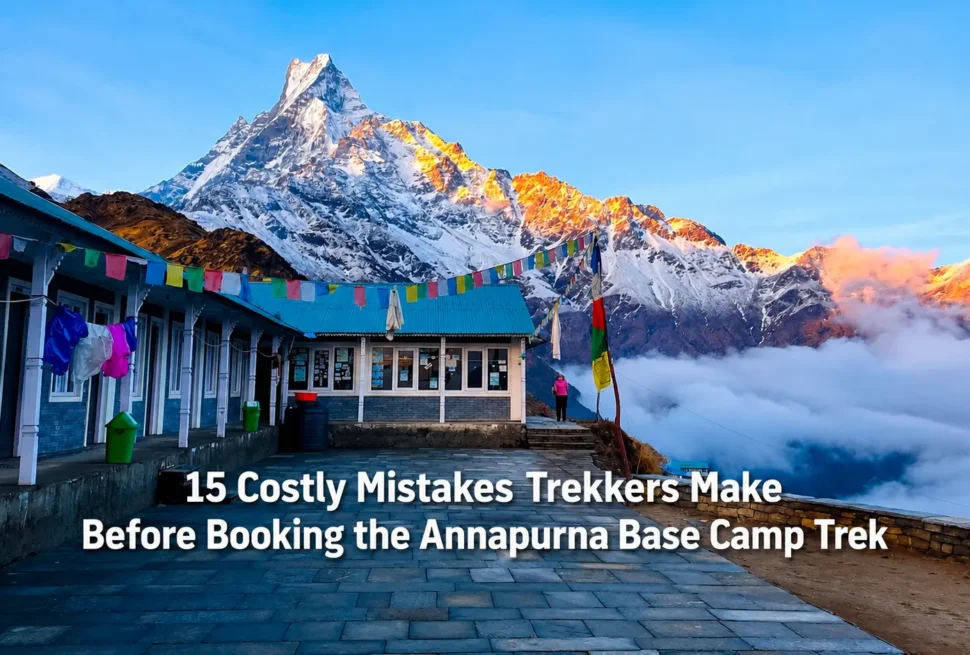
May is the final month of the spring trekking season on the Annapurna Base Camp route and sits in a unique position in the trekking calendar. It follows the peak crowds of April and precedes the monsoon that arrives in June, giving it characteristics of both seasons. The trail conditions are still technically good, all teahouses remain open, and the warmest temperatures of the trekking year make the lower valley sections feel subtropical. The mountain views, however, become increasingly hazy as the pre-monsoon moisture builds, and afternoon clouds frequently obscure the peaks by noon.
For trekkers who want to do ABC in spring but prefer fewer people on the trail, May is a genuine option with a clear trade-off: you get lighter crowds than April but you accept haze, heat at low elevation, the possibility of early monsoon rain in the second half of the month, and the most active leech season on the lower trail. With the right expectations and preparation, May delivers a rewarding ABC trek. With the wrong expectations, the heat and haze can disappoint.
This guide covers May conditions in detail: the weather differences week by week through the month, trail conditions including the leech issue, the itinerary and pace adjustments for heat, what to expect from teahouses in the shoulder-to-monsoon transition, how to pack for warm and wet conditions, and whether May is the right month for your trek.
May Weather on the ABC Route
May is the warmest month of the year at all elevations on the Annapurna trek below 3,500m. Pokhara reaches 33 to 34°C on the hottest days. The valley floor sections between Nayapul and Ghandruk are genuinely hot during the middle of the day. Above 3,000m, temperatures remain comfortable and even pleasant, making the high sanctuary sections of the trek more enjoyable in May than the lower sections.
The atmospheric haze that builds through May is caused by moisture and dust drawn up from the Indian plains by the building monsoon circulation. This haze reduces visibility on the mountain views significantly compared to March and April. Morning views before 8am are often clear; by 10am the peaks begin disappearing behind cloud and haze that fills the valleys from the south. This is the primary visual disadvantage of a May trek compared to earlier spring months.
| Location / Elevation | Night Low | Day High | Conditions |
|---|---|---|---|
| Pokhara (827m) | 22°C | 34°C | Hot, humid, afternoon thunderstorms from mid-May |
| Tikhedhunga (1,540m) | 18°C | 30°C | Very hot midday, leeches active after rain |
| Ghorepani (2,860m) | 8°C | 19°C | Pleasant, morning views possible, cloud by midday |
| Ghandruk (1,940m) | 14°C | 26°C | Warm, lush, hazy by afternoon |
| Chhomrong (2,170m) | 12°C | 24°C | Warm and green, late afternoon rain possible |
| Himalaya (2,920m) | 5°C | 15°C | Comfortable, mist possible in mornings |
| Deurali (3,230m) | 2°C | 12°C | Trail clear, afternoon cloud builds fast |
| MBC (3,700m) | -2°C | 9°C | Cool, clear mornings, cloud by 11am |
| ABC (4,130m) | -5°C | 8°C | Cold nights, early morning views, cloud from midday |
The critical pattern in May is the narrowing morning window for mountain views. In October, you might have clear views until 1pm. In April, the clouds often hold off until 11am or noon. In May, cloud can reach the ABC cirque by 9:30 to 10am. This means your arrival at ABC should be planned for the overnight stay, with the sunrise the primary view opportunity. Day-trippers to ABC who arrive after 10am in May often find the peaks in cloud.
May Trail Conditions
The trail from Nayapul to Deurali in May is in good structural condition but the atmosphere is different from March or April. The lower valley sections (below 2,000m) are hot and humid, and from mid-May onward afternoon rain makes the stone steps slippery and the forest sections wet. Leech activity begins at lower elevations from mid-May and becomes intense in the Sinuwa to Dovan gorge section during wet weather.
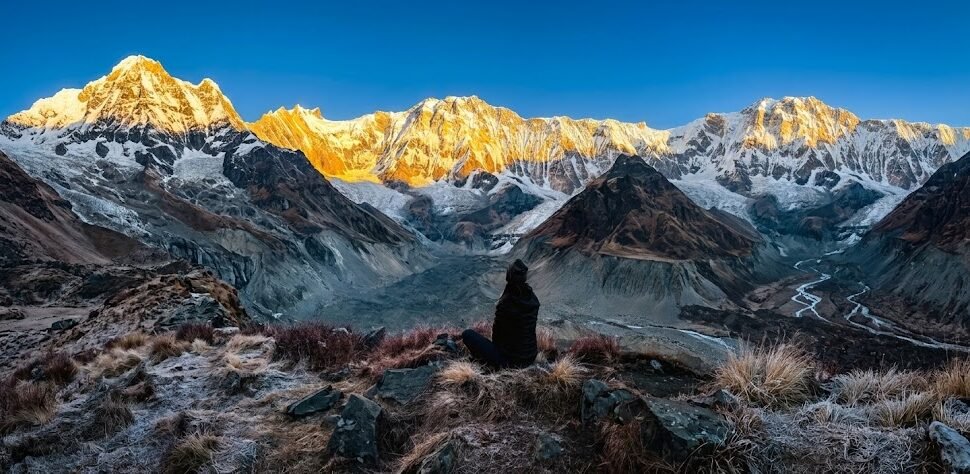
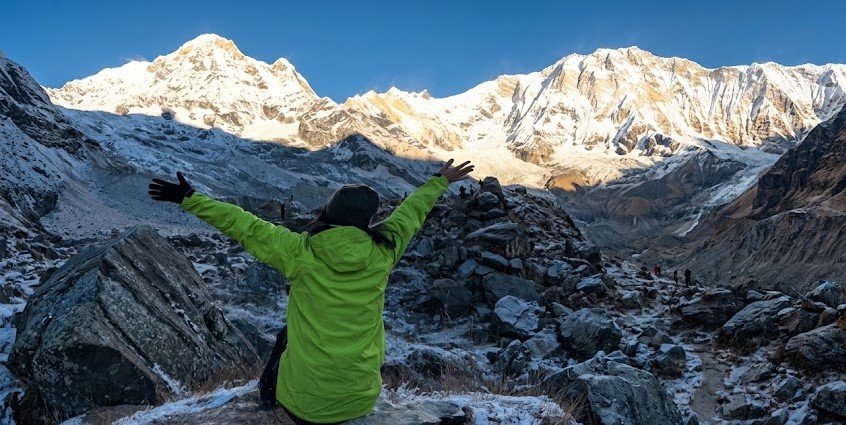
Above Deurali, conditions in May are actually very good. The trail to MBC and ABC is fully clear, temperatures are comfortable for walking, and the sanctuary itself is in its most verdant pre-monsoon state. The contrast between the challenging lower valley heat and leech activity and the pleasant high sanctuary conditions is one of the defining features of a May ABC trek.
The Modi Khola river level in May is at its highest of the pre-monsoon season due to snowmelt from the high peaks. The river at the gorge bottom is loud and forceful, which adds drama to the gorge section but does not affect the trail since all crossings use bridges.
Leech management is the main trail condition issue specific to May. Leeches are active from around Tikhedhunga (1,540m) through the forest sections up to approximately 2,500m. They are most prevalent in the Sinuwa, Bamboo, and Dovan forest sections during and after rain. Leech socks are a significant practical advantage. Salt applied to leeches causes immediate detachment. The leeches on the ABC trail are blood-feeding but not disease-transmitting, and the irritation is temporary. They are unpleasant rather than dangerous.
Poon Hill in May
The Poon Hill sunrise in May is one of the more uncertain viewpoint experiences of the year. Clear Poon Hill mornings in May do occur, but the frequency of completely clear pre-dawn skies is lower than in March or April. In good years (below-average pre-monsoon moisture), a clear Poon Hill sunrise in early May is still spectacular. In years with early and heavy pre-monsoon build-up, May Poon Hill mornings may be in cloud.
The rhododendron bloom at Poon Hill elevation (3,210m) is largely finished by May, with flowers dropping by late April at most elevations. The forest approach to Poon Hill is lush green in May but does not have the peak bloom colours of March and April. The combination of reduced bloom and less reliable views makes Poon Hill a lower priority addition in May than in the earlier spring months, though it remains worth attempting if conditions are clear.
Day by Day Itinerary for May
The May itinerary adjusts the March and April schedule to account for heat at low elevation. The primary modification is to start each day’s walking before 7am and finish the significant climbing sections by 11am before the heat of the day builds. Afternoon rest in teahouses is a practical and recommended strategy in May, particularly at low elevations.
Day 1: Pokhara to Nayapul, Trek to Tikhedhunga (1,540m)
Leave Pokhara early. The drive to Nayapul takes 45 to 60 minutes. Begin walking before 9am to be at Tikhedhunga before the midday heat. Carry at least 2 litres of water from Nayapul. Walking time: 3 to 4 hours.
Day 2: Tikhedhunga to Ghorepani (2,860m)
Start by 6am if possible. The 3,500-step climb is strenuous in any season but the May heat below 2,000m makes an early start essential. By the time you reach 2,200m or above, the temperature becomes more manageable. Ghorepani at 2,860m is a relief after the lower valley heat. Walking time: 5 to 6 hours.
Day 3: Poon Hill attempt, Trek to Tadapani (2,630m)
Pre-dawn Poon Hill attempt for sunrise. Check with teahouse staff the previous evening for current visibility forecast. If cloud is already on the ridge at 5pm, morning conditions are uncertain. Proceed regardless and you may be rewarded. After Poon Hill (successful or not), breakfast at Ghorepani then continue to Tadapani through the forest. Walking time: 6 to 7 hours.
Day 4: Tadapani to Chhomrong (2,170m)
Descend to the Kimrong Khola and climb to Chhomrong. This descent re-enters the warm lower elevation zone. Start early. The Kimrong Khola crossing is on a bridge; river level in May is high but the bridge is unaffected. Walking time: 5 to 6 hours.
Day 5: Chhomrong to Himalaya (2,920m)
The descent to the Chhomrong Khola and the gorge section upward passes through the most active leech zone on the route. Wear leech socks from the bridge downward. The gorge in May is very green, the river is loud with snowmelt, and the forest is dense. Above Bamboo (2,310m), the vegetation opens and the leech concern reduces. Himalaya village at 2,920m is pleasantly cool. Walking time: 5 to 6 hours.
Day 6: Himalaya to Deurali (3,230m)
Short day through Hinku Cave and Dovan to Deurali. At these elevations in May the trail is clear of snow and the temperature is comfortable. Rest at Deurali in the afternoon. Walking time: 3 to 4 hours.
Day 7: Deurali to ABC (4,130m) via MBC
Leave Deurali by 6:30am. At 3,700m and above in May, the clear morning window is shorter than in earlier months. Reaching MBC by 8:30am and ABC by 10:30am positions you for the clearest views of the day. An overnight at ABC captures the following morning’s sunrise at its best. Walking time: 4 to 5 hours.
Day 8: ABC Sunrise, Descend to Bamboo
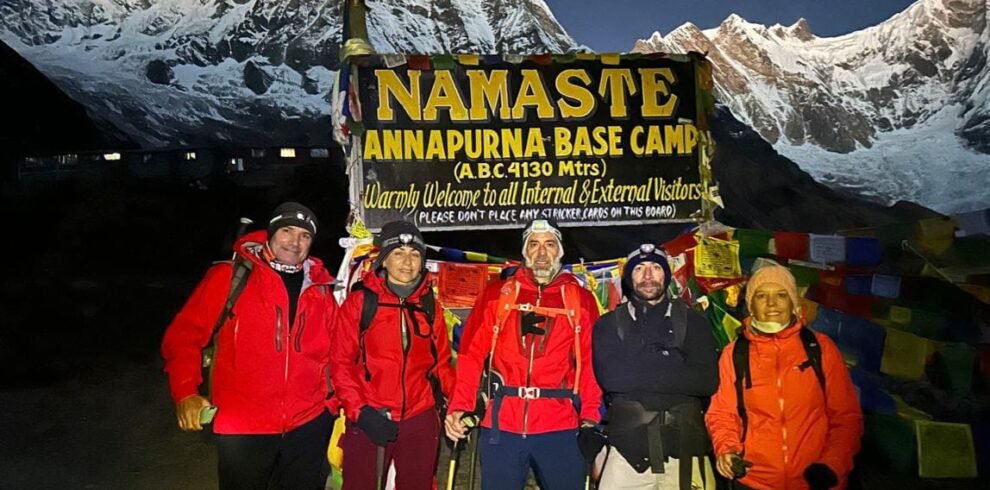
ABC sunrise in May comes between 5:45 and 6:10am. The early morning views before the cloud builds are the highlight of the trek. Descend after breakfast. Walking time: 6 to 7 hours.
Day 9: Bamboo to Jhinu Danda via Chhomrong
Return through the gorge and Chhomrong to Jhinu Danda. The hot spring soak in May at ambient temperatures of 22 to 24°C is refreshing rather than essential for warming, but the therapeutic effect after 8 to 9 days on the trail is unchanged. Walking time: 5 to 6 hours.
Day 10: Jhinu Danda to Nayapul, Drive to Pokhara
Final morning walk to Nayapul, drive to Pokhara. Walking time: 3 to 4 hours.
Teahouses in May
All teahouses on the ABC route are open in May and the supply chain to high camps is fully operational. The significant difference from April is crowd levels: May has fewer trekkers than April, making accommodation easier to find without advance booking and creating a more relaxed teahouse atmosphere. The premium teahouse experience at ABC and MBC is more accessible in May when fewer groups compete for the best rooms.
Teahouse food in May is at its best variety of the year. The fresh supply of vegetables from the lower valley continues, menus are complete, and the pre-monsoon warmth at low elevations means the gardens around some teahouses are producing fresh produce. At high elevations, the standard dal bhat, pasta, noodle soup, and energy snack menus continue year-round. Prices in May are identical to April at all elevations.
Permits for May
Permit requirements in May are identical to every other month of the year. The ACAP permit costs NPR 3,000 (approximately USD 22) for international trekkers and the TIMS Card costs NPR 2,000 (USD 15) for individual trekkers. Both are obtained in Kathmandu or Pokhara before the trek begins and are checked at the Birethanti checkpoint and at several further points along the route.
What to Pack for May
May packing is the most asymmetric of any trekking month on the ABC route. The starting conditions in Pokhara at 34°C feel barely connected to the overnight conditions at ABC at minus 5°C. Your gear list must cover this full range without overloading your pack.
For heat management at low elevation: lightweight moisture-wicking trekking shirts (2 to 3, since sweat is constant), lightweight trekking trousers that can be unzipped to shorts, a hat for sun protection, and a small personal towel for the teahouse at the end of hot days. These items are irrelevant at 4,000m but essential at 1,500m in May.
For the upper elevations, the same gear applies as in April: down jacket, fleece mid-layer, waterproof shell, sleeping bag to minus 15°C, and a liner. Do not be tempted to leave the down jacket home because of Pokhara temperatures. ABC at night in May is still cold.
Leech protection: leech socks (inexpensive, bought in Kathmandu or Pokhara), or gaiters pulled over the boot top and over the trouser leg. Salt packets in a small zip bag for quick removal. Waterproof boots with no gaps at the ankle are the correct footwear; trail runners with no ankle support are not ideal for May below 2,000m on wet trails.
Rain gear is more important in May than in March or April. Carry a quality waterproof jacket and waterproof pack cover. The afternoon showers at low to mid-elevation in May can be heavy and sustained, and being thoroughly wet on a 3-hour trek to the next teahouse is uncomfortable and potentially a hypothermia risk if the wind is cold.
| Category | Item | May Priority |
|---|---|---|
| Heat Layer | Moisture-wicking trekking shirts (2 to 3) | Essential |
| Lightweight convertible trousers | Essential | |
| Wide-brim sun hat | Essential | |
| Cold Layer | Down jacket (minus 10°C rated) | Essential (for high camp) |
| Fleece or softshell mid-layer | Essential | |
| Rain | Quality waterproof jacket | Essential |
| Waterproof pack cover (dry bags inside) | Essential | |
| Leeches | Leech socks or full gaiters | Essential (below 2,500m) |
| Salt (small container) | Recommended | |
| Waterproof trekking boots with ankle cover | Essential | |
| Sleeping | Sleeping bag (minus 15°C rating) | Essential |
| Lightweight sleeping liner | Recommended | |
| Hydration | 2-litre water bottles or hydration bladder | Essential |
| Water purification (tablets or filter) | Essential | |
| Electrolyte powder (sweating increases in heat) | Essential |
Altitude Sickness in May
AMS risk at ABC (4,130m) does not change month to month. The same acclimatisation schedule, the same warning signs, and the same management protocol apply in May as in any other month. One May-specific factor is dehydration risk. The hot temperatures at low elevation cause significantly more sweating than in winter months, and trekkers who do not consciously drink 4 to 5 litres per day may arrive at altitude in a dehydrated state that worsens acclimatisation performance.
Carry sufficient water capacity (2 litres) from the start of each day, drink consistently rather than waiting until you are thirsty, and use electrolyte replacement to compensate for salt lost through sweating. The water sources along the trail are reliable in May and purification tablets or a filter make them safe to use. Teahouses sell bottled water at all elevations, though the environmental impact of single-use plastic on the trail is a reason to prefer purification.
May Budget
May costs are slightly lower than April for some services as the post-peak shoulder reduces demand. Guide and porter fees may be 5 to 10 percent lower than in April. Teahouse accommodation prices are consistent with the rest of the year. The total estimated budget for a guided 10-day May ABC trek with guide and porter is USD 750 to 1,000, similar to March and below April’s peak pricing.
Is May the Right Month for You?
May is the right choice in specific circumstances. If your only available dates fall in May and you are comfortable with heat, humidity, leeches at low elevation, and pre-monsoon haze on the mountain views, May delivers a genuine ABC trek with fewer crowds than April. The high sanctuary in May is actually at its most pleasant temperature of the year, and the sunrise at ABC remains one of the defining experiences regardless of month.
May is not the right choice if clear mountain photography is your primary motivation (October or November are better), if leeches are a serious problem for you (avoid May below 2,500m entirely), or if you are considering trekking in the second half of May when the earliest monsoon years see the monsoon arrive before month end. If the monsoon arrives early in late May, trail conditions deteriorate rapidly and some high teahouses begin closing.
For most trekkers choosing between months, October, November, March, or April are better options than May. But for the trekker who understands the trade-offs, May offers a solid ABC experience with lighter trail traffic and the advantage of the warmest high-sanctuary conditions of the year.
Frequently Asked Questions: ABC Trek in May
When does the monsoon usually arrive in May?
The monsoon typically arrives in Nepal between June 1 and June 15 in average years, with the first significant monsoon rainfall reaching Pokhara and the Annapurna foothills in early to mid-June. In early-arrival monsoon years (which occur roughly one year in five), the first heavy monsoon rain may reach the lower Annapurna trail as early as late May, around May 25 to 30. In late-monsoon years, June can be well underway before the monsoon establishes. The first two to three weeks of May are generally pre-monsoon in character, with the last week carrying more weather risk than earlier in the month. Booking for early May reduces the monsoon timing risk significantly.
Are leeches dangerous?
No. The leeches on the ABC trail are blood-feeding invertebrates that are unpleasant but not dangerous. They do not transmit disease on the Annapurna trail. They attach painlessly because they inject an anaesthetic before feeding, which is why you often do not notice a leech until you see it. The bite leaves a small wound that may bleed briefly after the leech is removed (leeches inject an anticoagulant) and may itch for a day or two. Apply antiseptic to the bite site and it will heal normally. Leech socks are the most effective prevention. Do not burn leeches with cigarettes or lighters, as this causes them to regurgitate into the wound.
What happens to teahouses if the monsoon arrives early?
If the monsoon establishes in late May, some lower-elevation teahouses reduce their staffing as trekker numbers drop sharply. The high-elevation teahouses at MBC and ABC typically remain open through the monsoon months (June, July, August) at reduced capacity, catering to the small number of trekkers who walk the route in monsoon season. If you are trekking in late May and the monsoon is clearly arriving, your guide will advise on conditions ahead and whether it makes sense to continue or turn back.
Are the views at ABC in May worth the trek?
The sunrise at ABC in May is consistently excellent. Clear pre-dawn and early morning conditions occur on most days even in late May, and the view from ABC at sunrise, with Annapurna I’s south face catching the first light, is one of the most powerful mountain experiences available on any trek in Nepal. What you trade away in May versus March or April is the afternoon view: by 10am the peaks are frequently in cloud. If you accept that the morning window is the view window, May ABC delivers fully on the core visual experience of the trek.
How does the heat affect the physical challenge in May?
The heat adds meaningfully to the physical challenge on the lower sections of the route. The Tikhedhunga to Ghorepani climb in midday May heat is significantly harder than the same climb in the cool March or October air. An early start mitigates this substantially. Above 2,500m, the temperature becomes comfortable and the physical challenge returns to the standard moderate level for the ABC route. Budget extra time for the lower sections in May, take rest stops in shade, and carry more water than you think you need. Heat exhaustion is a real concern below 2,000m in May if you are walking in the middle of the day without sufficient hydration.
Should I go in May or wait until October?
If you have flexibility between May and October, October is the better choice for mountain photography and clear views. October offers the clearest skies of the year, no leech concern, comfortable temperatures at all elevations, and the post-monsoon landscape freshly washed and vividly green. May offers lighter crowds and the warmest high-sanctuary conditions, but at the cost of hazy views and lower trail conditions below 2,500m. For a first ABC trek where the mountain experience matters most, October is the more reliable choice. For a second or third visit where you have already done the post-monsoon route and want the pre-monsoon heat and solitude experience, May is a legitimate option.
May as a Transition Month
May sits between the peak spring energy of April and the monsoon reality of June. It is a month of contrasts: the lower trail is subtropical and active with leeches, while the high sanctuary is at its most welcoming temperature of the year. The crowds are lower than April, the teahouses are fully operational, and the ABC sunrise remains one of the most powerful experiences on the route regardless of what the rest of the day’s weather does.
Trekkers who do May ABC and understand what they are signing up for consistently report satisfaction with the experience. The ones who struggle are those who expected April conditions and found May conditions instead. Go prepared for heat, go prepared for leeches, plan your daily schedule around the morning view window, and May on the ABC route offers a version of the trek that has its own distinct character.
Planning a May ABC Trek?
Next Trip Nepal offers guided ABC treks in May with guides experienced in managing the pre-monsoon conditions, leech zones, and the shortened morning view windows at high altitude. We advise on the best departure dates within May to maximise your chances of clear ABC conditions. Get in touch with your preferred May dates.
WhatsApp Us Email UsAnnapurna Base Camp Trek: Complete Monthly Guide
Use these month-by-month guides to plan your ABC trek, or visit the Annapurna Base Camp Trek overview page for full itinerary, costs and booking details.
Trek in: January | February | March | April | May | June | July | August | September | October | November | December