Let me be straight with you. If you are searching “how difficult is the Everest Base Camp trek,” you are probably one of two types of person. Either you are someone who has already decided to go and wants reassurance that you can handle it. Or you are genuinely on the fence, unsure if EBC is within your ability, and worried about making an expensive mistake.
Fitness demands change somewhat if you fly back instead of walking out. Our training plan built specifically for the Everest Base Camp Trek with Helicopter Return covers how preparation differs for that shorter, more front loaded itinerary.
This guide is written for both of you. And I am going to give you the honest answer, not the reassuring one designed to sell you a booking.
Here is the truth: the Everest Base Camp trek is not a casual holiday hike. It is a serious, multi-week, high altitude trekking challenge that demands real preparation, real respect, and a real understanding of what altitude does to a human body. At the same time, it is not technical mountaineering. You do not need crampons, ropes, or climbing skills. You do not need to be a competitive athlete. Thousands of ordinary, moderately fit people complete it every year, including people in their sixties and seventies.
The single biggest variable on EBC is not your fitness. It is how your body responds to altitude. That is something no amount of gym training can fully predict or prevent. It is the reason fit, strong trekkers sometimes fail and slower, less athletic trekkers succeed. Understanding this truth is the most important thing you can do before you start planning.
What this guide covers: the overall difficulty rating with a realistic explanation of what “strenuous” actually means on the trail, the altitude challenge and how acclimatization works, the physical fitness level you actually need, a day-by-day distance and elevation table, the specific sections most trekkers find hardest, trail conditions, success rates backed by real data, how age affects the trek, a comparison with other famous treks worldwide, who should not attempt EBC, and ten specific things you can do to make the trek significantly easier.
By the end of this, you will have a clear, honest picture of whether EBC is right for you, and exactly what you need to do if the answer is yes.
Overall Difficulty Rating
On the standard trekking difficulty scale of Easy, Moderate, Strenuous, and Extreme, the Everest Base Camp trek sits firmly at Strenuous. That is not the highest grade, but it is not a category to dismiss.
What “Strenuous” means in practical terms on EBC:
- You will walk 5 to 8 hours per day for 12 to 16 consecutive days
- You will gain significant elevation most days above Namche Bazaar (3,440m)
- You will spend 7 to 8 nights sleeping above 4,000m
- You will reach a maximum altitude of 5,545m on Kala Patthar, or 5,364m if you stop at EBC itself
- Your body will be working significantly harder than normal at altitude, even at rest
What EBC is NOT:
It is not a technical climb. There is no glacier crossing on the classic route. There is no rock climbing, no rappelling, and no route-finding challenges that require mountaineering experience. The path is well-trodden and well-marked. Thousands of people walk it every season.
For context on where it sits relative to other experiences: EBC is harder than most multi-day treks in Europe or North America purely because of altitude. It is broadly comparable in altitude challenge to Kilimanjaro, though the routes are very different in character. It is easier than any actual peak climb in Nepal, including Island Peak (6,189m), which sits just above EBC and involves glacier travel and fixed lines. If you want to understand what stepping up from EBC looks like, the Island Peak climbing route gives you that picture clearly.
The classic EBC route is also easier in terms of daily terrain than some people expect. There are no exposed ridges, no via ferrata sections, and no off-trail navigation. What makes it hard is sustained, cumulative effort at altitude over two weeks. Day one is manageable. Day eight, at 5,000m, walking to EBC after a night at Gorakshep, is genuinely hard.
Not Sure If EBC Is Right for You?
Talk to our team. We assess hundreds of trekkers every year and can give you an honest answer based on your fitness level, age and experience. No hard sell.
WhatsApp Us Email UsThe Altitude Challenge: The Real Difficulty
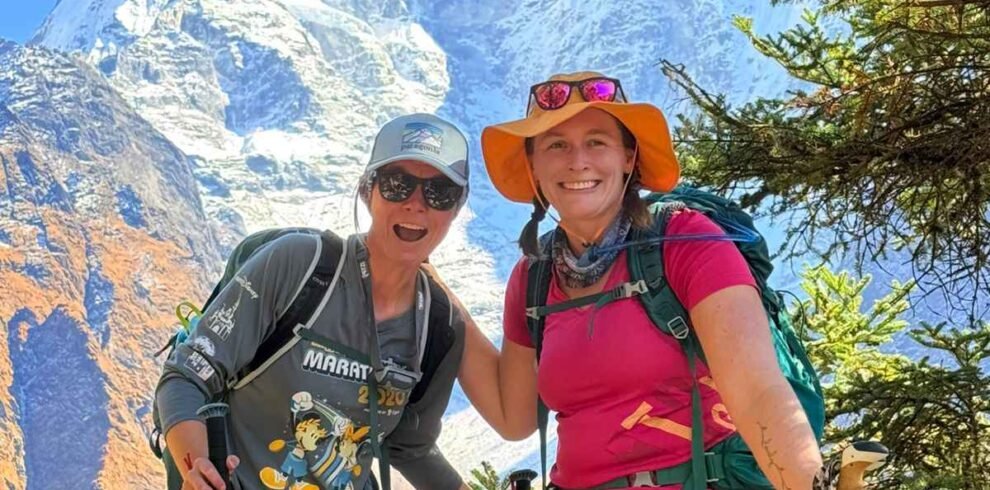
Altitude is the defining challenge of EBC. Not the distance. Not the terrain. Not even the weather, though weather matters. It is altitude.
Everest Base Camp sits at 5,364m (17,598 ft). Kala Patthar, the peak most trekkers climb for the best views of Everest, sits at 5,545m (18,192 ft). At these elevations, the barometric pressure is roughly half what it is at sea level. In practical terms, each breath delivers approximately 50 to 53% of the oxygen you would get from the same breath at sea level. That number is not symbolic. It is physiological reality, and it affects everything: your walking pace, your appetite, your sleep quality, your ability to think clearly, and your mood.
Here is what matters: above 4,000m, you will feel the altitude even without Acute Mountain Sickness. These are normal acclimatization symptoms, not signs that something is wrong:
- Shortness of breath when walking uphill, sometimes even on flat ground
- Reduced appetite, especially at dinner
- Unusual tiredness in the evenings despite not walking unusually hard
- Vivid, sometimes strange dreams
- Disrupted sleep, frequent waking
- Slight headache that appears in the afternoon and clears after rest
These symptoms are your body adapting. They are not a reason to turn back. They are signs that the acclimatization process is happening. Your body is producing more red blood cells, your breathing rate is increasing slightly even at rest, and your cardiovascular system is adjusting to extract maximum oxygen from thinner air.
Acute Mountain Sickness (AMS) is different. AMS affects 25 to 50% of trekkers above 4,000m in some form during their trek. Symptoms that indicate AMS rather than normal acclimatization: a persistent, worsening headache that does not improve with rest or simple painkillers, nausea or vomiting, loss of balance or coordination, confusion, and extreme fatigue that is disproportionate to the effort made. If these appear, you do not push on. You rest where you are, take paracetamol, drink water, and assess the next morning. If symptoms worsen, you descend. A drop of 500m is often enough to provide significant relief.
High Altitude Pulmonary Edema (HAPE) and High Altitude Cerebral Edema (HACE) are the serious forms, and they are medical emergencies requiring immediate descent. They are less common but real risks above 4,500m. This is why having a guide who knows the symptoms matters. More on that later.
How Acclimatization Works on the EBC Route
The standard 14-day EBC itinerary is not just a comfortable pacing option. It is engineered around acclimatization science. The rule of thumb above 3,000m: do not increase your sleeping altitude by more than 400 to 500m per day. The standard itinerary builds in two specific acclimatization rest days that follow this rule precisely.
The first is at Namche Bazaar (3,440m): two nights at Namche, with an optional hike on the rest day up to the Everest View Hotel at 3,880m. You sleep high, sleep low. Your body benefits from the higher elevation during the day hike but recovers at the lower sleeping altitude. This is the “climb high, sleep low” principle that underpins all acclimatization planning.
The second rest day is at Dingboche (4,410m), where a short hike to Nangkartshang at 5,083m on the acclimatization day gives your body a significant oxygen stress test before you sleep back at 4,410m.
Skip these rest days and your success rate drops sharply. Short itineraries, particularly anything under 12 days, have measurably lower success rates because the body simply has not had time to adjust. This is the most preventable cause of trek failure on EBC.
Physical Fitness Requirements
What Level of Fitness Do You Actually Need?
You do not need to be a runner, a cyclist, or someone who goes to the gym regularly. That is the honest answer. What you do need is the ability to walk uphill for 5 to 8 hours per day, on consecutive days, for two weeks, while carrying a day pack of 5 to 8 kg. Your main bag, typically 12 to 15 kg, will be carried by a porter.
The difference between a fit and an unfit trekker on EBC is significant but not insurmountable. A fit trekker finds the walking itself manageable and has more mental and physical reserves to handle the altitude stress. An unfit trekker has to work hard at both simultaneously: the walking is already near their physical limit, and then altitude adds another layer of difficulty on top. Both can succeed. But the unfit trekker’s margin for error is much smaller.
Heart rate at altitude is a useful reality check. At 5,000m, you can expect your heart rate to run 20 to 30% higher than normal for the same effort level. If a brisk uphill walk at sea level takes your heart rate to 130 bpm, at Gorakshep it might be 160 to 170 bpm for the same pace. This is not dangerous for a healthy heart, but it is exhausting if sustained for hours. Fitness reduces the baseline from which this climb happens.
Practical test: if you can comfortably hike uphill for 3 to 4 hours without stopping, carrying a light pack, without needing to sit down every 20 minutes, you have the baseline fitness for EBC. You still need training, but the foundation is there.
Training Recommendations
Start specific training at least 3 months before your departure date. General fitness is not the same as trekking fitness. Running a 5km is useful background conditioning, but it does not prepare your legs and joints for 8 hours of stone step descents.
The training plan that actually works:
Cardio base: 4 to 5 hours of hiking per week, including hills. Not flat walking. Hills. The uphill-downhill cycling of EBC requires your legs and your cardiovascular system to work together over sustained periods. If you live somewhere without hills, use a stair machine or spend extended time on a treadmill at 8 to 12% incline.
Stair training: 30 to 45 minutes of stair climbing, 3 times per week. This is the single most specific exercise you can do for EBC. The stone steps of the Khumbu region are steep, uneven, and relentless. Stair training builds the exact quad and glute engagement you need.
Leg strength: Squats, lunges, and step-ups. Three sets of 15 to 20 repetitions, twice per week. Focus on form. Your knees will take significant load on the descent sections, and strong quads are their best protection.
Carrying weight: Start training hikes with 4 kg in your day pack. Add 1 kg per month until you are regularly hiking with 7 to 8 kg. This replicates the load you will carry on the trail (water, snacks, layers, camera, first aid kit).
Back-to-back long days: Once a month, do two consecutive long hiking days. EBC does not give you rest days when your legs are tired. Training your body to perform on day two after a hard day one is specific and valuable preparation.
The more thorough your training, the more you will enjoy EBC. This is not just a motivational statement. It is practical reality. A well-trained trekker spends energy marveling at the scenery. An undertrained trekker spends that same energy just surviving the day.
Daily Distance and Elevation Gain
Here is the full route breakdown for the classic itinerary. Understanding what you face each day removes the fear of the unknown and helps you pace yourself appropriately.
| Day | Route | Distance | Elevation Change | Walking Time |
|---|---|---|---|---|
| Day 1 | Lukla (2,860m) to Phakding (2,652m) | 8 km | -208m | 3-4 hours |
| Day 2 | Phakding to Namche Bazaar (3,440m) | 11 km | +788m | 5-6 hours |
| Day 3 | Acclimatization at Namche (optional hike to Everest View Hotel at 3,880m) | 0 km (optional 5 km) | +440m (optional) | Rest day |
| Day 4 | Namche to Tengboche (3,860m) | 10 km | +420m | 5-6 hours |
| Day 5 | Tengboche to Dingboche (4,410m) | 10 km | +550m | 5-6 hours |
| Day 6 | Acclimatization at Dingboche (hike to Nangkartshang at 5,083m) | 0 km (optional 6 km) | +673m (optional) | Rest day |
| Day 7 | Dingboche to Lobuche (4,940m) | 12 km | +530m | 5-6 hours | +530m | 5-6 hours |
| Day 8 | Lobuche to Gorakshep (5,164m) then to EBC (5,364m) and back to Gorakshep | 13 km total | +424m up | 6-8 hours |
| Day 9 | Gorakshep to Kala Patthar (5,545m) then down to Pheriche (4,371m) | 12 km | +381m up, then significant descent | 6-7 hours |
| Days 10-14 | Descent via reverse route back to Lukla | Approx. 58 km total | Net descent | 4-6 hours/day |
A few things worth understanding from this table. First, the descent days are faster but not easier. Stone step descents are brutal on the knees and quads. Many trekkers find days 10 to 13 harder on their bodies than the ascent, despite the faster pace. Second, Day 8 is the hardest single day on the entire trek for most people. Thirteen kilometers at above 5,000m, after a week of cumulative altitude exposure, is genuinely demanding. Third, the descent from Namche to Lukla on one of the final days involves a significant drop in altitude in a short time, which your legs will feel.
For a full look at what the villages on the route offer in terms of lodging and food, that context helps you plan realistic daily expectations beyond just the physical numbers.
The Hardest Sections of the Trek
Every section of EBC has its challenges, but four sections stand out as the ones where most trekkers struggle most.
1. Phakding to Namche Bazaar (Day 2)
This day is a shock to many trekkers. You arrive in Lukla the day before, walk easily to Phakding, feel good, and then Day 2 hits. The climb from Phakding to Namche involves crossing several suspension bridges over the Dudh Koshi gorge before the trail turns sharply upward for the final 800m gain in about 4 km. This is a steep, relentless climb through forest. At 3,000m, where you start feeling the first real hint of altitude, it can feel much harder than the numbers suggest.
Most trekkers who have a very hard Day 2 recover well once they settle into Namche. But it is a wake-up call that EBC is serious.
2. Lobuche to EBC via Gorakshep (Day 8)
This is the day. At 5,000m, everything is harder. Walking a flat section feels like you are walking uphill at sea level. Going uphill feels like walking through deep water. The trail from Gorakshep to EBC crosses glacial moraine, rocky and uneven, with no smooth path. The oxygen at EBC is roughly half what you breathe at home. Most people stop talking, stop joking, and just walk. Slowly.
That said: most people who reach this day reach EBC. The acclimatization process has been working for 8 days. Your body is as adapted as it will get. You will be moving slowly, but you will be moving.
3. The Pre-Dawn Kala Patthar Ascent (Day 9)
Day 9 starts in the dark, typically at 4 am or 5 am, to catch sunrise from the summit. Temperatures at Gorakshep at 5,164m before dawn in October and November range from -10°C to -20°C, sometimes colder with wind chill. You are walking by headlamp over rocky terrain, already tired from Day 8. The final 200m of elevation gain from Gorakshep to Kala Patthar’s summit at 5,545m is genuinely brutal. Short steps. Frequent pauses. Lungs burning. Legs heavy.
Then you get to the top, and you see Everest. All 8,848m of it, lit by dawn light, without anything between you and the world’s highest mountain. There is nothing else like it. That moment is why people do this trek. Not for the suffering, but for what the suffering earns.
4. The Final Descents (Days 10-14)
Descending feels like it should be easier. It is not. Not on EBC. The stone steps that the Sherpa communities have built along the route are narrow, irregular, and steep in places. After 10 days of accumulation, your knees are already under strain. The descent from Namche to Lukla in particular has made many trekkers regret not training their quads more specifically. Trekking poles are not optional on the descent. They reduce impact on the knees by an estimated 25 to 30% per step, which over thousands of steps per day adds up to a significant difference in how you feel at the end of each day.
Trail Conditions
The EBC trail is better maintained than most people expect and more challenging than some guides suggest. Here is an accurate picture.
Surface: The majority of the trail is stone path, ranging from flat and well-laid through villages to rough, uneven moraine above Lobuche. Above Dingboche (4,410m), the trail surface becomes increasingly rocky and less defined. It is never technical, but it demands constant attention to foot placement.
Suspension bridges: There are many suspension bridges crossing the Dudh Koshi and its tributaries. Most are narrow, with wooden plank floors and metal wire sides. They move. If you have any fear of heights, these bridges will require steady breathing and focused concentration. They are not dangerous, but they are not comfortable either. The good news: they become routine within a day or two.
Wind: Above 5,000m, wind can be violent, particularly in October through November and during winter months. At Kala Patthar, wind speeds of 40 to 60 km/h are not unusual. Combined with -15°C temperatures, wind chill can push the apparent temperature below -30°C. Proper layering is not optional.
Ice: In autumn (October through November) and spring (March through May) trekking seasons, ice can form on shaded sections of the trail before sunrise, particularly above 4,500m. Early morning departures, which are common on acclimatization day hikes, can mean walking on icy rock. Lightweight microspikes are worth carrying from Dingboche upward, particularly for the Kala Patthar ascent.
Dust: The EBC trail is extremely dusty in dry season, especially near helicopter landing pads at Namche, Tengboche, Dingboche, and Gorakshep. A buff or lightweight face covering is useful, particularly if you are sensitive to dust or have respiratory issues.
Yak and dzo traffic: The trail shares space with loaded yaks and their hybrids (dzos) carrying supplies to lodges. When you meet a yak train, step to the uphill side of the trail and stand still. Yaks are large, heavy, and will not adjust their route for you. This is not a safety warning that sounds dramatic, it is practical advice that could prevent a serious fall.
Success Rate on EBC: What the Numbers Say
The most frequently cited number is this: with a proper acclimatization schedule, approximately 90 to 95% of trekkers who attempt EBC reach their target, whether that is EBC itself at 5,364m or Kala Patthar at 5,545m.
That leaves 5 to 10% who do not complete the trek. Understanding why they fail is more useful than the headline number.
Of those who turn back, the overwhelming majority do so because of altitude sickness. Not fitness. Altitude sickness. This is the most important single fact about EBC difficulty: you can be fit and fail, and you can be relatively unfit and succeed, entirely based on how your body responds to hypoxia. There is no pre-trip test that fully predicts your acclimatization response. Previous altitude experience helps as a guide, but the relationship is not perfectly linear.
Short itineraries dramatically lower success rates. Research and field experience from guiding companies consistently shows that trekkers on 9 to 10 day itineraries fail at significantly higher rates than those on 14-day itineraries. The reason is simple: the body needs time. Compressing the schedule does not compress the biology.
Guided trekkers consistently outperform independent trekkers in terms of completion rates. This is not because a guide physically carries you to EBC. It is because a guide monitors your AMS symptoms daily, controls your pacing (which most people are bad at when left to their own enthusiasm), makes descend-or-continue calls before symptoms become serious, and knows the route’s specific acclimatization nuances from experience. If you are weighing whether to go with a company, the choosing the right EBC company guide lays out exactly what to look for.
One more data point: most people who are evacuated from EBC by helicopter are evacuated from between Dingboche and Lobuche, in the 4,500m to 5,000m zone. This is where HAPE risk increases significantly and where the consequences of ignoring AMS symptoms become serious. It is also, not coincidentally, the zone where some trekkers who were told “it’s just a hike” first realize they were undersold the challenge.
Age and EBC Trek Difficulty
There is no official minimum or maximum age for the EBC trek. Nepal’s trekking permits do not have age restrictions.
The oldest person to complete the trek to EBC on record was in their late eighties, supported by a guide and a porter. Children as young as 10 to 12 have reached EBC with their parents. Neither fact means that age is irrelevant. It means age is not the primary variable.
For trekkers in their sixties and seventies: EBC is very much within reach with appropriate preparation, a good guide, and a 14-day minimum itinerary. The key adaptations for older trekkers are not dramatic. Build in an extra rest day if your body signals it needs one. Take a slower ascent pace without ego. Accept that your acclimatization may take slightly longer than a younger trekker’s. Many of the most content trekkers I have guided were in their late sixties: they had the patience to walk slowly, the experience to listen to their bodies, and the perspective to appreciate what they were seeing.
For younger trekkers: age does not grant altitude immunity. Physically fit, strong young trekkers are sometimes at higher risk than older, more experienced hikers because they push their pace, ignore early AMS symptoms, and trust their fitness to carry them through altitude stress. It does not work that way. AMS does not care how fast you can run a 10km.
The honest age-related advice: get medical clearance from your doctor regardless of age if you have any cardiovascular, respiratory, or metabolic health history. At altitude, existing conditions that are well-managed at sea level can become more significant. This is not a reason to stay home. It is a reason to be informed and prepared.
Comparing EBC to Other Famous Treks
Context matters when assessing difficulty. Here is how EBC sits relative to other major trekking destinations:
| Trek | Max Altitude | Duration | Technical Difficulty | Altitude Difficulty | Overall Grade |
|---|---|---|---|---|---|
| Everest Base Camp (Kala Patthar) | 5,545m | 12-16 days | Low | Very High | Strenuous |
| Annapurna Circuit (Thorong La) | 5,416m | 15-21 days | Low | Very High | Strenuous |
| Kilimanjaro | 5,895m | 6-9 days | Very Low | Extreme | Strenuous to Extreme |
| Inca Trail | 4,215m | 4 days | Low | Moderate | Moderate |
| Tour du Mont Blanc | 2,665m | 10-11 days | Low | Low | Moderate |
| Appalachian Trail (White Mountains, NH) | 1,917m | Variable | Low to Moderate | Very Low | Moderate |
The Kilimanjaro comparison is the most instructive. Kilimanjaro is higher than EBC, has a very short summit window (one summit day after 5 to 7 approach days), and has a lower summit success rate than EBC precisely because of the compressed acclimatization time. EBC’s advantage is duration: two weeks of gradual ascent gives your body genuine time to adapt.
The Annapurna Circuit comparison is also worth understanding. Thorong La pass (5,416m) is crossed in a single day with a 1,100m ascent before descending 1,600m. It is a harder single day than anything on EBC. But EBC spends more nights at extreme altitude and has a longer cumulative challenge. They are roughly comparable overall, with EBC having higher daily sustained altitude exposure.
For those who want a step beyond EBC once they have completed it, the more challenging Three Passes route crosses three high passes above 5,300m and adds significant technical challenge compared to the classic route.
Who Should NOT Attempt EBC (or Needs Medical Clearance First)
Being honest about contraindications is important. Some of this information is uncomfortable to read. Read it anyway.
Do not attempt EBC without specialist medical consultation if:
- You have a history of any serious heart condition: arrhythmia, heart failure, significant coronary artery disease
- You have any chronic lung condition: severe asthma, COPD, pulmonary fibrosis. Mild controlled asthma is generally manageable with a doctor’s guidance, but you need specific advice about medication at altitude
- You have had AMS, HAPE, or HACE on any previous altitude trip. Discuss Diamox (acetazolamide) prophylaxis with your doctor before going
- You have had any surgery in the 3 months before your planned trek
- You have uncontrolled hypertension. Blood pressure rises at altitude. If your baseline is already high, altitude can push it into dangerous territory
- You are pregnant. Above 3,500m, the reduced oxygen availability poses real risks to fetal development. This is not a grey area
- You are on medications that can interact with altitude, including certain diuretics, some blood thinners, and sedatives that suppress breathing rate. Review your medication list with your GP specifically in the context of altitude
If you are over 60, get a cardiac assessment regardless of whether you have any known history. A resting ECG and a simple stress test give your doctor useful information about how your heart handles exertion. This does not need to be expensive or complicated. It is just sensible.
The above is not a list designed to scare people away from EBC. The vast majority of people in the categories above who get proper medical advice go on to complete the trek successfully. The point is to be informed rather than find out the hard way at 5,000m that something needed attention before departure.
Tips to Make EBC Significantly Easier
These are not generic travel tips. These are specific, field-tested practices that separate trekkers who arrive at EBC feeling strong from those who arrive barely functional.
1. Book a 14-day itinerary minimum. Prefer 16 days if your schedule allows. The extra acclimatization time is not a luxury. It is a measurable variable in your success and your enjoyment. A 16-day itinerary allows an additional rest day between Lobuche and EBC, which is particularly valuable if you felt significant AMS symptoms at Dingboche. Avoid any operator selling you a 10 or 11-day EBC itinerary. It is either cutting acclimatization days or the math does not add up.
2. Hire a guide. Not because you cannot follow the route without one, but because AMS symptom management is significantly better with a trained set of eyes on you daily. A good guide catches the early signs before they become serious and makes the descend-or-continue call with experience behind it. If you are considering going without one, read the common booking mistakes guide first.
3. Hire a porter. Your main bag should weigh no more than 15 kg when packed. Your day pack should be 5 to 8 kg. A porter carries your main bag. This is not weakness. This is practical intelligence. At 5,000m, every additional kilogram on your back adds meaningfully to your cardiovascular load and your AMS risk. Let the porter carry the bag. Focus on getting yourself there.
4. Drink 3 to 4 liters of water per day above 4,000m. Not 2 liters. Not when you feel thirsty. Three to four liters, deliberately, throughout the day. Dehydration at altitude worsens every single AMS symptom. It thickens your blood, reduces oxygen delivery to tissues, and amplifies headaches. It is also easy to forget to drink when you are cold, not sweating visibly, and not feeling thirsty because altitude suppresses thirst sensation.
5. Walk slowly. Seriously slowly. The Sherpa phrase is “bistari bistari”: slowly, slowly. It is not a polite suggestion. It is the single most effective acclimatization technique available. At altitude, the slower you walk, the less oxygen you burn per hour, the lower your heart rate, and the more your body can do the background work of acclimatization. The trekkers who arrive at EBC feeling best are almost always the ones who were embarrassed by how slowly they were moving on day four and five. That pace pays dividends on day eight.
6. Do not push on if you have AMS symptoms. This is the rule that saves lives and trips. If you have a persistent worsening headache, nausea, or loss of balance, rest where you are. Take paracetamol. Drink water. If symptoms do not improve within 24 hours, descend 500m and reassess. The mountain will still be there. The acclimatization day you add by resting at Dingboche instead of pushing to Lobuche could be the day that makes EBC possible rather than impossible.
7. Pack trekking poles. Use them. Many trekkers pack poles and leave them folded in their pack because they feel self-conscious using them on easier terrain. Use them from day one. The descent from Namche to Lukla alone involves roughly 6,000 to 8,000 stone steps. Poles engaged with each step reduce the cumulative knee and joint load significantly. By the end of two weeks, this difference is felt in your body.
8. Train with your full pack weight for at least 2 months before departure. The day pack you carry to EBC will have water, camera, snacks, a spare warm layer, a rain shell, sunscreen, and your first aid kit. That is 6 to 8 kg. Your body needs to know what that feels like after 6 hours of uphill, not discover it for the first time at 4,500m.
9. Protect your sleep. Sleep quality at altitude drops significantly. The low oxygen environment causes something called Cheyne-Stokes breathing, where your breathing rate slows during deep sleep, causing you to wake gasping, sometimes with a start. This is normal but disturbing. Ear plugs help with the ambient noise of tea houses. A sleep mask helps with the early morning light in high-altitude lodges where curtains are minimal. Poor sleep compounds AMS symptoms. Protecting sleep quality is not a comfort issue; it is an acclimatization issue.
10. Eat the dal bhat. The Nepali staple of lentil soup, rice, vegetable curry, and pickle is exactly what your body needs at altitude: high carbohydrate, moderate protein, warm, and nutritionally solid. Most EBC lodges offer a variety of international food, from pasta to pizza to yak burgers. These are fine options and welcome variety. But on the harder days, above 4,500m, dal bhat is your friend. Your digestive system is also slightly compromised at altitude, and the familiar, simply prepared dal bhat tends to sit better than heavier Western dishes.
Frequently Asked Questions About EBC Difficulty
Can a complete beginner do EBC?
Yes, with the right preparation. “Complete beginner” means no trekking experience, not “no fitness.” You need at minimum 3 months of specific training, a 14-day or longer itinerary, a qualified guide, and a realistic understanding that the altitude will be harder than any training can fully replicate. Many first-time trekkers successfully complete EBC every season. None of them walked in unprepared.
Do I need to be able to run a marathon?
Absolutely not. Marathon runners sometimes struggle on EBC because they push their cardiovascular system hard when slow and steady is what the altitude demands. What you need is sustained aerobic endurance: the ability to keep moving at a moderate pace for many hours without needing to stop and recover. Running a marathon and trekking EBC use different energy systems in different ways. Marathon training helps, but it is not a prerequisite, and it is not a direct proxy for EBC readiness.
Is EBC harder than Kilimanjaro?
It depends on what you mean by harder. Kilimanjaro is higher (5,895m vs. 5,545m at Kala Patthar), with a more compressed schedule that gives your body less acclimatization time. Kili’s summit night is a single brutal push of 1,200m gain in extreme cold. In that sense, Kili’s summit attempt is harder than any single day on EBC. But EBC is longer, has more cumulative altitude exposure, and asks more of you over two weeks. They are different kinds of hard. EBC has a higher success rate than Kili precisely because of the longer acclimatization window.
How do I know if I am fit enough right now?
Try this test: go hike uphill for 4 consecutive hours carrying 6 kg on your back. Not flat, uphill. If you can do this without needing to sit down and rest, and without significant knee or joint pain the following day, you are at the baseline fitness level for EBC. If that test destroys you, you need 3 to 4 months of targeted training before attempting EBC. If that test feels easy, you are ahead of the curve and can focus training on the specific altitude preparation.
What percentage of people fail to reach EBC?
On a properly structured itinerary with acclimatization days and a qualified guide, 5 to 10% of trekkers do not reach EBC. The majority of those who do not reach it turn back due to altitude sickness. A small number turn back due to injury, illness unrelated to altitude, or personal decision. Very few turn back purely because of fitness.
Is EBC dangerous?
Not in the way that climbing Everest is dangerous. There are no objective hazards that require technical skill or expose you to avalanche or crevasse risk on the classic route. The main risk is altitude sickness and its serious complications: HAPE and HACE. With a qualified guide, a proper acclimatization schedule, and the discipline to descend if symptoms warrant it, that risk is manageable. Deaths on the EBC trail are extremely rare and almost always involve trekkers who ignored serious AMS symptoms and continued ascending.
Can older people do EBC?
Yes. Regularly. Age is not the limiting factor, provided you have no unmanaged cardiovascular or respiratory conditions. What matters at altitude is your cardiovascular baseline, your body’s acclimatization response, and your willingness to pace yourself and listen to your guide. Trekkers in their sixties and seventies complete EBC every season. They tend to take it more seriously than younger trekkers, prepare more thoroughly, and have the patience to walk slowly. Those qualities often matter more than physical youth.
Ready to Take On Everest Base Camp?
Next Trip Nepal has been guiding trekkers to EBC since 2005. Our guides know every hard section of this trail and will pace you to the top. Get your personalised quote today.
WhatsApp Us Email UsThe Honest Bottom Line
The Everest Base Camp trek is hard. Not impossible. Not out of reach for ordinary people. But genuinely, seriously hard in a way that demands your respect and your preparation.
The altitude is harder than most people expect. The cumulative fatigue of two weeks at elevation is harder than any training hike replicates. The cold, early morning starts above 5,000m test your mental resolve as much as your physical fitness. Day 8, walking to EBC across glacial moraine at half the oxygen you are used to, is genuinely grueling.
And then you get there. You stand at Everest Base Camp, with the Khumbu Icefall above you and the prayer flags snapping in the wind, and you understand why people call it the trek of a lifetime. Not because the marketing says so. Because standing there, having earned it over two weeks of real effort, it simply is.
The people who fail EBC are almost always the people who underestimated it, shortened the itinerary to save money or time, skipped the acclimatization days, pushed on when their body was telling them to stop, or went without a guide and missed the early signs of AMS.
The people who succeed come prepared. They train specifically. They book adequate time. They hire a good guide and actually listen to them. They walk slowly even when they feel strong. They drink the water. They eat the dal bhat.
If you want to start planning your EBC trek for 2026 or 2027, the first step is an honest conversation with a team that has done this hundreds of times and will tell you straight whether you are ready and what you need to do if you are not quite there yet.
EBC will ask everything of you. It will also give you something you cannot get anywhere else on earth.