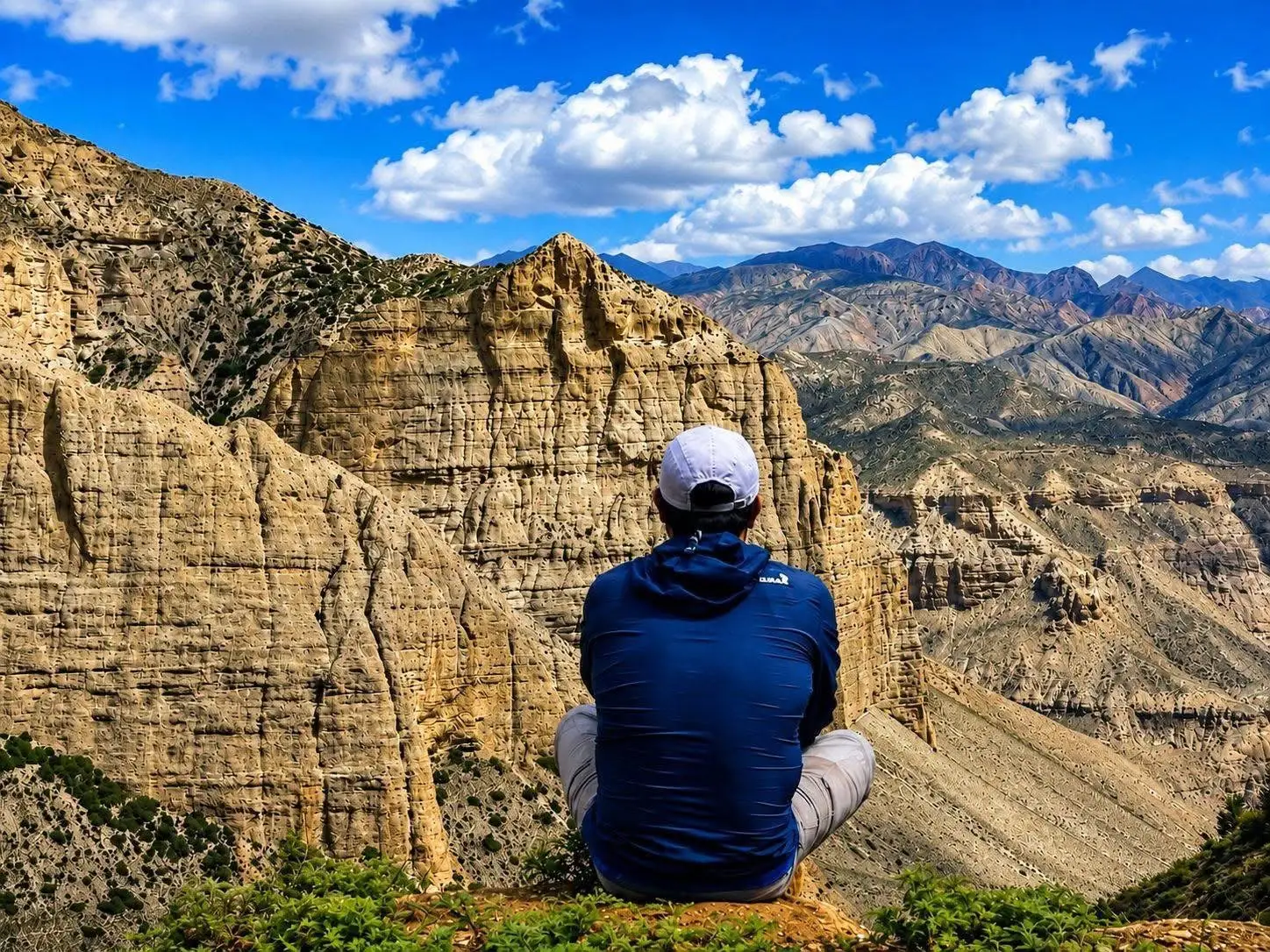
January in Upper Mustang feels like the rest of Nepal forgot it existed.
The teahouse owner in Kagbeni will tell you the same thing he told every trekker who passed through last month: nobody comes in January. And that is exactly why you should.
This guide covers everything you need to plan an Upper Mustang Trek in January, including the latest 2026 permit rules, weather, and a day by day itinerary.
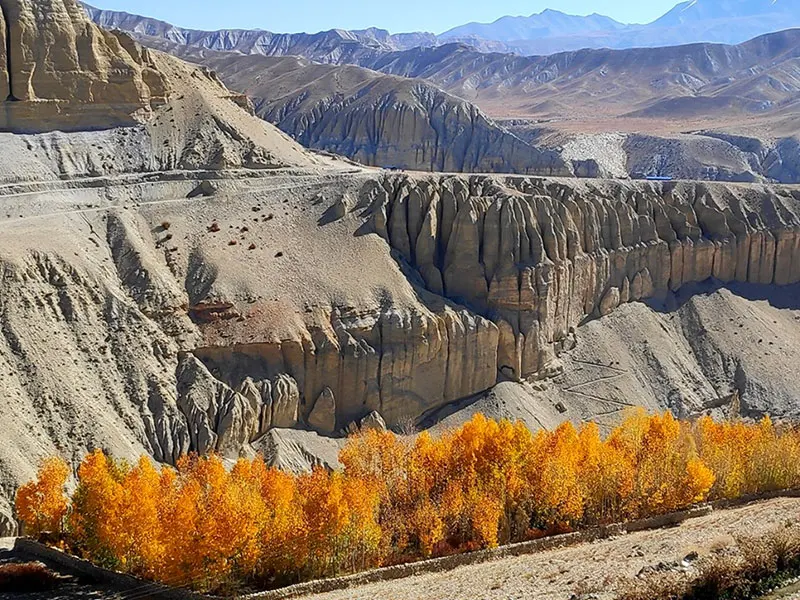
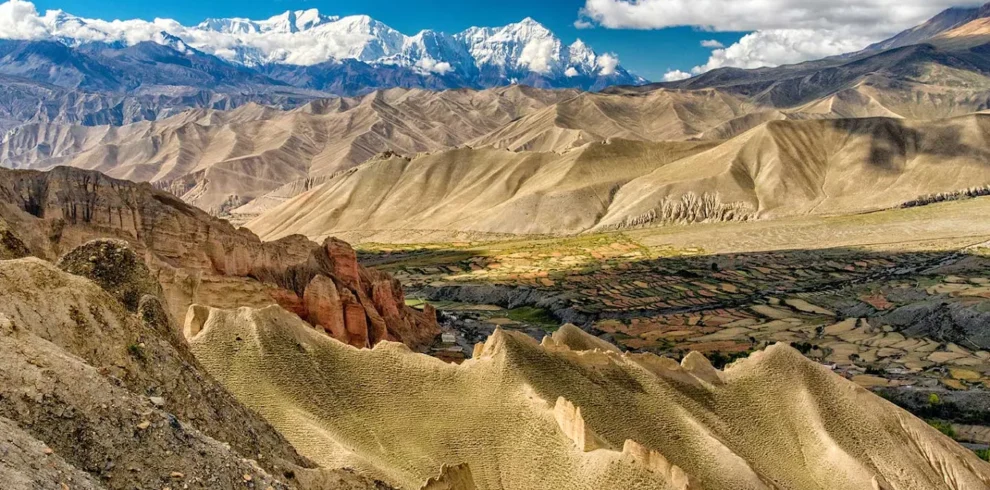
While the rest of Nepal sits under thick winter haze and trekkers huddle around fires in Namche or Pokhara, the high desert plateau of Upper Mustang sits clear, cold, and completely yours. January is the most extreme month to trek here and also one of the most rewarding. The Kali Gandaki gorge turns dramatic shades of orange and grey under winter light. Lo Manthang, the ancient walled capital, feels genuinely frozen in time when you are the only visitor walking its narrow lanes. The Himalayan peaks, Nilgiri, Annapurna, Dhaulagiri, stand sharp against a cobalt sky with no haze and no dust.
Planning your Upper Mustang Trek?
Upper Mustang Trek — Complete Guide 2026 Few places on earth stop you in your tracks the way Upper Mustang…
At a Glance: January Upper Mustang Trek
| Best for | Solitude seekers, photographers, experienced cold weather trekkers |
| Temperature at Jomsom (2,720m) | Night: -10°C to -15°C | Day: 0°C to 8°C |
| Temperature at Lo Manthang (3,840m) | Night: -15°C to -20°C | Day: -5°C to 3°C |
| Precipitation | Very low, occasional light snow possible |
| Wind | Moderate, less fierce than spring months |
| Crowd level | Extremely low (1 to 5 trekking groups in entire region) |
| UMAP Permit | USD 50 per day per person (no minimum) |
| ACAP Permit | NPR 3,000 |
| Guides required | Yes, mandatory by law since March 2026 |
| Duration | 12 to 15 days typical from Jomsom |
| Overall rating | Challenging but exceptional for the right trekker |
Weather and Temperature: What the Numbers Actually Mean
January is the coldest month in Upper Mustang. That is not a warning meant to scare you off. It is the single most important piece of information for planning your gear and your expectations.
At Jomsom, which sits at 2,720 meters above sea level and is the gateway to Upper Mustang, nighttime temperatures regularly drop to -10°C and occasionally -15°C in January. Daytime highs reach somewhere between 0°C and 8°C depending on cloud cover and wind. When the sun is out and the wind is calm, which happens frequently in the morning hours, the temperature feels warmer than the numbers suggest. The high desert light in winter is intense and your face will get sunburned faster than you expect.
Move north toward Lo Manthang at 3,840 meters and the cold becomes more serious. Nights in Lo Manthang during January sit between -15°C and -20°C. That is genuinely cold and demands proper sleeping gear rated to those temperatures. Daytime highs in Lo Manthang hover around -5°C to 3°C. Clear sunny days feel manageable with proper layers but you are never truly warm when you stop moving.
The villages beyond Lo Manthang, places like Chosar and Chhoser where the ancient sky caves sit carved into the cliff faces, experience similar temperatures to Lo Manthang itself.
What saves January in Upper Mustang is the rain shadow effect. The Annapurna and Dhaulagiri massifs block almost all precipitation from reaching the Mustang plateau even in the depths of winter. While the southern slopes of the Himalaya receive winter snowfall, Upper Mustang gets only occasional light dustings. The landscape stays walkable. The trails are not buried under meters of snow the way high passes in other regions are. You can trek through Upper Mustang in January because the trails themselves stay largely passable.
Wind in January is noticeably calmer than in spring. The famous Kali Gandaki afternoon winds, which blow with enough force in April and May to knock you sideways, are much milder in January. This makes January mornings particularly beautiful. The light is cold and golden, the air is still, and you can hear nothing but your own footsteps on frozen ground.
Temperature Comparison at Key Stops
| Location | Altitude | Night Low | Day High |
|---|---|---|---|
| Kagbeni | 2,810m | -12°C | 2°C to 6°C |
| Chele | 3,050m | -14°C | 0°C to 4°C |
| Syangboche | 3,475m | -16°C | -3°C to 2°C |
| Ghami | 3,520m | -16°C | -3°C to 2°C |
| Charang | 3,560m | -17°C | -4°C to 1°C |
| Lo Manthang | 3,840m | -20°C | -5°C to 3°C |
Planning your Upper Mustang Trek?
Trail Conditions in January
The main trekking trail through Upper Mustang follows the Kali Gandaki valley and the high desert ridges above it. In January, the lower sections from Jomsom to Kagbeni and from Kagbeni to Chele are completely walkable. These parts of the trail sit below 3,200 meters and see very little snowfall. The ground may be frozen hard in the morning but thaws slightly by midday and is easy to walk on.
The higher sections above Syangboche and approaching Lo Manthang can have patches of ice and occasional light snow dusting on the trail surface. Microspikes or traction devices are genuinely useful for these sections in January. They add almost no weight to your pack and can prevent a nasty fall on frozen ground.
The jeep road that was built through much of Upper Mustang in recent years means the main route has a wide, clear surface even in winter. The trail has changed significantly from the old mule path days. Most trekkers now walk portions of the jeep road mixed with the older trail sections. In January this road is usually clear but can have ice patches in shadowed sections, particularly in the mornings.
There is no need to worry about major snowfall blocking your route in January as long as you are prepared for cold and ice. The upper sections can have fresh light snow after a storm but this rarely accumulates to trail blocking depths in Upper Mustang because of how dry the region is. A storm might drop 5 centimeters overnight and it will have melted or blown away by the following afternoon.
The Kali Gandaki riverbed, which you walk through in several sections, can be partially frozen in January. This makes for striking photographs but requires care when walking on icy river rocks. Your guide will know the safe crossing points.
Upper Mustang Trek — Complete Guide 2026 Few places on earth stop you in your tracks the way Upper Mustang…
How Many Trekkers Will You See?
Honest answer: almost nobody.
January is the absolute quietest month in Upper Mustang. A good January might see 40 to 80 trekkers entering the restricted area across the entire month. That means on any given day on the trail, you are likely to be the only trekking group walking between villages. Some days you will not see another trekker at all.
This is rare in trekking. Even in other “off season” months at places like Annapurna Base Camp or Everest Base Camp, you still share trails with dozens of groups. Upper Mustang in January is different. You get an entire ancient kingdom to yourself.
The local Lo-pa people, the Tibetan Buddhist community who have lived here for centuries, carry on their daily lives regardless of whether tourists are present. In January you see them performing their morning prayers at the gonpas (monasteries), tending to their homes, bringing in the last of the stored barley from autumn. Your presence as a January trekker feels less like a tourist visit and more like a genuine encounter with a living culture that does not change its schedule for visitors.
Permits and Logistics in Winter
The permit requirements for Upper Mustang are the same in January as any other month. This is a restricted area and you cannot enter without the proper documentation.
Permits you need for Upper Mustang:
- UMAP (Upper Mustang Area Permit): USD 50 per day in 2026, charged per person for the exact number of days on your permit. There is no minimum purchase. A 14 day permit costs USD 700.
- ACAP (Annapurna Conservation Area Project) Permit: NPR 3,000 per person
- TIMS Card: NPR 2,000 per person for trekking in Nepal
These permits are obtained in Kathmandu through a registered trekking agency or at the Department of Immigration in Pokhara. You cannot get the UMAP permit at Jomsom or on the trail. You must have it before you pass the checkpoint at Kagbeni.
The guide requirement became law in March 2026. Independent trekking without a guide is no longer permitted, but solo travelers are welcome as long as they hire a licensed Nepali guide. This is enforced at the Kagbeni checkpoint and at check posts throughout the region. Your guide will also carry copies of your permits and handle the checkpoint formalities.
If you are booking through Next Trip Nepal’s Upper Mustang Trek, all permits and guide arrangements are handled as part of the service. This is the simplest approach for most international trekkers and avoids the bureaucratic complexity of arranging restricted area permits independently.
Teahouses and Accommodation in January
This is where January requires some research and realistic expectations.
Not all teahouses in Upper Mustang stay open in January. Most do, but a handful close for the winter. The main teahouses in the larger villages, Kagbeni, Chele, Syangboche, Ghami, and Lo Manthang, remain open all year. These are established guesthouses with multiple rooms and warming facilities. However, some of the smaller family run guesthouses in intermediate villages do close from December through February.
Your guide will know which teahouses are open in January. This is one of the practical reasons the mandatory guide rule, while frustrating to some independent trekkers, genuinely helps in off season months. A good guide who knows the region calls ahead to confirm accommodation availability before you arrive at each village.
The rooms in winter teahouses are cold. There is no getting around this. Most teahouses in Upper Mustang use wood or dung burning stoves in the common dining room but the sleeping rooms themselves are unheated. You sleep in your sleeping bag inside the room. A sleeping bag rated to at least -15°C is not optional in January. It is essential safety gear.
Food in January teahouses is simpler than in peak season. The standard dal bhat, egg dishes, noodle soups, and Tibetan bread are available. Fresh vegetables are limited in deep winter because road access becomes harder and supplies come less frequently. You eat well enough but the menu variety shrinks. Most trekkers in January actually appreciate the simpler food. It matches the stripped back, honest quality of the trekking experience itself.
Hot showers are available at the main teahouses in Kagbeni, Lo Manthang, and a few other larger stops. These are usually solar heated and work best in the early afternoon when the solar collectors have had time to heat the water. Bathing in January Upper Mustang is an adventure in itself. Many trekkers simply use wet wipes for most of the trek and save proper washing for the warmer teahouses.
What January Does to Upper Mustang (The Magic)
Upper Mustang in January is not comfortable trekking. You know this going in. What you might not expect is the quality of experience that the discomfort enables.
The ancient monasteries are empty of visitors. At Thubchen Gompa in Lo Manthang, one of the finest 15th century Buddhist temples in the Himalayan world, you can stand alone in front of its 700 year old murals in complete silence. In peak season these same rooms have groups of trekkers shuffling through on schedule. In January the monastery caretaker may invite you to sit for tea and spend an hour explaining the murals in broken English while the winter sun slants through the doorway. This kind of connection is almost impossible when crowds are moving through.
The landscape photography in January is extraordinary. The light quality in winter at high altitude is unlike anything in the green seasons. The air is bone dry and crystal clear. The red and ochre cliff faces of the Mustang plateau glow against the pale winter sky. The snowcapped peaks look close enough to touch. Long shadows in the morning and evening hours create drama that simply does not exist in the flat bright light of summer. Every photographer who visits Upper Mustang in January says the same thing: they got their best shots here.
The Chhoser sky caves, ancient cave dwellings carved into a 155 meter high cliff face north of Lo Manthang, are estimated to be 10,000 years old. Some of the 10,000 caves discovered across the Mustang region contain mummified human remains, ancient manuscripts, and Buddhist paintings from the 15th and 16th centuries. In January you visit these sites with no other visitors present. The scale of human history pressing down on you in this place, in total silence, in January cold, is something that stays with you.
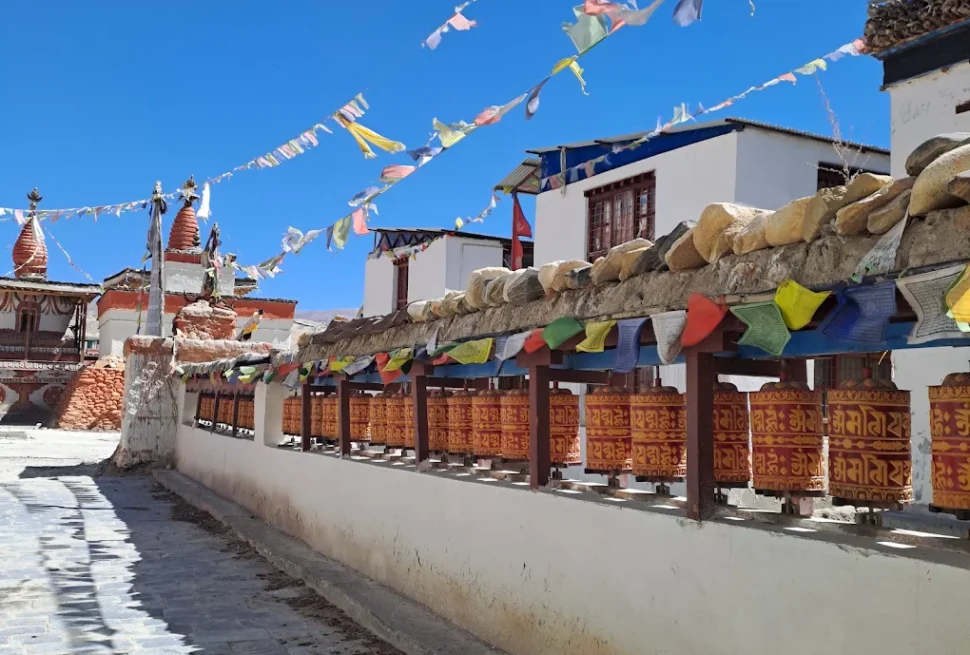
The Lo Manthang morning prayer circuit, where the local community walks the perimeter of the walled city spinning prayer wheels at dawn, is one of the most beautiful daily rituals in the Himalayan world. In October and April you observe this surrounded by other tourists with cameras. In January you join two or three local grandmothers doing their morning rounds and nobody notices you particularly. You are simply another person walking in the cold morning light, which somehow feels like exactly the right way to experience it.
Planning your Upper Mustang Trek?
Upper Mustang Trek — Complete Guide 2026 Few places on earth stop you in your tracks the way Upper Mustang…
Day by Day: The January Trek Experience
Most Upper Mustang treks run 12 to 15 days from Jomsom. Here is an honest account of what the January version actually feels like rather than a dry itinerary list.
Jomsom to Kagbeni (Day 1): You arrive at Jomsom either by early morning flight from Pokhara (the only practical option in winter, about 25 minutes) or via the long jeep road from Beni (8 to 10 hours). Jomsom at 2,720 meters feels cold but manageable on day one. The walk to Kagbeni takes about 2 hours along the riverbed. In January the Kali Gandaki is partly frozen and the canyon walls rise dramatically on both sides. Kagbeni itself is a beautiful medieval looking village. You check your UMAP permit at the checkpoint here. This is where Upper Mustang officially begins.
Kagbeni to Chele (Day 2): The trail climbs from 2,810 meters at Kagbeni to 3,050 meters at Chele. This is your first full day inside the restricted zone and the landscape changes immediately. The irrigated fields of the lower Kali Gandaki valley give way to the high desert. Red and yellow cliffs tower above you. The trail crosses ridges and drops into dry valleys. In January the morning light on these cliffs is extraordinary. Your legs feel the altitude today.
Chele to Syangboche (Day 3): This is the first genuinely cold night of the trek. Syangboche at 3,475 meters sees temperatures that can hit -16°C before dawn. The trail from Chele climbs over the Taklam La pass at around 3,624 meters before descending. In January this pass may have a light snow dusting. The views from the top are exceptional. You see back toward the Annapurna range and forward into the deeper Mustang plateau.
Syangboche to Ghami (Day 4): One of the most beautiful days of the trek. You cross the Nyi La pass at roughly 4,010 meters. In January this section requires care because ice patches are common on the north facing sections of trail. Your guide sets the pace. The descent to Ghami village at 3,520 meters passes through the world’s longest mani wall, a centuries old stone wall covered in carved Buddhist mantras. In January you have it entirely to yourself.
Ghami to Charang (Day 5): The trail continues through the high Mustang plateau. Charang village at 3,560 meters has a striking fortress monastery visible from the trail. In January the village feels very quiet. A few residents might be out in the morning sun. The caretaker at Charang Gompa usually allows visitors and in January you can spend as much time as you like without feeling rushed.
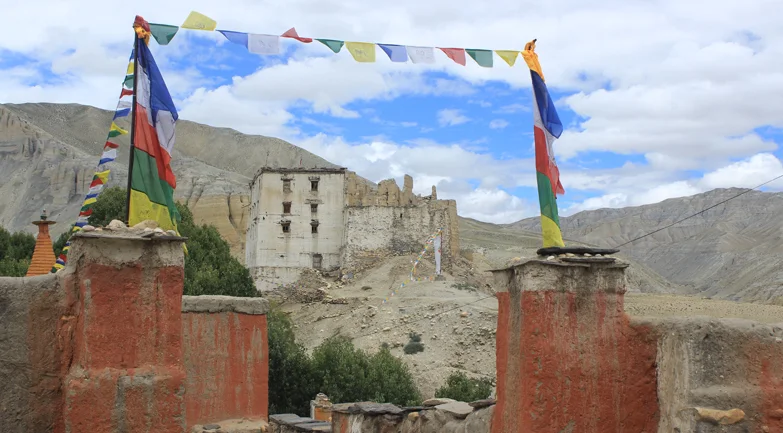
Charang to Lo Manthang (Day 6): The day you have been walking toward. The walled city of Lo Manthang appears suddenly as you round a ridge. The white walls, the red roofed monasteries rising above them, and the prayer flags whipping in the cold wind make an image that every trekker carries away. January arrival means you walk through the main gate into a village of about 200 residents going about daily winter life. No other trekkers. No tour groups. Just you and a place that has existed since the 14th century.
Lo Manthang rest days (Days 7 and 8): Most trekkers spend 2 days in Lo Manthang. Use these to visit Thubchen Gompa, Jampa Lhakhang, and the royal palace (currently under renovation in parts). The sky caves at Chhoser are a day trip from Lo Manthang and require an additional entrance fee. In January the light for cave photography is particularly good in the late morning.
Return route (Days 9 to 12): Most groups return via the same route or a variation through Ghiling. The return legs feel easier both because you are descending in altitude and because your body has acclimatized. January return days are when you notice how much the high desert silence has gotten into you. You start to dread going back to the noise of Jomsom and Pokhara.
Packing for January Upper Mustang
Packing for cold is a skill. Here is what you actually need for January Upper Mustang rather than a generic gear list.
Sleeping: A sleeping bag rated to at least -15°C is not negotiable. If your bag is rated to -10°C you will be cold in Lo Manthang. Bring a silk or fleece sleeping bag liner for extra warmth in the coldest nights. A small inflatable pillow saves you from using your down jacket as a pillow and losing its loft.
Insulation layers: A high quality down jacket with a fill power of 600 or higher is your most important item. Mid layer fleece or a synthetic insulation piece goes under this. A base layer of merino wool next to your skin regulates temperature better than anything else.
Hands and head: Your extremities lose heat fastest. Bring liner gloves that you can wear inside heavier outer mittens. A balaclava that covers your face matters on the coldest mornings. A warm beanie under your trekking hat hood is not overkill.
Feet: Insulated waterproof trekking boots. Your normal 3 season boots are not warm enough for January Lo Manthang nights. Bring wool socks and one backup pair minimum. Microspikes or Yaktrax traction devices for icy trail sections.
Sun protection: This is where January trekkers often make mistakes. The UV radiation at 3,840 meters in January is intense even when the air temperature is below zero. SPF 50 sunscreen, quality sunglasses, and a sun hat for daytime are essential. Your face, lips, and eyes need protection even when you are cold.
Power: Cold kills batteries. Your phone, camera, GPS, and headlamp batteries drain much faster below freezing. Carry extra batteries in a warm pocket close to your body. A solar panel charging bank that can work in direct winter sunlight is useful for longer trips. Keep electronics in your sleeping bag at night to preserve battery life.
Hydration: Water bottles can freeze solid overnight. Insulated bottle covers or neoprene sleeves help. Some January trekkers use a hydration bladder with an insulated hose. Start every day fully hydrated before you leave your teahouse. Dehydration at altitude in cold makes everything worse.
Getting to Jomsom in January
Jomsom is the gateway to Upper Mustang and getting there in January requires understanding how the mountain weather works.
The Jomsom domestic airport services flights from Pokhara. The flight takes 25 minutes and covers terrain that takes 8 to 10 hours by jeep. In January flights operate but are more weather dependent than in other seasons. Morning flights have the best success rate because mountain winds build in the afternoon. Tara Air and Summit Air are the main operators. Expect occasional delays and cancellations due to cloud and wind. Book the earliest possible morning departure.
The alternative is the Beni to Jomsom road via Tatopani and Marpha. This jeep road is mostly passable in January but specific sections can be icy or blocked after snowfall, particularly the higher sections above Ghasa. If you have flexibility in your schedule and cannot fly, this road option works but adds a full day of uncomfortable jeep travel. Most trekkers going in January prefer to fly and build extra days into their schedule for potential flight delays.
From Pokhara, Kathmandu to Pokhara is either a 25 minute domestic flight or a 6 to 7 hour scenic bus or tourist vehicle journey. The Pokhara to Kathmandu flight is cheap and worth taking to preserve energy for the trek itself. January in Pokhara is pleasant for a night or two before and after your trek.
Planning your Upper Mustang Trek?
Budget and Costs
Upper Mustang is more expensive than most Nepal treks because of the permit system. January does not make it cheaper on the permit side but costs in other areas are lower.
| Item | Cost (January, per person) |
|---|---|
| UMAP Permit (USD 50/day, no minimum) | USD 600 (12 days) |
| ACAP Permit | NPR 3,000 (approx USD 22) |
| TIMS Card | NPR 2,000 (approx USD 15) |
| Guide fee (10-14 days) | USD 300 to 500 |
| Porter (optional, winter gear is heavy) | USD 200 to 350 |
| Teahouse accommodation (per night) | USD 5 to 15 |
| Meals (per day, teahouse) | USD 10 to 20 |
| Flights Kathmandu to Pokhara | USD 80 to 130 |
| Flights Pokhara to Jomsom return | USD 120 to 180 |
A budget conscious solo trekker in January with their own guide might spend around USD 1,200 to 1,600 over 12 days all in. A couple sharing accommodation reduces per person costs. Most people booking a complete package through an agency like Next Trip Nepal’s Upper Mustang Trek find total trip costs of USD 1,800 to 2,500 per person for a fully organized 14 day trek including all permits, guide, accommodation, and flights.
January teahouse prices are sometimes slightly lower than peak season because there is no room shortage. You can occasionally negotiate a small discount on accommodation when you are the only guests. Food prices are similar year round.
January Upper Mustang Trek FAQ
Is Upper Mustang safe to trek in January?
Yes for experienced cold weather trekkers with proper gear and a good guide. The trails are not buried in snow, the altitude is not extreme enough to cause severe AMS in most trekkers if you ascend properly, and the cold, while serious, is manageable with the right equipment. The risk level is low if you prepare correctly. The risk level rises fast if you underestimate the cold or skip proper gear.
How cold does it actually get at night in Lo Manthang in January?
Minimum temperatures in Lo Manthang in January typically range from -15°C to -20°C. Inside a teahouse sleeping room, which is unheated, you might experience -5°C to -10°C if it is a particularly cold night. A sleeping bag rated to -15°C with a liner will keep you warm. The common room with its stove is warm in the evenings. You will be cold walking to the outdoor toilet at midnight. There is no way around this.
Will any teahouses be closed in January?
Most main teahouses in the key villages stay open all year. A small number of family guesthouses in intermediate villages close for winter. Your guide will confirm accommodation before the trek begins. Booking through a registered agency eliminates this uncertainty because they have pre-arranged accommodation relationships with the open teahouses.
Is the Jomsom flight reliable in January?
More reliable than the monsoon season but less reliable than spring and autumn. Weather cancellations happen. The mountain weather window for flights is usually early morning. Book the first flight of the day and build 1 to 2 buffer days into your Jomsom schedule. If flights are cancelled for more than 2 days, the jeep road to Beni is the backup option.
Do I need a guide in January? Can I trek solo?
As of March 2026, solo trekking in Upper Mustang is illegal. A licensed guide is mandatory for every trekker entering the restricted area, regardless of season. The guide requirement is enforced at the Kagbeni checkpoint. This rule applies in January just as it does in October. Beyond the legal requirement, having a guide in January makes practical sense. They know which teahouses are open, they can check trail conditions ahead, and they carry the local knowledge that makes the difference between a great winter trek and a miserable one.
Should I bring trekking poles for January?
Yes. Poles are useful year round in Upper Mustang but particularly valuable in January when trail surfaces can be icy in the mornings. Poles with wide baskets to prevent sinking into soft snow are better than summer poles. Rubber tips for icy rock surfaces are worth the small investment.
Can I combine Upper Mustang with other treks in January?
The most common combination is adding Muktinath to your Jomsom stop. Muktinath at 3,800 meters is cold in January but walkable. The Hindu and Buddhist pilgrimage site there is extraordinary in the winter quiet. Adding the Annapurna Circuit Trek before Upper Mustang in January is ambitious but possible for very experienced trekkers. The high pass sections of the Annapurna Circuit (Thorong La at 5,416 meters) are challenging in January and require specific preparation. Most people who do January Upper Mustang keep it as a standalone trek.
Final Verdict: Is January Worth It?
January Upper Mustang is not the easiest trekking experience you can have in Nepal. The cold is real. The limited teahouse services require adjustment. Getting to Jomsom in winter takes flexibility.
But there is a category of trekker for whom January Upper Mustang is not just worth it but is actually the best possible version of this trek. You know you are that trekker if the words “complete solitude,” “winter light photography,” “undisturbed cultural connection,” and “extreme quiet” make you lean forward rather than back.
January gives you the 14th century walled city of Lo Manthang the way it was before trekking tourism arrived. It gives you monastery conversations that take an hour rather than a minute. It gives you photographs that do not look like anyone else’s because very few people have stood in that exact light in that exact silence. It gives you the deep satisfaction of having done something genuinely difficult without anyone around to tell you that you did it.
For the right traveler, January Upper Mustang is not a compromise on the real experience. It is the real experience, unfiltered.
Ready to plan your January Upper Mustang journey? Check our full Upper Mustang Trek trip details, costs and itinerary and start planning your winter expedition to Nepal’s most extraordinary hidden kingdom.
Also worth reading: if you are considering other Himalayan treks for January, the Langtang Valley Trek and lower routes of the Ghorepani Poon Hill Trek offer excellent winter trekking at lower altitudes with more comfortable temperatures.
Upper Mustang Trek — Complete Guide 2026 Few places on earth stop you in your tracks the way Upper Mustang…