Booking a Nepal trek is not like booking a hotel room. You are usually paying a meaningful deposit weeks or months in advance, trusting a company you have never met to arrange restricted-area permits, hire the guide who will be responsible for your safety above 4,000 meters, and make the right call if something goes wrong on a trail with no road access. Get it right and the company fades into the background, handling logistics so you can focus on the mountains. Get it wrong, and the same company can turn a once-in-a-lifetime trip into a genuinely dangerous situation.
The difficulty is that almost every trekking company website looks reassuring. Professional photos, confident claims, a list of the same popular routes: Everest Base Camp, Annapurna Circuit, Langtang Valley, Manaslu Circuit. What separates a genuinely registered, properly insured, experienced operator from a reseller with no real presence in Nepal is rarely visible on the homepage. It is buried in registration numbers, licensing categories, and details that most travelers never think to ask about until something goes wrong.
This guide is not a sales pitch disguised as advice. It is a working checklist you can apply to any trekking company you are considering, including Next Trip Nepal. Wherever it is useful, we have pointed to exactly where you can verify our own registration, licensing, and TAAN membership independently, rather than asking you to simply take our word for it. If you want the short version first, our full breakdown of registration numbers, licenses, and certificates is published on our registration and licensing page.
The Fast Checklist: What a Trustworthy Nepal Trekking Company Should Have
If you only have five minutes before you need to reply to a quote, these are the things worth checking first. Each one is explained in more detail further down this page.
- A Company Registration Certificate from the Office of the Company Registrar, plus a PAN (tax) certificate from the Inland Revenue Department, both with numbers you can ask to see.
- A Trekking Agency License from the Department of Tourism, specifically naming trekking as a licensed activity, not just a general business registration.
- An active TAAN (Trekking Agencies’ Association of Nepal) membership with an ID number you can look up yourself in TAAN’s public member directory.
- Guides who hold a government trekking guide license, plus first aid and altitude sickness training, not just “years of experience” as a vague claim.
- Independent reviews on Tripadvisor or Google that include specific details: guide names, specific days, specific problems that were handled, not just star ratings.
- A written, itemized price quote that states exactly what is and is not included, before you are asked to pay a deposit.
- A clear, specific answer when you ask what happens if a trekker shows signs of altitude sickness partway through the itinerary.
- A real office address in Nepal and a WhatsApp or phone number that someone actually answers, ideally before you have paid anything.
- Transparent porter and guide welfare practices: fair pay, insurance, and reasonable carrying loads, not just a line about “responsible tourism.”
- Actual operating experience on the specific route you want to trek, not just a page listing every trek in Nepal.
1. Confirm the Company’s Government Registration and Licenses, Not Just a Business Name
Almost anyone can register a general business name and build a travel website. Operating legally as a trekking company in Nepal requires several distinct layers of government paperwork, and it is worth understanding what each one actually proves, because companies sometimes mention only the most impressive-sounding one.
- Company Registration Certificate, issued by the Office of the Company Registrar, Government of Nepal. This confirms the business legally exists as a private limited company, with a specific registration number. Next Trip Nepal Treks and Expedition Pvt. Ltd. is registered under number 390960/82/83.
- PAN (Permanent Account Number) Certificate, issued by the Inland Revenue Department. This is the company’s tax identification number, used for every formal transaction and invoice. Ours is 623602724.
- Trekking Agency License, issued by the Department of Tourism or the relevant provincial tourism office. This is the document that specifically authorizes a company to operate trekking agency services, as distinct from general tourism or hospitality. A company can have a company registration without this and still not be legally authorized to arrange treks.
- Local business registration, issued at the provincial or municipal level, confirming the company’s registered office address and physical business activity in that location.
A legitimate company should be willing to show you these documents, or publish them, rather than simply stating “we are registered” without specifics. We publish photographs of our own certificates, with the actual registration numbers readable, in the full documentation we’ve put online, specifically so this does not need to be taken on trust.
2. Check TAAN and NMA Membership the Right Way: by Looking It Up, Not Being Told About It
Most trekking company websites mention TAAN (the Trekking Agencies’ Association of Nepal) somewhere, usually as a small badge in the footer. Far fewer explain what that membership actually means, or make it easy to check. TAAN is the main industry association for Nepal’s trekking agencies, in operation since 1978, and since April 2023 it has worked with the Government of Nepal to enforce a rule that every trekker in Nepal must be accompanied by a licensed guide or porter arranged through a registered agency. That rule exists specifically to push unregistered operators out of the industry, which makes TAAN membership more than a decorative logo.
Here is the part most guides skip: TAAN membership is genuinely easy to verify yourself, in about two minutes, and you should actually do it rather than trusting a badge image on a website (which can simply be copied by anyone). TAAN publishes a public member directory at taan.org.np/members. Search for the company’s registered name, not just its trading or marketing name, since many Nepal trekking companies operate under a parent company with a different legal name. Confirm that the membership ID shown in the directory matches the ID the company has given you.
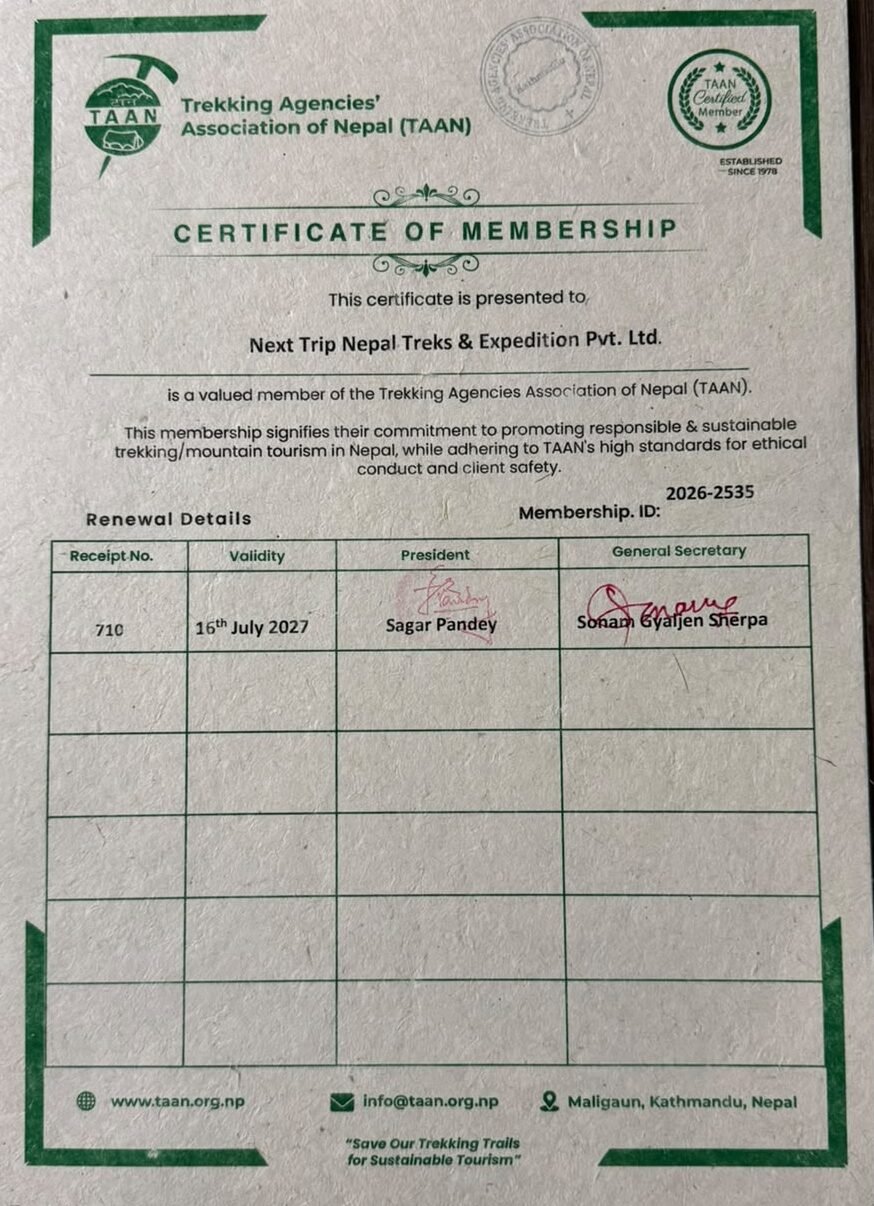
As a working example: Next Trip Nepal Treks and Expedition Pvt. Ltd. holds TAAN Membership ID 2026-2535. You do not need to ask us to confirm this. You can search for it directly in TAAN’s own member directory on taan.org.np, the association’s official website, and compare it against the certificate we have published. The same logic applies to NMA (the Nepal Mountaineering Association), which is especially relevant for high-altitude passes such as Thorong La on the Annapurna Circuit or the Larkya La pass on the Manaslu Circuit.
One important distinction: TAAN or NMA membership is an industry association credential, not a replacement for the government trekking agency license described above. A trustworthy company should hold both, and should be transparent about the difference, rather than relying on association membership alone to imply a government license that does not exist.
3. Look Past the Star Rating: How to Actually Read Trekking Company Reviews
A 4.9 or 5.0 average rating tells you almost nothing on its own, because a small number of reviews can produce a perfect score by chance, and reviews can be incentivized or, in rare cases, fabricated. What actually matters is what the reviews describe, and how many of them exist. A handful of practical checks:
- Read a spread of reviews across different months and different treks, not just the five most recent ones.
- Look for guide names mentioned repeatedly across different reviews. That pattern usually means the company retains experienced staff rather than hiring last-minute freelance guides for each trip.
- Look specifically for how a reviewer describes a problem being handled: a missed flight, bad weather, a change of plan, altitude sickness, a teahouse being full. Companies that handle problems well tend to have reviews that mention exactly that.
- Check more than one platform. Tripadvisor and Google reviews are generally harder to fabricate at scale than reviews posted only on a company’s own website.
As a point of reference, Next Trip Nepal currently holds a 5.0 rating from 55 reviews on Tripadvisor, and you can read trekker feedback across multiple trips on our own reviews page. We would rather you checked both independently than took a screenshot at face value.
4. Ask Who Your Guide Actually Is, Not Just How Many Years the Company Has Existed
“Experienced guides” is one of the most repeated phrases on trekking company websites, and one of the least specific. The company’s years in business and your guide’s individual qualifications are two different things, and the second one matters more for your actual safety on the trail. Before booking, it is reasonable to ask for:
- Confirmation that your guide holds a government-issued trekking guide license, which requires completing a recognized guide training course, not just informal experience.
- Wilderness or basic first aid training, including recognizing the early symptoms of acute mountain sickness, HAPE, and HACE, rather than only being briefed on what to do once symptoms are already severe.
- Specific prior experience on the route you are booking. A guide who has led the Everest Base Camp trail dozens of times is not automatically qualified to lead a technical pass on the Manaslu Circuit or a remote route like Upper Dolpo.
- A working level of English (or your language) sufficient to explain a medical decision clearly under pressure, not just day-to-day conversation.
If a company cannot tell you which guide will lead your specific trek until a few days before departure, that is not automatically a red flag on a small operation, but you should still ask the four questions above about whoever is eventually assigned, and get the answer in writing.
What a Properly Acclimatized Itinerary Actually Looks Like
Altitude sickness is less about fitness and more about pacing, which makes the itinerary itself one of the clearest signals of whether a company takes safety seriously. The general principle used across the Himalaya is “climb high, sleep low”: once above roughly 3,000 meters, total sleeping altitude should not increase by more than about 300 to 500 meters per day on average, with a dedicated acclimatization day built in every few days of altitude gain, often used for a shorter day hike to a higher point before returning to sleep lower.
When comparing itineraries for the same trek, specifically count the acclimatization days and where they fall. On the Everest Base Camp trek, for example, a well-paced itinerary typically includes acclimatization days built in around Namche Bazaar and again around Dingboche. On the Annapurna Circuit, pacing around Manang before crossing Thorong La matters for the same reason. A noticeably shorter itinerary for the same route, with the identical distance covered in fewer days, is often achieving that by cutting acclimatization time rather than by being more efficient, and it is worth asking directly which specific days were removed compared to a standard pacing.
This is also where a guide’s judgment matters more than the printed itinerary. Ask whether your guide has the authority to add a rest day, slow the pace, or turn a group or individual back if conditions call for it, rather than being required to stick to a fixed schedule set in advance regardless of how trekkers are actually feeling on the day.
5. Ask These Specific Safety Questions Before You Pay a Deposit, Not After
Vague reassurance is easy to give. Specific operational answers are harder to fake. Instead of asking “is it safe,” which almost any company will answer “yes” to, ask these directly in an email and see how specifically they respond:
- “If my guide suspects altitude sickness on day 6, what exactly happens next, and who makes that call?”
- “Does your guide carry a pulse oximeter and a basic first aid kit, and what is in it?”
- “How does the guide communicate with your Kathmandu office from the trail, and what happens in areas with no phone signal?”
- “If a helicopter evacuation is needed, how is that arranged, and is it my travel insurer or your company that coordinates it?”
- “What is the itinerary’s built-in buffer for a flight delay in or out of Lukla, or bad weather closing a pass?”
A company with real field operations will usually answer these in a few sentences, specific to your route. A company that is simply reselling someone else’s itinerary will often give a generic, delayed, or deflecting answer. Either way, make sure you separately arrange travel insurance that explicitly covers the altitude of your planned trek and emergency medical evacuation. No trekking company, however well run, can remove the underlying risks of altitude and remote terrain, and no honest one will claim to.
6. Get a Full, Itemized Price Breakdown Before You Book
The cheapest quote and the best value quote are often not the same trek. A lower price is frequently explained by what has been left out rather than genuine efficiency. Before comparing prices between companies, get a written breakdown of exactly what is included.
| Usually Included | Commonly Excluded or Extra |
|---|---|
| Teahouse or lodge accommodation on trek | International flights to and from Nepal |
| Meals during the trek (breakfast, lunch, dinner) | Nepal entry visa fee |
| Licensed trekking guide | Hot showers, Wi-Fi, and device charging at teahouses |
| Porter service, where specified in the package | Personal travel insurance and evacuation coverage |
| Restricted area and conservation area permits (TIMS, ACAP, MCAP, etc.) | Tips for guides and porters |
| Domestic flights named in the itinerary (e.g. Kathmandu–Lukla) | Restricted-area garbage deposit fees, where applicable |
| Kathmandu airport pickup, where stated | Extra nights caused by flight delays or itinerary changes |
Beyond the inclusion list itself, ask about the cancellation policy, the refund policy if your trek is cut short by weather or health, and what happens financially if a domestic flight delay adds an unplanned night in Kathmandu or at a mountain airstrip. A company confident in its pricing will put all of this in writing before asking for a deposit.
7. Match Group Size and Flexibility to How You Actually Like to Travel
Group and private treks are genuinely different experiences, and the right choice depends on your budget, schedule, and personality more than on which option is “better.”
| Group Trek | Private Trek | |
|---|---|---|
| Departure dates | Fixed, set in advance | Flexible, chosen by you |
| Typical cost per person | Lower, especially for solo travelers | Higher, since costs are not shared |
| Pace and itinerary changes | Set by the group, limited flexibility | Can usually be adjusted before and sometimes during the trek |
| Who you trek with | Other travelers you have not met before | Just your own party and your guide/porter |
If you want extra acclimatization days, a slower pace for older travelers or children, or the option to adjust the route partway through, ask specifically whether that is possible and what it costs, rather than assuming a “customizable” itinerary means unlimited flexibility once you are on the trail.
Understanding Nepal’s Permit System, Because It Directly Affects Your Price Comparison
One reason two quotes for the “same” trek can differ by a large margin is that permits are not a single flat fee. They vary by region, by whether the area is a restricted area or a conservation area, and sometimes by group size and nationality. Understanding the basic categories makes it much easier to tell whether a cheaper quote has actually left a permit out, rather than simply negotiated a better rate.
- TIMS card (Trekkers’ Information Management System): A basic trekker registration used on many general trekking routes, intended to help authorities track trekker numbers and assist in search and rescue if needed.
- Conservation Area Permits: Required for routes inside a conservation area, such as the Annapurna Conservation Area Permit (ACAP) for the Annapurna region, or the Manaslu Conservation Area Permit for the Manaslu region. These fund local conservation and community projects.
- Restricted Area Permits: Required for sensitive border or remote regions such as Upper Mustang, Upper Dolpo, and the Manaslu restricted section. These are typically more expensive, often priced per week per person, and usually require trekking as part of a registered group through a licensed agency, rather than independently.
- National Park entry fees: Apply in areas such as Sagarmatha (Everest) National Park, separate from any conservation area fee elsewhere.
When comparing two quotes for a restricted-area trek like Manaslu or Upper Mustang, ask directly whether the restricted area permit fee is included in the headline price or added afterward. This single question accounts for a large part of the price gap you will sometimes see between quotes that otherwise look similar.
8. Ask About Porter Welfare and Environmental Practices, Specifically
“Responsible tourism” has become a marketing phrase, which makes it worth asking for specifics rather than accepting the label. Reasonable questions include whether porters are insured against accident and altitude illness in the same way guides are, whether their carrying loads follow recognized limits rather than being left to informal arrangement, and whether they are provided with appropriate clothing and footwear for altitude rather than being expected to supply their own in poor condition. On the environmental side, ask whether the company provides water refill or filtration options to reduce bottled plastic waste on the trail, and how trekking group waste is carried out rather than left or burned locally.
These questions matter beyond ethics. A company that treats its own field staff well generally also communicates with them well, which directly affects how smoothly your trek runs and how quickly problems get escalated if something goes wrong.
9. Test Their Communication Before You Pay Anything
How a company communicates before you have paid them is a reasonable preview of how they will communicate once you are already committed. Send a specific, slightly detailed question, not just “please send a quote,” and see what comes back. A useful test question might combine a logistics detail with a safety detail, for example asking about both the acclimatization day placement and what happens if you need to turn back early. Vague, copy-pasted answers, long unexplained delays, or pressure to pay a deposit immediately before your questions are fully answered are all worth taking seriously as early signals, not dismissing as a one-off.
10. Confirm They Actually Operate the Specific Region You Want to Trek
Everest, Annapurna, Langtang, and Manaslu are different operating environments with different permit systems, altitudes, infrastructure, and logistics. A company that genuinely operates in a region will usually be able to speak in specific detail about current trail and teahouse conditions, recent permit rule changes, and realistic acclimatization pacing for that exact route, not only the marketing description on its own trip page.
- Everest region: Everest Base Camp Trek, Everest Three Passes, Gokyo Lakes. See our Everest Trek Guide for more.
- Annapurna region: Annapurna Base Camp, Annapurna Circuit, Ghorepani Poon Hill, Mardi Himal. See our Annapurna Trek Guide for more.
- Langtang region: Langtang Valley Trek, Langtang-Helambu, Tamang Heritage Trail. See our Langtang Trek Guide for more.
- Manaslu region: Manaslu Circuit Trek, Tsum Valley
If a route-specific permit was recently changed, a genuinely active operator should know about it without needing to check and get back to you days later.
Local Nepal-Based Company vs. International Booking Platform: What Actually Changes
Many well-known booking platforms operate internationally and route your trek through a local partner agency in Nepal, who does the actual on-the-ground work. That is not automatically a problem, but it changes a few things worth knowing before you book.
| Nepal-Based Local Company | International Platform | |
|---|---|---|
| Who you are actually communicating with | The company directly running your trek | Often a booking intermediary, who relays your questions to a local partner |
| Local knowledge and relationships | Direct, built over years of operating specific routes | Depends entirely on which local partner is used, which can change |
| Pricing | Usually reflects local operating costs directly | May include a platform margin on top of the local operator’s price |
| Flexibility to customize | Often higher, since you are talking to the decision-maker | Can be more limited, since changes may need approval from multiple parties |
If you book through an international platform, it is reasonable to ask directly which Nepal-based company will actually operate your trek, and to apply this same checklist to that company specifically, since that is who your safety and experience will actually depend on.
Red Flags That Should Make You Walk Away
- No specific registration numbers. “We are fully registered and licensed” with no company registration number, PAN number, or trekking agency license number when asked directly.
- A TAAN badge that doesn’t check out. A logo displayed on the site, but the company’s name or membership ID cannot be found in TAAN’s public member directory.
- A price dramatically below every competitor. With no clear explanation of what has been cut to reach that price.
- Reviews that read like templates. Generic, repetitive, oddly similar phrasing across many “different” reviewers, or reviews with no specific trek, guide, or date mentioned.
- Vague answers to direct safety questions. A deflecting or generic answer when you ask what happens if altitude sickness occurs partway through your trek.
- Pressure to pay a deposit immediately. Before your questions about registration, guides, or inclusions have been properly answered.
- No real office address, or one that doesn’t exist. A Kathmandu address that cannot be located, or no address at all beyond a contact form.
- Unclear cancellation and refund terms. Or terms that only appear after you ask directly, rather than being stated upfront.
If You’re Trekking Solo, With Kids, or as an Older Traveler, a Few Extra Questions Matter More
The checklist above applies to every trekker, but a few items deserve extra weight depending on who is actually doing the trek.
Solo travelers, and solo women in particular, should ask directly whether a female guide can be arranged if preferred, and should raise this at the time of booking rather than assuming it will be offered automatically. It is also worth asking how the company handles a solo client if illness or injury occurs, since there will be no other group member to assist or raise the alarm.
Families trekking with children should ask about realistic daily walking distances and elevation gain for the age of the child, not just the standard adult itinerary, and should confirm the guide has specific experience leading children at altitude, since the signs of fatigue or altitude discomfort can look different in kids than in adults.
Older travelers, or anyone with a known medical condition, should disclose it honestly at the time of booking, ask whether the standard itinerary’s acclimatization pacing can be slowed down with an extra night or two, and confirm the guide is comfortable adjusting the day’s walking pace rather than sticking rigidly to a fixed schedule built for an average fit adult.
In all three cases, the honest answer from a good company is usually “yes, and here is what we would change,” with specifics, rather than a blanket “don’t worry, it will be fine.”
Where Next Trip Nepal Fits Against This Exact Checklist
Rather than write a generic “why choose us” section, it seemed more useful to run our own company through the same checklist above, with links so you can check each claim yourself.
| Checklist Item | Next Trip Nepal |
|---|---|
| Company registration | Registered as Next Trip Nepal Treks and Expedition Pvt. Ltd., registration number 390960/82/83 |
| PAN (tax) registration | PAN number 623602724 |
| TAAN membership | Membership ID 2026-2535, verifiable in TAAN’s public member directory |
| NMA affiliation | Affiliated with the Nepal Mountaineering Association |
| Independent reviews | 5.0 rating from 55 reviews on Tripadvisor, plus trekker feedback on our own site |
| Published certificates | Photographs of our actual registration, license, and membership certificates in our certificate gallery |
| Office and contact | Thamel, Kathmandu, Nepal. Phone/WhatsApp +977 9869225929. Email nexttripnepal@gmail.com |
We would genuinely rather you checked the TAAN directory and Tripadvisor yourself and arrived at your own conclusion than simply trusted a page we wrote about ourselves.
Frequently Asked Questions
Is it safe to book a Nepal trekking company directly through its website, or should I only use a large international platform?
Either can be safe if you apply the same checks: verified registration, verifiable TAAN or NMA membership, genuine independent reviews, and clear written answers to direct safety and pricing questions. Booking directly with a verified local operator often means clearer communication and fewer intermediaries, but the company’s actual credentials matter more than which channel you booked through.
What is the single fastest way to check if a company is really TAAN registered?
Search the company’s registered legal name directly in TAAN’s own public member directory at taan.org.np/members, rather than trusting a logo on their website. If the name or membership ID does not appear, ask the company to explain the discrepancy before booking.
Does a low price automatically mean a company is unsafe or unregistered?
Not automatically, but it should prompt questions. Ask specifically what is included in the price and what is not, and compare that against the full inclusion checklist above. A lower price with full, comparable inclusions and verified registration is a good deal. A lower price with no clear explanation is a reasonable cause for caution.
I am trekking solo. Does that change what I should check?
It raises the importance of two items in particular: your guide’s individual qualifications, since you will not have other group members to rely on, and the company’s emergency communication and evacuation process, since you will be the only client the guide is responsible for on the trail.
Can I verify Next Trip Nepal’s documents myself before booking?
Yes. Our registration certificate, PAN certificate, trekking agency license, and TAAN membership certificate are all published with their actual numbers on our government-registered trekking company page, and our TAAN membership can be independently confirmed through TAAN’s own member directory.
What should I do if a company refuses to answer these questions directly?
Treat it as useful information rather than an inconvenience. A company confident in its registration, licensing, and safety procedures generally has no reason to avoid specific questions. Repeated vague or deflecting answers are one of the clearest red flags on this entire list.
Choosing a trekking company is really a question of trust, built from verifiable specifics rather than confident marketing language. If you run any Nepal trekking company, including ours, through this checklist, you should be able to get clear answers to every question here before you pay a single deposit. If you would like to talk through a Manaslu, Everest, Annapurna, or Langtang itinerary and ask us any of these questions directly, our team at Next Trip Nepal is available every day by WhatsApp, phone, or email.